
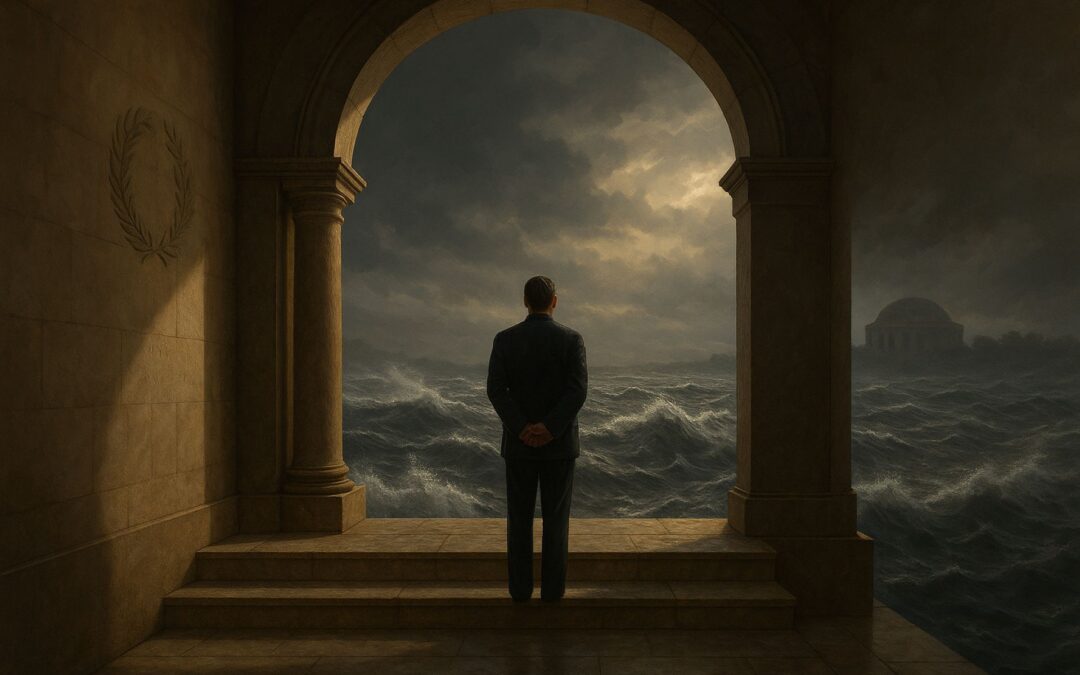
Seneca’s warning to “choose peace rather than war” may sound almost naive to a generation taught to worship struggle. We are told that greatness demands friction—that success belongs to those who fight hardest, grind longest, and never rest. Yet Seneca’s wisdom cuts through this cultural noise: endurance is noble, but seeking out suffering is not. The wise do not chase turmoil to prove their worth. They face hardship when it arrives, but they do not manufacture chaos to feel alive.
This teaching stands as a quiet rebellion against the modern cult of busyness. In an age where constant activity masquerades as purpose, Seneca invites us to examine our motives. Are we pursuing excellence—or simply fleeing stillness? His words remind us that peace is not a weakness but a form of mastery, a discipline that demands far more strength than any restless striving ever could.
“I don’t agree with those who plunge headlong into the middle of the flood and who, accepting a turbulent life, struggle daily in great spirit with difficult circumstances. The wise person will endure that, but won’t choose it—choosing to be at peace, rather than at war.”
— Seneca, Moral Letters, 28.7
The Stoic Warning
Seneca’s words carry a timeless wisdom often misunderstood in a world that idolizes struggle. He does not condemn adversity itself—he acknowledges its inevitability—but rather criticizes the deliberate courting of turmoil as a lifestyle. To “plunge headlong into the middle of the flood,” as he puts it, is to glorify chaos for its own sake, mistaking turbulence for significance. Many people believe that the more conflict they face, the more alive or purposeful they must be. Yet Seneca reminds us that this thinking is backwards. Life will provide its share of hardship; we need not summon more of it through restless ambition or unnecessary confrontation.
For the Stoics, endurance was a virtue, but it was never a trophy. To endure is not to seek pain but to remain unmoved by it when it arrives. The wise person, Seneca says, will endure difficulty with strength, but will not choose it when peace is available. This distinction separates discipline from compulsion. The person who feels compelled to fight every battle is ruled by impulse, while the one who selects battles carefully is ruled by reason. The former lives in reaction; the latter lives with intention.
In Stoic philosophy, tranquility—ataraxia—is the crown of wisdom. It is not the fragile calm that breaks under pressure, but the deep, unshakable serenity that comes from understanding the nature of things. The person who can stand on the bank of a raging river without needing to dive in possesses a strength greater than the swimmer who exhausts himself fighting the current. True composure is the ability to remain still in the presence of storms, to let the world rage without being drawn into its frenzy.
When Seneca contrasts peace with war, he is not only referring to external conflict. He is speaking of the inner war—the endless struggle within the self to prove, to dominate, to be seen, to matter. We live much of our lives in this internal combat, trying to defeat imagined enemies: others’ opinions, our own doubts, the ghosts of who we think we should be. The Stoic seeks to end this war through understanding. By mastering the self, one disarms the need for battle.
Seneca’s wisdom, therefore, is revolutionary. It redefines courage. To modern ears, bravery means charging forward, confronting danger, taking the fight. But to the Stoic, bravery is restraint—the audacity to remain calm when provoked, to decline invitations to turmoil, to choose stillness over spectacle. The greatest warrior, Seneca implies, is the one who does not always unsheathe his sword.
The Restless Hero: Theodore Roosevelt
Theodore Roosevelt was, in many ways, the living embodiment of the “man in the arena” ideal he himself celebrated. His life was an unbroken sequence of action—vigorous, daring, and larger than life. He was a rancher, a soldier, a statesman, an explorer, and a relentless reformer. He thrived in the heat of the contest, whether political, physical, or intellectual. To millions, he represented vitality incarnate. But beneath this extraordinary energy was a subtler truth: Roosevelt was not merely drawn to challenge—he was unable to live without it.
After leaving the presidency, when most would have rested on their achievements, he launched himself into new crusades. He ran for office again, formed a new political party, nearly died navigating an uncharted river in the Amazon, and begged to fight in World War I at nearly sixty years old. His was a life of unceasing forward motion, as if stillness were a kind of death. Every frontier he conquered only deepened his need for another.
From the Stoic viewpoint, this insatiable drive reflects both greatness and imbalance. Roosevelt’s strength was unquestionable, but it came at the cost of inner rest. He was perpetually at war—against nature, against politics, against time itself. His conquests inspired the world, yet they also hinted at an inner agitation that no victory could soothe. Seneca would have admired Roosevelt’s endurance but recognized in it the danger of excess—the way virtue, unrestrained, can curdle into vice.
Roosevelt’s compulsion reveals something universal. We, too, have inherited his restlessness. We live in an age where every moment must be filled, every silence conquered. The same energy that made Roosevelt remarkable now defines modern life. We chase goals, battles, and projects not always out of purpose but out of discomfort with peace. Stillness feels like failure because we have built our identities on motion.
In Roosevelt’s relentless striving, we glimpse our own reflection: the overworked professional who cannot take a weekend off, the student who fears idleness more than exhaustion, the entrepreneur who measures self-worth in output. The Stoics would call this enslavement to passion—an inability to distinguish activity from meaning. To them, true freedom lies not in doing more but in being able to stop.
Roosevelt’s life remains a lesson written in bold letters: that one may accomplish everything and still be unfulfilled if the mind never learns to rest. The Stoic path would have him, and us, ask a harder question—not “What can I conquer next?” but “Why must I always be conquering something at all?”
Our Own Addiction to Struggle
The compulsion that once drove Theodore Roosevelt has become the default state of modern life. We inhabit a culture that romanticizes exhaustion, glorifies busyness, and mistakes ceaseless motion for meaning. “Keep grinding,” “rise and hustle,” “no days off”—these are not just slogans but creeds, recited daily by millions who fear what might surface if they ever slowed down. The arena that Roosevelt entered with such vigor has multiplied; it now exists in every workplace, every social platform, every restless mind.
This addiction to struggle runs deep. We tell ourselves that we are pursuing excellence, that we are chasing success. But beneath those noble veneers lies something more fragile—a fear of stillness. Stillness threatens to expose the truth that much of our striving is directionless, that the noise we generate conceals an absence of inner clarity. When life grows quiet, the mind begins to speak, and its voice often unsettles us. It whispers questions we’d rather not face: “What am I really working for?” “Who am I without achievement?” “What remains if I stop?”
To silence that voice, we create battles. We pick fights online, inflate minor inconveniences into crises, take on projects we don’t need, and compete with people we don’t even know. We immerse ourselves in perpetual urgency because urgency feels like purpose. But this, Seneca would say, is slavery—an invisible chain binding us to our impulses and anxieties. The Stoics defined freedom not as the right to act, but as the power to refrain.
Our digital world compounds the problem. Every moment of calm invites intrusion—notifications, comparisons, distractions that fracture attention. We see others achieving, posting, performing, and so we rush to match their pace, forgetting that we are not in competition with them. We are in competition with our own disquiet. Each act of overwork, each restless gesture, is often a refusal to confront the self. We’d rather be exhausted than introspective.
The Stoics warned against this very tendency. They taught that busyness is not a virtue but a vice disguised as one. The frantic person appears industrious but is, in truth, disoriented—like a traveler running through the fog without a map. True progress, Seneca wrote, is measured not by the number of tasks completed but by the tranquility of one’s soul. To master the art of stillness is to reclaim one’s life from the tyranny of noise.
Our addiction to struggle, then, is not a sign of strength but of imbalance. It reflects a civilization that has confused motion with meaning and effort with excellence. The cure is not withdrawal from action but the recovery of intention—to act where it counts, to rest where it doesn’t, and to remember that the worth of a day lies not in how much we do, but in how consciously we live.
The Courage to Choose Peace
Peace is one of the hardest virtues to practice in a world addicted to urgency. It requires restraint in an age that rewards reaction, and reflection in an age that prizes noise. The courage to choose peace is not the cowardice of avoidance but the bravery of discipline—the decision to master oneself before trying to master the world.
To the Stoics, peace is not the same as passivity. It is active command over the passions, a state in which reason governs impulse and principle outweighs provocation. This kind of peace is forged through daily training: the habit of pausing before responding, of filtering the essential from the trivial, of distinguishing between what is up to us and what is not. Epictetus said that wisdom begins when we stop wasting effort on what lies beyond our control. Every argument, every anxiety, every needless competition we resist becomes an act of inner sovereignty.
To choose peace also means redefining victory. The modern mind associates winning with domination—with louder voices, sharper replies, longer hours. The Stoic mind associates winning with composure—with maintaining inner equilibrium amid chaos. Marcus Aurelius ruled the world yet kept a humble reminder on his desk: “You have power over your mind—not outside events.” The emperor understood that peace is the highest form of power because it cannot be taken from you.
Choosing peace requires humility because it asks us to accept our limits. Not every insult needs an answer. Not every opportunity deserves pursuit. Not every ambition aligns with our nature. The wise person learns to recognize the difference between what is energizing and what is draining, between meaningful struggle and self-inflicted chaos. Each act of restraint saves strength for what truly matters.
There is, paradoxically, immense action in stillness. The refusal to be provoked, the patience to wait, the capacity to observe without reacting—these are not acts of withdrawal but of mastery. Peace is not an empty silence; it is the deliberate ordering of the soul. It means standing amid life’s noise and saying, “I will not be moved.”
When Seneca wrote that the wise person chooses to be at peace rather than at war, he was not urging retreat from life’s duties. He was describing a higher kind of engagement: to meet the world on one’s own terms, with clarity rather than compulsion. The warrior who conquers himself needs no battlefield. The leader who governs his emotions governs everything else with ease.
To choose peace, finally, is to live with perspective. It is to see the endless cycle of conflict and ambition for what it is—a game of vanity that consumes those who never learn to stop playing. The Stoic’s victory is quieter, but far more enduring. It is the serenity of one who has nothing left to prove, and therefore nothing left to fear.
Conclusion
The Stoics knew that peace is not the reward for winning life’s battles—it is the realization that many battles need not be fought at all. The man who can be still amid motion, who can remain calm amid provocation, has achieved a victory that cannot be seen but can always be felt. Theodore Roosevelt’s life shows us the cost of endless struggle; Seneca’s philosophy shows us the alternative: composure, clarity, and the courage to be at ease.
To live wisely is to know when to engage and when to withdraw, when to fight and when to rest. The strongest person is not the one who conquers the most but the one who no longer needs to. For in mastering the self, one masters the world—and discovers that serenity, not strife, is the truest sign of strength.
This article is part of The Daily Stoic Series based on Ryan Holiday’s book.