
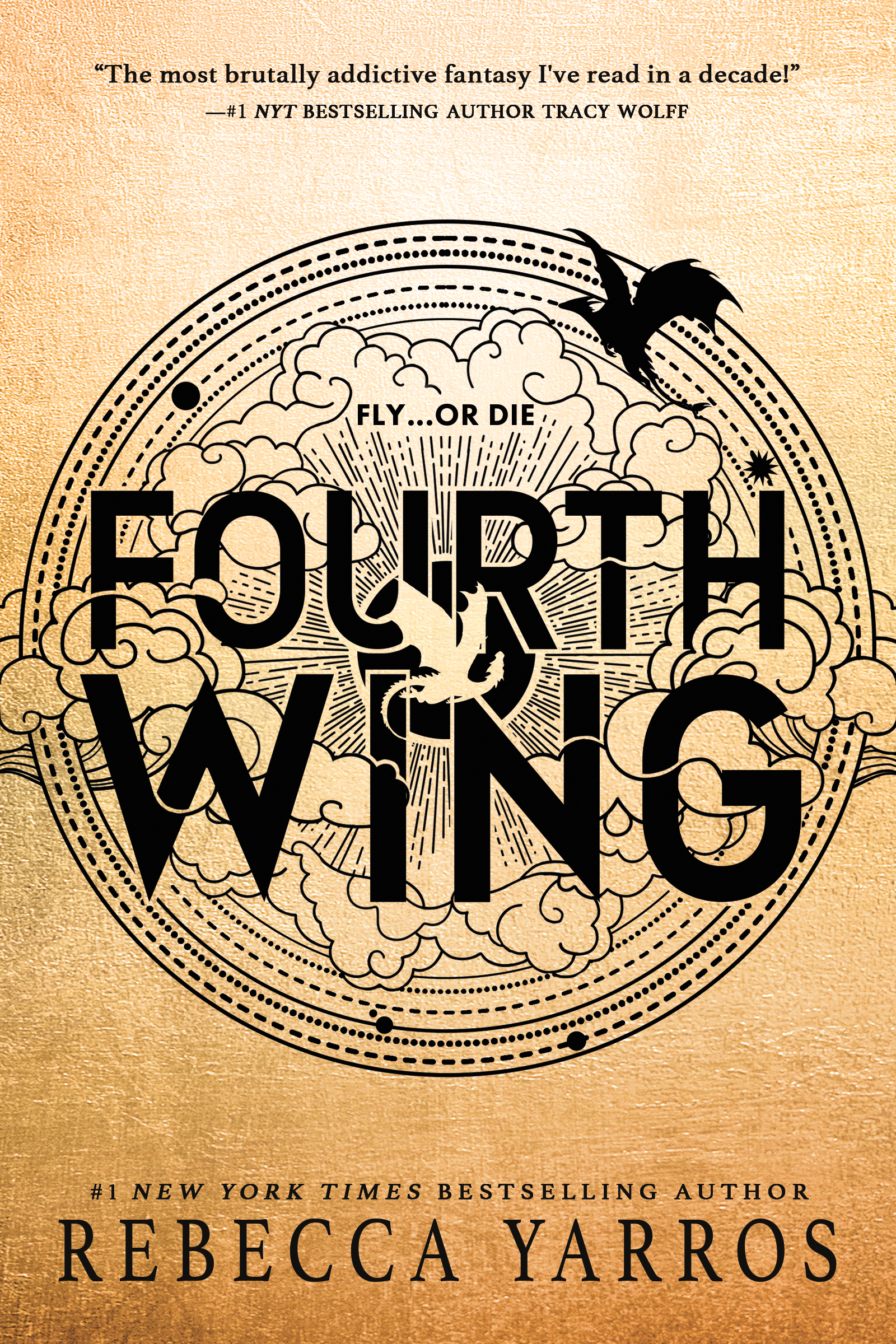
What happens when fragility collides with fire? In Fourth Wing by Rebecca Yarros, survival isn’t a privilege—it’s a battle waged daily against dragons, rivals, and the crushing weight of an empire built on lies. At the heart of this story is Violet Sorrengail, a young woman thrust into a world designed to break her. Forced into the rider’s quadrant of the brutal Bisgaith War College, Violet is expected to die before she ever learns to fly.
But defiance becomes her weapon. With two bonded dragons, lightning coursing through her veins, and a reluctant tie to the brooding Zayden Riorson, she transforms from fragile cadet to storm-wielding anomaly. Yet with every victory comes revelation, and the deeper Violet journeys, the more she uncovers a kingdom built on deception and a war far darker than she imagined.
Welcome to Navarre
In Navarre, there is no gentle easing into adulthood. At twenty, the state comes knocking, not with a celebratory feast but with the clanging summons of conscription. Every citizen of age is funneled into one of the quadrants of Bisgaith War College—scribes, healers, infantry, or riders.
The scribes spend their lives hunched over manuscripts and maps, a haven for minds rather than muscles. It is the path Violet Sorrengail dreams of, her body far too delicate for combat, her spirit drawn to parchment, ink, and the quietude of knowledge.
But her mother, General Lilith Sorrengail, is as unyielding as tempered steel. Compassion is a foreign concept to her, replaced by a doctrine of survival through cruelty. To her, fragility is failure, and weakness is shame. And so, she thrusts Violet into the rider’s quadrant—the deadliest of all.
For Violet, the decree is more than unfair; it is almost a death warrant. She has lived her life under the constant threat of her own body’s betrayal—joints that slip, bones that snap under strain, muscles too weak to bear the weight demanded of them. Yet Navarre has little patience for the fragile.
Those who falter are quickly forgotten, their names etched only into memorial stones, their families offered platitudes instead of justice. Violet knows this truth. And still, she obeys. Not because she wants to, but because choice has been stripped from her, ripped away by the same woman who should have protected her.
Her sister Meira, however, quietly rebels against the general’s cold decree. With tenderness disguised as practicality, she sneaks Violet a dragon-scale corset—a secret armor, light yet impenetrable, invisible beneath her uniform.
She presses Brennan’s survival journal into her hands, a volume scrawled with warnings, notes, and strategies collected by a brother Violet has mourned but never truly released. These tokens of love and rebellion are Violet’s inheritance. She steps into Bisgaith War College not only with fear in her veins but with whispers of hope tucked close to her ribs.
The Parapet: Where Gravity Sorts the Brave from the Dead
The War College wastes no time in declaring its philosophy: you live or you don’t. The first trial is the parapet, an infamous bridge that threads between two towers, narrow as a beam and slicked by rain. It stretches hundreds of feet above the ground, wind battering from all sides, daring cadets to falter. There are no rails, no nets, no second chances. The parapet is not a test of skill but of will—an initiation that weeds out the hesitant, the clumsy, and the unfortunate with terrifying efficiency.
As Violet approaches, the storm rages, her body already betraying her with tremors and pain. To others, the bridge is an obstacle. To her, it is a death sentence painted in stone. Still, she steps forward, whispering historical trivia beneath her breath as though facts could anchor her to life. The cadence of dates and battles becomes a prayer, each recitation a shield against panic.
Around her, cadets jostle for position. Some sneer, some laugh, others push forward with grim determination. Death here is not just possible—it is encouraged. When one falls, the others step harder, their eyes fixed on survival rather than mercy. It is here that Violet first collides with Jack Barlowe, the boy with a cruel smile and a taste for blood. He sees her fragility and decides she does not deserve the bridge. With a shove, he tries to cast her into the abyss. But Violet’s stubbornness ignites, fierce and desperate. She claws her way back from the brink, pain searing through her body, joints screaming as she forces them to hold.
Step by agonizing step, she moves forward, the parapet beneath her feet and death yawning below. When at last she reaches the far side, her chest heaving and her body trembling, disbelief greets her. The girl no one expected to survive has crossed. For her classmates, it is unsettling proof that she may not be so easily erased. For Jack, it is an insult, one he vows to repay. And for Violet, it is the first of many victories written not in strength, but in sheer defiance.
Zayden Riorson: Shadows and Smolder
Among the chaos of Bisgaith’s initiation rituals, one figure stands apart like a storm gathering on the horizon—Zayden Riorson. He is not simply another cadet; he is the son of the most infamous traitor in Navarre’s history. His father’s rebellion ended at the edge of General Sorrengail’s blade—Violet’s mother’s blade. That stain is indelible, etched into his very name, making him both pariah and legend among the student body. His presence carries a weight that silences whispers, a danger sharpened not just by his lineage but by the shadows he controls with his magic.
Violet notices him instantly. He is all sharp angles and watchful silences, exuding an energy that feels both magnetic and lethal. The War College thrives on fear, and Zayden wields it like a weapon. He does not need to raise his voice or flex his strength; a glance from him is enough to unsettle even the boldest cadet. For Violet, his proximity is suffocating. Their families are bound by bloodshed, their histories twisted together in betrayal and death. Every time her gaze meets his, she feels the echo of her mother’s ruthlessness mirrored in his hatred.
And yet, beneath the animosity, there is something else—something dangerous. His attention lingers longer than it should. His words, though laced with barbs, carry an edge of fascination. He christens her “Violence,” a twisted nickname that transforms her name from fragile flower into sharpened blade. The insult slides easily into banter, and the banter quickly sparks into something more volatile. It is not affection, not yet, but the undeniable pull of recognition: two souls marked by circumstance, orbiting one another with an intensity that promises either ruin or revelation.
For Violet, Zayden becomes an enigma. He is both adversary and reluctant ally, his intentions impossible to read. In a place where every misstep can mean death, his gaze unsettles her more than any blade. The line between threat and temptation blurs, and she realizes with unease that the boy she should hate most may become the one she cannot ignore.
Surviving on Cunning, Not Strength
Life in the rider’s quadrant is a ceaseless trial of endurance, violence, and cunning. Each day, cadets are hurled into sparring matches, endurance drills, and tactical exercises designed to kill as much as train. For most, it is survival of the strongest. For Violet, whose body bends under the weight of a sparring blade, brute strength is not an option. Every fight threatens to rip her joints from their sockets, every strike reverberates through bones that crack under pressure. She is not built for the battlefield. But she is built for adaptation.
Where others rely on muscle, Violet sharpens her mind. Brennan’s notebook becomes her secret weapon, a contraband survival guide that maps out the weaknesses of opponents, the rhythms of the school, and the subtleties of strategy. She studies it religiously, memorizing names, habits, and tendencies. Knowledge becomes her armor, foresight her sword. When she cannot overpower her opponents, she outthinks them. And when even strategy fails, she leans into the shadows of alchemy—discreetly poisoning her adversaries just enough to slow their reflexes or dull their precision. Not to kill, but to tip the scales. In a place where morality is already shredded, her actions are less a sin than a necessity.
This reliance on wit unsettles her peers. They expect Violet to fold, to perish quietly at the bottom of the parapet or in the first sparring ring. Instead, she proves that fragility is not the same as weakness. Her resilience lies not in muscle but in sheer audacity—the refusal to accept death when intellect offers her another way forward. She survives not by playing the War College’s game but by rewriting the rules in her favor.
Still, her victories are costly. Each bout leaves her battered, her body screaming with pain that never fully fades. Her survival does not erase her vulnerability; it exposes it more starkly. Every day she is reminded that she is an outlier, a fragile thread woven into a brutal tapestry. Yet with every poisoned opponent, every narrow victory, Violet earns something far rarer than strength: respect tinged with fear. It is this balance—this precarious dance between weakness and cunning—that allows her to endure long enough for destiny to reveal just how powerful she can become.
Threshing Day: Bond or Burn
Threshing is less a ceremony than a slaughter dressed in tradition. On this day, cadets are herded into the open fields where dragons roam freely—colossal, majestic, and utterly disinterested in human survival. The law is simple: bond with a dragon or die trying. The ground is littered with scorch marks from past failures, and the air itself trembles with heat and the guttural growls of impatient beasts. To the dragons, humans are ants—some amusing, most disposable.
Violet, her body already fractured from weeks of survival, knows her chances are slim. Every step across the field is agony, her ankles aching, her muscles screaming. Around her, cadets rush toward dragons with bravado, hoping that confidence alone will earn them a bond. Others are turned to ash in moments, their screams swallowed by the roar of fire. Yet Violet moves with wary purpose. She has no illusions of grandeur; she only hopes to avoid being reduced to a pile of charred bones.
Then comes the moment that defines her fate. Jack Barlowe and his pack of bullies, their hunger for power eclipsing any shred of wisdom, set their sights on a small golden dragonling—Andarna. Its scales shimmer like sunlight, its size marking it as vulnerable. To them, killing the hatchling seems a quick path to impressing a larger dragon. To Violet, it is a horror she cannot abide. Driven by instinct and spite more than strategy, she hurls herself into the fray, landing badly and shattering both ankles. Pain blinds her, but she shields Andarna with her broken body, daring them to come through her first.
It is an act of impossible courage—or reckless idiocy—that shifts everything. From the clouds above descends Tairn, a dragon of nightmare scale and ancient rage. Black as midnight, vast as a fortress, he crashes into the battlefield like an executioner. One exhale of fire reduces Violet’s attackers to little more than memory. He does not walk away. He chooses her. The bond sears into her mind, powerful and overwhelming, a tether that makes her his rider. And then, impossibly, Andarna too presses her consciousness against Violet’s, creating a second bond. The crowd stares in disbelief, for never in the War College’s bloody history has a cadet bound themselves to two dragons.
In an instant, the fragile girl who was expected to die becomes a walking impossibility—a rider whose very existence defies the rules of their world. Power surges within her veins, but so too does the knowledge that such a gift makes her a target for envy, sabotage, and death.
A Bond of Shadows and Secrets
The marvel of two dragons is not without consequence. Dragons do not exist in isolation—they pair, they mate, they weave bonds that ripple into the lives of their riders. Tairn, Violet’s newly bonded titan, is bound to Sigale, the dragon of none other than Zayden Riorson. This creates a tether not only between dragons but between riders. Suddenly, Violet’s thoughts, emotions, and vulnerabilities are exposed, bleeding across a psychic bond she cannot sever. Privacy becomes a luxury she no longer possesses.
At first, the intrusion feels unbearable. The very boy whose father her mother executed, the cadet who embodies danger and distrust, now has access to her innermost fears. Her panic, her doubts, even the sparks of attraction she tries desperately to suppress—all of it slips across the tether. Zayden, for his part, reacts with a controlled intensity. His hatred for her lineage wars with the protective instincts now etched into his very soul. If Violet dies, Tairn will suffer, Sigale will suffer, and by extension, so will he. Survival, once Violet’s burden alone, becomes a shared fate.
This forced intimacy changes everything. Their arguments take on a sharper edge, their silences grow heavier, and every glance carries unspoken words neither dares to voice. The dragons themselves complicate matters further. When Tairn and Sigale express affection, the emotional aftershocks ripple into Violet and Zayden, dragging them into a closeness they never consented to. It is maddening, like being pulled into an embrace by forces beyond their control.
For Violet, the bond is both lifeline and chain. It ensures her survival, for Zayden will not allow harm to befall her, but it also strips her of autonomy, tying her fate to a man who might be her greatest enemy—or her only ally. In this crucible of shadows and secrets, mistrust and attraction tangle into something far more dangerous than either expected. Where once she feared dying alone, Violet now fears something stranger: living bound to someone who could both save her and destroy her.
Death in the Shadows
Power paints a target, and Violet—bonded to not one but two dragons—shines like a beacon in a sky full of predators. To the unbonded cadets, she is not a comrade but a prize, a vessel standing between them and unimaginable power. Dragons cannot be stolen by force, but killing a rider frees them. And so, Violet becomes the object of whispered schemes and sharpened blades.
The attack comes under the cover of night, swift and brutal. Six cadets, desperate and unhinged, break into her quarters. They do not come to scare her; they come to kill her outright. The glint of steel is the last thing she expects before sleep. Her fragile body cannot withstand such odds, and she knows, in that moment, she is seconds away from becoming nothing more than a corpse with two dragons suddenly unmoored.
But fate twists in the form of Andarna, the golden hatchling no one expected to survive the field. Frightened for her rider, the small dragon unleashes a power unseen even among the greats—she stops time itself. The world halts mid-breath, blades frozen inches from Violet’s skin, hearts suspended between beats. It is a revelation that changes everything, proof that Andarna is no ordinary dragon but something far rarer, more dangerous.
When time resumes, salvation arrives in fury. Zayden bursts through the door like vengeance made flesh, his shadows spilling around him as he cuts through the attackers. To the cadets who sought Violet’s death, he is not a fellow student but a reaper. By the time the chaos ends, the room reeks of blood and fear, Violet alive by the narrowest margin. The morning after, the price of betrayal is displayed for all to see: the traitor who let the killers in is executed publicly, his death a grim warning that loyalty is enforced not with trust, but with terror.
Yet beneath the spectacle, Violet feels the deeper wound of betrayal. She realizes her survival is fragile not only because of her body, but because trust in this place is a myth. Everyone is a rival. Everyone has their own agenda. Even those who claim to care may not stand between her and a knife. From that night onward, sleep becomes another battlefield.
Lightning in Her Veins
The War College spares no time for healing. Trials continue, one more dangerous than the last, each designed to strip away weakness until only the lethal remain. For Violet, every day is an exercise in endurance—enduring pain, enduring doubt, enduring the constant awareness that her life dangles by a thread. Yet beneath the bruises and exhaustion, something simmers, something Tairn insists is waiting to be unlocked.
It happens when Jack Barlowe returns, as relentless as a curse. Unkilled, unbroken, he embodies every sneer, every cruel hand that has tried to push Violet off a cliff or into an early grave. This time, his malice turns toward Liam, the steadfast friend Zayden assigned to guard her—a boy who has become her anchor in the storm. When Jack moves to strike Liam down, Violet’s fear ignites into something else: rage, sharp and incandescent.
Lightning answers. Not metaphorical, but real—a storm surges from her chest, arcs through her veins, and tears through the sky. Bolts crash down with deafening fury, reducing Jack to ash in an instant. The crackle of electricity clings to her skin, the air thick with ozone, her body trembling under the weight of power she never knew she possessed. Her signet—the unique manifestation of a rider’s bond—has awakened.
No longer is Violet the fragile cadet barely scraping by. She is a wielder of storms, a conduit of destruction capable of calling the heavens themselves to her aid. The girl once mocked as weak now stands at the center of terrified awe, lightning crackling in her grasp. But with power comes fear. She feels it in the eyes of her peers, sees it in the way others now look at her not as prey, but as something unnatural. And within herself, she feels the haunting question: if such power dwells in her veins, what will it cost her to wield it?
The answer is not immediate. In that moment, Violet feels only the hollow aftershock—triumph laced with grief, strength overshadowed by the knowledge that she has stepped irrevocably into a destiny no one, least of all herself, expected her to claim.
War Masquerading as Training
The War College thrives on deception, and nowhere is that clearer than in the exercises it labels as “training.” On the surface, these missions are meant to harden cadets, to sharpen their instincts in simulated combat. But Violet’s instincts, honed through pain and paranoia, whisper otherwise. When her squad is dispatched to a remote outpost at the kingdom’s very edge, every detail feels wrong. The air is colder, the skies too still, and her dragons—Tairn with his ancient wisdom and Andarna with her strange, untested power—stiffen with unease. This does not feel like practice. This feels like war.
The truth reveals itself with merciless clarity. The wards, magical barriers that shield Navarre from nightmare enemies, are faltering. Through the cracks slither the Venin, creatures whispered about in bedtime tales meant to frighten children into obedience. But these are no stories. They are men twisted by dark magic, their bodies corrupted by the power they siphon directly from the earth. With them come wyvern—grotesque cousins of dragons, born of corruption and shadow, their scales warped, their eyes alight with unnatural hunger.
What follows is chaos unrestrained. Cadets who thought they were merely sparring with wooden weapons now find themselves clawing at survival with inadequate steel. Screams pierce the air as dragons clash with wyvern, the battlefield littered with fire and blood. Violet, already battered, rides the knife’s edge between life and death. Amid the carnage, Jack Barlowe—who should have been dead, charred to ash by her lightning—reappears, feral and deranged, as if death itself has rejected him. His madness ends only when Tairn crushes him in one decisive chomp, erasing him at last.
But there is no victory without loss. Liam, Violet’s protector, her steady anchor in a world that spins too violently, fights with the fury of ten men. He holds the line until his body can give no more. His death is not just a blow to Violet—it is a shattering. Grief claws through her even as poison from a Venin dagger seeps into her veins. Weak, bleeding, and teetering on the brink of unconsciousness, Violet calls upon the storm one last desperate time. Lightning roars from the heavens, her fury unleashed in incandescent arcs that obliterate enemies and light the battlefield with apocalyptic fire.
The dust settles, but the truth cannot be buried: this was no training exercise. This was war, unleashed upon unprepared cadets. And someone in power let it happen.
The Lies of Empire
When Violet awakens, she is no longer in the brutal halls of Bisgaith but in Archion, the hidden stronghold of the rebellion. The air here is different—less suffocating, less saturated with fear. For the first time in months, she breathes without expecting a blade at her throat. But the comfort is fleeting, for the truths she uncovers in this sanctuary are far more devastating than any knife.
The empire has lied. Lied about the Venin, dismissing them as myths. Lied about the stability of the wards, assuring its people of safety even as cracks widened. Lied about rebels, branding them traitors when, in fact, they were the only ones fighting the real war. Every death at the War College, every cadet sacrificed, has been built upon layers of deception meant to preserve the illusion of Navarre’s strength.
And then comes the revelation that rips Violet’s world apart. Brennan, her beloved brother—supposedly dead, mourned for years—is alive. He stands before her not as the ghost she carried in memory, but as flesh and blood, a leader of the rebellion, hardened yet familiar. The reunion is a tidal wave of relief and betrayal. Why had he let her believe he was gone? Why had her mother, ruthless and unflinching, concealed the truth?
Violet’s entire belief system collapses under the weight of these revelations. Her loyalty to the empire, already cracked, crumbles completely. The woman who raised her forced her into dragon rider school knowing the lies, knowing the dangers, and withholding the truth. Her nation, for which so many had died, has been rotting from within, its foundation built on silence and suppression.
Now, Violet stands at a crossroads. She bears the bonds of two dragons, lightning in her veins, and a psychic tether to Zayden that binds her to the rebellion whether she chooses it or not. The fragile girl who once wanted only books and quiet now carries the storm itself. And she must decide: remain a pawn of a deceitful empire or embrace the rebels who may be her only path to truth, even if that means turning her back on everything she once believed.
Conclusion
Fourth Wing is more than a tale of dragons and danger—it is a story of defiance, resilience, and the lies empires tell to maintain their power. Violet begins her journey as the least likely to survive, a girl too fragile for the brutal world of riders. But through wit, stubbornness, and bonds forged in fire and lightning, she becomes the fulcrum upon which her kingdom’s fate may rest. Every betrayal, every battle, strips away the illusions she once held about loyalty, family, and truth.
By the time the final pages turn, Violet is no longer merely surviving—she is questioning, resisting, and preparing to fight not just for her own life, but for the future of all Navarre. Her story is a reminder that strength is not always found in the body. Sometimes, it lies in the will to challenge the storm and, against all odds, to become it.