
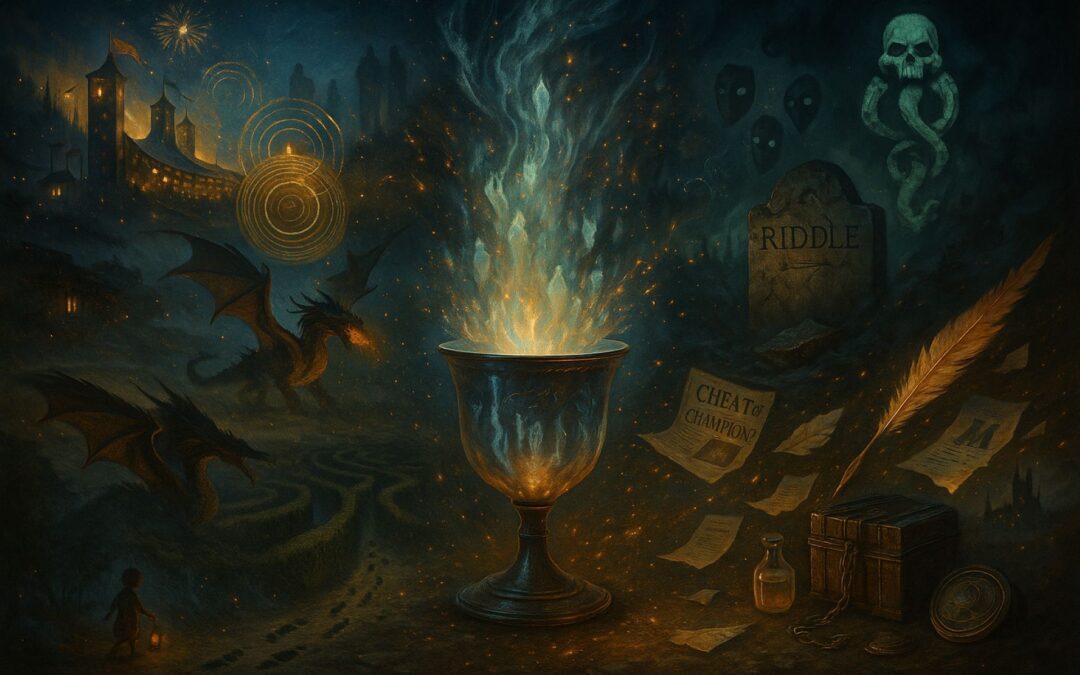
Overview: The Turning of the Age of Innocence
Harry Potter and the Goblet of Fire stands at the crossroads of wonder and dread. It is the book where the magical world loses its innocence — where the playful mysteries of Hogwarts give way to the grave realities of destiny and death. J.K. Rowling constructs this fourth installment not merely as an adventure but as a reckoning. The laughter of Quidditch, the glow of the Triwizard Tournament, and the thrill of adolescent rivalry are slowly engulfed by a rising darkness that seeps into every corner of the story.
For the first time, the reader senses that magic itself is not protection but peril. The world beyond Hogwarts, once distant and abstract, begins to close in — politics, prejudice, and the return of Voldemort intertwine to expose the frailty of institutions and the naivety of youth.
This is a tale of thresholds: of friendship tested, of truth unmasked, and of power awakening. The novel marks the end of Harry’s childhood, replacing innocence with knowledge and wonder with warning. By the time the final page turns, the fantasy has grown teeth — and the boy who lived has glimpsed the true cost of survival.

Full Plot Summary: Trials, Triumphs, and the Return of the Dark Lord
Harry Potter and the Goblet of Fire opens a darker chapter in the wizarding world — one where danger no longer hides in the shadows but infiltrates the heart of Hogwarts itself. J.K. Rowling weaves a narrative of spectacle and suspense, mixing grand tournaments with intimate emotional trials. It is the book where childhood wonder begins to dissolve under the weight of destiny.
The Dark Prologue: Shadows Before Dawn
The novel begins far from Harry — in the silent, decaying halls of the Riddle House, a setting steeped in history and unease. Once home to a wealthy family, it became infamous when all three Riddles were found dead one night, their faces frozen in terror, with no visible cause. The villagers whispered of dark forces, blaming their servant, Frank Bryce, who protested his innocence but was forever marked as the murderer.
Now, decades later, Frank still tends to the house out of habit and defiance. One summer night, he notices a flickering light in an upper window and goes to investigate, muttering to himself about trespassing teenagers. But inside, he finds something far more sinister.
In an upstairs room, Lord Voldemort, no longer human but a twisted, infantile creature sustained by dark magic, converses with Peter Pettigrew (Wormtail) and an unseen guest. They speak of plans to regain power, of a “faithful servant” hidden in Hogwarts, and of a ritual that will soon restore Voldemort to full strength. A snake, Nagini, slithers across the room, an omen of the evil to come.
Frank, horrified but determined, is discovered listening. He is beckoned forward and murdered with a flash of green light — Avada Kedavra. His body falls lifeless to the floor, and miles away, Harry Potter awakens, his lightning-shaped scar searing with pain.
This chilling prologue is a radical departure from the tone of the first three books. It opens not with humor or nostalgia but with death. Rowling repositions the series as something larger than school mischief or adolescent rivalry — a war story whose first tremors are only now being felt. The dark world, long hidden behind the veil of childhood, is stirring.
The Quidditch World Cup: A Celebration Shattered
Summer brings a brief illusion of joy. Harry, still troubled by his nightmare, receives a letter from the Weasleys inviting him to the Quidditch World Cup, the wizarding world’s most spectacular sporting event. Escaping the Dursleys, he joins Ron, Hermione, and the Weasley family as they travel by Portkey to the vast, enchanted stadium — a marvel of magical architecture that blends carnival energy with ancient ritual.
Tents dot the landscape like glowing lanterns. Wizards from every nation gather in a festive spectacle — green Irish flags waving beside scarlet Bulgarian banners. The match itself is a breathless whirlwind of motion and magic: Ireland wins through dazzling teamwork, while Viktor Krum, Bulgaria’s Seeker and prodigy, captures the Snitch despite his team’s loss.
For a moment, the tone is jubilant. Fireworks streak the night, laughter rings through the air, and Harry glimpses a vision of unity — a rare harmony in a divided world.
But this brightness collapses swiftly. In the dead of night, masked figures emerge from the shadows: Death Eaters, remnants of Voldemort’s followers, marching through the camp with cruel delight. They set tents ablaze and levitate Muggle families, twisting their bodies like grotesque puppets. Panic engulfs the camp. Ministry officials scramble to contain the chaos. Then, above the darkened sky, the Dark Mark — a skull with a serpent tongue — bursts into view, conjured by an unknown hand.
The joyous gathering disintegrates into terror. For the first time in years, the wizarding world remembers what it means to be afraid. The Dark Mark is more than a symbol — it’s a warning that Voldemort’s shadow has returned.
When the dust settles, suspicion falls on Winky, a house-elf belonging to Barty Crouch Sr., and a discarded wand — Harry’s own — is found at the scene, used to cast the mark. The incident ignites uneasy questions: who is manipulating these events, and how close is Voldemort’s reach?
This sequence transforms the magical world from playground to battleground. Rowling uses the World Cup as allegory — civilization masking its fragility beneath spectacle. What begins as wonder ends in dread, a microcosm of the novel’s entire arc.
Back to Hogwarts: Whispers of Change
When Harry returns to Hogwarts, the familiar comfort of the castle feels subtly altered. There’s excitement, yes — but also a strange, electric tension, as though something monumental is about to unfold. Even Dumbledore’s twinkling calm seems shadowed by gravity.
At the Welcoming Feast, the Great Hall glows with warmth, yet the students sense an undercurrent of anticipation. Their new Defense Against the Dark Arts teacher is the legendary ex-Auror Alastor “Mad-Eye” Moody, a man with a reputation for eccentric brilliance and paranoia. His magical eye spins freely, capable of seeing through walls, invisibility cloaks, and deceit. Moody’s arrival brings both comfort and unease — his lessons are practical, brutal, and unflinching. He teaches the students the Unforgivable Curses, showing them how a simple spell can destroy, dominate, or kill. For the first time, Hogwarts’ safety feels porous.
Dumbledore then announces the long-awaited event: the Triwizard Tournament will be revived after centuries of dormancy. It is a contest of magical skill and courage between three European schools — Hogwarts, Beauxbatons, and Durmstrang. The stakes are high; the challenges, deadly. To prevent recklessness, only students seventeen and older may enter, and the Goblet of Fire will choose one champion per school.
When the time comes, students submit their names with breathless excitement. The hall falls silent as the Goblet flares to life — first glowing blue, then spitting out the names of the chosen:
- Viktor Krum for Durmstrang,
- Fleur Delacour for Beauxbatons,
- Cedric Diggory for Hogwarts.
Applause thunders through the hall — until the Goblet burns once more. A fourth name appears.
Harry Potter.
The silence is suffocating. Harry stands frozen, disbelieving. He never entered. He is too young. Yet the magic of the Goblet is binding — once chosen, participation is compulsory. Whispers ripple through the crowd. Is he lying? Did he cheat? Even Ron’s face hardens, jealousy and doubt clouding his friendship.
The mood of Hogwarts fractures. What began as celebration becomes accusation. For Harry, the Triwizard Tournament transforms into a trial not just of skill, but of integrity.
This turning point captures the novel’s essence — the collision of fate and choice, fame and isolation. Harry, once celebrated as “the Boy Who Lived,” now becomes a symbol of suspicion. The world that once adored him begins to turn away.
The First Task: Fire and Fear
The Triwizard Tournament’s first challenge is announced with ominous simplicity — each champion must face a dragon. The task is to retrieve a golden egg guarded by one of these deadly creatures. What sounds like a test of skill is, in truth, a test of nerve.
Harry learns of the dragons accidentally when Hagrid, ever loyal and well-meaning, secretly invites him to watch the creatures being transported into the Forbidden Forest. Hidden under the Invisibility Cloak, Harry witnesses four monstrous dragons — scaled, winged, and breathing torrents of fire. One of them, the Hungarian Horntail, is said to be the most ferocious. When Harry discovers that this will be his opponent, dread seeps into his very bones.
For the first time, we see Harry wrestling not with external danger but with the inner tremor of fear. He is fourteen, untrained in advanced magic, and up against a creature that could kill him in seconds. His only advantage is courage — and the quick thinking born of desperation.
In a rare moment of mentorship, Mad-Eye Moody offers cryptic guidance, suggesting Harry use his strength rather than mimic others’. This advice leads Harry to what he knows best: flight. Summoning his broomstick through the Accio charm, he dodges and dives above the stadium as the Horntail scorches the air below. It is one of Rowling’s most cinematic sequences — pure motion, danger, and instinct.
When Harry finally outwits the dragon and seizes the golden egg, the roar of the crowd is deafening. The thrill of victory is intoxicating but deceptive; the audience sees spectacle, not survival. The task reaffirms his bravery, yet it also isolates him further. The other champions admire him grudgingly, while Ron, realizing the truth of his friend’s innocence, reconciles. For a moment, their friendship heals — but beneath the cheers lies a darker undertone. Someone powerful and unseen wanted Harry in this competition.
The golden egg, when opened, emits only a piercing shriek. Its secret remains unsolved, foreshadowing that the real trial has barely begun.
The Yule Ball and the Weight of Adolescence
Amid the looming dangers of the Tournament, Hogwarts briefly transforms into a place of festivity. The Yule Ball, a formal celebration marking the Christmas season, brings laughter, anxiety, and a dash of teenage chaos.
For the first time, Rowling allows her young characters to stumble through the awkward terrain of adolescence — invitations, jealousy, and the fragile art of pretending confidence. Harry and Ron, terrified at the thought of asking girls to dance, delay too long and end up scrambling for partners. Hermione, however, stuns everyone by arriving with none other than Viktor Krum, the famous Durmstrang champion. Her transformation from studious companion to young woman of poise and independence stirs admiration and envy in equal measure.
The evening is both charming and revealing. Beneath the glitter of enchanted snow and twinkling lights lies a subtle tension — the first flicker of adulthood. Hermione and Ron’s unresolved feelings surface in biting words. Harry, though momentarily distracted by his crush on Cho Chang, feels a vague melancholy, sensing that something precious is slipping away — the simplicity of childhood friendship.
Beyond the teenage drama, the Yule Ball serves another purpose: it marks a political intersection. Teachers, foreign guests, and Ministry officials mingle in uneasy civility. Igor Karkaroff and Severus Snape share cryptic exchanges. Ludo Bagman, ever cheerful, seems nervous beneath his grin. And Barty Crouch Sr., usually rigid and composed, behaves erratically, missing crucial meetings and muttering to himself. Rowling plants these threads quietly, transforming what appears to be a social event into a scene of subtle foreboding.
By the night’s end, the Ball leaves emotional residue — Hermione’s tears, Ron’s resentment, Harry’s restlessness. It is the most human interlude in the novel, reminding us that even as the shadow of war gathers, life — with all its awkward dances and unspoken desires — continues.
The Second Task: Beneath the Surface
Months pass, and the Tournament’s second challenge approaches. The champions must decipher the golden egg’s riddle to learn what awaits them. Its shrill scream continues to confound Harry until Moaning Myrtle, the ghost of a girl long dead, suggests opening it underwater. When he does, the noise transforms into haunting song: the merpeople of the Black Lake warn that something precious has been taken and will lie beneath the surface for one hour.
Harry’s dread deepens. He must not only dive into the unknown but rescue what he treasures most — and he has no idea how to survive underwater. Help comes, fittingly, from loyalty: Dobby the house-elf brings him Gillyweed, a magical plant that allows him to breathe beneath the waves.
The task begins on a cold February morning. As the whistle sounds, the champions plunge into the lake. Darkness swallows them; the water is cold and heavy, the silence broken only by eerie songs of the merpeople. Harry swims past schools of strange fish, clusters of skeletal weeds, and shadows that move too fast to name.
When he reaches the merpeople’s village, he finds four captives bound by ropes — Ron, Hermione, Cho Chang, and Gabrielle Delacour. Each represents what a champion “would sorely miss.” According to the rules, each may take only one. Yet when Fleur fails to arrive and Hermione remains under Krum’s care, Harry refuses to abandon Gabrielle, determined to save her too. His decision delays him but earns him the respect of the judges and the gratitude of Fleur.
The task becomes a moral test disguised as a physical one. While others compete for glory, Harry acts from empathy. His compassion distinguishes him as the truest champion — not because he wins, but because he chooses mercy over victory.
When he surfaces, exhausted but alive, the applause feels distant. What lingers instead is a shift in tone — the Tournament no longer feels like sport but prophecy. Its puzzles and monsters echo the larger moral choices Harry will soon face beyond the safety of Hogwarts.
The Third Task: The Maze of Shadows
By the time the third and final task arrives, the castle’s joy has faded into unease. Whispers of danger surround the Tournament. Barty Crouch Sr. has vanished, and his son, thought long dead, is rumored to have escaped Azkaban. Even the weather feels oppressive — still, heavy, waiting.
The Quidditch pitch has been transformed into an immense maze, its towering hedges twisting into darkness. Inside, the champions must navigate a path filled with enchantments and creatures, each obstacle testing not only magical skill but mental endurance. The crowd cheers as the contestants enter, but the sound soon fades, swallowed by the silence of the maze.
Rowling crafts this sequence like a psychological descent. As Harry moves deeper, the world grows dim and claustrophobic. Shadows stretch unnaturally. He encounters boggarts, blast-ended skrewts, and spells that distort perception. At one point, he stumbles upon Cedric Diggory, injured but determined. Instead of rivalry, camaraderie blossoms; they help each other through the maze, guided by flashes of wandlight in the dark.
The final moments are marked by both nobility and doom. When they reach the Cup simultaneously, neither wants to claim it alone. They agree to take it together — a decision that symbolizes unity, fairness, and mutual respect. Yet this act of friendship becomes a snare.
The moment their hands touch the Cup, the world spins violently. The hedges vanish. The cheers disappear. They land in a graveyard — cold, silent, foreign. The Portkey has betrayed them.
Cedric’s confusion lasts only seconds before a voice hisses the command that will haunt Harry’s life: “Kill the spare.” A flash of green light. Cedric falls. The Tournament, once a celebration of unity, collapses into tragedy.
Harry’s eyes fix on a grotesque infant-like creature — Voldemort, incomplete and waiting. A ritual begins, dark and methodical: the bone of the father, the flesh of the servant, and the blood of the enemy. In a swirl of magic, agony, and ancient evil, Lord Voldemort rises anew, restored to full, terrible life.
The maze, once a contest, becomes a metaphor — the labyrinth of fate. Every choice, every step, every act of courage has led to this point. The story’s tone transforms irrevocably. The age of games is over.
The Graveyard: Death Reclaims Its Throne
When Harry and Cedric land in the graveyard, disoriented and unsuspecting, the silence is deafening. The night air feels wrong — too still, too hollow. A cold wind cuts through the grass, and rows of crooked tombstones rise like sentinels in the dark. The name carved into the nearest one — Tom Riddle — sends a chill down Harry’s spine.
Before he can process where they are, a figure steps out of the shadows: Peter Pettigrew, trembling yet obedient, clutching something small and grotesque in his arms — a hairless, deformed creature, the remnants of Voldemort. With a flash of green light, Pettigrew kills Cedric Diggory on command — “Kill the spare.” The words hang in the air like a curse. Cedric’s death marks the end of innocence not only for Harry, but for the entire magical world.
Pettigrew sets the ritual in motion. Under Voldemort’s orders, he performs a dark spell that binds the living and the dead: the bone of the father taken from Tom Riddle’s grave, the flesh of the servant as Wormtail severs his own hand, and the blood of the enemy, as Harry is restrained and cut, his blood spilling into the cauldron. What follows is one of Rowling’s most haunting transformations — the rebirth of the Dark Lord.
From the cauldron emerges Voldemort, restored to full, terrible form — pale as bone, slit-eyed, his fingers long and spidery. His voice is cold and commanding, his power absolute. Around him, Death Eaters Apparate one by one, masked and groveling, reuniting in allegiance and fear. Voldemort walks among them, naming their betrayals, their cowardice, their failures to seek him in his absence. His cruelty is methodical, his intellect chillingly precise.
Then he turns to Harry — his chosen symbol of defiance. With mocking ceremony, he releases Harry from his bonds, returns his wand, and challenges him to a duel. The two wands, sharing a twin core, connect through an unforeseen magical phenomenon: Priori Incantatem. Streams of golden light entwine them, and ghostly figures emerge — the shades of Voldemort’s victims, including Harry’s parents. They form a spectral shield around him, urging him to flee. Cedric’s spirit, calm and kind even in death, asks Harry to take his body home.
Harry breaks the connection, grabs Cedric’s body, and seizes the Portkey. The graveyard vanishes, and the world spins into darkness.
The Revelation: The Enemy Within
Back at Hogwarts, the triumphant cheers of the crowd turn to confusion as Harry appears clutching Cedric’s lifeless body. Horror spreads through the stands. Harry, barely conscious, mumbles about Voldemort’s return, the Death Eaters, and the graveyard. Dumbledore and Moody rush to him, shielding him from the chaos.
Moody ushers Harry into his office, speaking softly, too softly. At first, he seems sympathetic — almost proud. But his questions grow sharper, stranger. “Did he forgive his Death Eaters?” “Who was there?” “Did he touch you?” There is an urgency beneath his tone, an obsession that feels wrong. Then, the final question: “Did he mention his servant at Hogwarts?”
The realization strikes too late. Moody reveals that he was the one who guided Harry throughout the Tournament — not out of mentorship, but manipulation. He had ensured Harry’s victory in every task, ensuring the boy would reach the Cup — the Portkey to Voldemort. As he prepares to kill Harry, Dumbledore, McGonagall, and Snape burst into the room. Dumbledore stuns him, and with the aid of Veritaserum, the truth is uncovered.
The man before them is not Mad-Eye Moody at all, but Barty Crouch Jr., a fanatical Death Eater who had escaped Azkaban and used Polyjuice Potion to assume Moody’s identity. The real Moody lies imprisoned in a trunk. Crouch Jr. confesses everything: he placed Harry’s name in the Goblet of Fire under a fourth school, manipulated each task, and guided events toward the resurrection of his master.
His confession connects every loose thread — the missing Ministry official (Barty Crouch Sr., killed by his son), the World Cup chaos, the Dark Mark, the subtle nudges throughout the Tournament. What had seemed coincidence was, in truth, design.
Denial and Division: The Ministry’s Blindness
Even with the truth laid bare, the wizarding world refuses to see. Dumbledore summons Cornelius Fudge, the Minister for Magic, urging immediate action. He explains Voldemort’s resurrection and Crouch Jr.’s confession in plain words. But Fudge, driven by pride and fear, refuses to believe. He insists that Voldemort’s return is impossible, that Crouch’s testimony is the ranting of a madman, and that Harry’s trauma has clouded his judgment.
His denial has deadly consequences. Fudge orders the Dementor guarding Crouch Jr. to administer the Kiss — removing the only living witness who could corroborate Dumbledore’s account. The act silences the truth. Dumbledore’s fury is quiet but unmistakable. He warns that ignoring Voldemort’s return will cost countless lives. Fudge leaves unconvinced, his political instincts overwhelming reason. The Ministry of Magic, once an institution of order, becomes the first casualty of denial.
This moment marks the beginning of a fracture that will dominate the next phase of the series — the divide between truth and illusion, courage and comfort. Dumbledore knows that the real war will begin not with Voldemort’s armies, but with disbelief itself.
The Farewell: The End of Innocence
The end of the school year arrives under a shroud of grief. The Great Hall, once a place of celebration, becomes a chamber of mourning. Dumbledore stands before the students and delivers one of his most profound speeches — a eulogy for Cedric Diggory, a call to unity, and a warning against fear. He refuses to sugarcoat the truth: Cedric was murdered by Voldemort. There is no glory in denial. “Remember Cedric Diggory,” he says. “Remember, if the time should come when you have to make a choice between what is right and what is easy.”
The foreign delegations depart with solemn faces. The laughter that had once filled the halls now echoes faintly, like a memory of another age. Harry, Hermione, and Ron sit together on the train ride home, the silence between them heavy with the knowledge of what lies ahead. Harry’s scar aches, a physical reminder that his connection to Voldemort is now deeper — and darker — than ever.
At King’s Cross, Dumbledore offers quiet reassurance. “You have shouldered a heavy burden, Harry. But remember — you are not alone.” Yet even as Harry returns to the Dursleys, it is clear that he has crossed an invisible boundary. The boy who once faced monsters for sport has now faced death for truth. The Fourth Year ends not in triumph, but in transformation.
The final image of The Goblet of Fire is not of Hogwarts’ towers gleaming in the sun, but of a boy clutching his friend’s memory, walking into a world that no longer feels safe. Childhood, as it once was, has ended.
Character Analysis: Courage, Rivalry, and the Cost of Growing Up
In Harry Potter and the Goblet of Fire, J.K. Rowling transforms her characters from children of wonder into witnesses of mortality. Every major figure faces a moral crossroad — the moment when innocence collides with consequence. Friendship is tested, heroism is redefined, and courage begins to look less like victory and more like endurance.
Harry Potter: The Unwilling Hero
Harry enters his fourth year as a boy accustomed to danger but still sheltered by the illusions of safety. At first, the Triwizard Tournament feels like another adventure, another test of his resilience. Yet as the year unfolds, it becomes a psychological crucible — forcing him to confront fear, betrayal, and the weight of death.
His courage in facing the Hungarian Horntail, his compassion in rescuing more than required in the lake, and his moral clarity in sharing victory with Cedric all reveal the hero he is becoming. But the graveyard scene alters him forever. Witnessing Cedric’s murder and Voldemort’s rebirth strips him of the last remnants of childhood naivety. For the first time, courage is not about daring but about surviving.
Harry’s defining trait — his instinct to act selflessly — now carries pain. He learns that bravery can cost lives, and that fate, no matter how resisted, will find its way to him. In the aftermath, he carries not triumph but trauma. He leaves Hogwarts no longer “the Boy Who Lived,” but the boy who must live with what he’s seen.
Hermione Granger: Intellect and Integrity
Hermione’s evolution in this book is quieter but equally profound. She emerges as the moral and intellectual core of the trio — rational where others are reckless, principled where others are impulsive. Her compassion extends beyond human boundaries when she begins her crusade for house-elf rights through S.P.E.W., a subplot that mirrors the larger themes of justice and moral blindness.
At the Yule Ball, Hermione also steps into her own selfhood. Her transformation is not simply physical; it symbolizes her transition from childhood invisibility to young adulthood. The boys, particularly Ron, begin to see her differently — and uneasily. Beneath her calm precision, she harbors deep emotional intelligence, seeing through the illusions others prefer to keep.
By the end, Hermione becomes more than a sidekick to Harry’s destiny. She represents reason — a steady light amid emotional chaos. Her courage is not loud but enduring, built on conviction rather than impulse.
Ron Weasley: Pride, Loyalty, and Insecurity
Ron’s arc is defined by contradiction. His loyalty to Harry is fierce, yet fragile; his admiration often tangled with envy. When Harry’s name emerges from the Goblet, Ron’s jealousy fractures their friendship, revealing the insecurities that have long shadowed his sense of worth — the burden of being one among many in a large family, perpetually in the glow of others’ success.
But Ron’s anger is human, not cruel. His reconciliation with Harry is genuine, born from remorse and rediscovered loyalty. He stands by Harry through each trial afterward, a testament to the resilience of friendship once broken and healed. By the novel’s end, Ron begins to confront his own identity — no longer merely Harry’s companion, but a young man struggling to define courage on his own terms.
Albus Dumbledore: The Visionary Who Sees Too Far
Dumbledore in this novel evolves from the archetypal wise mentor into a figure of haunting foresight. He is no longer simply Hogwarts’ guardian but a leader aware of coming war. His calm is edged with urgency, his decisions tinged with moral risk.
He alone believes Harry’s account of Voldemort’s return, standing firm against the Ministry’s denial. His speech at the end — urging unity, honesty, and courage — crystallizes his role as a moral compass in an age of deceit. Yet there is melancholy beneath his wisdom. Dumbledore knows that the war will cost innocence first and trust next.
His empathy toward Harry in the aftermath of the graveyard shows his humanity: he does not offer platitudes but acknowledgment of pain. “The truth,” he insists, “is a beautiful and terrible thing, and should therefore be treated with great caution.” It is a lesson he teaches the boy — and a warning he carries himself.
Cedric Diggory: The Noble Shadow
Cedric represents the ideal Hogwarts student — kind, fair, modest, and honorable. He is everything the Tournament claims to celebrate: bravery without arrogance, talent without cruelty. His decision to share the Cup with Harry transforms him from rival to mirror — a reflection of what true nobility means.
His death is devastating precisely because it is senseless. Cedric is not killed for weakness, but for being good in a world where goodness no longer protects. In that moment, Rowling introduces the series’ first real tragedy — the death of virtue in the face of evil. Cedric’s memory becomes the moral anchor of the book, a silent reminder that innocence cannot survive unscathed.
Lord Voldemort: The Rebirth of Fear
If Goblet of Fire marks the death of innocence, Voldemort’s return marks the resurrection of fear. His physical rebirth in the graveyard is symbolic of the spiritual decay that has been festering beneath the world’s surface. He is not just evil; he is the embodiment of power unrestrained by conscience — a reflection of what happens when ambition strips away humanity.
Voldemort’s interactions with his Death Eaters reveal the essence of tyranny: domination through fear, manipulation through loyalty, and the perversion of order into servitude. His calm cruelty contrasts sharply with the chaos he unleashes. In his return, Rowling signals that the story has matured — no longer a battle between good and bad students, but between the corrupt and the courageous.
Mad-Eye Moody / Barty Crouch Jr.: The Impostor of Trust
Perhaps the most complex figure in the book is the false Mad-Eye Moody — a man who embodies the novel’s central motif: deception. For most of the story, he appears as a stern, eccentric mentor, teaching valuable lessons about vigilance and survival. Ironically, his false identity allows those lessons to ring true.
The revelation that he is in fact Barty Crouch Jr., a Death Eater in disguise, reframes the entire narrative. His infiltration of Hogwarts is not merely a plot twist — it is a metaphor for corruption from within. The enemy is no longer outside the gates; he has been inside, shaping the next generation.
Crouch Jr.’s obsession with Voldemort mirrors fanatical devotion — blind, consuming, and self-destructive. Through him, Rowling explores the seduction of ideology, the ease with which faith can curdle into fanaticism.
Cornelius Fudge: The Politics of Fear
Fudge’s character embodies the moral cowardice of bureaucracy. His refusal to accept Voldemort’s return, even in the face of overwhelming evidence, illustrates a different kind of villainy — one rooted not in malice, but in denial. He is a politician of appearances, terrified less of evil than of disorder.
His blindness divides the magical world, creating an atmosphere of distrust and misinformation. In Fudge, Rowling captures a timeless truth: that complacency, cloaked in authority, can be as dangerous as open cruelty.
The Trio Together: The Breaking and Bonding of Youth
Harry, Ron, and Hermione’s dynamic in this book captures the essence of adolescence — the pain of growing apart and the strength of coming back together. Their friendship fractures under misunderstanding, jealousy, and the slow encroachment of adulthood. Yet it also evolves, moving from the innocence of shared mischief to the gravity of shared loss.
By the final chapters, they are no longer children bound by curiosity but companions bound by experience. Their unity, though shaken, becomes the quiet defiance against the fear Voldemort seeks to spread. The trio’s bond, tempered in fire and grief, becomes the emotional foundation of the war to come.
Themes and Motifs: Glory, Choice, and Corruption
Harry Potter and the Goblet of Fire is the fulcrum upon which the entire saga pivots — the story where innocence yields to awareness, spectacle gives way to substance, and moral simplicity fractures into shades of gray. Rowling interlaces themes of glory, power, choice, and corruption, transforming a magical tournament into an allegory of growing up in a world that no longer feels safe or fair.
Glory and the Illusion of Heroism
At its surface, the Triwizard Tournament is about courage, skill, and prestige. Its history is steeped in honor — champions who faced impossible trials to bring glory to their schools. But Rowling subverts this tradition, revealing how easily glory becomes spectacle and competition becomes manipulation.
The crowd cheers for dragons, near-death escapes, and dazzling magic, blind to the exploitation underneath. Even the Ministry treats the Tournament as political theater — a way to distract from bureaucratic rot and to display international unity. Harry, unwillingly thrust into this stage, becomes both hero and pawn. His victories, though genuine, are twisted by perception — admired by some, resented by others, doubted by many.
The novel dismantles the myth of glory. True courage, Rowling insists, is not the roar of the crowd but the quiet persistence to act rightly even when unseen. Cedric Diggory’s fairness in the face of rivalry, Harry’s compassion in the lake, and his refusal to claim sole victory redefine heroism as moral clarity rather than conquest.
Choice, Fate, and the Shape of Character
From its earliest pages, the book grapples with destiny — the Goblet’s inexplicable choice, the inescapable binding contract, and the unseen hand that guides events toward Voldemort’s rebirth. Yet Rowling refuses to make fate absolute. She uses the tournament’s structure to test choice against inevitability.
Harry may be forced to compete, but how he competes remains his own. His choices — to save more than he must, to share victory, to act with integrity when others act with ambition — distinguish him as a moral agent in a world obsessed with results. Dumbledore’s words at the end echo this theme: “It is our choices, Harry, that show what we truly are, far more than our abilities.”
Even the villains are bound by choice. Barty Crouch Jr. chooses devotion to Voldemort over freedom. Cornelius Fudge chooses denial over courage. Each decision, large or small, shapes the coming storm. Rowling portrays free will as both a burden and a gift — a force that defines identity even in a world ruled by prophecy.
Corruption and the Fragility of Institutions
Beneath the Tournament’s glamour runs the deeper corruption of the wizarding world. The Ministry of Magic, once seen as the pinnacle of order, reveals itself as bureaucratic, self-serving, and politically cowardly. Cornelius Fudge, more concerned with maintaining the illusion of stability than confronting truth, embodies the decay of leadership.
Even Hogwarts, the sanctuary of childhood, becomes vulnerable to infiltration. The imposter Moody, hidden in plain sight, turns the castle into a metaphor for violated trust — an institution compromised from within. Rowling exposes a world where evil no longer lurks in forbidden forests but walks the corridors disguised as authority.
The corruption extends beyond politics to culture itself. Prejudice against house-elves, giants, and werewolves reveals a society unwilling to face its moral contradictions. Through Hermione’s activism, Rowling critiques moral blindness — the comfort of ignoring injustice because it is inconvenient to challenge.
The Death of Innocence
The novel’s emotional core lies in the loss of innocence — both personal and collective. The first three books basked in the wonder of discovery: magical sweets, enchanted classes, invisible cloaks. Goblet of Fire tears that veil away. The laughter of the Quidditch World Cup turns into screams. The warmth of friendship gives way to jealousy. The games of magic lead to murder.
Cedric’s death crystallizes this theme. His fall is not merely a plot point; it is the symbolic death of the childish belief that good intentions guarantee safety. Harry’s tears over Cedric’s body mark his passage into adulthood — a moment of awakening through grief.
The world, once divided neatly between good and evil, now reveals moral complexity. Adults fail, institutions falter, and truth itself becomes a casualty of convenience. This thematic evolution signals the series’ transition from fairytale to tragedy — the beginning of moral adulthood.
The Return of Fear and the Psychology of Denial
Fear permeates every layer of the story — fear of truth, fear of loss, fear of change. Voldemort’s physical resurrection is less a beginning than an unveiling. He represents not just evil returned, but evil remembered — the terror people tried to forget.
Rowling’s insight lies in her portrayal of fear’s consequences. The Ministry’s refusal to acknowledge Voldemort’s return is political cowardice disguised as pragmatism. People prefer comfortable lies to dangerous truths. This collective denial mirrors real-world patterns of history — societies ignoring looming darkness until it consumes them.
For Harry, fear becomes personal and existential. His nightmares, his scar, his isolation — all point to a growing realization that evil is not only external but intertwined with his own destiny. Courage, from this point on, will mean learning to live with fear rather than denying it.
The Fire as Symbol and Cycle
The Goblet of Fire itself stands at the center of the book’s imagery — fire as both illumination and destruction. It chooses, purifies, and exposes. The same flame that selects champions also sets in motion deceit and death. Fire, in Rowling’s hands, becomes a living metaphor for transformation: it burns away illusion and leaves only truth behind.
From the fiery breath of dragons to the golden sparks of dueling wands, flame embodies change. It devours the old world of schoolboy innocence and forges a new era of vigilance and moral reckoning. Every spark in the novel — literal or emotional — heralds an awakening.
Unity and Division: The Choice Between Fear and Faith
Dumbledore’s closing speech distills the novel’s final message: unity is the only defense against fear. The wizarding world stands at a threshold — divided between those who believe and those who deny, those who remember Cedric’s death and those who explain it away. Rowling reminds readers that division is the true weapon of evil.
The alliances formed during the Triwizard Tournament — between schools, between students, between unlikely allies — stand as fragile symbols of hope. Though overshadowed by tragedy, they foreshadow the resistance to come.
Goblet of Fire thus becomes not merely a story of magic, but of moral awakening — a parable about what happens when comfort collides with truth, and when a boy, barely grown, is forced to carry the weight of a world that refuses to see.
Setting and Atmosphere: Between Festivity and Foreboding
In Harry Potter and the Goblet of Fire, J.K. Rowling constructs a world balanced precariously between celebration and catastrophe. Every setting, from the glittering arenas of magic to the shadowed corners of dread, mirrors the novel’s emotional rhythm — a world dancing at the edge of joy before tumbling into terror. The tone evolves from buoyant festivity to creeping foreboding, transforming Hogwarts and the wizarding world from sanctuaries of wonder into theaters of uncertainty.
The Riddle House: The Birthplace of Evil
The novel opens far from Hogwarts, in a setting stripped of enchantment — the dilapidated Riddle House. Its cold, decaying corridors echo with silence and memory. This is not the world of butterbeer and broomsticks but of ghosts and guilt. It feels grounded in the realism of horror — the quiet dread of the ordinary made uncanny.
The Riddle House introduces the series’ new aesthetic: evil not as fantasy but as history. It is a relic of the past whose curse bleeds into the present. The murder of Frank Bryce, a mundane Muggle caught in the supernatural, collapses the barrier between two worlds. From this point on, darkness is no longer distant — it exists alongside everyday life.
The atmosphere here is cinematic — mist-shrouded, candlelit, and silent except for whispered voices. It sets the novel’s moral weather: one of decay beneath grandeur, of evil biding its time beneath forgotten names.
The Quidditch World Cup: The Glitter and the Crack
Rowling’s depiction of the Quidditch World Cup is a masterpiece of tonal duality. The scene dazzles with sensory abundance — roaring crowds, luminous tents that defy gravity, mascots that dance and duel across the sky. It is magic at its most exuberant, a global carnival that seems to confirm the vitality of wizarding life.
But the grandeur masks fragility. Beneath the fireworks lies the arrogance of complacency. The sudden eruption of chaos — the Death Eaters’ attack, the Dark Mark in the sky — tears through the illusion of safety. What was meant to unite the magical world in celebration instead exposes its fractures.
The World Cup thus becomes a symbolic hinge: the transition from innocent spectacle to political terror. Rowling uses the scene to capture the emotional vertigo of the book — how quickly light turns to shadow, and how memory of joy deepens the sting of fear.
Hogwarts: From Haven to Battlefield
In the first three novels, Hogwarts was sanctuary — a place where danger could be defeated and home was always restored. Goblet of Fire dismantles that comfort. The castle remains physically the same — the enchanted ceilings, the flickering candles, the hidden passageways — but its emotional atmosphere shifts.
There is something heavier in the air this time. The arrival of foreign schools, the presence of the Goblet, the looming tests — all inject tension into the familiar corridors. Even the laughter in the Great Hall carries a strange restraint. Hogwarts, once the cradle of innocence, now feels like a stage where the stakes have grown impossibly high.
Rowling paints this evolution with subtle detail. The whisper of suspicion in the common rooms, the glances between professors, the way Dumbledore’s calm seems slightly forced — these create an atmosphere not of open conflict but of anticipation. Hogwarts becomes a microcosm of the larger world: a place where joy persists despite fear, where trust begins to erode, and where the boundaries of safety are slowly dissolving.
The Triwizard Tournament: The Theater of Transformation
Each of the Tournament’s settings — the dragon arena, the Black Lake, the hedge maze — acts as a symbolic landscape of transformation. The open sky of the first task represents exposure and courage; the underwater stillness of the second evokes introspection and moral depth; the claustrophobic maze of the third embodies confusion, deception, and the death of clarity.
Rowling’s mastery lies in turning these physical environments into psychological mirrors. As the tasks grow darker and more isolating, so too does Harry’s understanding of the world. The noise of applause fades with each trial until, in the final one, there is only silence.
The Tournament itself reflects the shifting mood of the wizarding world — what begins as celebration ends as prophecy. Its spaces evolve from arenas of skill to arenas of fate, where courage is not rewarded but tested to its breaking point.
The Graveyard: The Return of the Past
The Little Hangleton graveyard is the novel’s heart of darkness — the place where the story’s aesthetic of dread reaches its peak. It is an antithesis to Hogwarts: no safety, no spectators, no comfort of magic as wonder. The setting is stripped bare, elemental.
The gravestones, the moonlight, the stillness — everything speaks of finality. This is where the magical world’s denial of the past ends. The graves themselves are metaphors for buried history, the crimes of a generation that refused to reckon with its darkness. When Voldemort rises here, he does not merely return to life — he returns as the consequence of memory denied.
The graveyard scene fuses physical terror with moral revelation. In this cold, colorless place, Harry faces not only death but truth. The world he knew dies here, symbolized by Cedric’s fall and Voldemort’s rebirth.
The Ministry of Magic and Beyond: The World as It Is
Although the Ministry appears only briefly, its presence dominates the atmosphere through implication. The institution, polished on the surface and rotten underneath, looms as a silent character. Fudge’s denial of Voldemort’s return adds a new dimension to the book’s setting — corruption as landscape.
The wizarding world expands in this novel, but the expansion does not bring wonder; it brings exposure. With every new place Harry sees — the World Cup, the foreign schools, the graveyard — the world grows more vast, more magnificent, and more unstable.
Rowling captures a transition familiar to anyone who has outgrown innocence: the realization that the world’s beauty and cruelty coexist. Every location in Goblet of Fire bears this duality — Hogwarts’ warmth shadowed by deceit, the Ministry’s authority hollowed by fear, the graveyard’s quiet pierced by rebirth.
The Emotional Climate: Between Celebration and Fear
The settings of the book are not just physical — they are emotional climates. Rowling uses atmosphere as narrative pulse. The festive color of the Quidditch tents, the chill of the lake depths, the oppressive silence of the maze — each scene breathes with feeling.
This emotional geography charts the story’s descent from light to shadow. What begins in gold ends in gray; what begins in laughter ends in mourning. And yet, within that darkness, there remains a fragile thread of hope — the knowledge that fear, once named, can be faced.
By the novel’s end, the world of Harry Potter has irrevocably changed. The corridors of Hogwarts echo not with mischief but with memory. The magic remains, but it no longer feels like escape — it feels like responsibility.
Tone and Style: The Flicker Between Youth and Shadow
In Harry Potter and the Goblet of Fire, J.K. Rowling executes one of the most striking tonal evolutions in contemporary fantasy — a seamless movement from the buoyancy of childhood adventure to the gravity of moral awakening. The language, rhythm, and emotional texture of the novel all reflect this metamorphosis. It is as though the prose itself matures alongside Harry, shedding its playfulness for precision, its wonder for wisdom.
A Dual-Toned World: Light Entwined with Darkness
The novel oscillates between two emotional registers — festive exuberance and foreboding stillness. At one moment, the narrative delights in the sensory richness of the Quidditch World Cup, brimming with humor, wit, and spectacle. In the next, it plunges into tension, cruelty, and death. Rowling wields this tonal duality with mastery, not as contradiction but as transition.
The reader feels the same confusion that Harry feels: joy that curdles into dread, laughter interrupted by loss. This juxtaposition creates a subtle unease, a reminder that even in moments of light, darkness waits. The tone grows more reflective and symbolic with every chapter, preparing the reader for the moral complexity of the books that follow.
The Maturing Voice of the Series
Rowling’s prose matures alongside her protagonist. The sentences are longer, the diction weightier, the pacing slower when introspection deepens. Where earlier books relied on dialogue and mischief, Goblet of Fire depends on observation and emotional layering. The world no longer feels whimsical; it feels lived in.
The humor remains — Fred and George’s antics, Ron’s sarcasm, Hagrid’s blunders — but it now functions as contrast, not escape. The levity sharpens the gravity, emphasizing how fragile laughter becomes when fear enters the frame. Rowling uses humor like candlelight: flickering, human, and defiant against the encroaching dark.
The narrative perspective retains its limited third-person view through Harry’s eyes, but the emotional lens has widened. The boy who once noticed magic for its charm now observes it with moral curiosity. He questions power, truth, and authority — and the prose, in turn, mirrors his awakening conscience.
The Rhythm of Growing Tension
The structure of the novel mirrors its emotional pacing. The early chapters move with brisk energy, mimicking the rush of youth. The World Cup, the arrival of foreign schools, and the first tasks are rendered with cinematic motion — bright scenes, quick cuts, and bursts of dialogue.
But as the story progresses, the rhythm decelerates. Sentences lengthen. The atmosphere thickens. Descriptions linger on silence, on glances, on unease. The tone shifts from external adventure to internal reckoning. By the final act — the graveyard — the pacing becomes ritualistic, almost liturgical, echoing the cadence of myth.
This modulation of rhythm mirrors Harry’s psychological descent: from exhilaration to dread, from movement to stillness, from competition to consequence.
The Language of Fear and Revelation
Rowling’s use of imagery evolves dramatically. The bright, sensory magic of earlier books — feasts, fireworks, and classrooms — gives way to elemental symbols: fire, blood, shadow, and stone. The language turns tactile, often corporeal, emphasizing the vulnerability of the body — the pain of Harry’s scar, the cut that binds his blood to Voldemort’s rebirth, the cold grip of fear.
Dialogue, too, acquires new weight. Dumbledore’s speech, once whimsical, becomes grave and philosophical. Voldemort’s words, controlled and almost polite, are chilling for their restraint. Even the everyday banter among students feels slightly muted, touched by the awareness that words can wound.
The tone throughout is one of emotional chiaroscuro — a blend of brightness and shadow that captures adolescence itself. Rowling writes not about the end of childhood, but about its transformation into consciousness.
Irony and Foreshadowing
A quiet irony runs beneath the novel’s structure: the Tournament meant to promote unity instead becomes the mechanism of division; the object of celebration — the Goblet — becomes the catalyst for tragedy. Rowling threads foreshadowing into ordinary details — a fleeting line of dialogue, a misinterpreted gesture — creating an atmosphere of invisible tension.
The reader feels, long before the reveal, that something is off. The friendly laughter feels forced, the victories hollow. This tonal undercurrent of dissonance heightens the final shock of Cedric’s death and Voldemort’s return, making them feel both sudden and inevitable.
The Cinematic and the Intimate
Goblet of Fire is Rowling’s most cinematic work — vast in scope, filled with spectacle and crowd scenes — yet it never abandons intimacy. She writes from the inside out. Even in the grandest moments, such as the dragon chase or the duel in the graveyard, the focus remains on breath, heartbeat, fear, and thought.
This duality gives the novel its emotional resonance: it is epic in scale but personal in experience. The reader feels not just what happens, but what it costs.
The Tone of Aftermath
The final chapters leave behind grandeur for silence. The closing tone is subdued, almost elegiac. The laughter of the Great Hall fades into mourning. The rhythm slows, as though even the prose grieves. Dumbledore’s words — urging truth and unity — carry the tone of prophecy, while Harry’s return to the Muggle world feels stripped of color.
By the end, Rowling’s style has crossed a threshold. The whimsical storyteller of The Sorcerer’s Stone has become a chronicler of moral struggle. The flicker of youth has dimmed into shadow — but not extinguished. A faint ember of hope still burns beneath the ash, waiting for the next fire.
Symbolism and Imagery: Fire, Blood, and the Maze
In Harry Potter and the Goblet of Fire, Rowling’s use of imagery reaches a new sophistication. The symbols are no longer decorative — they are architectural, shaping the emotional and moral framework of the story. Fire, blood, and the maze emerge as recurring emblems of transformation, each representing a stage in the passage from innocence to awareness. Together, they illuminate the novel’s central truth: that growing up is not a process of discovery but of burning, bleeding, and finding one’s way through darkness.
Fire: The Element of Revelation and Judgment
The Goblet of Fire, at the novel’s center, is not merely a magical object — it is a vessel of fate. Fire in this story functions as a paradoxical force: it chooses, exposes, purifies, and destroys. The same flames that illuminate truth also burn away illusion.
When the Goblet selects Harry’s name, the fire acts as both herald and executioner. Its blue-white light symbolizes judgment — an otherworldly intelligence that bypasses human fairness. Fire here is divine yet dangerous, a mirror of destiny’s impartial cruelty.
Throughout the novel, flames appear at pivotal moments: the dragons’ breath in the first task, the candles flickering in the Great Hall, the sparks from wands in battle, the phoenix-like gleam of Dumbledore’s wisdom. Each iteration of fire carries dual energy — enlightenment and peril. It lights the path forward but reminds the reader that all illumination casts shadow.
By the end, fire becomes prophecy. The Goblet that once celebrated competition becomes the silent witness to corruption. It reminds us that not all chosen are blessed — some are chosen to suffer.
Blood: The Currency of Life and Death
If fire represents revelation, blood represents consequence. The novel’s turning point — Voldemort’s resurrection — revolves around the exchange of blood: bone of the father, flesh of the servant, blood of the enemy. In this ritual, blood becomes both literal and metaphysical — the medium through which evil is reborn and connection is redefined.
For Harry, whose scar already binds him to Voldemort, the taking of his blood deepens that connection. It is no longer symbolic; it is corporeal. His life force becomes the Dark Lord’s anchor, tying their fates through shared essence. Rowling uses this to explore the unsettling idea that evil and good are not opposites but entangled reflections — each defined by the other.
Blood also recurs in subtler forms: in the scraped knees of competition, the swelling tension of adolescence, the physicality of fear. It grounds the novel’s escalating abstraction in the human body. It is a reminder that beneath magic, the story is mortal — about the fragility of flesh and the price of being alive.
Cedric’s death, too, is an act of blood symbolism. The green flash that kills him is sterile and cold — a contrast to the warmth of human life it extinguishes. In a world of enchantments, the colorless lifelessness of his fall makes mortality visible.
The Maze: The Architecture of the Human Psyche
The maze, final setting of the Triwizard Tournament, operates as one of Rowling’s richest metaphors. It is not simply a test of magical skill — it is a journey inward. Its hedged corridors, shifting paths, and silent darkness externalize the labyrinth of adolescence and morality.
In mythology, mazes symbolize trial and transformation — the soul’s passage through confusion toward clarity. In Rowling’s rendering, it becomes a psychic landscape. Every obstacle within it — the boggart, the blast-ended skrewt, the disorienting spells — reflects internal struggles: fear, temptation, isolation.
As Harry and Cedric advance, the maze empties of noise. The crowd’s cheers fade, the torches dim. This absence of sound and witness mirrors the solitude of decision-making. Heroism here is not public but private — forged in the unseen space where conscience speaks louder than applause.
When the maze delivers Harry to the graveyard, its metaphor completes itself. The labyrinth of self ends at the confrontation with mortality. What began as a contest of skill becomes a confrontation with truth — the center of the maze is death, and only by facing it does the hero emerge transformed.
The Dual Symbolism of the Goblet and the Cup
The Goblet of Fire and the Triwizard Cup mirror each other — one a beginning, the other an ending, both vessels of fate. The Goblet chooses Harry without consent; the Cup delivers him to death without warning. Each represents the illusion of choice in a world governed by unseen forces.
Yet there is a poetic symmetry in their design. Both gleam with light — one burning, one gleaming — and both turn instruments of destiny into instruments of revelation. Through them, Rowling redefines what it means to be chosen: not as privilege, but as burden.
The Color Palette of Innocence and Corruption
Throughout the novel, Rowling manipulates color imagery with cinematic precision. The early chapters glow with golds and greens — the hues of youth and festivity. But as the story progresses, these colors darken: the gleam of dragon fire turns to ash, the blue of the lake deepens to black, and the vibrant maze dissolves into gray fog.
The recurring appearance of green — from the Dark Mark to the Killing Curse — inverts its traditional association with growth and vitality. Here it becomes the color of corruption, a visual echo of moral decay. In contrast, silver and white, often linked with Dumbledore and the phoenix, represent fragile clarity — the faint glow of conscience amid chaos.
Symbolism of Dreams and the Scar
The scar, once a mark of survival, becomes in this book a conduit — a living symbol of psychic connection. It throbs in moments of evil and foresight, blurring the line between dream and reality. Harry’s visions of Voldemort are not dreams but transmissions, reminders that innocence can never be fully isolated from darkness.
The scar’s pain symbolizes awakening — not only to fear but to understanding. It forces Harry to recognize that evil is not merely external; it is intertwined with destiny, memory, and self. Rowling thus transforms a physical mark into a metaphysical wound — the soul’s reminder that knowledge comes with pain.
The Phoenix and the Serpent: Opposing Archetypes
Running through the imagery of fire and blood is the ancient duality of phoenix and serpent — rebirth and corruption. Dumbledore’s phoenix, Fawkes, symbolizes regeneration through sacrifice; Voldemort’s serpent, Nagini, represents regeneration through consumption. Both embody immortality, but of opposing kinds — one moral, one monstrous.
Their coexistence across the novel embodies Rowling’s recurring idea: light and dark are not separate realms but reflections within the same fire.
From Symbols to Myth
By the close of Goblet of Fire, these images — fire, blood, maze, serpent, phoenix — merge into a single mythic vision: the rite of passage. The world of youth, once lit by candles and laughter, has burned down to embers. What remains is initiation — the transformation of a boy into a witness.
Rowling’s symbols thus move beyond metaphor into theology. They express not only what happens but why it matters. Fire purifies, blood binds, and the maze tests. Through these, Harry emerges scarred but awakened, no longer a seeker of wonder but a bearer of truth.
Moral and Philosophical Reflection: The Price of Truth and the Birth of Fear
In Harry Potter and the Goblet of Fire, Rowling’s narrative widens into a moral field — no longer the private tale of a boy at school, but a fable about truth, fear, and the decay of moral courage. The book marks the moment when the series ceases to be about magic and becomes about meaning. Through the fall of institutions, the failures of adults, and the awakening of youth, Rowling explores a timeless moral question: what happens to a society when truth becomes inconvenient and courage becomes rare.
The Nature of Truth: Beauty, Terror, and Responsibility
Dumbledore’s words at the novel’s end — “The truth is a beautiful and terrible thing, and should therefore be treated with great caution” — stand as its moral cornerstone. Truth, in Rowling’s vision, is not an abstract virtue but a dangerous flame. To seek it is noble; to speak it, costly.
Harry embodies this moral courage. When he returns from the graveyard, traumatized yet insistent, he tells the truth — that Voldemort has risen, that Cedric was murdered. He gains no glory from it; he is met with disbelief and suspicion. Yet his refusal to distort reality, even to protect himself, signals his maturation. He learns that truth is not about triumph, but about endurance — the willingness to stand alone when denial feels easier.
The world around him, however, recoils from truth. The Ministry of Magic silences witnesses, Dumbledore’s warnings are dismissed as alarmism, and even the ordinary public chooses comfort over clarity. Rowling captures here the universal psychology of denial: when truth threatens the illusion of safety, it becomes the enemy.
In this tension, the novel transcends fantasy. It becomes an allegory of moral adulthood — the acceptance that truth will not make one safe, but it will make one free.
Fear as the Instrument of Power
If truth is the novel’s moral axis, fear is its corrosive counterforce. Voldemort’s rebirth is not merely a physical event — it is the resurrection of fear as a social contagion. He does not need armies at first; he needs silence, hesitation, the paralysis of disbelief. Rowling shows how evil thrives not through mass cruelty but through collective cowardice.
Fear drives every act of corruption in the story. It makes Fudge deny evidence, the Death Eaters grovel, and ordinary people look away. Fear turns courage into compliance, twisting morality into self-preservation. The true horror of Voldemort’s return lies not in his magic, but in what it reveals: that society will often side with comfort over conscience.
Even within Harry, fear transforms from external threat to inner conflict. The scar that once burned as warning now pulses as connection. Evil no longer comes from without — it lives inside him as awareness. His nightmares are not symbols of danger but of knowledge. Fear, once something to flee, becomes something he must understand.
The Corruption of Innocence and the Education of the Soul
The moral education of Goblet of Fire is not taught in classrooms. It is learned through loss. Cedric’s death, senseless and unadorned, becomes the novel’s moral pivot. It shatters the childish idea that fairness governs life or that good deeds guarantee protection. Through grief, Harry discovers the adult truth: morality is not measured by reward, and justice is not assured.
Rowling refuses to sentimentalize this awakening. She allows Harry to grieve, to rage, to question the meaning of it all. Yet through his suffering, he acquires something more enduring than hope — understanding. The book teaches that goodness is not the absence of pain, but the refusal to let pain define one’s soul.
The Triwizard Tournament itself serves as a moral allegory — a ritualized version of the journey toward conscience. Each task strips away illusion: the dragon exposes courage, the lake tests compassion, the maze measures integrity. The graveyard delivers truth. Through them, Rowling builds a philosophy of growth: that every act of courage burns away comfort, and every act of truth leaves a scar.
Institutions and the Ethics of Denial
Rowling’s moral critique extends beyond individuals to the systems that govern them. The Ministry of Magic represents the danger of bureaucratic morality — the replacement of ethical courage with political convenience. Cornelius Fudge, well-meaning yet weak, embodies the failure of leadership in the face of moral crisis.
His refusal to accept Voldemort’s return is not ignorance but choice — the cowardice of a man who prefers illusion to accountability. In Fudge, Rowling constructs a chillingly realistic archetype: the leader who believes that to admit the truth is to lose control. Yet his denial becomes complicity, showing that evil needs not only servants but skeptics.
Hogwarts itself, once pure sanctuary, is no longer exempt from this moral erosion. Its infiltration by Barty Crouch Jr. — a Death Eater disguised as protector — symbolizes the collapse of trust. When the enemy can teach Defense Against the Dark Arts, the line between safety and threat dissolves. Rowling implies that institutions cannot preserve virtue; only individuals can.
The Philosophy of Pain and Growth
Running beneath the narrative is a Stoic undercurrent — the notion that suffering is not the enemy but the teacher. Harry’s trials resemble moral initiations rather than tests of power. Each victory costs him something intangible: a piece of naivety, a degree of faith, a measure of peace.
Through pain, he learns detachment — not from compassion, but from illusion. His confrontation with death teaches him that control is an illusion, and that courage is found not in mastery but in acceptance. The scar, which burns as Voldemort rises, becomes the emblem of this inner evolution: an ever-present reminder that survival is not the same as innocence.
The Ethical Mirror: Dumbledore and Voldemort
Rowling subtly juxtaposes Dumbledore and Voldemort as moral opposites bound by knowledge. Both understand the depths of magic and mortality, but where Dumbledore’s wisdom leads to humility, Voldemort’s leads to hubris.
Dumbledore accepts that love and death are inseparable — that compassion is the only enduring form of power. Voldemort, in his obsession with mastery, denies both. He seeks immortality through domination, failing to see that the fear of death is the truest death of all.
This philosophical contrast gives the novel its spiritual resonance. The battle between them is not merely magical but metaphysical — a conflict between acceptance and denial, between the courage to feel and the terror of vulnerability.
The Birth of Moral Agency
At its heart, The Goblet of Fire is about the awakening of moral agency — the moment when doing right becomes a choice rather than an instinct. Harry learns that goodness is not guaranteed by nature or prophecy; it must be renewed through decision, again and again.
His willingness to confront truth despite disbelief, to grieve without surrender, and to act without reward marks the birth of the ethical self. Rowling positions him not as a flawless hero but as a moral learner — one who carries his trauma not as burden but as evidence of life.
By the final page, the moral landscape of the series has transformed. Innocence is gone, certainty has fractured, and truth has become dangerous. Yet amid that desolation lies something enduring: integrity. The courage to face what is real, no matter how terrible, becomes the book’s quiet philosophy — the fire that does not consume but clarifies.
Author and Context: J.K. Rowling’s Expanding World and Audience
When Harry Potter and the Goblet of Fire was published in 2000, J.K. Rowling stood at a pivotal crossroads — both as a writer and as a cultural phenomenon. The book marks not only the midpoint of the series but the moment when Rowling’s fictional universe outgrew the boundaries of children’s literature. It is here that she redefined her readership, deepened her moral vision, and fused mythic structure with social realism.
The Author’s Transition: From Wonder to Consequence
The first three Harry Potter novels were written with the cadence of a modern fairy tale — witty, brisk, and imbued with the charm of discovery. The Goblet of Fire represents Rowling’s deliberate shift in artistic ambition. At over 600 pages, it is sprawling, layered, and structurally intricate. The world is no longer a backdrop for school adventures; it becomes a living organism governed by politics, memory, and moral decay.
This expansion mirrors Rowling’s own evolution as a storyteller. Having built a foundation of myth and innocence, she now turns to examine the cost of that innocence. Her prose grows darker, her humor more tempered, her moral questions more urgent. In many ways, Goblet of Fire is her first true work of literary realism cloaked in fantasy — a novel concerned as much with human systems and psychological tension as with magic.
The Socio-Political Climate of Its Time
Written at the dawn of the new millennium, Goblet of Fire arrived in a world on the edge of global change. The late 1990s carried a strange optimism — the illusion of stability after decades of upheaval — yet beneath it lay disquiet: fears of corruption, rising nationalism, and institutional mistrust. Rowling captured this atmosphere intuitively.
The Ministry of Magic’s bureaucratic denial of Voldemort’s return reflects the political evasion of uncomfortable truths — a timeless metaphor for the failure of governments to confront moral crises until it is too late. Her portrait of propaganda and public complacency would later resonate even more deeply in the post-9/11 world, when questions of truth, fear, and authority became global concerns.
Rowling’s choice to pivot the series toward politics and moral complexity also broadened her readership. The books were no longer confined to children; they became multigenerational works, read by adults as allegories of power, prejudice, and integrity.
Literary Influences and Mythic Structure
Rowling’s influences converge in Goblet of Fire more visibly than in any other installment. The structure of the Triwizard Tournament evokes the mythic pattern of the hero’s journey — three trials, each symbolizing a stage of inner awakening, followed by a descent into death and a return with knowledge. Echoes of Greek mythology (the labyrinth of Theseus), Arthurian legend (the noble competition and moral testing of knights), and Christian allegory (sacrifice and resurrection) weave through the text.
Yet Rowling grounds these mythic structures in psychological realism. The dragons, merpeople, and mazes are not just magical obstacles; they externalize Harry’s emotional and ethical evolution. In doing so, Rowling achieves what few fantasy writers manage — the merging of myth with modern consciousness.
Her language, though accessible, carries moral density. Like Dickens, she uses humor to expose hypocrisy; like Tolkien, she builds mythic resonance through detail and history. But unlike either, she roots her fantasy in the immediacy of adolescence — a realm where identity, loyalty, and fear are at their rawest.
Expansion of the World: Beyond Hogwarts
The fourth book widens the lens of the entire saga. For the first time, the reader glimpses the wizarding world as a global civilization. The arrival of Beauxbatons and Durmstrang introduces cultural diversity, rival traditions, and new moral contrasts. The Quidditch World Cup reveals a wizarding society not so different from our own — brilliant yet prejudiced, capable of joy yet prone to chaos.
This expansion was pivotal for the series’ longevity. It allowed Rowling to shift the narrative’s moral stakes from personal rivalry to social conflict. Hogwarts ceases to be a self-contained stage and becomes part of a vast, fractured world — a world whose corruption, denial, and inequality mirror our own.
Rowling’s Moral Vision and the Evolution of the Series
With Goblet of Fire, Rowling makes a silent promise to her readers: that the story will no longer protect them from pain. Cedric’s death, the return of Voldemort, and the Ministry’s denial signal a new realism — one that treats loss and moral ambiguity as central to growth. She begins to write for the adolescent and adult soul, acknowledging that growing up means learning to face darkness without losing decency.
The book also establishes the guiding moral theme of the remaining volumes: the tension between truth and comfort, unity and fear. In later installments, this theme will unfold into full political allegory, but here it is born — raw, personal, and immediate.
The Cultural Moment: A Generation Comes of Age
The release of Goblet of Fire marked a cultural milestone. Children who had begun the series as readers of whimsy now found themselves facing questions of mortality, propaganda, and moral courage. The novel’s tone matured in step with its audience, transforming reading itself into a shared rite of passage.
Rowling’s genius was not only in world-building but in timing — she grew with her readers, refusing to speak down to them. By challenging them emotionally and ethically, she ensured the series’ endurance beyond its genre. The book became a mirror for a generation learning that the world could be both magical and unjust.
The Author’s Broader Legacy
Goblet of Fire cemented Rowling’s position not just as a storyteller but as a cultural moralist — an author unafraid to interrogate the nature of truth, the dangers of denial, and the responsibility of choice. It is her first book that reads as a warning as much as a wonder.
In the years that followed, Rowling’s public image — once that of a writer of children’s fantasy — expanded into that of a moral voice. Her fictional world became a language through which readers could discuss power, prejudice, and resilience.
Thus, The Goblet of Fire is more than a literary milestone in a beloved saga; it is the hinge upon which Rowling’s authorship turns from mythmaker to moralist — from chronicler of wonder to witness of consequence.
Key Quotes and Interpretations: Words That Foreshadow a Darker Era
Rowling’s Harry Potter and the Goblet of Fire is filled with lines that transcend their immediate scenes, foreshadowing the moral, emotional, and philosophical transformation that defines the rest of the series. Her dialogue and narration shift from whimsical to prophetic, each phrase resonating like a quiet warning. Below are several key quotes that capture the novel’s evolving tone — from the fire of revelation to the chill of fear.
“Remember, if the time should come when you have to make a choice between what is right and what is easy, remember what happened to a boy who was good, and kind, and brave.” — Albus Dumbledore
This line, spoken at Cedric Diggory’s memorial, distills the moral axis of the book. Dumbledore’s words are not consolation but instruction — a call to moral fortitude in an age of fear. Rowling uses “right and easy” as binary poles defining her universe. The tragedy of Cedric’s death becomes a lesson for the living: that goodness requires effort, and integrity often comes at the cost of comfort.
“The truth is a beautiful and terrible thing, and should therefore be treated with great caution.” — Albus Dumbledore
This remark, echoing Dumbledore’s earlier wisdom in The Sorcerer’s Stone, gains new weight in Goblet of Fire. Here, truth is no longer the revelation of wonder but the unveiling of horror. The duality of “beautiful and terrible” defines the moral landscape of the novel — that understanding and suffering are inseparable. For Rowling, enlightenment is never safe; it burns.
“Kill the spare.” — Lord Voldemort
Few phrases in modern literature carry such quiet brutality. The order that ends Cedric Diggory’s life is devastating in its brevity. There is no flourish, no speech — just the erasure of humanity through indifference. The casualness of Voldemort’s command encapsulates evil in its purest form: not passion, but apathy. The moral horror of the line lies in its simplicity, reflecting how evil often speaks most chillingly when it speaks least.
“We are only as strong as we are united, as weak as we are divided.” — Albus Dumbledore
Delivered at the book’s end, this line stands as both moral plea and political warning. In a world fracturing under denial and fear, Dumbledore’s message transcends Hogwarts — it becomes a parable for nations and communities. Rowling’s insight is timeless: the first victory of darkness is division. It is an echo of every age’s struggle between solidarity and self-preservation.
“Differences of habit and language are nothing at all if our aims are identical and our hearts are open.” — Albus Dumbledore
This quote, often overlooked, captures Rowling’s humanist philosophy. Spoken during the welcoming feast of the Triwizard Tournament, it is both idealistic and ironic — for the tournament meant to unite schools will end in death. The line foreshadows the dissonance between noble intention and grim reality, a recurring motif in Rowling’s moral universe. It also gestures toward the later global scope of the series — a world where alliances must transcend boundaries of culture and creed.
“You’ve got to be brave, Harry. You’ve got to be strong. Don’t give up.” — Cedric’s Spirit
In the graveyard, as the shades of Voldemort’s victims emerge from the wand’s light, Cedric’s final words to Harry bridge the boundary between life and death. His calm, unresentful courage contrasts sharply with Voldemort’s cruelty. Through this moment, Rowling transforms Cedric from casualty into conscience — a figure of moral persistence whose voice lingers long after his fall.
“You have shown bravery equal to those who have died in service to the wizarding world. You have shown courage far beyond your years.” — Dumbledore to Harry
This line closes Harry’s arc of transformation. His courage is no longer the courage of adventure but of endurance — the ability to face horror without surrender. Dumbledore’s tone, stripped of warmth, reflects recognition rather than comfort. The boy who once sought approval now receives respect — a quiet acknowledgment that childhood has ended.
“Dark and difficult times lie ahead, Harry. Soon we must all face the choice between what is right and what is easy.” — Albus Dumbledore
Perhaps the most enduring line of the novel, this statement functions as prophecy. It not only encapsulates the moral philosophy of Goblet of Fire but foreshadows the thematic trajectory of the remaining series. The future will test not power but principle. Rowling leaves readers with this haunting paradox: that moral clarity often emerges only when the world darkens.
“You fail to recognize that it matters not what someone is born, but what they grow to be.” — Dumbledore
This line, though secondary in plot, captures the book’s deeper spiritual message — the rejection of essentialism and the affirmation of choice. Whether applied to wizards, Muggles, or one’s own past, it reaffirms Rowling’s central belief: destiny is less about origin than about will. It is the moral antidote to Voldemort’s obsession with blood purity and predetermined greatness.
Each of these lines serves as a beacon — a flicker of meaning within the growing shadow. Together, they trace the novel’s shift from charm to challenge, from story to statement. The language of Goblet of Fire no longer teaches magic; it teaches conscience.
One-Paragraph Moral Summary: The End of Childhood and the Dawn of Consequence
Harry Potter and the Goblet of Fire is the moment when innocence fractures and truth begins to burn. It marks the passage from wonder to wisdom — a world once lit by laughter now shadowed by loss. Rowling’s story, beneath its dragons and spells, is an allegory of moral awakening: the discovery that courage is not the absence of fear but the decision to act despite it, that truth is rarely comforting, and that goodness demands sacrifice. Through fire, blood, and betrayal, Harry learns that evil does not return with thunder but with silence — in denial, in indifference, in the ease of looking away. The tournament that began as a spectacle ends as a revelation: growing up means learning that magic cannot shield us from pain, but conscience can keep us from becoming its cause.