
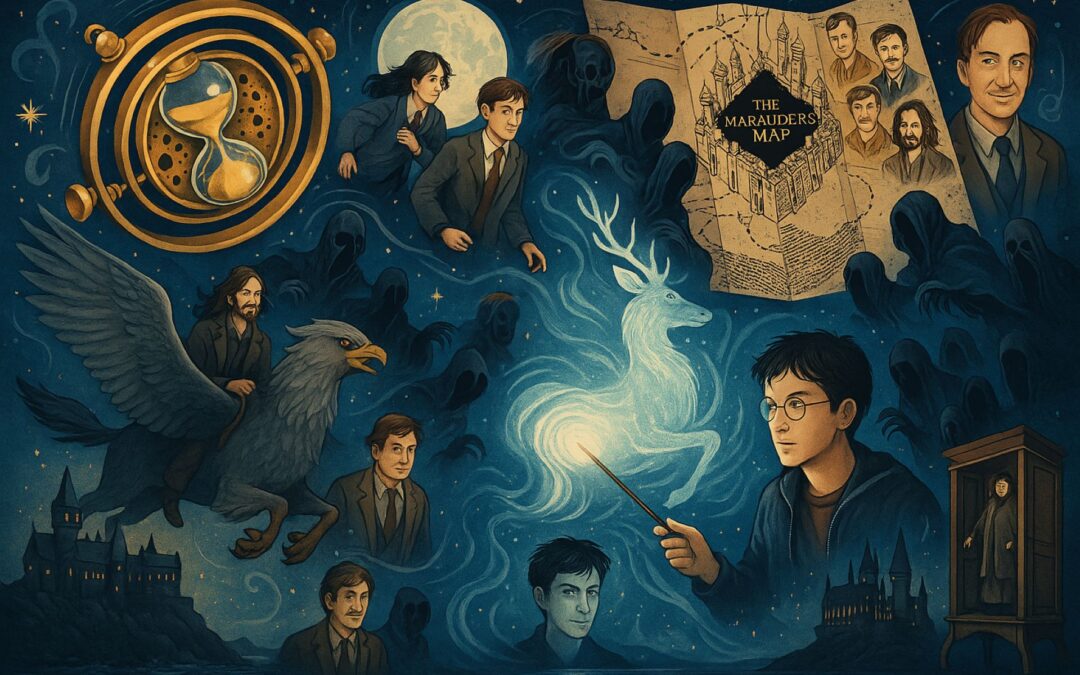
Overview: The Maturing of the Magical World
Harry Potter and the Prisoner of Azkaban is the hinge upon which the series begins to turn from childhood enchantment to moral awakening. The story opens not with triumph, but with tension — Harry, now thirteen, lives between worlds: too old for innocence, too young for certainty. The looming escape of Sirius Black, a notorious prisoner from Azkaban, casts a long shadow over the school year, and for the first time, danger feels intimate — not a distant evil, but something that might be tied to Harry’s very bloodline.
The book transforms Hogwarts from a place of pure wonder into a mirror of growing consciousness. Dementors patrol its grounds, their icy presence drawing out the deepest fears of the soul. Time itself becomes elastic, looping back on moral questions — what we see, what we believe, and what truly is. Beneath the adventure lies a haunting meditation on memory and forgiveness: the understanding that the monsters outside are often less terrifying than the ones within.
It is, above all, a story of perspective — of seeing the same event through different eyes until truth reshapes itself into compassion. In this third chapter, Rowling refines her world into something deeper, subtler, and infinitely more human: a tale about how we remember pain, how we confront it, and how we choose to move forward.
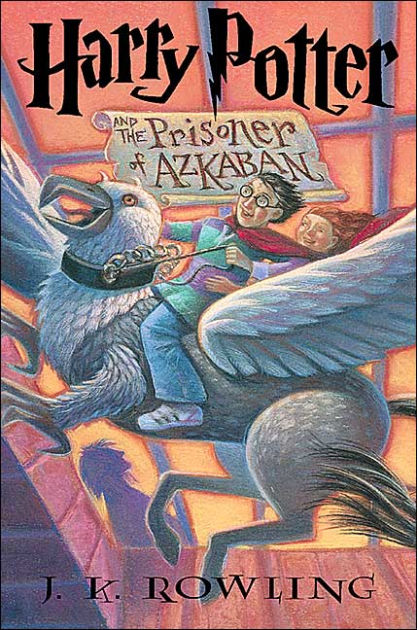
Plot Summary: The Prisoner, the Betrayal, and the Time Reclaimed
The story opens at the threshold of transformation, where Harry’s private world collides with the larger forces of fate. What begins as rebellion against his oppressive guardians unfolds into an encounter with destiny itself — the first time he senses that his struggle is not only against cruelty, but against history’s shadow upon him.
The Flight from Privet Drive
The novel begins under the stifling monotony of summer at Number 4, Privet Drive, where Harry Potter, once again trapped with the Dursleys, feels the ache of isolation more acutely than ever. Now thirteen, he is on the cusp of adolescence — restless, sharp-minded, and increasingly aware of how confined his world is. Cut off from his friends and forbidden to use magic, Harry spends his nights secretly completing homework under the covers and rereading letters from Ron and Hermione, his only connection to the world where he truly belongs.
The fragile peace of this uneasy summer shatters when Aunt Marge, Vernon’s bullying sister, visits. Crude and cruel, she delights in humiliating Harry, prodding at his parents’ memory until her mockery pierces the last of his restraint. When she calls Harry’s father “a useless drunk” and insinuates that his mother was “mad,” his fury boils over — and, for the first time, his magic responds to pure emotion. Aunt Marge inflates like a balloon and drifts away across the ceiling, screaming in horror as Harry storms out of the house, finally breaking free of his domestic prison.
The scene is more than comic relief; it marks a psychological rupture. For the first time, Harry’s rebellion feels personal — not against the Dursleys, but against helplessness itself. The act of running away becomes symbolic of his search for agency in a world that constantly dictates who he is allowed to be.
Out in the darkness, Harry realizes the magnitude of his action. Expulsion seems inevitable; he’s a wizard who has just used uncontrolled magic in front of Muggles. Yet, as he wheels his trunk down the empty street, something catches his eye — two glinting lights, low and watchful, like eyes in the dark. Before he can react, a violent crack splits the night: the arrival of the Knight Bus, a triple-decker purple vehicle that ferries stranded witches and wizards to safety.
Onboard, Harry — calling himself “Neville Longbottom” to conceal his identity — learns about Sirius Black, the escaped Azkaban prisoner who is believed to be hunting him. The bus hurtles through London’s streets in a blur of magic and noise, before depositing him at The Leaky Cauldron, where, surprisingly, the Minister of Magic, Cornelius Fudge, is waiting — not to punish, but to console. Fudge’s peculiar leniency, his insistence that Harry stay put and “keep out of trouble,” hints at deeper fears within the Ministry: that Black’s escape is no ordinary event.
For the rest of the summer, Harry stays at the Leaky Cauldron, savoring his first taste of independence — a brief interlude of warmth and belonging. He meets Ron and Hermione again, shops for school supplies, and even gets his new Firebolt broomstick admired through the shop window. But the sense of normalcy is short-lived. Conversations in hushed tones about Black and the Dementors — Azkaban’s soul-sucking guards — thicken the air with foreboding. Freedom, Harry realizes, always has a shadow.
The Journey to Hogwarts
The transition from the comforting bustle of Diagon Alley to the Hogwarts Express is charged with unease. Harry, Ron, and Hermione board the train with excited chatter, but tension hums beneath the surface. As rain lashes the windows and the countryside blurs past, the trio overhears snippets of fearful talk about Black’s movements. The Wizarding World, once whimsical and absurd, is darkening at the edges.
Midway through the journey, the train halts abruptly. The lights flicker, and cold seeps into the compartments like a creeping mist. A hooded figure — tall, decayed, faceless — appears at the door. A Dementor. The very air freezes as despair floods Harry’s senses. He hears a woman screaming — his mother’s voice — moments before he collapses into unconsciousness.
When he awakens, Professor Remus Lupin, the new Defense Against the Dark Arts teacher, is offering him chocolate — a gesture both practical and profoundly symbolic. The warmth of the chocolate, the quiet compassion of Lupin’s tone, and the contrast to the chill of the Dementor form one of the book’s recurring metaphors: that love, memory, and kindness are the most potent defenses against despair.
The train finally arrives at Hogwarts, but the sense of dread lingers. Dementors now guard the school gates, their presence authorized by the Ministry. Even the fortress of childhood innocence has been breached. Harry’s encounter with these creatures — beings that feed on joy and hope — sets the emotional tone for the year. They become external reflections of his internal struggle: the trauma of his parents’ death, his fear of loss, and the fragility of happiness in a world shadowed by evil.
The first night back is somber. Dumbledore’s warnings are grave, and even the feast feels subdued. Only Lupin, with his worn robes and quiet intelligence, offers comfort — a subtle yet crucial anchor for Harry as the year unfolds.
A Darker Year at Hogwarts
The new term begins under the long shadow of fear. For the first time, Hogwarts feels less like a refuge and more like a fortress under siege. The Dementors, stationed at the school’s boundaries, are meant to protect the students from Sirius Black — yet their presence chills the grounds, sucking warmth and laughter from even the brightest corners. Students whisper of seeing their breath frost in the air, of feeling hopeless for no reason. For Harry, the effect is devastating. Each encounter drags him back into the night of his parents’ murder, forcing him to hear his mother’s final screams.
Still, school life continues — lessons, Quidditch, and friendship — but each is tinged with unease. In Hagrid’s first Care of Magical Creatures class, the half-giant’s enthusiasm gets the better of him when he introduces the students to Hippogriffs, proud and temperamental creatures with the body of a horse and the wings of an eagle. When Draco Malfoy insults one, Buckbeak lashes out, injuring him. Malfoy exaggerates the injury, leading his father, Lucius Malfoy, to press charges. Hagrid, devastated, faces an inquiry before the Committee for the Disposal of Dangerous Creatures — a sign that even within Hogwarts, bureaucracy and politics can overshadow justice.
In Divination, Professor Trelawney foretells Harry’s imminent death, claiming to see “The Grim,” a spectral black dog, in his tea leaves — an omen of doom in wizarding folklore. Harry laughs it off, but the image haunts him. The next time he glimpses the mysterious black dog, it’s standing across the street under a flickering lamppost — silent, watching, as if waiting for him.
The year’s emotional center emerges through Professor Lupin’s Defense Against the Dark Arts classes. Calm, compassionate, and deeply human, Lupin introduces the students to practical magic that blends courage with self-understanding. His lesson on Boggarts — shape-shifting creatures that embody one’s greatest fear — becomes a turning point. Each student faces theirs: spiders, snakes, failing grades. But when Harry steps forward, the Boggart morphs into a Dementor. Lupin intervenes before it overwhelms him, conjuring a silvery moon to repel it.
The symbolism is layered: Harry’s greatest fear is not Voldemort, not death, but the re-experiencing of his trauma — the loss of love. Lupin’s swift action, protecting Harry from his own memories, mirrors a father’s instinct and hints at his hidden bond with Harry’s past.
Beyond the classroom, tension builds. The castle’s safety feels illusory after Sirius Black slips past the guards and slashes the portrait of the Fat Lady, sending the school into lockdown. Rumors multiply — that Black knows secret passages, that he’s been sighted near Gryffindor Tower. Sleep becomes uneasy, and fear takes on a name.
Harry’s emotional turmoil deepens when he overhears that Black betrayed his parents. In the Three Broomsticks, hidden under the table with Ron and Hermione, he listens as Professor McGonagall and Cornelius Fudge recount how Sirius served as the Potters’ Secret Keeper — the one entrusted with their hiding place. He was their friend, their confidant. And it was he who revealed their location to Voldemort.
The revelation shatters Harry. Until now, his rage had been abstract — directed at Voldemort, a distant embodiment of evil. But Sirius’s supposed betrayal makes it personal. The enemy has a face, a history intertwined with his own. From this point on, Harry’s desire for justice transforms into a burning thirst for vengeance.
The Marauder’s Map and the Truth Beneath It
Christmas arrives at Hogwarts draped in snow and melancholy. The castle, though glittering and festive, feels haunted by the fear of betrayal and unseen eyes. In this atmosphere of secrecy, Fred and George Weasley gift Harry the Marauder’s Map — a magical parchment that shows every room, corridor, and secret passage within Hogwarts, as well as the moving footprints of those who walk them. The map’s creators — Moony, Wormtail, Padfoot, and Prongs — remain anonymous to Harry, but its mischief-laden spirit speaks of a different time, one filled with friendship and rebellion.
The map becomes Harry’s silent companion, both a symbol of empowerment and a key to the past. Through it, he sneaks into Hogsmeade, the wizarding village he was forbidden to visit. Amid the cozy shops and snow-covered roofs, he experiences a rare moment of normalcy — until a conversation overheard at the Three Broomsticks dismantles his sense of security.
Hidden under his Invisibility Cloak, Harry listens as Fudge, McGonagall, and Madam Rosmerta discuss Sirius Black. He learns the story as the adults know it: Sirius was James Potter’s best friend, the one chosen to hide the family from Voldemort through the Fidelius Charm. When the Potters were murdered, Sirius was found laughing amidst the wreckage, surrounded by the remains of Peter Pettigrew — another of their friends — and twelve dead Muggles. Harry hears that Pettigrew’s only remnant was a single finger.
This overheard truth corrodes him from within. Rage and betrayal become his companions, entwined with a boy’s yearning for justice. For the first time, Harry feels hatred not toward Voldemort, but toward someone who once loved his parents. The emotional complexity of this hatred — born of grief, confusion, and longing — defines the novel’s darker psychological texture.
Yet the map continues to whisper mysteries. One night, Harry sees Peter Pettigrew’s name on the parchment — alive and moving within the castle. But Pettigrew, supposedly dead, cannot exist. The name flickers, vanishes, returns. The mystery thickens, threading suspicion and disbelief through every moment.
Meanwhile, Hermione’s overextension becomes its own subplot. Her impossible schedule and short temper signal that she is hiding something. Ron grows frustrated, and the tension among the trio foreshadows the inevitable strain that adolescence brings to friendship.
The map, the black dog, the secret passages — each of these threads begins to converge toward one truth: that the past is not finished with Harry, and the ghosts of his parents’ world are about to resurface in flesh and form.
The Patronus and the Shadow of the Past
After the chilling Christmas revelations, Harry’s world becomes more inward — darker, more psychological. He is no longer merely reacting to the external dangers of magic, but wrestling with an inner storm of anger, grief, and fear. The Dementors, stationed around Hogwarts, seem to respond specifically to him; their presence drags him to the edge of despair every time he faces them. When they approach the Quidditch pitch during a crucial match, Harry hears again his mother’s last scream before he faints and plummets from his broom — his beloved Nimbus 2000 splintering beneath the Whomping Willow.
This collapse forces Harry to confront what his fear truly means. It is not cowardice, but memory weaponized. The Dementors feed on joy, leaving their victims with only pain. Harry, whose childhood was marked by death and deprivation, is easy prey. Yet his suffering also becomes the seed of his strength. Seeking help, he turns to Professor Lupin, whose quiet empathy and unassuming wisdom mark him as one of the series’ most human mentors.
In their clandestine lessons, Lupin teaches Harry the Patronus Charm — a spell that conjures a guardian made of one’s purest, happiest memory. For Harry, this is not just magic; it is therapy, a reclamation of agency over trauma. The spell demands more than incantation — it requires emotional mastery, the ability to summon light from the darkest recesses of the mind. Time and again, Harry struggles. The silver mist he produces flickers, fades, collapses under the memory of screams. But Lupin’s patience and belief in him kindle something deeper: the idea that courage is not the absence of fear, but endurance within it.
As the lessons continue, Harry learns that Lupin knew his parents intimately — James and Lily were his friends. Lupin speaks of them not as icons, but as people: flawed, kind, mischievous. Through him, Harry receives the gift he never thought possible — new fragments of his parents, restored not through photographs, but through human memory.
Meanwhile, the shadow of the past stretches into the present in quieter ways. Hermione grows secretive, vanishing from classes and appearing in others simultaneously. Her knowledge grows uncanny, and though she is loyal, her secrecy isolates her. Ron, frustrated by her evasions and preoccupied with Scabbers’s mysterious illness, drifts from her. The trio, once united against the world, begins to fracture. Rowling subtly captures how growing up is not only about facing monsters, but about managing the quiet erosion of trust among friends.
As the school year moves toward spring, the noose tightens around Hagrid’s beloved Buckbeak. Despite appeals and petitions, the Hippogriff is sentenced to execution. The decision epitomizes the world’s moral imbalance — where bureaucratic order outweighs empathy, and fear of danger overrides justice. Hagrid, inconsolable, represents the innocence that the adult world casually crushes in its attempt to feel safe.
In the midst of this gloom, the Dementors seem to close in. During an unexpected Quidditch match, Harry finally manages to produce a fully formed Patronus — a shining stag that charges the Dementors back into the shadows. Though fleeting, this victory marks a profound internal shift. Harry has reclaimed control over the memory that once broke him. Yet the stag’s form — identical to his father’s Animagus — will later reveal a deeper connection than he yet understands.
The lessons with Lupin and the battle with the Dementors together trace Harry’s journey from reaction to creation — from helplessness to mastery. What began as fear now becomes faith: that even in darkness, light is something one can choose to summon.
The Night of Revelations
The story’s many threads converge on a single, storm-laden night — the night when past and present collide. It begins with a series of cascading events: Ron’s rat, Scabbers, reappears after weeks of hiding, gaunt and trembling. Moments later, the enormous black dog Harry has seen throughout the year lunges from the shadows, dragging Ron into the tunnel beneath the Whomping Willow. In pursuit, Harry and Hermione follow, discovering a hidden passage leading to the Shrieking Shack, a building long rumored to be haunted.
Inside, the truth waiting for them is far stranger than ghosts. Sirius Black stands before them — thin, wild-eyed, gaunt from twelve years in Azkaban, but unmistakably alive with purpose. Harry’s rage explodes. Here, finally, is the man he believes murdered his parents. But before he can strike, Professor Lupin bursts in, disarming them all — and to Harry’s astonishment, embracing Sirius like a brother.
The confrontation becomes an unmasking. With the air thick with confusion and betrayal, Lupin and Sirius begin to explain: they were best friends with James Potter, as was Peter Pettigrew, whom everyone believes dead. But Pettigrew is not dead — he is Scabbers.
The moment Ron’s trembling pet is forced into human form, the truth emerges in full horror. Pettigrew, small, cowardly, and sniveling, confesses that he was Voldemort’s true informant, the one who betrayed the Potters’ hiding place. Sirius, falsely accused, hunted Pettigrew down, but Pettigrew framed him for the murder of twelve Muggles before transforming into a rat and disappearing for over a decade.
For twelve years, Sirius has borne the weight of guilt and grief, confined in Azkaban, sustained only by his innocence and his love for Harry. This revelation overturns the world as Harry knows it. His parents’ betrayer is alive, his godfather is innocent, and the narrative of good and evil he has been told is fractured beyond repair.
The scene brims with emotional intensity: anger, relief, pity, and confusion overlap until moral clarity becomes a blur. Harry must decide whether to kill Pettigrew — the man responsible for his parents’ death — or to heed Sirius’s plea for mercy. In that moment, Harry chooses restraint. He insists that Pettigrew be handed to the Dementors alive, believing that his father would not want his friends to become killers. The decision defines Harry’s moral awakening — the understanding that justice cannot be born of vengeance.
But the night’s revelations are not over. As they prepare to bring Pettigrew back to the castle, the full moon rises. Lupin transforms into a werewolf, his control shattering. Chaos descends. Sirius, revealing himself as an Animagus, shifts into a great black dog and wrestles Lupin away from the children. In the confusion, Pettigrew escapes once more, vanishing into the darkness to serve a future master.
Soon after, Dementors swarm the lake where Sirius lies wounded. Harry tries to defend him with a Patronus, but his strength fails. As he collapses, he sees across the water a figure casting an enormous, radiant stag to drive the Dementors away — a figure he believes to be his father. The vision becomes both comfort and mystery, an image of salvation that transcends time.
When Harry awakens in the hospital wing, the truth is buried once more under bureaucracy. Sirius has been recaptured, Pettigrew is gone, and no one believes their story. Yet the past has already shifted. Harry has glimpsed the real nature of betrayal and loyalty — and the cruel simplicity with which the world mistakes one for the other.
Turning Time and Twisting Fate
After the storm of revelations in the Shrieking Shack, the night settles into an uneasy silence. Sirius Black — innocent but condemned — is dragged back to the castle and locked in the highest tower, awaiting the Dementor’s Kiss, a fate worse than death. The weight of injustice presses upon Harry and Hermione like the very air around them; they know the truth, yet the world will not listen. Dumbledore, in his inscrutable calm, visits them in the hospital wing. His words are cryptic but charged with urgency: “You can save more than one innocent life tonight.”
Only then does Hermione reveal her greatest secret — the Time-Turner. For months, she has been using the device, gifted by the Ministry, to attend multiple classes at once by slipping through time. Now, the same tool of overachievement becomes an instrument of destiny. With Dumbledore’s quiet blessing, the two set the chain spinning, and time folds in on itself.
The castle rewinds. Shadows move backward, voices un-speak themselves, the clock strikes again. Hermione and Harry find themselves standing outside their own past — witnesses to an evening they have already lived, now seen from the opposite side of fate.
This sequence is one of Rowling’s most intricate and poetic achievements: a literalization of reflection. Time travel here is not a trick of science fiction but a moral device, showing that sometimes salvation lies not in changing the past but in understanding it differently.
From the cover of darkness, they watch their earlier selves flee into the night. They see Hagrid’s hut moments before the executioner’s axe falls — and realize they can still save Buckbeak, whose death marked the triumph of fear over fairness. Working silently, they free the creature, hiding it deep within the forest. The Hippogriff’s wings spread like a symbol of hope resurrected, defying both death and decree.
But their mission is not complete. As the hours repeat, they reach the lake where the Dementors attacked Harry and Sirius. The sight is almost unbearable: their past selves writhing on the ground, the hooded Dementors closing in. Across the water, Harry waits for the mysterious figure who once appeared to save them — his father, he believes. Yet no one comes. In that moment of revelation, Harry understands: it was never his father at all. It was himself.
Stepping forward, he raises his wand. Fueled by the memory of his parents’ love and his own growing courage, he conjures a fully formed Patronus — a magnificent silver stag, radiant and alive, charging across the darkness. It is not merely magic; it is self-knowledge made visible. The scene embodies the novel’s central truth: that the strength we seek in others often already resides within us.
Their final task is to save Sirius. They race to the tower where he awaits his execution. Buckbeak is waiting, trembling but ready. As the clock ticks toward midnight, Sirius mounts the Hippogriff and meets Harry’s eyes — godfather and godson, bound by loss and redemption. Their exchange is brief but eternal: a promise of belonging restored, if only for a moment. Then, with one last look, Sirius and Buckbeak rise into the night sky, the moon casting silver light over their flight — the purest image of liberation in the series so far.
When time corrects itself, dawn spills over Hogwarts. The world believes the official story — that Sirius escaped once again — and Pettigrew remains unpunished. But Harry’s heart is lighter. He has seen how courage, compassion, and even time itself can bend toward mercy.
Aftermath and Reflection
The following days are heavy with contradiction. Justice has not been served, yet truth has found its witnesses. Lupin, exposed as a werewolf, resigns from his post to avoid scandal. His departure leaves an ache in Harry deeper than he expected. The quiet understanding between them — that of a boy searching for his father and a man haunted by a friend — dissolves with the morning light. In Lupin’s absence, Harry realizes that mentorship, like love, is transient but transformative: it leaves behind strength.
Sirius’s name remains tarnished, but he manages to send Harry a letter via owl, carried by the very Hippogriff they freed. The letter, written in a trembling hand, is part apology, part benediction. Sirius offers Harry a place to live, a home beyond the Dursleys — a glimpse of the family that fate had long denied him. Though Harry cannot accept yet, the gesture fills him with a sense of belonging that no spell could conjure.
The school year concludes under an uneasy peace. The students chatter about Sirius’s escape and the Minister’s embarrassment; life, as it always does, flows on. Yet something within Harry has irrevocably changed. He no longer sees the world in absolutes of good and evil. He has looked into the face of supposed monsters and found humanity, and into the hearts of men and found cowardice disguised as innocence.
On the train back to London, the world outside blurs into green and gold. Harry receives one final gift from Sirius — permission for Ron to keep the owl, and a promise that one day, when the truth comes to light, they will meet again as family, not fugitives.
The return to Privet Drive feels different this time. The boy who once fled that house in fear now carries with him the memory of triumph — not victory over an enemy, but mastery over himself. He has faced his past, rewritten it with compassion, and learned that power does not lie in erasing pain, but in transforming it.
The year’s final image — Harry standing in sunlight, the echo of the Patronus still within him — captures the novel’s essence: the passage from innocence to understanding. The Prisoner of Azkaban ends not in finality but in awakening. The shadows remain, but now Harry knows they can be illuminated from within.
Character Analysis: Faces of Loyalty, Fear, and Betrayal
Each character in The Prisoner of Azkaban mirrors a fragment of moral truth, shaping the emotional mosaic of Rowling’s world. Their loyalties are tested, their fears exposed, their choices sharpened by consequence. Through them, we see that courage is never pure — it is born from conflict, from the human need to protect what one loves.
Harry Potter: Between Fear and Freedom
In The Prisoner of Azkaban, Harry begins to outgrow the innocence of childhood and step into the moral complexity of adolescence. He is no longer the wide-eyed boy discovering magic, but a young man confronting the emotional and ethical weight of his own history. His encounters with the Dementors become metaphors for trauma — they force him to relive his mother’s dying scream, to face the raw memory of loss without the veil of fantasy. For the first time, Harry’s greatest battles are internal.
Throughout the story, Harry wrestles with anger — toward Sirius, toward fate, and even toward himself. The overheard truth about his parents’ betrayal ignites a desire for vengeance that nearly consumes him. Yet by the novel’s end, Harry chooses mercy. He spares Pettigrew’s life, even though every part of him yearns for retribution. This act marks a crucial turning point in his character: compassion over cruelty, restraint over rage.
In summoning his Patronus, Harry achieves a symbolic rebirth. The stag — his father’s Animagus form — represents not only lineage but continuity: Harry becoming the protector his parents once were. His triumph is not in defeating an enemy, but in mastering himself. By learning that the savior he awaited was his own reflection, Harry begins to understand the paradox of growth — that the child waiting for rescue must become the one who rescues.
Hermione Granger: The Burden of Perfection
Hermione’s arc in this story transforms her from the series’ archetypal know-it-all into a symbol of control stretched to its breaking point. Her use of the Time-Turner embodies her defining trait: the relentless pursuit of mastery. She believes that diligence can outpace destiny, that with enough work, she can be everywhere, know everything, fix every wrong. But time itself — the very thing she tries to dominate — becomes her teacher.
The strain of her impossible schedule, her isolation, and her conflicts with Ron all underscore the limits of intellect when untempered by emotional wisdom. Her final act — using the Time-Turner not to get ahead but to undo harm — signals growth. She learns that knowledge finds its highest form not in achievement, but in compassion. In saving Buckbeak and Sirius, she transforms from student to moral agent.
Ron Weasley: Loyalty in the Shadows
Ron continues to serve as Harry’s emotional ballast — flawed, loyal, and impulsive. His friendship is often comic on the surface, but his courage reveals itself in moments of crisis. His confrontation with Sirius in the Shrieking Shack — standing on a broken leg, refusing to abandon his friends — defines his essence.
Through Scabbers, Ron becomes unwittingly entangled in the sins of the past. His pet rat, long taken for granted, is the physical embodiment of deceit hiding in plain sight. When Scabbers is revealed to be Pettigrew, Ron’s sense of betrayal mirrors Harry’s on a smaller, more intimate scale. His faith in the ordinary world — in pets, people, and friendship — is tested, but not broken.
Remus Lupin: The Teacher as Redeemer
Professor Lupin stands as the book’s moral center — a man whose gentleness masks immense suffering. A werewolf and an outcast, he embodies the tension between human frailty and moral strength. Unlike the grandiose teachers of earlier books, Lupin teaches Harry not through power but through empathy. He recognizes trauma not as weakness but as a place of transformation.
His mentorship gives Harry something he’s never had: an adult who sees him, not as “the Boy Who Lived,” but as a boy learning to live. Lupin’s lessons about the Patronus are lessons in self-possession — that light can be summoned from within, not borrowed from others. His quiet resignation at the end of the story, accepting exile with dignity, reinforces his belief that goodness sometimes means retreat, not recognition.
Sirius Black: The Wrongly Condemned
Sirius’s presence haunts the novel long before he appears. His name, whispered in fear, becomes a symbol of the unknown and the misunderstood. When he finally emerges from the shadows, his complexity is staggering. He is both feral and fiercely loyal, shaped by twelve years of imprisonment and injustice. His friendship with James Potter — and his willingness to die for that bond — defines the moral heart of the story.
Through Sirius, Rowling examines the fragility of reputation and the ease with which society labels a man “monster.” He is the mirror opposite of Pettigrew: wrongly condemned rather than falsely exalted. For Harry, Sirius is more than a godfather — he is the embodiment of the family that was stolen from him. Their brief union gives Harry something deeper than freedom: a sense of belonging rooted in shared memory and mutual love.
Peter Pettigrew: Cowardice as Corruption
If Voldemort represents evil in its purest, most deliberate form, Pettigrew represents the evil of weakness — the kind born not from malice but from moral decay. His betrayal of the Potters was not ideological but instinctual: the survival reflex of a coward who values his life above all else. Disguised for years as Scabbers, he lives unnoticed, the embodiment of guilt camouflaged by banality.
His reappearance shatters the binary of good and evil. Pettigrew’s villainy is small, pathetic, and deeply human — and therefore all the more chilling. His escape ensures that betrayal, once unleashed, continues to echo through the future, poisoning the innocence of loyalty itself.
Albus Dumbledore: The Architect of Wisdom
Though he remains in the background for much of the story, Dumbledore’s influence permeates every turning point. His cryptic interventions — his trust in Harry and Hermione to rewrite time — show his understanding that moral growth cannot be handed down; it must be lived. He remains the quiet conductor of fate, allowing chaos to unfold so that meaning can emerge.
His guiding principle, as seen here, is not control but trust. He knows that the young must make their own mistakes, must arrive at truth through struggle. His belief in the goodness of those the world condemns — from Lupin to Sirius — reveals his radical empathy, his willingness to see light even in shadow.
Themes and Motifs: Time, Truth, and the Illusion of Evil
Beneath the novel’s spells and suspense runs a web of interconnected themes — questions about destiny, justice, and the ways time reshapes understanding. Rowling uses fantasy not to escape reality, but to expose it: how perception distorts truth, how memory preserves pain, and how redemption often arrives disguised as second chances.
The Fluidity of Time
Time in The Prisoner of Azkaban is not merely a setting but a character — mutable, circular, and moral. Rowling turns it into both a puzzle and a parable. Through Hermione’s Time-Turner and Harry’s temporal self-rescue, the novel suggests that the past is never fixed; it can be revisited, reinterpreted, even redeemed. Yet it also warns that altering time’s course is not about rewriting events, but re-seeing them.
This notion transforms the traditional hero’s journey. Instead of conquering an enemy or discovering a secret, Harry must return to a moment of fear and face it from a new angle. He learns that salvation lies not in external intervention — a father figure appearing across the lake — but in realizing that he was the one holding the wand all along. The act of summoning the Patronus becomes a metaphor for reclaiming authorship over one’s own history.
Time here is elastic but ethical. It bends not for power, but for mercy — to free Buckbeak and Sirius, to correct injustice without violence. The story teaches that understanding, not dominance, is the proper use of power. The past cannot be erased, but it can be healed by acts of courage and compassion in the present.
Truth and the Fracturing of Certainty
If The Sorcerer’s Stone was about discovery and The Chamber of Secrets about identity, The Prisoner of Azkaban is about truth — its layers, distortions, and moral weight. Every revelation in the book — from Sirius’s innocence to Pettigrew’s deceit — unravels what seemed absolute. Good and evil cease to be binary; loyalty and betrayal blur into one another.
This instability mirrors adolescence itself — the moment when moral absolutes begin to crumble and the world’s contradictions reveal themselves. Harry’s perception of his parents, once idealized, grows more complex as he learns of their friendships and flaws. Lupin, a werewolf, is kind and wise. Sirius, branded a murderer, is a man of honor. Pettigrew, meek and pitiable, is a monster. Truth becomes an act of discernment, not obedience.
Rowling’s handling of revelation is psychological as much as narrative. The truth is not a comfort; it wounds before it heals. In learning who betrayed his parents, Harry loses innocence but gains insight — the first step toward moral maturity.
The Illusion of Evil
The book dismantles the simplistic image of evil as something monstrous or easily identifiable. Sirius Black, once the face of terror, becomes a victim of collective fear. The Dementors, supposedly agents of justice, are embodiments of cruelty sanctioned by law. Even Lupin, gentle and loyal, is shunned for his condition.
Through these reversals, Rowling critiques society’s tendency to equate difference with danger. The true evil is not always in the villain, but in the institutions that enforce blindness — the Ministry of Magic, the media, and even Hogwarts itself. Evil, in this world, often wears the mask of order.
Meanwhile, the Dementors’ hunger for happiness represents the quiet, pervasive kind of evil that feeds on despair — an allegory for depression, trauma, or institutional oppression. They do not destroy by violence, but by draining the will to live. In that sense, the Patronus Charm is not just a spell but a philosophy: that light must be actively summoned against darkness, not passively awaited.
Friendship, Loyalty, and the Ghosts of the Past
At the novel’s heart lies friendship — both the rekindling of old bonds and the testing of new ones. The story of the Marauders (James, Sirius, Lupin, and Pettigrew) parallels that of Harry, Ron, and Hermione: a reminder that friendships too can fracture under fear. Pettigrew’s betrayal becomes the cautionary mirror image of the trio’s loyalty. Where Pettigrew preserved himself at the expense of others, Harry risks himself to save those he loves.
Loyalty in Rowling’s world is not blind allegiance but a moral stance. It means standing beside what is right even when truth is unpopular, as Hermione and Harry do when they defy the Ministry to save Sirius. Each act of friendship in the novel is tested by secrecy, fear, or authority — and strengthened by resistance.
The ghosts of the past — literal and emotional — haunt every friendship. Yet they also offer a blueprint for redemption: that broken bonds can be mended through understanding, and that the sins of the fathers need not be repeated by the sons.
The Passage from Innocence to Awareness
Perhaps the most profound theme of all is the coming of age itself — the slow, painful awakening from a world of simplicity into one of ambiguity. In earlier books, Hogwarts was a place of wonder. Here, it becomes a site of reckoning. The magic remains, but it now coexists with consequence.
Harry learns that adults can be wrong, that justice can fail, and that safety is a fragile illusion. His childhood belief in rescue — in Dumbledore’s wisdom or his father’s memory — gives way to the realization that the burden of action falls to him. The story ends not in triumph, but in understanding.
It is this moral awakening — not victory or vengeance — that defines the novel’s tone. The Prisoner of Azkaban is not about the defeat of evil, but about seeing it clearly. It is about light meeting shadow and recognizing both as parts of the same truth.
Setting and Atmosphere: Darkness Descends upon Hogwarts
Hogwarts, once radiant with childhood magic, becomes a landscape of shadowed corridors and uneasy silences. The familiar castle, with its portraits and towers, feels changed — more alive, more watchful. As fear enters its gates, the school transforms into a mirror of its students’ inner weather: innocence dimming under the approach of consequence.
A Shift in the Air
From its opening pages, The Prisoner of Azkaban signals a transformation in tone. Gone are the purely whimsical enchantments of the earlier books — the floating candles and feasts of color. The magic here is colder, quieter, threaded with foreboding. The book begins not in Diagon Alley’s glittering streets or Hogwarts’ sunlit halls, but in darkness: an ordinary suburban night disrupted by flight, fear, and freedom. This tonal change mirrors Harry’s growing consciousness — his move from innocence to awareness.
The world outside Hogwarts grows larger and more threatening. The introduction of Azkaban — a prison guarded by creatures that feed on hope — adds a new moral dimension to the wizarding world. It is not simply a place of wonder anymore; it is a society with punishment, injustice, and institutional cruelty. The very idea of Dementors stationed at a school feels wrong, and Rowling plays with that dissonance: Hogwarts, once a symbol of safety, is now permeated by chill and dread.
The Haunted Sanctuary
Within Hogwarts, atmosphere and emotion are inseparable. The school itself seems to shift with the students’ moods — corridors growing colder as Dementors linger nearby, the Great Hall echoing more solemnly during announcements of danger. Even the colors feel different: less gold, more gray; fewer sparks of laughter, more shadows around the edges.
At the same time, Hogwarts retains its living, breathing complexity. Its secret passages, whispering portraits, and moving staircases create a paradox — a world that hides as much as it reveals. The Marauder’s Map becomes a metaphor for the castle itself: a place of invisible histories, secrets embedded within its stones. Each hidden corridor echoes with the ghosts of the past — James, Sirius, Lupin, and Pettigrew — whose youthful mischief once animated the school and whose choices now cast long shadows over it.
This duality — wonder intertwined with melancholy — defines the novel’s mood. The reader feels both awe and anxiety, the thrill of discovery balanced by the weight of loss. Hogwarts has grown up alongside Harry, and its magic has matured into something closer to truth.
Weather as Emotion
Rowling uses weather and season as emotional barometers. The persistent chill of the Dementors freezes not just the air but the soul of the story. Rain lashes against the windows of the Gryffindor Tower; mist curls around the Quidditch pitch; even sunlight, when it appears, feels fragile, momentary. Each meteorological detail reflects the characters’ inner states — isolation, fear, and fleeting warmth.
The snow at Christmas offers temporary reprieve, a kind of suspended stillness. The Great Hall glitters with frost and cheer, yet beneath it all lies the tension of secrets unspoken. By spring, as time twists and converges in the climactic chapters, the atmosphere grows charged — winds rising, skies turning to silver, and nature itself seeming to echo the moral storm about to unfold.
The external world here is not backdrop but mirror. The landscape breathes with intention: the Forbidden Forest, both menacing and redemptive; the Whomping Willow, a sentinel guarding the truth; and the Black Lake, reflective and deep, becomes the stage for revelation.
The Encroaching Realism of Fear
For the first time in the series, Rowling roots magic in realism. The Dementors are not abstract monsters but tangible representations of depression and anxiety. Their power to drain happiness, to make one relive the worst moments of their life, captures the essence of psychological fear — a fear that cannot be fought with courage alone, but with understanding and emotional endurance.
The Azkaban motif adds to this realism. The fortress, distant yet omnipresent, embodies state-sanctioned terror: an institution that maintains order through despair. The wizarding world is revealed as morally fallible — a society capable of injustice even in pursuit of safety. In contrast, the beauty of Hogwarts — the floating candles, the enchanted ceilings, the comforting bustle — feels increasingly fragile, as though light itself is an act of defiance.
The Interplay of Light and Shadow
Ultimately, the novel’s setting is constructed from contrasts. Light and shadow coexist, neither conquering the other. The Quidditch pitch, bathed in sunlight one moment, becomes a stage for terror the next as Dementors descend. The hospital wing, a place of healing, becomes the site of moral reckoning. Even time itself — moving forward and backward, layering events over one another — is rendered as part of the landscape.
Hogwarts, by the end of this book, is no longer merely a school. It has become a microcosm of the human psyche — a place where innocence collides with knowledge, where joy and fear share the same corridors. The atmosphere of The Prisoner of Azkaban thus signals the beginning of a new kind of magic: not the external wonder of spells, but the internal alchemy of growing up.
Tone and Style: A Bridge Between Childhood and Courage
The rhythm of Rowling’s storytelling deepens here, evolving from buoyant adventure into something textured and contemplative. Humor still flickers through the dialogue, yet beneath it runs melancholy, a quiet awareness of mortality. The language matures alongside Harry himself — expressive, deliberate, no longer in awe of magic, but in conversation with it.
The Evolution of Voice
In The Prisoner of Azkaban, Rowling’s tone matures alongside her protagonist. The language remains accessible, yet it carries a new weight — sentences stretch longer, imagery grows more textured, and the humor that once defined the series gives way to melancholy and introspection. The narrative voice, once content to marvel at the wonders of magic, now lingers in moments of quiet uncertainty.
The result is a tonal bridge between children’s fantasy and moral literature. The story retains the charm of its predecessors — jokes about homework, enchanted sweets, mischievous ghosts — but threads through them an undercurrent of emotional realism. The balance between levity and darkness is delicate: laughter breaks tension, but never erases it. Even moments of comic relief — such as the antics of the Knight Bus or Professor Trelawney’s absurd predictions — serve to amplify the fear that lingers beyond them.
Rowling’s style here signals the first step into literary adolescence: a mixture of wonder and disillusionment. She begins to use silence, pacing, and tone as tools of psychological storytelling. Scenes slow down when Harry listens to the echoes of his mother’s scream; they quicken during chaos but never lose emotional clarity. The rhythm of her prose mirrors the push and pull between courage and fear.
Cinematic Darkness
Compared to the warmth of The Sorcerer’s Stone or the mythic adventure of The Chamber of Secrets, this book feels like a shift from daylight into twilight. The imagery grows starker, more cinematic — wind howling across the castle, torches guttering in cold corridors, the silvery glow of the Patronus illuminating darkness. Each image captures a world still magical, yet burdened with reality.
The use of light as motif becomes central to Rowling’s style. The Patronus, for instance, is described not simply as a defensive spell but as an embodiment of hope — light made conscious. Its silvery luminescence cuts through not just physical dark but emotional paralysis. Rowling’s description of the Patronus radiating like moonlight across the lake remains one of the series’ most haunting visual moments, blending mythic symbolism with cinematic precision.
Dialogue, too, deepens in tone. Conversations between Harry and Lupin hum with quiet gravity; Dumbledore’s words now carry moral weight rather than mystery. Even the humor becomes layered — tinged with irony, self-awareness, or bittersweetness. This tonal complexity marks Rowling’s growing command of her narrative universe.
The Shift in Emotional Register
Emotion in this book is less about triumph and more about transformation. Rowling’s prose lingers on internal states — fear, guilt, longing — giving psychological depth to her characters without losing the immediacy of plot. When Harry produces his first Patronus, it is not a victory of technique but of spirit. When he spares Pettigrew, it is not naivety but moral choice.
This subtlety infuses the story with maturity. The magic no longer dazzles for its own sake; it now reveals emotional truth. Every spell becomes symbolic — the Dementor’s Kiss as the annihilation of the soul, the Time-Turner as the loop between trauma and healing, the Patronus as the manifestation of love as protection. Rowling’s writing becomes metaphorical, gently shifting the reader’s focus from what happens to what it means.
A Narrative Between Worlds
Stylistically, The Prisoner of Azkaban is written as a hinge — poised between the fable-like structure of the first two books and the epic gravitas of what will follow. The pacing reflects this in-betweenness: brisk yet reflective, suspenseful yet meditative. The alternating rhythms of action and contemplation mirror Harry’s psychological journey — moments of flight punctuated by stillness, bursts of revelation followed by silence.
Rowling begins to trust her readers more here. She withholds explanations, leaves moral questions open-ended, and allows ambiguity to stand. This confidence in subtlety elevates the narrative from entertainment to reflection.
The Tone of Becoming
Ultimately, the tone of The Prisoner of Azkaban is one of becoming — not triumph, but emergence. Rowling captures the texture of adolescence: its mixture of fear and exhilaration, anger and empathy. The writing oscillates between the brisk clarity of adventure and the soft ache of remembrance.
The book closes not with finality but with resonance — a quiet, hopeful uncertainty. Sirius’s flight into the night, Harry’s faint smile as he reads the letter, the lingering echo of the stag — all convey a tone that is neither victory nor loss, but growth.
This tonal transformation — from wonder to wisdom — is what makes The Prisoner of Azkaban the emotional turning point of the series. It teaches that courage is not found in defeating darkness but in walking through it, carrying one’s own light.
Symbolism and Imagery: Mirrors, Moons, and Time-Turners
The symbols that thread through this story are not decorative; they are the language of its soul. Mirrors, moons, and shifting shadows reveal how identity fractures and reforms under pressure. Each image becomes an act of revelation — an invitation for both Harry and the reader to see truth reflected in the shimmer of myth.
The Mirror of the Self
At the heart of The Prisoner of Azkaban lies a recurring motif of reflection — both literal and psychological. The novel’s structure itself mirrors this theme: events replayed, moments repeated, perspectives reversed. Time folds back on itself, allowing Harry to view his own actions as if from a mirror. The act of saving himself with the Patronus is not simply an event of temporal paradox; it is the symbolic moment of recognition.
When Harry believes he sees his father casting the Patronus, he is really witnessing the person he will become. The scene embodies the book’s spiritual revelation — that identity is not inherited, but realized. The mirror does not show him who he was, but who he is capable of being. In this, Rowling transforms time travel into a profound psychological metaphor: growth as self-recognition across the boundaries of time.
The Moon and the Monster
The moon, omnipresent throughout the novel, governs both the physical transformation of Lupin and the thematic transformation of the story’s tone. Under its pale light, truth reveals itself — sometimes mercifully, sometimes cruelly. The full moon, which triggers Lupin’s metamorphosis into a werewolf, becomes a symbol of suppressed nature and the struggle for self-control.
Lupin’s curse, hidden from society, mirrors the stigma of all those considered “other.” The moon’s cycles remind us that transformation is part of existence — that humanity contains both light and shadow, discipline and instinct. His condition redefines monstrosity not as moral corruption, but as suffering misread by fear. The moon thus becomes a dual image: illumination and exposure, enlightenment and vulnerability.
The Time-Turner: Circular Redemption
The Time-Turner stands as the book’s central symbol — a small, delicate device capable of bending destiny. Yet its magic is not one of dominance, but of humility. It does not change the past so much as allow characters to understand it differently. Hermione’s use of it for academic overachievement — to be in two places at once, to know everything — evolves into its truer purpose: to serve compassion rather than control.
When she and Harry use the Time-Turner to save Buckbeak and Sirius, the act becomes a moral inversion of Pettigrew’s betrayal. Time, once the stage of tragedy, becomes the tool of mercy. The device thus symbolizes the possibility of ethical time — that moral insight can retroactively heal what fear or ignorance once destroyed.
Its circular shape also echoes the novel’s structure: cause and effect, action and understanding, forming a closed loop. What appears as repetition becomes revelation. The Time-Turner shows that wisdom often comes not from changing events, but from perceiving them anew.
The Dementors: Shadows of the Soul
The Dementors are among Rowling’s most powerful symbols — embodiments of depression, trauma, and the loss of inner warmth. They represent fear not as aggression, but as absence — the void left when joy and memory are drained away. Their kiss, which consumes the soul, is a literalization of despair: a life lived without meaning.
Harry’s particular vulnerability to them speaks to his emotional depth, not his weakness. The Patronus he learns to conjure becomes the antithesis of the Dementor — a manifestation of light, memory, and love. Together they form the novel’s moral binary: darkness as absence versus light as presence. The contrast is existential rather than moral — despair cannot be destroyed, only dispelled.
Through this imagery, Rowling creates a psychological realism that resonates beyond fantasy. The Dementors are not monsters to be slain, but metaphors to be understood — the inner terrors that one must learn to face rather than flee.
The Patronus: Memory as Salvation
The Patronus embodies the book’s emotional and philosophical center. It is not powered by anger or bravery but by remembrance of joy. The spell insists that protection begins with recollection — that the memories which sustain us become shields against the darkness within and around us.
Harry’s Patronus takes the form of a stag, a creature of nobility, grace, and guardianship. Its identity as his father’s Animagus form ties it to lineage, yet it also symbolizes renewal. In Celtic mythology, the stag is a guide between worlds — life and death, light and shadow. In conjuring it, Harry does not simply invoke his father’s memory; he resurrects his presence within himself.
This moment of conjuration is more than magical triumph — it is spiritual inheritance. Harry learns that to remember love is to embody it, and to embody it is to become it. The Patronus thus transcends magic to become philosophy: the belief that light, once remembered, can never be extinguished.
The Black Dog: Omens and Misjudgment
The Grim, seen by Trelawney and feared by Harry, epitomizes the novel’s meditation on illusion. What everyone believes to be a death omen — the spectral black dog — turns out to be Sirius himself, a protector misinterpreted as a predator. This reversal encapsulates Rowling’s critique of superstition and surface judgment.
The black dog’s duality — omen and ally — mirrors the book’s moral inversion: that fear distorts truth. It reminds readers that what we dread most often hides what we need most. Sirius, mistaken for a murderer, becomes Harry’s only true guardian. The image of the Grim thus transforms from symbol of death into symbol of deliverance.
Hogwarts and the Map: The Living Past
Even the Marauder’s Map becomes an image of symbolic depth — a literal map of memory. Created by four friends whose fates diverged into loyalty, betrayal, and loss, the map stands as both relic and warning. It shows that the past never lies still; the footsteps of its makers continue to move through the present.
When Harry uses it, he unknowingly walks through the traces of his father and his father’s friends, their mischief echoing beneath his own. The map is not simply a magical object but a palimpsest of legacy — the invisible writing of those who came before, guiding and haunting in equal measure.
Light and Shadow Intertwined
Ultimately, the imagery of The Prisoner of Azkaban rests on dualities: light and darkness, fear and faith, time and memory. Rowling’s use of these symbols matures the series beyond the realm of fairy tale. Every image — from the gleam of the Patronus to the gloom of Azkaban — becomes a reflection of moral reality: that darkness exists not to terrify, but to teach the meaning of light.
Moral and Philosophical Reflection: The Nature of Fear and Freedom
Once the adventure’s dust settles, what remains are questions — quiet, persistent, and moral. Rowling shifts her gaze inward, examining the unseen forces that drive choice: fear’s ability to distort perception, freedom’s cost, and the fine line between justice and vengeance. It is here that her story transcends fantasy and enters philosophy.
The Ethics of Fear
At its moral core, The Prisoner of Azkaban is an inquiry into the uses and misuses of fear. Every major force in the story — from the Dementors to the Ministry of Magic — operates through fear’s machinery. The Dementors enforce obedience by consuming joy; the Ministry controls the public by inflating threats; even the students at Hogwarts internalize dread, whispering myths and accepting falsehoods as truth.
Rowling’s philosophical insight lies in her refusal to depict fear as simply the opposite of courage. Instead, she shows it as a form of blindness — a distortion that reshapes perception. When Harry first believes Sirius Black to be his parents’ murderer, his rage is inseparable from fear: fear of betrayal, fear of abandonment, fear that love itself can turn against him. It is only when he sees through fear — when he recognizes the man behind the myth — that truth becomes visible.
This is the moral turning point of the novel: the realization that fear clouds understanding, while empathy clarifies it. Rowling suggests that courage is not the absence of fear, but the ability to act with compassion despite it. The true victory of the story is not over darkness, but over the distortions that darkness creates in the mind.
Freedom and Its Burdens
Freedom in this book is fragile and paradoxical. Sirius Black — the titular “prisoner” — is both a fugitive and the freest soul Harry meets. His physical captivity in Azkaban mirrors Harry’s emotional confinement within his trauma. Both are prisoners of memory, bound by events that defined them.
Sirius’s escape, then, is symbolic rather than literal: he represents the possibility of liberation through truth. When Harry helps him fly to freedom on Buckbeak’s back, the act transcends rescue — it is the release of the unjustly condemned, the redemption of misjudgment. Freedom here is not achieved by defying rules, but by restoring moral balance.
Yet Rowling resists romanticizing freedom. Each liberated figure pays a price. Sirius must live as a fugitive; Lupin must withdraw from the safety of Hogwarts; even Buckbeak’s flight is exile disguised as triumph. Freedom, the novel suggests, demands solitude and sacrifice. It is the choice to live by conscience rather than comfort.
The Nature of Justice
Justice, as portrayed in The Prisoner of Azkaban, is deeply flawed. The wizarding world’s institutions — courts, prisons, newspapers — are revealed as reactive, fearful, and often cruel. Sirius is condemned without trial; Buckbeak’s death sentence is driven by politics; Lupin is ostracized for his condition. Rowling exposes the rot in systems built on the illusion of order.
Dumbledore stands apart as the moral counterpoint. His quiet faith in individuals over institutions defines the story’s ethical axis. He entrusts Hermione and Harry with the Time-Turner, not because of hierarchy or legality, but because of their capacity for discernment. In this, Rowling articulates a philosophy of personal justice — that righteousness is not decreed by authority but enacted through compassion.
The story’s moral triumph, then, is not that the guilty are punished — for Pettigrew escapes and Sirius remains hunted — but that truth, once known, cannot be erased. The moral act is the recognition itself: to see clearly in a world that rewards blindness.
Love as Resistance
Amid fear, memory, and injustice, love remains the book’s quiet insurgency. It is neither sentimental nor safe. Harry’s love for his parents, Lupin’s loyalty to his lost friends, Hermione’s compassion for the innocent — all are forms of defiance. The Patronus, born from love, is the physical manifestation of this principle: light created not by aggression, but by remembrance.
Rowling suggests that love does not shield one from darkness; it gives the strength to endure it. The memories that feed Harry’s Patronus — laughter, belonging, hope — are not distractions from pain but its antidotes. The spell’s philosophy becomes clear: the only true protection against despair is to hold fast to the moments that gave life meaning.
The Illusion of Evil and the Redemption of Vision
Perhaps the novel’s deepest moral insight lies in its dismantling of evil as a fixed category. No one is wholly monster or saint. Lupin is a werewolf, yet gentle; Sirius is branded a murderer, yet innocent; Pettigrew is cowardly, yet pitiable. Even the Dementors, as embodiments of horror, act without malice — they are instruments of a world that has normalized fear.
This reframing aligns the book with a larger philosophical tradition — that evil often begins as misunderstanding, as a failure to see others in their full humanity. In revealing Sirius’s innocence, Rowling stages a moral revelation that doubles as a metaphysical one: that truth is not discovered, but uncovered, through empathy.
The novel therefore asks its readers — and its young hero — to look again: at what they fear, what they judge, and what they call “monstrous.” The redemption of vision, the restoration of clarity, becomes the book’s final philosophical act.
Becoming One’s Own Light
By the end, Harry no longer seeks salvation from others. The figure he believed to be his father across the lake was, in truth, his own reflection — his future self, his inner strength. This realization captures the novel’s moral philosophy: that self-knowledge is the highest form of courage, and that illumination comes from within.
The Prisoner of Azkaban is thus not a tale of good defeating evil, but of fear transmuted into wisdom. It affirms that darkness exists not to crush us, but to teach us to kindle our own light — a lesson as ancient as myth and as human as memory.
Author and Context: Rowling’s Turning Point in the Saga
When Harry Potter and the Prisoner of Azkaban was published in 1999, J.K. Rowling had already become a global name. Yet this third installment marked a striking evolution — both in her craft and her philosophical vision. The first two books had introduced readers to the allure of the wizarding world: its whimsy, its rules, its sense of belonging. With this volume, Rowling stepped deliberately into deeper, more introspective territory.
This was the moment her writing matured — not in language alone, but in moral intention. She shifted from storytelling as enchantment to storytelling as awakening. Themes of justice, trauma, and psychological fear replaced the innocence of discovery. It was also the first book in which she explored ambiguity in earnest: where good and evil could no longer be neatly divided, and characters carried the weight of contradiction.
The influence of Rowling’s own life is quietly woven into the novel’s tone. Her experiences as a single mother, writing in cafés between jobs, informed her understanding of isolation, resilience, and hope — emotions that pulse beneath Harry’s story. The Dementors, she has often said, were inspired by her own encounter with depression: creatures that drain joy and warmth until one is left hollow. This gives the book’s darkness a rare authenticity. It is not darkness for drama’s sake, but for truth’s.
The Prisoner of Azkaban also marked a turning point in Rowling’s literary style. The structure grew more sophisticated, the subplots more elegantly braided. Time travel — notoriously difficult to write without chaos — became not a gimmick, but a moral architecture for the story’s meaning. The layering of timelines reflected Rowling’s growing mastery over narrative complexity and psychological depth.
Culturally, this novel also deepened the series’ emotional reach. It invited readers — many of them still children — into the adult world’s moral tensions: injustice, prejudice, the corruption of authority, and the need to discern truth for oneself. It was the book that began to teach rather than simply to dazzle.
In retrospect, The Prisoner of Azkaban is often seen as Rowling’s artistic threshold — the point where fantasy grew into literature. It paved the way for the gravity of the later volumes: Goblet of Fire, Order of the Phoenix, and beyond. Without this tonal transformation — this willingness to let light and shadow coexist — the saga would never have achieved its eventual mythic and moral scope.
Key Quotes and Interpretations: Echoes of Courage and Compassion
1. “You think the dead we loved ever truly leave us? You think that we don’t recall them more clearly than ever in times of great trouble?” — Albus Dumbledore
This line distills the spiritual heart of the novel. Dumbledore reframes death not as absence, but as persistence — the continuation of love through memory. The book’s entire philosophy of the Patronus Charm rests on this truth: that remembrance itself is a living force. For Harry, it transforms grief into strength, allowing his parents’ love to manifest as light that wards off darkness. The quote captures Rowling’s recurring theme — that love, once known, becomes incorruptible.
2. “Happiness can be found even in the darkest of times, if one only remembers to turn on the light.” — Albus Dumbledore
This is perhaps the most quoted line of the entire series, and for good reason. It encapsulates Rowling’s response to despair. The light is not an external miracle but an act of will — a conscious choice to recall joy in moments when it seems lost. In the context of the novel, this mirrors the function of the Patronus: the summoning of inner brightness through memory and hope. Dumbledore’s aphorism thus becomes both moral and metaphysical, suggesting that illumination is a human creation.
3. “It is the unknown we fear when we look upon death and darkness, nothing more.” — Albus Dumbledore
Though simple, this statement dismantles one of the book’s central illusions: that evil and death are terrifying because they are powerful. Dumbledore reveals them instead as products of ignorance — shadows cast by misunderstanding. The story’s central reversals (Sirius as hero, Pettigrew as traitor, Lupin as misunderstood) embody this idea. The quote challenges both characters and readers to replace superstition with clarity, fear with comprehension.
4. “The world isn’t split into good people and Death Eaters.” — Sirius Black
This moment, spoken later in the series but rooted in the moral landscape of The Prisoner of Azkaban, reflects the same wisdom Sirius begins to embody here. He is the first adult figure to show Harry that morality exists on a spectrum — that courage, cowardice, and cruelty often inhabit the same heart. This understanding begins in this book’s revelations: the innocent branded guilty, the guilty escaping judgment. The line crystallizes the novel’s rejection of moral absolutism.
5. “You’re the only family I’ve got left.” — Harry Potter
This confession, spoken to Sirius, is simple yet heartbreaking. It defines Harry’s yearning for connection — a human need that has driven every choice he makes. In claiming Sirius as family, Harry extends his capacity for love beyond blood, reaffirming one of Rowling’s deepest convictions: that chosen bonds can heal inherited wounds. The line carries the quiet triumph of belonging reclaimed.
6. “Expecto Patronum!” — Harry Potter
Though only two words, this incantation becomes the novel’s emotional refrain. Its meaning — I await a guardian — fuses the external and internal themes of the book. When Harry shouts it beside the lake, he is not summoning protection from elsewhere, but awakening it from within. The simplicity of the spell conceals its profundity: it is both command and prayer, a declaration that light is possible even amid despair.
7. “I solemnly swear that I am up to no good.” — The Marauder’s Map
Playful on the surface, this line captures the story’s deeper tension between innocence and rebellion. The map’s mischief becomes a vessel of truth, and its defiant phrase a quiet philosophy: that discovery often begins in disobedience. The words remind us that moral insight sometimes requires the courage to break the rules — to question, to explore, to uncover what authority conceals.
Together, these quotes form the pulse of The Prisoner of Azkaban — a rhythm of remembrance, resistance, and renewal. Each speaks to a different kind of courage: to see clearly, to forgive deeply, and to stand in light even when surrounded by shadow.
One-Paragraph Moral Summary: What the Shadows Reveal
Harry Potter and the Prisoner of Azkaban is less a tale of victory than of vision — of learning to see the world, and oneself, without distortion. It teaches that evil is not always monstrous, that fear is often mistaken for truth, and that light, when it comes, is rarely external. Through time’s looping corridors and memory’s quiet hauntings, Harry discovers that salvation is not inherited but earned — that the love we lose becomes the courage we carry forward. In the end, the story reveals that freedom begins not in escape, but in understanding: to face one’s past without hatred, to meet darkness without despair, and to know that even in the deepest shadow, one’s own light can still be summoned.