
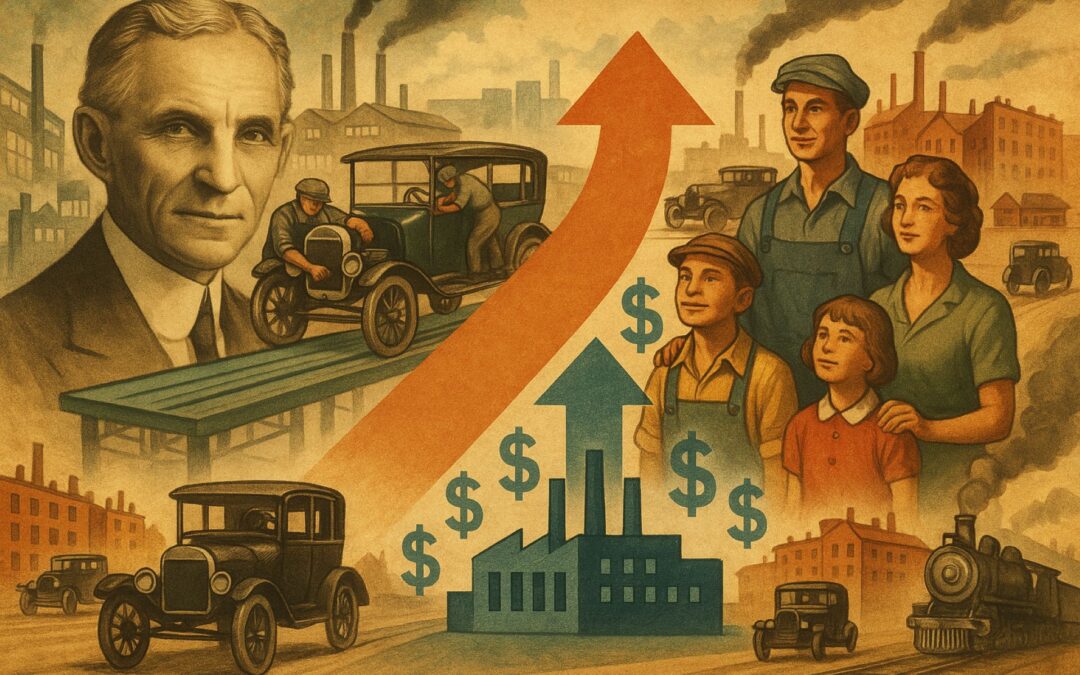
Henry Ford, China’s economic transformation, and India’s leap from poverty to global power seem worlds apart. Yet, they share a foundational truth: productivity, wages, and demand intertwine to lift entire populations from scarcity to prosperity. This is not just the story of nations—it’s the story of a radical wager by one man that changed history.
Henry Ford’s Radical Vision: Serving Everyone, Not Just the Elite
At the dawn of the 20th century, the prevailing business paradigm was to cater exclusively to the wealthy elite. Luxury goods, including automobiles, were designed and priced for the upper crust, creating an exclusive market inaccessible to the working class. Henry Ford’s vision was a direct challenge to this status quo. He understood that the true engine of economic growth wasn’t serving a tiny wealthy minority but rather empowering the vast majority—the everyday workers.
Ford’s mantra, “You don’t have to serve the rich to become rich,” was more than a catchy phrase; it was a revolutionary economic principle. He recognized the latent power of the working class as consumers—if only they had the means to participate in the market fully. This was a radical departure from the dominant thought, where workers were seen solely as costs to be minimized rather than potential customers whose spending could drive demand.
The barriers, however, were formidable. Wages at the time were kept at subsistence levels—barely enough to cover food, shelter, and basic clothing. Industrialists deliberately suppressed wages to keep labor costs low, which paradoxically limited the market for consumer goods. Even if wages were to rise, the cost of production was so high that products like cars remained out of reach for the majority.
Ford’s solution required attacking the problem on two fronts simultaneously: raising wages to boost purchasing power, and drastically reducing production costs to bring prices down. This dual approach was unprecedented and carried immense risk. But Ford’s conviction was unshakable. He believed that by increasing workers’ wages, he wasn’t merely incurring an expense—he was cultivating a customer base for his products. This insight flipped the traditional capitalist model on its head and laid the groundwork for the emergence of the modern middle class.
The Elites’ Skepticism and the Working Class as Non-Consumers
The skepticism Henry Ford faced from elites and lawmakers was rooted deeply in the classist assumptions of the era. The concept that working-class families would desire, let alone afford, a car was dismissed as fanciful. To the upper classes, cars were symbols of privilege and leisure—frivolous toys meant for weekend joyrides rather than essential transportation.
At the turn of the century, automobiles were unreliable, expensive, and cumbersome. Their value lay primarily in status display, not utility. Rich families used them as an alternative to horse-drawn carriages for recreation, parading wealth in urban and rural settings alike. The idea that a working family would use a car to commute, run errands, or explore was unimaginable to most manufacturers and policymakers.
Moreover, the lifestyles of working-class families reinforced these assumptions. Many lived close to their workplaces, often within walking distance or reachable via inexpensive public transportation like horse-drawn streetcars. Their daily routines were tightly bound to fixed routes and schedules. The notion of personal mobility as a form of freedom was alien.
This pervasive mindset influenced manufacturing priorities. Companies designed goods exclusively for affluent customers, and workers were perceived merely as inputs—labor costs to be minimized rather than consumers to be cultivated. The belief was that lowering prices for mass consumption was not only unprofitable but unnecessary.
Ford’s vision directly confronted these biases. He saw the working class not as passive labor but as active participants with aspirations and desires. His mission challenged entrenched economic and social hierarchies, aiming to redefine who deserved access to modern conveniences.
Ford’s Humble Origins and Unshakable Insight
Ford’s worldview was shaped profoundly by his upbringing in a modest farming family in rural Michigan. Unlike many industrialists who emerged from privilege, Ford knew scarcity and hard work intimately. His father, a small-scale farmer, expected him to inherit the family land, but Ford’s ambitions lay elsewhere.
From a young age, Ford displayed an extraordinary mechanical aptitude. Without formal schooling in engineering, he learned by doing—disassembling and reassembling watches, farm equipment, and machinery. This hands-on curiosity was more than a hobby; it was a language he spoke fluently, an intuitive grasp of how things worked beneath the surface.
Ford’s mechanical talents earned him positions as a machinist apprentice and eventually as chief engineer at the Edison Illuminating Company in Detroit. It was here that he built his first gasoline-powered quadricycle, a pioneering step during a time dominated by horse-drawn carriages, trains, and steamboats.
What set Ford apart was his vision of transportation not as a luxury but as a tool of liberation. He understood that existing transit systems constrained where people could live and work, effectively limiting economic and social mobility. A car, in his eyes, wasn’t just a machine—it was a ticket to freedom, opportunity, and a better life.
Ford grasped a critical insight about human psychology: desire is tethered to access. When something is beyond reach, imagination struggles to visualize its place in one’s life. But once given a glimpse or taste, people begin to imagine new possibilities and then yearn to realize them. This understanding fueled Ford’s relentless drive to create affordable cars, believing that unlocking access would unleash a wave of demand and fundamentally alter society.
His empathy for the working class and belief in their potential as consumers laid the foundation for an economic revolution that would reverberate worldwide.
Early Failures and the Road to Respectability
Henry Ford’s path to success was anything but smooth or guaranteed. His initial foray into the automotive industry, the Detroit Automobile Company, was plagued by technical issues and exorbitant production costs. The cars frequently broke down, and the company hemorrhaged money. Investors quickly lost faith, and the fledgling enterprise collapsed within two years, tarnishing Ford’s reputation and casting doubt on his vision.
Yet, Ford’s resilience and determination were unwavering. Recognizing that success required not only better engineering but public credibility, he undertook a calculated effort to restore trust. He designed a new, more reliable car and boldly entered it in a 10-mile race—a proving ground that held significant sway over public and investor opinion.
Against the odds, Ford’s vehicle outperformed the favorites, capturing attention and respect. This victory was pivotal: it signaled that Ford was a serious innovator, rekindling investor interest and laying the foundation for future ventures.
His next company, the Henry Ford Company, was mired in internal conflict. Ford’s passion for racing and technical innovation clashed with investors’ focus on production efficiency and profitability. These tensions culminated in Ford’s departure, but also in valuable lessons about balancing innovation with business pragmatism.
Undeterred, Ford launched the Ford Motor Company, which ultimately realized his vision with the Model A and the breakthrough Model T. This phase illustrated a crucial truth: innovation is rarely a straight line. It demands perseverance through failures, reputation management, strategic pivots, and an unrelenting commitment to one’s vision.
Disrupting the Shareholder Model and Reimagining Wages
Ford’s approach to corporate finance and labor relations was unconventional and often confrontational. Unlike his contemporaries, who paid dividends regularly to shareholders, Ford chose to reinvest all profits into expanding production capacity. This reinvestment strategy was revolutionary at the time but deeply unpopular among shareholders accustomed to immediate returns.
Tensions peaked with early investors like the Dodge brothers, who owned a significant stake and expected dividend payouts. When Ford withheld dividends, the Dodge brothers sued, arguing that Ford had a fiduciary duty to act in shareholders’ financial interests. The court ruled in their favor, mandating dividend payments.
In response, Ford engineered a shrewd countermeasure. He secretly formed a new company and orchestrated a panic sell-off of shares in the original company. Capitalizing on this, Ford bought back all minority shares, consolidating 100% ownership. This maneuver gave him absolute control to pursue his vision without shareholder interference.
Simultaneously, Ford revolutionized labor compensation by offering a $5 daily wage—double the standard for assembly workers. Economists branded this move “suicidal,” predicting profit collapse. Ford saw beyond immediate cost concerns. He recognized that higher wages would empower workers to become consumers themselves, creating a virtuous cycle where increased purchasing power fueled demand, which in turn justified wage hikes.
This wage policy wasn’t mere philanthropy; it was strategic capitalism reimagined. By investing in his workforce, Ford cultivated loyalty, reduced turnover, and boosted productivity, while expanding his market. This holistic understanding of the interplay between wages, consumption, and production costs reshaped industrial relations and economic thought.
The Assembly Line: Mastering Scale and Efficiency
Ford’s transformative innovation wasn’t confined to wages or finance; it fundamentally reshaped manufacturing. The introduction of the moving assembly line broke down the complex process of car production into a series of simple, repetitive tasks. This modular approach enabled the hiring of unskilled workers, drastically reducing training time and labor costs.
The efficiency gains were staggering. Building a Model T went from taking 12 hours to just 90 minutes—a reduction that slashed production costs and time to market. The assembly line allowed Ford to dramatically increase output while maintaining consistent quality.
This innovation had profound social and economic implications. By simplifying production, Ford democratized manufacturing, making it accessible to a broad labor pool. Though the repetitive nature of the work reduced individual autonomy on the factory floor, the higher wages and steady employment compensated, attracting a stable workforce.
The assembly line model became a blueprint for mass production across industries, catalyzing the growth of the American middle class. Affordable goods flooded the market, spurring consumerism and economic expansion.
Ford’s synthesis of operational efficiency with progressive labor policies created a self-reinforcing cycle: cheaper products expanded the market; higher wages empowered consumers; and increased demand drove further production innovation. This delicate balance laid the foundation for modern industrial capitalism.
Echoes in Global Economic Transformations
The economic alchemy pioneered by Henry Ford—melding productivity gains, elevated wages, and burgeoning consumer demand—has echoed far beyond early 20th-century America, shaping global development patterns in profound ways. This triad forms the backbone of many modern economic miracles, where access unlocks opportunity and fuels sustained growth.
Take post-World War II America as a prime example. The GI Bill, a landmark policy, provided returning veterans with education benefits and home loans, effectively democratizing wealth-building opportunities. Coupled with pent-up savings accrued through wartime rationing, this injection of purchasing power ignited a consumer boom. Suddenly, millions who had been locked out of economic prosperity found themselves with the means—and the desire—to purchase homes, cars, appliances, and more. This surge catalyzed new industries, expanded job markets, and reshaped the American social fabric into the middle-class powerhouse that defined the mid-20th century.
Halfway across the world, China’s meteoric rise mirrors this pattern, albeit on a scale unprecedented in history. For three decades, wages were deliberately suppressed to attract global manufacturing investment, transforming China into the world’s factory. Urbanization programs relocated hundreds of millions into cities, simultaneously providing a concentrated labor pool and creating demand hubs. When wages and consumption were finally unleashed, fueled by increased access to credit, a middle class emerged by the hundreds of millions. This transition spurred consumption across countless sectors—from electronics to automobiles—and reshaped global supply chains.
India’s transformation took a slightly different path but adhered to the same fundamental principle: access as a catalyst for growth. The country’s vast rural population initially posed immense infrastructure challenges, limiting traditional economic expansion. However, the proliferation of affordable Chinese smartphones—courtesy of companies like Xiaomi—collapsed barriers to digital access. Mobile data and digital payments democratized commerce, education, and social interaction. Young consumers, once isolated by geography and poverty, leapt forward, integrating into the global digital economy and spawning entirely new markets and business models.
These examples underscore a universal truth: when wages, productivity, and access align, the result is an economic explosion that elevates millions out of poverty. The latent demand suppressed by systemic barriers is like a coiled spring—once released, it powers transformative change that reshapes societies and the global economy.
The Fragile Balance of Mass Market Success
While the rewards of capturing mass markets are immense, the journey is fraught with peril. The balance between productivity, wages, and demand is not naturally stable—it requires precise alignment and constant recalibration. The razor-thin profit margins inherent in serving the masses leave little room for error, demanding scale and speed that many enterprises struggle to achieve.
History is littered with cautionary tales. Jet.com, for instance, entered the e-commerce arena with an ambitious plan: leverage dynamic pricing and ultra-low margins to rapidly scale and compete with Amazon. Their strategy depended on sustained cash burn to capture market share, with profitability deferred indefinitely. Unfortunately, scaling failed to materialize quickly enough, and the cash reserves depleted before the business could achieve sustainable growth, leading to its closure in 2020.
Better Place, an early innovator in electric vehicle infrastructure, gambled on mass adoption of EVs by building extensive battery-swapping networks ahead of market readiness. The colossal investment, totaling $900 million, preceded consumer demand by years. Without sufficient sales volume, the model was untenable, and the company folded by 2013.
Product innovation alone doesn’t guarantee success if the offering lacks genuine consumer value. Segway’s attempt to revolutionize personal transport overlooked a critical factor: a compelling consumer need. Despite technological sophistication, the product failed to resonate, languishing without mass adoption.
Similarly, Google Glass, despite the tech giant’s backing and an estimated $1 billion investment, stumbled because the product clashed with social norms and user comfort. It was awkward, intrusive, and ultimately alienated potential users, illustrating that innovation divorced from consumer desires is a recipe for failure.
These examples highlight a vital lesson: operational excellence must be coupled with authentic value. Process innovation is necessary but insufficient without a product that truly solves problems or fulfills desires. The intricate dance of efficiency, affordability, and desirability is challenging but essential for mass-market triumph.
The Next Middle-Class Revolution: Opportunities on the Horizon
The question facing today’s innovators and policymakers is who will engineer the next wave of middle-class expansion. History teaches us that this is not automatic; it requires deliberate alignment of technological innovation, labor dynamics, and access to capital.
Countries like Japan, South Korea, and Scandinavian nations have showcased models where investment in education, public infrastructure, and efficient production systems coalesce to uplift living standards. Their examples demonstrate the critical role of systemic support alongside entrepreneurial initiative.
Corporate innovators, too, have catalyzed change. Zara’s rapid “design-to-store” cycle compresses fashion production timelines to under three weeks, combining responsiveness with scale. This agility democratizes fashion access and fuels consumer engagement.
Emerging sectors brimming with potential include AI hardware, where rapid development and manufacturing could democratize access to powerful computational tools. Elder care services, driven by aging populations globally, represent an urgent and scalable market that intertwines social need with economic opportunity. Modular housing, offering affordable, efficient, and scalable construction solutions, promises to revolutionize housing markets in both developed and developing regions.
The challenge and opportunity lie in recognizing these trends early and engaging actively. Will you stand at the sidelines, watching as these revolutions unfold? Or will you be a driver, shaping industries and economies that lift millions into prosperity? The stage is set for bold bets—echoing Ford’s legacy—and the outcomes will shape the contours of the 21st-century middle class.
Conclusion
Henry Ford’s wild bet—to pay workers well, slash production costs, and sell to the masses—transformed not only the auto industry but the very structure of modern wealth. It sparked a cycle of access and demand that lifted millions into prosperity, created vibrant markets, and redefined capitalism.
The lesson endures: breakthrough change demands defying orthodoxy, betting on mass access, and embracing the fragile dance of productivity, wages, and demand. The question remains: what will your wild bet be?