
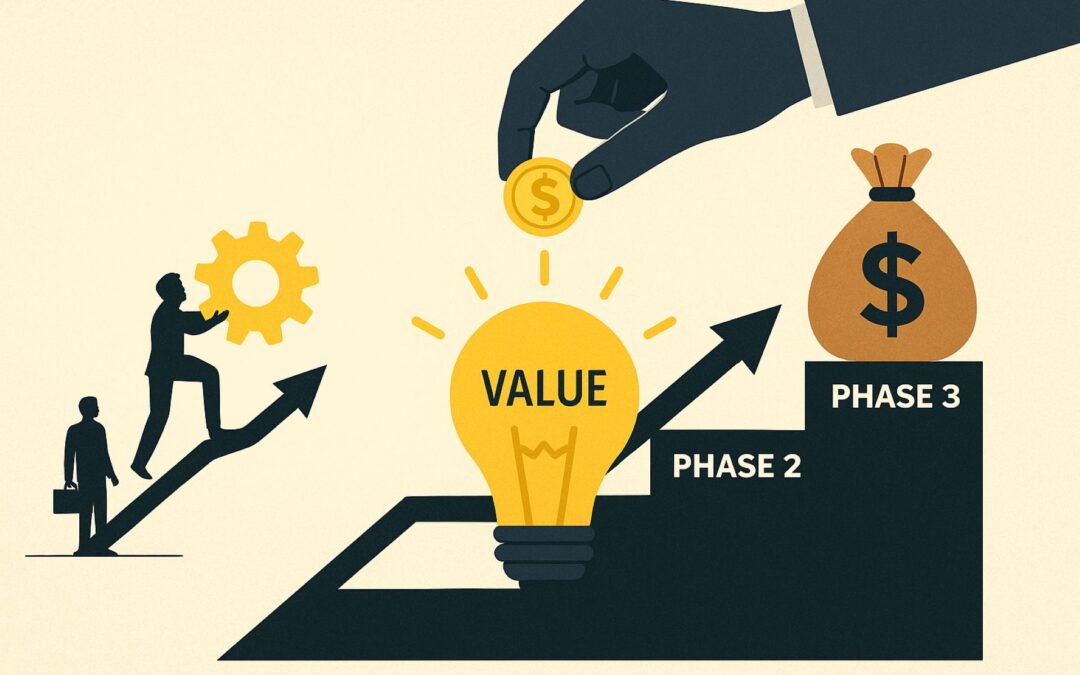
In today’s world, a million dollars doesn’t hold the same allure it once did. While it’s no longer enough to sustain a lavish lifestyle for the rest of your life, it certainly offers a huge leap toward financial independence. For many, achieving the $1 million mark seems like an unreachable dream, especially when the road to financial success is often lined with skepticism and doubt. But here’s a little-known truth: you don’t earn a million dollars—you make it. The secret to breaking into the 1% is simple but elusive: create value, and exchange it for money.
The real question is: how do you brute force your way to that coveted million? The answer isn’t in quick-fix solutions or speculative investments, but in persistent, focused actions. Through understanding and embracing the three phases of growth, you can push through the chaos and land yourself in the upper echelons of financial success.
The Key Difference: Earning vs. Making $1 Million
The first step to achieving wealth is understanding the distinction between “earning” money and “making” money, especially when it comes to crossing the $1 million threshold. Most people go through life in jobs where they “earn” a salary or hourly wage—essentially exchanging their time and effort for money. This traditional route is limited in its earning potential because, no matter how hard you work or how much you increase your hourly rate, your income is always tied to the amount of time you put in.
Earning Money: The concept of earning money is linear. If you work 40 hours a week for 50 weeks a year, you get paid a fixed amount. There are a few ways to boost your earnings, such as getting a promotion, negotiating a higher salary, or switching to a higher-paying job. However, no matter how hard you hustle, you’re still trading your time for money. Even at the highest paying jobs, your income is capped because there’s only so much you can work in a given week or year.
Making Money: The path to making $1 million isn’t about earning—it’s about creating something of value that generates income without a direct tie to your time. This is where entrepreneurship comes into play. When you make money, you are building something that can produce returns without requiring your constant, hands-on involvement. It’s about creating systems, products, or services that work for you. Instead of trading hours for dollars, you’re developing assets that can be leveraged repeatedly to generate revenue.
For example, if you start an e-commerce store or create an online course, you create value once and have the potential to make money as people purchase from you over time. Unlike earning, where you get paid only for the hours you put in, making money can continue to generate income even when you’re not actively working. This concept is foundational to achieving significant wealth—specifically, $1 million or more. As your business scales, the time and effort you invested early on will multiply, leading to returns that far exceed the amount of time you initially spent building your business.
So, the first hurdle in reaching $1 million is shifting your mindset from earning a salary to making money through value creation. You must stop thinking of money as something you can only earn through work and start thinking of it as something you can create and leverage.
Phase One: The Learning and Building Phase
Phase one is the foundation of your journey. It’s the chaotic and often frustrating early stage when everything is in disarray, but it’s also the most critical phase in establishing the groundwork for future success. During this time, you are in what we call the “learning and building phase.” This is where the majority of your hard work will take place, but it will also feel like you’re getting little to no recognition for your efforts. It’s in this phase where many would-be entrepreneurs give up, but the key to success lies in persevering through this uncomfortable, often demoralizing stage.
The Chaos of Phase One
At the start, you’ll face a lot of uncertainty. The moment you launch your business, you will likely feel overwhelmed by the sheer amount of things that need to be done. There will be days when it feels like you are spinning your wheels, making no progress. You don’t have a clear business model, you don’t know exactly who your customers are, and you’re still figuring out the right product-market fit. You’re in full-blown “trial and error” mode.
This phase is characterized by trying to do everything yourself because you’re on a tight budget, relying on free tools and platforms. Whether you’re setting up a website, designing your product, or crafting your marketing plan, you’re doing it all. You’ll probably face many failures early on. Sales might not come, your marketing strategies might flop, and your product might not resonate with your target audience. These early failures are necessary, as they serve as the foundation for future success. Each failure is a lesson in what doesn’t work, and each small win teaches you what does.
Learning to Learn
One of the most valuable skills you can acquire during phase one is “learning how to learn.” As you face obstacles, you’ll need to develop an ability to adapt and quickly acquire new knowledge. In this phase, the focus is on figuring things out as you go. This is where the most valuable lessons in entrepreneurship are learned—not from books or courses but from real-world experience. You will likely struggle with a steep learning curve, whether it’s learning how to use digital marketing tools, mastering the art of sales calls, or understanding cash flow management.
To succeed in phase one, you need to be a sponge for new information. You need to read books, watch videos, take online courses, and seek mentorship. You’ll have to figure out how to do everything yourself, which will make the skills you learn that much more valuable. The key here is perseverance. You can’t give up just because things aren’t working right away. The more skills you develop, the closer you get to understanding how to build a scalable business.
Staying Resilient Through Rejection and Doubt
One of the hardest things about phase one is the feeling of rejection. You might have family and friends who doubt your business idea or dismiss your efforts as a pipe dream. People will criticize you, tell you to get a “real job,” and question your decisions. During this time, your belief in yourself and your mission will be put to the test. You’ll question whether you’ve made the right choice or if you’re just wasting your time.
But it’s crucial that you keep going despite the doubts and setbacks. This phase will test your mental toughness. You will need to learn how to quiet the negative voices in your head and continue forward with unwavering focus. The goal during this phase is not to succeed immediately but to keep pushing, learning, and iterating. The fastest way to grow is by accepting failure as a part of the journey and using it as fuel for growth. The most successful entrepreneurs are those who can endure through the toughest of times.
The Importance of Building Systems
While you’re still in phase one, don’t just focus on the chaos of the day-to-day tasks—start building systems that will help you manage your business. Even though you may only be one person at this point, laying the groundwork for processes that can be scaled in the future will save you time and effort later on. Whether it’s a customer service system, an order fulfillment process, or a marketing campaign workflow, start creating standard operating procedures (SOPs) to streamline your operations.
The goal is to set up processes that are repeatable and can be passed on to future employees or automated as you grow. For example, you might create templates for emails, a system for tracking inventory, or a structure for how you handle customer feedback. The more you can standardize, the easier it will be to delegate tasks and scale your operations once you reach phase two.
Building a Resilient Mindset
As you face the struggles of phase one, it’s essential to cultivate a resilient mindset. The road to $1 million will be long and difficult, and there will be times when you feel like giving up. But the ability to keep going, even when things aren’t working, is what sets successful entrepreneurs apart from those who never make it. Resilience is not just about pushing through difficult times; it’s about using each setback as an opportunity to grow. You must remain committed to the vision of what your business can become, even if the results aren’t immediate.
Conclusion of Phase One
If you can survive the chaos of phase one and continue learning and building, you’ll emerge with a much clearer understanding of how to run your business. You’ll have learned how to overcome failure, developed a deep understanding of your market, and built foundational systems that will help you scale. Most importantly, you’ll have the resilience necessary to face the next challenges ahead in phase two. The road is long, but the efforts you put in now will lay the groundwork for a business that will grow exponentially in the future.
Phase Two: The Optimized Traction Phase
By the time you reach phase two, things are beginning to look much more promising. While phase one was about figuring everything out and pushing through the chaos, phase two is when you start seeing tangible results from your efforts. In this stage, you move from merely surviving to actively thriving, as you begin to build momentum in your business. This phase is marked by what is known as “optimized traction,” where the hard work and lessons learned from phase one start to pay off in the form of sustainable growth.
Achieving Early Wins
The hallmark of phase two is the realization that your business model works. This is where you begin to see consistent customers, regular orders, and steady cash flow. You’ve learned what works and what doesn’t, and you’ve optimized your product or service offering based on feedback from your early customers. This is a significant milestone, as it marks the transition from an idea in its infancy to a business that has proven it can operate effectively.
While you’re not yet hitting massive growth, you’re seeing progress. Your systems are beginning to work, and you can rely on them to produce consistent results. You now know exactly who your customers are and what they value most, which allows you to hone your marketing strategy. At this stage, your business is beginning to gain traction, and you’re no longer just putting out fires—you’re focusing on growth and refinement.
Team Expansion and Delegation
One of the most critical transitions in phase two is the expansion of your team. You’ll likely hire your first employee, or perhaps you’ll engage freelancers to help with specialized tasks. The key here is to start delegating tasks that are essential but time-consuming, such as customer service, order fulfillment, or content creation. This allows you to free up time to focus on higher-level strategic decisions, such as business development and scaling operations.
At first, your employees may not match your energy or commitment to the business. That’s normal. They won’t have the same level of passion and drive, but their help will still be invaluable. You’ll quickly learn how to delegate effectively, and this is crucial for your growth. Delegation allows you to focus on the tasks that are most important for driving the business forward while ensuring that the operations continue running smoothly.
Streamlining and Optimization
Now that you have a bit of stability, it’s time to streamline and optimize your business. The systems you set up in phase one are still in place, but they need fine-tuning. This is where you get into the details and look for efficiencies. You might find ways to improve your customer acquisition process, refine your sales funnel, or optimize your inventory management system.
You’ll also start to experiment with different strategies to see what yields the best results. Whether it’s testing different pricing strategies, refining your messaging, or exploring new marketing channels, phase two is all about optimizing your current processes. With your systems and team in place, you now have the bandwidth to tweak and experiment to get the best outcomes.
In addition, this is the time to learn more about your competitors. Phase two allows you to closely observe the market and understand what your competition is doing. You’ll begin to analyze their strengths and weaknesses and find ways to differentiate your offering. Knowing what the competition is doing gives you an edge, and you can use this information to improve your own business strategy.
Steady, Predictable Growth
The pace of growth in phase two is linear. It’s not yet the explosive, exponential growth that you’ll experience in phase three, but it is steady and predictable. You’ve built a foundation that you can rely on, and the systems you’ve implemented are beginning to show consistent results. It’s a great time to focus on expanding your customer base and getting your product into the hands of as many people as possible.
At this point, your primary challenge is ensuring that you maintain your growth trajectory. You’ve overcome the initial hurdle of getting your business off the ground, and now you need to stay on track. Phase two is about refining your processes, ensuring customer satisfaction, and positioning your business for the next phase of growth.
Maintaining Focus Amid Growth
Even as you experience growth, it’s important to remain focused. The challenge in phase two is resisting the urge to spread yourself too thin. There will be new opportunities, shiny objects, and distractions that may seem tempting, but it’s critical to stick to what’s working. The businesses that fail in this stage are often the ones that chase every new opportunity and forget to focus on their core strengths.
Stay focused on building systems, creating value for your customers, and refining your operations. If you can maintain this focus while scaling your business, you’ll be setting yourself up for the explosive growth of phase three.
Phase Three: The Liftoff Stage
Phase three is where the magic happens. You’ve laid the foundation, you’ve found your stride, and now you’re ready for liftoff. This is the stage where exponential growth begins. You’ve figured out how to scale, and now it’s time to let your business grow rapidly and sustainably. Unlike phase two, where growth was linear, phase three is all about accelerating your business and achieving breakthroughs that put you on the path to $1 million and beyond.
Exponential Growth and Scaling
In phase three, your business begins to experience the kind of growth that was once just a distant dream. This is when your business starts to take off and expand at an exponential rate. You’ve built the systems, established a steady flow of customers, and now you’ve figured out how to scale those systems to handle much larger volumes of work.
One of the key factors in phase three is the realization that you can build once and sell repeatedly. You’ve optimized your product or service, and now your focus shifts from making one sale at a time to building systems that bring in customers consistently. For example, you may have set up automated marketing campaigns or optimized your website to convert visitors into buyers at a higher rate. As demand starts to exceed your ability to deliver, you must scale your operations to meet that demand.
Becoming a Client Magnet
Phase three is where you transition from chasing customers to becoming a “client magnet.” You’ve built a brand, established a reputation, and now you have a steady stream of customers coming to you. Your focus shifts from constantly looking for new clients to nurturing and maintaining your existing customer base while attracting new customers with minimal effort.
This is also the time when word-of-mouth marketing starts to take effect. Your satisfied customers are referring others to you, helping to expand your customer base at a faster rate. At this point, your business is becoming self-sustaining, and the efforts you’ve put in during phases one and two are now bearing fruit. You no longer need to constantly hustle to bring in new business because your reputation and marketing systems are doing the work for you.
Focusing on Scalability
In phase three, it’s crucial to focus on scalability. You’re no longer just concerned with serving one customer at a time; you’re now thinking about how to serve thousands or even millions of customers. This involves refining your processes, investing in new technologies, and expanding your team to handle the increased demand.
To scale, you may need to raise capital or secure partnerships with other businesses to expand your reach. You’ll need to automate as much of the process as possible, whether it’s through tools like customer relationship management (CRM) systems, automated email campaigns, or outsourcing certain tasks. The goal is to build a system that works even when you’re not actively working in the business. This is when your business starts to function like a well-oiled machine that runs itself.
Capitalizing on Marketing and Brand Recognition
As your business grows, your marketing efforts will start to yield exponential returns. At this stage, you’ll begin to see the true power of branding and marketing. Your ads will start to convert at higher rates, and your brand will become more recognizable in the market. The key is to continue investing in marketing and fine-tuning your strategy to ensure that your messaging reaches the right audience at the right time.
It’s also the point where you should start exploring new marketing channels and refining your messaging to reach even more people. In phase three, your marketing strategy needs to be highly targeted and optimized to ensure that you’re reaching your ideal customer consistently.
The Liftoff Moment
The liftoff moment in phase three is when you realize that your business has gained the momentum necessary to reach new heights. This is when everything starts to come together—the brand recognition, the steady stream of customers, and the automated systems that make it all run smoothly. Demand begins to surpass supply, and your focus shifts to scaling operations even faster to meet that demand.
In the liftoff phase, your business isn’t just growing—it’s soaring. And with that, your path to $1 million becomes not just a possibility, but an inevitability. You’ve built something that works, and now it’s time to take it to the next level.
Embracing Asymmetric Risk
In business, exponential growth often comes from embracing asymmetric risk. Asymmetric risk is the concept of making decisions where the potential upside far outweighs the potential downside. For example, spending money on a marketing campaign that has the potential to bring in a massive return is an asymmetric risk. The key to embracing asymmetric risk is understanding that, in the early stages of business, you need to take calculated risks that could lead to large rewards, even if the risks are high.
As you move through the different phases, it’s important to take risks that allow you to grow faster than your competitors. While others might be playing it safe, you need to make bold moves that will pay off in the long run. But you can’t do this recklessly—you must weigh the potential benefits against the risks carefully and make decisions that allow you to scale your business in the most effective way possible.
Taking calculated risks is one of the fastest ways to reach your goals, and it’s the key to unlocking the exponential growth that will take you from $0 to $1 million and beyond.
The Ten Stages of Growth
The journey to reaching $1 million is not a straightforward path. It’s a process that unfolds in distinct stages, each representing a different level of growth and challenges. Understanding these stages will help you know where you are in your entrepreneurial journey and what to expect as you progress. The ten stages outlined in this framework act as milestones, helping you map out the trajectory of your business. Let’s break down each stage in detail and explore what it takes to advance through them successfully.
The A Point: The Decision to Start
The A point marks the very beginning of your entrepreneurial journey. It’s the moment you decide to go from just having an idea to actually taking action. At this stage, you’ve probably been dreaming about starting your business, but it’s time to stop dreaming and start doing. The A point can be a little daunting because it represents the first step into the unknown. You have no product, no clients, and no infrastructure, but you have an idea and a vision.
This stage often involves practical actions such as registering your domain name, building your first website, or listing your first product. You may be spending your own money to get things off the ground, and the financial risk can feel significant. But this is the moment that separates the thinkers from the doers. Taking that first step is crucial because it’s easy to get caught in the planning phase forever without ever executing.
Starting at the A point doesn’t require a massive investment—just a commitment to get moving. With modern tools and platforms, you can set up an online store, create social media profiles, and begin promoting your product all on a very limited budget. The key here is to leverage all available technology to make the start as smooth as possible, without letting a lack of resources hold you back. Even if you start with under $100, you can make significant strides by using free tools and platforms. For example, Instagram, TikTok, and Shopify offer low-cost ways to get your business off the ground quickly.
The B Point: Struggling but Learning
The B point is where most people get stuck or give up entirely. After the initial excitement of launching, reality sets in, and you realize that building a business is harder than it looks. Your initial efforts may not have resulted in the success you were hoping for. Your website may be up, but the traffic isn’t coming in, and sales are low. You might even feel discouraged as you put in long hours with little to show for it.
At the B point, you’re still in the early stages, and you’re figuring out how to make money. You’ve learned a lot, but the results aren’t immediate. This is the phase where most entrepreneurs give up. The business is not yet profitable, and it feels like you’re running in circles. But this is also the phase where true entrepreneurs demonstrate their resilience.
The B point is a test of determination. You will likely face rejection, frustration, and self-doubt. It’s here that you’ll need to push through. For instance, if your product isn’t selling, try different pricing strategies or tweak your marketing efforts. If your customer engagement is low, consider improving your messaging or targeting a new demographic.
The important lesson at this stage is the necessity of volume. You’ll have to perform tasks that feel menial but are essential for long-term success. Whether that’s sending hundreds of direct messages, posting 100 pictures on Instagram, or making countless cold calls, the key is persistence. At this point, you are building the foundation of your business by grinding through the tedious tasks that move the needle. This stage can be grueling, but the effort you put in now will pay dividends later. If you can survive this phase, you’ll be ready for what comes next.
The C Point: The First Payment
The C point is where everything changes. This is the moment when you receive your first genuine payment for your product or service. While it might not be a huge sum, it’s a profound moment of validation. It’s the point at which you realize that your business is not just an idea—it’s a reality. Someone has paid you for what you’re offering, which means you’ve solved a problem, fulfilled a need, or provided value to someone.
The first payment, no matter how small, is the turning point that proves your concept works. Up until now, you’ve been doing everything yourself: product creation, marketing, sales, customer service, and fulfillment. But once that payment hits your account, everything changes. You have a business. You have a legitimate transaction that proves your model works.
At this stage, you’re still doing almost everything yourself. You might be the only one fulfilling orders, responding to customers, and making sales. But now that you’ve received payment, you know that the effort was worth it. This is the point when you make a choice: do you continue doing everything yourself, or do you start building a team to handle certain aspects of the business? While it might still be too early to hire, the first payment shows you that growth is possible, and that it’s time to scale.
The D Point: Hiring Your First Employee
The D point is a major milestone in your business. By now, you’re growing steadily, and you’ve realized that you can’t do everything yourself. You’re ready to bring in some help, but hiring your first employee is no small decision. You may not yet be making enough money to comfortably pay someone else, but the business is growing, and you need support to keep up with demand.
Hiring your first employee is a critical step in your growth. At this point, you may still be working at full capacity, but now you have someone to help with the heavy lifting. The first employee is often a generalist who can wear many hats, but as you scale, you’ll eventually need to hire more specialized roles.
This is also the stage where you start learning how to manage people. It’s not just about getting the work done; it’s about leading a team, communicating effectively, and setting clear expectations. Hiring the right person can be a game-changer, but hiring the wrong person can slow down your progress. At this stage, you must focus on hiring individuals who share your vision, are committed to your mission, and are flexible enough to wear multiple hats as the business evolves.
The E Point: Sustainable Growth
The E point is when your business starts to show consistent, sustainable growth. You’ve proven the viability of your business model, you’ve learned how to scale, and now you’re seeing real, predictable results. At this stage, your sales are no longer fluctuating wildly. You’ve got a steady stream of customers, and your systems are running more smoothly.
In this phase, your focus is on refining your operations, optimizing your marketing efforts, and increasing your customer base. You’ll begin to reinvest your profits into the business to further scale it. It’s also the point where you’ll start thinking about how to expand your team further. As the business grows, so does the complexity, so you’ll need to bring on specialists who can help you manage the increasing workload.
You might hire additional employees to handle customer service, marketing, or operations. You might also invest in new tools or technology to automate processes and improve efficiency. The key at this point is to keep building on what’s working while addressing any inefficiencies in your systems. If you’ve reached this point, it’s a good sign that you’ve found a formula for success. Now, it’s time to focus on scaling.
The F Point: Scaling and Upgrading Infrastructure
At the F point, you’ve achieved a certain level of success, but the real growth is just beginning. You’ve reached a stage where your business is growing fast enough that you can no longer maintain the same operations. You need to upgrade your infrastructure to handle the increasing demand.
This might mean investing in new software to manage orders, upgrading your website to handle more traffic, or hiring additional staff to keep up with the volume. You will also need to start thinking about your product’s long-term sustainability—how do you maintain quality while scaling production? At this point, you will also need to think about your financial infrastructure. You may need to seek outside funding or loans to support your growth.
The key challenge at this stage is to ensure that your business can handle exponential growth without collapsing under its own weight. This is the time to invest in technology, improve your supply chain, and upgrade your marketing efforts. You’ll need to make smarter decisions about how to scale efficiently and ensure that the systems you’ve put in place can handle the increased workload.
The G Point: Crossing $100,000
The G point is a significant milestone in your journey. When you reach this point, your business has crossed the $100,000 threshold in revenue. You’ve built a solid foundation, and now you’re beginning to see the rewards of your hard work. At this stage, you’ve gained a good understanding of your customer base, your product offerings, and your business’s needs.
Crossing $100,000 in revenue means you’ve figured out a lot of what it takes to build a sustainable business. You’re likely starting to pay yourself, and the business is generating enough profit to reinvest in further growth. This is also when you realize the importance of marketing. Now that you have a product people are willing to pay for, you need to reach even more customers.
To reach the next level, you need to invest more heavily in marketing. You need a scalable way to reach a larger audience, and that means refining your marketing strategy. At this stage, you can’t just rely on word of mouth anymore—you need to actively promote your business through paid advertising, content marketing, partnerships, and other strategies.
The H Point: Marketing Takes Off
At the H point, your marketing efforts have started to pay off in a big way. You’ve figured out how to reach more customers and generate more sales, and demand is now surpassing your ability to fulfill orders. This is a great problem to have, but it’s still a problem. Your business is growing, and you need to scale even faster to meet the demand.
To keep up, you need to hire more staff, invest in new technology, and improve your processes. You may need to outsource parts of your operation, such as logistics, customer service, or production. You’ll also need to build a more efficient supply chain to keep up with the increased demand. But if you can manage this growth effectively, you’re on the path to scaling your business and hitting that $1 million goal.
The I Point: Exponential Growth
Exponential growth occurs at the I point. By this time, your business has grown enough to generate between $1 million and $5 million in annual revenue. You’ve refined your processes, built a sustainable marketing strategy, and developed the systems that support large-scale operations.
At this stage, you begin to think strategically about long-term growth. You’re no longer focused on immediate returns but on how to continue scaling while keeping quality and efficiency high. You’ll be investing in new products, exploring new markets, and developing strategic partnerships that will help you expand further.
The J Point: Joy and Legacy
Finally, you reach the J point—the point at which your business is stable, profitable, and able to take care of you and your family. Your business is worth over $10 million, and you can afford to reward yourself for your efforts. You’ve achieved financial freedom, and you now have the option to either continue growing your business or exit.
At this point, the focus shifts from building wealth to enjoying the fruits of your labor. You’ve built something sustainable that will provide for you in the long term. Whether you decide to sell, scale, or pass the business on, the J point represents the culmination of your entrepreneurial journey—a place where your hard work has truly paid off.
Reaching these stages isn’t easy, but with persistence, strategy, and the right mindset, you can make it to $1 million and beyond.
Conclusion: The Journey to Joy – Reaching the $10 Million Mark
Once you hit the $1 million milestone, the real work begins. At this point, you’ve built a business that can sustain you, but it’s also the moment when you must start thinking about how to scale further. Reaching $10 million is a significant achievement, and it’s where you begin to see the true rewards of your hard work. You’ve built a sustainable, profitable business that can take care of you and your family for years to come.
In conclusion, the journey to $1 million isn’t a sprint; it’s a marathon. It requires persistence, adaptation, and a willingness to push through the tough phases. From the chaos of the early days to the triumph of exponential growth, every stage is necessary to reach that ultimate goal. Stay focused, keep learning, and don’t give up. Your $1 million is within reach.