
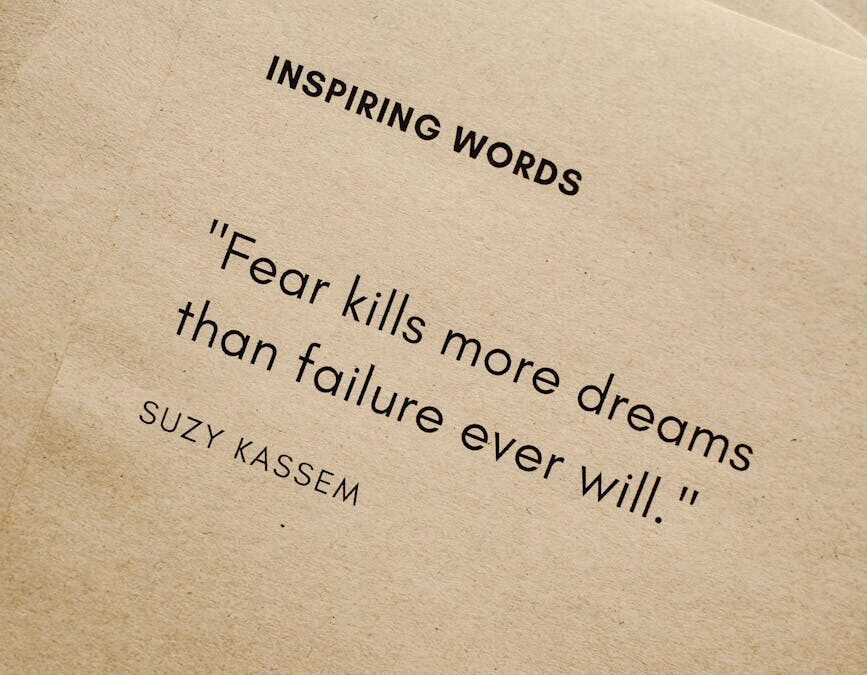
Life isn’t about eliminating fear, avoiding embarrassment, or chasing a mythical state where all problems vanish. It’s about learning to carry fear without letting it dictate your choices, about using boredom as fertile ground for ideas, and about trading up your problems for better ones over time. Fear, failure, and frustration are not signs that you’re broken—they’re signals that you’re alive, moving, and stretching beyond your comfort zone.
The key is to reframe them: fear as a compass, cringe as proof of growth, boredom as fuel for creativity, and problems as opportunities for higher-quality trade-offs. Once you see them this way, life stops being an endless struggle to avoid discomfort and becomes a game of choosing challenges worth playing.
The Fear of Failure Is Never About Failure
Failure, in its rawest form, is simply feedback. You attempt something, and it doesn’t work; now you know what not to do next time. However, we rarely experience it with such neutrality. We inflate failure into something bigger, something personal. Missing a shot in basketball isn’t just a missed shot—it becomes proof you’ll never make the team. Bombing a presentation isn’t just an off day—it’s a story that you’re not cut out for leadership.
This distortion happens because humans are meaning-making machines. We can’t help but attach narratives to events. Failure, therefore, mutates into a symbol of inadequacy, rejection, or doom. And here’s the kicker: the pain doesn’t come from the event itself but from the anticipated consequences. It’s the image of colleagues whispering, friends pitying, parents judging, or strangers laughing. In other words, the fear of failure is the fear of social death.
That’s why failing in private often feels tolerable. Practice guitar alone, mess up the riff, and you shrug. But play it wrong at a party, and suddenly you’re burning with shame. The same action, the same mistake—yet the emotional weight shifts dramatically depending on the imagined audience. This is the spotlight effect, the phenomenon where people believe they are being watched and scrutinized far more than they actually are. Most of the time, they aren’t. They’re busy worrying about their own spotlights. But our brain convinces us that the whole world is tuned into our flaws, which keeps us paralyzed at the starting line.
The irony is that failure itself is neutral, even useful. It’s the story that makes it unbearable. When we strip away the imagined consequences—the idea that one stumble defines us forever—the monster shrinks back into what it truly is: a single data point on a much longer journey.
The People Who Judge You Least Are the Ones Who’ve Done the Work
There’s a peculiar pattern in human nature: the harshest ridicule rarely comes from the experts. It comes from the amateurs, the bystanders, the ones who’ve never dared to step into the arena. A seasoned entrepreneur who’s raised capital and weathered bankruptcy doesn’t laugh at your shaky startup pitch—she empathizes. A bodybuilder who has trained for years doesn’t mock the beginner lifting light weights—he nods, remembering his own first rep. True practitioners understand the grind because they’ve lived it.
The loudest critics, on the other hand, are almost always those who’ve never tried. They jeer not because your attempt is laughable but because your courage exposes their avoidance. Your act of trying reminds them of their own inertia, and criticism becomes their shield. Their mockery says more about their fear than about your performance.
This is why Mark Manson’s maxim resonates: If you wouldn’t take advice from them, why take their criticism? Think about it. If you wouldn’t trust a friend’s guidance on how to start a business, why let their opinion stop you from trying? If you wouldn’t learn fitness from the guy scoffing at you in the gym, why let his sneer define your effort? Respect must be earned, and the people most worth respecting rarely waste their time tearing others down.
Recognizing this truth liberates you. It shifts your attention away from the peanut gallery and toward the voices that matter—the mentors, the peers, the veterans who want to see you succeed. And often, those people aren’t judging you at all. They’re cheering you on, offering pointers, and quietly respecting the fact that you had the guts to begin.
Cringe Is Proof of Growth
To cringe at your past self is to hold up a mirror to progress. It’s an emotional reflex that tells you: I am no longer who I was. That moment when you reread an old essay and grimace at clumsy phrasing, or watch your early YouTube videos and squirm at the awkward delivery, isn’t evidence of failure—it’s evidence that you’ve advanced. The discomfort comes from an upgraded standard colliding with an outdated attempt.
Consider the athlete who watches footage of their rookie season. They cringe not because they were incompetent but because they now play at a higher level. Or the musician who listens to their first recordings—the off-key notes make them wince, but only because their ear has matured. If you don’t cringe at your past, you haven’t moved forward.
The problem is, most people interpret cringe as shame. They avoid revisiting their earlier efforts, or worse, they stop creating altogether to avoid future embarrassment. But the truth is inverted: cringe is a badge of honor. It marks the distance you’ve traveled. It proves that you were brave enough to begin, bold enough to fail publicly, and committed enough to improve.
In fact, a life devoid of cringe is a life stuck in stasis. If you never look back and feel uneasy about your old work, it means you’ve been standing still, repeating the same patterns, never evolving. Cringe, then, is not just a signal of growth—it’s a requirement. To grow is to outgrow. To outgrow is to cringe. And the only way to keep moving forward is to keep producing things today that your future self will one day find slightly embarrassing.
Strategies to Disarm Fear
Fear thrives in silence and avoidance. To dismantle it, you don’t wait for courage to magically appear—you build it through deliberate practices. Five proven strategies stand out:
1. Exposure Therapy
The antidote to overwhelming fear is small doses of discomfort. If speaking in public paralyzes you, don’t leap onto a stage of 500 people. Start by speaking in a group of five. Then ten. Then twenty. Each step builds resilience until what once felt insurmountable becomes routine. The secret lies in the “Goldilocks zone”—stretching yourself enough to feel challenged but not so much that you’re overwhelmed. Fear shrinks when faced gradually.
2. Orthogonal Exposure
Sometimes the best way to tackle a fear isn’t head-on but sideways. If presenting in front of colleagues terrifies you, practice telling jokes to friends. If starting a business feels overwhelming, experiment with selling a single item online. These adjacent challenges, though not identical, build transferable confidence. They strengthen the muscles of courage without triggering full-scale panic.
3. Altitude Training
Push yourself into situations so exaggeratedly difficult that your original fear pales in comparison. Imagine training for a marathon by running in high-altitude mountains; when you return to sea level, the air feels easy. In life, this looks like deliberately placing yourself in extreme conditions—a daunting language barrier abroad, a chaotic improv class, or a challenge that exaggerates discomfort. When you come back, the thing you once dreaded feels trivial by contrast.
4. Gamification
Failure loses its venom when you turn it into play. Collect rejections like baseball cards, tally mistakes like points, laugh at your clumsiest efforts. By reframing failure as part of a game, you strip it of its finality. Each “loss” becomes progress, each stumble a data point. Suddenly, fear transforms from a paralyzing weight into a quirky challenge: how many times can I fail today and keep going?
5. Identity Reframe
Perhaps the most powerful shift is internal: stop seeing fear as a threat to your identity and start weaving resilience into your identity. Instead of “I’m not good at this,” adopt “I’m the kind of person who attempts difficult things and learns.” When you believe failure doesn’t define you but refines you, fear loses its sharp edge. Over time, this identity compounds: you become the person who tries, who adapts, who persists. That identity is far stronger than any single outcome.
Fear doesn’t vanish—it never does. But with these strategies, it stops dictating your life. You stop waiting to be fearless and start acting despite the fear. And paradoxically, that’s how fear loosens its grip.
Boredom as a Catalyst for Creativity
Boredom is often misunderstood as a void to be filled, something to escape with a swipe, a scroll, or a stream. Yet beneath its dull exterior lies an underappreciated engine of imagination. When the mind is unoccupied, it wanders. It stitches fragments of memory, observation, and fantasy into unexpected patterns. This wandering—known as divergent thinking—is the birthplace of creativity.
Researchers have demonstrated this effect in curious experiments. Participants tasked with copying names from a phone book, or even worse, reading them aloud, later produced more creative ideas in problem-solving tasks than those who had been entertained. Stripped of stimulation, their minds searched for novelty. They looked at a plastic cup and invented dozens of new uses for it. They connected random words into clever associations faster. Boredom, it turns out, primes the brain to innovate.
But not all boredom is equal. Psychologists distinguish between state boredom (a temporary lull in stimulation) and trait boredom (a chronic tendency to disengage from life). The former sparks creativity by encouraging exploration. The latter dulls it, pushing people toward impulsive distractions rather than meaningful creation. The difference lies in what you do when boredom strikes.
In our overstimulated world, state boredom is rare. Every pause is instantly filled with digital noise. Podcasts for walks, music for showers, videos for idle moments—our brains rarely sit in silence. Yet those unstructured gaps are where the best ideas tend to surface. Think of the shower thought, the epiphany on a quiet drive, the breakthrough during a mindless chore. These are not accidents; they are boredom doing its work.
The lesson is counterintuitive: to cultivate creativity, allow yourself to be bored. Resist the urge to fill every crack of the day with content. Take a walk without headphones. Clean the kitchen without a podcast. Sit quietly, staring out the window. What feels like idleness is in fact mental composting—your brain recycling experiences into insights. Creativity is not summoned by force; it emerges in the space boredom provides.
Why Life Is a Chain of Problems
Life is never free of problems—it only offers different tiers of them. Every stage comes with dilemmas, trade-offs, and choices. What changes is not the presence of problems but their quality. At the lower rungs of Maslow’s hierarchy of needs, the problems are stark: Do I have enough food to survive? How will I pay rent? Where can I find safety? These are problems of scarcity and survival, where the wrong decision can cost you dearly.
Climb higher, and the problems shift. Instead of “Do I have shelter?” it becomes “Which home should I buy?” Instead of “Can I afford dinner?” it becomes “Which restaurant best fits my diet and values?” The stakes remain real, but the context changes. Higher-level problems are often about meaning, identity, and optimization rather than survival. They demand wisdom more than desperation.
Consider the difference between two people with “money problems.” One struggles to cover utility bills, choosing between groceries and gas. The other struggles to decide whether to invest in real estate or index funds. Both face money problems, but one operates in survival mode while the other navigates abundance. The higher the quality of your problems, the better your life is.
This is why progress in life is less about eliminating problems and more about trading up. You move from solving immediate, low-level issues to grappling with higher-order dilemmas that align with your goals and values. Stress never disappears, but it transforms. Instead of being crushed by scarcity, you wrestle with choices about purpose and contribution.
The tragedy is that many people chase the fantasy of a problem-free life. They wait for the day when all burdens lift and every decision feels easy. That day never comes. The human mind is wired for mild dissatisfaction—it’s always scanning for the next obstacle, the next improvement, the next trade-off. Accepting this truth is liberating. The goal isn’t freedom from problems but choosing better ones—problems that stretch you, enrich you, and elevate your sense of self.
The Red Paperclip Philosophy
In 2005, a Canadian man named Kyle MacDonald started with a single red paperclip and set out to trade it for something bigger. Over the course of a year and fourteen trades, he went from a paperclip to a fish-shaped pen, to a doorknob, to a camping stove, to an afternoon with Alice Cooper—and eventually to a house in Saskatchewan. His experiment wasn’t just a quirky internet stunt; it was a vivid metaphor for life itself.
Every decision we make is a trade. You exchange time for money, money for security, comfort for growth, certainty for possibility. These trades may seem small in the moment—a dollar saved, an hour invested in practice, a conversation with a stranger—but compounded over time, they scale into extraordinary outcomes. The red paperclip is whatever modest resource you start with: your current skill set, your limited savings, your shaky confidence. The “house” is what you build through years of incremental, intentional exchanges.
The brilliance of this philosophy is that it reframes progress as a series of small, manageable steps rather than a leap into the extraordinary. Too many people paralyze themselves waiting for the “perfect” trade—the big opportunity, the life-changing deal—when in reality, progress begins with the smallest swap. Move the needle just a little, and momentum builds.
The challenge, of course, is discernment. Not every trade is equal. Trading your evening for another mindless TV binge is a paperclip-for-paperclip exchange—it doesn’t compound. But trading your evening for reading, writing, or building a skill is paperclip-for-pen territory—it opens doors to the next trade. Over time, the compounding effect of wise exchanges pulls you further up the ladder of possibility.
The red paperclip story teaches us that growth isn’t about what you start with—it’s about the direction of your trades. Ask yourself daily: am I compounding upward, or am I shuffling sideways?
Fear Is Not the Enemy—Avoidance Is
Fear itself is not the villain. It’s a messenger, a signal from the nervous system alerting you to risk. It sharpens focus, quickens reaction time, and can even prepare you for action. In evolutionary terms, fear kept us alive. The real enemy is avoidance—the refusal to act because fear whispers too loudly.
Avoidance masquerades as safety. It tells you, Don’t try, don’t risk, don’t expose yourself. For a moment, it feels like relief. But over time, avoidance extracts a brutal cost. Every time you avoid, the fear grows stronger. Every time you step back, the arena of your life grows smaller. Avoidance compounds, shrinking your world until even small challenges feel insurmountable.
Think of the difference between two people who both fear public speaking. One accepts the fear, steps on stage, stumbles through a rough performance, and learns. The other avoids the stage, rationalizes the decision, and promises to “do it later.” Ten years on, the first has grown comfortable in the spotlight. The second still trembles at the thought of speaking to a room of ten. Fear didn’t hold them back—avoidance did.
Franklin Roosevelt captured it during the depths of the Great Depression: “The only thing we have to fear is fear itself.” But what he truly meant was the paralysis that comes from letting fear dictate your actions. Courage isn’t the absence of fear; it’s the willingness to move forward in its presence.
The paradox is simple: when you face fear, it diminishes; when you avoid fear, it multiplies. The way out is not to silence fear but to act alongside it. Take the step, make the attempt, allow yourself to stumble. In motion, fear loses its grip. In avoidance, it metastasizes.
Fear will always ride shotgun in the human experience. The question is whether you let it drive.
Conclusion
Fear will never disappear. Problems will never vanish. Boredom will always lurk. But that isn’t a curse—it’s the structure of a meaningful life. The people who grow, create, and thrive are not the ones who’ve escaped fear or conquered every challenge; they’re the ones who leaned into it.
They tolerated the cringe of early efforts, treated failure as tuition, carved space for their minds to wander, and traded paperclips for houses one choice at a time. Avoidance shrinks your world, but engagement expands it. The point isn’t to dodge difficulty—it’s to fear less, spark more, and choose better problems, over and over again. That’s how you build a life worth living.