
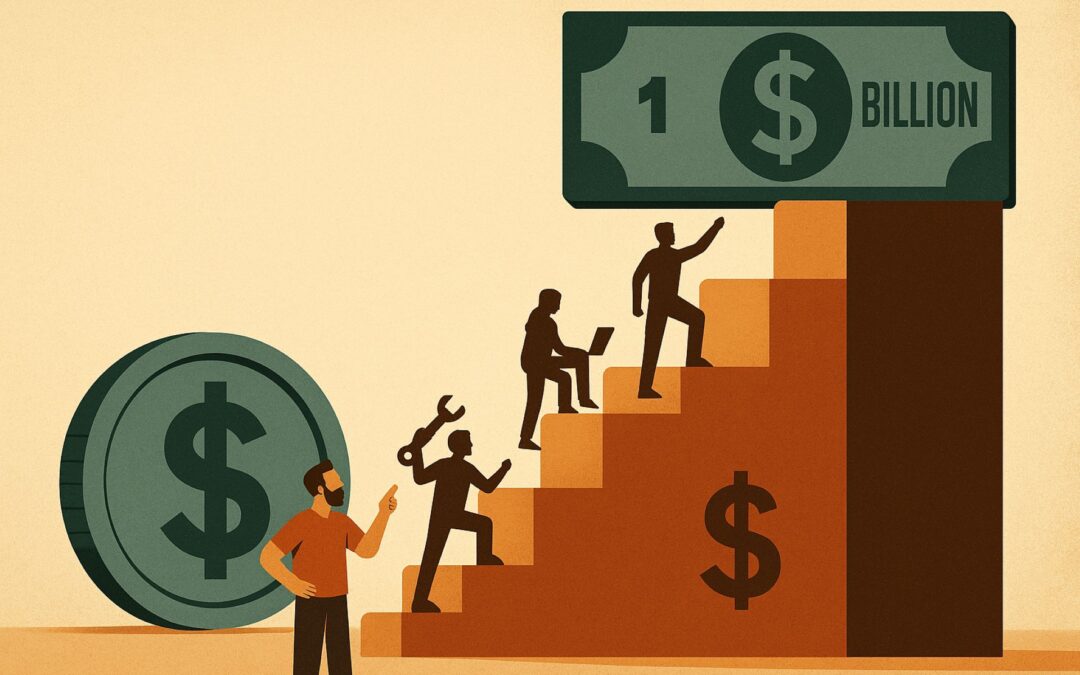
Wealth isn’t a monolith. It’s a layered universe, a series of distinct games, each governed by its own rules, tactics, and mindsets. The moves that get you your first dollar won’t catapult you to $100,000. The strategies that build a millionaire’s fortune won’t nudge you anywhere close to a billion. The truth is, each level of wealth demands a new blueprint, a different approach to creating value, and an evolved understanding of money’s mechanics.
This guide dissects those real-world strategies, unfolding the journey from your first dollar to the elusive billion. Prepare to recalibrate your perspective on wealth, value, and the alchemy of money-making at every tier.
Making Your First Dollar: The Simplicity of Value Exchange
Your first dollar is far more than just a token of currency; it represents a foundational victory—proof that you have successfully navigated the core principle of commerce: exchanging value for money. At this nascent stage, the process is remarkably straightforward, almost primal. You observe a need or desire in another person, and you offer something tangible or intangible that satisfies that need. In return, you receive payment.
Consider the classic scenario of selling cold bottled water on a sweltering beach. The product is basic, the transaction unembellished, yet this simple act encapsulates the essence of all business: someone values what you provide enough to part with their money. There are no complex business plans, no digital marketing campaigns, no intellectual property rights—just a direct, immediate exchange between two parties. This raw simplicity is critical because it lays bare the unchanging economic truth that underpins every financial transaction: money flows when perceived value flows.
At this stage, the relationship between you and your customer is intimate and one-to-one. You are the creator, the distributor, and the salesperson all at once. The value you provide is tangible, easily understood, and instantly gratifying to the buyer. It satisfies an immediate, often urgent need—thirst in the case of the water bottle—and the price point reflects the urgency and scarcity of the resource.
This initial experience is more than a small win; it’s a microcosm of all wealth-building endeavors. It teaches you to recognize opportunity in everyday circumstances and underscores the importance of delivering something others want or need. The $1 you earn may seem inconsequential in the grand scheme of wealth, but it is the cornerstone upon which all larger fortunes are built. It affirms that wealth creation is not about magic or luck; it is about identifying demand and meeting it effectively.
Understanding this simple exchange is critical because it forms the conceptual framework for every subsequent step on your financial journey. From here, you begin to grasp that wealth isn’t about hoarding money but about generating value that others are willing to compensate you for. This mindset shift—from viewing money as a goal to seeing it as the natural outcome of providing value—is the first and most essential lesson on the road to financial success.
Scaling to $10: Amplifying Value through Creativity
Once you have grasped the rudimentary act of exchanging value for money, the next progression involves amplifying the value you provide so you can command a higher price. Moving from making your first dollar to earning ten dollars is not merely a matter of increasing prices arbitrarily; it demands creativity, problem-solving, and a keen understanding of what people truly need and value.
Imagine sitting down at your computer and using a simple design tool like Canva to create a digital product—a meal planner, a habit tracker, or a daily to-do list. Unlike the water bottle, this product is intangible. It doesn’t quench thirst but addresses a more nuanced need: the desire for organization, productivity, or self-improvement. While this may not seem as immediate or primal as thirst, the value it provides can be profound for someone trying to establish healthy routines or maintain focus.
Here, you enter the realm of subjective and psychological value. The worth of your product is measured not in physical utility alone but in its ability to improve a customer’s life in meaningful ways. The time and effort a customer saves, the motivation they gain, or the stress they avoid are all components of the value you offer.
Platforms like Etsy and other digital marketplaces provide a direct channel to millions of potential customers without the traditional overheads of manufacturing or distribution. Your digital product can be sold repeatedly with virtually no additional production cost, giving you leverage that physical goods cannot match at this stage.
The principle that “more value equals more money” becomes palpably clear. Your ten-minute investment in creating a digital tool that solves a genuine problem allows you to charge ten times as much as the $1 water bottle because the perceived benefit is greater. Moreover, this stage introduces the critical advantage of scalability. Unlike physical goods or direct services, digital products can multiply sales without multiplying effort or costs, creating an exponential income potential.
The leap to charging $10 is a psychological and strategic one. You must move beyond basic needs and address more complex, often emotional or aspirational desires. You must understand your customer’s pain points deeply enough to craft a solution that resonates.
In essence, scaling your value at this stage is about honing your creativity, sharpening your empathy, and leveraging accessible technology to meet evolving customer demands. It’s the first step towards turning your skills and ideas into sustainable income streams and sets the foundation for more sophisticated value creation models to come.
Creating Value from Thin Air: The Art of Transformation
The act of creating value from thin air is a paradigm shift that separates mere trading from true entrepreneurship. It transcends the simple exchange of goods and services by introducing the powerful principle of transformation—taking something perceived as worthless or undervalued and converting it into an asset that commands a premium price. This approach is not just about buying low and selling high; it is about adding tangible and intangible improvements that fundamentally increase worth.
Consider the example of purchasing a dilapidated dresser at a garage sale for $30. To the untrained eye, it’s an old piece of furniture—scratched, faded, and nearly discarded. But your imagination sees beyond the surface flaws. You visualize potential: a fresh coat of paint, replaced handles, and a bit of TLC can breathe new life into this forgotten item. With some investment in materials and effort, you convert the dresser into a stylish, desirable piece worthy of $130 or more.
This transformation is an act of value augmentation—you are not simply reselling, but reimagining and improving. The increase in value arises from several factors:
- Aesthetic Enhancement: Making the product visually appealing, often the most immediate factor influencing perceived worth.
- Functional Improvement: Repairing or upgrading elements that enhance usability or durability.
- Emotional Appeal: Crafting a story or aura around the product that resonates with buyers’ tastes and desires.
What makes this strategy compelling is that you are essentially manufacturing money by adding creative energy and craftsmanship where none existed before. It illustrates the entrepreneurial principle that value is not intrinsic but contextual and malleable.
This mindset—seeing opportunity where others see waste—is essential for wealth creation. It requires a combination of vision, skill, and confidence to invest time and resources into assets others overlook. It also teaches a vital lesson in risk and reward: you take a modest upfront cost and apply effort, hoping the market will reward your enhancements with higher sales prices.
The ability to create value from thin air scales beyond furniture flipping. It’s the same principle behind many startups and innovations—taking raw ideas, improving processes, or repurposing existing technologies to create compelling new products or services. It’s where ingenuity meets execution, and where entrepreneurs distinguish themselves from traders.
Ultimately, this approach crystallizes the transformative power of entrepreneurship: it’s not about what you have but what you do with it that creates wealth.
Turning Skills into Income: From Freelancer to Founder
Skills, especially in high-demand areas like coding, design, or writing, are potent engines for generating income. However, the path from wielding a skill to creating lasting wealth requires a deliberate shift in how those skills are deployed.
Imagine you’ve spent months learning to code, building small projects like websites, automation scripts, or simple games to hone your craft. You’ve developed problem-solving acumen and technical competence, but the question remains: how do you monetize this effectively?
The traditional route begins with freelancing—offering your skills on platforms such as Upwork or Fiverr. You take on discrete tasks: building a landing page, writing a data-cleaning script, or debugging software. Each project pays well, reflecting the specialized nature of the work and the value you provide by solving specific problems for clients who lack your expertise.
However, this model is inherently limited by time. Your income is directly proportional to the hours you can work. Even if you charge premium rates, there are only so many hours in a day, and your earning potential plateaus.
The crucial evolution here is transitioning from selling time to selling products or tools derived from your skills. Instead of crafting bespoke solutions for each client repeatedly, you create a scalable product—a software tool, plugin, or platform—that automates the solution. You design an intuitive user interface, host it online, and offer it as a subscription service.
This shift transforms your role from a service provider to a founder. Your income becomes decoupled from your hours. The software you create can be sold repeatedly, simultaneously to thousands of customers, generating passive or semi-passive revenue streams.
To successfully make this transition, you must adopt several new competencies:
- Product Development: Moving beyond coding to understand user experience, interface design, and product-market fit.
- Business Acumen: Pricing strategies, customer acquisition, and retention become as important as technical skills.
- Scalability Mindset: Designing solutions that handle growing numbers of users without proportional increases in effort.
Moreover, this phase requires patience and persistence. Building a product that resonates with users takes iteration, feedback, and continuous improvement. You’ll face challenges like customer support, bug fixes, and competition.
Ultimately, turning skills into income by founding a product-based business is the gateway to meaningful wealth. It amplifies the value of your expertise, leverages technology, and lays the foundation for scaling beyond the confines of personal labor. It’s a pivotal moment where craftsmanship meets entrepreneurship, and the potential for exponential growth begins.
Building Systems: From Product to Business
Owning a product that people are willing to pay for is a significant achievement, but it marks only the beginning of a more complex challenge: transforming that product into a sustainable, scalable business. At this stage, many entrepreneurs find themselves trapped in a paradox—while their creation is gaining traction and generating revenue, their personal involvement becomes the bottleneck. Customer inquiries flood their inbox, bugs crop up unpredictably, and the relentless grind of marketing and sales threatens to consume every waking moment.
This is the critical juncture where building systems becomes indispensable. Systems are the structured processes, workflows, and automated mechanisms that enable a business to operate efficiently and consistently without depending solely on the founder’s direct intervention.
Consider the following components essential to building robust business systems:
- Customer Support Infrastructure: Instead of personally responding to every user query or complaint, establishing a dedicated support team or outsourcing customer service ensures timely assistance and improves user satisfaction. Comprehensive FAQs, tutorial videos, and knowledge bases empower customers to resolve common issues independently, reducing support load.
- Sales and Marketing Automation: Automated email campaigns, lead nurturing sequences, and conversion funnels systematically guide prospects from awareness to purchase. These systems reduce the reliance on manual outreach and create predictable revenue streams.
- Product Maintenance and Development Protocols: Implementing agile workflows for bug tracking, updates, and feature rollouts streamlines development and maintains product quality. Assigning clear roles and responsibilities ensures accountability and faster resolution times.
- Financial and Operational Processes: Automated invoicing, accounting systems, and inventory management tools reduce errors and free up valuable time.
The transformation from product owner to business operator demands a shift in focus—from the minute details of creation and delivery to designing and managing scalable processes. It requires cultivating a mindset attuned to optimization, delegation, and continuous improvement.
One of the most profound realizations at this stage is that a business only truly becomes a business when it functions without you constantly “holding it together.” The founder’s role evolves into that of a strategist and overseer, orchestrating systems that keep the engine running smoothly.
While setting up these systems requires upfront investment—both in time and resources—the payoff is immense. It paves the way for consistent growth, higher customer satisfaction, and the freedom for you to focus on innovation, partnerships, and scaling.
Without systems, even the most promising product risks collapsing under the weight of its own success. With systems, you create an infrastructure designed to handle growth gracefully, turning a fledgling project into a thriving enterprise.
Growing the Team: Multiplying Brains and Speed
As your business grows beyond the initial phase of systemization and begins to generate substantial revenue—say, into the seven-figure range—the complexity of operations expands exponentially. Suddenly, the limitations of solo entrepreneurship become painfully clear. One person, no matter how skilled or dedicated, cannot manage every aspect of a growing company.
This realization signals the need to build a team, a diverse group of skilled individuals who can share the workload and bring specialized expertise to propel the business forward faster and smarter.
Hiring a team is not merely about adding more hands; it’s about multiplying intellectual capacity, creativity, and execution speed. Each new member brings unique skills, perspectives, and experience, turning the business into a collective brainpower hub.
Key roles you might add include:
- Developers: To accelerate product innovation, fix bugs more rapidly, and build complex features that would be impossible alone.
- Designers: To craft intuitive, visually appealing interfaces that enhance user experience and brand perception.
- Marketers: To devise and execute sophisticated campaigns that increase reach, drive customer acquisition, and boost conversion rates.
- Customer Success Managers: To nurture client relationships, ensuring retention and upselling opportunities.
- Operations and Administrative Staff: To handle day-to-day logistics, freeing leadership to focus on vision and growth.
Bringing in the right people requires more than just technical skills. Effective team-building hinges on finding individuals whose values align with the company culture, who can collaborate effectively, and who are motivated to contribute to a shared mission.
Moreover, managing a team demands leadership skills: clear communication, delegation, conflict resolution, and the ability to inspire and empower others.
The impact of a strong team is transformative. Projects that once took months can be completed in weeks or days. Marketing efforts become more targeted and effective. The business can innovate continuously, keeping pace with market demands and outpacing competitors.
Importantly, this stage shifts the entrepreneur’s role from a doer to a conductor—someone who sets the rhythm, aligns efforts, and ensures that the collective energies of the team are harnessed productively.
Building a team also compounds value creation. The synergy of multiple expert minds working together enables breakthroughs and solutions no individual could achieve alone.
In essence, growing the team is a critical step in moving from a successful business to a scalable enterprise capable of sustaining rapid growth and evolving with the market. It’s the catalyst that transforms your venture from a solo effort into a powerhouse operation with the capacity to reach millions in revenue and beyond.
Evolving into a Platform: Deepening User Value
When your business crosses the $10 million threshold, growth strategies must evolve from simply acquiring new customers to deepening engagement and expanding the value you provide to existing users. This is the transition from being a one-trick product to becoming a comprehensive platform—a centralized ecosystem that addresses multiple facets of your customers’ needs in one seamless experience.
Consider the example of a scheduling app. Initially, your product might have simply allowed users to book appointments or manage calendars. But over time, your users begin to request additional features—reminders, task management, note-taking, analytics, and integrations with other tools. Instead of pushing customers to juggle multiple disparate apps, you start building these functionalities into your own platform.
This approach creates a “stickiness” effect: users become more embedded in your ecosystem because your platform solves a broader set of problems in a unified way. The more indispensable your platform becomes, the harder it is for customers to switch to competitors or abandon your product altogether. This deeply integrated experience leads to higher user retention and greater lifetime customer value.
Economically, evolving into a platform unlocks network effects and economies of scale. As you add features that interconnect, the whole becomes greater than the sum of its parts. Users benefit from the convenience and efficiency of an all-in-one solution, while your business benefits from increased revenue streams and reduced churn.
Notable companies like Notion, Figma, and ClickUp have exemplified this strategy by starting with a core product and gradually layering in complementary features that deepen user engagement and broaden their addressable market—all without diluting their brand or complicating user experience.
However, this expansion requires careful product management:
- User-Centered Design: Every new feature must solve a real user problem and integrate naturally with existing functionalities to avoid feature bloat.
- Technical Scalability: Your platform architecture must support smooth integration and performance as complexity increases.
- Strategic Focus: Prioritize features that enhance core value propositions rather than chasing every potential add-on.
By moving deeper rather than wider, your platform becomes a central hub in your customers’ workflows, creating powerful competitive advantages and sustainable revenue growth that naturally push your business toward the $10 million-plus mark.
Building a Brand: The Emotional Currency of Wealth
Crossing into the $100 million realm demands a fundamental shift in how you think about your business. At this scale, competing purely on product features or price is a race to the bottom. Instead, success depends on crafting a strong, resonant brand—an identity that transcends transactions and taps into the emotions, values, and aspirations of your customers.
Brands do something remarkable: they create value before a product is even purchased. They tell stories, evoke feelings, and foster communities that align customers’ identities with what the company represents. Take Shopify, for example. Yes, their e-commerce platform is powerful and user-friendly, but what truly catapulted them was the emotional connection they forged. Shopify doesn’t just sell software; it sells the dream of entrepreneurship, independence, and creative freedom.
Building such a brand means:
- Narrative Crafting: Articulating a compelling story about who you are, what you stand for, and why your product matters in a larger cultural or social context.
- Consistent Messaging: Ensuring every touchpoint—from marketing campaigns to customer service—reflects your brand’s personality and values.
- Community Building: Engaging customers in meaningful ways that foster loyalty, advocacy, and a sense of belonging.
The payoff of this emotional currency is immense. A strong brand commands pricing power—customers are willing to pay a premium because they trust and believe in what you offer. It creates customer loyalty that withstands competitive pressures and market fluctuations. It enables cross-selling and upselling because customers are more likely to try new products from brands they love.
Moreover, a well-established brand acts as a multiplier for all business efforts. Marketing campaigns become more effective, customer acquisition costs decline, and word-of-mouth referrals soar.
Building this brand is not about superficial gloss or flashy advertising. It requires authenticity, consistent value delivery, and genuine engagement. It demands that your company live and breathe the values it promotes.
At the $100 million stage, your brand becomes your most valuable asset—often worth more than your physical products or revenues alone. It is the emotional and psychological bridge that transforms customers into lifelong advocates and positions your company for enduring success and expansion.
Becoming Infrastructure: The Billion-Dollar Strategy
Reaching the billion-dollar mark requires a monumental shift from being a mere provider of solutions to becoming the essential infrastructure upon which entire industries depend. At this level, success is no longer about outcompeting rivals in a crowded marketplace; it’s about becoming so deeply embedded and indispensable that your product or service forms the very foundation of other businesses’ operations.
Take Stripe as a quintessential example. Though few consumers might know the name, Stripe processes trillions of dollars of online payments every year, powering everything from independent creators selling digital courses to massive streaming platforms charging subscriptions. The company didn’t seek flashy consumer appeal or viral marketing stunts. Instead, it focused relentlessly on solving a critical, widespread pain point—simplifying and securing online payments with reliability and ease.
By doing so, Stripe transformed into the invisible backbone of the internet economy. It became infrastructure in the truest sense: a foundational layer upon which countless businesses build their revenue streams. This positioning creates an unparalleled competitive moat, because once a company becomes infrastructure, it is no longer fighting for market share—it is the market.
Becoming infrastructure demands visionary thinking and flawless execution:
- Solve a Fundamental Problem: Identify an essential, universal pain point that affects a vast and growing market.
- Design for Scalability and Reliability: Infrastructure must operate flawlessly at massive scale; downtime or errors have cascading effects.
- Offer Seamless Integration: Make it easy for others to adopt and embed your solution within their systems.
- Focus on Security and Trust: When you’re the financial or technical foundation, trustworthiness is non-negotiable.
The rewards are transformative. Infrastructure companies earn steady, often recurring revenue streams with immense scalability and remarkably high barriers to entry for competitors.
For entrepreneurs aspiring to billionaire status, this strategy underscores a vital lesson: instead of chasing incremental improvements or battling over customers, become so essential that your success is tied to the success of everyone else in your ecosystem. When your product or service is the platform everyone else depends on, your growth becomes both inevitable and exponential.
The Wealth Ladder: Purposeful Progression
The journey from making your first dollar to reaching a billion-dollar valuation is not a random series of strokes of luck; it’s a purposeful progression through distinct stages, each requiring new mindsets, strategies, and skill sets.
Understanding where you are on this ladder—and what the next level demands—is crucial to sustainable wealth creation. Each rung of this ladder represents a unique game with its own rules:
- At the start, it’s about identifying and meeting immediate needs with simple value exchanges.
- Then, it’s amplifying value creatively, using skills and digital tools to reach wider audiences.
- Next comes value transformation and systemization, where processes and teams replace founder time.
- After that, it’s about deepening user engagement via platforms and building emotional resonance through branding.
- Finally, true exponential wealth emerges when you become indispensable infrastructure—the foundation of other businesses’ success.
Each phase builds on the last but demands new competencies and outlooks. What got you here won’t get you there.
This ladder isn’t a checklist but a roadmap that calls for intentional learning, adaptability, and strategic vision. Success depends on your ability to:
- Recognize the shifting dynamics at each stage.
- Invest in building the right systems and teams.
- Cultivate emotional connections through authentic branding.
- Aim for foundational impact that creates lasting value.
By mastering each level’s challenges, you unlock compounding returns that propel you toward generational wealth.
In essence, wealth creation is not an accident but a deliberate, stepwise journey. It rewards those who understand the evolving game and play it with clarity, creativity, and conviction—transforming simple ideas into extraordinary empires.
Conclusion
The path from your first dollar to a billion-dollar empire is a journey of transformation—of mindset, strategy, and scale. Each stage demands new ways of thinking: from recognizing simple value exchanges to creating scalable products, building effective systems, leading powerful teams, and ultimately becoming the indispensable infrastructure that powers entire industries. Wealth is not stumbled upon by chance; it is crafted with intention, insight, and relentless execution. By understanding and mastering the distinct rules at every level, you don’t just make money, you build a lasting legacy. So, whether you’re just selling water on a beach or architecting the backbone of the digital economy, remember: the game changes, but the principle remains the same—create true value, and the wealth will follow.