
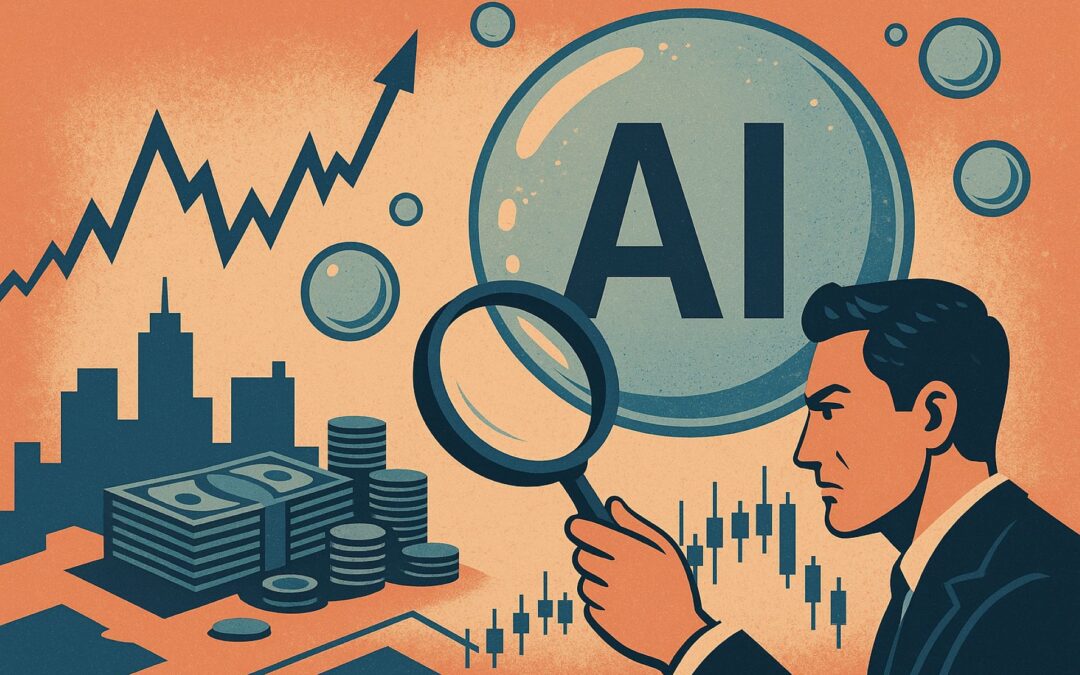
Every generation crowns its next great revolution — railroads, electricity, the internet, cryptocurrency — and now, artificial intelligence. Billions are being poured into its promise, fortunes are being minted on speculation, and entire industries are reorganizing around the belief that AI will reshape civilization itself.
Yet beneath the glow of progress lies an uneasy question: Is this a genuine transformation, or just another bubble wrapped in digital glitter? The signs are contradictory. On one hand, AI is already embedded in our daily lives — writing our emails, designing our graphics, coding our tools.
On the other hand, most of the companies building it are hemorrhaging money, sustained not by profit but by belief. This tension — between real utility and inflated expectation — defines the moment we’re in. The AI revolution may indeed be the future, but as history reminds us, even the future can get ahead of itself.
The Bull Case: Foundations Stronger Than the Hype
To call today’s AI boom a “bubble” is to misunderstand its foundation. Unlike the dot-com mania of the late 1990s, this surge in artificial intelligence isn’t being propped up by fragile startups or speculative euphoria alone. It’s being underwritten by some of the most profitable, entrenched, and liquid corporations in human history — companies that not only have the means to experiment but the balance sheets to absorb failure.
In the late ’90s, the internet was new, mysterious, and poorly understood. Investors were betting not on the internet itself but on its promise, blindly throwing money at any company that dared append “.com” to its name. Pets.com sold pet food online, burning through millions before collapsing. Dozens of other firms — eToys, Webvan, Kozmo — shared the same fate. They weren’t pioneers; they were placeholders for an idea the infrastructure couldn’t yet support. Dial-up connections, expensive servers, and rudimentary software made the dream of a truly digital economy technologically premature.
Fast-forward to the 2020s, and the contrast couldn’t be sharper. The companies driving the AI revolution — Microsoft, Google, Amazon, Meta, Apple, Nvidia — aren’t small speculative bets. They’re corporate empires sitting atop mountains of cash, sustained by steady, recurring profits from advertising, software, and cloud services. Microsoft alone generated over $80 billion in operating income last year. These firms aren’t chasing survival; they’re funding the future with yesterday’s success. They’re reinvesting profits, not borrowing belief.
This matters because it changes the entire character of the boom. In a traditional bubble, the inflow of capital comes from speculation — investors betting on growth that doesn’t yet exist. In this case, the money fueling AI isn’t coming from desperate venture funds or debt-laden startups. It’s coming from the accumulated profits of the world’s most stable enterprises. Microsoft isn’t mortgaging its future to build AI. Google isn’t pawning its core business to develop Gemini or DeepMind’s models. These are strategic reinvestments, not speculative leaps. Even if AI underdelivers in the short term, the companies funding it remain wildly profitable in their existing domains.
The other crucial distinction lies in utility. The internet in 1999 was still a curiosity; it promised transformation but delivered inconvenience. Streaming a video, buying a product online, or finding directions required patience and luck. By contrast, AI has entered the public consciousness as an immediately useful tool. It can write, code, summarize, design, and automate with astonishing speed. Millions of individuals and organizations now use AI daily — not as a novelty but as an integral part of their work. Writers use it for drafts, developers for debugging, marketers for campaigns, analysts for data parsing. The adoption curve isn’t theoretical; it’s happening in real time, across industries.
Every major technological revolution in history has gone through this phase — from electricity to the internet — but few have offered this level of instant accessibility. You don’t need specialized hardware or training to use AI; you just need a browser and a question. The barrier to entry is virtually zero, and the productivity upside is tangible. Even if efficiency gains are incremental today, they accumulate over time, as businesses learn to integrate AI more intelligently into their operations.
Then there’s the matter of infrastructure. The dot-com boom had to invent its own scaffolding. Startups were forced to build their own servers, invent digital payment systems, and develop the protocols that would later form the backbone of the internet. When the bubble burst, much of that scaffolding collapsed with it. But AI is being built atop a foundation that’s already complete. The world now runs on high-speed internet, cloud computing, and decades of accumulated software expertise. There are global data centers, distributed networks, and specialized GPUs capable of handling the monumental computational loads that machine learning demands. The architecture is already there — resilient, scalable, and continually improving.
This creates a safety net. If an individual AI company fails, the infrastructure it relied upon doesn’t disappear. Nvidia’s chips, Amazon’s servers, and Google’s data centers remain indispensable, powering not just AI but the broader digital economy. The industry may prune its weaker branches, but the tree itself is deeply rooted.
Finally, and perhaps most importantly, the nature of the participants makes collapse less catastrophic. In 2000, the dot-com crash wiped out thousands of companies that had no cash reserves, no proven products, and no diversification. When the bubble burst, they imploded overnight. Today’s AI leaders, however, are diversified juggernauts. If AI underperforms, they still have advertising, cloud, search, e-commerce, and hardware to sustain them. A slowdown would hurt valuations, not obliterate them.
In essence, this isn’t a speculative sprint — it’s a long-term structural evolution. The largest corporations on Earth are aligning their resources, talent, and infrastructure toward a technology that’s already proving useful and that stands to redefine entire industries. That doesn’t mean there’s no excess, no hype, or no misallocation of capital. There always is. But unlike the hollow optimism of the dot-com days, today’s AI wave is anchored in tangible capability, robust profitability, and the solid bedrock of an economy that’s already digital.
If the dot-com era was a leap of faith into the unknown, the AI era is a calculated step across a bridge we’ve already built.
The Bear Case: When Usefulness Meets Unprofitability
Every boom has its blind spots, and the AI surge may be no exception. For all the talk of transformation, much of the current excitement around artificial intelligence rests on shaky ground — a cocktail of overestimation, misapplication, and economic imbalance. The technology works, yes. But as history has shown, “working” and “creating sustainable value” are two very different things.
The first crack in the narrative appears when you examine the numbers. According to recent studies, roughly 95% of companies experimenting with generative AI have reported no measurable improvement in productivity since adopting it. Even more worrying, some saw efficiency decline due to workflow disruptions, employee confusion, and integration costs. Only about one in twenty firms saw a positive return on their investment. These are not statistics of a mature, transformative technology; they’re signs of a tool still searching for its fit.
The reason runs deeper than the technology itself — it lies in how businesses use it. Over the past two years, corporate adoption of AI has often been driven more by fear of missing out than by strategic necessity. Executives worried that competitors might “get ahead” threw money at AI pilots, integrations, and consultants without a clear sense of purpose. In many cases, the technology was wedged into systems that didn’t need automation or creativity at all. Companies used chatbots to replace customer service, even when their customers preferred human interaction. They automated content creation but then spent double the time editing the AI’s mistakes. What resulted wasn’t efficiency — it was confusion wrapped in novelty.
This points to a fundamental distinction often lost in the noise: usefulness isn’t the same as profitability. AI can generate text, code, or imagery impressively, but that doesn’t automatically translate into financial gain. The majority of generative tools on the market today either duplicate existing capabilities or offer minor improvements to processes that weren’t broken. A company using AI to generate meeting summaries may save minutes, not millions. And at scale, the cost of implementation, employee retraining, and compliance often outweighs those small gains.
Then there’s the expectations gap — the chasm between what AI was supposed to do and what it’s actually doing. Artificial intelligence was sold as a civilization-altering force, an innovation on par with electricity or the internet. We were promised a world where algorithms cured cancer, solved climate change, and created post-scarcity abundance. What we got, at least so far, are tools that mostly generate words and images. They’re clever, creative, and at times uncanny — but rarely revolutionary.
Take OpenAI’s Sora, the much-hyped text-to-video model. It can generate stunningly realistic footage, entire cinematic sequences conjured from prompts. Yet, its primary use so far? Meme creation, short-form entertainment, and marketing experiments. These are cultural curiosities, not economic revolutions. Even Google’s AI-powered search — heralded as the future of information retrieval — has so far proven more incremental than epochal. It might save a few clicks, but it hasn’t fundamentally changed how people search, learn, or buy. The gap between aspiration and application grows wider by the month.
Still, the most alarming reality isn’t the technology’s underperformance — it’s the economics behind it. Running modern AI systems is staggeringly expensive. Each user query, image generation, or text completion consumes vast amounts of computational power. Behind every conversation with ChatGPT lies a small army of GPUs, servers, and energy resources working in concert. Each inference — the process of producing an output from a trained model — costs real money. Scale that across millions of users, and you begin to see the financial strain beneath the surface.
In fact, many of the companies leading the AI revolution are operating deep in the red. OpenAI, Anthropic, and others are spending far more than they earn. Subscription plans and API licenses generate revenue, yes, but nowhere near enough to offset the cost of running massive neural networks 24/7. Every query you make, every image you render, every code block generated — it all burns electricity and cash. The irony is sharp: the more popular AI tools become, the more money they lose. Usage scales faster than profitability.
The only consistent winner so far is Nvidia, whose GPUs power nearly every major AI model on Earth. In effect, Nvidia is selling the shovels during the gold rush — the indispensable hardware that everyone else needs to compete. Its valuation has skyrocketed accordingly, making it one of the most valuable companies in the world. But even this dynamic exposes fragility. If AI adoption slows or investment stalls, Nvidia’s growth engine sputters too. When miners stop digging, shovel sales collapse.
Beyond profitability, there’s another issue — the illusion of advancement. Much of what’s being built under the AI banner today isn’t truly innovative; it’s iterative. New startups are raising tens or hundreds of millions of dollars to build interfaces, wrappers, and minor variations of the same underlying models produced by OpenAI or Anthropic. This creates a bloated ecosystem of redundant tools, each vying for attention but offering little differentiation. It’s reminiscent of the late 1990s, when thousands of internet startups existed solely to ride the wave of hype rather than to solve real problems.
And perhaps most revealing of all is the way society measures AI’s impact. Despite the widespread excitement, productivity growth in developed economies remains flat. Real wages haven’t surged. Hours worked haven’t dropped. If AI were truly reshaping work and industry at the scale promised, those effects would already be visible in the macro data. For now, they aren’t.
That doesn’t mean AI isn’t valuable — it clearly is — but it suggests the value is unevenly distributed. A handful of chip manufacturers, cloud providers, and platform owners are reaping enormous rewards, while the rest of the ecosystem struggles to translate hype into tangible return. This imbalance — a few winners floating atop a sea of unprofitable ventures — is precisely what defines a bubble in its early stages.
In short, AI’s problem isn’t that it doesn’t work. It’s that it works just enough to keep people believing, but not enough to justify the scale of the investment. And when belief, not profit, becomes the main currency sustaining an industry, history shows that it doesn’t take much to bring it all back down to earth.
A Game of Circular Money
Follow the flow of money in the AI ecosystem, and you begin to see a strange dance — a choreography of investment, partnership, and reinvestment so intricate that it sometimes feels detached from reality. Beneath the inspiring talk of innovation lies a financial loop, where dollars circulate endlessly between the same handful of players, inflating valuations and reinforcing the illusion of unstoppable momentum. This phenomenon has a name: round-tripping — when companies fund one another in closed circles, each counting the exchange as growth. It’s the kind of circular motion that keeps markets spinning long after the underlying energy has faded.
Take Nvidia, the undisputed kingmaker of the AI revolution. In 2024, the company announced plans to invest billions of dollars in OpenAI to help it expand its computing capacity. On the surface, this sounds visionary — a leading chip manufacturer backing the most famous AI lab in the world. But then comes the catch: OpenAI will use a large portion of that same capital to buy Nvidia’s GPUs. Nvidia records those sales as revenue. Its stock price climbs. OpenAI’s valuation rises because it now controls more infrastructure. Everyone looks richer on paper, even though no new value has been created. The same money has simply been passed in a circle, dressed in different accounting clothes.
This is not an isolated example. AMD, Nvidia’s closest rival, struck a similar deal — promising to supply chips to OpenAI in exchange for equity. Oracle, another major player in the AI race, signed a $30 billion agreement to provide cloud hosting and data center capacity to OpenAI, which in turn is financed by investments from Nvidia and other tech giants. Money flows from one balance sheet to another, each transaction booked as income or asset growth. What looks like expansion is often just a system feeding itself.
This circular financing creates a dangerous illusion — one where activity masquerades as profitability. On earnings calls, each company reports rising demand, growing contracts, and impressive revenue numbers. Analysts applaud, stock prices soar, and investors pile in. But peel back the layers, and the same dollars are doing laps around Silicon Valley. The ecosystem begins to resemble a hall of mirrors: every reflection brighter than the last, every reflection built on the same light.
Of course, this isn’t fraud. It’s not illegal. It’s a byproduct of an over-concentrated industry where the same companies are both customers and investors in one another. Microsoft invests in OpenAI and then integrates its products into Azure and Office 365, generating demand for its own cloud infrastructure. Nvidia funds AI labs that, in turn, spend billions on Nvidia’s chips. Oracle leases its servers to AI firms that boost Oracle’s revenue while relying on the same capital inflows Oracle helped secure. Each player becomes both a financier and a client in a loop of self-sustaining optimism.
The problem arises when such systems are mistaken for genuine market growth. Investors see Nvidia’s revenue explode and assume AI adoption must be booming across the economy. They see OpenAI’s rising valuation and conclude the technology must be generating massive returns. But what’s really happening is a kind of financial echo chamber — value reverberating within the same confined space. The system hums beautifully, but its music depends entirely on uninterrupted liquidity. If the money stops circulating, the melody dies.
This pattern echoes what economists call reflexivity — the feedback loop between perception and reality that George Soros famously described. When investors believe a market will grow, they pour in money. That inflow drives prices up, validating their belief. But the moment sentiment shifts, the illusion collapses in reverse. In the AI sector, round-tripping amplifies this reflexive effect: the more companies invest in each other, the stronger the illusion of health. Yet all it takes is one link in the chain to falter — one major fund to dry up, one corporation to pause its spending — for the whole circle to lose momentum.
This vulnerability becomes clearer when you imagine the chain reaction. Suppose Nvidia scales back its investments. OpenAI loses a key source of capital, forcing it to cut back on hardware purchases. That reduction hits Nvidia’s bottom line, which in turn makes it less likely to invest in other AI companies. Oracle, dependent on OpenAI’s demand for cloud capacity, suddenly sees its data centers underutilized. AMD’s anticipated chip deals stall. Each step in the loop triggers the next — not because any single company failed technologically, but because the web of interdependence stopped spinning.
And therein lies the hidden danger of this “AI economy.” It is not yet powered by self-sustaining profits but by a choreography of shared expectations — a network of trillion-dollar firms playing musical chairs with capital. As long as the music plays, everyone looks productive. But if it stops, we may discover that much of the apparent momentum was a trick of timing — money moving faster than meaning.
To be clear, this doesn’t make AI itself a scam. There is genuine innovation taking place — breakthroughs in model efficiency, robotics, and multimodal reasoning. But the business of AI, as it currently stands, is propped up by a cycle of reinvestment that feels more like speculation than revolution. The market has confused motion for progress and partnership for profitability.
History tells us this pattern rarely ends quietly. In every major boom — from railroads to dot-coms to crypto — circular financing appeared just before the correction. Money was being recycled faster than value could be created. The question isn’t whether the AI cycle will slow, but when. Because when an industry’s lifeblood becomes its own reflection, gravity has a way of reminding it that no loop lasts forever.
The Economic Domino Effect
Every financial cycle eventually collides with the real economy, and the AI boom is no exception. The scale and concentration of capital now tethered to artificial intelligence are so immense that what happens in this sector could soon dictate the direction of the entire global market. This is where optimism starts to turn uneasy — because the same forces lifting the economy today could, under strain, drag it down tomorrow.
According to JPMorgan, roughly 30 companies now make up about 44% of the total value of the S&P 500, and almost all of them are directly or indirectly tied to AI. That statistic should give anyone pause. Nearly half of the world’s most influential stock index — the barometer of American capitalism — depends on the success of a single technological paradigm. When one idea carries that much weight, it ceases to be a niche innovation; it becomes a systemic risk.
The market’s dependence on AI is not purely speculative either — it’s measurable in the macroeconomic data. Analysts estimate that in 2025, around 40% of U.S. GDP growth will come from AI-related spending. That includes everything from chip manufacturing and data center construction to software development, cloud expansion, and digital infrastructure. Strip that out, and the remaining growth in the economy is barely visible. Without AI-driven investment, the U.S. would have grown by an anemic 0.1% in the first half of the year — a number perilously close to stagnation. In other words, remove the AI frenzy, and the economic pulse almost flatlines.
This has created a peculiar paradox: AI is both lifting and hiding the economy’s weaknesses. On one hand, the sector’s expansion has driven stock prices, kept employment steady in tech-adjacent industries, and fueled optimism about future productivity. On the other, it has masked the fragility of sectors that aren’t directly benefiting from the boom — manufacturing, retail, real estate, and even parts of finance. The U.S. economy looks healthy, but much of that vitality is being projected by AI-related corporate activity. Without it, the underlying picture may be far less resilient.
Such dependency makes the system brittle. If AI continues to grow, the illusion of strength holds. But if something interrupts the flow — if interest rates rise, consumer spending falters, or investors lose confidence — the correction could be swift and severe. This is where the concept of a “domino effect” becomes more than metaphor. Because in today’s financial architecture, AI isn’t just one sector among many; it’s the connective tissue linking several trillion-dollar industries — semiconductors, cloud computing, social media, and e-commerce.
Here’s how the chain might unfold. Suppose a mild recession emerges — not because of AI itself, but due to broader economic slowdown. Investors, looking to offset losses elsewhere, start withdrawing from riskier tech stocks. AI startups, dependent on continuous rounds of funding, suddenly find their capital pipelines drying up. Without cash, they scale back operations, cut staff, or shut down entirely. The ripple travels upward: cloud providers like Amazon and Oracle lose clients. Nvidia sells fewer chips. Demand for data center space cools. Each link weakens the next.
At the same time, large corporations — Microsoft, Google, Meta — face a new dilemma. Their valuations are inflated partly by the AI narrative. If enthusiasm fades, their share prices fall, cutting into market capitalization and investor confidence. Pension funds and institutional investors, heavily exposed to these giants, feel the tremors next. A contraction in AI spending, even if temporary, could therefore affect everything from tech employment to national GDP. It’s the same feedback loop that turned the housing market collapse of 2008 into a global recession: a single over-leveraged sector infecting the system that depended on it.
The real irony is that the companies most responsible for inflating the AI bubble may also be the only ones capable of surviving its collapse. Microsoft can absorb a few years of disappointing returns; it still dominates software and enterprise services. Google’s ad empire will continue to print cash even if Gemini underperforms. Amazon’s e-commerce and logistics networks are too embedded to vanish. Nvidia, though volatile, remains the indispensable hardware supplier. In short, the giants that fueled the bubble have the balance sheets to outlast it — leaving smaller competitors to bear the brunt of the fallout.
This means that when the correction comes, the AI landscape could actually become more concentrated, not less. Thousands of smaller firms — startups, tool builders, consultants — would evaporate overnight, unable to sustain losses without investor capital. The survivors would be the titans who already own the servers, data, and distribution networks. The same consolidation that followed the dot-com crash would repeat itself: innovation contracting into the hands of those who can afford its inefficiencies. The long-term result? Fewer players, higher barriers, less diversity — and more control concentrated in Silicon Valley’s upper echelon.
It’s also worth noting the psychological dimension of this phenomenon. AI’s growth narrative has become a cultural story, not just a financial one. It’s tied to national pride, technological destiny, and the idea of progress itself. Governments view AI as a strategic asset; nations compete for dominance in chips and models the way they once did for oil and steel. When a technology becomes this intertwined with ideology, pulling back becomes politically difficult. Policymakers, reluctant to dampen the narrative of “innovation leadership,” may continue subsidizing or encouraging investment long after the private sector has lost enthusiasm. That delay could cushion the fall — or amplify it, depending on timing.
If history is a guide, we can expect one more acceleration before the slowdown. Bubbles rarely deflate gently; they often expand until belief exceeds logic, and only then do they collapse. The AI sector, given its current scale and concentration, is likely to follow that rhythm. The turning point won’t necessarily be technological — it will be psychological. The moment investors realize that “growth” was actually circular, that profitability remains distant, and that the broader economy is no longer keeping pace, the correction will begin.
And yet, there’s a strange comfort in this inevitability. When the dust settles, the real value of AI will remain — the core innovations that genuinely change how humans work, think, and create. The froth will vanish, but the foundation will hold. The dominoes may fall, but not all will break. What emerges on the other side will be leaner, slower, and perhaps wiser — an AI industry that finally learns to grow not on hype, but on reality.
Beyond the Hype: What Survives the Pop
Every era of technological exuberance ends the same way — in correction. The housing bubble, the crypto mania, the dot-com frenzy — all burned brightly before collapsing under the weight of their own excess. Yet, paradoxically, each one left behind something valuable: infrastructure, ideas, and habits that would quietly mature once the noise subsided. The internet bubble built the digital world we now live in. The renewable energy bubble accelerated a shift toward sustainability. The question for AI, then, isn’t if it will experience a reckoning — it’s what will remain standing when it does.
To begin with, bubbles are not merely destructive; they are purifying. They force an industry to reveal its core. When the speculative money dries up, only products with genuine utility survive. In the early 2000s, thousands of internet startups vanished, but out of that chaos rose Amazon, Google, and eBay — companies that solved real problems with real users. In the same way, the AI correction, when it arrives, will strip away the noise — the dozens of copycat startups building chatbots, the endless “AI for X” ventures chasing funding rather than purpose — and leave behind the innovations that truly matter.
The real AI revolution isn’t happening in viral tools or flashy demos; it’s unfolding quietly in the background — in medicine, climate science, logistics, and research. These are domains where AI’s analytical power could reshape humanity’s fundamental capacities. Algorithms capable of modeling protein structures or predicting molecular behavior are already transforming drug discovery. In climate science, machine learning models can simulate planetary systems faster and with more precision than any supercomputer could a decade ago. AI-driven logistics optimization is cutting waste, fuel costs, and emissions at global scale. These are the undercurrents of a deeper transformation — less visible, less hyped, but far more consequential than another text generator.
The challenge, however, lies in patience. The market rarely rewards technologies that take time to bear fruit. Investors want growth now, not in ten years. But paradigm shifts seldom move at the speed of quarterly earnings. The railroad bubble of the 1840s bankrupted dozens of companies, yet the railways themselves went on to connect entire continents. The dot-com crash erased trillions in paper wealth, yet within a decade, the internet became indispensable to human life. AI is poised for the same trajectory: an overhyped beginning, a painful correction, and then a quiet, durable rise into permanence.
Another key point often overlooked is how bubbles build infrastructure. Even when the optimism fades, the physical and digital scaffolding remains. The billions of dollars currently flowing into data centers, GPUs, energy grids, and cloud infrastructure won’t simply evaporate when valuations fall. These assets are tangible. They will continue to power research, startups, and future technologies for decades. The same data centers built to train today’s large language models will one day host new systems — leaner, smarter, and more efficient. Just as the fiber-optic cables laid during the dot-com boom became the backbone of the modern internet, today’s AI infrastructure could become the foundation of the next digital epoch.
There’s also a deeper philosophical dimension to this pattern. Human beings, as a species, are cyclical learners. We overestimate the short term and underestimate the long term. Every innovation — from the steam engine to the smartphone — begins with utopian promises and ends with disillusionment before settling into quiet utility. The hype cycle isn’t a flaw; it’s a feature of how we collectively process change. The AI boom is simply our latest iteration of this ritual — a burst of collective imagination that pushes boundaries faster than reason can keep up, followed by a necessary correction that brings vision back in line with reality.
When that correction arrives, it will force a shift in narrative — from spectacle to substance. The focus will move from consumer-facing gimmicks to foundational research and problem-solving. Companies that have built their business models purely on novelty will vanish; those that embedded AI as a tool rather than a product will thrive. The next generation of winners won’t be those chasing virality but those quietly integrating intelligence into systems that already matter — education, governance, environmental management, manufacturing, and health care. The true value of AI won’t be in replacing humans but in amplifying human capability.
And beyond the economics, there’s an ethical awakening that must come. The more AI infiltrates our world, the clearer it becomes that intelligence without conscience is insufficient. The frenzy of profit has, for now, overshadowed questions about bias, misinformation, and the moral architecture of these systems. But when the hype fades, those questions will take center stage. The survivors of the bubble will not just be the most efficient — they’ll be the most responsible. The future of AI will belong to the builders who pair technical brilliance with human wisdom.
That’s perhaps the greatest irony of this entire cycle. For all the talk about artificial intelligence surpassing human intelligence, the determinant of its fate will still be profoundly human: our restraint, our foresight, and our willingness to learn from excess. Bubbles are, in essence, moral lessons disguised as market phenomena. They expose our collective impatience — our desire to compress decades of progress into months of profit. But they also remind us that what endures is never the hysteria, only the work.
So when the AI bubble pops — and it almost certainly will — the wreckage will not be the end of innovation. It will be its renewal. The inflated promises will collapse, the speculative capital will flee, and in that silence, the real builders will emerge. The researchers refining algorithms for cancer detection. The engineers designing energy-efficient chips. The educators using AI to democratize learning. The artists exploring creativity, not automation.
And perhaps that’s the enduring truth about all human progress: we advance not by avoiding bubbles, but by surviving them. They are the price we pay for our ambition, and the proof that we are still reaching — imperfectly, impulsively — for the next horizon.
Conclusion
The story of technology is the story of overreach and correction — of belief racing ahead of reality, and then reality catching up. If AI is a bubble, it is one built on both delusion and direction: a fever of speculation fueling genuine discovery.
When the froth subsides, the noise will quiet, and what remains will be the infrastructure, ideas, and applications that truly matter. The next phase of AI won’t be about dazzling demos or inflated valuations; it will be about integration, ethics, and endurance.
In time, this moment — the frenzy, the fear, the fortune — will be seen not as a failure, but as a necessary stage in humanity’s learning curve. Because every bubble, in the end, is a mirror: it shows us not just what we build, but what we believe.