
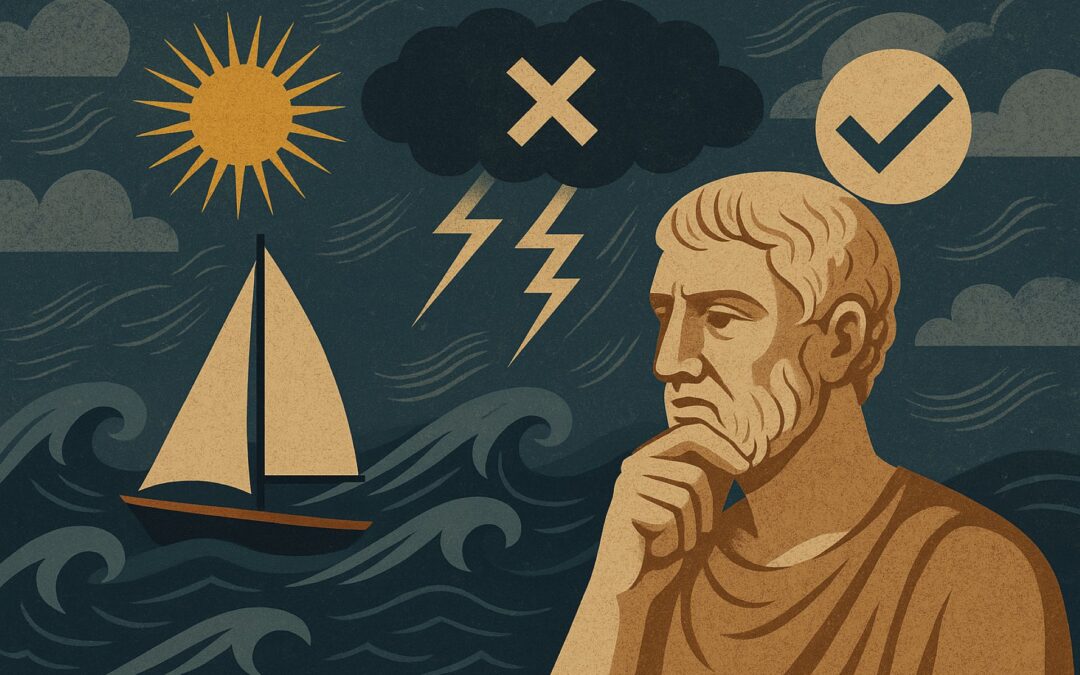
Every day, we fight invisible battles—against traffic, time, people, even the weather. We curse the world for not bending to our will, forgetting one essential truth: most of life is outside our control. The Stoics understood this better than anyone. They knew that peace begins where control ends. What we can influence—our choices, our effort, our attitude—is small but powerful. What we cannot—everything else—must be met with calm acceptance.
This distinction between control and chaos is the heart of Stoic philosophy. It is the key to resilience, composure, and strength in a world that never stops shifting. When you stop wasting energy on what you can’t command and focus it on what you can, life becomes lighter. The storms still come, but they no longer throw you off course. You learn to steer, not struggle.
“The chief task in life is simply this: to identify and separate matters so that I can say clearly to myself which are externals not under my control, and which have to do with the choices I actually control. Where then do I look for good and evil? Not to uncontrollable externals, but within myself to the choices that are my own . . .”
—Epictetus, Discourses, 2.5.4–5
The Discipline of Discernment
The essence of Stoic philosophy lies in a single, unyielding principle: to distinguish clearly between what we can control and what we cannot. It sounds elementary, almost trivial—until you try to practice it. Every day, we are tested by circumstances that pull at our emotions, provoke our impatience, and tempt us into believing that the world should conform to our desires. The Stoics knew this illusion well. They saw that most human misery springs not from events themselves, but from our mistaken belief that we can—or should—command what lies beyond our reach.
The average person spends much of life tangled in this confusion. They shout at the television, curse the traffic, obsess over the past, or worry about outcomes that have not yet unfolded. This inner turmoil comes from a simple failure to separate the controllable from the uncontrollable. The result is exhaustion—emotional, mental, and spiritual. We spread ourselves thin chasing control in places it doesn’t exist, while neglecting the one domain where control is absolute: our own mind.
For the Stoic, the mind is sovereign territory. It cannot be invaded without permission. Within it lies judgment—the lens through which every experience is filtered. Whether we call an event a tragedy or an opportunity, an insult or indifference, depends entirely on our interpretation. That interpretation is within our command. External events are not.
This practice of discernment requires constant vigilance. It’s not a one-time revelation, but a discipline forged through reflection and repetition. When Marcus Aurelius wrote, “You have power over your mind—not outside events,” he was reminding himself, not preaching to others. Even an emperor needed to rehearse this truth daily. Because clarity fades under pressure, and the world delights in distraction.
Discernment also demands humility—the acceptance that we are not omnipotent, that the universe does not revolve around our preferences. This humility is not defeat but liberation. Once you stop insisting that everything go your way, life becomes lighter. You begin to conserve your strength for what truly matters: your attitude, your ethics, your effort, and your decisions.
Those who master this separation—who can see clearly where their influence begins and ends—gain an extraordinary advantage. They do not crumble under chaos, because their foundation is internal. They do not depend on the weather of fortune to determine their mood. They navigate life with composure, for they know that while they cannot control the wind, they can always adjust their sails.
The Futility of Resistance
Imagine standing on a shoreline, shouting at the waves to stop crashing. You could scream until your throat gives out, but the tide would not yield. The sea is indifferent to your will. Yet this is precisely how most of us live—resisting what cannot be changed, as if our defiance could rewrite the laws of nature.
A delayed flight, a betrayal, a market downturn, an illness—each becomes a battlefield for our expectations. We react with outrage, self-pity, or denial, believing our emotions might reverse what has already occurred. But resistance only deepens the wound. As the Buddha said centuries before the Stoics, pain is inevitable; suffering is optional. Pain is the event. Suffering is our refusal to accept it.
This refusal is born of pride—the quiet arrogance that insists the world should bend to our plans. But nature is impartial. The storm does not consult your schedule before it forms. The economy does not rise or fall to honor your ambition. People will not always reciprocate your kindness, no matter how sincere it is. The universe owes us nothing, and to expect otherwise is to invite perpetual disappointment.
When we fight against what cannot be altered, we lose twice: once to reality, and once to our own resistance. The Stoics understood this double defeat. They taught that tranquility is not found in controlling circumstances but in harmonizing with them. Acceptance, therefore, is not passivity—it is strategic intelligence.
Consider Epictetus himself. Born a slave, he endured poverty, pain, and powerlessness in every external sense. Yet he refused to see himself as a victim. He recognized that his master could chain his body, but never his mind. His freedom lay not in rebellion, but in understanding where his control truly resided. That insight transformed his suffering into strength—and his bondage into wisdom.
To resist what is immovable is to waste the finite energy of life. That energy could instead be used to act wisely within the realm of control—to improve character, to respond with grace, to endure with dignity. The Stoic redirects the instinct to fight outward into the will to refine inward.
This shift marks the turning point between chaos and composure. The world may remain wild and unpredictable, but the wise no longer flinch at its storms. They stand firm, not because they control the tempest, but because they no longer try to.
The Serenity to Accept
Acceptance, to the Stoic, is not a gesture of surrender—it is an act of power. It’s the calm recognition that while the universe is vast, unpredictable, and often indifferent, our peace depends on our ability to live in harmony with its rhythm. Acceptance means seeing the world as it is, not as we wish it to be. It means learning to breathe in the midst of uncertainty, to stay composed in the face of disappointment, and to continue acting with integrity even when outcomes defy our expectations.
The Serenity Prayer, often recited in recovery circles, distills this ancient wisdom into a single, elegant plea: “God, grant me the serenity to accept the things I cannot change, the courage to change the things I can, and the wisdom to know the difference.” It captures the essence of Stoic philosophy without ever naming it. Serenity, courage, wisdom—three virtues that together form the architecture of a grounded mind.
For those struggling to rebuild their lives—whether from addiction, loss, or failure—acceptance is often the hardest lesson. The mind resists it because it feels like giving up. But the Stoic sees acceptance differently. It’s not resignation; it’s alignment. It’s a deliberate refusal to waste emotional energy fighting what cannot be undone. The past cannot be rewritten. The weather will not change to suit our mood. People will act according to their nature, not our expectations. The wise person accepts this not with cynicism but with clarity.
Epictetus embodied this truth. Born into slavery, crippled by his master, and stripped of worldly control, he could have grown bitter and broken. Yet he didn’t. He discovered that freedom begins where acceptance starts. His body was confined, but his mind was limitless. His external conditions were dictated by others, but his internal state was his own creation. Through acceptance, he found serenity—and from serenity, he built strength.
Acceptance is not passive. It’s a strategic pause before decisive action. It’s the stillness that allows one to think clearly before responding. When we stop wrestling with the uncontrollable, we reclaim the energy to act wisely in the present. We begin to notice opportunities hidden beneath obstacles. We start to see challenges not as punishments, but as invitations to grow.
To accept is to return to the present moment—the only moment where control exists. It’s the space between stimulus and response, between impulse and decision. There, in that quiet gap, lies the power to choose how to live, how to think, and how to move forward. Acceptance doesn’t make life easier. It makes it clearer. And clarity is the foundation of peace.
The Advantage of Awareness
Awareness is the unseen edge of wisdom. It is the silent advantage possessed by those who no longer mistake control for dominance. In a world obsessed with manipulation—of outcomes, appearances, and perceptions—the Stoic remains anchored in awareness. They see life for what it is: a dynamic interplay of forces, some within reach, most beyond it. The unwise react; the aware respond.
Modern life thrives on the illusion of control. It tells us that everything can be optimized, hacked, or mastered—if only we buy the right course, download the right app, or follow the right guru. We are told we can control our success, our relationships, our time, even our destiny. Yet, the more we cling to this illusion, the more fragile we become. Every unexpected twist feels like an assault, every setback a failure. We grow restless, anxious, perpetually at war with reality.
But the Stoic’s awareness is different. It is calm, rooted, and unswayed by circumstance. They begin each day with reflection: What is within my control today? The answer is often smaller than we’d like—our effort, our attention, our honesty, our patience. And yet, within that small circle of control lies immense power. For when you focus on what you can actually influence, you multiply your effectiveness. You no longer scatter energy on impossibilities; you channel it into deliberate action.
This awareness creates a form of invincibility. The person who understands the limits of their control cannot be easily shaken. When others panic, they remain composed. When fortune turns, they adapt. Their peace does not depend on luck, approval, or circumstance. It is self-generated. They possess what the Stoics called ataraxia—a state of unshakable tranquility.
It is this advantage that separates the wise from the weary. The masses chase control as if it were a prize; the wise cultivate awareness as if it were armor. They don’t try to command the universe—they cooperate with it. They don’t try to predict every outcome—they prepare themselves for all outcomes. Awareness gives them the foresight to recognize when to act and when to step back, when to persist and when to let go.
Each day becomes a quiet exercise in mastery: observing, discerning, adjusting. The world continues its unpredictable dance, but the aware person moves with it, not against it. They are no longer victims of circumstance but participants in it. The chaos around them becomes context, not crisis.
And therein lies the Stoic advantage—not in controlling the external world, but in mastering the internal one. The person who understands this distinction walks through life with a rare composure. Their serenity is not borrowed; it is built. Their strength does not depend on fortune; it flows from within. And their awareness, clear and constant, turns every challenge into an opportunity to practice freedom.
Conclusion
Life will always be unpredictable. People will disappoint you, plans will unravel, and fate will have its say. But within that uncertainty lies your greatest power—the ability to choose your response. The Stoics remind us that serenity isn’t found in taming the world, but in mastering ourselves.
When you accept what cannot be changed, and act wisely upon what can, you reclaim your freedom. You become untouchable—not because the world grows gentler, but because you grow steadier. The difference between chaos and calm, frustration and peace, lies in one question: Is this within my control?
Once you learn to answer it honestly, life no longer happens to you—it begins to happen through you.
This article is a part of The Daily Stoic Series based on the book by Ryan Holiday.