
Every person is born with an invisible map—a quiet sense of direction embedded deep within their being. It’s not written in words or logic but in emotion, instinct, and curiosity. In childhood, this map is easy to follow. You’re drawn to certain activities, ideas, or experiences without hesitation. Yet, as life unfolds, the world begins to interfere. Expectations, fears, and comparisons drown out that inner voice until you lose sight of the path that was once clear.
“Everyone holds his fortune in his own hands, like a sculptor the raw material he will fashion into a figure. But it’s the same with that type of artistic activity as with all others: We are merely born with the capability to do it. The skill to mold the material into what we want must be learned and attentively cultivated.”
— Johann Wolfgang von Goethe
The truth is, you were never meant to live a life of imitation. You were meant to sculpt one. Within you lies the raw material of your destiny—talents waiting to be refined, passions waiting to be expressed, and a calling that only you can fulfill. The journey to mastery begins not with the external world but with an inward turn, a rediscovery of who you were before the noise began. Finding that calling, nurturing it, and walking its path is the foundation of a life well-lived.
Daily Law: Mastery is a process and discovering your calling is the starting point.
— Mastery, I: Discover Your Calling—The Life’s Task
The Inner Force That Guides You
Somewhere beneath the noise of modern life lies a force that is uniquely yours—an invisible current that has been present since birth. It’s not something mystical or abstract; it’s a quiet, guiding intelligence that speaks through fascination, instinct, and joy. This is your inner force—the compass of your life’s direction.
When you were a child, this force was unfiltered. You didn’t overthink or question it; you simply followed it. You were drawn to certain toys, games, or stories without needing to explain why. Maybe you loved taking things apart just to see how they worked. Maybe you could spend hours sketching, performing, or organizing imaginary worlds. That wasn’t random curiosity—it was early evidence of your natural wiring, your innate tendencies calling for expression.
Children operate from essence, not expectation. They don’t seek approval or social validation; they follow energy. When something excites them, they lean in. When something bores them, they drift away. It’s pure, intuitive navigation. But as we age, that internal compass gets clouded.
The world begins to intrude. Parents—often with the best intentions—project their fears and unrealized dreams onto us. They want safety and stability for their children, not risk and uncertainty. Teachers begin grading curiosity. Society rewards conformity over originality. Soon, we learn that passion doesn’t pay bills, that curiosity is indulgent, and that success means fitting into pre-defined molds.
And so, the inner voice grows faint. We start choosing based on external metrics—status, income, prestige—rather than internal resonance. We convince ourselves that practicality is maturity, when in truth, it’s often disguised surrender.
But here’s the paradox: the more we ignore that inner force, the more restless we become. No amount of achievement compensates for a lack of alignment. You can climb every corporate ladder and still feel empty if the climb itself doesn’t echo your nature. That gnawing dissatisfaction—the quiet ache that no success seems to cure—is your inner force reminding you that you’ve strayed too far from your essence.
To reclaim it, you must listen differently. Pay attention to the small signals that most people overlook—the topics that spark your curiosity, the work that makes time disappear, the moments that give you an inexplicable sense of “rightness.” These are not coincidences; they are coordinates.
Your task is to follow them with reverence. To quiet the world’s expectations long enough to hear your own. Because this force—your calling—has never left. It’s been whispering all along, waiting for you to remember the sound of your own truth.
Reconnecting with What Makes You Unique
Reconnection is both an excavation and a homecoming. It’s the act of peeling back years of conditioning to uncover what was always there—the authentic self that existed before you began performing for approval.
Each person carries a distinctive constellation of talents, temperaments, and inclinations. These are not arbitrary traits; they are clues. They point toward the domain where your potential can unfold most fully. The challenge is that we often lose sight of them beneath the weight of comparison. We measure our worth by others’ timelines, achievements, or definitions of success, forgetting that uniqueness, by nature, cannot compete—it can only express.
Reconnecting begins with radical self-inquiry. Ask yourself:
- When do I feel most alive?
- What activities make me lose track of time?
- What did I love doing before I learned what was “impressive”?
- What would I pursue even if no one were watching?
These aren’t surface-level questions. They are invitations to remember.
Often, the signs of your uniqueness are hiding in plain sight. The things you dismiss as “just hobbies,” “quirky habits,” or “unmarketable interests” may actually be fragments of your calling. The skill you take for granted because it feels easy to you—that’s precisely the point. What feels effortless to you feels impossible to others. That’s your leverage.
Reconnection also requires a shedding process. To make room for the authentic, you must release the inauthentic. The titles you chase for recognition. The paths you follow out of obligation. The roles you play to meet expectations. This shedding can feel like loss—but in truth, it’s reclamation. You are not abandoning who you are; you are returning to it.
Once you start living from that inner authenticity, your life begins to reorganize itself around it. Energy flows differently. Work feels lighter yet deeper. You attract people, opportunities, and challenges that resonate with your true nature. The external world starts to reflect your internal clarity.
This process isn’t linear. You’ll stumble, question, and sometimes doubt your direction. That’s normal. The mind resists what threatens its comfort zone. But if you remain devoted to your rediscovery, you’ll notice something profound: life begins to make sense again.
You stop asking, What should I do with my life? and start asking, What wants to be expressed through me?
That shift—from control to collaboration with your nature—is where power, peace, and purpose intersect.
Because reconnecting with what makes you unique isn’t about becoming something new. It’s about remembering who you were before the world told you who to be.
The Inward Path to Mastery
Mastery does not begin with talent, nor with ambition—it begins with awareness. Before you can conquer a field, you must first understand the instrument through which you’ll do it: yourself. Every artist, scientist, athlete, and innovator who rose to greatness began by looking inward. They studied their instincts, their rhythm, their natural curiosities, and allowed those to guide their long apprenticeship toward excellence.
To walk the path of mastery, you must first silence the obsession with external results. The world measures worth through outcomes—titles, income, recognition—but mastery is concerned only with depth. It asks, How deeply can you go into your craft? How fully can you inhabit what you do? The answers to those questions emerge not through shortcuts but through relentless refinement.
Self-knowledge becomes your compass. When you know your strengths, you learn to use them like precise tools. When you know your weaknesses, you learn how to train them, delegate them, or transform them into unconventional advantages. The process becomes symbiotic: as you shape your work, your work shapes you.
But mastery also demands humility. It asks you to abandon the ego’s craving for applause and instead commit to the invisible grind—the hours spent perfecting technique, observing details, questioning assumptions. It’s a quiet devotion to process, not performance. You’ll spend long periods in obscurity where your efforts seem unseen and your progress uncertain. Yet, this is the sacred stage of formation.
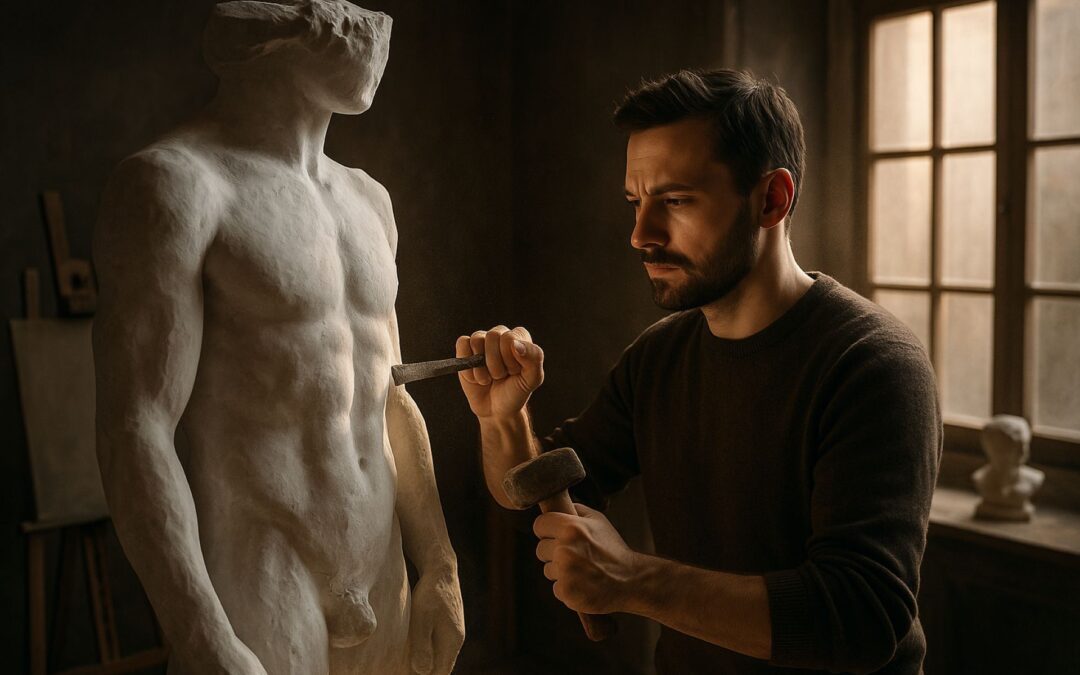
Think of the sculptor chiseling marble. Each strike seems minor, but together they reveal the form hidden beneath. The sculptor does not rush; he studies the stone, listens to its resistance, and adapts with care. Similarly, your craft will resist you at first. It will test your patience and expose your insecurities. But persistence transforms resistance into rhythm. Over time, what once felt like struggle begins to flow with grace.
True mastery is less about domination and more about harmony. You and your craft become inseparable. You no longer think about performing the act—it performs itself through you. The effort fades, replaced by instinct, and that is when your work begins to transcend. You move from doing to being.
And the beautiful paradox? The deeper you go inward, the further your influence extends outward. Mastery radiates. It doesn’t need to announce itself—it’s felt in the quiet confidence, the precision, and the unshakable calm of someone who knows their place in the order of things.
It Is Never Too Late
The tragedy of human life is not that people never find their calling—it’s that they stop believing it’s still possible. They imagine that purpose has an expiration date, that dreams have a shelf life. But life itself contradicts this. The inner force that once guided you as a child doesn’t vanish with time—it merely waits, buried beneath layers of practicality, duty, and distraction.
Many reach a point where they look back and feel regret: I should’ve done that. I should’ve started sooner. But regret only measures how long you’ve ignored your truth, not how far you are from it. The path remains open because purpose is not bound by age—it’s bound by awareness. The moment you remember, you can return.
In fact, beginning late often carries unexpected advantages. With age comes discernment. You’ve tested paths that weren’t yours and learned what emptiness feels like. You’ve gained resilience, emotional depth, and perspective—qualities your younger self lacked. These are not liabilities; they are the tools of reinvention. You now understand not only what you want but why it matters.
Starting again doesn’t mean abandoning everything you’ve built. It means repurposing it. Every skill, connection, and experience you’ve gathered becomes raw material. The corporate executive who rediscovers her love for design finds her managerial discipline invaluable in her new creative pursuit. The engineer who returns to teaching brings structure and clarity that his students desperately need. Nothing is wasted when you return to your true work.
The first step is honesty. Admit that the life you’ve been living no longer fits. That’s not failure—it’s awakening. From there, begin small. Take a class. Revisit an old passion. Volunteer in a field that excites you. Follow the faint pull of curiosity until it grows stronger. Momentum is built not from giant leaps but from consistent steps in the right direction.
When you realign with your calling, something extraordinary happens: the universe begins to cooperate. Opportunities that once seemed random start to align. People enter your life who reflect your renewed purpose. The outer world reshapes itself around your inner clarity.
It is never too late because the call never ceases. The sculptor may have left his marble untouched for decades, but the stone remains—waiting, patient, ready. The only question is when you will pick up the chisel again.
And when you do, you’ll realize that time wasn’t lost. It was seasoning you—preparing you to carve with precision what you could once only imagine finally.
Conclusion
Your calling is not something you chase—it’s something you uncover. It’s been with you all along, waiting beneath the surface for recognition. The pursuit of mastery begins when you reconnect with that hidden force, when you dare to shape your life around what feels deeply, unmistakably yours.
There will be moments of doubt, resistance, and even fear. But remember—the sculptor doesn’t abandon his work when the marble resists; he listens, adjusts, and continues. So must you. Every stroke of effort, every act of courage, and every return to authenticity reveals more of the masterpiece you were born to create.
It is never too late to begin again. Your life’s task still awaits—quiet, patient, and faithful to your return. Pick up the chisel. The marble is ready.
This article is a part of The Daily Laws Series based on Robert Greene’s book.