
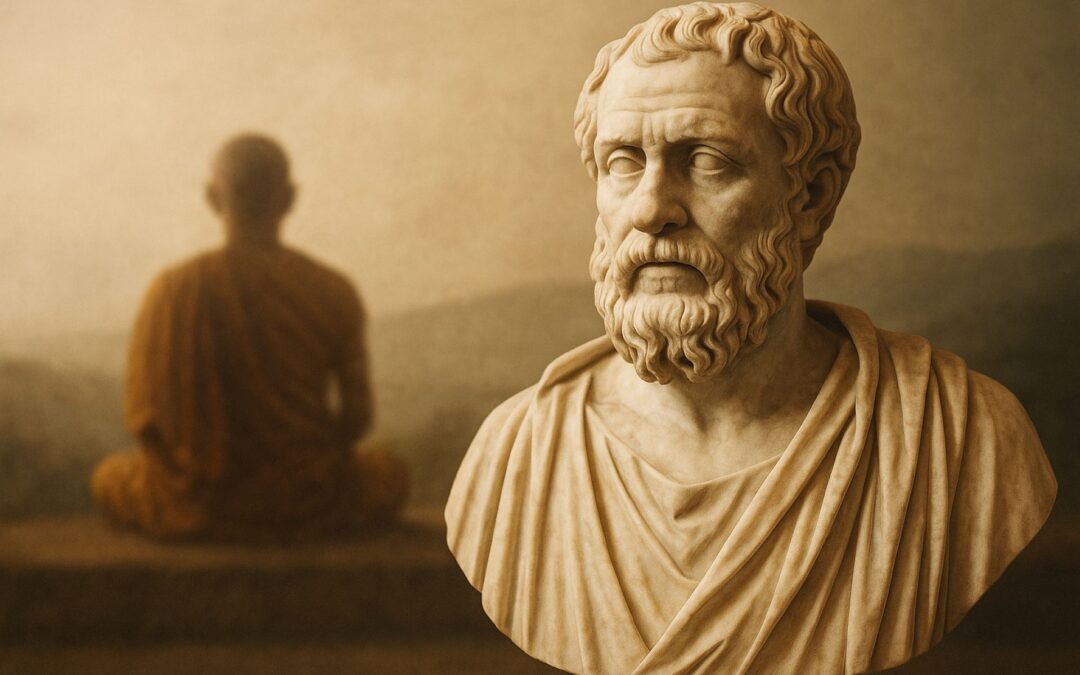
Everyone wants to be calm, but few understand what true steadiness demands. We chase quiet environments, simplified schedules, or perfect conditions, believing that peace will follow if we can just clear the noise. Yet the more we try to manipulate the world around us, the more fragile our calm becomes. A single disruption—a rude remark, an unexpected change, a missed opportunity—can shatter it completely.
The Stoics offered a harder, wiser truth: steadiness is not found in the absence of disturbance, but in the mastery of response. It is an inner state, built by reason and guarded by choice. You can stand in the center of chaos and still remain unmoved. As Epictetus wrote, if you anchor your peace to what’s beyond your control, you invite fear and instability. But if you root it in your own judgment, the world loses its power to shake you.
What follows is not an escape plan, but a manual for standing firm—how to find stillness in motion, composure amid conflict, and peace without retreat.
“For if a person shifts their caution to their own reasoned choices and the acts of those choices, they will at the same time gain the will to avoid, but if they shift their caution away from their own reasoned choices to things not under their control, seeking to avoid what is controlled by others, they will then be agitated, fearful, and unstable.”
— Epictetus, Discourses, 2.1.12
The Myth of the Serene Monk
For most of human history, our image of tranquility has been externalized. We picture it in the silhouette of a monk meditating at dawn, in the mist that curls through pine trees, in the rhythmic strike of a temple bell echoing through silence. It’s a beautiful fantasy—the idea that peace lives in remoteness, that if we could just withdraw far enough from the world, the noise would fade and stillness would appear.
But that illusion carries a hidden danger: it convinces us that calm depends on circumstance. We begin to believe that serenity is a matter of location, that stillness requires distance from difficulty. So, we flee the crowd, the city, the workplace, the relationships that agitate us—only to discover that we have packed the real source of our unrest in our own minds.
The Stoics dismantled this fantasy with surgical clarity. Marcus Aurelius ruled an empire from a war camp, surrounded by soldiers and disease, yet wrote in Meditations about inner peace. Epictetus, born a slave, lived in poverty and taught philosophy in noisy marketplaces, yet spoke of tranquility as something internal and constant. Seneca, a statesman in the heart of political chaos, wrote letters on equanimity amid corruption and intrigue.
Their example flips the modern ideal of serenity upside down. The monk on the mountain has peace because the mountain is still. The Stoic has peace because their mind is still—even when the mountain collapses.
The Stoic rejects isolation as a prerequisite for calm because isolation is fragile. It requires conditions that can be broken—a quiet place, a specific routine, the absence of others. True steadiness must survive without conditions. It must hold steady whether the world applauds or condemns, whether fortune smiles or sneers.
The Stoic’s peace is not delicate—it is forged. It doesn’t need a temple, because the temple is built within. It doesn’t require silence, because silence exists in their judgment. It doesn’t demand retreat, because their reason travels with them.
The monk’s serenity is borrowed from stillness; the Stoic’s serenity is self-generated. One depends on environment; the other depends on mastery. That is why the Stoic can remain calm amid traffic, argument, or tragedy—they do not wait for peace to arrive. They carry it.
And so, the myth must die: tranquility is not somewhere else. It is not found by moving away, but by moving inward. The real practice is not to avoid chaos—it’s to remain unmoved within it.
The Marketplace as the True Temple
The marketplace, in all its noise and negotiation, is where the Stoic’s philosophy comes alive. It’s the perfect testing ground for the mind. People rush, bargain, complain, boast, and deceive. There are smells, sounds, interruptions, and tempers. Nothing stays still for long. To most, this is distraction incarnate—a place to survive, not to grow. To the Stoic, however, it’s sacred. It’s the real temple of practice.
Marcus Aurelius, writing as emperor, described his mornings in a similar chaos: attendants, petitions, soldiers, schemers. Yet he reminded himself before rising from bed that the world would be full of “meddling, ungrateful, arrogant, deceitful, jealous, and surly” people—and that his task was not to change them, but to meet them with reason. Every day in the Forum was a sermon on self-command.
That is the essence of Stoicism: not to flee the world, but to remain whole within it.
The Stoic knows that inner strength must be tested against reality. Peace that depends on silence is weak. Virtue that thrives only in solitude is unproven. The philosopher who can keep composure amid clamor has achieved something rare: mastery of attention.
In this sense, the marketplace symbolizes modern life itself—emails, deadlines, conversations, misunderstandings, all colliding at once. We think that once we reach a quiet weekend or a long vacation, calm will return. But calm is not a time slot—it’s a state of being. If your peace evaporates the moment your phone buzzes, then it was never peace to begin with.
The Stoic doesn’t demand a change in the environment; they demand refinement of perception. Each external disturbance is reinterpreted as internal training. The impatient customer becomes a teacher of patience. The loud noise becomes a reminder of resilience. The rude remark becomes a test of ego. Every inconvenience becomes instruction.
This perspective transforms chaos into curriculum. The Stoic doesn’t curse the marketplace; they study within it. They are not distracted by noise—they use it to sharpen focus. They are not repelled by imperfection—they use it to refine endurance.
Seneca once wrote, “The Stoic should be like the soldier in the field, not the one who keeps to the safety of the walls.” The true temple, then, is wherever you stand. Every crowded street, every meeting room, every ordinary day is your monastery—if your mind is trained to treat it as one.
Peace is not about detaching from life. It is about engaging with it differently. The Stoic doesn’t pray for calm seas—they learn to steady the ship.
The Source of Instability
Epictetus’s warning cuts directly to the root of human unease: our obsession with controlling what we cannot command. We live under the illusion that peace will come once everything outside us aligns—once the economy stabilizes, the people around us behave, the weather improves, the world finally “makes sense.” But this fixation is exactly what makes us unstable.
When your mind depends on conditions, it mirrors their chaos. The more you tie your emotional equilibrium to the unpredictable movements of the world, the more volatile your inner life becomes. A single criticism shatters your confidence. A delay in plans poisons your mood. The praise or blame of others dictates your sense of worth. You become a puppet whose strings are pulled by circumstance.
Epictetus saw through this illusion. He divided the world into two domains: the controllable and the uncontrollable. The first contains our judgments, intentions, choices, and actions—everything that originates from our own reasoning. The second contains everything else—fortune, reputation, weather, other people, health, timing, and fate. Stability, he taught, comes from investing attention in the first and withdrawing it from the second.
But we do the opposite. We spend hours replaying conversations, predicting outcomes, worrying about things already past. We treat external chaos as an internal emergency. The result is a kind of mental vertigo—our focus spins where we have no foothold.
To reclaim steadiness, the Stoic redirects caution inward. Instead of fearing loss, they fear folly. Instead of trying to control outcomes, they control effort. Instead of wishing others would change, they ensure their own mind remains upright. The goal isn’t indifference—it’s discipline.
You can feel disappointment, anger, or fear, but you don’t need to be governed by them. You can let the emotion exist without letting it steer you. That’s the mark of the stable mind: it experiences turbulence but never mistakes turbulence for direction.
So if you wish to be unsteady, continue building your peace on what you can’t own. But if you wish to be calm, remember this simple division: some things are yours; most things are not. Build your life accordingly.
The Art of Staying Still in Motion
Stillness isn’t a matter of doing nothing—it’s a matter of doing everything without losing yourself. The Stoic ideal of steadiness doesn’t call for withdrawal from life but for participation without panic. It’s the difference between being in motion and being moved.
Life never slows for long. The moment you think you’ve reached calm, something interrupts: a message, a demand, a crisis. Yet, amid all this, it’s possible to remain internally still—to respond instead of react, to observe before deciding, to breathe before breaking. This is not instinctive; it’s practiced.
The Stoics approached emotional steadiness as a skill to be trained daily. Marcus Aurelius reminded himself each morning that he would encounter selfishness, rudeness, and ignorance. This wasn’t pessimism—it was preparation. Seneca advised rehearsing adversity in the imagination—premeditatio malorum—so the mind wouldn’t be shocked when hardship arrived. Anticipation turns chaos into rehearsal; reaction turns it into crisis.
Imagine two people facing the same event—a sudden financial loss. One collapses in despair, interpreting it as catastrophe. The other steadies themselves, seeing it as instruction. The event is identical; the difference lies entirely in judgment. The second person has trained for it. Their emotions exist, but they no longer command. They have learned to pause where others panic.
This pause—this deliberate stillness in motion—is the foundation of mastery. It allows you to stay centered in conversation, undisturbed in conflict, and graceful in failure. It’s how generals command armies and surgeons operate under pressure. It’s the calm of competence, born from understanding that external turmoil does not require internal chaos.
Stillness in motion also demands flexibility. The Stoic doesn’t cling to rigidity or denial. Like a tree that bends but doesn’t break, they adapt to shifting winds without losing their roots. They yield outwardly, yet remain firm inwardly. That paradox—strength through surrender—is what allows them to navigate life’s storms without capsizing.
To practice steadiness is to practice presence: not to escape life’s movement but to find stillness inside it. When the mind becomes your anchor, the ocean can rage and yet you remain unshaken.
The Inner Fortress
Every Stoic built what Marcus Aurelius called an “inner citadel”—a mental fortress capable of withstanding fortune’s siege. It’s not made of walls or weapons but of reason, discipline, and self-governance. The world will always hurl challenges: betrayal, illness, loss, injustice. But inside the citadel, these things cannot enter unless you open the gates.
Most people live without such defenses. They depend on comfort, status, or approval to feel secure. Remove those, and their sense of self collapses. But the Stoic builds stability on something unshakable—virtue. As long as their choices align with wisdom, justice, courage, and self-control, they remain sovereign. Nothing outside can dethrone them.
Marcus Aurelius wrote, “The mind free from passions is an impregnable fortress; no stronger place exists.” This is not cold detachment—it’s emotional independence. It means loving without clinging, succeeding without arrogance, suffering without despair. It’s not about feeling less; it’s about being less ruled by what is felt.
This fortress doesn’t isolate—it empowers. Because once you stop fearing disturbance, you can fully engage with life. You can lead, create, speak truth, and take risk without being paralyzed by outcome. The Stoic doesn’t hide from the world—they walk into it armored in clarity.
And that’s the ultimate freedom: to move through chaos untouched by it, to stand amid noise and remain tuned to your own reason, to lose everything external yet remain whole internally.
The unsteady person constructs their life out of fragile materials—praise, possessions, comfort. The steady person builds from bedrock—their own mind. When the storms arrive, one collapses; the other simply closes their eyes and breathes.
To be unsteady, let your peace depend on the weather. To be steadfast, realize that the fortress is not somewhere else—it’s you.
Conclusion
The world will never stop moving. Markets will rise and fall, people will misunderstand you, plans will unravel, and fortune will shift without warning. If your steadiness depends on calm seas, you’ll spend your life waiting for a tide that never comes. But if you learn to steady your ship within, no storm can sink you.
This is the Stoic’s secret: peace is not the reward for control—it’s the result of surrendering everything except what truly belongs to you—your reason, your choices, your conduct. Once you master those, the noise of life becomes background music.
To be unsteady, keep fighting what you can’t control. To be serene, master what you can. The choice, as always, begins—and ends—within.
This article is part of The Daily Stoic Series based on Ryan Holiday’s book.