
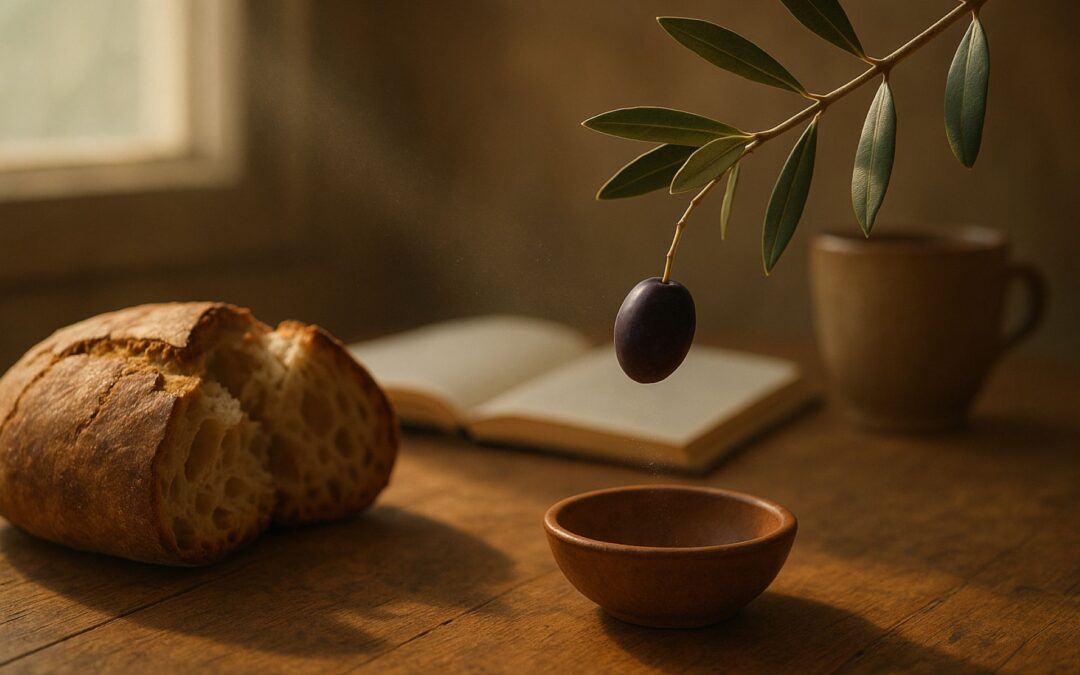
There is a certain radiance in the way Marcus Aurelius saw the world. Amid the burdens of empire, war, and mortality, he found beauty in the smallest things — the bend of a stalk, the crack of bread, the fall of a ripened olive. His vision was neither sentimental nor detached; it was attentive. He looked upon nature not to escape life’s hardships, but to understand them.
In Meditations, Marcus teaches us that philosophy is not sterile logic but a form of seeing — an art of perceiving order where others see chaos, of recognizing grace where others find decay. To see the world like a poet and an artist, as he did, is to reclaim our capacity for wonder. It is to live alert to beauty, even in what fades.
“Pass through this brief patch of time in harmony with nature, and come to your final resting place gracefully, just as a ripened olive might drop, praising the earth that nourished it and grateful to the tree that gave it growth.”
—Marcus Aurelius, Meditations, 4.48.2
The Artist in the Emperor
When Marcus Aurelius sat down to write Meditations, he was not composing for an audience or crafting literature to endure through time. He was writing for himself — notes, reminders, small acts of self-communion meant to keep his mind aligned with reason and nature. And yet, through that private dialogue, something extraordinary emerged: prose that reads like poetry.
It’s almost paradoxical. The most powerful man in the world wrote with the sensitivity of a painter describing light. He noticed textures, moods, and transitions in the natural world — the bending of grain, the foam on a wild boar’s mouth, the quiet dignity of ripening fruit. There is an intimacy in these observations, a tenderness rarely found in rulers or philosophers.
Marcus’s artistic sensibility didn’t come from aesthetic indulgence but from attention. The Stoic life, after all, is one of observation — of the self, of others, of nature’s constant unfolding. To him, the philosopher and the artist shared the same task: to look without judgment and to record what they saw honestly. In this way, Marcus painted the world not with brush or pigment but with thought itself.
His teacher, the orator Marcus Cornelius Fronto, had trained him in rhetoric and the art of expression. Yet Marcus’s words transcend style. They reveal an emotional intelligence that feels startlingly modern — the awareness that beauty is not in ornamentation but in truth. He could have written about glory, conquest, or imperial splendor. Instead, he wrote about bread. About lions. About olives.
That choice speaks volumes. It tells us that Marcus, despite his rank, saw himself as part of nature, not apart from it. Every crack, curve, and creature became for him a reflection of the divine order. The emperor’s gaze was not on marble thrones or golden banners but on the quiet pulse of the world — the same pulse that beats within us.
To read Meditations today is to enter that vision. It is to be reminded that wisdom does not come from withdrawing from the world but from paying deeper attention to it. The beauty of Marcus’s writing lies in its humility. He does not try to elevate reality into grandeur; he allows reality to elevate itself. And in doing so, he invites us to see as he saw — with the eyes of both a ruler and a poet.
Learning to See, Not Just Look
We are surrounded by miracles that we no longer notice. The way a shadow shifts across a wall. The slow unfurling of a leaf. The subtle variations in a stranger’s tone. We call these things ordinary only because we’ve forgotten how to see them. Marcus Aurelius had not.
His training under Fronto sharpened more than his tongue; it refined his perception. The exercises of rhetoric — observation, comparison, metaphor — became, for Marcus, exercises in seeing. He learned that beauty is not something you add to life; it is something you find within it. To describe the world well, one must first look at it closely.
This sensitivity shaped his philosophy. The Stoics taught that perception determines experience — that nothing is inherently good or bad, but thinking makes it so. Marcus applied this principle not only to emotions but to aesthetics. What you see depends on how you see. A decaying fruit can be disgusting or divine. A sunset can be a cliché or a revelation. A crack in bread can be an imperfection or an invitation.
When Marcus writes of “the charm and allure” of natural processes, he isn’t romanticizing the world. He is recognizing its underlying intelligence. Everything, he realized, unfolds according to its nature — the same reason that causes bread to split also makes clouds form, rivers bend, and humans err. To see this is to understand that beauty and wisdom are twins born of the same parent: awareness.
Most of us, by contrast, are content to look without seeing. We scroll, consume, and glance past. We live amid abundance but perceive scarcity — of time, of meaning, of beauty. Marcus would call this blindness a kind of moral failure, because it reflects disengagement from the world that sustains us.
To see like Marcus is to reawaken to what is already there. It is to slow down and study the details — not for escape, but for enlightenment. Seeing, in the Stoic sense, is a moral act. It is the first step in wisdom, because one cannot live in harmony with what one refuses to perceive.
Marcus understood this deeply. His way of seeing was not sentimental or artistic for its own sake; it was a path to serenity. By observing the world’s patterns — its rise and fall, growth and decay — he could see himself as part of that same rhythm. This awareness gave him balance in power, grace in difficulty, and gratitude in loss.
That is the lesson we inherit from his gaze: to look until we begin to see, and to see until the world, once dull and heavy, starts to shimmer again with quiet meaning.
Beauty in Imperfection
When Marcus Aurelius wrote of bread splitting in the oven — that its cracks, unintended by the baker, nonetheless “catch our eye and serve to stir our appetite” — he was not describing pastry. He was describing life. That line, hidden amid stoic meditations on virtue and mortality, is one of the most human moments in his work. It reveals a mind that not only accepts imperfection but delights in it.
To Marcus, the cracked loaf is a parable of the universe. The baker may shape and knead the dough, but once it enters the heat, the outcome is no longer fully his. The bread swells, bursts, and browns of its own accord — and those spontaneous marks, the signs of its transformation, are what make it beautiful. Likewise, the Stoic knows that control ends where nature begins. Life’s uneven surfaces, its surprises and disruptions, are what give it texture and flavor.
Modern culture worships smoothness — flawless skin, seamless design, perfect performance. Marcus’s insight cuts through this illusion. The world’s most beautiful forms are seldom symmetrical. The mountain erodes, the marble cracks, the human face carries the lines of its laughter and sorrow. These are not defects but declarations of life’s vitality.
The artist understands this instinctively. A painter leaves brushstrokes visible. A sculptor embraces the stone’s imperfections. A poet knows that rhythm depends on breaks. Marcus, in his own way, was all three. He saw the universe as an unfinished artwork, and imperfection as evidence of its living motion.
When we see cracks — in our plans, our relationships, our selves — our reflex is to patch them. But what if, like Marcus, we admired them instead? The fracture becomes not a flaw but a feature: a record of time, pressure, and endurance. To accept imperfection is to surrender the ego’s obsession with control. To love it is to glimpse harmony in chaos. That is the poetry at the heart of Stoicism — not cold endurance, but warm acceptance.
The Practice of Perception
Seeing the world like a poet is not a gift bestowed on a few; it is a discipline cultivated by many small acts of attention. Marcus practiced this daily. His meditations are less philosophy than training — a method of refining perception until the ordinary becomes luminous.
The Stoics understood perception as a moral act. They believed that every impression we receive from the world carries a choice: to interpret it well or poorly. The philosopher’s task, then, is to choose well — to look without distortion, to resist the temptation to label, exaggerate, or overlook. For Marcus, this act of clear seeing was sacred. He saw perception not as passive observation but as participation in the divine order.
In our age, perception is dulled by noise. The constant stream of images and words leaves little room for wonder. Yet the antidote remains the same as in Marcus’s time: to look, and to keep looking, until one truly sees. Try it. Watch the morning light trace its path across a floor. Notice the subtle temperature of silence in a room. Observe the rhythm of breath, the movement of shadows, the structure of stillness. Each act of noticing pulls us closer to reality.
This practice restores depth to our experience. The poet Mary Oliver called it “attention,” the rarest and purest form of generosity. Marcus would have agreed. By attending to the world, we align ourselves with it. We stop demanding that life be extraordinary and start realizing that it already is.
The practice of perception changes how we live. It softens our judgments, lengthens our patience, and steadies our emotions. When we see clearly, we react less and respond more. We find ourselves capable of gratitude not because everything is good, but because everything is. To perceive deeply is to participate in creation — to recognize that beauty is not a quality we find, but one we awaken.
Harmony with Nature
Marcus’s meditation ends with an image both humble and profound: the ripened olive dropping from its tree, praising the earth that nourished it and the branch that bore it. There is no fear in that fall, no clinging. Only grace. The olive accepts its descent as part of the same order that raised it up.
This vision of harmony lies at the heart of Stoicism. To live in accordance with nature is not merely to observe it but to join it — to act with the same effortless rhythm that governs the tides, the seasons, the stars. Marcus saw himself not as an exception to this rhythm but as one small expression of it.
For most of us, harmony feels like surrender. We equate acceptance with weakness, letting go with loss. But in Stoic thought, to harmonize with nature is the ultimate strength. It means recognizing that resistance does not preserve us — it exhausts us. The olive that refuses to fall rots on the branch. The human who refuses to change hardens into bitterness.
Harmony requires faith: that the same force which ends things also renews them. The olive nourishes the soil, the soil feeds the tree, and life continues. Death, decay, and beauty are not opposites; they are collaborators. To see this is to be liberated from fear.
When Marcus wrote of passing “gracefully” through his brief time on earth, he was not prescribing passivity. He was describing alignment — the capacity to act, to love, to labor, to let go, all in accordance with what is natural and right. To live harmoniously is to live attentively, gratefully, without vanity.
We spend our lives trying to shape the world to our will. The Stoic reverses this impulse. He shapes his will to the world. Like the olive, he learns to drop when it is time — not as a resignation, but as a final act of praise.
That is the ultimate poetic vision of Marcus Aurelius: to see beauty not only in the rising of things, but also in their falling. To walk through the brief patch of time given to us, not clinging, not complaining — but singing quietly in harmony with the song of the earth.
Conclusion
Marcus Aurelius invites us to look again — not at the grand or the glamorous, but at the ordinary moments that make life whole. The cracks in the bread, the fall of the olive, the quiet passing of time: these are not accidents to endure but miracles to behold.
To live in harmony with nature, as he writes, is to stop resisting the flow of existence and begin participating in it — fully, gratefully, gracefully. The Stoic life, then, is not cold or austere; it is profoundly aesthetic. It asks that we see the poetry already written into the world and, in doing so, become part of its art.
When we learn to see as Marcus saw — with steadiness, humility, and awe — we discover that even the most fleeting moment can contain eternity.
This article is part of The Daily Stoic Series based on Ryan Holiday’s book.