
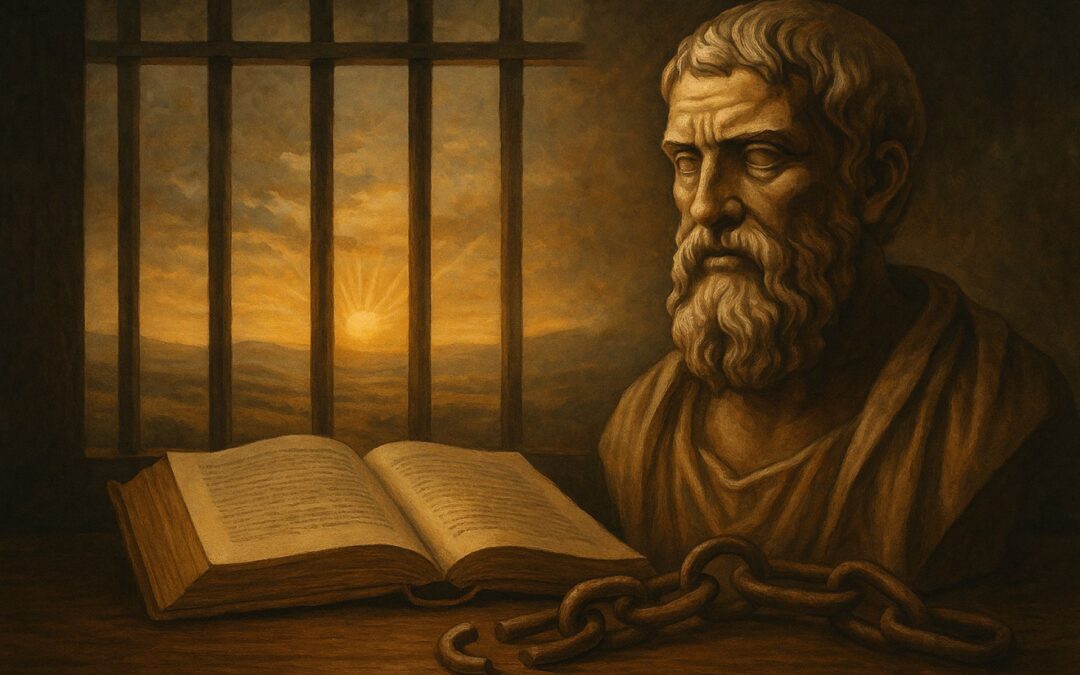
Every human being is born into a kind of captivity—not one made of walls or chains, but of ignorance. We are governed by our emotions, enslaved by our desires, and blinded by our assumptions. The purpose of education, as the Stoics saw it, was to set us free from that imprisonment. Not through wealth, status, or external liberty, but through understanding.
Epictetus, once a slave himself, knew that the only true freedom is found within the mind. Knowledge, when rightly pursued, liberates us from confusion, fear, and dependence. It teaches us how to think, how to act, and ultimately, how to live. The educated are not those who have read the most books, but those who have learned to govern themselves.
This is what it means when the Stoics say, education is freedom. It is not about acquiring information—it is about attaining inner mastery. It is the art of transforming knowledge into character, and thought into
“What is the fruit of these teachings? Only the most beautiful and proper harvest of the truly educated—tranquility, fearlessness, and freedom. We should not trust the masses who say only the free can be educated, but rather the lovers of wisdom who say that only the educated are free.”
—Epictetus, Discourses, 2.1.21–23a
The True Purpose of Learning
What does it mean to learn? Not in the conventional sense—not memorizing facts, not reciting theories, not chasing credentials to decorate a résumé. Learning, in its purest form, is an awakening. It is the slow, deliberate process of unlearning illusions and rediscovering truth.
The world mistakes information for education. But one can consume endless information and remain profoundly ignorant. You can know how the stars move, how economies rise, how empires fall—and yet, if you do not understand yourself, you remain uneducated. True learning begins the moment knowledge ceases to be ornamental and becomes existential.
The Stoics saw education not as a privilege of the elite but as a responsibility of the human being. To live without striving for understanding, they believed, was to live half-awake. They studied not to appear wise, but to become wise—to act with composure in the face of adversity, to navigate life with reason rather than reaction. Education, therefore, was not about literacy but liberation.
To Epictetus, learning was an act of rebellion against servitude—the servitude of fear, greed, anger, and ignorance. Every time you read with intention, every time you reflect with sincerity, you are reclaiming sovereignty over your mind. You are asserting: “I refuse to be ruled by my impulses. I will not be a captive of emotion. I choose awareness.”
This is why reading cannot be a casual affair. It is not entertainment. It is confrontation. When you read deeply, the text challenges you, provokes you, mirrors you. It shows you what you believe, why you believe it, and where those beliefs may have betrayed you. A book, then, is not an escape—it is a reckoning.
And from this reckoning comes freedom. Freedom from the mind’s constant chatter. Freedom from the opinions of others. Freedom from the tyranny of desire. The educated person, as the Stoics defined it, is not the one who knows many things, but the one who no longer suffers from the same delusions. They have peeled away the unnecessary until only clarity remains.
So the true purpose of learning is not accumulation—it is transformation. It is not to speak elegantly but to live wisely. Every page studied with attention, every idea meditated upon, moves you closer to a kind of serenity that cannot be bought or borrowed. It is the quiet confidence of one who has seen through the noise of life and found peace in understanding.
That is the education Epictetus spoke of. Not the education that fills libraries, but the one that frees minds.
Learning How to Live
Most people read to escape life. The wise read to understand it.
To “learn how to live” sounds deceptively simple, yet it is perhaps the hardest lesson of all. The world offers endless instruction on how to earn, how to compete, how to accumulate—but almost none on how to exist. Schools teach us how to make a living, but not how to make meaning. We graduate knowing how to build careers, not how to build character.
The Stoics filled this void. They treated philosophy as a form of training—an apprenticeship in being human. They believed that knowledge without application was useless, that wisdom untested by experience was hollow. The pages of philosophy were not meant to be admired, but absorbed. Every idea was a seed, meant to grow in the soil of daily action.
Reading, then, becomes an intimate dialogue with life itself. When you encounter the words of Marcus Aurelius—his reminders to remain calm, to accept what cannot be controlled, to act with justice—you are learning to live deliberately. You are shaping the architecture of your inner world. You are learning to respond instead of react, to see instead of judge, to endure instead of escape.
This kind of learning changes how you experience time. A person who has not reflected moves through days like a leaf carried by the wind—tossed, turned, and exhausted by forces they cannot name. But one who studies with attention becomes grounded. They see patterns where others see chaos, meaning where others see randomness. They learn to act with intention rather than impulse.
Learning how to live also means learning how to suffer well. To face pain without self-pity, loss without collapse, uncertainty without panic. Books alone cannot teach that, but they can prepare the mind for it. They can show you that hardship is not punishment but practice. That every challenge is an invitation to grow sturdier in spirit.
And this is why true education demands humility. The more you learn about life, the more you realize how little you control—and paradoxically, how much peace that truth brings. You stop demanding that life obey your will, and instead focus on mastering your own.
This is the freedom Epictetus spoke of: the kind born from understanding, not from circumstance. To learn how to live is to learn how to be unshaken by what happens and uncorrupted by what tempts. It is to possess the quiet strength of one who has studied not only the world, but their place within it.
Education, in this light, is not preparation for living—it is the living itself. Each thought examined, each emotion understood, each principle practiced is a step toward the ultimate knowledge: that wisdom is not something we acquire, but something we become.
The Discipline of the Mind
Education without discipline is like a lamp without oil—it may shine briefly, but it cannot endure. The Stoics understood that the cultivation of knowledge demanded constancy, a daily engagement with one’s own thoughts and tendencies. The mind, left to wander, grows wild. It must be trained, not tamed by force, but guided with deliberate repetition until clarity becomes its nature.
Discipline begins in small, almost invisible moments—the decision to read instead of scroll, to reflect instead of react, to stay silent when anger tempts you to speak. Each choice, though minor in isolation, compounds into character. This is how the mind is schooled in freedom. You begin to master not the world, but yourself.
Epictetus taught that freedom is not achieved by avoiding constraints but by learning to command your own impulses. To do that, the mind must be fortified through daily practice. A philosopher’s study is not a place of luxury—it is a gymnasium for the intellect. Reading, journaling, meditating, and questioning are the weightlifting of the soul. These exercises strengthen judgment, sharpen perception, and soften the hold of emotion.
Modern distractions make this discipline harder than ever. The world is designed to keep you in a state of mental fragmentation—jumping from notification to thought, from thought to worry, from worry to noise. In such an environment, discipline becomes a radical act. Every moment you choose stillness over stimulation, focus over frenzy, you reclaim a piece of yourself from the chaos.
This discipline also means facing discomfort. True learning often begins where convenience ends. To confront your flaws, to dissect your fears, to admit ignorance—these are not pleasant tasks, but they are essential ones. The undisciplined mind avoids them, preferring pleasure to progress. The disciplined mind, however, understands that growth is rarely gentle.
A disciplined learner does not chase novelty; they pursue depth. They return to the same truths repeatedly until understanding crystallizes into action. They study philosophy not to collect aphorisms but to embody them. They revisit failure not to dwell on it but to extract its lessons. This is what separates the educated from the informed—the former are transformed by what they learn.
Over time, discipline gives rise to a peculiar kind of peace. You begin to trust yourself—to trust your ability to think clearly when others panic, to act with integrity when others waver, to persevere when others quit. You stop needing motivation because principle has replaced it. You no longer rely on willpower to do what’s right; it becomes who you are.
In the end, discipline is the invisible architecture of freedom. It anchors you when the world shifts, it protects you from your own chaos, and it ensures that knowledge does not fade into memory but matures into wisdom. The disciplined mind, like a well-tuned instrument, plays the melody of reason no matter the noise around it.
The Harvest of Wisdom
Every discipline, every reflection, every effort to understand yields a quiet reward—the harvest of wisdom. But wisdom does not arrive as a thunderclap. It creeps in like dawn—subtle, patient, inevitable. You begin to see the same world differently, not because the world has changed, but because you have.
The Stoics described this transformation as the attainment of ataraxia—a state of inner tranquility untouched by external circumstances. It is not apathy; it is composure. The truly educated person no longer sways with the opinions of others or bends beneath the weight of misfortune. They have become their own foundation.
Wisdom manifests not in eloquence, but in stillness. The wise are not loud. They do not rush to correct others or parade their insight. They listen more than they speak because they understand that truth requires quiet to be heard. Their confidence does not come from superiority but from understanding how fleeting most things are—praise, possessions, pain, and even life itself.
To be wise is to know what deserves your energy. It is to discern between what you can influence and what you cannot, and to place your effort accordingly. You stop fighting the inevitable. You stop fearing the uncontrollable. You learn to move with life rather than against it, and in doing so, you find a rhythm that feels like peace.
Such peace is not the absence of challenge—it is the presence of understanding. When hardship arrives, the wise do not ask, “Why me?” They ask, “What is this teaching me?” They do not curse the storm; they adjust their sails. This adaptability, this graceful resilience, is the essence of freedom.
The fruit of wisdom is not perfection but perspective. You begin to see setbacks as detours, not dead ends. You understand that success is fleeting, that loss is universal, and that the only thing that truly belongs to you is your response. That realization is liberation.
Epictetus himself was born a slave, yet he spoke of freedom more than any emperor. Because he knew what many still don’t—that no one can imprison a disciplined mind or an educated soul. You can confine the body, but not the spirit of one who has mastered themselves.
The harvest of wisdom is not just tranquility; it is fearlessness. A courage born not from arrogance but from comprehension—the understanding that nothing external can define your worth, disturb your peace, or dictate your happiness. You stop living reactively and start living deliberately.
And in that moment, you embody what all true education strives for: sovereignty over the self. You are no longer a servant of impulse, ego, or fear. You are guided by reason, grounded in virtue, and free in the truest sense of the word.
This is the ultimate harvest—the beautiful and proper fruit of the truly educated: a mind that cannot be enslaved, a heart that cannot be corrupted, and a soul that walks through the world untethered.
Conclusion
The aim of education is not to impress the world, but to understand it—and in doing so, to understand oneself. The Stoics remind us that the fruits of true learning are not applause, credentials, or cleverness, but tranquility, fearlessness, and freedom.
When you study not for vanity but for virtue, you begin to see life differently. You no longer chase approval or resist hardship; you engage with both as lessons. You become calm where others are restless, grounded where others are shaken.
To be educated, in the highest sense, is to live deliberately—to think clearly, to feel deeply, and to act wisely. It is to be free not because the world allows it, but because your mind no longer needs permission.
This article is a part of The Daily Stoic Series based on the book by Ryan Holiday.