
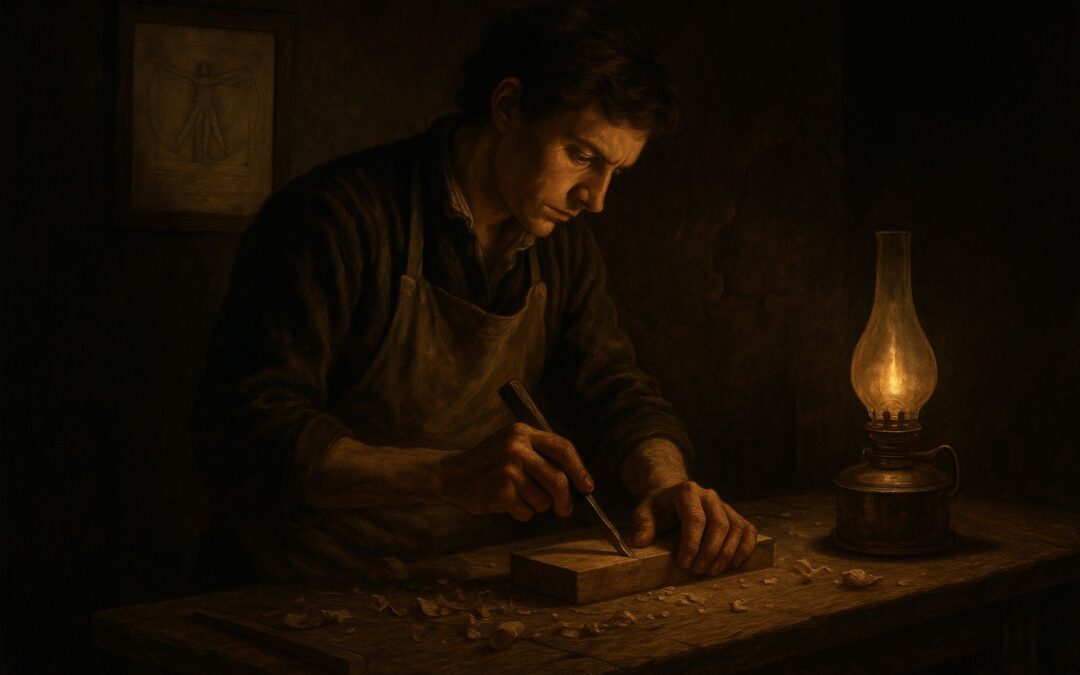
Every generation faces its own kind of crisis. Ours is not one of survival, but of significance. Surrounded by abundance, convenience, and noise, we have forgotten the deep satisfaction of creation—the kind that demands patience, struggle, and devotion. We have confused activity with purpose, consumption with contribution, ease with fulfillment. But beneath this disorientation lies an older truth: mastery has always been humanity’s saving grace.
“The misery that oppresses you lies not in your profession but in yourself! What man in the world would not find his situation intolerable if he chooses a craft, an art, indeed any form of life, without experiencing an inner calling?”
— Johann Wolfgang von Goethe
To master something—to pour yourself into a craft until it becomes second nature—is not an act of ego, but of evolution. It reconnects you with what is timeless in your nature: the impulse to build, to refine, to bring order to chaos. It is through mastery that we regain meaning, direction, and self-respect. In a time of complacency, to pursue mastery is to rebel against decay. It is not just a path to success—it is a path to salvation.
Daily Law: You must see your attempt at attaining mastery as something extremely necessary and positive.
— Mastery, I: Discover Your Calling—The Life’s Task
The Source of Misery Lies Within
Human beings have an extraordinary capacity for self-deception. We blame our unhappiness on our environment—our boss, our paycheck, our routine, our lack of luck. We tell ourselves that if only we had chosen a different job, lived in a different city, or met the right person, things would be better. But this is a comforting illusion. Misery, in most cases, does not come from what surrounds us—it comes from the void within us. It is the ache of a spirit detached from its purpose.
When you work without conviction, time becomes an enemy. The hours drag, and every task feels heavier than it should. Even success loses its flavor when it is unmoored from meaning. You can accumulate wealth, recognition, and status, yet still feel like a stranger in your own life. Why? Because the soul demands alignment. It seeks coherence between what you do and who you are.
The tragedy is that many never stop to ask what truly calls to them. They drift into professions not through passion but through inertia—following parental expectations, social approval, or convenience. They confuse activity with purpose and achievement with fulfillment. The result is a subtle but chronic dissatisfaction—a quiet despair that festers under the surface of apparent success.
To live this way is to exile oneself from one’s own potential. It is to spend life performing roles rather than expressing essence. Every day becomes an act of quiet betrayal—betrayal of curiosity, talent, and imagination. The mind, aware of this betrayal, begins to rebel. It grows restless, anxious, irritable. The world starts to feel unbearable, not because it is cruel, but because the self has been silenced.
Yet the cure is not to flee or to reinvent your surroundings. The cure is to return—to return to the original impulse that made you feel alive. Beneath the layers of obligation and expectation lies a kernel of fascination, something that once lit you up as a child. It might have been drawing, building, experimenting, performing, solving, writing—whatever activity made time dissolve. That impulse is your compass.
The task, then, is not to find a “better” job or chase an imagined lifestyle, but to reconnect with that inner necessity and let it guide your craft. When you act from that place, work ceases to be drudgery and becomes devotion. The most menial task becomes meaningful if it serves your purpose. The janitor who sees himself as a custodian of order works with quiet dignity. The teacher who sees her work as shaping minds feels the weight of every word she speaks. The carpenter who measures twice and cuts once is not just working with wood—he’s communing with precision itself.
Mastery begins here—with self-reconciliation. You do not need to change your life; you need to inhabit it fully. To act in accordance with your calling is to align soul and skill, to turn labor into art. Once that happens, misery loses its grip, not because the world becomes easier, but because your spirit becomes stronger.
The Age of Passive Irony
The modern temperament is defined by detachment. We are taught to be skeptical, to question everything, to keep our enthusiasm in check. To care deeply is to risk ridicule; to try earnestly is to risk failure. And so, people hide behind irony. They mock what they secretly admire. They perform indifference as a shield against vulnerability.
This posture of passive irony has become the default mode of the educated, the disillusioned, the perpetually online. To say “whatever” is easier than to say “I care.” It protects you from disappointment, but it also protects you from growth. Because to grow, you must expose yourself—to passion, to possibility, to loss. Irony avoids all three.
You can see this in the way people approach their work. The artist who fears mediocrity calls himself a “hobbyist.” The writer who never finishes a manuscript insists it’s all “just for fun.” The entrepreneur who quits halfway claims he’s “pivoting.” Each uses humor and distance as armor, pretending detachment is strength when it is really avoidance.
Irony is the elegant mask of fear. It allows a person to remain safe in mediocrity while appearing clever. But make no mistake—beneath that mask lies paralysis. The ironic individual contributes nothing to the world. They critique, they comment, they consume, but they do not create. They mock the dreamers for being idealistic, forgetting that everything they value—every book, invention, philosophy, and song—was made by someone once mocked for caring too much.
This attitude seeps into culture. We celebrate snark more than sincerity, trends more than truth. But progress depends not on cynics, but on believers—on those willing to devote themselves fully to an idea, to endure ridicule for the sake of creation. Every meaningful advance, from the light bulb to the internet, from poetry to philosophy, was born of stubborn faith.
Irony breeds stagnation; sincerity breeds evolution. The ironic man observes the world as if it were a spectacle, while the master enters it as a participant. One drifts; the other builds. One fears being wrong; the other risks everything for the chance to be right.
The master knows that to care deeply in a cynical age is an act of defiance. To dedicate yourself to something—to pour your time, energy, and love into it without guarantee of reward—is not naïve. It is revolutionary.
So the question is not whether you are talented enough or lucky enough. The question is whether you care enough to begin. The world has enough spectators; what it lacks are participants—people unafraid to take things seriously, to strive, to fail, to try again.
Because in the end, mastery belongs not to those who mock, but to those who make.
The Human Obligation to Create
To be human is to create. From the moment our ancestors shaped stone into tools and pigments into symbols, creation became our defining instinct. It’s what separated us from the beasts—the ability to imagine something that did not yet exist and then will it into being. Civilization itself is the cumulative product of this impulse: the bridge built from idea to reality.
But in the modern era, this instinct has dulled. Convenience has replaced curiosity. Consumption has replaced contribution. We no longer feel compelled to build; we expect to be served. Screens feed us infinite stimulation, and yet the soul starves. The more we outsource creation—to technology, to automation, to others—the more alienated we become from our own power.
Creation is not merely about producing art, innovation, or material goods. It’s about engaging with existence as an active participant. When you create, you impose order on chaos. You wrestle with uncertainty and extract meaning from it. The writer shapes language to reveal thought. The scientist designs experiments to unveil truth. The craftsman transforms raw materials into form and function. In doing so, each becomes a vessel for something greater than themselves—the timeless dialogue between imagination and matter.
Every generation inherits the duty to rebuild the world in its image. The institutions that once served us begin to crack; the systems that guided us become obsolete. It is not enough to repair the old—we must invent the new. To shrink from this responsibility is to invite decline. Stagnation is not peace; it’s decay disguised as stability.
You create not because the world demands it, but because your nature does. The drive to produce something meaningful—something that outlives your presence—is the human spirit’s deepest expression of gratitude for existence. Even if your work never gains recognition, the act itself redeems you. It binds you to the lineage of those who refused to remain idle—those who built bridges, discovered medicines, composed symphonies, painted visions, engineered revolutions.
When you create, you stand in opposition to entropy. You say, “I will not let the world drift into disorder.” You become a node of renewal, a spark in the long chain of evolution. And in that act, you rediscover the most ancient truth of all: to make something with your hands, your mind, or your words is to make yourself.
Mastery as a Form of Resistance
To pursue mastery in the modern age is to resist everything the world tries to make you. Society rewards immediacy—instant gratification, instant validation, instant success. We are told to move fast, to multitask, to never pause long enough to feel the weight of boredom or the depth of focus. But mastery demands the opposite. It asks for slowness, solitude, repetition, and an almost monastic devotion to the craft.
This is not fashionable work. It’s invisible, unglamorous, and often misunderstood. To those who chase trends, the master appears stubborn, perhaps even archaic. But there is quiet rebellion in his persistence. Each hour spent refining technique rather than seeking attention is an act of defiance. Each failure studied instead of avoided, each setback endured without complaint—these are small revolutions of character.
Mastery is resistance against the decay of attention. It requires you to focus deeply in an era of distraction. It is resistance against superficiality, because mastery demands understanding, not mimicry. It is resistance against despair, because the pursuit itself gives meaning where none existed before. When you dedicate yourself fully to something, you declare war on indifference.
Every stroke of the brush, every solved equation, every perfected movement becomes a statement: “I will not be reduced to noise.” The world tells you to move on; mastery tells you to stay. The world urges you to consume; mastery compels you to create. The world rewards speed; mastery exalts depth.
And yet, paradoxically, the discipline mastery requires leads to freedom. When you command your craft, you are no longer at the mercy of external forces. You no longer depend on luck, timing, or approval. You can stand on your own ground and shape your destiny with precision. Mastery liberates you not from struggle, but through it.
It is also a moral act. In a society that thrives on shortcuts, choosing the long road is a form of integrity. To master something is to reclaim dignity—to say that excellence still matters, that attention still counts, that depth is not dead. Through your effort, you remind others what it means to care.
In this way, mastery is not only personal salvation—it is cultural resistance. It restores meaning to work and reminds humanity that growth is not found in convenience, but in commitment.
The Mind You Deserve
The mind is not a gift; it is a construction. Every thought, every focus, every deliberate act of attention molds its structure. Just as muscles grow through strain, the mind sharpens through struggle. Those who avoid difficulty remain mentally soft. Those who engage deeply with complexity forge intellect as a weapon.
We are born with roughly the same neurological clay, but what we sculpt from it depends on how we live. A distracted life builds a distracted brain. A disciplined life builds a disciplined one. If you fill your days with trivialities—doomscrolling, gossip, shortcuts—you train your mind to crave stimulation without depth. It learns to skim, not to see. It becomes restless, unable to sustain a thought long enough to reach insight.
Mastery rewires this architecture. Through patient repetition and sustained focus, the mind learns endurance. It learns to hold complexity, to perceive patterns invisible to the unfocused. Every craft has its own language—of movement, of intuition, of timing—and the more fluently you speak it, the more sophisticated your perception becomes. The painter sees light differently. The musician hears silence differently. The strategist reads human nature differently. Each, in their own way, has earned a superior mind through discipline.
This is why the ancients equated mastery with wisdom. They understood that excellence was not merely technical—it was psychological, even spiritual. To refine your skill is to refine your being. It teaches humility, because the more you learn, the more aware you become of what you don’t know. It teaches patience, because true growth cannot be rushed. And it teaches clarity, because mastery forces you to distinguish between what matters and what doesn’t.
The mind you deserve is not one given by birth or chance—it is one earned through deliberate attention. It is shaped by the books you read, the questions you ask, the silence you endure, the failures you dissect. Over time, this cultivated mind becomes your greatest asset—a vessel capable of depth, insight, and creation.
And the world, in turn, reflects this transformation. When your mind becomes ordered, so does your life. You begin to perceive opportunity where others see chaos. You respond to difficulty not with panic, but with precision. You act with intention, not impulse.
The ultimate reward of mastery is not fame or fortune—it is freedom. The freedom that comes when your mind, once scattered and restless, becomes an instrument of pure focus and creation. You get the brain you earn. You get the life you build.
Conclusion
Mastery is not a luxury reserved for the gifted. It is the human condition fulfilled—the alignment of spirit, intellect, and effort in pursuit of something worthy. In a culture obsessed with shortcuts, mastery reminds us of the value of depth. In a world that celebrates distraction, it restores the sanctity of focus.
When you dedicate yourself fully to your craft, you not only transform your skill—you transform your mind, your character, and the very quality of your existence. You begin to live with intent, to act with clarity, and to create with courage. That is what it means to see mastery as salvation—not a pursuit of perfection, but of purpose.
The future belongs to those who build, not those who watch. And in building—patiently, deliberately, wholeheartedly—you redeem not just yourself, but the time you’ve been given.
This article is a part of The Daily Laws Series based on Robert Greene’s book.