
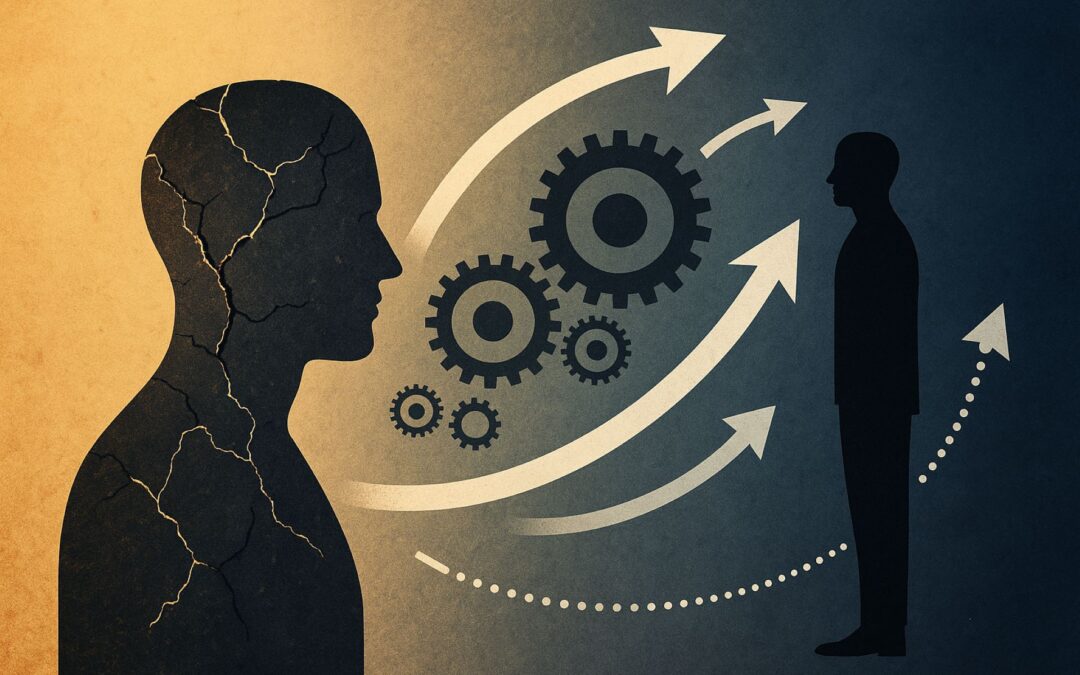
There comes a point in every career when the ground shifts beneath your feet. The systems you once trusted falter. The titles that defined you lose their weight. The world, in its relentless churn, demands that you evolve—or vanish. In such moments, it’s easy to cling to what was, to grasp at familiarity as if it were stability. But the truth is far more unforgiving: permanence is an illusion. Change is the law.
To survive, even to thrive, you must reshape your loyalty. Not to a company, not to a career, not to any external framework—but to your Life’s Task. That deeper calling within you, that force that hungers for expression, is the only constant you can depend on. Everything else is transient. Companies rise and fall. Industries transform overnight. The skills that made you valuable today might be obsolete tomorrow. Yet the essence of what drives you—your curiosity, your creativity, your strategic mind—remains intact.
“Daily Law: Adapt your inclinations. Avoid having rigid goals and dreams. Change is the law.”
From Mastery, I: Discover Your Calling—The Life’s Task
The Freedom of Adaptability
Adaptability is the secret rhythm of progress—the unseen pulse that determines who survives and who fades into history. In a world defined by volatility, those who cling to the old inevitably crumble. The adaptable, on the other hand, move fluidly between roles, environments, and challenges. They don’t resist change; they absorb it, interpret it, and redirect it to their advantage.
Being adaptable doesn’t mean being unanchored or without conviction. It means staying grounded in your essence while allowing your form to evolve. You may change careers, skill sets, or industries, but your deeper purpose—your Life’s Task—remains constant. The adaptable person understands that the how may shift a hundred times, but the why endures.
Think of adaptability as mental agility—the capacity to interpret signals of change before they become crises. The world always whispers before it shouts: subtle trends, new technologies, emerging mindsets. The flexible individual listens for those whispers. They read between the lines, sense the tremors before the earthquake, and adjust course long before others even recognize the landscape has shifted.
Rigid people crave certainty. They see change as loss, disruption, or betrayal of effort. But change is not an interruption—it’s the natural continuation of evolution. Every system—economic, technological, emotional—reorganizes itself when it reaches saturation. The adaptable mind recognizes this pattern and thrives in it. When conditions shift, they don’t panic; they pivot. They experiment, they unlearn, they rebuild faster than the rest.
Adaptability also requires a quiet humility—the willingness to accept that what worked yesterday might not work tomorrow. The proud mind resists this truth and breaks; the humble one bends and survives. This humility gives rise to curiosity, and curiosity keeps you alive. Once you stop learning, you start dying.
Those who cultivate adaptability live lightly. They can carry their talents across borders, industries, and decades without fear of becoming obsolete. They view uncertainty not as a threat but as a frontier. In every disruption, they see an invitation: to learn, to redefine, to advance. That freedom—the freedom to reinvent without losing your sense of self—is the essence of adaptability.
The Self-Reliant Mindset
The modern world teaches dependence in subtle ways. We are conditioned to wait—for approval, for opportunity, for instruction. But those who rise above the crowd understand that no one is coming to save them. The organization you work for, the manager who praises you, the mentor who guides you—they are transient fixtures in your journey. The constant, the only constant, is you.
Self-reliance begins with awareness: the realization that your career, your progress, and your potential are entirely your responsibility. It’s not cynicism; it’s empowerment. When you accept that you are on your own, you stop waiting for permission and start creating momentum. You start studying your field not because someone told you to, but because mastery has become a personal obligation.
This mindset transforms how you view work. Instead of seeing your job as employment, you see it as training. Every project, every mistake, every success becomes data—an experiment through which you refine your craft. You stop measuring your worth by titles or validation and start measuring it by competence and growth. You become a student of everything around you.
The self-reliant person treats their career as a private enterprise, even within an organization. They think like a founder, not an employee. They observe inefficiencies, propose solutions, learn new tools, and build reputational equity. They’re not afraid to detach from systems that no longer serve them, because they’ve built internal stability—skills, discipline, and confidence that no external force can revoke.
True self-reliance also extends to emotional resilience. When you depend too heavily on the praise or approval of others, your mood fluctuates with their perception. But when you rely on your own evaluation—your own sense of progress—you become unshakeable. Criticism becomes feedback, not rejection. Failure becomes data, not defeat. You develop a kind of calm detachment that allows you to act strategically even in chaos.
This independence doesn’t mean isolation. It doesn’t reject mentorship or collaboration—it redefines them. You seek guidance not as dependence but as enrichment. You build alliances not out of need but out of strength. The self-reliant individual navigates relationships from a position of agency, not anxiety.
Over time, this mindset compounds. You become the person others turn to when change arrives—the steady center in a spinning world. Because while everyone else scrambles to adapt, you’ve already accepted the truth: you are responsible for your own evolution, and that is the greatest power there is.
The Freddie Roach Lesson
When Freddie Roach’s body began to fail him, his first instinct might have been despair. Years of training, discipline, and sacrifice—all seemingly wasted in the span of a few injuries. For a boxer, physical decline isn’t just professional loss—it’s an identity crisis. The ring isn’t merely a place of competition; it’s a home, a world of belonging and purpose. To be told you can no longer fight is to have the ground ripped from beneath you.
But Roach understood something profound: his devotion wasn’t to boxing as an activity—it was to the deeper thrill that boxing represented. He wasn’t in love with the punches, the sweat, or the blood. He was in love with strategy—the mental dance of anticipation and reaction, the quiet intelligence of reading an opponent, the satisfaction of shaping chaos into victory. His calling wasn’t physical; it was intellectual and emotional. And that kind of passion cannot be confined to one form.
When his body retired, his mind refused to. Roach redirected his energy into teaching, channeling his tactical instincts into training the next generation of fighters. What began as a loss became his renaissance. As a trainer, he shaped legends like Manny Pacquiao—proof that his greatest contribution to boxing wasn’t his fists but his mind.
The essence of Roach’s transformation lies in the ability to separate the medium from the mission. Most people confuse the two. They believe their identity lies in what they do, not in why they do it. But the medium is transient. Industries collapse, tools evolve, markets change. The mission—the inner drive that animates your curiosity—can always find new expression.
When change strips away what’s familiar, the question to ask is not, “What have I lost?” but “What remains?” Because what remains is your truest asset: your instinct for creation, your fascination with a craft, your hunger to build, teach, lead, or solve. When you operate from that foundation, no disruption can destroy you—it can only redirect you.
This is the Freddie Roach lesson: transformation is not surrender. It’s translation. You translate your passion into a new form without diluting its power. You evolve, not away from your purpose, but deeper into it.
Reinvention Without Erasure
Many people fear reinvention because they equate it with starting over. They imagine erasing their history, abandoning everything they’ve built, and walking into the unknown unarmed. But reinvention, at its core, is not about abandonment—it’s about adaptation. It’s the art of preserving your essence while reshaping its form.
Every phase of your life leaves behind a trail of skills, habits, and insights. Reinvention is about rearranging those fragments into a new mosaic. You’re not discarding your past—you’re upgrading its relevance. The work you once did, the roles you once held, and even the mistakes you once made become raw material for your next evolution. Nothing is wasted.
To reinvent without erasure, you must learn to see patterns across your experiences. What themes have repeated themselves in your life? What kinds of problems do you feel drawn to solving? What skills come naturally to you, regardless of the context? These recurring elements are your compass—they reveal the continuity beneath your changes.
Reinvention also demands courage. You must be willing to release outdated versions of yourself, not because they were wrong, but because they’ve fulfilled their purpose. It’s like shedding an old skin—uncomfortable but necessary for growth. You can’t carry the weight of who you were while stepping into who you’re meant to become.
And yet, reinvention is never a total break. You can respect your past without being confined by it. The wisdom you’ve earned—the intuition, the discipline, the ability to navigate complexity—becomes the scaffolding upon which your new structure is built. You don’t destroy the foundation; you expand it.
Think of every master who has transcended their field: the musician who becomes a film composer, the athlete who becomes an entrepreneur, the writer who becomes a teacher. Each one carried forward their core essence—the drive to express, to understand, to refine—and simply found a broader stage for it. That’s the beauty of reinvention: it’s continuity disguised as change.
The Creative Shake-Up
Change rarely feels graceful. It’s usually messy, abrupt, and uncomfortable. But those moments of disruption—the layoffs, the failures, the personal collapses—are often the catalysts that propel us toward our highest potential. The creative shake-up is not punishment; it’s preparation. Life dismantles the old structure precisely so a stronger one can be built.
When everything you relied on suddenly stops working, you’re forced to confront questions you’ve been avoiding: Am I still growing? Have I outgrown this environment? Am I doing what truly matters to me? Most people only ask these questions when they’re cornered. But the ones who thrive treat these disruptions as sacred invitations—a chance to reassess direction and design their next evolution consciously.
The creative shake-up demands two virtues: composure and curiosity. Composure keeps you from collapsing into self-pity. Curiosity helps you explore the unknown with wonder instead of fear. Together, they turn chaos into clarity.
The paradox is that discomfort sharpens perception. When the ground shakes, you begin to notice what’s stable and what isn’t. You identify what’s truly essential. You learn to distinguish between your authentic motivations and the ones society imposed on you. In that discomfort lies insight—the kind of clarity you can’t gain from comfort.
Every creative leap in history has been born from such shake-ups. When old paradigms crumble, the adaptable see opportunity where others see destruction. They recognize that endings and beginnings are the same moment viewed from different angles.
You might lose a job, a partnership, or a sense of direction—but what you gain is often far greater: a renewed sense of agency, a deeper understanding of your craft, and the freedom to rebuild on your own terms. The shake-up doesn’t break you; it dismantles the parts of you that were never truly alive.
If you can meet these moments with grace and curiosity, you won’t just survive change—you’ll harness it. Because in every collapse lies the raw material for creation, and in every ending hides the blueprint of a better beginning.
Conclusion
Change is not the enemy—it’s the proving ground of growth. Every disruption, every ending, every unexpected detour is an invitation to evolve closer to your essence. The adaptable do not mourn the past; they reinterpret it. They use it as fuel to reimagine their future.
When you align yourself with the rhythm of change, life ceases to feel like a series of losses and becomes a sequence of transformations. You stop fearing uncertainty because you’ve learned to trust your own ability to navigate it. The real mastery lies not in holding still, but in staying fluid—moving with purpose even as the world rearranges itself around you.
This article is a part of The Daily Laws Series based on Robert Greene’s book.