
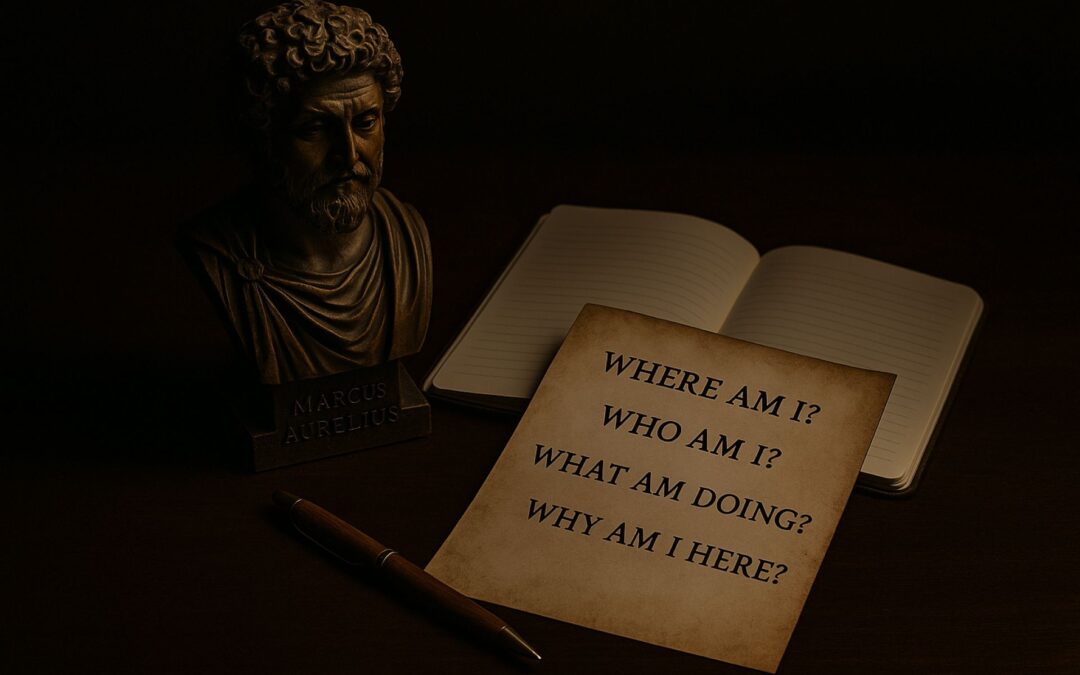
Most people can tell you where they work, what they do, and even what they want. But ask them why—why they’ve chosen this path, why they wake up every morning to repeat the same routines—and silence fills the room. We’ve built lives rich in activity yet poor in reflection. The Stoics, however, believed that true wisdom begins with orientation—with knowing where you are, who you are, what you’re doing, and why.
Marcus Aurelius posed these questions not as philosophy but as survival. Without them, a person becomes lost—drifting through life on borrowed desires, chasing the praise of those who don’t even know themselves. This isn’t just a philosophical problem; it’s an existential one. Because until you know your coordinates in this vast universe, you’ll keep mistaking motion for progress, distraction for purpose, and applause for meaning.
This meditation is an invitation to pause—to locate yourself again in the grand order of things, to rediscover who you are beneath the noise, and to live with the clarity that the Stoics called virtue.
“A person who doesn’t know what the universe is, doesn’t know where they are. A person who doesn’t know their purpose in life doesn’t know who they are or what the universe is. A person who doesn’t know any one of these things doesn’t know why they are here. So what to make of people who seek or avoid the praise of those who have no knowledge of where or who they are?”
— Marcus Aurelius, Meditations, 8.52
The Questions That Define a Life
Most people spend their lives reacting rather than reflecting. They move from one task to another, one goal to the next, without ever pausing to ask the most fundamental questions of existence. The days blur into months, the months into years, and soon they are running on autopilot—confusing motion for meaning. They mistake activity for accomplishment, busyness for purpose.
But every so often, a question cuts through the noise. “Who am I?” “Why am I doing this?” “What is all of this for?” These questions are not philosophical luxuries reserved for monks or scholars—they are the backbone of a conscious life. They separate those who exist from those who live.
Marcus Aurelius, writing as emperor of the world’s mightiest empire, understood how easy it was to lose oneself in the machinery of duty, ambition, and distraction. Yet even amid war and politics, he wrote nightly reminders to himself—pleas for clarity. “A person who doesn’t know what the universe is, doesn’t know where they are,” he said. “A person who doesn’t know their purpose in life doesn’t know who they are or what the universe is.”
To him, these weren’t abstract riddles. They were practical tools for living with integrity. If you don’t know where you stand, how can you make wise choices? If you don’t know who you are, how will you decide what’s worth your time? If you don’t know why you’re here, what stops you from being swept away by the currents of other people’s opinions?
The Stoics believed that philosophy’s purpose was not to complicate life but to simplify it—to strip away illusions until only what truly matters remains. Most of us, however, do the opposite. We pile on layers of ambition, expectation, and social conditioning until we can no longer hear our own voice.
When someone asks, “Who are you?” most of us respond with what we do, not who we are. We identify ourselves by profession, possessions, or popularity—as though our essence could be measured by an external metric. The result is a quiet identity crisis that permeates modern existence: people with everything to live with, but nothing to live for.
To live deliberately requires the courage to stop and face these questions head-on. To sit in the discomfort of not knowing. Because in that space—between confusion and clarity—begins the work of understanding oneself.
The truth is, every human being needs orientation. A sense of where they are, who they are, what they are doing, and why. Without it, you are just wandering through the fog, pulled by the inertia of the world. With it, you move with purpose. You become anchored, even in chaos.
Where Are You?
“Where” is not merely about location—it’s about awareness. It’s not a question of geography, but of grounding. Where are you right now in the landscape of your life—mentally, emotionally, spiritually? Are you present in your own existence, or are you simply passing through it?
The modern world makes it easy to drift. Our attention is fragmented by devices, our desires shaped by algorithms, our values borrowed from trends. We rarely pause long enough to ask: Where am I, really? Not just in the physical sense, but in the trajectory of my being. Am I where I intended to be, or have I been carried here by default?
Marcus Aurelius looked to the cosmos for perspective. He reminded himself daily that he was a fragment of the whole—a small part of an immense and ordered universe. To forget this, he said, is to become enslaved by trivialities. To remember it is to see things in their proper scale.
Think about that for a moment. When you feel overwhelmed, it’s often because you’ve lost perspective. You’ve zoomed in too closely on one inconvenience, one disagreement, one failure. But if you pull back—if you see yourself against the vastness of existence—the weight of these small moments begins to dissolve. You realize how little control you have over the external world and how much freedom you have over your internal one.
To know where you are is to be conscious of context. It’s to see not just the moment you’re in, but the greater pattern it belongs to. It’s to understand the forces that shape you—your environment, your habits, your influences—and decide consciously which of them deserve to stay.
Without this awareness, you live reactively, always responding, never directing. You are pushed by circumstances instead of guided by principle. You confuse motion with direction and urgency with importance.
The Stoic practice of reflection was designed precisely to combat this drift. Each night, Marcus Aurelius and Seneca would review the day—where they faltered, where they stood firm, and where they lost themselves in the noise. This simple ritual grounded them. It reoriented their inner compass.
Knowing “where you are” in life doesn’t require maps or milestones—it requires mindfulness. It’s the quiet pause before reaction, the widening of the lens before judgment. It’s saying to yourself, “This is where I am right now. This is the truth of my situation. Now, how will I move within it?”
Because once you know where you are, the path forward begins to reveal itself. The fog doesn’t vanish, but you start to see the outlines of meaning through it. You begin to walk, not wander. You begin to act, not drift.
Who Are You?
This is the question most people spend a lifetime avoiding. It’s uncomfortable, even threatening, because it asks you to look beyond the masks. And masks are comforting. They tell you who to be at work, how to behave around friends, what to post online. But the moment you remove them, you’re forced to face something raw and uncertain—the unadorned truth of yourself.
Ask someone, “Who are you?” and watch how quickly they retreat into labels. “I’m a manager.” “I’m an artist.” “I’m a mother.” “I’m from Delhi.” But these are descriptions, not definitions. They tell you what a person does or belongs to, not who they are. Remove the job, the family, the hometown, and who remains?
Marcus Aurelius would have said: what remains is your ruling principle—the hegemonikon. The part of you that chooses, discerns, and governs. It’s the inner citadel, the quiet authority within that no one else can touch. To know yourself is to be ruled by this inner faculty, not by the noise of ego, emotion, or expectation.
But self-knowledge doesn’t appear by accident. It demands work—the slow excavation of conditioning, the unlearning of inherited desires. Most people live out scripts written by others: parents, teachers, influencers, peers. They pursue success because society said success is good, wealth because others worship it, status because they fear obscurity. They rarely stop to ask, “Do I actually want this?”
To know who you are is to sift through all these voices until only one remains—your own. It’s to study your reactions, not your reputation. It’s to ask why certain things anger you, why others inspire you, why you hide from some truths and chase others compulsively. These are not random patterns—they are clues to your inner architecture.
The Stoics saw this process as an act of self-governance. You are both ruler and territory. You must learn the landscape of your mind, its mountains of pride and its valleys of fear. You must understand what tempts you, what grounds you, what distracts you from your better nature. Only then can you act freely—because freedom without self-knowledge is chaos.
And when you finally begin to grasp who you are, something remarkable happens: you stop being swayed by external opinion. Praise and criticism lose their grip. You no longer need constant affirmation because your sense of self no longer depends on the crowd.
You become quieter, more deliberate. You say less but mean more. Your choices start aligning with your principles, not your insecurities. The world doesn’t necessarily get easier—but it gets clearer.
To know who you are is not to have a fixed identity; it’s to have a stable core. Everything outside you—titles, possessions, appearances—can change without dismantling your sense of self. Like a tree with deep roots, you remain upright, even when the storm arrives.
What Are You Doing?
If “who” is about essence, “what” is about expression. It’s how your internal compass translates into external action. It’s the bridge between belief and behavior, between intention and impact.
But look around: the world is frantic with motion. People running from meeting to meeting, chasing deadlines, stacking achievements, building résumés. And yet, for all this movement, few can answer a simple question—what are you actually doing with your life? Not in terms of tasks or job descriptions, but in terms of purpose.
The modern condition is one of perpetual distraction. We are so consumed with doing that we forget to ask why we’re doing. We mistake efficiency for meaning. We chase productivity as if more output equals more worth. The Stoics would call this a fundamental confusion—living as if the purpose of life were to stay busy, rather than to live well.
To know what you’re doing means knowing the aim behind your actions. Every decision should point toward something higher—some principle, some ideal, some contribution to the greater good. It doesn’t matter whether you’re a soldier, a teacher, or a baker; what matters is the spirit in which you act. Marcus Aurelius wrote, “What is your profession? To be a good man.” That’s the universal job description of a rational being.
Consider this: two people can do the same work, yet one lives meaningfully and the other aimlessly. The difference lies not in the work itself, but in the why beneath it. The first builds something of value, guided by clarity. The second works only to escape boredom or seek validation. Both labor, but only one lives.
So ask yourself: What are you doing when no one is watching? When there’s no reward, no recognition, no measurable gain—do you still act with integrity? Do you still try to serve something beyond yourself?
To the Stoics, every action was a moral act. Each choice either aligned with virtue or opposed it. You couldn’t separate “doing” from “being.” Your conduct was the proof of your character.
In today’s world, where distraction masquerades as duty, this principle is more vital than ever. The person who knows what they are doing doesn’t waste their energy reacting to every impulse or chasing every trend. They move deliberately, like a sculptor shaping marble—each stroke intentional, each gesture aligned with vision.
This doesn’t mean you must have a grand mission statement for life. It means that whatever you do—however small or routine—should be done with awareness and excellence. You cook, you write, you negotiate, you build, you lead—do it with the consciousness that this is your craft, your contribution, your moment in the fabric of the world.
When your “what” becomes a reflection of your “who,” you begin to experience coherence—a sense that your life is not fragmented, that your actions and your essence are in conversation with each other. That is the beginning of wisdom. Because a person who knows what they are doing, and why, is no longer merely existing. They are living artfully, intentionally, and well.
Why Are You Here?
This is the question that strips everything down to its essence. It dissolves vanity, ambition, and pretense in a single breath. Because if you cannot answer why you are here—why you wake up each morning, why you struggle, why you persist—then every success, no matter how grand, will eventually feel hollow.
We live in an age where distraction has replaced direction. People drift from one purpose to another, mistaking stimulation for fulfillment. They chase goals that impress others but mean nothing to themselves. Their calendars are full, yet their hearts are empty. Marcus Aurelius, ruling an empire, saw this same emptiness in his own court. Surrounded by wealth, power, and constant flattery, he still paused each day to ask: Why am I doing this? What is my duty?
For the Stoics, purpose wasn’t something to be discovered like a hidden treasure—it was something to be lived. Your purpose is revealed through your actions, not your ambitions. You are here to play your role well, whatever that role may be. Seneca put it plainly: “The whole future lies in uncertainty; live immediately.” Meaning isn’t granted—it’s made, moment by moment, by how you conduct yourself.
But purpose requires awareness. It cannot thrive in autopilot. To live purposefully means to live with intention—to act with the knowledge that each decision either contributes to or detracts from the person you’re becoming. Purpose doesn’t always roar; sometimes it whispers. It hides in your daily disciplines, in how you treat others, in how you respond to difficulty.
Your “why” might evolve with time. In youth, it might be to learn. Later, to build. Then, to teach, to serve, to love, to leave behind something meaningful. The shape changes, but the essence remains the same: to participate fully in life’s unfolding—to give more than you take, to align yourself with nature’s rhythm, to leave the world a little more ordered than you found it.
When you know your “why,” life organizes itself. Decisions become simpler. Distractions lose their power. Setbacks no longer feel fatal; they become part of the curriculum. You no longer see suffering as punishment but as preparation. You stop needing to be seen as important because being useful is enough.
Marcus Aurelius often reminded himself: “At dawn, when you have trouble getting out of bed, tell yourself: I am rising to do the work of a human being.” That’s the essence of the Stoic “why.” It’s not about glory, legacy, or perfection. It’s about duty. To do what’s in front of you with excellence and humility.
When you act from this place, your life takes on a quiet gravity. You may not always know where you’re going, but you always know why you’re walking. And that alone is enough to steady you through the storm.
The Folly of the Unexamined Life
The world today worships visibility. People measure worth in followers, applause, and approval—seeking validation from those who have never examined their own lives. They curate identities instead of cultivating character. They broadcast, but rarely reflect. Marcus Aurelius saw this tendency centuries ago and dismissed it with clarity: “So what to make of people who seek or avoid the praise of those who have no knowledge of where or who they are?”
It’s a piercing question. Why do we crave the approval of the confused? Why do we let strangers define our value? When we live for the crowd’s applause, we surrender the steering wheel of our lives. We become reactive, bending ourselves to whatever earns acceptance in the moment. But the moment you start asking the deeper questions—Where am I? Who am I? What am I doing? Why am I here?—you begin to detach from this madness. You stop performing and start living.
The unexamined life is seductive because it’s easy. It asks nothing of you except conformity. It keeps you distracted, entertained, and externally focused. But comfort and clarity rarely coexist. To examine your life means to question your beliefs, to confront your contradictions, to acknowledge where you’ve been dishonest with yourself. It means dismantling illusions brick by brick until truth—often simple, sometimes painful—remains.
Socrates called the unexamined life “not worth living.” The Stoics would have agreed, though they might have phrased it differently: the unexamined life is a wasted one. Because without self-awareness, you cannot act with wisdom. Without wisdom, you cannot live with virtue. And without virtue, no amount of success or pleasure can bring peace.
Self-examination isn’t a one-time event; it’s a lifelong discipline. It’s the nightly inventory Marcus Aurelius took before sleep, the candid dialogue Seneca urged his students to have with themselves, the daily reflection Epictetus demanded of all who wished to be free. It’s not self-criticism—it’s self-honesty. It’s the courage to look inward, again and again, until your thoughts, words, and actions align.
When you live an examined life, you become less concerned with impressing and more concerned with understanding. You stop comparing your path to others because you realize each life has its own terrain, its own tempo. You begin to value depth over display, integrity over image.
The irony is that the more you turn inward for validation, the more peace you find outwardly. You no longer chase approval because you’ve found alignment. You don’t need to prove your worth because you’re living it.
In the end, the examined life is not about having all the answers—it’s about refusing to stop asking the right questions. To know where you are, who you are, what you’re doing, and why you’re here is not just to live wisely—it’s to live fully, deliberately, and without regret.
Conclusion
The questions where, who, what, and why are not intellectual riddles. They are the compass points of a meaningful life. They demand that you stop, look inward, and align your actions with understanding. Most people will never ask them seriously, content instead to drift between busyness and boredom. But the few who do—the few who dare to examine themselves deeply—find something rare: peace.
When you know where you stand, the world no longer feels overwhelming. When you know who you are, you stop bending to the crowd. When you know what you’re doing, you act with purpose. And when you know why you’re here, every moment—no matter how ordinary—becomes sacred.
Clarity, after all, is not given. It’s built. One honest question at a time.
This article is part of The Daily Stoic Series based on Ryan Holiday’s book.