
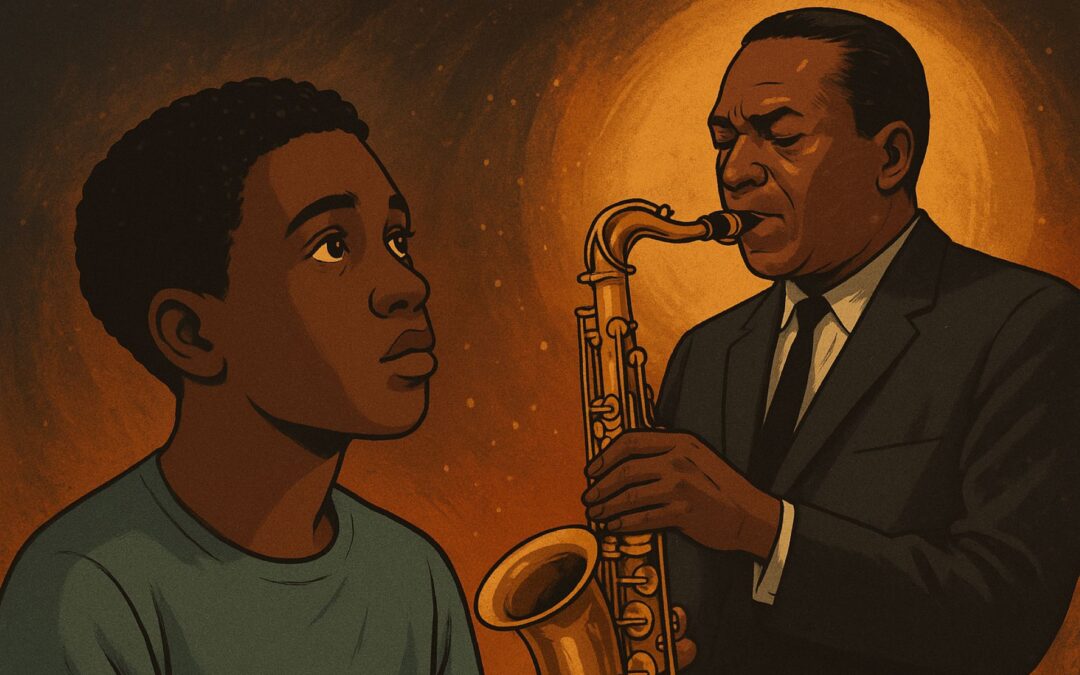
As a young boy growing up in North Carolina, John Coltrane often felt out of place. While other children ran wild in fields and chased laughter, he was contemplative, drawn inward, wrestling with emotions too complex for his age. He wasn’t aloof by choice—just built differently. His spirit searched for something ineffable, a way to translate what he felt but could not articulate.
At first, music was just an escape—a pastime, not a purpose. The saxophone was merely an instrument, not yet an extension of his soul. He joined the school band, played a few notes, followed the sheet music, and drifted through melodies without meaning. Then, one evening, fate placed him in the presence of genius.
He heard Charlie “Bird” Parker perform.
The air changed. Parker’s saxophone didn’t just make sound—it spoke. It cried, soared, and clawed its way into the human heart. Coltrane felt as though someone had reached into his chest and mirrored the longings buried inside him. That night, something awakened. He wasn’t merely listening to music anymore; he was witnessing the divine expressed through breath and brass.
That encounter rewired him. The instrument was no longer an object—it became a vessel. And in that instant, Coltrane discovered what all masters eventually learn: true greatness begins the moment passion fuses with purpose.
Daily Law: Are there people whose work affects you in a powerful way? Analyze this and use them as models.
— Mastery, I: Discover Your Calling — The Life’s Task
The Spark of Resonance
There are moments in life that change everything—quiet, almost imperceptible at first, yet seismic in their aftershocks. You stumble upon a work of art, a piece of music, a performance, or even a single idea that reaches inside you and rearranges your inner architecture. It doesn’t just impress you—it awakens you. Something deep, ancient, and wordless stirs, and you realize that what you’ve just experienced isn’t random. It’s personal.
For John Coltrane, that moment came the first time he heard Charlie “Bird” Parker play live. The experience was less a concert and more a revelation. Parker’s saxophone seemed to breathe with a kind of divine fire—a raw, unfiltered honesty that bypassed intellect and struck directly at the soul. In that instant, Coltrane saw himself. Not the self that the world saw—the quiet, introspective boy from North Carolina—but the vast, yearning self that had always been reaching for something he couldn’t yet define.
That’s what true resonance does: it reveals. It exposes a hidden kinship between the creator and the observer. It’s as if you’re hearing your own thoughts spoken back to you in another person’s language. You recognize the vibration, the intention, the emotional frequency—and it calls you home.
Most people dismiss these moments. They nod in appreciation, applaud, and move on. But for the few who are awake enough to listen, resonance becomes direction. It’s a signpost, a whisper that says, “This is your path.”
Resonance isn’t admiration—it’s recognition. When something moves you so deeply that you feel almost unsettled by it, that’s your inner compass pointing toward what you were meant to explore. It’s the universe using someone else’s genius to remind you of your own.
To find your calling, you must learn to honor these moments. Don’t let them slip by. Trace them backward—what exactly did you feel when you encountered that work? What part of you responded? Was it the precision, the vulnerability, the defiance, the beauty? That emotional reaction is the beginning of alignment.
It is in these rare collisions between inspiration and identity that purpose begins to crystallize. The task, then, is not to chase meaning blindly but to follow the trail of resonance—to listen for the echoes of your own voice in the work of others. Because buried in that recognition lies the clue to your life’s task.
Beyond Admiration
Admiration is seductive—but it’s also safe. It keeps genius at a distance. You can marvel at someone else’s brilliance without ever challenging yourself to rise to it. That’s why most people remain spectators in life. They see greatness, applaud it, and go back to their routines unchanged.
Coltrane refused to be a spectator. When Parker’s performance lit that fire in him, he didn’t idolize from afar—he entered the fire. He began to dissect everything about Parker’s sound—the phrasing, the timing, the breath control, the emotional undertones that made each note feel alive. He studied, practiced, experimented, and failed endlessly. What started as admiration evolved into devotion, and devotion into transformation.
That’s the difference between passive inspiration and active pursuit. The former fades; the latter forges character. When you admire someone deeply, it’s easy to mistake appreciation for progress. But appreciation changes nothing—it’s the disciplined act of emulation, inquiry, and interpretation that turns admiration into evolution.
To move beyond admiration, you must study your heroes not as distant icons but as living blueprints. Don’t just see their triumphs—see their process. What did they sacrifice? How did they think? How did they push through mediocrity? What invisible habits shaped their visible mastery?
Then, turn that understanding inward. Ask: What do I see in them that I want to awaken in myself? Because the truth is, you’re not drawn to your heroes because they’re different from you. You’re drawn to them because they reflect something dormant within you—something you already possess but haven’t yet expressed.
This is how inspiration matures into identity. You start by admiring their courage, but end by cultivating your own. You begin by borrowing their voice, but eventually, you find your tone. You follow their rhythm until one day, almost unexpectedly, you create your own.
Coltrane began by imitating Parker. But over time, imitation gave way to innovation. His music became a bridge between sound and spirit—distinct, transcendent, unmistakably his. That evolution—from admirer to master—is the journey every creative soul must undertake.
Your heroes are not there for worship. They are there to wake you up. Their work isn’t a finish line—it’s a doorway. Step through it.
The Religious Connection
To achieve mastery, your relationship with your craft must evolve beyond casual interest—it must become sacred. The path from competence to genius is not paved by mere ambition but by devotion. True mastery, the kind Coltrane embodied, demands reverence. It asks that you love your pursuit so intensely that it begins to blur the line between work and worship.
For Coltrane, music was never just an art form; it was a form of prayer. Every note he played was an invocation, an attempt to commune with something greater than himself. His practice sessions were not just repetitions of scales—they were meditations. His saxophone was not an instrument; it was a vessel for truth. In his later years, he even referred to his compositions as spiritual offerings, expressions of divine longing and gratitude.
This is what separates the master from the skilled practitioner. The skilled learn techniques; the master surrenders to them. The skilled seek applause; the master seeks communion. There’s a difference between playing music and becoming the music—between painting a picture and being painted through. The latter requires faith—faith in your craft, in your calling, and in the unseen process that shapes you through years of discipline and doubt.
When you reach this level of connection, your work stops being about you. It transcends ego. You no longer perform to impress or create to prove—you create because you must. It becomes a biological, almost spiritual necessity. The devotion consumes you, yet paradoxically, it sets you free.
This kind of devotion cannot be forced. It emerges when what you do aligns perfectly with who you are. When the task in front of you feels like a mirror for your soul, effort becomes ritual. Long hours stop feeling like sacrifice because they’re infused with meaning. Fatigue turns into fulfillment; struggle transforms into transcendence.
To love something this deeply is to give it power over you—and yet, that surrender is the gateway to mastery. The mind that is half-committed never crosses into brilliance. But the one that treats its craft as sacred, that approaches it each day as a form of prayer, touches eternity through effort.
Whatever your field—art, science, entrepreneurship, writing, or design—the same law applies. The work must consume you to complete you. Because mastery is not simply about doing something well; it’s about becoming one with the act of doing itself.
Turning Inspiration into Action
Inspiration without execution is illusion. It may feel profound in the moment, but without movement, it evaporates. Every hero, every artist, every innovator you admire reached greatness not because they felt inspired, but because they acted on that inspiration relentlessly.
Coltrane’s genius was not born from that single night of hearing Parker play—it was forged in the years that followed, in the endless hours of disciplined practice, in the unglamorous repetitions that no one else saw. Inspiration gave him direction, but action gave him destiny.
Turning inspiration into action means transforming emotion into momentum. Start by identifying what exactly moves you. When a person’s work grips you, ask why. Is it their courage to speak truth? Their ability to blend logic and feeling? Their refusal to conform? Once you identify what resonates, trace it back to your own life. Where does that same potential lie dormant in you? What would it look like if you gave it form?
Then, build ritual around that pursuit. Devotion grows through discipline. If you admire a writer, write daily. If you revere an athlete, train with intent. If you’re moved by innovators, build and test relentlessly. The point is not to mimic their output but to emulate their consistency, their resilience, their faith in process.
This is where most people falter. They treat inspiration as fuel when it’s really a spark. It’s not meant to sustain you—it’s meant to start you. Once the fire is lit, you must feed it with commitment, structure, and time. Without that, the spark fades back into fantasy.
Action refines inspiration. Every attempt, every experiment, every failure chisels your understanding of your craft and of yourself. In the beginning, your work may feel derivative—that’s natural. Every artist imitates before they innovate. But as you stay with it, your own voice will start to emerge from beneath the borrowed forms.
The process is cyclical: inspiration ignites effort, effort deepens understanding, and understanding attracts new inspiration. Over time, the outer influence that once guided you becomes internalized—you no longer need to look outward for motivation because the work itself becomes your source of energy.
In the end, turning inspiration into action is how you claim your calling. It’s how admiration evolves into mastery, and how your heroes stop being unreachable icons and start becoming your peers in spirit.
The world doesn’t need more admirers—it needs more makers. The music has already been played; now it’s your turn to pick up the instrument.
Conclusion
Your heroes are not accidents of admiration—they are signals. They appear in your life to awaken something dormant, to remind you of a truth you’ve forgotten about yourself. When a person’s work moves you to your core, it’s not just appreciation; it’s alignment. Their voice resonates with a frequency already alive within you, urging expression.
John Coltrane’s journey wasn’t about becoming another Charlie Parker—it was about discovering the voice that only he could give to the world. That is the essence of mastery: not imitation, but revelation. You start by following in the footsteps of those who ignite your spirit, but eventually, you carve your own path.
So pay attention to the work that stirs your emotions. Study it. Let it guide you, challenge you, and transform you. But most importantly, let it drive you toward your own unique expression. Because the highest way to honor your heroes is not by repeating their songs—it’s by finding your own.
This article is a part of The Daily Laws Series based on Robert Greene’s book.