
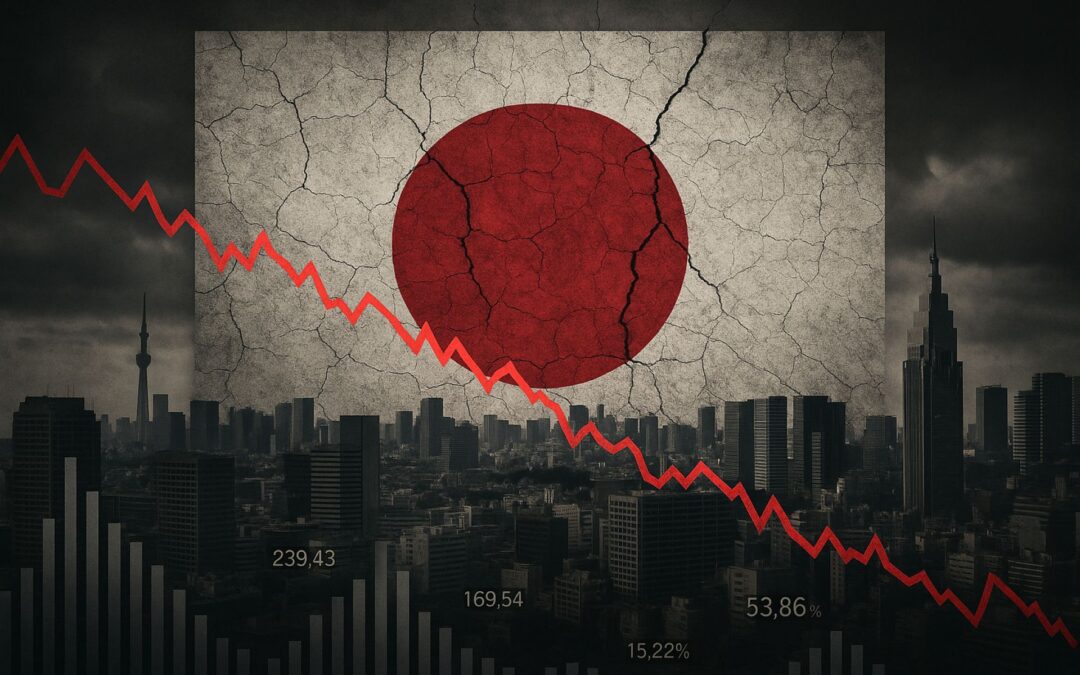
In the late 1980s, Japan looked unstoppable.
Tokyo was the center of the financial world. The Nikkei stock index reached record highs, Japanese corporations dominated global markets, and the country seemed poised to surpass the United States as the world’s leading economic power. At the peak of this confidence, eight of the ten largest companies in the world were Japanese. Japanese investors bought iconic Western assets such as Rockefeller Center in New York, and popular culture began imagining a future dominated by Japanese corporations.
At the time, the numbers seemed to justify the optimism. Japan’s GDP per capita had risen above that of the United States, its exports were flooding global markets, and its manufacturing sector was widely considered the most advanced in the world. For decades, Japan had experienced one of the most extraordinary economic expansions in modern history.
But the rise did not last.
In 1990, the Japanese stock market collapsed. Within months, the Nikkei lost massive amounts of value, wiping out trillions of dollars in wealth. At the same time, Japan’s real estate bubble began to implode, destroying the financial foundations that had supported the country’s boom years.
What followed was something few economists expected: decades of stagnation.
Wages stalled. Growth slowed dramatically. Deflation became a persistent problem. Even today, more than thirty years after the bubble burst, Japan’s economy still struggles with many of the same structural challenges that emerged in the early 1990s.
The story of Japan’s economic decline is not just about a financial crash. It is about a series of policy decisions, institutional weaknesses, and demographic shifts that turned a short-term crisis into a long-term economic trap.
To understand how one of the most powerful economies in the world became stuck in decades of slow growth, we need to start at the beginning — with the remarkable rise of Japan’s post-war economic miracle.
The Post-War Foundations of Japan’s Economic Miracle
Japan’s economic success did not happen by accident. It was the result of a unique combination of geopolitical strategy, structural reforms, and deliberate industrial policy that transformed a devastated nation into one of the most powerful economies in the world.
When World War II ended in 1945, Japan was in ruins. Much of the country’s industrial infrastructure had been destroyed by bombing campaigns, its workforce had been depleted by war casualties, and its economy had collapsed. Factories were damaged, supply chains were broken, and food shortages were widespread.
Yet within a few decades, Japan would experience one of the most remarkable economic transformations in modern history.
A major reason for this turnaround was the role of the United States during the post-war occupation. Washington viewed Japan not only as a defeated enemy but also as a strategic asset in the emerging Cold War. There was significant concern that economic instability in Japan could push the country toward communism, similar to what had recently happened in China.
To prevent this, the United States supported a sweeping set of reforms designed to stabilize and modernize Japan’s economy.
U.S. Occupation and Structural Reforms
One of the most important reforms involved dismantling the zaibatsu, powerful family-controlled conglomerates that had dominated Japan’s pre-war economy. These massive business groups concentrated wealth and industrial power in the hands of a small elite, limiting competition and economic participation.
Breaking them up helped decentralize economic power and created space for a more competitive corporate environment.
Land reforms were another crucial change. Large landholdings were redistributed to tenant farmers, giving millions of Japanese citizens ownership of the land they worked. This policy dramatically improved rural incomes and created a broader base of economic participation across society.
These reforms laid the institutional groundwork for Japan’s post-war recovery.
The Birth of Japan’s Export Machine
While domestic reforms helped stabilize the country, Japan’s real economic engine would become export-driven industrial growth.
A key turning point came during the Korean War in the early 1950s. As the United States mobilized its military operations in the region, Japan became a critical supplier for war-related goods and logistical support. American procurement orders flooded into Japanese factories, providing an immediate boost to industrial production.
At the same time, the Japanese government actively promoted industrial development through targeted policies and financial support. Cheap loans and coordinated planning encouraged investment in manufacturing sectors that could compete internationally.
The results were dramatic. During the 1950s, Japanese exports surged, and industrial production expanded rapidly. Factories rebuilt after the war began producing goods at an increasingly competitive scale.
This export-oriented model would become the foundation of Japan’s economic strategy for decades — setting the stage for the country’s transformation into a global manufacturing powerhouse.
Japan’s Manufacturing Renaissance
By the late 1950s and early 1960s, Japan’s economic recovery had evolved into something much bigger. What began as a post-war rebuilding effort quickly turned into a full-scale industrial transformation.
Initially, Japan’s export economy relied heavily on low-cost textiles and basic manufactured goods, much of which was sold to developing markets across Asia. While this strategy generated early growth, Japanese policymakers recognized that it would not sustain long-term prosperity. Competing purely on low costs was risky, especially as other countries could eventually produce similar goods even more cheaply.
To secure its economic future, Japan needed to move up the value chain.
The government responded by aggressively pushing the country toward higher-value manufacturing industries such as electronics, automobiles, and precision machinery. This shift would fundamentally reshape Japan’s role in the global economy.
The Role of Industrial Policy and MITI
A central driver of this transformation was the Ministry of International Trade and Industry (MITI), one of the most influential government institutions in Japan’s economic development.
MITI coordinated investment, directed credit toward strategic industries, and encouraged companies to adopt advanced technologies from abroad. Rather than leaving industrial development entirely to market forces, the Japanese government actively guided the direction of economic growth.
This strategy involved identifying sectors with strong export potential and channeling resources toward them. Companies in targeted industries received access to low-interest loans, favorable regulations, and support for technological development.
At the same time, Japan imported cutting-edge technologies from Western countries and rapidly improved upon them. By combining foreign innovation with highly efficient manufacturing processes, Japanese firms were able to produce goods that were both high quality and competitively priced.
Over time, this strategy helped create one of the most advanced manufacturing ecosystems in the world.
The Rise of Global Japanese Brands
By the 1960s and 1970s, the results of Japan’s industrial strategy were becoming increasingly visible.
Japanese companies began to dominate global markets in sectors such as automobiles, electronics, and consumer goods. Brands that would later become household names — including Toyota, Sony, Panasonic, and Honda — were expanding rapidly and exporting products across the globe.
Exports surged at extraordinary rates. By 1970, Japan’s exports had increased by nearly 380%, and the country had become the fifth-largest economy in the world. In just a few decades, Japan had surpassed major European powers and even overtaken China in terms of economic size.
This export boom fueled rising incomes and a rapidly expanding middle class. Japanese consumers began enjoying a level of prosperity that had been unimaginable only a generation earlier.
Luxury brands took notice as well. International companies such as Louis Vuitton and Hermès opened flagship stores in Tokyo, recognizing that Japan had become one of the most lucrative consumer markets in the world.
For many observers during this period, Japan appeared to have discovered a permanent formula for economic success.
But beneath the surface of this remarkable prosperity, a set of financial and policy decisions were beginning to create the conditions for one of the largest economic bubbles in history.
The 1980s Boom and the Seeds of the Bubble
By the early 1980s, Japan had become one of the most powerful economies in the world. Its export-driven growth model had generated massive wealth, and Japanese corporations were expanding aggressively into global markets.
At the same time, Japanese financial markets were booming. Stock prices were climbing rapidly, real estate values were soaring, and investors believed the country’s economic momentum would continue indefinitely.
But behind this wave of prosperity, a series of policy decisions and economic shocks were quietly laying the groundwork for an enormous financial bubble.
The Plaza Accord and Currency Shock
One of the most important turning points came in 1985 with the signing of the Plaza Accord.
During the early 1980s, the United States was struggling with a large trade deficit and growing concerns about the decline of its manufacturing sector. At the same time, the U.S. dollar had appreciated sharply against other major currencies, making American exports more expensive and less competitive.
To address this imbalance, the United States coordinated with several major economies — including Japan, West Germany, the United Kingdom, and France — to weaken the dollar.
The agreement required Japan to allow its currency, the yen, to strengthen significantly against the dollar.
The results were dramatic. Within just a few years, the exchange rate shifted from roughly ¥239 per dollar to around ¥128 per dollar. In effect, the value of the yen nearly doubled.
While this helped reduce trade imbalances, it also created serious problems for Japan’s export-driven economy. A stronger yen made Japanese goods more expensive in international markets, threatening the competitiveness of the country’s manufacturing sector.
Japanese policymakers feared that this sudden currency appreciation could slow economic growth.
Their solution was to stimulate the domestic economy with aggressive monetary policy.
Cheap Money and Asset Speculation
To offset the economic pressure caused by the stronger yen, the Bank of Japan sharply lowered interest rates. By the late 1980s, borrowing costs had fallen to extremely low levels, making credit widely available throughout the financial system.
Cheap money flooded the economy.
Banks began lending aggressively, businesses expanded rapidly, and investors poured money into financial markets. With borrowing costs so low, speculation became increasingly attractive.
The most dramatic surge occurred in real estate and stock markets.
Land prices in Japan — particularly in major cities such as Tokyo — began rising at astonishing rates. Investors believed that land values would continue increasing indefinitely, and many buyers were less interested in the buildings themselves than in the land underneath them.
Japanese tax policies also encouraged this behavior. Certain tax rules made real estate a particularly attractive asset for wealthy investors, allowing them to minimize capital gains or inheritance taxes.
Meanwhile, banks were fueling the frenzy by issuing large loans backed by inflated asset values. In many cases, loans were secured using real estate or stocks as collateral — assets that were themselves rising rapidly in price.
This created a dangerous feedback loop. Rising asset prices encouraged more borrowing, which pushed prices even higher.
By the late 1980s, Japan’s economy had entered one of the largest asset bubbles in modern history.
But bubbles built on easy credit and speculation rarely last forever.
The Collapse of Japan’s Asset Bubble
By the late 1980s, Japan’s financial markets had reached extraordinary heights. Stock prices and land values had risen so quickly that many investors believed the upward trend would never stop. Speculation had become deeply embedded in the financial system, and both banks and investors were heavily exposed to inflated asset prices.
But the very policies that fueled the bubble would soon trigger its collapse.
In 1989, the Bank of Japan began raising interest rates in an attempt to cool the overheating economy. What had once been extremely cheap credit suddenly became more expensive. Borrowing slowed, speculative investment began to weaken, and the fragile foundation supporting asset prices started to crack.
Within months, the market began to unravel.
The Stock Market Crash
The first major shock came in the stock market.
At the end of 1989, Japan’s benchmark stock index — the Nikkei 225 — reached its historic peak. But as interest rates continued rising, investor confidence began to collapse. The flood of easy credit that had fueled the market was disappearing, and many investors rushed to sell their positions.
The results were catastrophic.
Within a short period of time, the Nikkei lost an enormous share of its value, wiping out hundreds of billions of dollars in market capitalization. By the early 1990s, trillions of dollars in stock market wealth had vanished.
For investors who had borrowed heavily to speculate on rising asset prices, the crash was devastating.
The Real Estate Meltdown
At the same time, Japan’s real estate bubble began to burst.
Government regulators introduced restrictions on real estate lending in an attempt to slow speculation. Banks were suddenly limited in their ability to issue loans tied to property investments, cutting off one of the main sources of funding that had sustained the housing and land boom.
Once credit dried up, land prices began to fall rapidly.
Because so many loans had been secured using real estate as collateral, falling land prices created enormous problems for the banking system. Borrowers found themselves holding assets worth far less than the debt they had taken on to acquire them.
The scale of the collapse was staggering. Real estate values across Japan lost trillions of dollars, destroying wealth across the financial system.
By the end of 1990, the combined crash in stocks and real estate had erased enormous amounts of economic value. What had once seemed like an unstoppable boom had transformed into a full-blown financial crisis.
And with the collapse of asset prices, the deeper structural weaknesses of Japan’s financial system were about to be exposed.
The Banking Crisis and the Rise of Zombie Banks
When Japan’s asset bubble collapsed in the early 1990s, the country’s financial system was left in a deeply fragile state.
During the boom years, banks had issued massive amounts of loans backed by real estate and stock market assets. As long as those assets continued rising in value, the system appeared stable. But once prices began to fall, the collateral supporting many of these loans quickly evaporated.
Banks were suddenly left holding enormous amounts of non-performing loans — debts that borrowers could no longer repay.
In most financial crises, failing banks are forced to recognize losses, restructure their balance sheets, and in some cases shut down entirely. This process, although painful, helps the economy recover by clearing out bad debt and allowing capital to move toward more productive businesses.
Japan chose a different path.
Non-Performing Loans and Financial Paralysis
Instead of forcing banks to recognize their losses quickly, the Japanese government allowed many financial institutions to keep bad loans on their books for years.
This created a phenomenon that economists later called “zombie banks.”
These banks were technically insolvent but continued operating because regulators avoided confronting the scale of the problem. Rather than writing off bad loans or restructuring failing businesses, banks often rolled over existing debt, extending loans to struggling companies that had little chance of recovery.
The result was a financial system trapped in paralysis.
Banks were reluctant to lend to new, innovative firms because their balance sheets were already weighed down by bad debt. At the same time, they continued supporting inefficient companies simply to avoid recognizing losses.
This prevented the normal process of economic restructuring that typically follows a financial crisis.
Government Bailouts and Delayed Reform
The government eventually stepped in to stabilize the banking system, but its response was slow and cautious.
Although Japan’s banking crisis began in the early 1990s, it took nearly a decade before large-scale public funds were injected into the financial sector. By the time significant intervention occurred in 1999, the damage had already spread throughout the economy.
Non-performing loans had grown to enormous levels, representing a substantial share of Japan’s GDP. Even after government bailouts, banks remained hesitant to restructure failing companies or fully write down bad debts.
This prolonged the economic stagnation.
Instead of allowing inefficient firms to fail and freeing resources for more productive businesses, Japan’s financial system continued supporting struggling companies that could not compete effectively.
As a result, capital remained trapped in unproductive sectors of the economy, slowing innovation and delaying recovery.
The banking crisis that followed the asset bubble did not end quickly. Instead, it lingered for years, becoming one of the central reasons Japan’s economic slowdown turned into what would later be known as the “Lost Decades.”
Fiscal Policy Mistakes That Deepened the Stagnation
As Japan’s banking system struggled with bad debt and economic activity slowed, the government attempted to stimulate the economy through fiscal policy. In theory, increased public spending and government investment could help revive demand, create jobs, and encourage private-sector growth.
But in practice, Japan’s fiscal response often failed to deliver meaningful results.
A combination of modest stimulus packages, poorly targeted spending, and poorly timed tax increases prevented fiscal policy from providing the economic boost that the country desperately needed.
Ineffective Stimulus Spending
Throughout the 1990s, the Japanese government introduced a series of stimulus programs designed to jumpstart economic growth. However, the scale of these efforts was relatively small compared to the magnitude of the crisis.
Between 1992 and 1997, Japan’s fiscal stimulus totaled roughly 4.5% of GDP, a modest amount given the size of the economic collapse following the asset bubble. Even more problematic was the way the money was spent.
Much of the government spending focused on public works projects, particularly infrastructure development in rural regions. While these projects were intended to create jobs and stimulate local economies, many of them produced limited long-term economic value.
In some cases, roads, bridges, and construction projects were built in areas with little economic activity, serving political interests more than economic ones. Instead of investing heavily in the urban areas and industries that could drive productivity and innovation, the government often directed resources toward projects that had minimal impact on long-term growth.
As a result, the stimulus programs failed to generate the strong economic momentum policymakers had hoped for.
The Consumption Tax Shock of 1997
Just as the economy began showing early signs of recovery in the mid-1990s, the government made a critical policy decision that would undermine the fragile progress.
In 1997, Japan raised its consumption tax from 3% to 5%.
The goal was to stabilize government finances and reduce the growing fiscal deficit. However, the timing proved disastrous.
The tax increase immediately reduced consumer spending, weakening household demand at a moment when the economy was already struggling to regain momentum. Confidence among consumers and businesses quickly deteriorated, and Japan slipped back into recession.
Rather than strengthening the country’s fiscal position, the move deepened the economic slowdown and reinforced the cycle of stagnation that had begun after the asset bubble burst.
Combined with the unresolved banking crisis, these fiscal policy mistakes made it even more difficult for Japan’s economy to recover during the critical early years following the crash.
Monetary Policy and the Liquidity Trap
As fiscal policy struggled to revive economic growth, Japan increasingly relied on monetary policy to stimulate the economy. The Bank of Japan attempted to revive investment and consumption by lowering interest rates and expanding liquidity in the financial system.
However, these efforts soon ran into a fundamental economic problem: once interest rates approach zero, traditional monetary policy loses much of its power.
Japan became the first major economy to experience this problem on a large scale.
Zero Interest Rates and Deflation
In response to the economic slowdown of the early 1990s, the Bank of Japan gradually reduced interest rates in an effort to encourage borrowing and investment. By 1995, short-term interest rates had been pushed down to nearly zero.
Normally, lower interest rates make borrowing cheaper, which encourages businesses to invest and consumers to spend. But in Japan’s case, the policy produced far weaker results than expected.
One major reason was the emergence of deflation, a persistent decline in the overall price level.
When prices are falling, consumers and businesses often delay spending because they expect goods and services to become cheaper in the future. Instead of stimulating economic activity, deflation encourages saving and discourages investment.
This created a dangerous cycle. Weak demand pushed prices down further, and falling prices reduced the incentive to spend.
Even with interest rates close to zero, the economy remained sluggish.
Quantitative Easing Arrives Too Late
Eventually, the Bank of Japan introduced more unconventional monetary tools.
In 2001, the central bank launched one of the world’s first major programs of quantitative easing, an aggressive policy that involved purchasing government bonds and injecting large amounts of liquidity into the financial system.
The goal was to increase the money supply and encourage banks to lend more aggressively.
However, by the time these policies were introduced, Japan had already spent nearly a decade struggling with slow growth and deflation. Many businesses and consumers had become deeply cautious about borrowing and spending, and banks were still burdened with large amounts of bad debt from the earlier crisis.
As a result, even these aggressive monetary policies had limited impact.
Japan had entered what economists call a liquidity trap — a situation in which traditional monetary tools become largely ineffective because interest rates are already extremely low and economic confidence remains weak.
While other countries would later face similar challenges during global financial crises, Japan was the first major economy to become trapped in this prolonged period of monetary stagnation.
Japan’s Corporate System and the Iron Triangle
Beyond financial crises and policy mistakes, another major factor behind Japan’s long economic stagnation was the structure of its corporate system.
For decades, Japan’s economy had been organized around a powerful network linking banks, corporations, and government regulators. This system was often referred to as the “Iron Triangle.” In theory, it allowed policymakers, financial institutions, and businesses to coordinate long-term economic development.
During Japan’s rapid growth years, this structure helped accelerate industrial expansion. Close relationships between banks and corporations ensured that companies had reliable access to financing, while government ministries guided investment into strategic sectors.
But after the economic bubble burst, the same system that once fueled growth began to hold the economy back.
Crony Capitalism and Protected Industries
One of the most damaging features of the Iron Triangle was its tendency to protect failing businesses.
In many economies, companies that cannot compete eventually collapse, allowing capital and labor to shift toward more productive industries. This process of creative destruction is essential for innovation and long-term economic growth.
In Japan, however, banks often continued lending to struggling companies rather than allowing them to fail. These firms — sometimes called “zombie companies” — survived largely because of continued financial support from banks that were themselves trying to avoid recognizing losses.
Government regulators often tolerated this arrangement because widespread corporate failures could have triggered deeper economic instability.
The result was an economy filled with businesses that remained alive but were unable to grow, innovate, or compete effectively.
Stagnant Productivity and Slow Innovation
Over time, this environment significantly weakened Japan’s productivity growth.
In dynamic economies, new firms regularly emerge to challenge established players, introducing new technologies and business models. But Japan’s corporate system made it difficult for new companies to break into existing industries.
Large corporations dominated key sectors, and the culture within many firms emphasized hierarchy, seniority, and long working hours rather than experimentation and innovation.
While other advanced economies saw productivity growth rates of 2–3% annually, Japan’s productivity growth during the 1990s and early 2000s averaged closer to 1.2%.
Even industries that had once made Japan globally competitive began to lose momentum.
Instead of adapting quickly to changing global markets, many large corporations remained locked into outdated management structures and slow decision-making processes.
What had once been a powerful system for coordinated growth had gradually turned into a structure that resisted change.
Demographics and the Immigration Problem
While financial crises and policy mistakes played a major role in Japan’s economic stagnation, another powerful force was quietly reshaping the country’s future: demographics.
Japan is now facing one of the most severe demographic challenges in the developed world. A rapidly aging population combined with extremely low birth rates has dramatically reduced the size of the country’s workforce.
Unlike many other advanced economies, Japan has been reluctant to offset this decline through immigration.
Over time, this combination has placed increasing pressure on economic growth.
Japan’s Aging Population
Japan’s population structure began changing significantly in the 1990s.
As birth rates fell and life expectancy increased, the proportion of elderly citizens began rising rapidly. Today, more than a quarter of Japan’s population is over the age of 65, making it one of the oldest societies in the world.
At the same time, the number of working-age citizens has steadily declined. Since the mid-1990s, Japan’s working-age population has shrunk by more than 10%, reducing the available labor force that drives economic activity.
A shrinking workforce creates several challenges.
Fewer workers mean lower overall production and slower economic growth. At the same time, governments must support a growing elderly population through pensions, healthcare systems, and social services.
This places increasing strain on public finances while reducing the tax base that funds those programs.
Cultural Resistance to Immigration
Many countries facing demographic decline have attempted to offset labor shortages through immigration. By allowing foreign workers to enter the labor market, governments can stabilize population growth and maintain economic productivity.
Japan, however, has historically been reluctant to pursue this path.
The country has long maintained a strong cultural preference for social homogeneity, and immigration policies have remained relatively restrictive compared to other advanced economies.
As a result, Japan has not significantly expanded its workforce through foreign labor, even as demographic pressures intensified.
This decision has contributed to persistent labor shortages in several industries and limited the inflow of new talent that might otherwise stimulate innovation and entrepreneurship.
At the same time, Japan’s demanding work culture — characterized by long hours and rigid corporate hierarchies — has discouraged younger generations from starting families. Combined with the country’s restrictive immigration policies, this has accelerated population decline.
The demographic reality is clear: Japan’s population is shrinking, its workforce is contracting, and the economic consequences are becoming increasingly difficult to ignore.
Why Japan’s Economy Still Struggles Today
More than three decades after the collapse of its asset bubble, Japan’s economy continues to face many of the same structural challenges that emerged in the early 1990s. While the country remains one of the largest and most technologically advanced economies in the world, its long-term growth has been consistently weak compared to other developed nations.
Several factors have combined to keep Japan trapped in this prolonged period of stagnation.
One major issue is the lasting impact of the asset bubble collapse. The financial damage caused by falling stock prices and real estate values reshaped the behavior of Japanese businesses and households. Companies became far more cautious about investment, while consumers became more inclined to save rather than spend. This shift in economic behavior reduced demand across the economy and made it harder for growth to accelerate.
Another challenge has been persistent deflationary pressure. For much of the past three decades, prices in Japan have either stagnated or declined. While low prices may seem beneficial for consumers in the short term, deflation can weaken an economy by discouraging investment and consumption. If people believe prices will fall in the future, they may delay spending, which further suppresses economic activity.
Japan’s corporate structure also continues to limit economic dynamism. Many large companies remain protected by long-standing relationships with banks and regulators, making it difficult for new competitors to disrupt established industries. This environment slows innovation and reduces productivity growth compared to more competitive economies.
At the same time, Japan’s demographic challenges continue to intensify. The shrinking workforce and aging population place increasing pressure on economic output, government budgets, and social support systems. Without a growing labor force, maintaining strong economic expansion becomes significantly more difficult.
Despite these obstacles, Japan has attempted numerous reforms in recent years. Policies such as aggressive monetary easing, government stimulus programs, and structural reform initiatives have been introduced to revive growth.
Yet the results have been mixed. While these policies have helped stabilize certain sectors of the economy, they have not fully resolved the deeper structural issues that emerged after the bubble burst.
Today, Japan remains a highly developed nation with world-class industries and infrastructure. But its economic trajectory serves as a reminder that even the most powerful economies can struggle for decades if financial crises, policy missteps, and demographic pressures converge at the same time.
This long period of stagnation has turned Japan’s economic story into one of the most important cautionary tales in modern economic history.
Conclusion
Japan’s economic story is one of the most dramatic reversals in modern economic history.
In the span of just a few decades, the country went from a war-torn economy to one of the most powerful industrial forces in the world. By the late 1980s, Japan appeared unstoppable. Its corporations dominated global markets, its financial system was overflowing with capital, and many observers believed it would soon surpass the United States as the world’s leading economic power.
But the extraordinary boom of the 1980s was built on fragile foundations.
Cheap credit, speculative investment, and soaring asset prices created an enormous financial bubble. When that bubble finally burst in the early 1990s, it exposed deep weaknesses in Japan’s banking system, corporate structure, and policy framework.
Instead of allowing markets to rapidly clear bad debt and restructure failing institutions, policymakers moved slowly and cautiously. Banks were allowed to carry bad loans for years. Inefficient companies were kept alive through continued lending. Fiscal stimulus was often poorly targeted, and monetary policy struggled to combat persistent deflation.
At the same time, long-term structural challenges began to intensify. Japan’s corporate culture resisted innovation and competition, while demographic changes steadily reduced the country’s working-age population. Combined with limited immigration and rigid labor markets, these forces placed increasing pressure on economic growth.
The result was a prolonged period of stagnation that came to be known as Japan’s Lost Decades.
Despite these challenges, Japan remains a highly developed economy with strong technological capabilities and a high standard of living. However, its experience offers a powerful lesson for other advanced economies.
Financial bubbles, policy delays, and structural rigidity can transform even the strongest economies into slow-growing ones. When crises occur, decisive reforms and institutional adaptation are essential to restoring long-term growth.
Japan’s story ultimately serves as a reminder that economic success is never permanent. Sustained prosperity requires constant innovation, flexible institutions, and the willingness to confront problems before they become entrenched.
The rising sun once symbolized Japan’s unstoppable ascent. Whether it can rise again economically will depend on how the country addresses the structural challenges that continue to shape its future.