
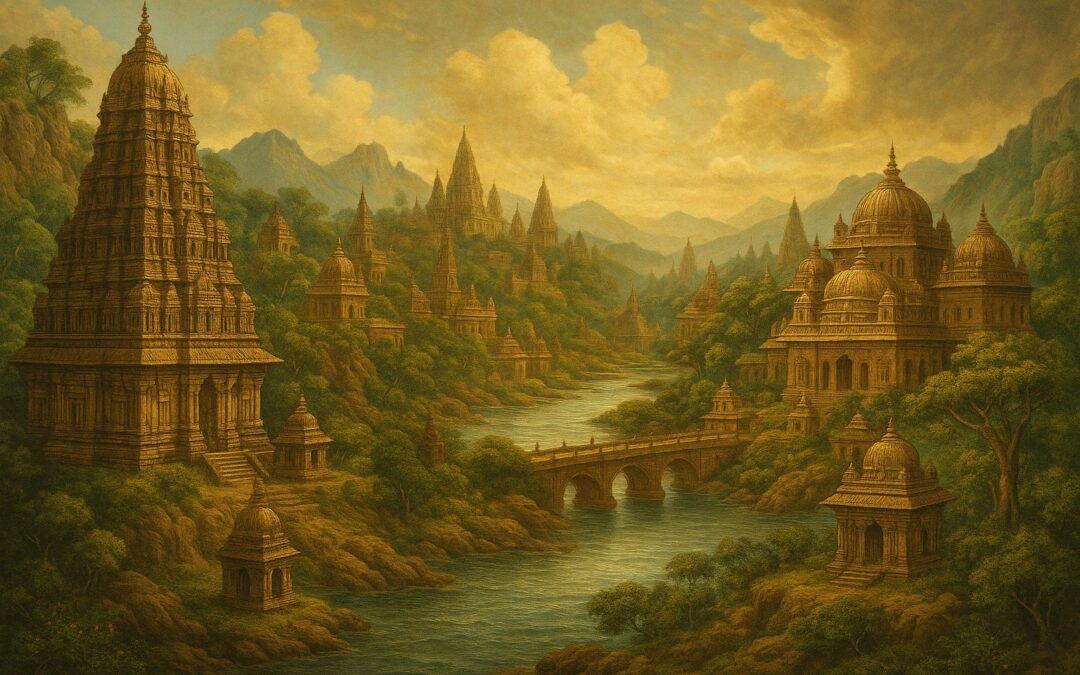
Kumari Kandam, an ancient civilization shrouded in mystery, stands as a testament to a time before the rise of the known world. Long before the Mahabharata unfolded, a land existed that embodied divine wisdom, cosmic harmony, and a blend of spirituality, art, and knowledge. Its story is woven into the sacred scriptures of Hinduism and ancient Tamil literature, carrying echoes of a civilization that thrived under the watchful eyes of the gods. While the land has vanished beneath the sea, the legends and the wisdom it embodied continue to captivate those who seek to uncover the secrets of the past.
A Land Beyond Time and Space
Kumari Kandam, often depicted as a land of untold wonders, existed in an age long before the rise of civilizations as we know them today. Its location remains an enigma, often described as a vast continent that once stretched across the southern oceans. The geography of Kumari Kandam is not just an aspect of the physical world, but a mystical realm woven into the fabric of myth and divine reality. Ancient scriptures, particularly those of Tamil literature, speak of a land so radiant, so deeply connected to the divine that it was considered a manifestation of cosmic order. The descriptions in these texts often blur the lines between the physical and the metaphysical, suggesting that Kumari Kandam was not simply a piece of land, but a conduit through which the divine communicated with the mortal realm.
The people of Kumari Kandam, according to ancient texts, were uniquely gifted with an innate connection to the cosmos. The rivers, mountains, and valleys were more than just natural features; they were living entities imbued with divine energy. The people could communicate with nature in ways that are beyond our understanding today, sensing the very pulse of the earth beneath their feet. This extraordinary ability to feel the divine presence in the natural world allowed the inhabitants of Kumari Kandam to live in harmony with their environment. Every tree, every rock, every stream was seen not as an object to be used but as a manifestation of the divine that deserved reverence.
What makes Kumari Kandam particularly intriguing is that its inhabitants were said to have been spiritually enlightened long before the establishment of other great civilizations. This wasn’t just a land of knowledge but a place where that knowledge was directly tied to the spiritual growth and well-being of its people. The connection between the divine and the mundane was so seamless that the two realms seemed to exist as one. The idea of Kumari Kandam as a land blessed by gods implies that every event, every ritual, every word spoken held a deep and profound meaning, directly linked to the cosmic forces of the universe.
The Divine Gift of Knowledge
Kumari Kandam’s greatness is largely attributed to the sacred knowledge that it possessed—a divine gift bestowed upon its people by celestial beings. These divine visitors were believed to have been messengers of the gods, imparting not only practical wisdom but also spiritual teachings that were considered the foundation of the human connection with the divine. The sacred texts that emerged from Kumari Kandam were thought to contain the secrets of the universe, encompassing not only religious practices but also the laws of nature, the movements of celestial bodies, and the mysteries of the human soul.
The texts from Kumari Kandam, passed down through generations, contain a wealth of knowledge. They cover diverse subjects ranging from the esoteric realms of metaphysics to the tangible aspects of earthly existence. It is said that the teachings were embodied in ancient hymns and mantras, passed on through oral traditions and written in stone, as well as on palm leaves. These sacred texts emphasized the connection between the spiritual world and the material world, illustrating how the two realms were inseparably intertwined.
In Kumari Kandam, wisdom was not confined to the elite or the learned few; it was something that permeated the entire society. Spiritual knowledge was seen as a force that transcended individual enlightenment, permeating every aspect of life. Temples built from living rock acted as repositories of this wisdom. They were not just places of worship but also centers of learning, where sacred verses were recited, and cosmic truths were imparted. These temples were often located in the most sacred and natural locations—by flowing rivers, atop mountains, or within dense forests—places that were believed to be particularly attuned to divine energies.
The pursuit of knowledge in Kumari Kandam was not simply an intellectual endeavor but a spiritual practice. The teachings taught the people not just how to understand the world but how to live in harmony with it. The deep connection between human beings and the divine was a central theme in all teachings, with the ultimate aim being spiritual awakening and enlightenment. Knowledge in Kumari Kandam was the key to understanding the universe itself, and the people believed that through wisdom, they could align their actions with the cosmic order.
The Harmony of Nature and Human Endeavor
Kumari Kandam is perhaps most remarkable for its deeply ingrained sense of balance between the natural world and human life. The people of Kumari Kandam believed that the natural world was not something to be conquered but something to be lived with and respected. This reverence for nature was reflected in their way of life, their architectural practices, and their understanding of the cycles of the earth. The harmony between nature and human endeavor was at the core of their spiritual teachings, and it permeated every aspect of their civilization.
The land was abundant, not in material wealth but in the spiritual richness that the people derived from it. Rivers that flowed with crystal-clear water symbolized purity, while forests full of life represented the divine energy that flowed through all beings. Seasons were seen not just as natural occurrences but as divine acts, orchestrated by the gods to maintain the balance of the universe. The arrival of the monsoon, the blooming of flowers, and the harvest were all celebrated as sacred moments, deeply intertwined with the divine rhythms of nature.
Culturally, the people of Kumari Kandam saw their cities not as separate from nature but as an extension of it. Their architecture was in harmony with the land around them, designed not to disrupt the natural landscape but to enhance it. The buildings were constructed using natural materials that were in keeping with the environment, and the structures themselves were often designed to complement the natural features of the land. The architectural style emphasized simplicity, beauty, and functionality, with buildings often blending seamlessly into their surroundings.
In Kumari Kandam, the cycles of life, death, and rebirth were seen as part of a larger cosmic process. Human life was not viewed in isolation but as part of the grand, eternal cycle of the universe. Festivals, rituals, and ceremonies were held to mark these cycles, ensuring that the connection between human life and the natural world remained strong. The people understood that their lives were part of a much larger rhythm, one that was constantly shifting but always in harmony with the divine.
The Fall of Kumari Kandam: A Mystery of Fate
The fall of Kumari Kandam is one of the greatest mysteries in the history of myth. According to the legends, the great continent of Kumari Kandam vanished without a trace, swallowed by the ocean in a cataclysmic event. The cause of this disappearance has been a subject of much debate, with some suggesting that it was a divine act, while others believe that natural disasters, such as floods or earthquakes, caused the land to sink beneath the waves.
Some texts claim that the gods themselves decided that Kumari Kandam’s time had passed and that its destruction was necessary to make way for the next phase of human evolution. The loss of Kumari Kandam was therefore seen not as a tragedy but as a necessary transition. The land’s role in the grand cosmic cycle had ended, and it was time for the Earth to move forward into a new era. According to these legends, the land was not lost forever but transformed, its energies absorbed into the cosmos to be reborn in some other form.
Other theories suggest that Kumari Kandam’s fall was due to natural forces beyond the control of its inhabitants. Some believe that the land was destroyed by massive floods that inundated the entire continent. Others point to tectonic shifts that caused the land to sink beneath the ocean. While these explanations may seem plausible, the truth of Kumari Kandam’s destruction remains elusive, locked away in the mysteries of time and myth.
The disappearance of Kumari Kandam has left behind only traces of its once-glorious civilization. Temples, inscriptions, and artifacts have been discovered, scattered across the landscape, serving as clues to a lost world. These remnants offer a tantalizing glimpse into a society that was far ahead of its time, but they also raise more questions than they answer. What happened to Kumari Kandam? Was it truly destroyed by divine intervention, or was its fall the result of natural forces beyond anyone’s control? The search for answers continues, but the full story remains a mystery, waiting to be uncovered.
The Eternal Legacy: Lessons for the Modern World
Despite the physical disappearance of Kumari Kandam, the spiritual and intellectual legacy of the civilization continues to resonate in the modern world. The wisdom imparted by the ancient sages of Kumari Kandam, particularly their understanding of the interconnectedness of life, continues to influence contemporary spiritual seekers and scholars. The divine knowledge that the people of Kumari Kandam possessed is reflected in many aspects of modern spiritual practices, especially within Hinduism and other Eastern philosophies.
The legacy of Kumari Kandam challenges us to rethink the relationship between humanity and the natural world. The civilization’s belief in the importance of living in harmony with nature, rather than exploiting it, is a lesson that is increasingly relevant today as the world grapples with environmental degradation and climate change. The teachings of Kumari Kandam remind us that true progress is not measured by material wealth but by our ability to live in balance with the world around us.
In modern society, there is a growing movement toward sustainability, spiritual awakening, and a deeper connection with nature—principles that align closely with the teachings of Kumari Kandam. The ancient wisdom of this lost civilization encourages us to look inward, to seek knowledge not just for the sake of intellectual growth but for the sake of spiritual transformation. It reminds us that true wisdom is not something that can be acquired through material means but something that must be cultivated within, through a deep connection with the divine.
The legacy of Kumari Kandam is not just a relic of the past but a living testament to the timeless truths that transcend history. It calls us to return to a state of balance, to seek wisdom in all things, and to live in harmony with the universe. In this sense, Kumari Kandam is not lost; it is simply waiting for those who are ready to rediscover it within themselves.
The Quest for the Sacred Relic: A Journey of Revelation
The search for the sacred relic of Kumari Kandam is not just a physical expedition—it is a spiritual journey that requires inner transformation. According to legend, this sacred artifact, imbued with divine power, has the ability to unlock forgotten memories and reveal the ancient knowledge of the lost civilization. It is said that those who seek it must undergo a series of trials—challenges that test not just the mind but the spirit as well.
The trials are described as intricate puzzles, each one designed to challenge the seeker’s understanding of the world and their place within it. They are not merely tests of intelligence but of wisdom, requiring the seeker to engage with the mysteries of life on a deeper level. Each trial offers a glimpse into the lost knowledge of Kumari Kandam, unlocking secrets about the universe, the divine, and the self.
The journey for the relic is not just about uncovering an object; it is about uncovering the truth within oneself. Each trial forces the seeker to confront their own limitations, their beliefs, and their understanding of the world. The relic is said to be a key to the divine, a gateway that opens the mind to a higher level of consciousness. Those who succeed in the trials will not only find the relic but will also gain a deeper understanding of the spiritual truths that have been hidden for centuries.
The search for the sacred relic, then, is not just about uncovering the past—it is a path toward spiritual awakening. It calls the seeker to journey inward, to awaken the dormant wisdom within, and to reconnect with the divine. The relic is not simply a physical object; it is a symbol of the eternal truths that have always been present, waiting to be rediscovered by those who are ready to receive them.
Conclusion: The Eternal Quest for Truth
The story of Kumari Kandam, like all great myths, endures because it speaks to something deeper within us all—the search for truth, for wisdom, and for a connection to something greater than ourselves. While the civilization may have been lost to time, its teachings continue to resonate, offering a roadmap for those who seek to live in harmony with the universe. The divine spark that once illuminated Kumari Kandam still burns brightly in the hearts of those who seek to understand the mysteries of life and the cosmos. The lost civilization may be gone, but its legacy—woven into the fabric of time—continues to guide us on our journey.