
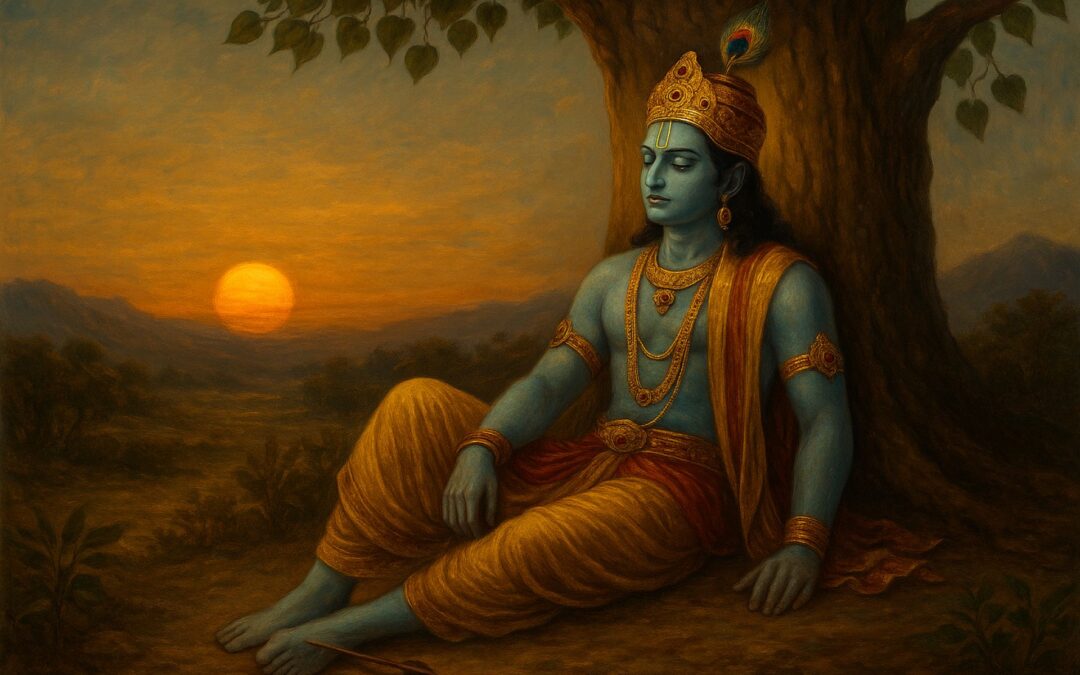
Lord Krishna’s final moments on Earth, beneath the sacred Peepal tree, illuminated by the setting sun, marked not just the end of an era but the beginning of a profound message intended for humanity in its darkest age: Kali Yuga. His departure was not a simple passing, but a deliberate act imbued with cosmic significance.
Hidden within his final actions lies a roadmap, designed to help individuals survive and thrive in the tumultuous age to come. This message, concealed within the layers of Hindu cosmology, would take humanity thousands of years to fully comprehend.
The Cosmic Puzzle and the Bhagavad Gita
Lord Krishna’s teachings to Arjuna on the battlefield of Kurukshetra marked the beginning of a cosmic journey that would resonate through the ages, but the Bhagavad Gita, often regarded as the sacred scripture for understanding the essence of life, was only the beginning. Krishna’s words during the Gita were not just tailored for the immediate situation of Arjuna, who stood at the precipice of moral turmoil in the face of battle, but they were timeless wisdom embedded with universal truths meant for all of humanity.
The battlefield of Kurukshetra, a place of both physical and spiritual warfare, symbolized the inner conflict that every human soul faces between righteousness (dharma) and selfish desires. Krishna’s teachings emphasized the importance of understanding the higher self and realizing one’s connection to the divine. The essence of these teachings was to guide Arjuna through his personal battle, but also to prepare the human race for the greater battles that lay ahead in future ages. In this light, the Bhagavad Gita serves as a cosmic manual for dealing with the conflicts of life, offering insights into how to navigate the complexities of the world with a sense of duty, detachment, and inner peace.
The Gita’s teachings are rooted in the concept of “yoga”—the discipline and practices that help unite the body, mind, and spirit with the divine. Yoga, in its various forms, becomes the bridge between the material world and the eternal truths. Krishna’s words about karma (action) and bhakti (devotion) resonate through time as principles that go beyond simple ethical guidance; they are cosmic principles designed to help humanity align with universal laws, preparing them for the trials and tribulations that would come in later ages. The Bhagavad Gita, thus, becomes a key to unlocking the meaning of life, an essential text that would reveal itself in layers of understanding with each passing era, especially in the face of the Kali Yuga.
The deeper message of the Bhagavad Gita, known only fully to those who would encounter it during times of spiritual darkness, was that the solutions to our existential struggles are not hidden in the mystical or inaccessible realms of complex rituals. Rather, they lie in our everyday experiences and choices, guiding us through the storms of life, as Krishna intended for Arjuna. The Gita, a conversation between divinity and humanity, holds profound wisdom about transcending suffering and embracing one’s higher self. It was, and still is, a guide for human survival, particularly when faced with the profound spiritual crisis that would define Kali Yuga.
The Kali Yuga and Lord Krishna’s Foreknowledge
Kali Yuga, often described as the “Age of Darkness,” is a period of moral and spiritual decline that marks the fourth and final age in Hindu cosmology. It is an age that Krishna was deeply aware of during his time on Earth. The Kali Yuga would be characterized by strife, moral decay, and a disconnection from the divine. Humanity, during this age, would face trials that test the very foundation of spiritual consciousness. This age of spiritual blindness would be fraught with deception, ignorance, and an overwhelming attachment to materialism and ego, leaving people to wander without spiritual direction.
Krishna’s knowledge of this upcoming age was not just intellectual; it was prophetic and deeply rooted in his understanding of the cycles of time. The Hindu cosmological system divides time into four yugas (ages): Satya Yuga, Treta Yuga, Dwapara Yuga, and finally, Kali Yuga. Each yuga represents a different phase in humanity’s spiritual journey, with the golden age of Satya Yuga giving way to the gradual decline of virtue and the ascent of vice and materialism in Kali Yuga.
During his time on Earth, Krishna understood that humanity was nearing the transition from the righteous era of Dwapara Yuga to the dark age of Kali Yuga. His departure, thus, was not only a physical transition but an acknowledgment of the end of an era of relative spiritual purity. He knew that in Kali Yuga, people would struggle to maintain their connection with the divine. The challenges in this age would be insurmountable for many, as they would lose their way, blinded by the allure of transient pleasures and the false promises of material success.
Despite this impending darkness, Krishna’s teachings provided a solution. They were not just intended for his contemporaries but were designed to be passed down through generations, to serve as a beacon of hope in the midst of the spiritual blindness of Kali Yuga. Through his teachings in the Bhagavad Gita and the way he chose to depart from the physical realm, Krishna demonstrated that there would always be a path to spiritual awakening, even in the darkest of times.
Three Key Elements of Lord Krishna’s Departure
The manner of Lord Krishna’s departure from Earth is a subject of great significance in Hindu philosophy, with every element of his final moments carrying profound symbolism. Krishna’s final moments were not just a passive leaving but a deliberate act filled with cosmic meaning. The location, the tree under which he rested, and the way in which he left—struck by an arrow in his foot—were all part of a carefully woven message meant for the future.
- The Sacred City of Dwarka: Krishna’s departure occurred in the sacred city of Dwarka, a city built with divine foresight and cosmic planning. Dwarka was not just a physical location but a symbol of spiritual advancement and prosperity. In its final moments, as the city sank into the ocean, it signified the loss of an age of righteousness. Dwarka’s sinking symbolized the collapse of the values that had sustained the earlier yugas—virtue, dharma, and spiritual wisdom.
As Dwarka sank, it marked the arrival of Kali Yuga, the age of darkness and decay. This event was not just the destruction of a city, but the end of an era where divine wisdom was accessible and flourishing. The submersion of Dwarka into the ocean was, therefore, a powerful cosmic metaphor for the dissolution of the spiritual integrity of society. It marked the beginning of a new age where the divine connection would become increasingly difficult to perceive, and humanity would need to look inward for spiritual guidance. - The Peepal Tree: Krishna chose to rest his foot against the sacred Peepal tree during his final moments. The Peepal tree is a symbol of spiritual enlightenment in Hinduism, often associated with the connection between the earthly and the divine. It represents the interconnectedness of all things and the path to awakening. By positioning himself under this tree, Krishna reinforced the idea that spiritual enlightenment is available to all, even in the most trying of circumstances.
In Kali Yuga, the mundane world can often seem like a place of disconnection from the divine. However, the Peepal tree teaches that enlightenment is not something external but can be found in the present moment, in our connection with the world around us. The Peepal tree’s heart-shaped leaves, a symbol of love and devotion, echoed Krishna’s message: the divine is not separate from our daily lives but deeply embedded within it. As humanity faces the struggles of Kali Yuga, Krishna’s act of resting beneath the Peepal tree was a subtle reminder that spiritual connection is available to all, even in the darkest times. - The Arrow in the Foot: Krishna’s departure through the wound in his foot is one of the most poignant symbols in Hinduism. The foot represents the journey of life and our connection to the physical world. Krishna’s foot being struck by an arrow at the time of his departure symbolizes the vulnerability inherent in the human experience. Despite being a divine incarnation, Krishna chose to manifest his vulnerability in the most striking way possible.
This vulnerability was not a sign of weakness, but a powerful demonstration of the paradox that would define the human experience in Kali Yuga. In Kali Yuga, vulnerability is often viewed as a sign of weakness, but Krishna’s final act shows that it is through embracing our vulnerabilities that we can transcend them. The wound in his foot becomes a symbol of the spiritual wounds that all human beings carry. But it is also a reminder that these wounds, if approached with the right mindset, can become sources of strength and transcendence.
The Transition Between Ages
Krishna’s departure from the Earth marked the precise transition from Dwapara Yuga to Kali Yuga. This shift was not merely a chronological event; it was a cosmic transition with deep spiritual significance. The end of Dwapara Yuga, an age of relative virtue and spiritual clarity, made way for the arrival of Kali Yuga, an era marked by moral decline and spiritual confusion. Krishna’s departure served as the turning point in this transition.
The exact timing of Krishna’s departure was significant. It was a moment when the forces of darkness and ignorance began to overshadow the light of truth. However, this transition also signified that within the darkness of Kali Yuga, the seeds of spiritual awakening were already planted. By choosing this precise moment to depart, Krishna made it clear that even in the midst of decay, there was hope. The wisdom contained within his teachings, especially those in the Bhagavad Gita, would be the key to unlocking the hidden potential of this age.
The transition between the yugas is a reminder that change is inevitable. What Krishna’s departure symbolizes is not only the end of one era but the dawn of another, one where humanity must face unprecedented spiritual challenges. The message of hope in this transition is clear: the light of the divine will always be present, even in the darkest times, and it is through the struggle to reclaim it that spiritual growth will occur.
The Three Layers of Krishna’s Hidden Message
Krishna’s final moments were not just a physical event; they were layered with multiple layers of meaning, each one offering a profound teaching for humanity, especially for the dark times ahead in Kali Yuga. His departure encoded three essential lessons that would unfold with the passage of time.
- Vulnerability Becomes Strength: The first layer of Krishna’s message is the profound teaching that vulnerability, often seen as a weakness, can be transformed into strength. His final act—being struck by an arrow in the foot—was a powerful demonstration of this. Vulnerability is a part of the human experience. In Kali Yuga, where ego and pride dominate, embracing vulnerability becomes a crucial step towards spiritual growth. The ability to acknowledge one’s limitations, weaknesses, and struggles is not a sign of defeat, but a step towards transcendence. Krishna’s vulnerability shows us that we must not shy away from our weaknesses, but rather use them as stepping stones to greater strength and spiritual awakening.
- The Challenges of Kali Yuga Contain the Seeds of Their Own Solution: The second layer of Krishna’s message is about the paradox inherent in Kali Yuga. While this age is full of difficulties, suffering, and moral decline, these very challenges contain the seeds of their own solution. The darkness of Kali Yuga is not an end but a space for transformation. Every challenge faced in this age has within it the potential for spiritual awakening. Krishna’s teachings encourage humanity to see challenges not as obstacles but as opportunities for growth. The very conditions of Kali Yuga, though seemingly oppressive, hold the potential to lead humanity to a higher understanding of truth and divinity.
- Spiritual Growth Through Daily Struggles: The final layer of Krishna’s message emphasizes that the path to spiritual growth in Kali Yuga does not lie in grand rituals or external austerities. Instead, it is found in transforming the struggles of daily life into opportunities for spiritual growth. This is the most accessible path for humanity in this age. Krishna’s act of leaving Earth beneath the Peepal tree, with the arrow in his foot, shows that the sacred and the divine can be found in the most mundane of experiences. In Kali Yuga, where complex rituals may be lost or inaccessible, the divine is available through the most ordinary moments of life. Spiritual growth, in this age, is about recognizing the divine presence in everyday experiences and learning to align one’s actions with higher spiritual principles.
A Blueprint for Spiritual Evolution
Krishna’s final moments were not just a demonstration of divine wisdom; they were a living blueprint for how humanity could evolve spiritually in Kali Yuga. He understood that the age to come would be difficult, but through his actions and teachings, he encoded a path forward—a path that humanity could follow even in the darkest times. His message was clear: to thrive in Kali Yuga, humanity must look inward and transform their struggles into opportunities for growth.
The divine is not found in the distant or the extraordinary, but in the here and now, in the everyday challenges that life presents. This is the ultimate lesson of Krishna’s departure: the potential for spiritual evolution lies not in escaping life’s difficulties but in embracing them and using them as tools for personal and collective transformation.
The Paradox of Kali Yuga
The paradox of Kali Yuga is that it is both an age of decay and an age of potential. While it is characterized by spiritual blindness, it also contains the seeds of enlightenment. Krishna’s final message embodies this paradox perfectly. It teaches us that in the depths of darkness, there is light waiting to be discovered.
Vulnerability can become strength, suffering can lead to enlightenment, and the challenges of the world can transform us into spiritual beings if we approach them with the right mindset. In the paradox of Kali Yuga lies the profound truth that the divine is always present, even in the most unlikely of places. It is up to humanity to open their hearts and minds to this truth and allow it to guide them towards spiritual awakening.