
“Before the first arrow was loosed, before brothers became enemies, destiny was already writing in silence. The seeds of war are never sown in battle—they are planted in love, in vows, and in pride.”
Every epic begins not with war, but with a whisper—a promise, a vow, a curse. Before kingdoms clashed and brothers drew blades, the Mahabharata was a story of choices made in silence, of destinies sealed long before the first arrow was loosed.
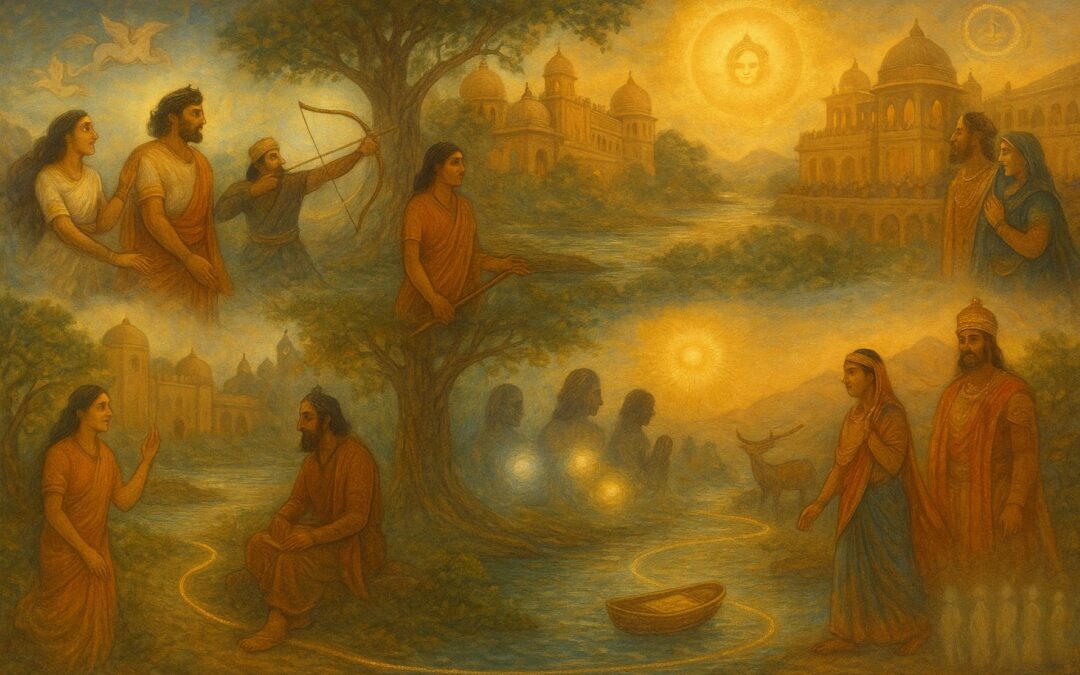
The Seeds of Destiny is the first installment in a five-part cinematic retelling of the Mahabharata. This immersive narrative journeys through divine births, impossible vows, and the fragile threads of fate that bind gods and mortals alike.
This opening part traces the origins of the Kuru dynasty—from King Shantanu’s love for the river goddess Ganga to the birth of Bhishma, from the veiled union of Satyavati and Parashara to the rise and curse of King Pandu. It is a world where duty outweighs desire, where every promise alters the course of generations, and where destiny begins to move quietly through bloodlines like a shadow waiting for dawn.
What you are about to read is not merely mythology—it is the unfolding of a moral universe, the foundation upon which the greatest war of dharma will one day be fought.
Chapter 1 – The Bharata Lineage and King Pratipa
“Every dynasty begins with a promise whispered to the river.”
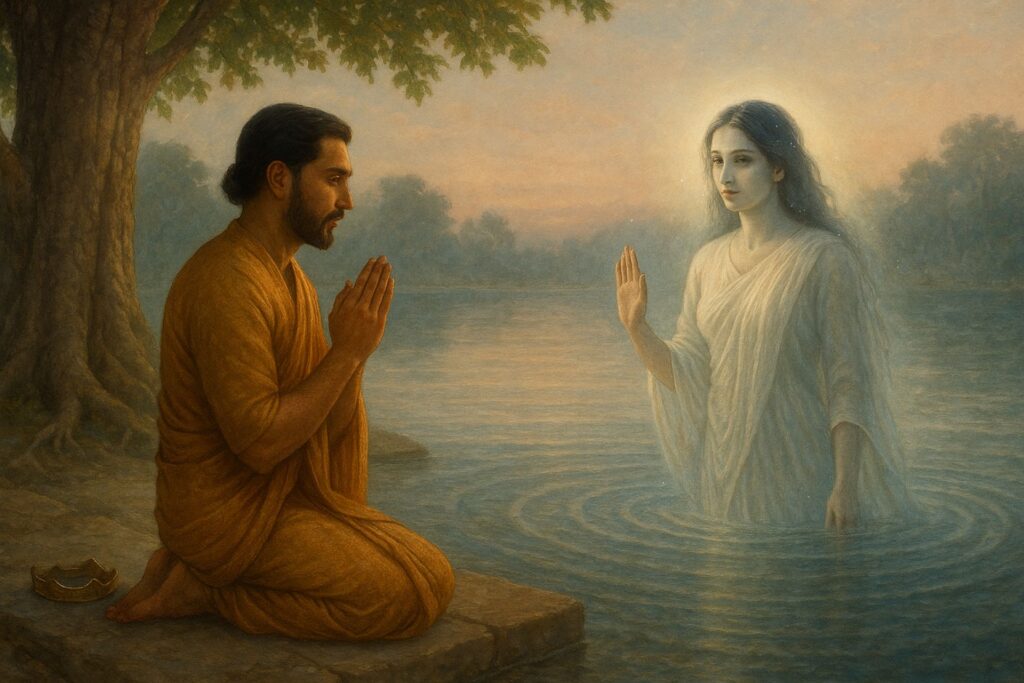
The wind drifted low across the plains of Hastinapur, carrying the scent of rain and memory. The Ganga moved with the patience of eternity—her waters bright beneath the morning light, her depths heavy with silence. Beneath a peepal tree sat King Pratipa, ruler of calm lands and quieter thoughts. His reign had been measured and just, yet his eyes betrayed the fatigue of a man who had seen too many seasons pass unchanged.
He knelt beside the river, his reflection trembling upon the surface. Peace had become his companion, but peace is a thin veil—too fragile to conceal destiny for long.
The air thickened. The river stirred. From her silver depths rose a figure of light—a woman draped in flowing brightness, her gaze both tender and terrible. The water clung to her ankles like worshippers unwilling to let go.
Pratipa did not move. He knew divinity when he saw it. The river goddess smiled, and the sky dimmed as if bowing to her presence.
“O king,” she said, “I come to claim your love. Accept me, and let the union of mortal and divine begin upon this earth.”
The words rippled through the stillness, sweet and commanding. Pratipa, though taken by her grace, felt the weight of dharma pressing upon his heart.
“I am bound by vows,” he answered, “and cannot take another in this life. But if a son is born to me, he shall be yours. I offer you my lineage, if not myself.”
The river’s eyes deepened—serene yet knowing. For such promises are rarely made without consequence.
“So be it,” she said softly. “Through your blood, destiny shall flow like my waters—pure, relentless, eternal.”
With that, she vanished beneath the surface, leaving behind only ripples and the faint echo of her words. The wind sighed, as if the world had just exhaled after holding its breath.
Pratipa stood in silence, watching the current fold and unfold upon itself. Somewhere beneath those waters, a future had already begun—a story written not in ink, but in oaths.
When he turned to leave, the river glimmered in the corner of his eye—quiet, infinite, patient.
The promise had been made. The wheel had begun to turn. And the river kept flowing, as she always would, carrying within her the first whisper of destiny.
Chapter 2 – Shantanu and the River Goddess Ganga
“Love, when born of the divine, never asks permission—it simply arrives.”
Mist hung low over the Ganga, wrapping the river in a shroud of silver. The dawn had barely broken, yet the air carried that quiet expectancy before something sacred begins. The birds had not yet sung; even the wind waited.
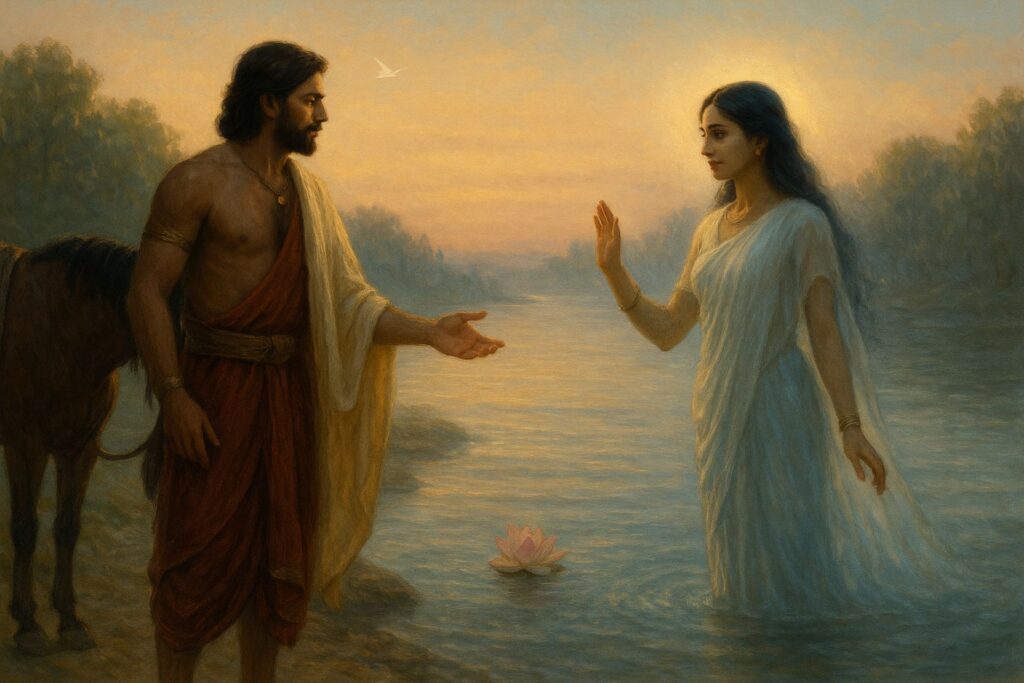
It was then that King Shantanu, son of Pratipa, rode along the banks on a white stallion. The reins glinted with dew, the hooves struck rhythm into the soft earth, and each breath of his horse mingled with the river’s own. Shantanu was not seeking war, nor glory—only solitude. He ruled a peaceful kingdom, but peace had begun to taste like still water: clear, cold, and without pulse.
As he approached a bend in the river, the world seemed to pause. The sunlight fractured across the waves, forming a shape—a woman emerging from the water as if carved from light itself. She stepped onto the bank, each droplet that fell from her body shimmering like pearls. Her eyes were the color of deep time, and her silence was heavier than sound.
Shantanu dismounted, unable to speak, his heart a drum in his chest. The air trembled between them.
“Who are you,” he asked softly, “that the river itself bows before your feet?”
Her smile was gentle, knowing.
“I am she whom your father once promised,” she said, her voice flowing like water over stone. “The river that binds heaven and earth. You see me now not as dream, but as destiny.”
Love, sudden and absolute, overtook him. Words fled, leaving only a vow waiting to be spoken.
“Then let destiny be fulfilled,” said Shantanu. “Be my queen, and let this river bear witness.”
The goddess inclined her head.
“I will be your wife,” she replied, “on one condition—you shall never question my actions, however they may appear.”
He agreed without hesitation, not knowing how cruelly such beauty tests its promises.
Seasons turned. The kingdom bloomed beneath their rule. Yet with every birth, tragedy returned. Each time Ganga bore a child, she walked to the river and let the infant slip into her depths. The court watched in terror, but Shantanu kept his silence, bound by his word.
Seven times he endured this grief in silence, the weight of fatherhood crushed beneath the sanctity of vows. But when the eighth child was born and Ganga turned once more toward the river, something human broke within him.
“Enough,” he cried, “I can bear this no longer! What sin demands such cruelty?”
The world stilled. The river went silent. Ganga turned, her expression neither anger nor mercy—only infinite sorrow.
“The sons you grieve were the eight Vasus—divine beings cursed to live as men. I freed them from that burden. But now, because you have spoken, our time together ends.”
She cradled the child against her heart.
“This one shall live,” she said softly. “His name shall be Devavrata, and he will carry both our legacies—yours in duty, mine in destiny.”
The sky darkened as she rose into the mist, vanishing into the current that had first revealed her.
Shantanu stood on the empty bank, the child’s cry fading into memory.
The Ganga flowed on, vast and indifferent, as if love and loss were merely ripples upon her endless surface.
And thus began the lineage of vows—the sacred and the sorrowful alike—bound forever to the river that remembers everything.
Chapter 3 – The Eight Vasus and the Birth of Devavrata
“When gods fall, they are reborn as men—and remember what pain feels like.”
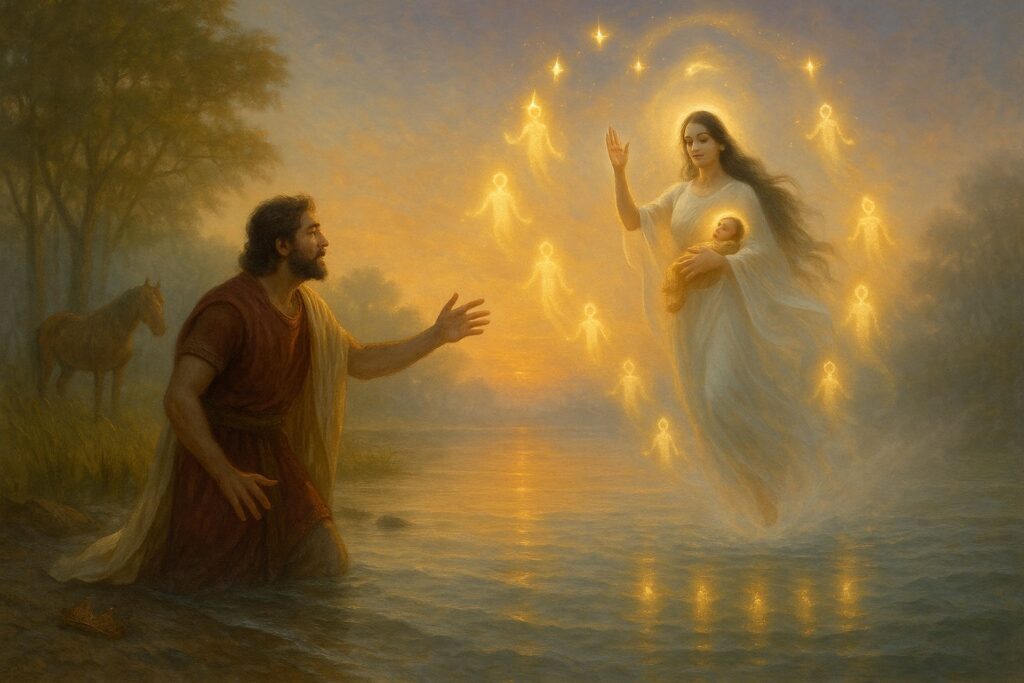
The Ganga swelled beneath the first light of dawn, her waters tinted gold, her voice a constant murmur between earth and sky. Beneath her calm surface, destinies stirred like silt. The gods had once danced freely across the heavens—but even immortals cannot escape the weight of consequence.
Long before her union with Shantanu, the river goddess had crossed paths with the Eight Vasus, radiant beings of light and wind. One of them, out of desire and folly, had stolen the sacred cow of Sage Vasistha. The sage’s fury fell upon them like thunder:
“You shall be born upon the earth as mortals,” he declared, “to taste the bitterness you have forgotten.”
Their cries echoed through the celestial vault. Only one among them—the thief himself—received no promise of quick release. His punishment would be long and heavy.
Seeking mercy, the Vasus turned to Ganga, their sister among the divine rivers.
“Grant us your compassion,” they pleaded. “Bear us into the mortal realm, and release us swiftly. Let us not linger long in flesh.”
Ganga, moved by love, consented. Thus began the chain that bound her to King Shantanu—the human vessel chosen by destiny to father their brief lives.
When she first descended to earth, she carried their secret like a flame hidden beneath her heart. Each time she cast a newborn into her waters, she whispered a prayer, freeing another soul from the prison of form. The river took them gently, reclaiming what heaven had lost.
Only the eighth remained—the one who had sinned most. His birth broke the silence between heaven and man. When Ganga left Shantanu’s side, she took the child with her, raising him among celestial currents where no mortal sorrow could reach.
Years passed, and the boy grew into something beyond mortal comprehension. His name was Devavrata, son of the river and the king, heir to two worlds. His eyes held the calm of still water, his strength the pulse of the tides. Ganga taught him the hymns of creation, the ways of weapons and wisdom, and the discipline of silence.
“You are not born merely to rule,” she told him. “You are born to remember what gods forget—the cost of power, and the sanctity of restraint.”
When at last she led him back to his father, the Ganga glimmered like liquid starlight. She placed the young prince before Shantanu and said softly:
“Here is your son, O king—the bridge between your world and mine. Guard him well, for through him your destiny shall unfold.”
Then she was gone, her form dissolving into mist and memory. The river resumed her eternal flow, indifferent yet watchful, carrying echoes of what had been promised long ago.
Shantanu knelt before the boy who stood with divine stillness, unaware that the blood of heaven and earth now mingled within him—and that both realms had begun to move at his birth.
The river had done her part. The rest, as always, would be left to men.
Chapter 4 – Devavrata’s Celestial Training
“Discipline is the bridge between divine birth and mortal greatness.”
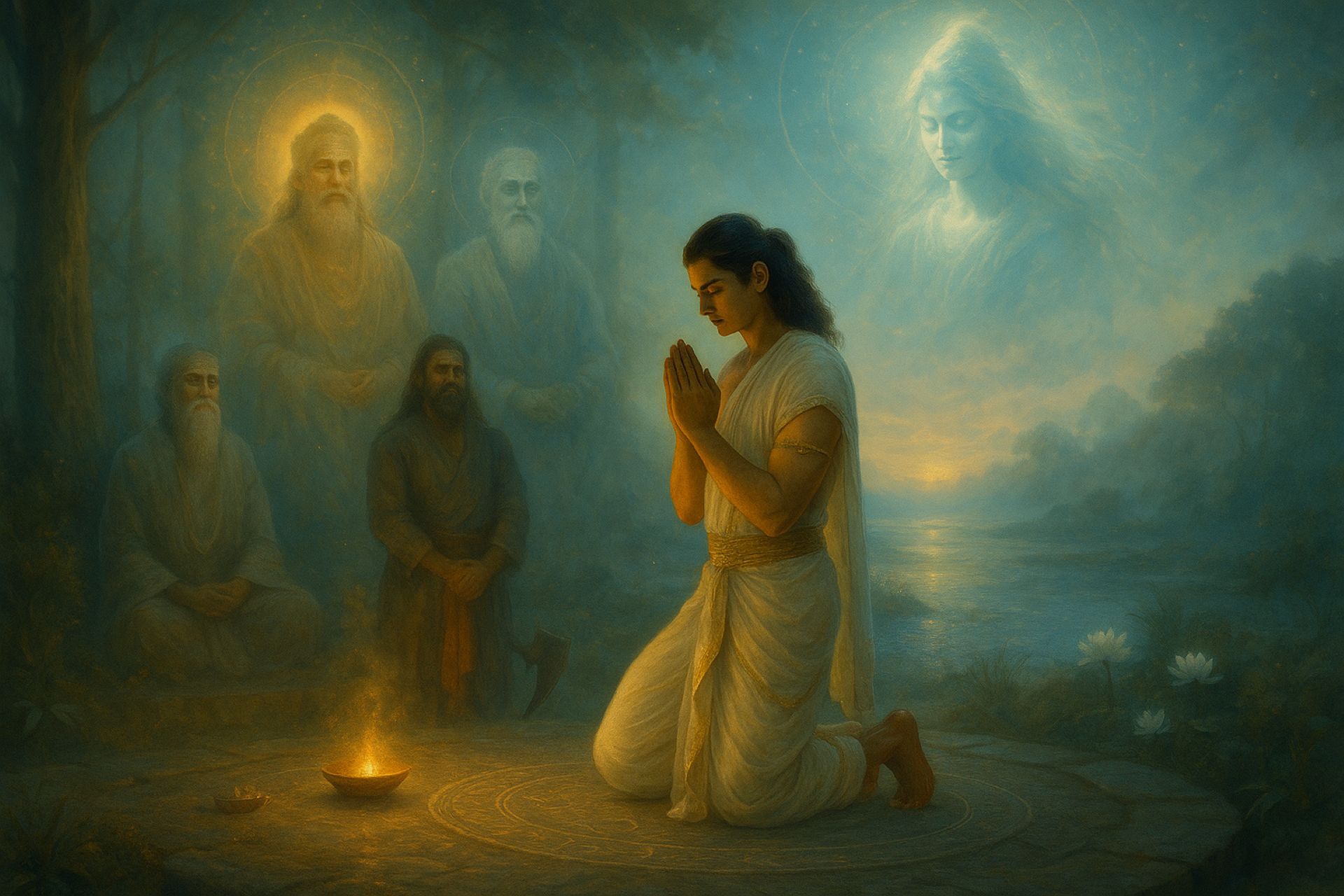
The years turned quietly along the river’s edge.
The boy born of a king and a goddess grew beneath the gaze of heaven, his childhood measured not by games or laughter, but by silence, study, and the rhythm of water. The river herself was his first teacher. She spoke to him not through words, but through patterns—the pull of the current, the stillness before flood, the patience that carves stone over centuries.
When Ganga judged him ready, she brought him to the hidden realms where mortals rarely tread. There, among sages and celestial masters, Devavrata learned the crafts that shape kings and destroy them alike. He was taught by Brihaspati, the preceptor of gods, who showed him the structure of reason and the weight of words.
“Speech is not power,” Brihaspati told him, “unless silence stands behind it.”
Under Shukracharya, he learned the sciences of command and persuasion, of diplomacy wrapped in restraint. Parashurama, the fiercest of warriors, taught him the discipline of arms—not to win wars, but to understand them.
“A weapon serves no purpose,” Parashurama said, “until the hand that holds it learns mercy.”
Day by day, Devavrata’s mastery deepened. He could move through the air like a hawk, command the wind to still, or read intent from the breath of an enemy. Yet it was not power that shaped him—it was the humility of knowing where power ends.
In his final season of training, Ganga brought him back to the riverbank. He had grown tall and radiant, his eyes reflecting both calm and storm. The goddess watched him, her expression serene but distant—the pride of a mother mingled with the sorrow of farewell.
“You are ready,” she said. “But remember—wisdom is not measured by what you conquer, but by what you refuse to destroy.”
Devavrata bowed deeply, his forehead brushing the earth.
“Mother,” he said softly, “you have given me more than birth. You have given me purpose.”
When he rose, the river shone brighter, her waters trembling in quiet blessing. Ganga smiled—only once—then dissolved back into the current, leaving him standing in the golden light of his own becoming.
From that moment, the boy ceased to exist. In his place stood the man history would call Bhishma—one whose name would become a synonym for vows stronger than death.
The river had taught him patience; the gods had taught him strength. The world would now teach him sorrow.
Chapter 5 – The Reunion of Shantanu and Devavrata
“A father’s pride is a crown no kingdom can match.”
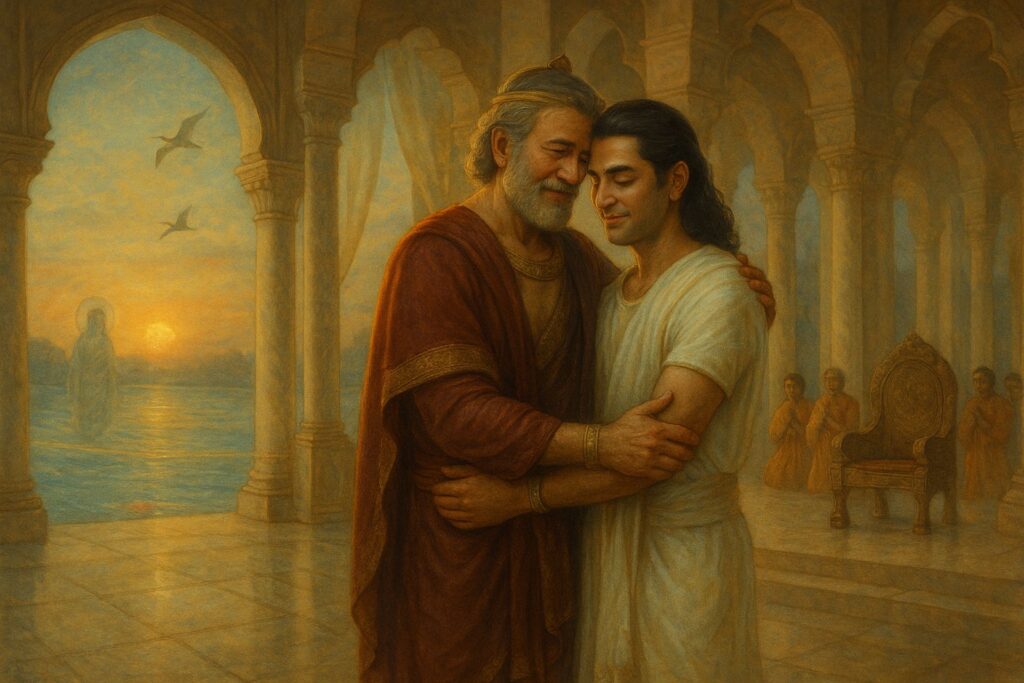
The palace of Hastinapur stood still beneath the setting sun, its courtyards bathed in a mellow light. From the riverbanks to the royal gates, word had spread that the king’s son had returned—Devavrata, born of Ganga, shaped by the discipline of the heavens.
Years had passed since the river carried his mother away, leaving Shantanu with both blessing and grief. The boy she had promised to return had grown into a man—broad-shouldered, calm-eyed, and radiant with purpose. As Devavrata entered the great hall, the courtiers fell silent, for he carried in his bearing the quiet authority of one born to rule.
Shantanu rose from his throne before the herald could announce the name. The father in him outpaced the king. He crossed the marble floor and drew his son into his arms. For a moment, the burden of the crown dissolved.
“You are her gift and my redemption,” the king said softly. “The river took my sorrow, but she returned me my future.”
Devavrata bowed deeply.
“My life belongs to your will, Father. Command me as you command your kingdom.”
From that day forward, the young prince became the pillar of the realm. His counsel steadied the throne, his sword secured the borders, and his presence restored to the kingdom a sense of divine order. In the court and among the people, his name spread—Devavrata, the perfect heir, the son whose virtue mirrored his valor.
Years passed in peace. The boy became the measure by which loyalty and wisdom were judged. Even the elders of Hastinapur confessed that the gods had favored their land twice—once through Ganga’s grace, and again through the son she left behind.
When Shantanu looked upon him, pride warred with tenderness. He had found not only a successor but a mirror of the dharma he himself sought to uphold.
One evening, standing upon the ramparts as the river shimmered below, Shantanu placed his hand upon Devavrata’s shoulder.
“The kingdom is yours to inherit,” he said. “But remember—power without restraint is ruin. Rule not by might but by mercy, and the world will follow your example.”
Devavrata bowed, eyes bright with resolve.
“Then may I never fail the path you have walked, Father. The throne shall be my duty, not my desire.”
In that moment, Shantanu felt the weight of his reign lift. For the first time, he believed the line of kings would endure without strife.
But destiny, ever patient, had already begun to stir in the river below.
For love was waiting upon the waters—quiet, fragrant, and unseen—and it would soon draw the king away from the peace his son had built.
For in every fulfilled vow, destiny plants the seed of another.
Chapter 6 – Satyavati and the Fisherman’s Condition
“The heart does not recognize destiny until it is already entangled.”
The kingdom of Hastinapur had entered an age of ease. The wars were distant, the fields generous, and the throne secure. Yet King Shantanu, even in peace, felt a restlessness he could not name. It was the same quiet ache that had haunted his father—the silence that follows when destiny waits for its next turn.
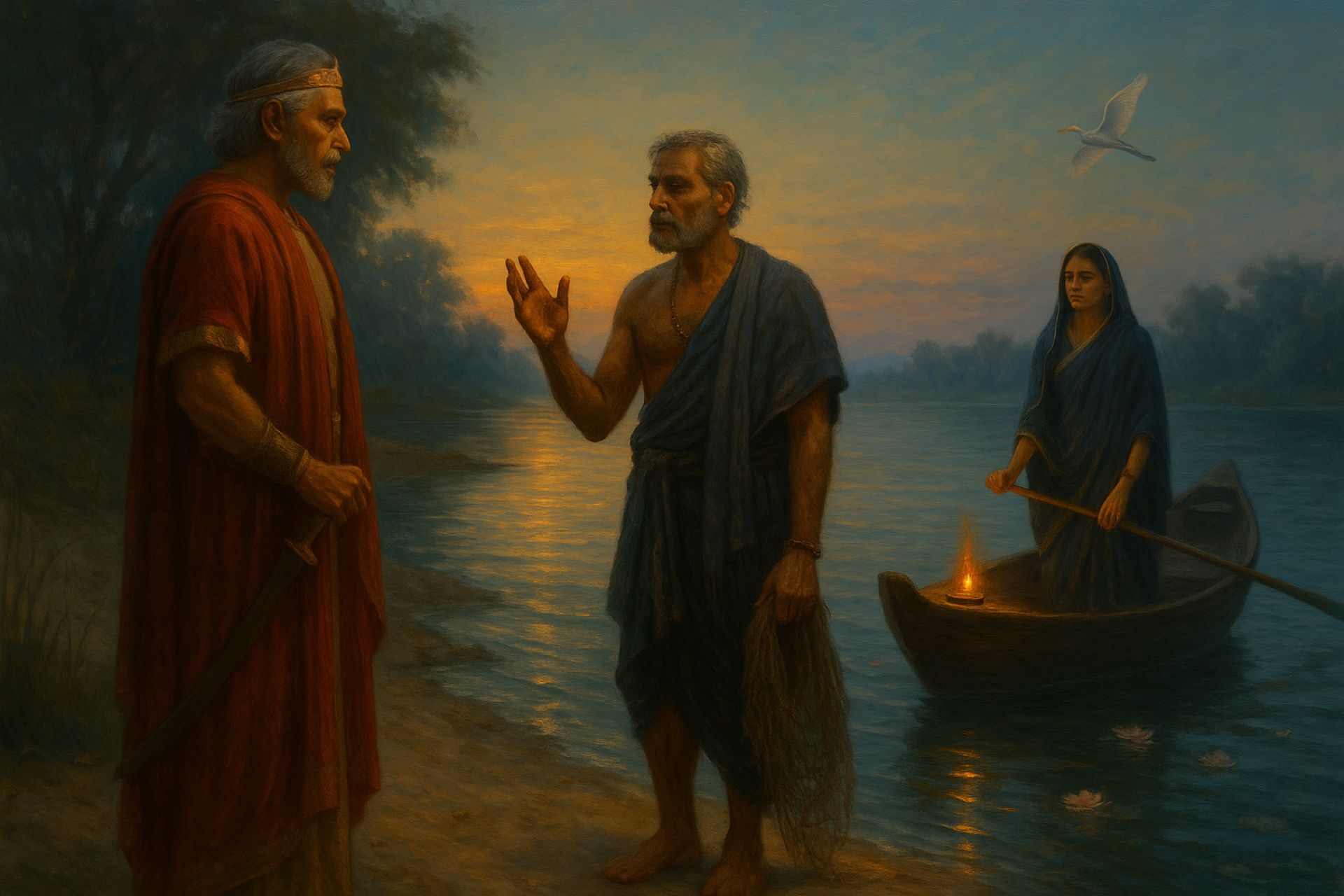
One evening, as the king rode along the banks of the Yamuna, the scent of the river changed. The breeze carried something unfamiliar—an aroma neither of rain nor earth, but of musk and lotus. Following it, he came upon a boat gliding across the twilight water. At its stern stood a young woman, dark-eyed and radiant, her movements precise, her gaze unwavering. The oars rose and fell with the grace of ritual.
For a long moment, Shantanu simply watched her, struck by a beauty that felt older than time. When she noticed him, she bowed with quiet composure—neither flattered nor afraid.
“Who are you,” the king asked, “whose presence turns even the river shy?”
Her voice, when it came, was low and steady.
“I am Satyavati,” she said. “Daughter of the chief of fishermen. The river is my world, the boat my kingdom.”
The words struck him not as humble, but as sovereign. She spoke of her lineage without shame, of her duty without embellishment. The king dismounted, compelled by a force he could not resist.
“Will you come to my palace?” he asked. “The river will not be jealous. I will make you queen.”
For the first time, her eyes softened, though her reply was measured.
“Your Majesty,” she said, “my father decides where the current takes me. Ask him, and if he consents, I will follow.”
That night, Shantanu’s sleep abandoned him. The river’s scent lingered on his garments, the echo of her voice in his mind. At dawn, he went to meet her father, a man named Dashraj, whose face bore the dignity of one who had bargained long with the tides.
When the king proposed marriage, the fisherman bowed deeply, yet his words were sharp as coral.
“I am honored, O King,” he said, “but my daughter’s children will inherit the life of the river, not the throne. Unless you swear that her sons, and her sons alone, shall rule after you, I cannot consent.”
The demand struck Shantanu like a blow. His firstborn, Devavrata, was heir to the empire—beloved, rightful, unmatched. To displace him would be an injustice he could not bear. The king left in silence, his heart divided between love and duty.
Days turned to months, and the weight of longing carved hollows into his face. The courtiers whispered; the kingdom dimmed under a ruler’s unseen sorrow.
Devavrata saw it. The father who had once stood like a mountain now walked like a man shadowed by his own heart. The reason was not spoken, but the river had many tongues, and word reached the prince of a fisherman’s daughter and an impossible condition.
That night, Devavrata set out for the river. He rode alone, knowing that some burdens must be met not as a son, but as destiny itself.
For love may stir a heart, but duty must steady the world it beats within.
Chapter 7 – Bhishma’s Terrible Vow
“Some vows illuminate the world; others darken the heart that keeps them.”
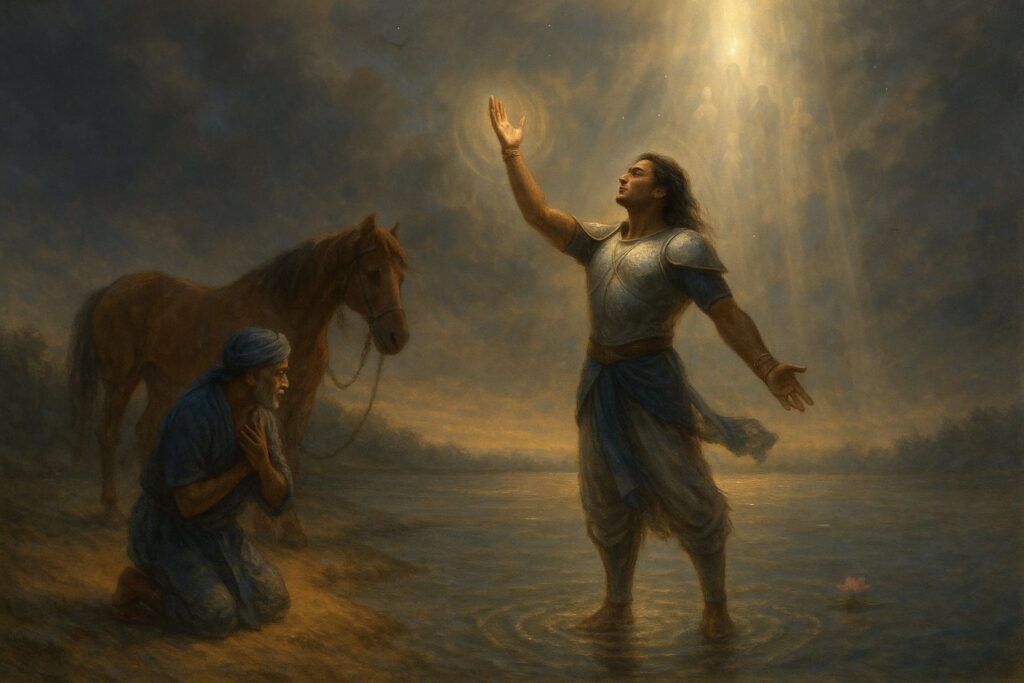
The morning was still, the river silver beneath a cloudless sky. Upon its bank sat Dashraj, the fisherman, mending his nets with patient hands. He did not turn when hooves echoed across the sand—he had expected this visitor, for destiny never travels alone.
Devavrata, son of Shantanu and Ganga, dismounted and approached with calm resolve. His armor gleamed like tempered moonlight; his eyes, clear and untroubled, carried the serenity of a man who had already made peace with his sacrifice.
“Your Majesty’s sorrow has reached even the waters,” said Devavrata. “I come to ask what stands between your daughter and my father’s joy.”
The fisherman set aside his net, studying him carefully.
“Prince,” he said, “I have no quarrel with your father, nor with you. But I have lived long enough to know the price of promises made to kings. I wish my daughter’s sons to inherit what she is offered—yet your claim, as heir, cannot be undone. How can a father send his child into a life where her children will always live in shadow?”
There was no arrogance in his tone, only the weary caution of a man who had bartered survival against power all his life.
Devavrata listened, silent. The river flowed between them, murmuring like a witness. When he finally spoke, his voice carried both steel and grace.
“Then let the doubt end here,” he said. “I renounce my claim to the throne of Hastinapur. The sons born of Satyavati shall rule after my father.”
The fisherman’s hands stilled. Even the river seemed to pause. But Devavrata was not finished.
“And more,” he continued, his words now trembling with divine intensity. “To ensure that no child of mine shall ever contest their right, I vow before the heavens and this sacred river—I shall never marry, nor know the touch of woman. My life shall serve only my father, my king, and the house of Kuru.”
A sudden hush fell upon the world. The air thickened; the sunlight dimmed. Then, as if in answer, thunder rolled across a clear sky, and a celestial voice resounded:
“Behold, the gods bear witness! From this day forth, he shall be called Bhishma—the man of the terrible vow!”
The fisherman fell to his knees, awe-struck.
“Prince, your word has the power of thunder. My daughter shall be queen.”
But Devavrata’s gaze had turned inward. The vow had carved through him, leaving no wound visible, yet none more permanent.
He mounted his steed and returned to Hastinapur. The river rippled faintly in his wake, as though mourning what had just been given away.
When he reached the palace, King Shantanu awaited him. The father saw in his son’s eyes the calm of something irreversible.
“What have you done, my son?” Shantanu whispered.
“I have given you happiness, Father,” said Bhishma. “May the kingdom now rest easy.”
In that moment, the heavens stirred again, and the river breeze carried a scent not of flowers, but of immortality.
Shantanu, moved beyond words, raised his hand in blessing.
“No father was ever served by a son so noble. May your life outlast the ages, and may death itself wait upon your command.”
Thus was the boon of Ichha-Mrityu born—not as reward, but as recognition of devotion beyond mortal measure.
And Bhishma bowed, not in pride, but in quiet resignation.
The vow that had earned him heaven had also cost him everything that makes heaven desirable.
For every promise given to preserve love, something of love itself must die.
Chapter 8 – The Blessing of Ichha-Mrityu
“When a man masters his desires, even death waits for his command.”
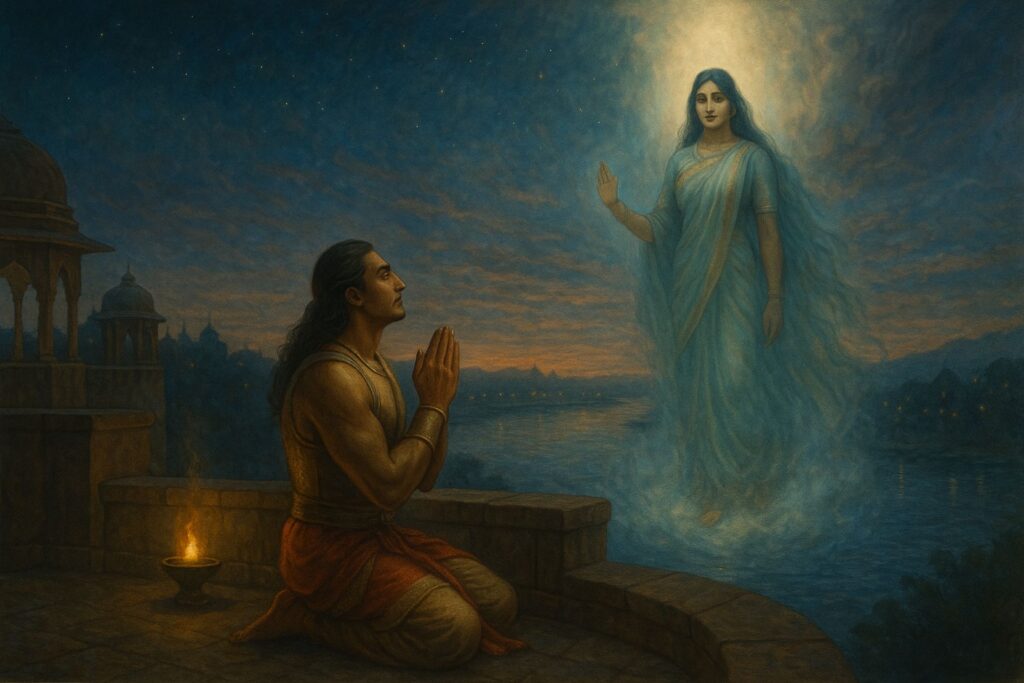
The sun had slipped beyond the western hills, but the air above Hastinapur still glowed with the warmth of twilight. On the palace terraces, lamps flickered to life—fragile flames trembling against the deepening dusk. Below, the river whispered its endless hymns to the night.
Bhishma stood alone on the ramparts, his armor set aside, his eyes fixed upon the horizon where the Ganga wound her silver path. He had fulfilled his father’s wish, secured the throne, and won blessings that would echo through time. Yet within him, a silence deeper than victory began to grow.
The vow had brought peace to the kingdom but had stripped him of every human solace—love, lineage, companionship. Even joy seemed a luxury he could no longer afford. He gazed at his hands, steady and strong, and wondered how something so mortal could now feel beyond life’s reach.
That night, as the moon rose over the palace, a presence stirred within the stillness. The air shimmered; the scent of lotus and lightning filled the sky. From the river’s depth arose a soft radiance, and within it appeared the divine form of Ganga, serene and sorrowful.
“My son,” she said, her voice flowing like the current itself, “the heavens have been moved by your vow. No mortal has ever bound himself so completely to dharma. The gods themselves marvel at your restraint.”
Bhishma knelt before her, his head bowed.
“I sought only my father’s peace,” he said. “If I have shaken the heavens, it was not by design.”
The river mother smiled faintly.
“The gods reward not intent alone, but sacrifice. Ask of them a boon worthy of the strength you have shown.”
Bhishma lifted his gaze, calm and unshaken.
“If I must ask,” he said, “let it be this: that my life shall remain mine to command. Grant me the power to choose the moment of my death, so that I may guard the house of Kuru until my duty is fulfilled.”
A hush fell over the world. Then the sky brightened as if dawn had broken anew. From unseen heights came a voice vast and gentle—the voice of the gods themselves.
“So be it. From this day, you shall hold the gift of Ichha-Mrityu—death at will. Until you release yourself, no force of man or fate shall lay you low.”
The light faded, and the river resumed her song. Ganga’s presence dissolved into mist, leaving only her blessing in the night air.
Bhishma remained kneeling long after she had vanished, his thoughts quiet as stone. The stars above gleamed indifferently, countless and eternal. He felt the weight of immortality settle upon his shoulders—not as triumph, but as burden.
When dawn came, the courtiers found him standing in the courtyard, his armor once more upon him, his face serene. King Shantanu, still radiant from his union with Satyavati, placed his hand upon his son’s head.
“You have outdone even the gods, my son,” he said softly. “May you stand as the pillar of this house, unbroken for all time.”
Bhishma bowed.
“If the gods decree it, Father, I shall stand until the world itself bends.”
The sun rose above the eastern towers, and its light fell upon Bhishma’s face. In that glow, the prince became legend, the man became myth.
The vow that had silenced his heart now made him eternal.
For the gods do not reward mortals with eternity; they burden them with remembrance.
Chapter 9 – Marriage of Shantanu and Satyavati
“Every joy purchased with sacrifice carries the taste of sorrow beneath it.”
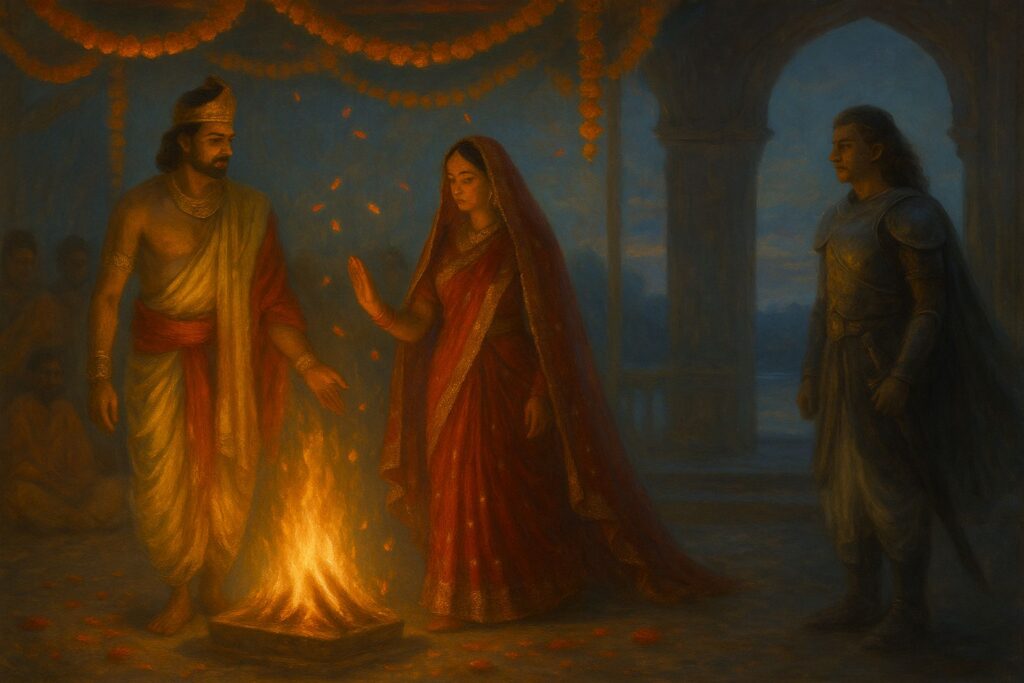
The riverbanks of the Yamuna bloomed with garlands. The palace drums echoed like thunder rolling through clear skies. Hastinapur rejoiced—for its king would wed again. The long wait of longing had ended, but not without a shadow. For beneath the fragrance of celebration, a quiet grief moved unseen—the cost of a son’s vow and the silence of a father’s guilt.
Shantanu, radiant yet wearied by emotion, rode at the head of the procession. Beside him, veiled and serene, sat Satyavati, the daughter of the fisherman who had once ruled the river with her oar. Her eyes did not wander, her expression neither proud nor humbled. She understood what this union meant to him—and what it had taken from his blood.
As they entered the city, the people cheered, throwing petals upon the path. Yet every sound of joy seemed to echo faintly against Bhishma’s composure. He stood upon the palace steps, the crowd parting as he approached. His armor glinted like frozen sunlight.
When the king saw him, he dismounted, and for a moment, neither spoke. Then Shantanu placed his hand upon his son’s shoulder.
“You have made this possible,” the king said softly. “No father has been blessed with a son so noble. Yet I fear the gods have taken too much from you in return.”
Bhishma bowed deeply.
“A father’s happiness is worth more than a son’s comfort,” he said. “And comfort, as I have learned, is but the soft disguise of weakness.”
Shantanu’s gaze faltered; his pride could not conceal his sorrow.
“May your strength never turn to loneliness,” he whispered.
But the prayer, though pure, came too late. The blessing of Ichha-Mrityu already bound Bhishma to a solitude that no love could undo.
The wedding that followed was magnificent. Priests chanted beneath a canopy of golden cloth, the air thick with the scent of camphor and jasmine. As Shantanu and Satyavati circled the sacred fire, the flames rose high, flickering like the eyes of unseen gods. The river breeze flowed through the courtyard, carrying whispers of fate yet to unfold.
When the final chant faded, the king looked upon his queen, and for the first time in years, peace softened his face. Yet in that same instant, Bhishma turned toward the horizon. His eyes lingered on the river, where the moonlight fractured upon her surface like broken glass.
“May this peace endure,” he murmured. “Though I know—nothing born of sacrifice remains untouched by its echo.”
Far away, the Ganga shimmered in quiet approval, knowing the story she had begun was still far from its end.
And so love returned to the palace, but it came walking hand in hand with destiny.
Chapter 10 – Birth of Chitrangada and Vichitravirya
“Every birth is a promise whispered to the future—and a debt owed to fate.”
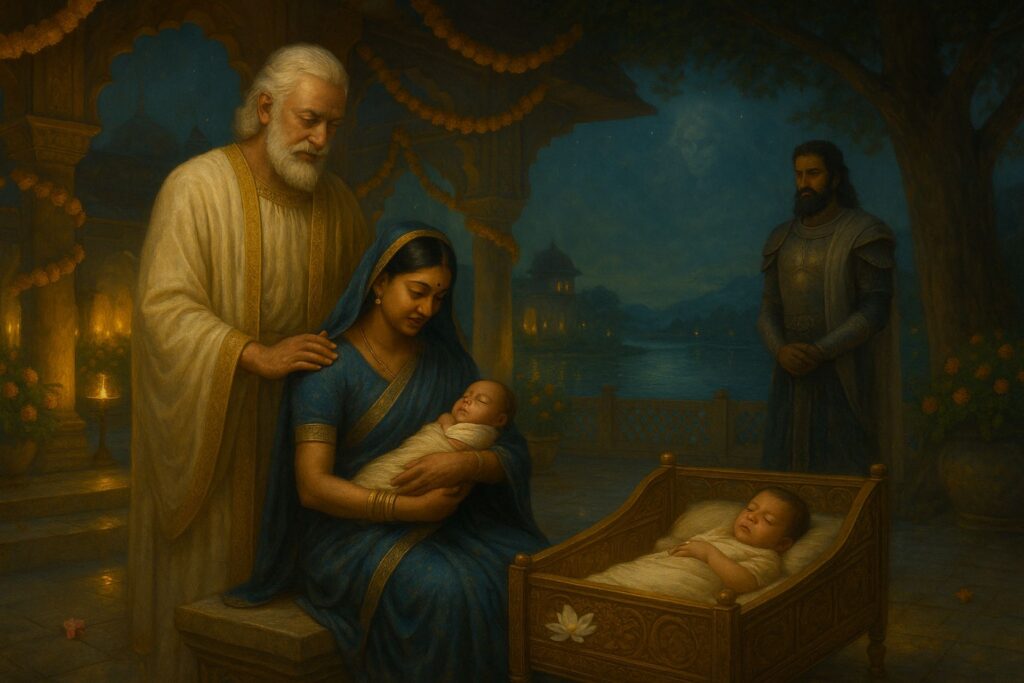
The palace of Hastinapur bloomed with light once more. The corridors, long accustomed to echoes of duty and silence, now carried the laughter of attendants and the rhythm of songs. Years had softened King Shantanu’s face, the burden of solitude replaced by the quiet contentment of love fulfilled. Beside him, Queen Satyavati moved with the calm authority of one born to command destiny, though she had once rowed alone upon the river.
Their union brought forth two sons—Chitrangada and Vichitravirya. From the moment of their birth, the stars above Hastinapur burned brighter, their light falling upon the palace walls as though blessing the line of kings yet to come.
Chitrangada, the elder, was fierce and radiant, inheriting his father’s valor. Even as a child, his gaze carried the boldness of one who would meet destiny head-on. Vichitravirya, gentler and thoughtful, bore his mother’s quiet strength and the patience of the river that had shaped her life.
The court rejoiced. The kingdom flourished. The king, content at last, would often walk through the gardens at dusk, Satyavati by his side, her hand resting lightly in his.
But joy, as it often does, carries the faint scent of its own ending.
One evening, Shantanu called for Bhishma. The son who had once renounced the world now ruled it in all but name—his wisdom guiding the throne, his restraint shaping its peace. The two stood beneath the same banyan tree where father and son had spoken years before.
“The gods have been kind to us,” said Shantanu, his voice filled with gratitude. “The lineage continues. My heart is light again.”
Bhishma inclined his head, his tone measured but warm.
“The gods honor your righteousness, Father. These sons will be the pillars of your house.”
The king smiled faintly, his eyes glistening in the lantern light.
“If not for you, none of this would exist. When I am gone, you will guide them—as only you can.”
Bhishma’s gaze lingered upon the palace, where the two boys slept in gilded silence.
“I will guard them as I guard your name,” he said softly. “But may the gods grant that they never inherit the burdens I have carried.”
The night deepened. The river murmured beyond the palace walls, her rhythm steady, eternal. Satyavati watched from the terrace above—her heart both full and restless. For though she had been given everything she once desired, there was a whisper in her blood that told her peace, in the house of kings, is never meant to last.
And far away, the Ganga flowed unseen, as if watching over the children of another woman—the next wave in the tide of destiny she herself had set in motion.
The river remembers every promise, even those made by those who never meant to keep them.
Chapter 11 – Death of Chitrangada in Battle
“The gods favor the brave, but they do not protect them.”
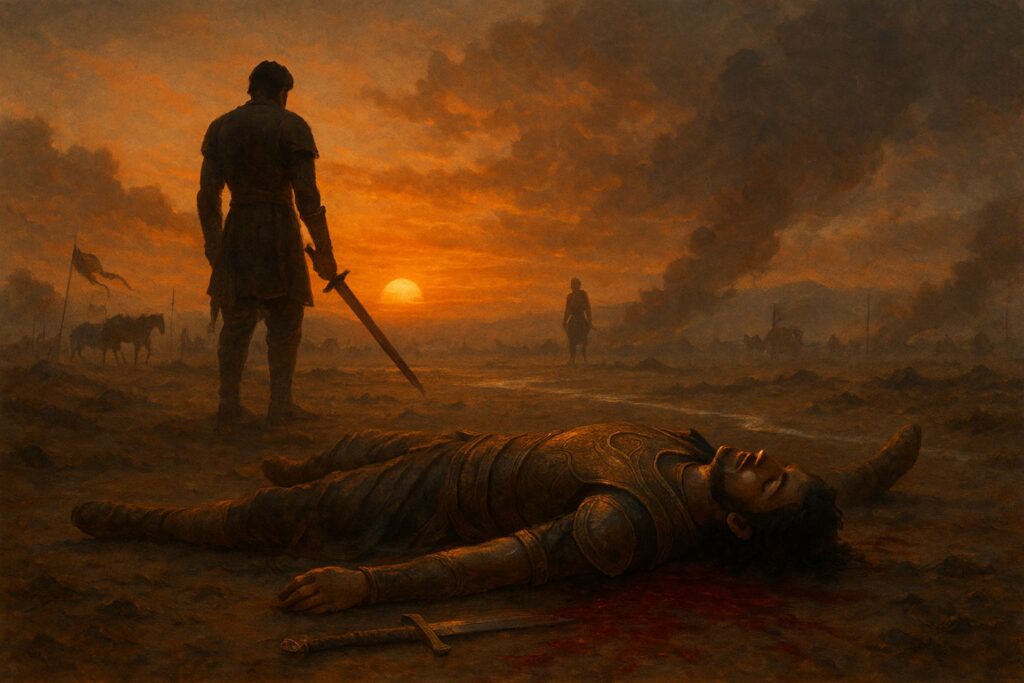
The sun burned high above the plains of Hastinapur, staining the sky with fire. The air trembled with the clang of steel and the cries of war. For the first time since Shantanu’s reign began, the sacred soil of Kuru land drank blood.
Chitrangada, son of Shantanu and Satyavati, stood at the heart of battle—his armor glinting like flame, his eyes bright with youth and pride. The kingdom had grown strong under his command, and with strength had come challenge. Across the river, a rival king—another Chitrangada, fierce and ambitious—had laid claim to his glory, declaring that two men of equal name could not share the same earth.
“Come then,” the challenger had said, his voice carrying across the wind, “let fate choose which name the bards shall sing.”
The young king had accepted, his blood surging with the fire of youth and honor. He had trained beside Bhishma himself; fear was not a word he understood.
The armies clashed beneath a copper sky. Spears broke, horses screamed, and the earth quaked beneath the weight of men’s ambition. In the chaos, the two Chitrangadas met, swords flashing like mirrored lightning. Their strikes were swift, their movements precise, each blow an echo of the other.
Bhishma watched from afar, his expression unreadable. Pride warred with unease in his chest. He had seen too many battles to mistake valor for safety. The river wind brought to him the scent of iron and dust—the fragrance of destiny at work.
For a long time, neither warrior yielded. The fight stretched from dawn into twilight. Finally, as the light began to fail, the rival struck a blow deep into Chitrangada’s chest. The young king fell, his sword slipping from his hand, his breath scattering like petals in the wind.
The challenger stood over him, triumphant yet hollow, for even victory tastes bitter when it is bought with the life of one who mirrors you.
Bhishma arrived as the sun sank, the battlefield painted in the color of endings. He knelt beside his fallen brother, his hand resting on the cooling armor.
“You fought as a Kuru should,” he said quietly. “With courage, and without regret. The gods have taken you not for punishment, but for proof—that even the strongest must return to silence.”
He carried the body back to Hastinapur himself, the army following in wordless grief. The city that had once celebrated birth now lit lamps for the dead. Satyavati’s cry pierced the night; Shantanu’s heart faltered with the weight of loss.
Bhishma stood apart, his gaze fixed on the horizon. He felt no tears, only the familiar ache of prophecy fulfilled. For every joy in this house seemed destined to end in a mirror of sorrow.
And the river, far away, swelled with the monsoon’s tears, as if the heavens themselves wept for the first Kuru prince to fall.
Chapter 12 – The Abduction of the Kashi Princesses
“Promises made to protect others often become prisons for the self.”
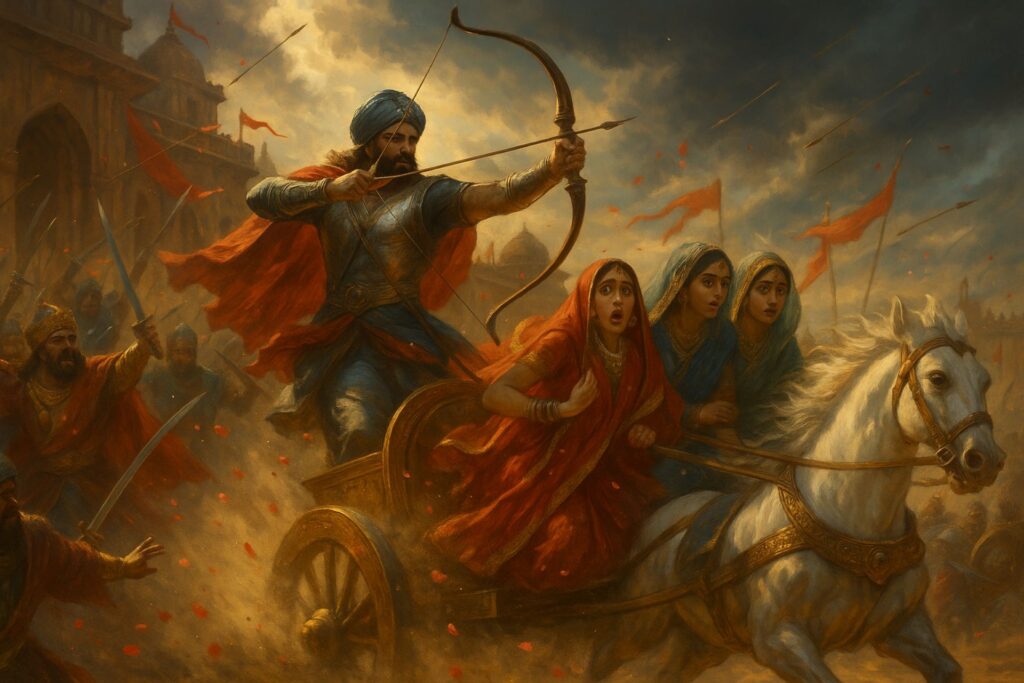
The mourning lamps for Chitrangada had only just burned out when duty demanded new light. Vichitravirya, the younger prince, now stood as heir to Hastinapur. Still tender in years, he had inherited the throne more by fate’s impatience than his own readiness. The kingdom needed a queen—no, a lineage—and Bhishma, the guardian of vows and empire, took it upon himself to secure one.
News came from the east: the King of Kashi was holding a swayamvara, a ceremony where princesses would choose their husbands among assembled kings. Three daughters—Amba, Ambika, and Ambalika—were to be wed. Every noble house sent champions, each hoping to claim alliance and glory.
But Bhishma went not as a suitor. He went as a servant of the throne.
The morning of his departure was silent. He stood before the sacred fire, his armor gleaming with the reflection of its flames. The courtiers watched in awe, for none doubted his power, though all pitied his solitude.
“For my brother’s sake,” he murmured, “I go not to win hearts, but to fulfill a kingdom’s need.”
The sound of his chariot soon echoed through the plains—a roar of thunder drawn by white horses. He arrived at Kashi amidst a sea of banners and gold, his presence turning heads and silencing drums. The suitors looked upon him and saw not a rival, but an omen.
When the ceremony began and the eldest princess stepped forward with the garland of choice, Bhishma rose, his voice carrying through the hall like the edge of a blade.
“O kings and princes of the land,” he declared, “I, Bhishma of Hastinapur, claim these maidens on behalf of my brother, King Vichitravirya.”
A murmur rippled through the assembly. Before protest could gather, Bhishma lifted the princesses into his chariot as effortlessly as one lifts petals from the ground. The suitors shouted in fury; weapons clashed against shields. The earth trembled beneath the horses’ hooves as Bhishma thundered toward the horizon, arrows raining behind him like sparks from a divine forge.
Kings pursued him, yet none could close the distance. His bow sang, his armor blazed, and the wind itself seemed to part for him. The princesses sat silent—half in awe, half in terror—watching a man who moved not for desire, but for duty so absolute it no longer resembled mercy.
When at last he returned to Hastinapur, victory followed him like a storm. He stood before Satyavati, the three daughters of Kashi beside him, and bowed.
“The brides for your son have been brought,” he said. “The promise of lineage is fulfilled.”
But as silence filled the hall, the eldest Princess Amba stepped forward. Her eyes were steady, her words sharp as a blade.
“I was already pledged to another,” she said. “To King Shalva, who fought for me today. Release me, O son of Ganga, for I love him and him alone.”
Bhishma paused, his expression unreadable.
“Then you shall return to him,” he replied. “For I seek no victory that dishonors the heart.”
The court fell silent. In that moment, duty bowed before compassion, though neither knew it would not be the last time they met.
As Amba departed, the wind outside rose again, carrying the scent of river and storm. The fates had begun to stir, weaving a thread that would one day return to pierce Bhishma’s own armor.
And somewhere, far beyond the city walls, the river sighed—knowing that vows, once made, always find their way back to the one who made them.
Chapter 13 – Amba’s Rejection and Quest for Vengeance
“A heart denied its right to love will turn that love into fire.”
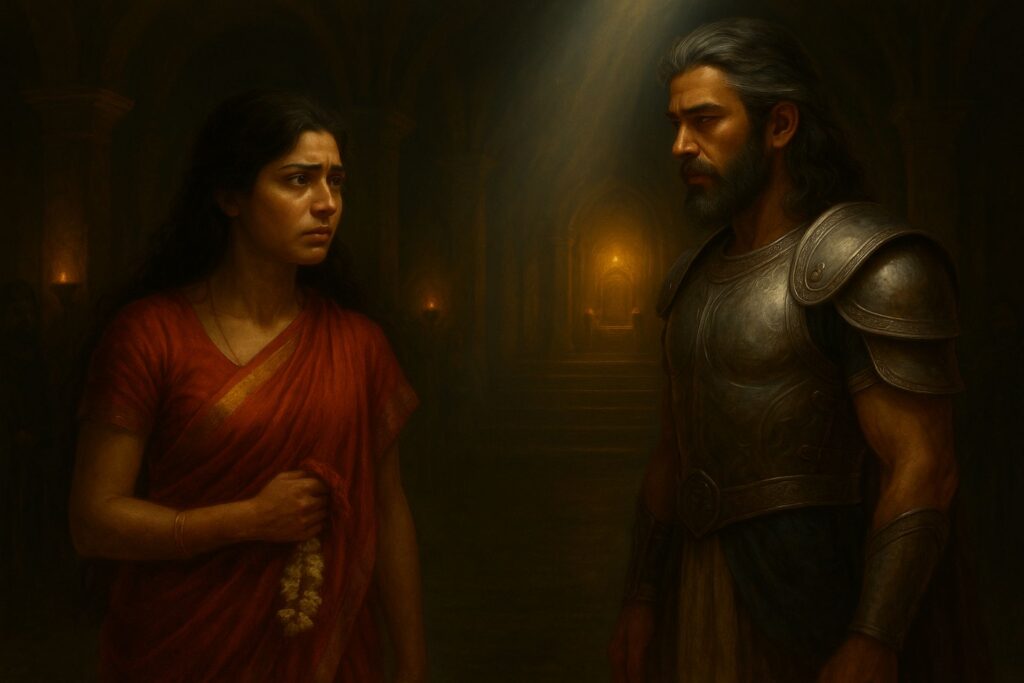
When Amba returned to the court of King Shalva, the man for whom she had risked honor and defied empire, she carried no fear—only the fragile certainty that love, once declared, must be enough. Her chariot still bore the scent of Bhishma’s conquest, her silks torn by wind and battle. She entered Shalva’s hall with pride unbroken, her eyes steady on the man who had fought for her.
But the hall that should have welcomed her fell silent. Shalva’s gaze, once tender, now burned with wounded pride.
“You were taken by another,” he said coldly. “Even if against your will, the world has seen it. You were carried in his chariot, and no man can claim what another has held.”
Amba’s breath caught in disbelief.
“I was not touched,” she said. “I was taken as a prize of war, not as a woman. You know my heart—does it not count for anything?”
But Shalva turned away.
“Love is no match for honor,” he murmured. “Go, and seek your destiny elsewhere.”
The words struck harder than any blade. Amba left the court without another word. The streets blurred before her, her heart dissolving into rage and despair. In one stroke, love had betrayed her, and duty had abandoned her.
She returned to Hastinapur, the palace of her humiliation. The courtiers whispered as she entered, her face pale yet aflame with defiance. Bhishma stood in the great hall, calm as always, the stillness of a man who had made peace with sacrifice.
“Why do you return, princess?” he asked, his tone composed.
“Because your vow has destroyed my life,” she said, her voice trembling with fury. “You took me from my father’s house, gave me to a man who will not have me, and left me to wander between disgrace and pity. Now, you must make it right—marry me, and restore my honor.”
The hall froze. Bhishma’s silence was absolute, his face carved in sorrow and resolve.
“You know I cannot,” he said at last. “The vow I took binds me beyond desire or redemption. It was sworn before heaven, and I cannot break it, even for compassion.”
“Then may heaven bear witness,” Amba cried. “If your vow is stronger than justice, may it one day destroy you as it has destroyed me!”
She turned and left the palace, her footsteps echoing through the corridors like the tolling of fate. The courtiers watched her go—some in pity, others in fear—for they saw something divine and terrible awakening behind her eyes.
Amba sought refuge among sages, warriors, and gods. She pleaded for retribution, for balance, for a power that could strike down the man she held responsible. Many turned her away, unwilling to stand against Bhishma, the man who had defeated even death.
Until one day, deep in the forests of the Himalayas, she met Parashurama, the immortal warrior-sage, teacher of Bhishma himself. Her words were sharp as arrows, her grief purified into vengeance.
“Great Rishi,” she said, “you taught him his strength. Now teach him the pain of its misuse.”
Parashurama listened, his brow furrowed, his heart caught between justice and affection for his pupil.
“If he has wronged you,” he said, “then let fate decide between you both. I will summon him.”
Thus began the tremor that would one day shake the lineage of kings—the vengeance of a woman denied, and the promise of a duel between master and disciple.
And far away, the river that had given Bhishma life now darkened, sensing that her son’s vow had at last found its equal—in a woman’s curse.
Chapter 14 – The Duel Between Bhishma and Parashurama
“When righteousness stands against itself, even victory becomes meaningless.”
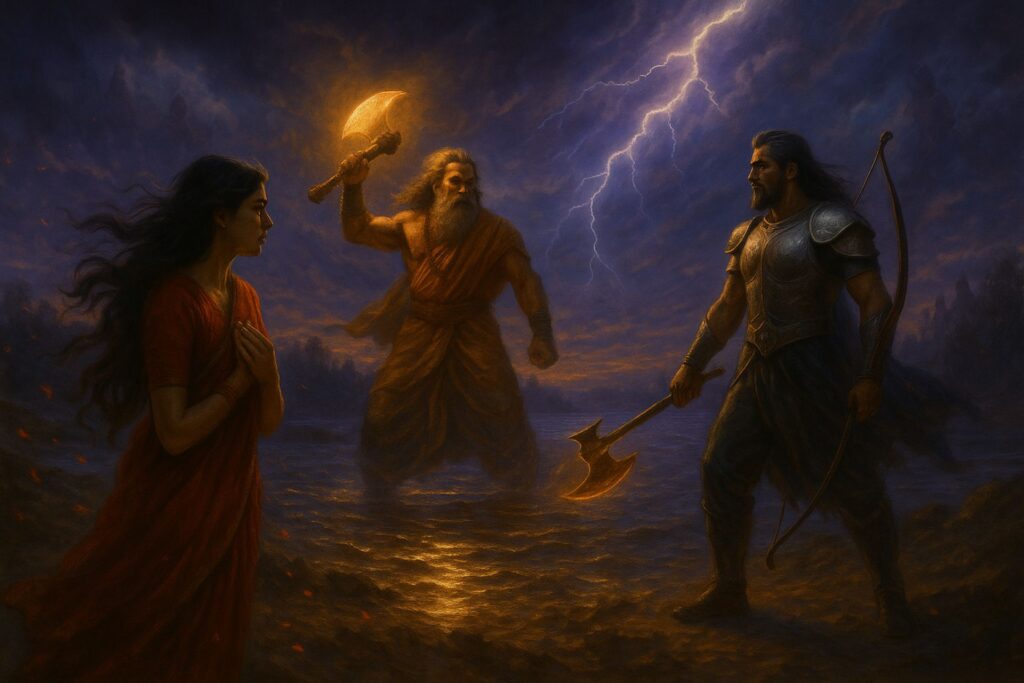
The summons came like thunder.
From the peaks of the Himalayas, where silence dwells among the clouds, the great Parashurama—warrior-sage, destroyer of kings, teacher of Bhishma—rose from meditation. His disciple’s vow had rippled through the ages, and now it called him not as pride, but as justice unanswered.
At his side stood Amba, her face pale yet fierce, her eyes burning with a flame no mortal grief could extinguish. She had fasted for days, prayed for weeks, and now her plea had reached heaven’s most dangerous ear.
“He has wronged me,” she said, her voice trembling not from fear but from faith. “He stole my honor and hides behind the mask of virtue. You alone can make him bend.”
Parashurama’s gaze softened, but only briefly.
“He is my student,” he said, “but dharma binds even the teacher. If he has erred, I shall remind him of righteousness—with the sword if I must.”
The sky darkened as he strode forth from his ashram. The rivers whispered his name, the earth trembled under his feet. Every creature that knew the scent of battle fell silent, for Parashurama’s wrath was legend—a storm that spared no king, no warrior, no empire.
In Hastinapur, Bhishma awaited him. Word of the approaching sage reached the court like a wind before lightning. Satyavati’s face paled, and the young prince Vichitravirya watched his guardian with unease. But Bhishma, serene as ever, merely laid aside his crown of duty and took up his bow.
“If my teacher comes in anger,” he said, “I will meet him not as a son, but as a warrior. For truth is not served by fear.”
The two met upon the banks of the Saraswati River—the ancient witness of divine duels. The sun burned low, turning the waters to molten gold. The air shimmered with tension. Parashurama stood like a mountain draped in thunderclouds, his axe gleaming with divine fire. Bhishma stood opposite, his bow drawn, his eyes calm and resolute.
“Bow before your teacher,” Parashurama commanded, “and make amends for the injustice done to this woman.”
“I bow before you, revered one,” Bhishma replied, “but not before falsehood. My vow was not born of cruelty, but of duty. I have wronged no one.”
The sage’s eyes blazed.
“Then let battle be your truth.”
The heavens roared. Arrows like comets streaked across the sky, clashing in bursts of flame. Rivers reversed their flow, mountains shuddered, the air turned crimson with divine fury. For twenty-three days and nights, the battle raged—each strike echoing through time, each blow shaking the balance of dharma itself.
On the twenty-fourth dawn, the earth could bear no more. The gods descended, pleading with both to cease. Narayana himself appeared in light, his voice cutting through the chaos.
“Enough! Two righteous men cannot destroy the world to prove who is more pure. Let the cycle of justice rest—Bhishma’s vow shall stand, and Amba’s fate shall find its own path.”
Parashurama dropped his weapon, his rage dissolving into sorrow.
“You have not won, my son,” he said quietly. “You have endured. May your endurance one day teach the world what even righteousness cannot escape—its own shadow.”
Bhishma bowed deeply, tears unshed.
“Your lesson is eternal, Master,” he said. “But some destinies must still be lived to be understood.”
And so the war of teacher and disciple ended without victor, leaving only silence—a silence that stretched like an unhealed wound.
Amba stood upon the riverbank, watching them depart. Her vengeance had not yet found its form, but her purpose had found its fire.
And the Saraswati flowed on, carrying the memory of a battle that had shaken the gods—and birthed the seed of Bhishma’s undoing.
Chapter 15 – Amba’s Transformation into Shikhandi
“Vengeance does not die; it merely changes its name.”
After the duel between Bhishma and Parashurama, the world fell silent again. The rivers resumed their flow, the stars dimmed to ordinary light, and men returned to their small concerns. But Amba did not return to peace. The flames that had consumed her heart still burned, feeding upon her very soul.
Her quest for justice had left her neither alive nor content. Kings had turned her away, gods had refused to intervene, and the man she hated had become immortal by his own restraint. What vengeance could reach a man who had mastered death itself?
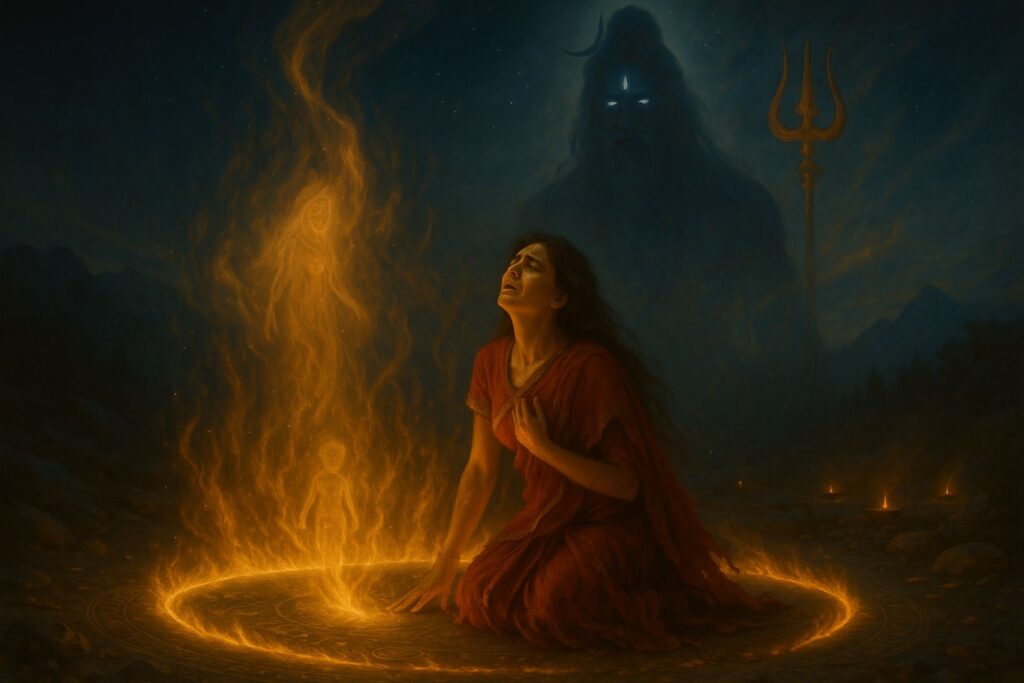
Wandering through forests and shrines, Amba sought one final refuge—Lord Shiva, the destroyer, the silent witness of all transformations. She stood before his mountain shrine, her body frail, her spirit unbroken. Days turned to weeks as she fasted beneath the open sky, the cold biting into her flesh, the wind whispering doubts into her ears. But her resolve was forged beyond pain.
Finally, the night came when the earth itself seemed to be still. A presence descended—a shadow outlined by firelight. Shiva’s voice echoed not in the air, but within her bones.
“You have called upon me with fury, not faith. What do you seek, daughter of Kashi?”
Amba raised her face, eyes burning with tears and rage.
“Justice,” she said. “The man who ruined my life lives unpunished. I wish for his death—and I will give anything for it.”
The god’s silence stretched across centuries. Then, slowly, the darkness rippled with light.
“In this life, you cannot defeat him,” Shiva said. “He bears the gift of Ichha-Mrityu—death by choice. But your will is strong enough to bridge lifetimes. You shall be born again, not as a victim, but as the instrument of his end.”
“So be it,” Amba whispered. “Let me return as his destroyer.”
The wind roared, the stars bent low, and the fire around her flared into a circle of gold. When the flames subsided, Amba’s mortal body lay still—her final breath carrying both curse and prayer.
Years later, in the kingdom of Panchala, a child was born to King Drupada—a daughter who was raised as a son. She was named Shikhandi. The people whispered that strange omens had marked her birth, that the wind carried the cry of two voices instead of one.
Shikhandi grew in strength and skill, mastering weapons, riding chariots, and commanding armies. Yet beneath the warrior’s calm, a restless shadow stirred—a memory that did not belong to this life.
At night, the young prince dreamed of rivers and vows, of a chariot racing through dust, of a man who could not die.
“Who am I?” Shikhandi would whisper to the empty dark.
And somewhere far away, in Hastinapur’s marble halls, Bhishma would stir from uneasy sleep, feeling the faint tremor of a fate he could not yet name.
Thus the wheel of time turned once more—where love had failed, vengeance was reborn; and where the vow had begun, destiny waited to finish what it started.
Chapter 16 – Satyavati and Parashara — The Fog and the Birth of Vyasa
“Every secret carries the weight of a future it cannot yet reveal.”
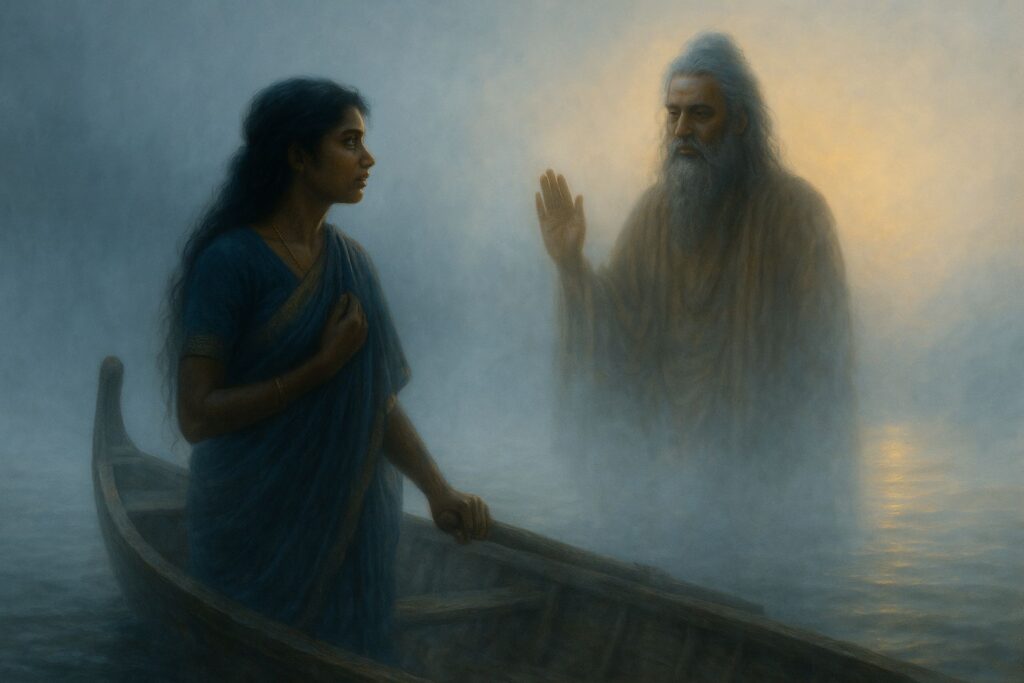
The river lay still that morning—its silver skin shrouded by fog, its voice hushed by dawn. The world itself seemed to pause, as if holding its breath for what destiny was about to write upon its waters.
Before she was queen, before the world knew her as Satyavati, daughter of a fisherman, she was simply Kali, the dark-hued girl who ferried travelers across the Yamuna. The scent of the river clung to her skin, and her eyes held a calm that unsettled kings. She had grown used to silence, to the rhythm of oars cutting water, to the whispers of the current that carried stories older than men.
That day, as mist gathered around her small boat, a man appeared upon the far bank—tall, ascetic, eyes bright as lightning trapped in calm seas. His matted hair was streaked with age, but his presence filled the air with the gravity of command. The river itself seemed to bow before him.
It was Parashara, the wandering sage—descendant of Vasishtha, keeper of divine wisdom, and master of the unseen.
“Boat-girl,” he said softly, “carry me across. The world waits for my journey.”
Satyavati nodded, guiding her oar into the mist. As the fog closed around them, the river vanished into silence, and the air grew dense with an otherworldly fragrance.
“The scent of fish,” he said, his voice deep, “clings to you, yet beneath it I sense the fragrance of destiny.”
Her heart quickened. She was no stranger to the gaze of men, but this was something else—a gaze that saw beyond form, into essence.
“I am what the river made me,” she replied. “I belong to water, not to crowns or sages.”
Parashara smiled, the kind of smile that hides prophecy behind patience.
“And yet, from your womb will rise one who binds heaven and earth—a voice through which even gods will speak.”
The river stilled. The mist thickened until it became a world apart—time suspended, creation waiting. Satyavati felt the weight of something vast, not as fear but as recognition, as if she had always known this moment would come.
“You speak of fate, but you ask for me,” she said quietly. “I am mortal. The world will not forgive a woman touched by a sage.”
“Then the world will forget,” Parashara answered. “I shall cloak this day in fog. None shall see, none shall remember. Your virginity will return, your scent will change—from river to lotus—and your name shall live eternal.”
She looked into his eyes and saw no lust, only certainty—the calm of one who knows the script of destiny and merely turns its page.
The fog thickened, the world dimmed, and silence fell. When the light returned, the sage was gone. The air shimmered with the fragrance of wild flowers, and the river once again found its voice.
Satyavati stood alone in the boat, her heart trembling, her skin radiant with a glow not of this world. From the depths of that divine union, a child had been conceived—a son who would carry the knowledge of all worlds, born not of passion but of prophecy.
She would hide that secret for years, bury it beneath her life as queen and mother. Yet when the time came, that child would return—Vyasa, the sage who would compose the story of his own beginning.
And so, within the fog that veiled the river, destiny wrote its first secret in silence—one that would echo across generations, until the world itself became the story he would one day tell.
Chapter 17 – Vyasa’s Austerities and Wisdom
“Those who master silence hear the voice of the cosmos.”
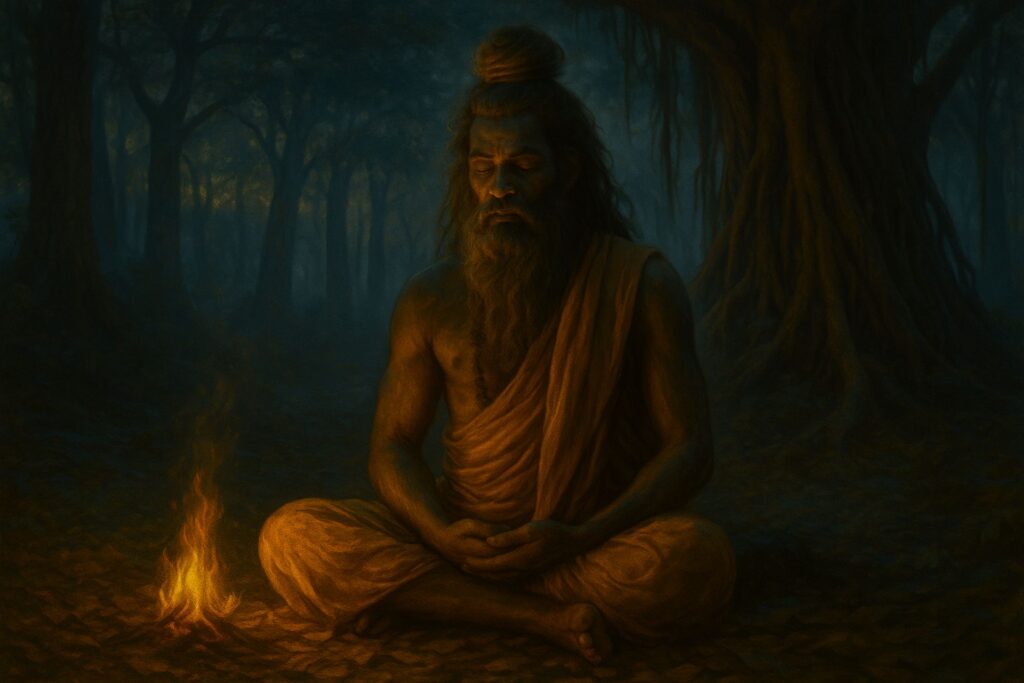
He was born on an island the river made for him. No cradle, no palace—only wind, water, and the hum of existence as his lullaby. His skin bore the hue of twilight, half light, half shadow, as though creation itself could not decide whether to keep him divine or mortal. Thus, he was named Krishna Dvaipayana—the dark one born on the island.
Even as a child, he spoke little. His eyes carried a stillness that unsettled even the wise. The river flowed for him; the trees bent toward him; the birds paused mid-flight. Nature recognized what men would take centuries to understand—this was the one who would weave the song of time itself.
Raised by sages in the deep forests of the Himalayas, Vyasa grew under the discipline of silence. He fasted not to weaken the body but to sharpen the soul. He spoke only when his words could move the stars.
“Knowledge is not gathered,” his teacher once told him. “It is remembered. You are not here to learn but to recall.”
And Vyasa did recall. Memories of ancient worlds, of cosmic rhythms, of the language the gods spoke before sound was born. He wandered across mountains, meditating by rivers that mirrored his own birth, each austerity a chiseling of self, each silence a bridge to eternity.
When storms raged, he sat unmoved; when snow fell, he breathed warmth into the air. He saw the wheel of life turn endlessly—birth, growth, decay, death, and return. And one day, under a banyan older than memory, realization descended like dawn:
“Everything that happens has already happened. Everything that will happen waits in the folds of time. To know the world is to remember the pattern.”
From that moment, Vyasa became more than sage—he became seer. His mind turned inward until it stretched beyond space, beholding the eternal dance of karma and dharma. Kings would seek his counsel, gods would honor his words, and yet he would remain barefoot, his only companion the echo of his thoughts.
It was said that when he opened his eyes after years of meditation, the air itself carried his vision—past, present, and future mingling into one unbroken thread. And he knew his purpose.
“I was born of fog and silence to bring clarity to the world,” he whispered to the wind. “I shall bear witness to the rise and fall of kings, to love that defies death, and to hate that shapes destiny.”
Years later, when a queen named Satyavati would summon him to save her bloodline, Vyasa would not need explanation. He had already seen that moment in the stillness of his meditation.
He smiled gently, knowing his own story was not separate from theirs—it was their story, and through him, it would live forever.
And thus, in the solitude of the forest, among the whispers of unseen worlds, the voice that would one day narrate the Mahabharata was born—not in grandeur, but in the quiet brilliance of absolute knowing.
Chapter 18 – Death of Vichitravirya and Crisis of Heirship
“Dynasties do not end with death—they end with the failure to foresee it.”
The palace of Hastinapur had grown quieter since the passing of King Shantanu. The echoes of laughter had dulled, the great halls felt colder, and even the Ganga that flowed nearby seemed to murmur with grief. Yet within those marble corridors, the pulse of duty still beat faintly. Vichitravirya, the youngest son of Shantanu and Satyavati, now wore the crown of the Kuru dynasty.
He was young, barely a man, still learning the weight that rested upon his lineage. His brother Chitrangada, the warrior who once led Hastinapur’s armies with fire and pride, had perished in a duel against a Gandharva lord. The empire, robbed of its defender, turned its hopes toward Vichitravirya. And beside him, as steadfast as a shadow, stood Bhishma—the guardian who had sworn celibacy so that this very boy could reign.
For a while, peace endured. The land prospered. But time, patient and cruel, never ceases its quiet work.
Vichitravirya grew into a gentle ruler, loved for his fairness, but fragile in body and uncertain in spirit. His mother, Queen Satyavati, had found wives for him—Ambika and Ambalika, princesses of Kashi. Their union was meant to secure the lineage, to continue the thread of Bharata’s blood through royal sons. Yet the gods had woven another pattern.
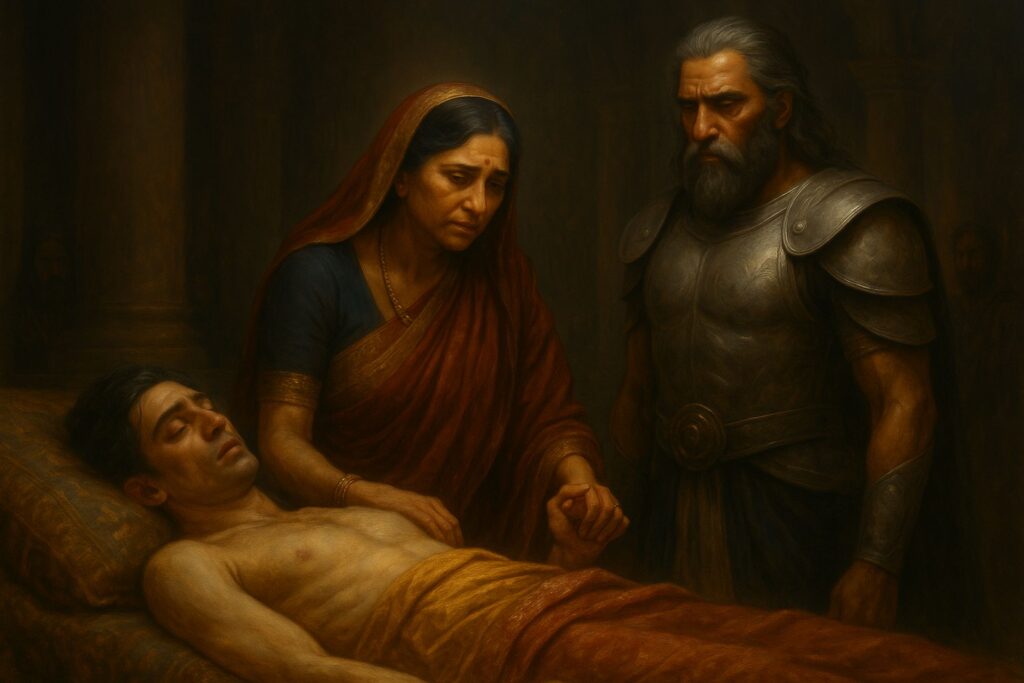
Soon after the wedding, the young king fell ill. No physician could name the ailment; no prayer could undo it. It was as though a hidden curse had taken root within him. His breath grew shallow, his laughter faded, and his skin turned pale like moonlight over ash.
“Mother,” he whispered one evening, his voice barely rising above the sound of wind, “my body weakens though my heart still clings to duty. Will our line perish because I could not fulfill it?”
Satyavati clasped his hand, her face carved from grief and fear.
“No, my son,” she said, “the river does not die when one wave falls. I will find a way.”
Bhishma stood nearby, silent as ever. His vow had chained him to a duty that demanded witness but forbade intervention. His eyes—calm yet heavy—followed the boy who was fading like twilight beyond reach.
“The throne does not need strength,” Bhishma murmured softly. “It needs continuity. If it must be protected, I shall protect it even against fate itself.”
But even Bhishma could not shield a king from destiny.
Within weeks, Vichitravirya’s breath faltered. His body, frail and fevered, could no longer bear the burden of the crown. As dawn bled across the Ganga, he took his final breath in his mother’s arms.
And thus, the palace of the Kurus fell silent once more.
No heir. No successor. No light to guide the kingdom.
The great vow of Bhishma now loomed like irony—he had renounced his right to father children, and the sons who inherited the throne had both perished childless. The curse of foresight had come full circle.
That night, the river Ganga murmured louder than before, as if whispering to Satyavati, “What you buried in fog must now be revealed.”
Satyavati, remembering the promise of the sage Parashara, felt the weight of that prophecy return. Somewhere in the forests, her forgotten son—the one born of mist and divine purpose—waited. And she knew what she must do.
Thus ended the reign of Vichitravirya, and with his death began the great crisis of heirship—the turning point that would summon destiny’s hidden child and set into motion the long echo of war yet to come.
Chapter 19 – The Niyoga — Birth of Dhritarashtra, Pandu, and Vidura
“When destiny closes a door, it forces open one that terrifies even the gods.”
The pyres of Vichitravirya still smoldered when Satyavati summoned Bhishma to her chambers. The air reeked of sandalwood and sorrow, and yet beneath it lingered a scent older than grief—the faint, river-born fragrance of destiny returning.
“The throne stands empty,” she said, her voice cold as command. “Our line teeters on extinction. You swore an oath, Bhishma, to protect this house. Will you now watch it crumble?”
Bhishma lowered his head. His vow had become both shield and prison.
“Mother,” he said quietly, “my oath forbids me to father heirs. The future of the dynasty must come through another.”
The queen’s eyes hardened. In that moment, she seemed not merely mortal but the embodiment of the will that holds kingdoms together.
“Then another it shall be,” she declared. “There is a way sanctified by scripture—niyoga, the sacred act by which the righteous continue their line through chosen men of virtue. Our kingdom will not perish.”
Bhishma’s silence stretched across the room like a drawn sword. He knew what she meant, and the name that trembled behind her lips.
“You will summon him,” he said finally. “The sage who was born of your secret.”
The words stung. For years, Satyavati had buried the memory of that fog-veiled dawn, when the river had swallowed her innocence and gifted her a son beyond mortal measure. But now, as the dynasty trembled, that forgotten promise called her back to its purpose.
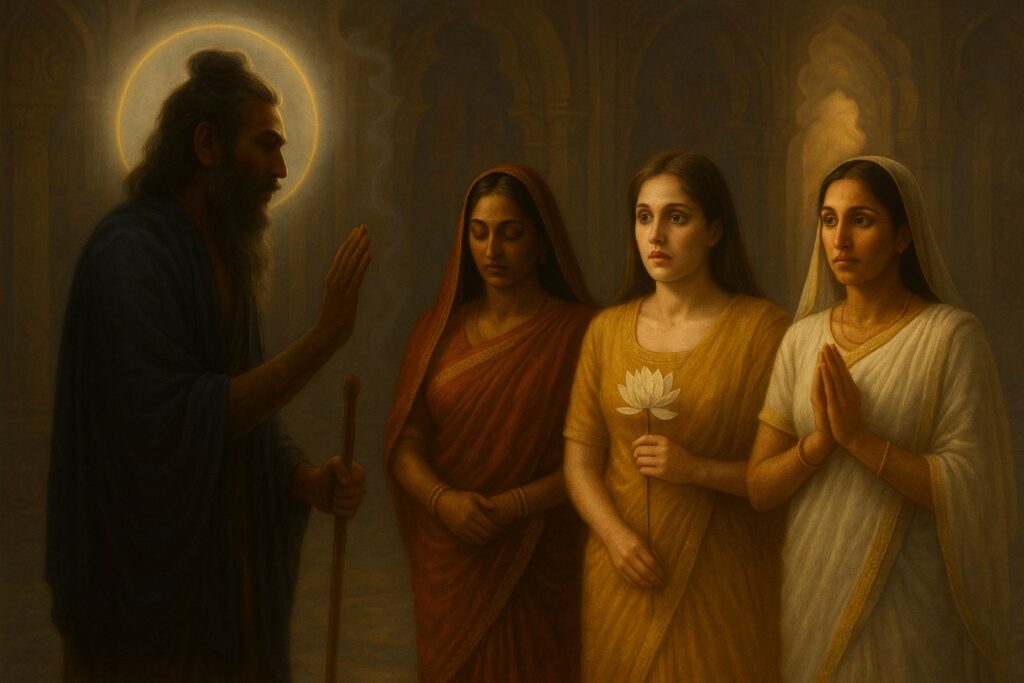
That night, under the same stars that had once witnessed her union with Parashara, she lit the lamps of invocation. The wind grew still. The waters beyond the palace whispered, and the fragrance of wild blooms filled the air. From the mist, a figure emerged—tall, radiant, serene. His eyes shone with timeless knowing.
“Mother,” said Vyasa, bowing slightly, “I felt your thought before your lips spoke it. You call for heirs; destiny answers through me.”
Satyavati’s hands trembled. “The kingdom stands barren,” she said. “My sons have left no children. Will you, O sage, restore the flame of our lineage?”
Vyasa looked toward the silent corridors of the palace—the chambers of Ambika and Ambalika, still wrapped in widow’s veils.
“I will obey, for it is dharma,” he replied, “but know this: the act will bear the weight of what each heart carries. Purity begets clarity; fear begets flaw.”
That night, he entered the chamber of Ambika. She trembled at the sight of him—his unkempt hair, his austere presence, his eyes burning like twin suns. Terror seized her. When it was done, she shut her eyes in dread.
Months passed. She bore a son—Dhritarashtra, powerful as a mountain, but blind from birth.
Next, Vyasa entered the chamber of Ambalika. She did not close her eyes but paled in fright, her breath shallow, her skin cold as ash. She too bore a son—Pandu, fair and strong, but frail in blood, his body cursed with weakness.
Seeing the sorrow on Satyavati’s face, Vyasa spoke once more.
“Mother, fear has tainted the lineage. One more chance remains, if you will it.”
Satyavati nodded. She sent for a servant girl—Parishrami, pure of heart, gentle of spirit—to meet the sage without fear.
When Vyasa approached her, she greeted him with calm devotion, seeing not his form but his divinity. Her acceptance bore fruit. The third son, Vidura, was born—wise, virtuous, clear-eyed, yet denied kingship by his mother’s station.
And thus, three sons came forth: Dhritarashtra, the blind strength; Pandu, the pale warrior; and Vidura, the unthroned wisdom.
When Vyasa took his leave, he turned to Satyavati and spoke softly:
“You have restored the line, but know this—every birth bears its own curse. The eyes that cannot see will rule, the hands that cannot hold will conquer, and the voice that counsels truth will go unheard. Such is the balance the world demands.”
Then he vanished into mist, as the dawn broke over Hastinapur.
Satyavati stood alone, her heart divided between triumph and unease. The kingdom had heirs once more—but she could already feel the shadow of their destinies gathering like storm clouds over the throne.
And so, from the act that sought to preserve life, fate planted the seeds of its greatest conflict.
Chapter 20 – The Threefold Curses of Destiny
“Every blessing, if held too tightly, turns upon its giver.”
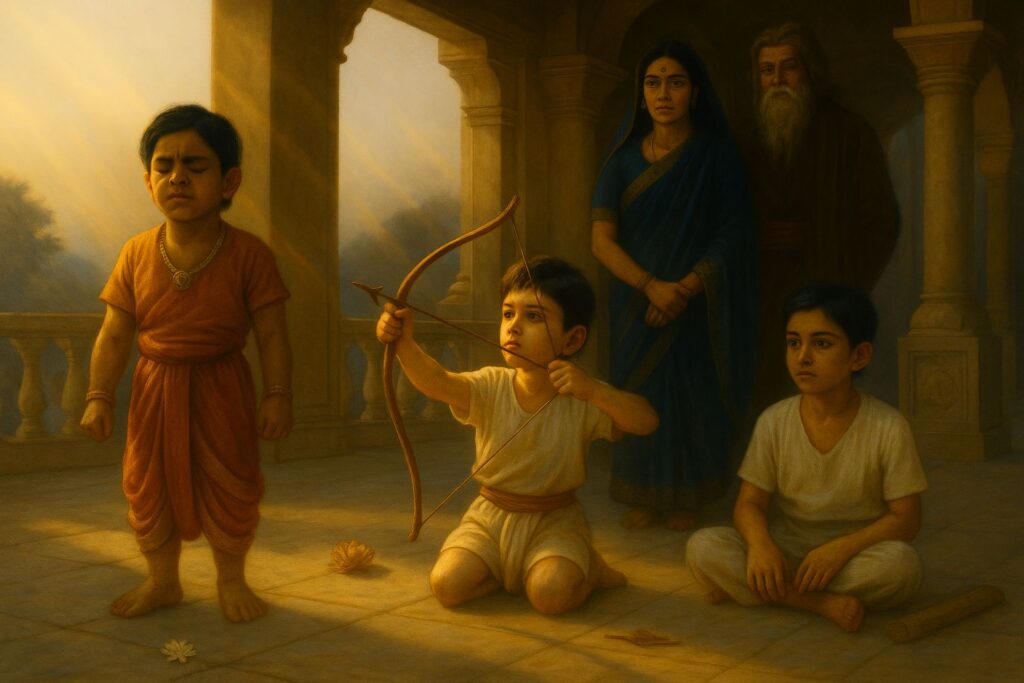
The bells of Hastinapur rang for renewal, yet beneath their echo, the air trembled with unease. Three sons had been born to continue the Kuru line—Dhritarashtra, Pandu, and Vidura—but each carried within them the quiet mark of imbalance, a shadow that no ritual could cleanse.
Dhritarashtra, the firstborn, was vast in strength and towering in presence. His grip could crush iron, his voice carried the weight of command even as a child. Yet his eyes, though open, could not see. The gods had taken from him what his mother had withheld in fear. For when the sage Vyasa came to her, Ambika had shut her eyes in terror, and that blindness had passed to her son like an inheritance. He grew surrounded by light yet forever bound in darkness. His blindness was not of eyes alone but of sight—of the kind that sees truth beyond appearances.
Pandu, born of Ambalika, was fair and radiant, the golden child whose very name meant “the pale one.” He bore the beauty and grace of the gods, yet in his veins ran fragility. His body was strong to behold but weak within, his vitality dimmed by the fear his mother had felt when the sage had touched her. The world looked upon him and saw perfection, unaware that each breath was a negotiation between life and death. And yet, his mind was steady, his will fierce. Even as he fought weakness, he carried himself as one born to command, destined to balance his brother’s blindness with clarity and courage.
The third child, Vidura, was born of the servant woman Parishrami, who met the sage without fear or judgment. Her heart was pure, her mind serene, and so her son was born whole in body and clear in spirit. Though denied royal blood by station, Vidura possessed a wisdom that would later outshine kings. His eyes held the justice of Yama himself, for it was said that the god of death had taken mortal form through him. He grew in silence, watching, learning, and understanding what others missed—the hidden rhythm of dharma beneath the noise of ambition.
Satyavati looked upon her grandsons and felt both pride and dread. The curse of imperfection had touched each one differently. Power without vision, beauty without strength, wisdom without inheritance—three reflections of fate’s symmetry. She summoned Vyasa once more, her heart torn between gratitude and accusation.
“You have saved my line,” she said, her voice trembling, “but at what cost?”
Vyasa stood silent for a moment before answering.
“What is born of fear bears fear. What is born of acceptance bears peace. You sought heirs for a kingdom, Mother, but the world does not move by blood alone. Each son carries a mirror—of ambition, of frailty, of truth. Together, they will build and break the age that follows.”
His words lingered like prophecy.
When he departed, the queen stood at the palace balcony, watching the three children play in the courtyard. Dhritarashtra stumbled but rose again, refusing aid. Pandu aimed arrows at the sky, his pale arms taut with resolve. Vidura stood apart, quietly observing both.
Satyavati turned away. She had restored her house, but she could feel the undercurrent that would one day pull it apart.
The wind rose suddenly across the plains of Hastinapur, carrying with it the faint murmur of the river—a sound she had long ago learned to fear.
And thus, the line of Bharata was reborn, not in perfection, but in paradox: the blind who would rule, the frail who would conquer, and the wise who would be unheard. The blessings of the gods had already begun to turn.
Chapter 21 – Gandhari’s Marriage and Her Blindfold
“Love that imitates virtue often outlives both.”
Far to the west, beyond the Sindhu and the mountains where the winds smell of salt and iron, ruled King Subala of Gandhara. His daughter, Gandhari, was a woman of fierce intellect and quiet strength—learned in the scriptures, revered for her restraint. It was said that her prayers could calm tempests, that her silence carried more conviction than sermons.
When word reached her that Hastinapur sought an alliance, her heart grew restless. The messenger came not with garlands or gold, but with Bhishma’s command. The Kuru throne required a queen for its heir, Dhritarashtra, blind from birth.
The court of Gandhara murmured in disbelief. A blind prince for their daughter? Even her brother Shakuni, sharp-tongued and shrewd, rose in protest.
“Is this how Hastinapur rewards loyalty?” he spat. “They send for our sister to serve a crippled throne?”
But her father, wearied by years and politics, saw further. “An alliance with the Kuru bloodline,” he said, “is a fortress, not a chain.”
Gandhari heard all this and remained still. The decision was made in chambers of men, yet destiny often begins in the silence of women.
The day she left for Hastinapur, the sun hid behind clouds. She walked barefoot toward the chariot, her head bowed not in shame but in acceptance. On the road, she passed beggars, ascetics, and widows—each bound by fate, each carrying unseen vows. By the time she reached the Kuru court, her resolve had turned to iron.
When she first met Dhritarashtra, he stood waiting, tall and composed, his sightless gaze fixed somewhere above her. His voice was deep, solemn, steady.
“I cannot see the world that greets me,” he said. “But perhaps you will be my eyes.”
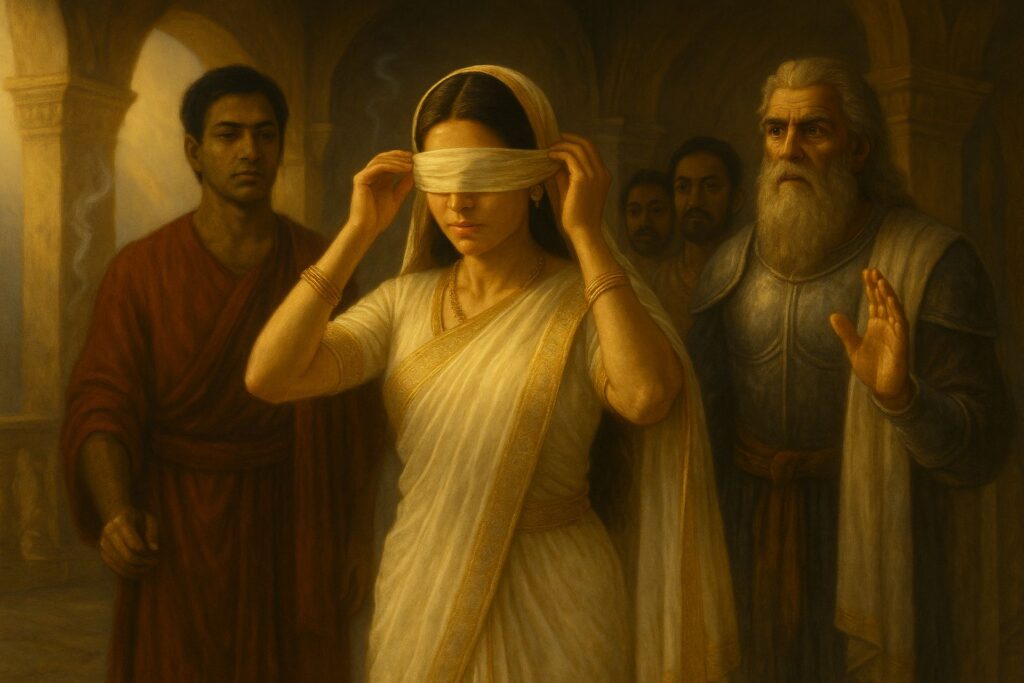
She studied him—this man robbed of vision but not dignity. Then, before the entire court, she lifted a silk cloth, folded it, and tied it firmly across her own eyes.
Gasps filled the hall. Even Bhishma, master of self-control, faltered.
“Daughter of Gandhara,” he said, “why do you bind the gift the gods gave you?”
Her answer came like a blade drawn slow.
“How can I look upon what my husband cannot?”
That day, the courtiers called it an act of devotion. The poets sang of her sacrifice. But the gods—who see beyond surface—fell silent. For they knew what mortals could not: that in binding her eyes, Gandhari had chained an empire to its fate.
The years passed. Her blindness became both veil and weapon. She moved through the palace like a shadow that saw more than light could reveal. She learned to listen to footsteps, to measure words by breath, to feel deceit in silence. Beside her, Dhritarashtra’s kingdom swelled, and so did his pride.
Her brother Shakuni visited often, whispering into the dark corridors of her heart. “Sister,” he would murmur, “the blind rule through others’ eyes. Remember whose eyes they are.”
And so, love, duty, and resentment began their slow, invisible war within her.
Thus entered Gandhari, the woman who chose darkness in a world obsessed with sight. In her vow was loyalty; in her loyalty, defiance. And though her eyes were covered, she saw clearer than most—the gathering of clouds that would one day drown the house she had sworn to honor.
Chapter 22 – Kunti’s Youth and the Divine Mantra
“The gods hear those who dare to listen beyond reason.”
Before she became queen, before her name was bound to kings and war, she was Pritha, daughter of the noble King Shurasena. Her beauty was not of ornament but of presence—calm, composed, luminous with a kind of grace that made people lower their voices when she entered. Yet her life, like the river she was destined to cross, flowed between duty and wonder.
As a young girl, she was given in adoption to Kunti Bhoja, a childless ruler of great virtue. From him, she inherited not wealth but restraint, and from the palace halls she learned the ways of service—how to listen, when to speak, and how to conceal what the heart could not show. She became known for her humility and discipline, the girl who never defied her elders and never turned away a guest.
One summer, the sage Durvasa came to her kingdom, a man both revered and feared for his temper as much as for his powers. Others trembled before him, but Kunti, unafraid, welcomed him with devotion. She served him without hesitation—washed his feet, prepared his meals, and bore his silences without complaint. For months, she cared for him as though he were a god in disguise.
When it came time for him to depart, Durvasa regarded her with an expression rare for him—gentleness.
“You have pleased me beyond measure, child,” he said. “Ask for a boon, and it shall be granted.”
Kunti bowed deeply. “I ask for your blessing, not for reward.”
The sage smiled faintly, seeing both humility and destiny in her eyes.
“Then take this mantra,” he said. “Through it, you may summon any god and bear a son in his likeness. Guard it well, for such power binds as much as it frees.”
And so he left her, the sound of his chant fading into the wind, leaving behind a secret too vast for her young heart to grasp.
In the solitude of her chamber, curiosity stirred like fire beneath ash. Could it be true? Could words alone summon the divine? The thought haunted her until, one dawn, she yielded to wonder.
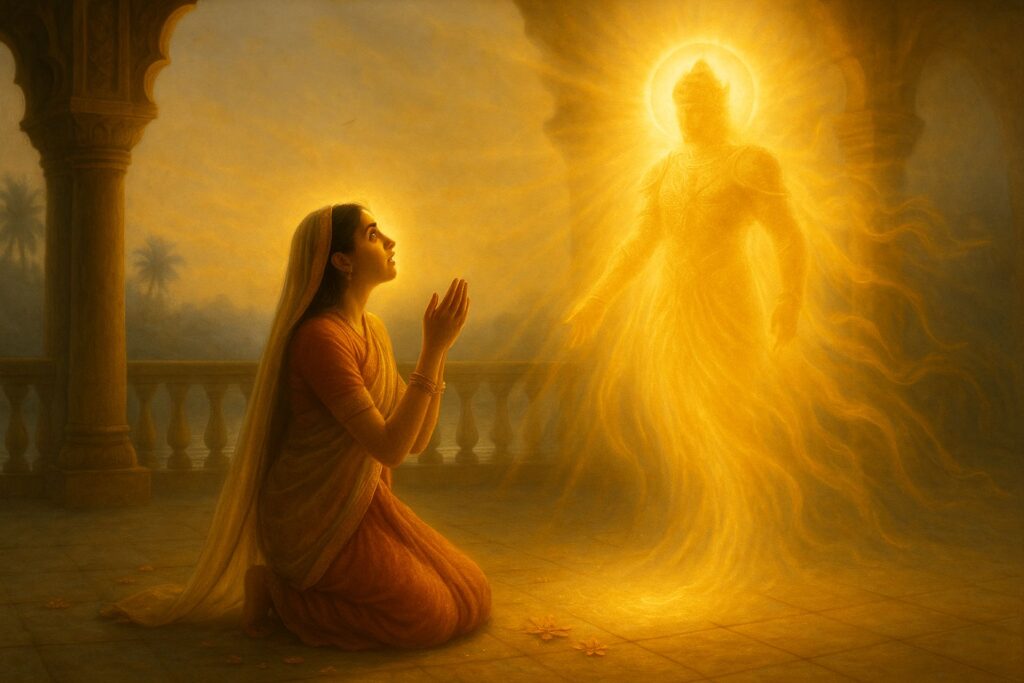
She stepped into the courtyard where the morning light spilled like gold upon the stones. Facing the rising sun, she whispered the mantra as taught, her hands trembling as the syllables fell from her lips.
The world stilled. The air grew heavy. From the heart of the sun, Surya, lord of light, descended—radiant, majestic, yet gentle in his gaze. His brilliance filled the sky, his warmth wrapped around her like an embrace.
“You have called, and I have come,” he said, his voice like music through flame. “Ask, and it shall be so.”
Kunti fell to her knees. “Forgive me,” she whispered. “I spoke without knowing.”
“No call to the divine goes unheard,” Surya replied. “You have invoked creation itself. From this union, a child will be born—marked by armor and earrings of gold, untouched by mortal frailty.”
Tears filled her eyes as light surrounded her. The god’s touch was not of flesh but of essence—a merging of spirit with the infinite. And when the brilliance faded, she stood alone once more, trembling with awe and fear.
Months later, she bore a son—radiant as the dawn, his body encased in celestial armor. He did not cry; he simply gazed at her, and she felt the unbearable weight of both miracle and sin.
Unable to reveal the truth, terrified of shame, Kunti placed the infant in a small basket and set him adrift upon the river. Her tears fell into the current as she whispered,
“May the world be kind where I could not.”
The river carried the child away, and the gods turned their faces in silence.
Thus was born Karna, the son of the sun, destined to blaze against the very brothers he would never know. And Kunti, who once dared to summon divinity, learned that some gifts are too heavy for innocence to hold.
Chapter 23 – Birth and Abandonment of Karna
“The river forgets nothing; it only carries away what we cannot bear to keep.”
The dawn that followed Kunti’s secret union was no ordinary morning. The palace still slept beneath the hush of dew, but in her chamber, the air trembled with an unfamiliar stillness—a silence thick enough to hear one’s own heartbeat. In that silence, Karna was born.
He emerged into the world not with a cry, but with an otherworldly calm. His body shimmered with a faint golden hue, and upon his chest gleamed natural armor, smooth and unbreakable as sunlight hardened into metal. From his ears hung kundalas of gold, radiant and divine. He did not weep. He looked upon his mother as though he already knew the grief in her heart.
Kunti stared at him, torn between awe and terror. He was proof of both her blessing and her undoing. The sage Durvasa’s mantra had been no illusion—the gods truly heeded her call. And yet, no one could know. She was unwed, her reputation her only shield in a world that devoured women’s honor before it understood their virtue.
She held him close, whispering apologies he could not yet comprehend.
“Forgive me, my son,” she murmured. “You were born of light, but I must hide you in shadow.”
For days she hid him in secrecy, torn between divine wonder and human fear. Every coo, every breath of the child reminded her of the impossible truth she had invited into the mortal world. No one could know—not her father, not King Kunti Bhoja, not a single soul.
But the child grew restless, radiant even in darkness. Servants began to whisper about the strange glow seeping from her quarters at night. The walls themselves could no longer contain her secret.
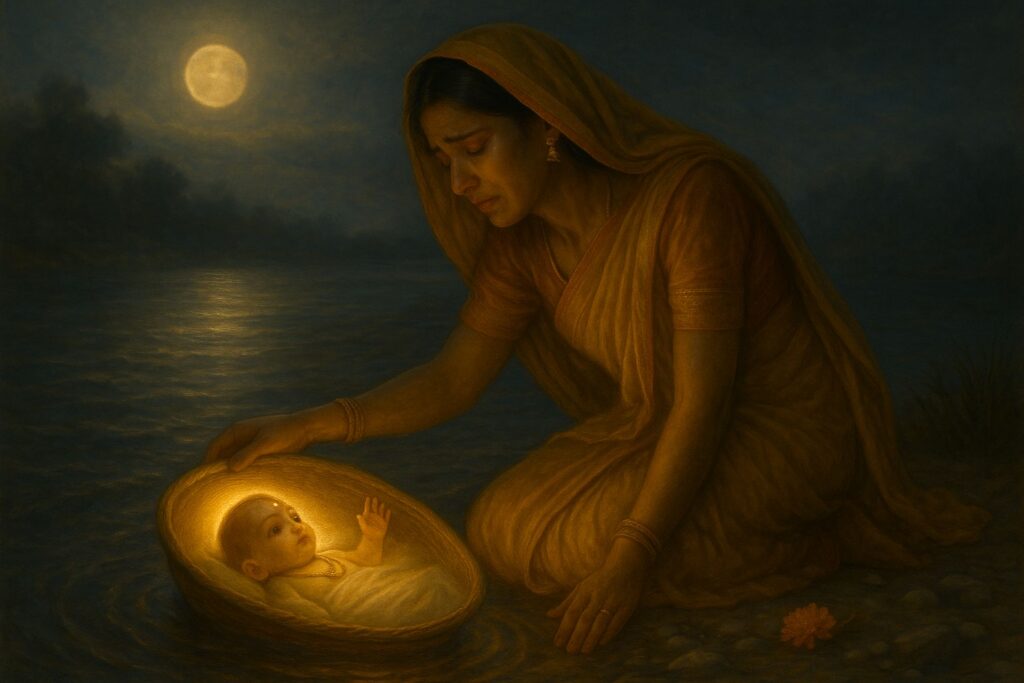
One night, under the cover of stars, Kunti wrapped the infant in soft cloth. Her hands trembled as she lined a wooden basket with silk and placed him within it. She pressed her lips to his forehead one last time.
“You came from the sun,” she whispered, “and the sun watches over all. Go where fate will carry you, my child of light. Forgive me for choosing survival over truth.”
She walked to the riverbank alone. The moon hung pale over the water, its reflection breaking in the current. She knelt, setting the basket upon the rippling surface. For a moment, the river resisted—as if even nature hesitated to take what heaven had given.
Then the current caught hold. The basket drifted slowly into the dark, rocking gently as it vanished downstream.
Kunti watched until the faint glimmer of gold disappeared into the mist. She felt her heart leave her body, floating away with it.
“May you live,” she whispered through tears, “even if it is away from me.”
Miles downstream, the basket came to rest in the reeds near the home of Adhiratha, a humble charioteer in the service of King Dhritarashtra. Hearing a faint sound, he and his wife Radha came running. When they opened the basket, the baby smiled, the golden light illuminating their astonished faces.
Radha lifted him into her arms, her heart melting with instant love.
“He has come to us from the gods,” she said softly. “If heaven has sent him, we shall raise him as our own.”
And so they named him Karna, “the one born with armor.”
He would grow not as a prince, but as a charioteer’s son—his divinity hidden behind the dust of the common road. Yet even as a child, when he looked toward the sun, something within him stirred—an ancient recognition, a longing that words could never name.
Thus the river carried more than a child—it carried the future’s greatest sorrow, the unspoken bond between mother and son. The secret of his birth would flow unseen beneath every war, every vow, every cry for justice. For the gods had written tragedy in sunlight, and left it to the river to deliver.
Chapter 24 – The Rise and Curse of King Pandu
“Power tests virtue not by granting choice, but by hiding consequence.”

The sun rose over Hastinapur with the quiet splendor of renewal. The cries of children echoed through the palace courtyards once more, and after long years of uncertainty, the Kuru dynasty stood restored. Dhritarashtra, strong but blind, and Pandu, fair but frail, had grown to manhood under Bhishma’s stern guardianship. Between them, destiny waited—silent, impartial, and patient.
It was Pandu, the younger, who captured the kingdom’s heart. His hands were steady on the bow, his judgment cool in counsel. Though Dhritarashtra was the elder, his blindness weighed upon the court like an unspoken question. The elders gathered, and Bhishma—bound to truth before sentiment—spoke the words none dared.
“A king must see the world he rules. Let Dhritarashtra advise, but let Pandu reign.”
Thus, with reluctant blessing, the crown passed to Pandu. His coronation was simple, yet solemn—a ceremony less of grandeur than of responsibility. Beside him stood Kunti, his first queen, her calm presence tempering the fire of his ambition. Later came Madri, princess of Madra, whose beauty shimmered like moonlight beside Kunti’s sunrise.
Under Pandu’s rule, Hastinapur prospered. The borders widened, justice thrived, and even Bhishma, so often disappointed by kings, found peace in the boy’s discipline. Warriors and sages alike praised him as the perfect ruler—righteous, courageous, and humble.
But the wheel of fate turns sharpest when it seems most still.
One spring, Pandu rode north with his armies to hunt in the forests of the Himalayas. The world was in bloom—trees jeweled with blossoms, air heavy with the scent of life. The hunt began as a festival of vitality, the king’s bow singing through sunlight. Then, through the thick of reeds, he saw a pair of deer locked in embrace.
He loosed an arrow. The shaft sang through the air—and struck true. The deer fell, writhing, then shifted before his eyes into human form. It was no animal, but a sage in disguise, joined with his mate in love. Blood darkened the grass.
The dying sage turned his eyes upon the king, and Pandu’s joy curdled into horror.
“You have slain one united in sacred union,” the sage cried. “For this act, you too shall die the moment you seek to embrace your wife.”
The forest went silent. The curse fell like thunder, sinking into Pandu’s soul.
He fell to his knees, trembling. “Forgive me, O holy one,” he pleaded, “I mistook you for prey.”
But the sage’s voice was unyielding.
“Ignorance does not soften consequence. May the memory of this arrow haunt you until your final breath.”
With that, the sage died, his body fading into dust that glimmered like falling ash.
From that day, Pandu’s laughter vanished. He renounced the throne and withdrew with his wives into the mountains, leaving Dhritarashtra to rule in his stead.
Kunti followed him without complaint, Madri without hesitation. They lived as ascetics in the wilderness, Pandu seeking peace through penance, though his heart remained a battlefield. Each dawn he rose to meditate, but his gaze often lingered on his wives, and shame would seize him anew.
“A king I was,” he told Kunti once, “and yet one arrow undid all I had built. Power is an illusion, Kunti. The gods lend it only to remind us how swiftly they can take it back.”
Kunti said nothing. She understood the quiet torment that ate at him, but within her heart, she carried a secret that might yet undo his despair—the memory of Durvasa’s mantra, the gift that could summon the gods themselves.
She waited, as the mountain winds whispered through the pines, knowing that the time would soon come when her husband’s curse and her own divine gift would meet—and from that meeting, the world would be born anew.
Thus ended the reign of Pandu the Just, not in battle, but in renunciation. The throne he left behind would breed ambition; the vow he could not fulfill would summon destiny. And in the silence of the mountains, the age of heroes waited to awaken.
Conclusion — The Seeds of Destiny
“Every vow, every curse, every silence has a pulse—and in time, that pulse becomes destiny.”
The tale of Hastinapur had begun not with war, but with longing. Kings had fallen for love, sages had uttered curses that shaped generations, and vows taken in moments of passion had chained entire bloodlines to fate. Bhishma’s renunciation had secured a throne, but it had also opened the door to emptiness. Satyavati’s hunger for legacy had birthed both greatness and grief. And in the wake of their choices stood Pandu—an heir burdened by virtue and doomed by desire.
Now the throne of the Kurus stood divided between duty and destiny. Dhritarashtra, blind yet unwilling to let go of power, ruled a kingdom haunted by what could have been. Pandu, the warrior-king, turned his back on conquest to seek peace in the forest, carrying the weight of a curse that denied him love, lineage, and legacy.
But destiny is patient. It moves quietly, gathering its strength through generations. And even as Pandu renounced his throne, the gods looked down upon his sacrifice and began to weave the next act of the story—the births of sons not born of men, but of the divine.
The first part of the tale ends in silence—of mountains, of exile, of a heart that seeks redemption. But within that silence, the winds are stirring.
For soon, two dynasties will be born beneath the same curse. Brothers will rise in the same halls, tutored by the same masters, destined to face each other across a field of dharma.
Thus ends Part I — The Seeds of Destiny.
The story continues in Part II — Rival Bloodlines, where the heirs of two mothers will awaken within one kingdom, and the first sparks of envy will light the path to war.