
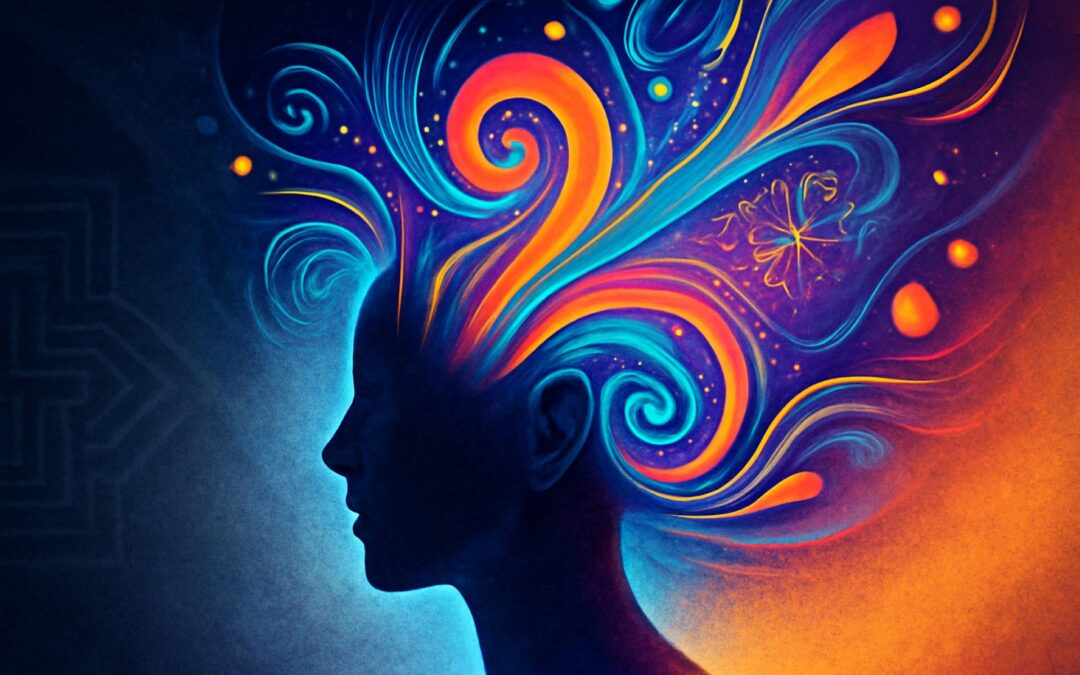
Within each of us lies an inborn creative force, a wellspring of potential known as the Original Mind. It is the mind’s natural tendency to explore, connect, and innovate—constantly seeking new ways to engage with the world. Yet, as we grow older and accumulate knowledge, many of us find ourselves stifling this creativity.
Comfort with what we already know, coupled with a fear of failure, leads us to resist new ideas, ultimately preventing us from reaching our full creative potential. This article explores the power of our Original Mind, the dangers of complacency, and how embracing novelty and flexibility can reignite our creativity, leading to mastery and growth. By embracing the new, we can break free from mental stagnation and awaken the boundless possibilities within us.
Daily Law: Do what the mind wants to do—explore, entertain, and embrace new ideas.
— Mastery, V: Awaken the Dimensional Mind—The Creative-Active
Unleashing the Power of Our Creative Force
Each of us is born with a creative spark, an innate drive to create, connect, and explore. This creative force, known as our Original Mind, is not merely a talent or skill—it’s an essential part of who we are. It is the mind’s natural inclination to make associations, to merge seemingly unrelated ideas into new ones, to think in new ways and look at the world through an ever-shifting lens of curiosity and possibility.
The human mind is not static; it is actively engaged in making sense of the world around us, always processing information, searching for patterns, and finding meaning in chaos. Creativity, in this context, is more than just an outlet for artistic expression; it is the mind’s primary function. We are, by nature, creators, continuously shaping the world through our thoughts, perceptions, and actions.
This inborn creativity is not limited to any specific field. Whether in art, science, technology, or even interpersonal relationships, the mind is driven by the need to innovate. This creative impulse is evident in everything from childhood curiosity, where every new object is an opportunity to discover, to the profound innovations of our greatest thinkers, whose work has changed the course of human history.
Our Original Mind is our most valuable resource because it provides us with unlimited potential. When we tap into this potential, we unlock our capacity to invent, to challenge existing ideas, and to redefine what is possible. The mind is not simply passive; it is an active agent in transforming our world, starting with the individual.
This creative potential is often suppressed as we age, as we encounter societal expectations and pressures to conform. Yet, the urge to create remains within us, waiting to be unleashed. The gift of our Original Mind is that it can continually evolve, no matter where we are in life. We can choose to nurture it, allowing our creativity to flourish, or we can stifle it, allowing our minds to stagnate. The choice is ours.
The Dangers of Stifling Creativity
As we grow older and accumulate knowledge, we often fall into the trap of becoming too comfortable with the familiar. We begin to feel that we have learned enough, that we have mastered certain skills or areas of knowledge, and we stop questioning, stop exploring, and stop taking risks. This is the first and most insidious danger to our creative force—complacency.
Over time, we may start to fear new ideas. We become afraid of making mistakes or appearing foolish by embracing something unfamiliar. The mind that was once an active force for exploration becomes a passive observer, simply processing known information rather than seeking out the new and unknown. We grow attached to our existing ideas and routines, finding comfort in what we already know. But this comfort comes at a cost. The longer we remain within these boundaries, the more rigid our thinking becomes, until we are unable to see beyond them.
This fear of newness is often rooted in fear of failure. To entertain new ideas means we are admitting that we do not have all the answers, and for many, this is an uncomfortable place to be. The fear of failure—or worse, ridicule—becomes so powerful that it stifles our willingness to engage with new, potentially transformative ideas. We are willing to stay within the confines of the known because the unknown feels too risky, too uncertain. Yet, this is the very process that kills creativity: a refusal to embrace failure as part of the journey to discovery.
As our minds become more fixed in their ways, we begin to lose our edge. The world moves forward, constantly evolving with new ideas and discoveries, but we remain stuck in our old habits and thinking. As we limit ourselves, we become replaceable. In the workplace, we might find that our skills are no longer in demand because we have stopped challenging ourselves and growing. In our personal lives, we become less adaptable, less capable of handling new challenges, and less willing to engage with the world in fresh, innovative ways.
The consequences of this complacency are far-reaching. Stagnation in thought leads to stagnation in action. Our ability to innovate, to solve problems creatively, and to find new ways forward diminishes. What once brought us joy and fulfillment—be it creating, learning, or discovering—becomes a dull routine. The mind becomes less agile, less curious, and ultimately less alive.
We become passive observers of the world, content to exist within the limits we have imposed on ourselves. But the cost of this comfort is high: we lose the ability to shape our futures, and with it, the essence of who we truly are—creators.
Embracing the New: Awakening the Creative Mind
To unlock our Original Mind, we must learn to embrace new ideas and novelty. Creativity thrives on the fresh, the untried, and the unexplored. Every new idea we entertain is like a spark that reignites our imagination, allowing us to break free from the rigid confines we have constructed for ourselves.
The first step in rekindling the creative force within us is to challenge the assumptions and beliefs we’ve carried with us for years. Our minds become comfortable with what we already know, and we tend to stop questioning what seems familiar. But the essence of creativity lies in questioning—asking what else is possible, what might happen if we look at things from a different perspective. It requires a willingness to step out of our comfort zones, to leave behind the certainty of the familiar for the uncertainty of the unknown.
To do this, we must first embrace the idea of failure as a natural part of the creative process. So often, we shy away from taking risks because we fear that we might fail. But failure is not the end—it is simply part of the journey. The most successful innovators, artists, and thinkers are often those who have failed repeatedly before finally succeeding. What sets them apart is their ability to keep going, to view each setback as an opportunity to learn and improve. Creativity is not about being flawless; it’s about being persistent and willing to try new things, even when they don’t work the first time.
When we embrace the new and the unknown, we allow our Original Mind to come alive. We stop living in the prison of fixed ideas and open ourselves to a world of possibilities. It’s through this process of exploration—of entertaining a wide range of new thoughts, ideas, and methods—that we begin to see the world with fresh eyes. New perspectives can lead to new breakthroughs and profound insights, ones that might have been hidden if we had stayed content with our old ways of thinking.
It is also important to make space in our lives for divergent thinking—a thinking style that encourages considering multiple possibilities instead of jumping immediately to a conclusion. Divergent thinking is the opposite of convergent thinking, which is about narrowing ideas down to one solution. By fostering a mindset of divergence, we free ourselves from the pressure of having to immediately solve problems and instead allow our minds to wander, explore, and come up with multiple potential solutions. This practice helps keep creativity flowing, as we are no longer bound by the limitations of “the right answer.”
Daily habits can support this process. Set aside time for creative exploration—whether that’s through journaling, brainstorming, or simply allowing yourself to daydream. Engage in activities that encourage unstructured thinking, such as walking in nature, taking up a new hobby, or even talking to people with different perspectives from your own. The more we expose ourselves to different ideas and viewpoints, the more likely we are to see connections we never noticed before.
By consistently engaging in creative activities, we cultivate a habit of exploration, making it easier to break free from mental blocks and live in a state of constant innovation. This, in turn, leads to personal growth and a deeper sense of fulfillment as we reconnect with our creative power.
Mastery Through Flexibility and Novelty
True mastery is not achieved by sticking to the same old methods, clinging to outdated ideas, or remaining in a state of intellectual stagnation. Rather, mastery is about flexibility—the ability to continuously adapt, evolve, and challenge ourselves in the pursuit of greater understanding and skill. The mind that seeks to master a craft, whether it’s painting, leadership, technology, or business, must remain open and flexible to new ideas, perspectives, and challenges.
At its core, flexibility means being willing to pivot—to change direction when necessary. It requires a willingness to discard what no longer serves us, to reevaluate our assumptions, and to adjust our methods to align with evolving circumstances. Mastery, therefore, is not a fixed point we arrive at, but a dynamic process of continual growth. The most accomplished individuals are often those who maintain an ongoing commitment to learning and self-improvement, constantly pushing the boundaries of their abilities.
To truly master anything, we must also embrace novelty. The pursuit of mastery involves deliberate practice, but it also involves stepping outside the familiar and trying new techniques, exploring new theories, and questioning conventional wisdom. Without novelty, we fall into a routine of repetition, doing things the same way because they feel comfortable. But comfort leads to stagnation. To elevate our mastery, we must consistently seek out new challenges and experiences that push us to think differently, to test our limits, and to broaden our skills.
This could mean exploring new fields outside our current expertise, diving into areas that seem unrelated, but could actually provide insights or techniques that enhance our primary work. For example, a writer might draw inspiration from studying science or mathematics, while a tech entrepreneur could gain valuable insights from studying the arts or humanities. The more we expose ourselves to unfamiliar domains, the more we expand our mental toolkit, allowing us to approach problems with a fresh perspective.
Mastery through novelty also requires an understanding that the process of learning is not linear. It is often messy and filled with setbacks, failures, and moments of frustration. However, it is this very messiness that allows us to discover new possibilities and breakthrough ideas. The road to mastery is nonlinear and requires us to stay curious and open to serendipity—the unexpected discoveries that occur when we step outside the boundaries of our usual routines.
It’s also essential to recognize that mastery involves mentality as much as it involves skill. A fixed mindset—believing that talent is static and that we have reached our peak—is detrimental to growth. Instead, a growth mindset encourages us to see challenges as opportunities to stretch our abilities. In this framework, failure is not a signal of incompetence but a learning opportunity, a necessary step on the path toward greater expertise.
Thus, the path to mastery is a journey of continuous learning, flexibility, and openness to new experiences. By embracing the unknown and constantly seeking out new ways to challenge ourselves, we unlock the true potential of our Original Mind—a mind that is limitless, adaptable, and constantly evolving.
Conclusion
To unlock the full potential of our Original Mind, we must first break free from the constraints of familiarity and embrace novelty. Creativity isn’t about avoiding failure—it’s about daring to explore uncharted territory, to question the status quo, and to remain adaptable in the face of challenges. Through flexibility and new ideas, we don’t just unlock personal growth, but we also discover a deeper sense of fulfillment, purpose, and mastery.
The journey toward creative freedom begins with a single step: choosing to venture beyond the comfort zone and allow our minds to awaken to the endless possibilities of exploration. So, let your mind roam, entertain the unknown, and step into a life of creative abundance. The power of your Original Mind is waiting to be unleashed.
This article is part of The Daily Laws Series based on Robert Greene’s book.