
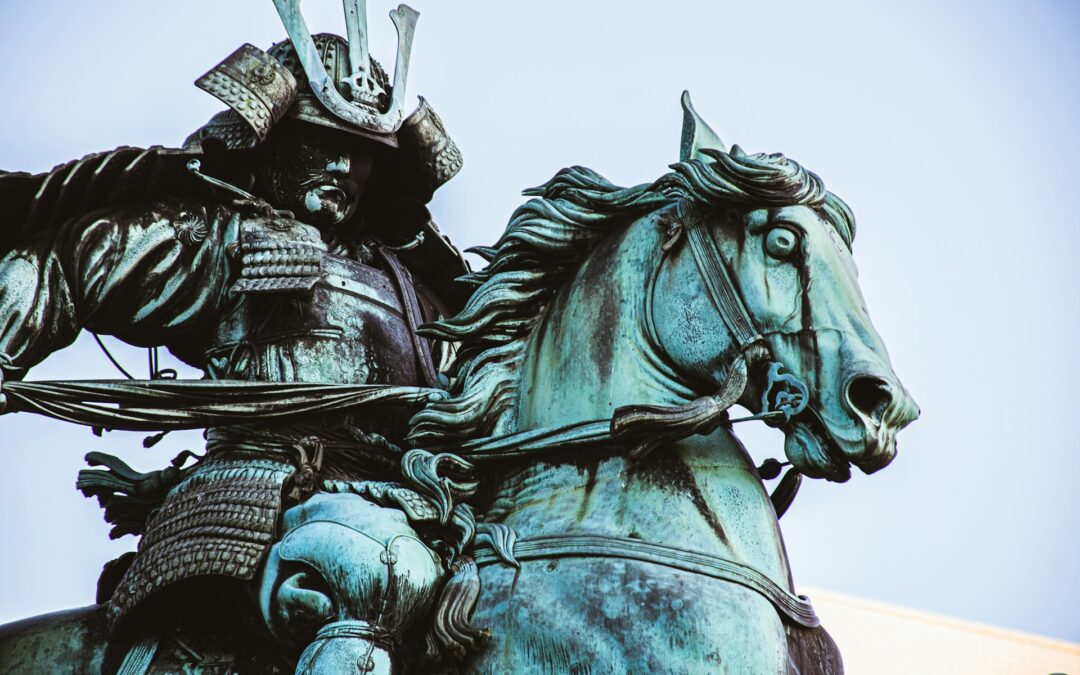
At fifteen, Miyamoto Musashi embarked on his musha shugyō—a warrior’s pilgrimage. This solitary journey took him across the rugged terrains of feudal Japan, where he honed his swordsmanship and tested his mettle in countless duels. No entourage, no patronage, just a young ronin carving his path through sheer skill and relentless discipline.
His life as a wandering swordsman was punctuated by a fateful encounter with his most formidable adversary, Sasaki Kojiro. Their duel, steeped in legend and myth, ended with Musashi’s victory—an event so pivotal that he renounced lethal dueling thereafter. Retreating into solitude, he took refuge in a cave, dedicating himself to recording the distilled wisdom of a warrior’s life. His works crystallize the Bushidō—the way of honor, discipline, focus, and restraint that defines the samurai spirit.
Before his death, Musashi penned the Dokkōdō—twenty-one principles that serve as a manual for living with purpose and integrity. The previous parts of this series, Miyamoto Musashi: The Way of the Ronin and Miyamoto Musashi: A Life of Ultimate Focus, talk about the first 14 principles. This final part explores the last seven of those timeless precepts, illuminating the austere yet profound path of the warrior.
15. Do Not Act Following Customary Beliefs
Human behavior is deeply influenced by an inherent tendency to seek safety and acceptance within a group. This inclination manifests as adherence to customary beliefs—those societal norms and traditions passed down through generations and embraced as unquestionable truths. Musashi, however, understood the inherent danger in this unreflective conformity. To blindly follow what “everyone else does” is to relinquish personal judgment and surrender the mind to the crowd’s sway.
The herd mentality, while providing a semblance of belonging, often shackles individuals in intellectual and moral complacency. When customs become sacred merely by virtue of their longevity or popularity, they risk perpetuating outdated or harmful practices. Historical epochs abound with examples of collective delusion fueled by uncritical acceptance of dominant narratives. The tragic complicity of ordinary people in atrocities such as those witnessed during the Second World War starkly illustrates this peril. Entire populations, swept by propaganda and societal pressure, participated in acts that defied fundamental human decency, all while believing their actions to be justified or even righteous.
This cautionary principle extends beyond extremes of history to subtler, everyday social dynamics. Consider the role of alcohol in many Western societies. Despite being a psychoactive substance with addictive potential and significant health consequences—including a staggering three million deaths annually worldwide—alcohol consumption remains culturally institutionalized. It is woven into the fabric of celebrations, business dealings, and social rituals. Yet, the normalization of drinking blinds society to its destructive power, creating an environment where abstaining is often socially awkward or requires justification, unlike other narcotics which are stigmatized.
Musashi’s own life as a wandering ronin and later as a hermit distanced him from the gravitational pull of such social norms. Solitude offered him a vantage point from which to observe human behavior and societal customs with a clear, discerning eye. Free from the echo chamber of groupthink, he was able to distinguish between traditions that genuinely benefited the individual and those that merely perpetuated collective inertia or harm.
The lesson here is profound and timeless: do not be a passive participant in tradition. Question what you are told, even when it comes cloaked in the authority of custom or majority opinion. Develop your own compass of reason and morality. The path of the warrior is marked by intellectual independence and the courage to stand apart when conformity demands compromise.
16. Do Not Collect Weapons or Practice with Weapons Beyond What Is Useful
Musashi’s mastery with the katana and wakizashi was not an exercise in ostentation or accumulation, but a deliberate strategy rooted in deep understanding of each weapon’s utility and context. The dual swords symbolize a sophisticated approach: knowing not just how to wield a weapon, but when and why it is the appropriate tool for a particular circumstance.
The companion sword, shorter and more maneuverable, excels in close-quarters combat, while the longer katana is better suited for engagements demanding reach and power. This nuanced knowledge allowed Musashi to adapt fluidly to diverse battlefields and opponents, maximizing efficiency and effectiveness. He did not amass weapons indiscriminately, but rather focused on those essential to his survival and success.
This principle resonates beyond martial arts as a metaphor for focused intentionality in life. In the modern world, we are often tempted to accumulate tools, skills, and connections beyond what truly advances our objectives. Whether it is hoarding gadgets, chasing numerous side projects, or scattering attention across countless commitments, overextension dilutes focus and impairs mastery.
Yet Musashi’s wisdom does not promote rigidity or narrow obsession. He cautions equally against becoming overly attached to a single weapon or method. Over-familiarity breeds complacency and blindness to alternatives, leaving one vulnerable to unexpected challenges. The samurai’s practice of training with diverse weapons—swords, staffs, spears—ensured a versatility that could meet the shifting demands of combat.
Applied to contemporary pursuits, this means cultivating core competencies without closing oneself off from alternative approaches. The key is to strike a balance: develop focused expertise in essential tools, but remain adaptable and open to new strategies. This dynamic equilibrium avoids the pitfalls of distraction on one hand and dogmatic inflexibility on the other.
Musashi’s counsel reminds us that success is not about the sheer quantity of resources or methods at one’s disposal, but about discerning what is genuinely useful and committing to its mastery, while maintaining the agility to pivot when necessary. It is a call to ruthless prioritization coupled with strategic versatility.
17. Do Not Fear Death
For the samurai, death was not a distant, abstract concept but an ever-present reality woven into the very fabric of their existence. From their earliest training, warriors were immersed in the contemplation of mortality, conditioned to face the ultimate test without hesitation or despair. Musashi encapsulated this ethos with profound clarity: “The Way of the warrior is the resolute acceptance of death.” This acceptance is far more than intellectual acknowledgment; it is a radical internal transformation that dissolves fear and replaces it with fearless presence.
To truly accept death is to transcend the paralyzing grip of fear that so often governs human behavior. When fear of death dominates, it breeds caution, avoidance, and compromises that erode integrity. Warriors who embraced death as inevitable found strength and clarity—qualities that enabled them to act decisively under life-threatening pressure. They were not reckless but resolute, knowing that hesitation could be fatal.
This principle extends deeply into the psychology of living. In our modern context, though we may not face the blade in daily life, the fear of death manifests in subtler but equally corrosive ways. It fuels anxiety, risk aversion, and a preoccupation with security that often leads to stagnation. We cling to comfort zones, avoid challenges, and delay living fully because the shadow of death looms, unacknowledged but potent.
Musashi’s teaching invites us to radically reconsider our relationship with mortality. Death, after all, is the one certainty we all share, yet it remains the greatest taboo in many cultures. Philosophically, it is a realm beyond experience—we do not know what death is like because, by definition, it is the cessation of life’s awareness. It could be liberation from suffering or the portal to an unknown existence; both possibilities demand humility and acceptance.
By integrating the inevitability of death into consciousness, we free ourselves from its tyranny. Life becomes urgent, precious, and unburdened by irrational fears. The warrior’s stance is one of fearless engagement—knowing that the quality of each moment is heightened precisely because it is finite. This fearless acceptance propels us to act authentically and courageously, embodying the fullest expression of our potential.
18. Do Not Seek to Possess Either Goods or Fiefs for Your Old Age
Musashi’s life was marked by austere simplicity and a profound detachment from material possessions. His relentless pursuit was mastery—of swordsmanship, of self, and of honor—rather than the accumulation of wealth or land. In advising not to seek possessions or fiefs for old age, he confronts a deeply human temptation: to sacrifice the vitality and integrity of the present moment in exchange for future security.
In modern terms, this principle critiques the relentless chase for financial accumulation, often justified as preparation for a comfortable old age. While prudence in planning is essential, Musashi warns against allowing this pursuit to consume one’s life and distract from immediate growth and fulfillment. The relentless striving for possessions risks reducing life to a transactional existence, where time and energy are spent amassing things rather than cultivating wisdom or joy.
From a Buddhist perspective, which likely influenced Musashi’s philosophy, attachment to material goods is a source of suffering. The Buddha taught that while wealth is not inherently evil, craving and clinging to it bind us to an endless cycle of desire and dissatisfaction. True security arises not from external riches but from inner contentment and equanimity.
Musashi himself, having repeatedly confronted death on the battlefield, seemed to grasp the transient nature of worldly goods. His legacy was not in estates or treasure but in the knowledge he left behind and the spirit he embodied. This principle calls us to reconsider what constitutes true wealth.
Rather than hoarding resources for an uncertain future, the focus shifts to developing qualities that endure—discipline, character, skill, and peace of mind. Investing in these cultivates a richness that no external possession can match. Moreover, by finding contentment with less, we liberate ourselves from the endless treadmill of acquisition and anxiety.
In essence, Musashi challenges the assumption that old age must be secured through material means alone. Instead, he proposes a life dedicated to meaningful pursuit, where preparedness is rooted in personal growth rather than possession. This fosters a resilient, fulfilled existence capable of facing the future with dignity, regardless of external circumstances.
19. Respect Buddha and the Gods Without Counting on Their Help
Musashi’s principle to respect Buddha and the gods without relying on their intervention strikes a delicate balance between spirituality and personal responsibility. In many religious traditions, reverence for divine figures embodies a profound acknowledgment of forces greater than ourselves—be they cosmic order, moral law, or transcendent wisdom. Yet, Musashi warns against the temptation to abdicate agency by expecting miracles or divine rescue when faced with adversity.
Across cultures, spiritual systems often emphasize human accountability alongside faith. The Seven Virtues in Christianity, the Five Pillars in Islam, and the Eightfold Path in Buddhism all underscore that while belief and devotion shape the soul, it is ultimately one’s actions and choices that determine life’s trajectory. This interplay between reverence and responsibility is crucial: faith should inspire strength and clarity, not passivity.
Musashi lived in an era where fatalism and superstition were common. His insistence on self-reliance reflects a warrior’s pragmatism. Prayers and rituals might calm the mind or offer solace, but they do not replace preparation, skill, or courage. Relying solely on external forces can foster a dangerous complacency, leaving one ill-equipped to confront real challenges.
Respecting Buddha and the gods, then, is about honoring the values they represent—wisdom, compassion, discipline—while understanding that divine entities do not intervene directly in human affairs. Instead, it is through cultivating our own strength, resilience, and insight that we navigate fortune’s unpredictability.
This principle encourages a mature spirituality: one that embraces reverence as a source of guidance but insists that the burden and privilege of living rightly remain firmly in our hands. The warrior bows to the divine but steels himself to act, recognizing that salvation, success, and survival depend first on himself.
20. You May Abandon Your Own Body But You Must Preserve Your Honor
Honor occupies a central place in the samurai ethos, a value so paramount that it eclipses even the instinct for self-preservation. Musashi’s stark assertion—that one may abandon the body but must never forsake honor—speaks to a profound worldview where integrity and reputation constitute the essence of a warrior’s identity.
This perspective can be challenging to grasp fully from a modern vantage point, where individual life is often prioritized above all else. Yet, in Musashi’s cultural and historical context, honor was the currency of social and spiritual worth. To live dishonorably was to sever oneself from the community of warriors and ancestors, effectively erasing one’s legacy.
Historical accounts illuminate the depth of this conviction. The Portuguese missionary Francis Xavier, among the first Westerners to witness Japanese culture in the 16th century, marveled at the samurai’s reverence for martial valor and honor, noting it as a defining element of their identity. Centuries later, during World War II, this spirit persisted, with soldiers embracing death for the Emperor as the highest honor. Surrender was synonymous with disgrace, and those who capitulated were met with contempt regardless of their prior bravery.
Honor, however, is not a static or universal concept; it is deeply entwined with cultural values and personal conscience. For some, preserving life at all costs may be paramount; for others, dying with honor defines their existence. Musashi’s teaching unequivocally prioritizes the latter, urging warriors to accept bodily sacrifice if it means safeguarding their moral and ethical essence.
This principle challenges us to reflect on what we value most deeply. Is our sense of self rooted in external survival or in the authenticity and integrity of our actions? Musashi invites a radical alignment where honor governs choices even in the face of death, making life’s quality inseparable from its meaning.
In practical terms, this calls for living with unwavering commitment to one’s principles, accepting consequences with courage, and preserving dignity above transient gain or comfort. Honor becomes the warrior’s true armor—impervious to physical defeat and eternal beyond mortality.
21) Never Stray From the Way
The final and perhaps most profound precept of Musashi’s Dokkōdō is a call to unwavering dedication: “Never stray from the Way.” This injunction encapsulates the essence of the warrior’s journey—a path demanding relentless focus, discipline, and sacrifice. To stray is to dilute purpose, fragment effort, and risk losing oneself in the distractions and temptations that assail every seeker of mastery.
Musashi’s own life was a testament to this principle. From his earliest duel at the tender age of thirteen to the sixty or more battles he fought, many to the death, his commitment to the Way of the sword was absolute. This singular devotion eclipsed all else—family, comfort, even the instinct for self-preservation. His identity fused with the discipline of swordsmanship so completely that his entire existence was a continuous act of refining and embodying the warrior’s path.
In the modern world, such extreme commitment is rare and often misunderstood. Contemporary culture, especially in consumer-driven societies, promotes instant gratification and fleeting pleasures, fostering a restless spirit that shies away from sustained effort or sacrifice. We live in a time of distraction, where the temptation to jump from one interest to another undermines the cultivation of depth and mastery.
Yet the principle remains timeless: profound achievement requires that we anchor ourselves to a chosen path with steadfastness. Whether in business, creative arts, relationships, or personal development, half-heartedness breeds mediocrity. To make meaningful progress, we must embrace the discomforts of discipline, endure setbacks, and resist the seductive lure of ease and diversion.
Musashi’s Way is not simply about martial prowess; it is a metaphor for wholehearted commitment to any worthy pursuit. This commitment demands clarity of purpose and a willingness to subordinate lesser desires in service of a greater goal. It requires sacrifice—of time, comfort, and often social conventions.
Moreover, never straying from the Way implies continuous vigilance. The path is not a linear journey but a demanding practice requiring daily reaffirmation. It is easy to falter or be led astray by external pressures or internal doubts. The warrior’s strength lies in his capacity to recalibrate, renew resolve, and advance with undiminished focus.
This level of dedication cultivates not only skill but also character: patience, resilience, humility, and integrity. The Way shapes the practitioner into more than a master of technique; it forges a person whose very being reflects their commitment.
Ultimately, Musashi’s final precept challenges us to identify our own Way—the pursuit that gives life meaning—and to walk it with unshakable resolve. The rewards of such devotion are profound: mastery, purpose, and a legacy that endures beyond the fleeting moments of existence. The path of the warrior is austere and demanding, but it is also the crucible through which greatness is born.
Conclusion
Miyamoto Musashi’s teachings transcend time, offering a rigorous yet inspiring blueprint for living with clarity, purpose, and integrity. The Path of the Loner is not merely about solitude or combat; it is about cultivating an unshakable inner strength that navigates life’s uncertainties with wisdom and honor. By questioning customary beliefs, focusing on what truly matters, embracing mortality without fear, honoring responsibility over reliance, and committing wholly to one’s chosen path, we unlock the potential for profound mastery—not just in skill, but in character. Musashi’s legacy challenges us to strip away distractions, face life with resolute courage, and walk our own Way unwaveringly, forging a life that resonates with meaning long after we are gone.