

What happens after the storm breaks but the sky refuses to clear? Onyx Storm, the third installment in Rebecca Yarros’s Empyrean series, answers with a tale that is darker, sharper, and more devastating than what came before. Violet Sorrengail staggers from the wreckage of Iron Flame carrying scars that ache deeper than any wound, only to discover that survival was not the end—it was the beginning of something far more perilous.
The wards that once protected kingdoms are failing. Enemies evolve into something monstrous. And love itself threatens to become the sharpest betrayal. In this world of dragons, politics, and prophecy, Violet must decide whether she is a pawn, a partner, or the weapon everyone has been waiting for.
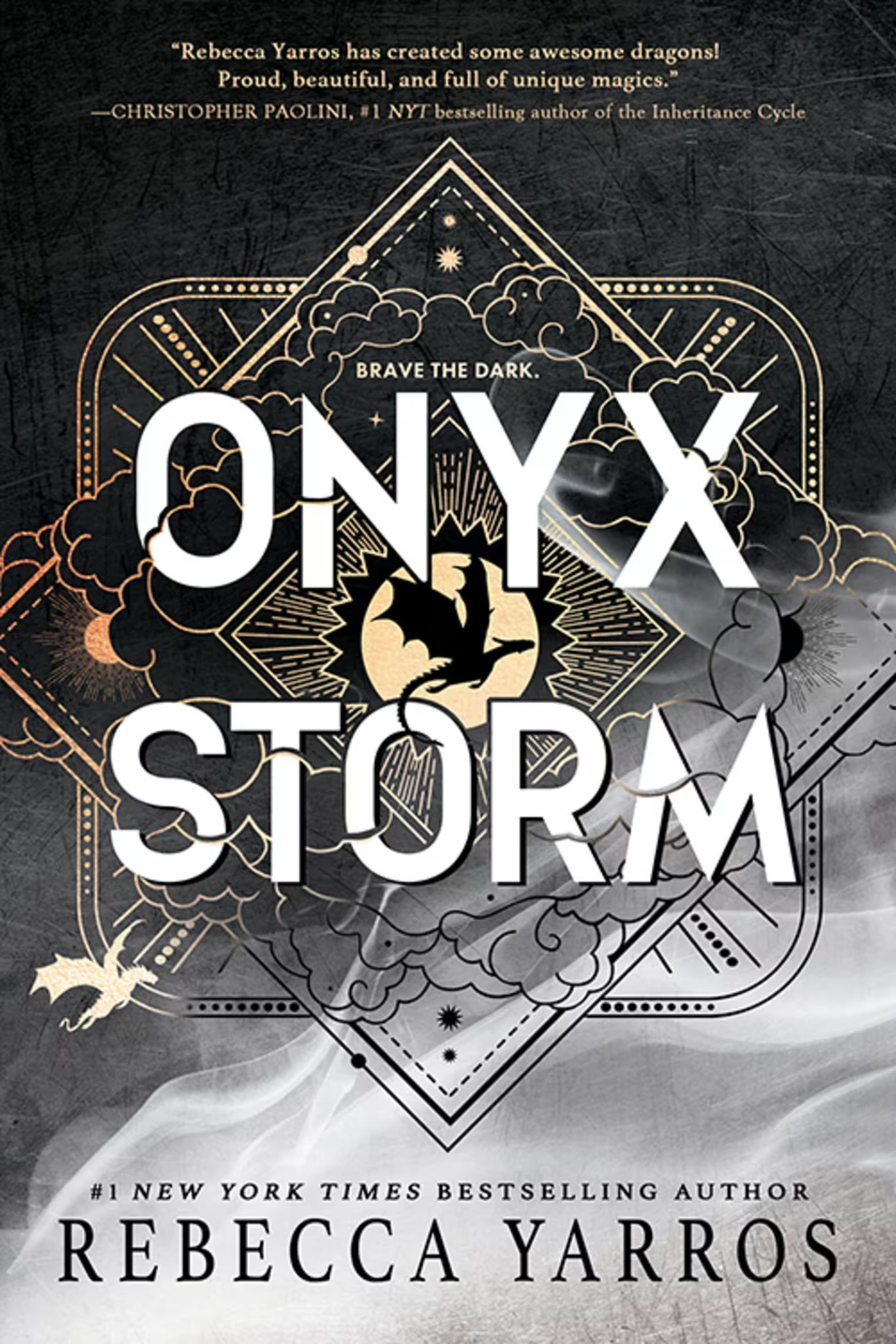
The Aftermath of Iron Flame
Violet Sorrengail enters Onyx Storm not as a triumphant heroine but as a survivor whose victories taste more like ashes than glory. She carries the residue of every betrayal, every scream, every night spent bleeding in silence. The last war carved its signatures into her body and her mind—torture etched lines of pain she can still feel in her bones, while her mother’s sacrificial death haunts her dreams like a phantom she cannot banish. She is alive, yes, but every breath feels borrowed, every step taken under the weight of ghosts that will not rest.
The world around her mirrors her fractured state. The magical wards that once shielded entire kingdoms are no longer steady fortresses of protection but fragile barriers riddled with fissures. Their collapse is not a distant threat; it is happening in real time, the cracking of stone echoing like the cracking of Violet’s own faith in stability. Where there should be safety, there is only the gnawing certainty that ruin seeps closer with each passing day.
At the center of her turmoil stands Zayden Riorson—the shadow-wielding figure who embodies both salvation and destruction. In saving her life, he crossed into forbidden magic, his eyes now rimmed in venomous red, marking him as something neither entirely human nor entirely trustworthy. For Violet, he is a paradox: the man she loves, the one she clings to when the world burns, yet also a walking reminder that love can become the very weapon that undoes you. His silence grows heavier, his shadows darker, and Violet’s instinct screams that her heart may already be tethered to the enemy she was born to fight.
In this aftermath, Violet finds herself not just fighting for survival but for clarity. She must navigate a world unraveling at its seams, a kingdom led by fractured councils more concerned with power than people, and a love story that may already be rotting from within. Her scars are not the kind that heal. They are maps of every loss she has endured, every choice that has chained her to a destiny she never sought. And as she looks ahead, she knows one truth with bone-deep certainty: what broke her in Iron Flame was not the end. It was only the beginning of a storm darker and more merciless than she has ever faced.
Chaos Squad and the Burden of Leadership
The council’s idea of leadership is punishment dressed as duty, and Violet becomes its unwilling victim. Instead of a team she can rely on, she’s assigned a squad designed to fracture under pressure: strangers with mismatched loyalties, led by a war-hardened officer so uninspiring he could drain courage from the bravest rider. Their first mission unfolds exactly as expected—chaos, distrust, and blood. The ambush is brutal, lives are lost, and Violet learns a cruel truth: the council doesn’t want her to succeed. They want her to fail, to shatter under responsibility so they can prove their suspicions about her fragility correct.
But Violet has never been one to surrender to other people’s narratives. From the ruins of that failed mission, she seizes authority. She discards the council’s imposed command and forges a unit of her own. It’s not polished. It’s not neat. It’s forged in betrayal and redemption, in loyalty tested under fire. Dain, the childhood friend who once betrayed her but clawed his way back to redemption, joins her. Cat, sharp-edged and blade-fast, adds menace and steel. Royals with gilded bloodlines, rebels hardened by resistance, and misfits with nothing to lose fall in beside them. What emerges is not a conventional squad but a living paradox—a group stitched together by Violet’s will, bound not by hierarchy but by survival.
This new team earns its name through action: Chaos Squad. They are unpredictable, combustible, often on the edge of disaster, yet held together by Violet’s refusal to let them splinter. Their mission becomes bigger than strategy—it is survival with a heartbeat. And when diplomacy calls them to Poriel, Violet commits the unthinkable to ensure its success. She tampers with the sacred wardstones, granting griffin riders access to magic within Navarre, an act so incendiary it brands her as a traitor. Treason, yes—but also transformation. Violet is no longer a cadet of war, no longer just a rider. She is an architect of change, willing to fracture laws if it means saving lives. And in doing so, she ignites a conflict not only with her enemies but with the very kingdom she once swore to protect.
Storms, Secrets, and Second Signets
The war does not wait for Violet’s soul to heal. It presses closer, manifesting in the figure of Theophony, a silver-haired stormcaster whose presence feels like an omen made flesh. Theophony does not strike Violet down when she has the chance; instead, she watches, calculates, and marks her. This is not mercy—it is ownership, the way a predator spares prey only to track it later. She wants Andarna, the golden dragon whose true bloodline ties her to the lost Irids. And with that revelation, Violet’s sense of purpose splinters. Her dragon is not just rare—she is coveted, hunted, the key to something ancient and terrifying.
As if that weren’t enough, the impossible begins to unfold among Violet’s companions. Signets—the unique powers each rider is bonded with—are no longer singular. Riders begin developing second signets, abilities layered like unstable explosives. It defies every law of their world, every truth they’ve been taught. What should be extraordinary feels like a curse, a ticking bomb inside their veins. Violet herself feels her lightning glitch, surge, and warp, hinting that even her own body is rewriting the rules.
In the background, Jack Barlowe returns like a specter. Once a sneering antagonist presumed dead, he now sits in chains, his eyes carrying the cold amusement of someone who knows more than he should. His words are barbed riddles, his silence as dangerous as his smirks. To the others, he is a nuisance. To Violet, he is a warning wrapped in human skin.
Here, amid storms, secrets, and the unsettling rise of second signets, Violet realizes she is not just a soldier in someone else’s war. She is the fulcrum, the hinge on which prophecy turns. She was never meant to simply endure. She was meant to be wielded—an instrument of destruction shaped long before she was born. And that revelation weighs heavier than any blade she has ever carried.
Exile and Betrayal at Court
Punishment for Violet’s treason arrives swiftly, cloaked as strategy but designed as humiliation. She and her ragtag squad are exiled to Develli, a kingdom so suffocatingly bleak it feels like the air itself resents joy. The exile is meant to strip Violet of agency, to bury her under monotony and distance. But war does not respect borders or political theatrics. Even in Develli, danger stalks them.
Their most perilous encounter comes with King Courtland of Poriel, a monarch whose paranoia bleeds into every word and gesture. He views Violet and her squad not as potential allies but as trespassers, interlopers who have crossed his lands without permission. One audience with him spirals into near-execution, his court poised on the knife’s edge of bloodshed. The tension is a reminder that alliances are not won with ideals but with bargaining chips and sacrifices.
It is Zayden who makes that sacrifice. To save them, he relinquishes the blade of Arishia, the sacred heirloom passed through generations of his family. For him, the dagger is not just steel—it is identity, history, a lifeline to his lineage. Handing it over is akin to carving away a part of his soul. For Violet, the gesture lands like a warning shot: this is not devotion alone, but desperation, a man fraying at the edges of himself. His willingness to bleed away pieces of who he is only deepens her unease.
And then, within the dust of exile, Violet discovers her father’s journal. Its entries are fragmented, veiled in code, but they reveal a pursuit that predates her bond with Andarna. Her father had searched for the Irids, convinced that the mythical seventh breed of dragon still breathed somewhere beyond memory and myth. More startlingly, he left a map. This discovery reframes everything—her bond with Andarna, her purpose, and perhaps even her destiny. What once felt like coincidence begins to look like orchestration, a path her father carved in secret, one she is now compelled to walk whether she wishes to or not.
Meanwhile, Zayden’s unraveling grows impossible to ignore. His shadows stretch longer, his silences deepen, and Sigal—once his proud dragon companion—withdraws from him. He is losing more than control; he is losing trust, not only in others but in himself. And Violet, caught between loyalty and fear, begins to realize she may already be walking beside a man half-claimed by the darkness.
A Quest for the Irids
The journal’s map becomes both compass and curse, leading Violet and her squad on a voyage that reads like a myth but feels like a nightmare. Each island they reach offers not sanctuary but trial, each more dangerous than the last, as if testing their resolve and punishing their hope.
On one island, the hospitality of rulers turns venomous—literally. Goblets are lifted in a toast, only for poison to scald their throats. Panic spreads like wildfire. One squadmate collapses, convulsing, life slipping away before their eyes. Violet’s response is raw lightning and fury; she threatens to burn the temple to rubble unless an antidote is produced. It is delivered quickly, the rulers’ smiles gone, bridges burned before they were ever built. Survival comes at the cost of diplomacy, a bitter exchange Violet will carry long after they leave.
On another island, negotiations warp into spectacle, a grotesque game of cards with lives as currency. The stakes are not metaphorical—death falls on the loser. A griffin rider named Trager, loyal and brave but tragically peripheral to the story, loses. His death is immediate, cold, and final. His sacrifice wins them the alliance they sought, but the cost echoes in Violet’s chest. How many more bodies will pave this fragile road to cooperation? She knows she will feel the weight of his loss for years, perhaps forever.
At last, the map leads them to the place Violet has both feared and longed for: the home of the Irids. For Andarna, the moment is revelation. She glows with recognition, her very being resonating with the place as though she has finally come home. But for Violet, the welcome is ice. The Irids refuse her presence, speaking only to Andarna, dismissing Violet as sullied by too much human contact. Their verdict cuts deeper than any sword: Andarna is pure, Violet is corrupted.
Andarna makes her choice with heartbreaking finality. She stays, choosing kinship and destiny over loyalty to the girl who raised her from hatchling to dragon. For Violet, the abandonment is unbearable. It feels like being hollowed out, left with only the echo of wings disappearing into the clouds. The bond severed, she is not just weakened—she is broken. Every victory since her conscription at Basgiath has been tethered to Andarna’s companionship, and now that bond is gone.
The squad leaves the Irids with more questions than answers, more wounds than victories. Violet walks away not as a rider with two dragons, but as a rider suddenly stripped bare. In her chest lies a new wound—raw, ragged, and unforgiving. And in its silence, she begins to wonder whether destiny is not just cruel but merciless.
The Death of a Storm Goddess
Theophony does not return quietly. She descends like a calamity incarnate, her storms ripping through temples and drowning the land in thunder and lightning. The very air bends to her will—winds sharp as blades, skies dark enough to smother hope. For Violet, the battle is not just against Theophony’s power but against despair itself. The storm goddess is not reckless; she is deliberate, precise, every strike calculated to wear Violet down, body and spirit alike.
In the eye of this chaos, fate intrudes. A boy appears, barely more than a prophecy’s vessel, holding a dagger Violet knows before she even touches it. She has seen it in her visions, dreamed of it in moments that felt less like sleep and more like haunting. It feels inevitable, the way the hilt settles into her palm. There is no time for hesitation, no space for doubt. Violet moves on instinct, every ounce of grief and fury coalescing into a single strike. She drives the blade into Theophony’s heart.
The storm dies with her. Skies clear as if scrubbed clean, silence settling with the abruptness of a slammed door. Around Violet, allies cheer, some collapsing in exhausted relief. To them, the battle is won. To Violet, the victory is hollow. It was too easy, too swift. Theophony—so cunning, so powerful—should not have fallen with one strike. The unsettling quiet hums beneath her skin, the way lightning sometimes lingers in the air long after the storm has passed. She knows with a bone-deep certainty that this was not the final adversary. It was an opening act, a test disguised as triumph. And in killing Theophony, Violet has awakened something greater within herself. Power surges like a second heartbeat, unfamiliar and dangerous, and she cannot decide whether it feels like a gift or a curse.
The others may see a slain goddess. Violet feels the shiver of a door unlocked, of a new level of destiny she was never meant to touch. The blade in her hand, the lingering hum in her veins, all whisper the same truth: the storm is far from over.
Memory Lost, Marriage Gained
In the wake of battle, Violet’s spirit frays. She is unraveling—grief for Andarna’s absence, unease at Zayden’s slow corruption, and the unsettling shift in her own magic. Her power glitches, her dreams grow darker, her visions bleed into waking hours. She is exhausted, hunted by shadows within as much as enemies without. And then she does something desperate. Something dangerous. She turns to Imogen, the one squadmate capable of altering memory, and begs her to erase the unbearable.
The choice is not made lightly, but it is made with the certainty of someone who believes the truth is more dangerous than ignorance. When Violet wakes, the world has shifted. She finds herself in Zayden’s home, a wedding ring heavy on her hand, her last name changed to his. Duchess of Terranor—not through choice, not through recollection, but through absence. Twelve hours gone, carved clean from her memory, leaving only echoes she cannot touch.
The squad looks at her with pity, with unease. They know what she asked Imogen to do. They know she begged for this. And yet, Violet feels only disorientation, as though she is a stranger in her own skin. Zayden, once her anchor, now feels like a void. He offers no explanation beyond vague assurances. His distance is suffocating, his silences sharper than any blade. She cannot shake the feeling that something vital, something terrifying, was hidden in those lost hours—that she saw a truth so unbearable she chose to erase it.
Her body seems to remember what her mind cannot. Lightning sparks in her veins whenever Zayden enters the room, an instinctive reaction she cannot explain. Her magic recoils from him, drawn and repelled in equal measure, as though it recognizes a danger she has blinded herself to. The marriage that should have been binding becomes a prison of questions. Why did she beg for erasure? What did she see? And can love survive when it is built not on memory but on silence and shadows?
For Violet, the memory wipe is not relief—it is exile from her own truth. And the ring on her finger feels less like a vow and more like a chain.
Zayden’s Fall into Darkness
The truth, when it emerges, is not a revelation but a slow, inevitable collapse. For weeks, Violet senses it—the heaviness in Zayden’s silence, the sharp edges of his temper, the way his dragon Sigal seems to fade into absence. What she does not see until too late is the sacrifice he made, one that severs him forever from the man she knew. Sigal was dying, her magic dwindling to embers, and Zayden could not stand by and let his dragon slip into oblivion. To save her, he crossed the line. He drew on the forbidden currents again, deeper this time, binding himself not to life but to corruption. In doing so, he didn’t just brush against the Venin—he became one.
It is an act born of love, but its consequence is damnation. There is no loophole, no redemption arc, no path back to humanity once that threshold is crossed. Zayden is Venin, capital V, his shadows darker, his eyes burning with a crimson glow that can no longer be explained away as temporary. And worse than the act itself is his secrecy. He told no one—not Violet, not Brennan, not even those who would have died for him. He chose silence over truth, leaving Violet to piece it together through whispers, half-glimpses, and instinct that refuses to be ignored.
When she confronts him, the moment is not fire and thunder but something colder, more shattering. There is no shouting, no plea for forgiveness. Zayden does not argue, does not excuse. He accepts her realization with quiet resignation, as though he has already buried the man he once was. And then he dissolves into shadow, slipping from her grasp, vanishing without a goodbye.
For Violet, the abandonment is not simply the loss of a partner—it is the collapse of a foundation. She is left married to a man she cannot trust, bound to a duchess title she never asked for, and surrounded by whispers of betrayal she cannot silence. Riders begin to vanish without trace, four of them disappearing as though the earth itself swallowed them whole. No bodies, no footprints, not even the courtesy of a villain’s monologue. The silence that follows is worse than screams. Rumors bloom like poison: perhaps they didn’t vanish at all. Perhaps they turned. Perhaps Zayden is leading them, gathering shadows into an army no one is prepared to face.
Violet’s heart is torn between grief and fury, but her duty leaves no room for indulgence. She must now accept what Zayden has become, even if it means facing him as an enemy. And the cruelest truth of all lingers in her chest like a blade: he crossed into the dark not for power, not for conquest, but for love. And yet, that love may be the very thing that destroys them both.
The Unfinished Battle
By the end of Onyx Storm, Violet is not victorious. She is fractured, left standing amid ashes where trust, love, and certainty once lived. Theophony’s death, once celebrated as a triumph, tastes bitter now, her defeat feeling more like a diversion than a conclusion. The real enemy is still veiled, its presence hinted at only in the unnatural quiet that follows storms. The wards are still crumbling, alliances still fragile, and the Venin threat swelling like a tide. Nothing has truly been won.
Andarna is gone, choosing kin over rider, leaving Violet hollow and aching. The bond that once steadied her is broken, the silence where her dragon’s voice used to be a wound that will not close. Zayden is lost to shadow, his humanity surrendered for the sake of his dragon, his marriage to Violet a hollow shell filled with secrets she cannot remember and truths she cannot face. Even her squad, loyal though they remain, is frayed by trauma, each carrying grief that pulls them further from one another.
Violet herself is unraveling. Her lightning behaves unpredictably, her dreams suffused with images of ancient wars, blood-soaked fields, and whispers she cannot silence. She is haunted by the memory she chose to erase, a decision that now feels less like protection and more like a trap of her own making. She cannot remember what she feared, but she can feel its echo inside her, a constant reminder that she is hiding from something monstrous.
The war ahead is no longer about enemies alone. It is about identity. Violet must decide whether she is a weapon wielded by fate or a woman who will claim her own path. The battle is unfinished, not because the war continues, but because Violet herself is incomplete. Every scar, every betrayal, every loss has forged her into something sharper than steel, but also more fragile than glass.
And as the book closes, one truth lingers like the roll of distant thunder: survival is not victory. Violet’s war has only just begun, and the storm that awaits is far darker than anything she has yet endured. The question is no longer whether she can save the world—but whether she can survive herself.
Conclusion
Onyx Storm is not a story of neat resolutions. It is a descent into broken trust, unraveling alliances, and the unbearable tension between love and ruin. Violet loses a dragon, gains a husband she cannot trust, and finds herself branded by destiny as much as by lightning. Every triumph comes stained with sacrifice, every revelation cut with grief.
Yarros does not grant her characters the mercy of rest; she thrusts them into deeper storms, where survival itself feels like a pyrrhic victory. By the end, Violet stands scarred, abandoned, and haunted, yet unbroken. The storm rages on, and with it rises the question that will define her future: when everything is fractured, what does it mean to keep fighting?