
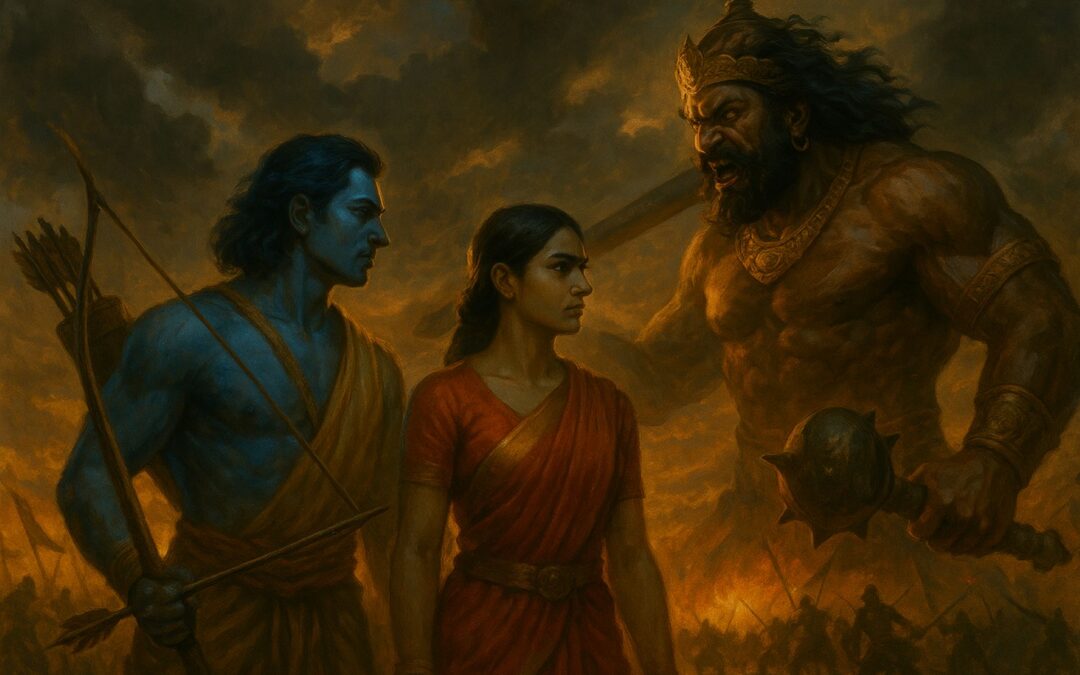
The War of Lanka marks the climactic conclusion of Amish Tripathi’s Ram Chandra Series—a saga that intertwines myth, dharma, and human complexity. This epic retelling of the battle for Lanka transcends a simple war story. It delves deep into themes of pride, sacrifice, resilience, and the eternal struggle to uphold righteousness against overwhelming odds. The story navigates through the fractured psyche of the mighty warlord Raavan, the unwavering resolve of Ram and his allies, and the quiet strength of Sita, whose spirit becomes the very heart of the conflict.
This article unfolds the major events and emotional currents of the War of Lanka, bringing to life the timeless lessons embedded in this mythic struggle. From the construction of the legendary Ram Setu bridge to the ultimate showdown between fate and dharma, we explore the rich tapestry of strategy, valor, and philosophy that defines this monumental tale.

The Ominous Prelude: Ravan’s Haunting Dream
The narrative thrusts readers immediately into the turbulent psyche of Ravan, the mighty monarch of Lanka, through a vivid and unsettling dream that sets the entire tone of the story. This nightmare is more than just a fleeting image—it is a visceral, almost prophetic vision that encapsulates the emotional and psychological storm brewing within Ravan. As he soars across the skies in the Pushpak Viman, the flying chariot that epitomizes his immense power, his mind is invaded by haunting images of Vedvati, his beloved, lying at the edge of death. The dream’s raw intensity reveals a man grappling with loss, regret, and a promise that weighs heavily on his conscience.
Vedvati is not merely a figure from Ravan’s past; she embodies a tether to his humanity, a reminder of love and vulnerability beneath his fearsome exterior. The dream’s imagery—flickering embers fading into darkness—symbolizes the fragile nature of life and the inexorable approach of fate. As Ravan witnesses the final moments of Vedvati’s existence, a profound sadness overtakes him, disrupting his formidable confidence and foreshadowing the unraveling of his grand designs.
This premonition arrives at a critical narrative juncture—Ravan is en route to Lanka with Sita, the abducted princess, whose presence rekindles memories of Vedvati in striking ways. The dream thus functions as a bridge between past and present, intertwining Ravan’s personal torment with the unfolding epic. It exposes an internal fissure in a character often portrayed as monolithically villainous, inviting readers to explore the complexity and contradictions that define him. In this way, the dream is not just a storytelling device but a psychological portrait that primes the reader for the multidimensional conflict ahead.
Ashok Vatika: A Sanctuary Amidst Suffering
Ashok Vatika emerges as a critical, layered setting—a paradoxical haven and prison where Sita is confined. Situated far from Lanka’s bustling capital of Sigiriya, the garden is strategically isolated to protect Sita from the devastating plague that ravages the city. This physical separation underscores the precariousness of her captivity: shielded from the external chaos but trapped within an invisible cage.
Ravan’s treatment of Sita in Ashok Vatika reveals a deeply conflicted mindset. Though he is her captor, his actions reflect a desire to preserve her dignity and well-being. The garden is meticulously tended, furnished with provisions designed to nurture both body and soul: nourishing food to sustain her, sacred scriptures for spiritual comfort, and musical instruments to soothe her mind. These gestures are not mere acts of kindness but manifestations of Ravan’s complex emotions—a blend of obsession, reverence, and a grudging respect for Sita’s spirit.
The lush greenery of Ashok Vatika contrasts starkly with the bleakness of captivity. It becomes a microcosm of the larger struggle: beauty interlaced with suffering, freedom bound by restraint. The garden’s serenity masks an underlying tension, mirroring Sita’s inner turmoil as she navigates isolation and hope. It also serves as a stage where the personal and the political intersect, reflecting the broader conflict between Lanka and Ram’s forces.
This sanctuary-prison dynamic amplifies the thematic richness of the narrative. Ashok Vatika is not simply a backdrop but a character in its own right—an emblem of conflicting forces and emotions that shape the epic. It challenges readers to reconsider notions of captivity and care, power and vulnerability, setting the stage for the unfolding drama that balances tenderness with tension.
The Vigil of Ram, Lakshman, and Jatayu’s Final Tribute
The scene of Ram and Lakshman performing the last rites for Malayaputra Jatayu is steeped in solemnity and profound symbolism. Jatayu, the valiant vulture who had valiantly tried to protect Sita from Ravan’s abduction, embodies selfless sacrifice and unwavering loyalty. His death is not merely a loss of a warrior but a poignant testament to courage in the face of overwhelming evil. The funeral pyre, with its roaring flames, illuminates the depths of grief felt by Ram and Lakshman, as well as the moral gravity of their quest.
This moment is layered with emotional complexity. Hanuman’s arrival injects a raw vulnerability into the scene; initially overcome with despair, he mistakenly believes that Sita has also fallen victim to Ravan’s cruelty. His grief is visceral and contagious, echoing the audience’s own anxieties about Sita’s fate. Ram’s gentle embrace and reassurance not only soothe Hanuman but reaffirm their collective resolve. It is a powerful affirmation of hope amidst despair—a reminder that loss, while painful, fuels determination rather than defeat.
Beyond the immediate emotions, this vigil symbolizes the passing of the torch. Jatayu’s sacrifice marks a turning point where mourning transforms into mobilization. Hanuman’s grief quickly channels into strategic action, catalyzing the plans to rescue Sita. This juncture reflects the thematic essence of the epic: that heroism is born from both sorrow and steadfast commitment. The scene resonates as a profound meditation on sacrifice, loyalty, and the indomitable spirit that binds allies together against darkness.
A Mirror to the Past: Ravan’s Encounter with Sita
Ravan’s first gaze upon Sita serves as a pivotal psychological moment, fraught with uncanny parallels and haunting reminiscences. The striking resemblance between Sita and Vedvati—his deceased beloved—throws Ravan into a profound state of inner turmoil. It is as though the past has resurfaced, a spectral echo that disrupts his cold calculations and ambitions. This doppelgänger effect blurs lines between memory and reality, injecting a spectral tenderness into the heart of a feared tyrant.
This encounter unravels layers of Ravan’s character that extend beyond villainy. The resemblance rekindles his unresolved emotions and reminds him of the solemn promise he made to Vedvati in her final moments—a vow to protect and honor her memory. This promise clashes with his own imperial ambitions, creating a fissure between duty and desire. Instead of the ruthless captor, Ravan is revealed as a man shackled by love and honor, wrestling with conflicting impulses.
The psychological weight of this moment reverberates through the narrative. It not only complicates Ravan’s motivations but also humanizes him, inviting readers to perceive him as a tragic figure caught in the inexorable currents of fate. This internal conflict casts a shadow over his plans, foreshadowing the unraveling of his schemes and the eventual cataclysm. The encounter thus deepens the thematic texture of the epic, exploring how love, memory, and promises can both empower and imprison.
The Triad’s Breakfast and the Unfolding Conspiracy
One of the most striking and unexpected moments in the narrative is the depiction of Ravan, his brother Kumbhakarna, and Sita sharing breakfast together. This seemingly ordinary act is laden with profound symbolism and layered complexity. It shatters traditional notions of enmity, revealing a nuanced relationship that transcends simple binaries of hero and villain. The intimacy of these shared meals highlights an unusual camaraderie, an uneasy alliance forged amid the looming specter of war.
During these breakfasts, the three engage in conversations that reveal startling insights—they have already deliberated on the fate of the impending battle between Ram and Ravan. This foreknowledge and joint acceptance of the outcome introduce a sense of tragic inevitability. Sita, far from being a passive captive, is deeply aware of the cosmic and political machinations at play. She understands why Ravan pursues his course and even becomes part of the conspiratorial fabric by collaborating with him and Kumbhakarna.
Kumbhakarna’s involvement is especially significant. Known for his immense strength and legendary presence, his inclusion in these strategic discussions underscores the gravity and gravity-defying nature of their alliance. This triad is not just a family or political unit but a complex coalition, where personal relationships, loyalty, and shared destinies intertwine. Their breakfasts become a crucible where humanity and ambition meet, setting the tone for the unfolding saga—a war where even foes are bound by unseen threads of understanding and fate.
The Secret War Council: Ram, Lakshman, Hanuman, and Guru Vashishta
Across the battlefield’s horizon, Ram’s camp pulses with strategy, faith, and unyielding hope. The secret war council—consisting of Ram, his brother Lakshman, the devoted Hanuman, and the wise sage Guru Vashishta—serves as the intellectual and spiritual command center for the mission to rescue Sita. Their gatherings are charged with a mix of solemn deliberation and fiery determination.
Ram’s guiding principle is unmistakable: the pursuit of peace above all else. He advocates for a resolution that avoids bloodshed if possible, viewing war as a last resort with catastrophic consequences. This philosophy reflects a profound understanding of dharma and the tragic cost of conflict. Yet, even within this circle of trusted allies, divergent visions emerge.
Vishwamitra, leader of the Malayaputra and a formidable warrior-sage, pursues a distinct and more aggressive agenda. His decision to dispatch his disciple Arishtanemi to infiltrate Ashok Vatika and extricate Sita introduces an element of covert action and layered intrigue. His plan to proclaim Sita as the new Vishnu and rally forces under her banner reflects a strategic and symbolic recalibration of the war’s stakes—transforming it into a righteous battle to reclaim honor and assert cosmic justice.
This schism within Ram’s own faction adds depth and realism to the narrative, acknowledging that even noble causes are fraught with competing ambitions and interpretations. The council’s secret meetings unfold as a complex interplay of faith, strategy, and power, highlighting the epic’s broader themes: the tension between idealism and pragmatism, destiny and free will. The war to come is as much a battle of wills and ideologies as it is of swords and armies.
A Nighttime Rescue and Sita’s Resolute Decision
Under the veil of darkness, two emissaries arrive at Ashok Vatika—Hanuman and Arishtanemi—each approaching from different paths and with different intentions. Their simultaneous arrival is a moment charged with tension and uncertainty, as both are aware of the stakes but unaware of each other’s presence. This convergence symbolizes the multifaceted nature of the rescue mission, blending elements of stealth, courage, and divine intervention.
However, what makes this scene particularly compelling is Sita’s unwavering resolve. Despite the opportunity to escape captivity, she refuses to accompany either rescuer. This decision asserts her agency and strength, emphasizing that her liberation is not simply a physical act but a deeply spiritual and moral one. Sita’s refusal is rooted in her unshakable faith in Ram and the righteousness of the struggle ahead.
To communicate her steadfastness and inspire coordinated action, Sita pens a heartfelt letter addressed to Ram, whom she reverently calls Vishnu. In this letter, she implores Ram to take up arms against Ravan and reclaim her honor. Furthermore, she calls upon the sons of Vayu (Wind God) and the Malayaputra to unite in this righteous battle. This act of written declaration elevates Sita from a captive to a beacon of hope and leadership, driving the narrative forward with renewed purpose.
The nighttime rescue attempt thus becomes not merely a mission to free a captive but a profound assertion of destiny, faith, and collective resolve. It reinforces the themes of honor, duty, and the power of individual will within the cosmic order that governs the epic.
The Heartfelt Tragedy of Sursa and the Bonds of Friendship
Within the tapestry of war and strategy, Amish Tripathi introduces a poignant subplot centered around Sursa, Hanuman’s beloved. Sursa’s character adds emotional depth and humanizes the otherwise grandiose narrative of gods and kings. Her unrequited love for Arishtanemi, who himself harbors no reciprocal feelings, paints a bittersweet portrait of longing and sacrifice.
Hanuman, bound by his Brahmacharya vow of celibacy, represents spiritual discipline and self-control. His relationship with Sursa, therefore, is complex—marked by affection but constrained by personal vows and cosmic duties. Despite this, the trio—Hanuman, Sursa, and Arishtanemi—share a profound friendship, supporting each other amid the chaos of war.
Their journey back from Ashok Vatika is fraught with danger. In a sudden and tragic turn, Sursa is struck by an arrow during a skirmish with Lankan soldiers while boarding the boat amid the sea. Her death is both brutal and tender; she breathes her last in Hanuman’s arms, who is overcome with grief and tears. This moment is a powerful meditation on love, loss, and the sacrifices that war demands.
Arishtanemi’s subsequent rage and vengeance underscore the fierce loyalty and deep bonds forged through shared hardship. His wrath drives him to avenge Sursa by striking down Lankan foes, highlighting how personal loss intertwines with the broader conflict. This subplot enriches the narrative’s emotional texture, balancing divine and heroic deeds with intimate human experiences.
The Alliance with King Vali and the Birth of Angad’s Kingdom
Ram’s pilgrimage to the Sabari Mala temple marks a profound spiritual interlude that deepens the epic’s mythological resonance. Although Ram is eager to offer prayers to Lord Ayyappa, he is constrained by his Brahmacharya vow—a sacred commitment to celibacy that requires purity before entering the temple precincts. Unable to physically enter, Ram performs his worship from a distance, honoring tradition while acknowledging his current limitations.
Sabari, the temple’s devoted caretaker, emerges as a pivotal figure. Her wisdom and insight extend beyond ritual observance; she holds prophetic knowledge about the emergence of the next Vishnu and the alliances necessary to fulfill this destiny. Recognizing Ram’s divine mission, Sabari advises him to seek the help of King Vali, the formidable monarch of Kishkindha.
The ensuing encounter between Ram and Vali is more than a mere battle; it is a test of valor, honor, and cosmic will. Their duel is fierce and deeply symbolic, representing the struggle between different facets of dharma and power. Ram’s ultimate victory, achieved with strategic acumen and righteousness, paves the way for a significant political realignment.
With Vali’s defeat, Angad—Vali’s son—ascends to the throne of Kishkindha. This coronation solidifies a crucial alliance, uniting the vanara kingdom with Ram’s cause. Angad’s kingship introduces fresh leadership and reinforces the unity necessary to confront the forces of Lanka. The narrative here intertwines mythology, spirituality, and statecraft, highlighting how divine purpose and earthly politics converge in shaping history.
This alliance is not merely tactical; it signifies the coming together of diverse realms and traditions under a shared vision, strengthening Ram’s army both in numbers and in spiritual resolve.
The Ingenious Bridge and the Unconventional Army
In a remarkable narrative twist, the monumental task of constructing the bridge to Lanka is undertaken not by the celebrated vanara engineers Nal and Neel, but by Ram’s brothers Bharat and Shatrughna. Drawing inspiration from ancient engineering marvels and divine guidance, Shatrughna spearheads this colossal endeavor, embodying human ingenuity and determination.
The bridge’s construction is depicted with vivid detail, emphasizing the blend of architectural prowess and sheer willpower. This feat of engineering symbolizes not just a physical crossing over treacherous waters, but also the bridging of disparate forces united against a common enemy. The involvement of Bharat and Shatrughna elevates the significance of familial loyalty and the collective commitment to Ram’s cause.
As the bridge takes shape, the allied forces swell to an impressive one hundred sixty thousand soldiers, combining human warriors with the might of vanara troops. A distinctive feature of this army is the inclusion of battle elephants—majestic and formidable creatures that provide a strategic advantage absent from Ravan’s ranks. The elephants’ presence underscores the synthesis of strength and strategy that defines Ram’s coalition.
This unprecedented assembly of forces—diverse in origin yet unified in purpose—reflects themes of collaboration, innovation, and resilience. The bridge and the army stand as testaments to the epic’s celebration of human endeavor, divine blessing, and the relentless pursuit of justice. Together, they set the stage for the cataclysmic conflict that will determine the fate of kingdoms and ideals alike.
The Fiery Tactics and the Siege of Lanka
As the grand army of Ram prepares to cross the ocean and engage the formidable defenses of Lanka, strategic ingenuity becomes paramount. Recognizing that a direct assault on Lanka’s impregnable fortress would result in heavy casualties and prolonged conflict, Hanuman and the vanara commanders devise a bold plan to weaken the enemy psychologically and materially.
Under the cloak of night, Hanuman leads a daring mission to set fire to Lanka’s ripe wheat fields. The golden crops, heavy and ready for harvest, become an inferno that swiftly engulfs the surrounding lands. The roaring flames are not just a tactical strike but a symbolic act—setting ablaze the foundations of Ravan’s power and forcing the enemy to confront the inevitable.
This act of arson compels Ravan to abandon his strategic advantage of defending from within the city’s walls and confront Ram’s forces in open battle. The burning fields disrupt supply lines and sow panic among the defenders, tipping the balance in favor of Ram’s army.
The ensuing battle is fierce and multifaceted. On the first day, Ram’s forces deliver a devastating blow by killing Ravan’s brother, Kumbhakarna, a giant whose very presence on the battlefield instills fear. Alongside him falls Marich, Ravan’s uncle, further eroding Lanka’s defensive might. The loss of these key warriors shakes the morale of the defenders and boosts the confidence of Ram’s troops.
On the second day, Ravan’s son Indrajit emerges as a formidable adversary. Piloting the celestial Pushpak Viman, he executes aerial attacks with precision, launching volley after volley of arrows that decimate Ram’s forces and create chaos. His mastery of aerial warfare momentarily shifts the momentum toward Lanka, threatening to turn the tide of battle.
The presence of battle elephants on Ram’s side, though initially thrown into disarray by Indrajit’s assaults, adds a critical dimension to the combat, showcasing the clash between traditional brute strength and divine weaponry. Ram’s leadership and bravery shine as he rallies his forces, inspiring them to withstand the onslaught and press forward.
This segment of the narrative captures the chaos, strategy, and valor that define the siege of Lanka, painting a vivid picture of war’s complexity beyond mere clash of swords.
The Climactic Duel and the Fulfillment of Vows
Following the death of his son Indrajit, Ravan faces Ram in the legendary ‘Indra Duel’—a final confrontation destined to decide the fate of kingdoms and ideals. This duel is steeped in ritual significance, embodying not just a contest of martial prowess but a cosmic struggle between dharma and adharma, light and darkness.
Before the battle commences, Ravan makes an extraordinary request: he demands nine solemn vows from Ram, pledges that Ram must fulfill after Ravan’s death. These vows encompass matters of honor, justice, and the future governance of Lanka, including provisions for Ravan’s wife Mandodari and the succession of the throne. Ram’s agreement to these conditions reflects his unwavering commitment to righteousness, mercy, and the ethical codes that govern even warfare.
The duel itself is epic in scale and intensity. Both warriors display unparalleled skill, courage, and determination. Ravan fights with the ferocity of a desperate king defending his legacy, while Ram embodies divine justice and measured resolve. The battle’s suspense is heightened by the knowledge that the outcome will resonate far beyond the immediate conflict, shaping the destiny of nations.
Upon Ravan’s death, Ram honors each vow with solemnity and compassion. He ensures Mandodari’s safety and exile from Lanka, preventing further bloodshed or revenge. He also respects Ravan’s wishes regarding the throne, navigating the complex political landscape with wisdom and foresight.
The fulfillment of these vows cements Ram’s stature as a just and magnanimous leader, contrasting with Ravan’s tragic downfall. This episode intertwines themes of honor, sacrifice, and the moral dimensions of power, elevating the war from a mere physical contest to a profound ethical drama.
The Dawn of a New Era and the Origin of Diwali
With the echoes of battle fading, the narrative transitions from the devastation of war to the hopeful dawn of renewal and transformation. Mandodari, Ravan’s widow, accompanied by the sage Guru Vashishta, boards the celestial Pushpak Viman, setting course for Ayodhya—the heart of Ram’s kingdom. Their journey symbolizes not only the physical return to a homeland but the ushering in of a new epoch, a rebirth of order and righteousness after the chaos of conflict.
During their voyage, Mandodari and Vashishta engage in profound dialogue about the future of Meluha and the emerging civilization that Ram, Sita, and Bharat are destined to shape. This exchange is rich with philosophical reflection on governance, dharma, and the responsibilities that come with power. It portrays the transition from old regimes to new visions, underscoring the necessity of wisdom and compassion in leadership.
The arrival of the Pushpak Viman in Ayodhya marks a pivotal cultural moment that is immortalized through the inception of Diwali, the festival of lights. This joyous celebration commemorates the triumph of light over darkness, good over evil, and knowledge over ignorance. The lighting of lamps across the kingdom symbolizes hope, unity, and the enduring spirit of renewal. Diwali’s establishment as an annual festival embeds the epic’s legacy into the cultural fabric, connecting myth and tradition with the lived experiences of generations.
This closing section weaves together themes of closure and beginnings, honoring sacrifice while inspiring aspiration. It invites readers to reflect on the cyclical nature of history—the fall of one era paving the way for another—and the power of light, both literal and metaphorical, to illuminate the path forward. Through this, the story transcends its mythic bounds, offering timeless insights into resilience, renewal, and the enduring quest for justice and harmony.
Conclusion
The War of Lanka is more than an epic war narrative. It is a profound exploration of dharma—the righteous path—in a world riddled with pride, sacrifice, and moral complexity. Through the downfall of Raavan, the resilience of Sita, and the steadfastness of Ram and his allies, the story reflects the timeless human struggle to balance justice, humility, and duty.
This mythic saga challenges us to consider the cost of ego, the power of restraint, and the unyielding quest to uphold righteousness even when the world tempts us to stray. The lessons woven into the War of Lanka resonate beyond legend, inspiring all who seek courage and wisdom in their own battles.
May the fire of dharma guide your path.