
Reality is the one thing none of us can escape, yet the one thing none of us can truly pin down. We spend our lives moving through it as though it were obvious: the ground beneath our feet, the air in our lungs, the objects that stay where we leave them. But scratch that surface and the certainties collapse. What you see may not be what is there. What you believe may not be inherently true. What science reveals undermines what you thought you knew. And what mystics whisper suggests that everything you take for granted is a veil.
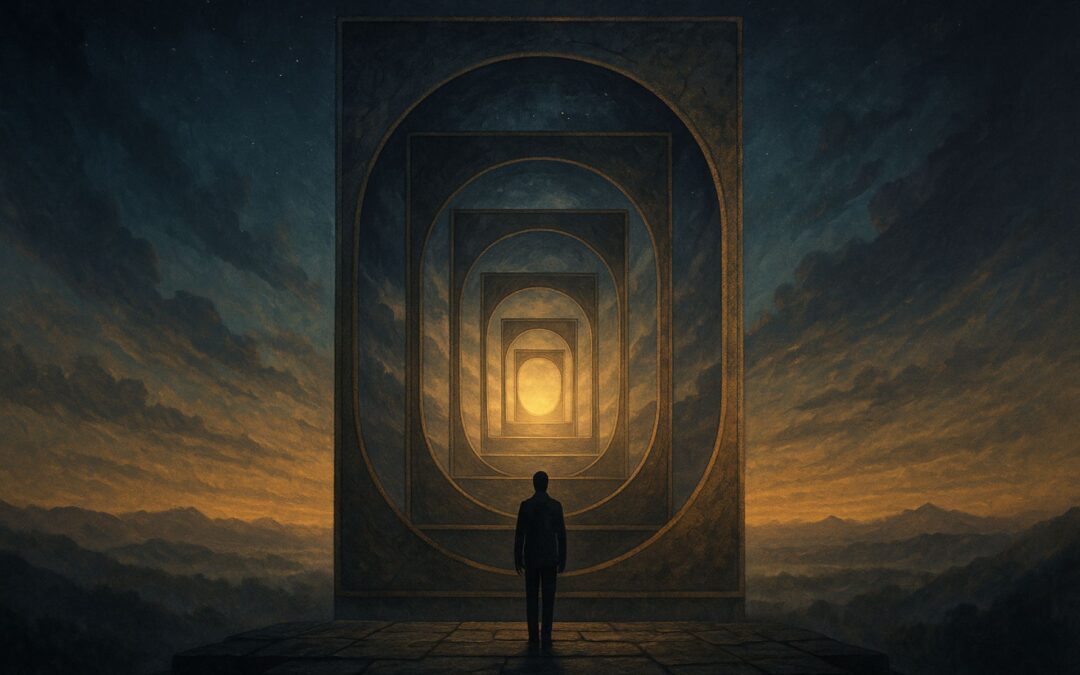
The most unsettling fact of existence is this: reality is not one thing, but many. It comes in layers, each more perplexing than the last. From the consensus of daily life to the unknowable abyss beyond thought, reality unfolds like nested illusions, a hall of mirrors where each reflection conceals another. To trace these seven levels is not to find a final answer—it is to confront the possibility that no final answer exists, and that the strangeness of being is the only constant.
Level One: Consensus Reality
Consensus reality is the most obvious, yet also the most deceptive, layer of existence. It is the familiar world you step into each morning—the one where gravity keeps you pressed against the earth, where water slakes your thirst, and where the sun rises without asking permission. It is the reality of clocks, schedules, and sidewalks, where objects appear solid, stable, and dependable. This is the realm of routine, the backdrop against which you live, work, and love.
It feels self-evident. When you flick a light switch, the room brightens. When you push a chair, it moves. Pain registers when you stub your toe, and that sensation reinforces the idea that matter is unyielding. Life seems straightforward because the rules appear consistent. At this level, reality is a stage play with well-rehearsed actors, scenery that doesn’t move, and props that behave exactly as expected.
Yet beneath the surface, consensus reality is less a bedrock and more a shared performance. Our confidence in its stability relies entirely on our senses, and those senses are deeply unreliable narrators. Consider how easily they can be fooled. A desert mirage convinces travelers there is water where there is only sand. A simple optical illusion can make static images appear to spin. A phantom limb convinces an amputee that a missing body part still itches or aches. Hallucinations create voices and visions out of thin air, and synesthesia merges senses in ways most of us cannot imagine—like tasting colors or hearing textures. What feels like one seamless, unquestionable world is in fact a stitched-together patchwork, edited and re-edited by the brain.
This fragility becomes even clearer when you realize consensus reality is not just biological but social. It isn’t only about what your senses perceive—it’s about what we all agree to perceive. We maintain a tacit contract: tables are solid, the sky is blue, and bread tastes like bread. But remove agreement and the stage begins to crumble. A colorblind person literally sees a different world than you do. Someone experiencing psychosis navigates a completely alternate stage set. Even across cultures, interpretations differ: one person sees a sacred shrine; another sees mere stone.
And in the modern age, consensus reality is increasingly mediated by forces that blur its integrity. Social media promised to expand our shared world but instead fragmented it. Now billions of people live in parallel digital realities—echo chambers shaped by algorithms that feed them personalized truths. Add to this the erosion of privacy, where corporations and data brokers reduce human beings to exploitable categories: “tough start,” “rural and barely making it,” “young family.” These labels shape how we are seen and treated, not because they reflect inherent truth, but because systems enforce them.
Consensus reality, then, is not the final word on what is real. It is a negotiated performance—a fragile agreement patched together by senses that lie and societies that curate what counts as truth. It is a useful fiction, a stage set that allows life to move forward. But like any stage set, it begs the question: what lies behind the painted backdrop?
Level Two: The Realm of Perception
If consensus reality is the stage set, perception is the backstage machinery pulling the strings. At this level, reality stops being a fixed, external world and becomes something generated within the mind. It’s not that the world “out there” doesn’t exist—it’s that you never experience it directly. What you encounter is your brain’s version, an elaborate construction pieced together from sensory fragments.
Take vision, the sense we trust the most. Light bounces off objects, enters your eye, and strikes the retina. But the image arrives inverted and fragmented, with gaps where the optic nerve leaves the eye. What reaches your brain isn’t a picture of the world at all but a two-dimensional electrical storm of signals. Your brain then flips it, patches over the blind spot, fills in missing details, and smooths the result into a continuous field of vision. You don’t see reality—you see a reconstruction. A hallucination, but one you happen to agree on with everyone else.
And vision is just one example. Time itself is stitched together from fragments. Your brain receives snapshots like frames in a film reel, but instead of showing you the gaps, it edits them out. That’s why the world feels continuous instead of flickering. It’s why you don’t notice the darkness during a blink, and why magicians can make a card vanish without your awareness—the mind edits reality too quickly for you to catch the seams. Smell, taste, touch, and hearing follow similar rules: they filter, prioritize, and discard, giving you not the truth but the most useful story.
The unsettling part is how narrow that story is. Your perception is not reality—it is a species-specific user interface designed to keep you alive. A dog hears pitches you cannot. A bat maps space through ultrasonic pulses. Bees navigate ultraviolet patterns invisible to the human eye. Birds sense magnetic fields, moving through a world of invisible highways. Meanwhile, your brain delivers a shrunken version of reality, filtered and simplified for human survival.
Philosopher Donald Hoffman captures this in his “user interface theory of perception.” Just as a computer desktop shows you icons instead of the complex circuitry beneath, your senses provide icons, not the machine itself. The green folder on your screen is not “real”—it is a shortcut to something incomprehensibly more complex. In the same way, a tree, a sound, or the taste of an apple is not reality itself but your brain’s symbol for what lies beyond.
This realization destabilizes the certainty of everyday life. If your senses give you only a curated, heavily edited interface, then the “real world” is always hidden. You live not in the universe as it is, but in a model of it—a fragile rendering. And while this rendering is useful for crossing the street or finding food, it tells you nothing about the raw, unmediated truth.
At level two, the curtain is lifted just enough to see the trick. You realize that what you thought was reality is a reconstruction, and what you thought was direct experience is only your brain’s best guess. The unsettling conclusion: the real reality—whatever it is—remains forever beyond reach.
Level Three: The Realm of Belief
If perception reveals that reality is a brain-made reconstruction, belief shows that it is also a social construction. At this level, the world is not defined by atoms or photons but by ideas—shared agreements that take on the weight of granite simply because enough people accept them. Reality here is woven out of abstractions that have no intrinsic existence, yet govern human life with overwhelming force.
Take money. Physically, it’s nothing: paper, ink, metal coins, or now, strings of numbers glowing on digital screens. Left in isolation, a hundred-dollar bill is no more valuable than a scrap of parchment. Its power comes only from collective agreement—billions of tiny acts of trust repeated daily. You accept money for your labor because you believe it will buy food, and the shopkeeper believes it will pay their rent. Money is a shared hallucination, yet it organizes economies, builds empires, and decides who thrives and who suffers.
Or consider borders. Viewed from orbit, the Earth shows no lines dividing nations. The planet is seamless, its landscapes flowing into each other without interruption. Yet down here, invisible boundaries determine whether you live in safety or under oppression, in wealth or in poverty. A river becomes a dividing line, a wall becomes destiny, a stamp in a passport becomes the difference between freedom and confinement. Borders are not natural facts—they are agreements enforced by power and belief.
Even morality is not immune. Cannibalism is condemned as monstrous in one culture, yet practiced as sacred ritual in another. Monogamy is upheld as moral truth in one society, while polygamy is normal in another. Honor, justice, gender roles, marriage—all these realities shift across time and culture. They feel absolute when you are inside them, but history reveals their mutability. Beliefs ossify into truths until a new generation rewrites them.
The anthropologist Clifford Geertz described humans as suspended in “webs of significance” spun by themselves. These webs are what make us human—languages, religions, ideologies, traditions. They are the frameworks through which we interpret the world, the stories we inherit and pass down. But they also ensnare us. Step outside one web, and the reality it constructs collapses. Belief both binds and blinds.
And because belief is interpretive rather than objective, it fractures. When worldviews clash, conflict follows. One person’s sacred scripture is another’s blasphemy. One nation’s founding myth is another’s oppression. Competing belief systems collide, and the results shape history: crusades, revolutions, colonization, wars. Reality at this level is no longer shared consensus—it is contested territory. Which story will dominate? Which version of truth will endure?
At level three, reality ceases to be merely perceived. It becomes actively constructed, maintained, and defended. You are no longer just a passive participant—you are a co-author of the story. Every institution, every social system, every cultural truth is fragile because it rests on interpretation. And when interpretations fracture, entire civilizations can crumble.
Level Four: The Realm of Science
By the time we arrive at this level, the ground beneath consensus and belief has already begun to wobble. Science promises solidity, a system of logic and experiment to reveal how the universe actually works. Yet the deeper it peers, the more reality itself disintegrates into paradoxes and probabilities. What once felt firm and dependable—matter, time, space—now becomes ghostly, provisional, almost dreamlike.
Start with matter. To your senses, the world feels solid. The floor resists your weight, the chair supports your body, the cup in your hand is reassuringly tangible. But zoom in past the molecules, past the atoms, into the subatomic heart of things, and that solidity evaporates. Atoms are not tiny billiard balls snugly pressed together, but vast fields of emptiness. If an atom were the size of a football stadium, its nucleus would be a grain of rice at midfield. The electrons? Flecks of probability buzzing somewhere near the rafters. Everything else—99.9999999%—is void. What you call “touch” is nothing more than the electromagnetic resistance between your atoms and another object’s atoms. You never actually touch the table, the wall, or the hand of someone you love. You are always held apart by invisible forces.
Then there is time. To daily experience, time feels like a steady river flowing from past to future. Science shows it is anything but steady. Einstein’s theory of relativity demolished the notion of absolute time. Speed up, and time stretches. Fall into gravity’s grip, and it bends. An astronaut orbiting Earth for months returns younger than their twin who stayed behind—a difference not of perception, but of biology itself. Time is not universal—it is elastic, contingent, a fabric that twists under the weight of mass and motion.
Quantum mechanics takes the strangeness further. At the atomic scale, particles refuse to behave like stable things. Instead, they exist as waves of probability—smears of possibility—until measured. Only observation forces them into a definite state. Before measurement, a particle is not here or there but everywhere and nowhere at once. Schrödinger’s cat, famously both alive and dead until you open the box, was not a thought experiment meant to be comforting. It was a warning: reality does not pick a shape until someone looks.
And then there is entanglement, Einstein’s “spooky action at a distance.” Two particles can be linked in such a way that altering one instantly alters the other, even if they are separated by light-years. This connection defies the speed limit of the universe. It suggests that at some fundamental level, space itself may not be what we think—it may be stitched together by hidden threads.
John Archibald Wheeler, one of the great physicists of the 20th century, put it bluntly: “No phenomenon is a real phenomenon until it is an observed phenomenon.” In other words, science itself implies that reality is not fully there until we interact with it. Observation is not passive—it is participatory. The universe does not simply exist waiting for us to notice it; in some sense, our noticing brings it into being.
At this level, the reassuring solidity of everyday life shatters. The microscope and telescope don’t just expand our vision—they undermine it. They reveal that the foundation of existence is not made of stable building blocks, but of shifting equations, probability clouds, and paradoxes. Science, which set out to explain reality, ends up showing us just how provisional, slippery, and unfathomable reality truly is.
Level Five: The Simulation Layer
If the realm of science dismantles the familiar picture of reality, the simulation layer takes a bolder leap—it asks whether there is a “base” reality at all. This level moves beyond empty space, warped time, and quantum uncertainty into something even stranger: the possibility that everything you see, feel, and remember is not just provisional but programmed. It suggests that our entire universe may be an artificial construct, a kind of cosmic software running on an unimaginable substrate.
The idea isn’t as fringe as it once seemed. Philosopher Nick Bostrom popularized the modern form of the “simulation hypothesis,” arguing that if advanced civilizations can build computer simulations indistinguishable from reality, then the odds that we’re inside one are astronomically high. Each “real” universe could spawn millions—even billions—of simulations. The math points to a staggering conclusion: statistically, you’re far more likely to be a character inside a simulation than a being in the one true reality.
Picture what this would mean. Your senses—the smell of coffee, the texture of rain on your skin, the sound of someone laughing—could be nothing more than data packets rendered in real time. Your memories, your identity, even your most intimate emotions could be information stored and retrieved by some underlying system. The laws of physics—gravity, electromagnetism, even the passage of time—would simply be the engine rules of this universe, like a video game’s physics engine telling characters how to jump, run, or collide.
And from inside the simulation, you would never know. Just as a character in a video game cannot see the code that animates their world, you cannot perceive the substrate—if it even exists. Every glitch could be dismissed as coincidence. Every anomaly could be patched seamlessly. Your entire sense of normalcy could be nothing but a perfectly rendered interface, designed to keep you from noticing what’s behind it.
Some thinkers take this literally, proposing that we are indeed living in a computer simulation. Others interpret it metaphorically, seeing the hypothesis as a symbol for how reality behaves like a coded system—emergent rules stacked atop emergent rules, complexity arising from simple instructions, illusions built upon illusions. Either way, the unsettling implication remains the same: what you call “real” may not be fundamental. It may be an interface—a copy of a copy, a shadow of a deeper architecture.
Even hints of this possibility surface in science. The pixelation of space-time at the Planck scale, the mathematical nature of physical laws, and the “fine-tuning” of universal constants all suggest that the cosmos could be computational at its core. Some physicists even describe the universe as a vast information processor. In this view, matter and energy are not the ultimate stuff of reality—information is.
At level five, reality ceases to be a stage or even a field of paradoxes. It becomes a program, perhaps endlessly nested, where every layer gives rise to another. Whether literal or figurative, the simulation layer forces a profound shift: you are not a passive observer of an objective universe. You may be an active participant inside a coded environment, one whose true nature will forever remain invisible from within.
Level Six: Mystical Reality
At this level, the intellect yields to something older and far more visceral. The mystics of every age have whispered what physicists are only beginning to hint at: the world you see is not the real world. It is a veil, a projection, a mirage. Hinduism calls it Maya—the grand illusion. Buddhism calls it samsara—the endless cycle of appearances. Gnostic traditions frame it as a false world, a cosmic trap that hides the divine. Though separated by centuries and continents, these traditions converge on a single message: the everyday reality you navigate is less real than it appears, and behind it lies a deeper ground of being.
Mystics, meditators, saints, and psychonauts often describe the same pattern. In altered states of consciousness—whether achieved through decades of meditation, spontaneous revelation, or the ingestion of entheogens—the boundaries of the self dissolve. The body ceases to feel like a prison of skin. The chair, the air, the heartbeat, the universe—all of it becomes a single, seamless field. Space and time no longer feel like containers but like constructs, transient and insubstantial. In their place emerges something vivid and vast, not just “real” but more real than real.
Aldous Huxley called this state “the mind at large.” Neuroscience, studying psychedelic states, observes something similar: the brain’s “default mode network”—the storyteller that keeps your identity intact—shuts down. With the ego offline, the floodgates open. Experience ceases to be filtered, labeled, and categorized. Instead, it pours in raw, unmediated, undivided. The result is often described as unity, oneness, or infinity—a condition where the line between observer and observed, self and other, simply ceases to exist.
People who have touched this realm often report an overwhelming sense of familiarity, as though they are not discovering something new but remembering something ancient. It feels like returning home, like awakening from a dream. They speak of love, interconnectedness, and timelessness with a conviction that shakes their former certainties. And here lies the paradox: if a state feels more authentic, more vivid, and more self-evident than waking life, which one deserves to be called “reality”?
Mystical traditions have grappled with this question for millennia. The Upanishads declare, “Tat Tvam Asi”—“You are That.” The Sufi mystic Rumi writes, “You are not a drop in the ocean. You are the entire ocean in a drop.” These are not metaphors to the mystic but literal descriptions of a reality that lies beneath appearances. Science, with its focus on measurement and observation, may be peering at shadows while ignoring the light that casts them.
At level six, reality is no longer external or even participatory. It is not something you live in; it is something you are. Subject and object, self and world, collapse into one seamless field. This level raises unsettling questions. If everything you experience as separate is ultimately one, then individuality itself—identity, history, even the universe you inhabit—may be a kind of useful fiction. And suppose mystical reality is indeed more “real” than everyday life. In that case, everything that came before—the consensus, the perceptions, the beliefs, the science, even the simulation—becomes a mere curtain drawn across an infinite stage.
Level Seven: The Unknowable Realm
At the deepest stratum of this journey lies the point where language fractures, where thought itself becomes inadequate. After consensus, perception, belief, science, simulation, and mysticism, there remains one more layer—the unknowable. This is not simply another “hidden” world waiting to be revealed. It is the realm where there may be no “behind the curtain” at all, only the absence of curtains, walls, and floors. It is the edge of the map where the cartographer writes, “Here be dragons,” knowing full well that even dragons are a metaphor.
The unknowable realm is not a place in any conventional sense. It is the domain where every concept collapses. Science, which thrives on measurement, can only shrug. Philosophy, which thrives on distinctions, finds no foothold. Spirituality, which speaks in symbols, falls silent. The Tao Te Ching opens with a warning: “The Tao that can be spoken is not the eternal Tao.” The moment you describe ultimate reality, you have already turned it into something less than itself. Words about water are not wet. Maps are not territories. Images of fire do not burn.
This level is not emptiness in the sense of a void or a blank screen. It is not “nothing” in the everyday sense. It is rather the groundless ground—the ineffable source from which all appearances arise. The silence behind thought. The darkness out of which light emerges. The canvas on which perception, belief, science, and even mysticism are painted. If everything we call “real” is a layer or an interface, this is not another layer but the substrate itself—one that cannot be known because it is not an object of knowledge but the condition for knowing.
Many traditions hint at this. Buddhist texts call it Śūnyatā—emptiness, not as void but as freedom from inherent form. Christian mystics speak of the “cloud of unknowing.” The Upanishads refer to Brahman, the infinite without attributes, beyond all comprehension. Modern physics nods in the same direction when it acknowledges that no theory can be final, no measurement absolute. At the edges of quantum cosmology, speculation turns into poetry. Even the question “What came before the universe?” dissolves, because “before” presupposes time and causality—concepts that might themselves be local illusions.
The unknowable realm is not something you can stand outside of to observe. It is not an object, not an event, not even an experience in the conventional sense. It is the medium in which all objects, events, and experiences arise. To “reach” it is not to go somewhere but to recognize that you never left it. It is what mystics point to when they say “I am That.” It is what scientists stumble upon when their equations suggest the impossibility of ultimate answers.
At this level, reality is no longer a riddle to be solved. It is the space in which riddles, questions, and answers emerge. It is not a truth waiting to be discovered but the silent backdrop that makes truth and falsehood alike possible. Perhaps it is the hidden law that spawns universes, or perhaps it is something forever beyond even that. But the truest insight here is not what it “is”—it’s the recognition that it cannot be grasped at all.
And yet, paradoxically, it is always here. The unknowable realm is not remote or rarefied. It is the breath you are taking as you read this. It is the blankness behind each thought. It is the mystery at the heart of your own awareness, the same mystery that shone through the previous six layers in veiled form. At level seven, reality is no longer something you explore. It is what you are, before names, before stories, before even the idea of “levels.”
Conclusion
When you strip it all down—consensus, perception, belief, science, simulation, mysticism—you arrive at a silence that refuses definition. Reality does not yield to categories, nor does it rest in the hands of philosophers, physicists, or prophets. It is at once ordinary and unfathomable: the coffee cup in your hand and the abyss behind existence itself.
Maybe reality isn’t a puzzle to solve but a mystery to live inside. Maybe the point is not to uncover the “true” layer but to recognize the layering itself—the way the obvious hides the impossible, the way the familiar conceals the infinite. The deepest truth may not be that reality is an illusion, a simulation, or an ineffable ground. The deepest truth may be that it is all of these at once. And perhaps the real wonder is not what reality is, but that it is here at all—and that somehow, impossibly, so are you.