
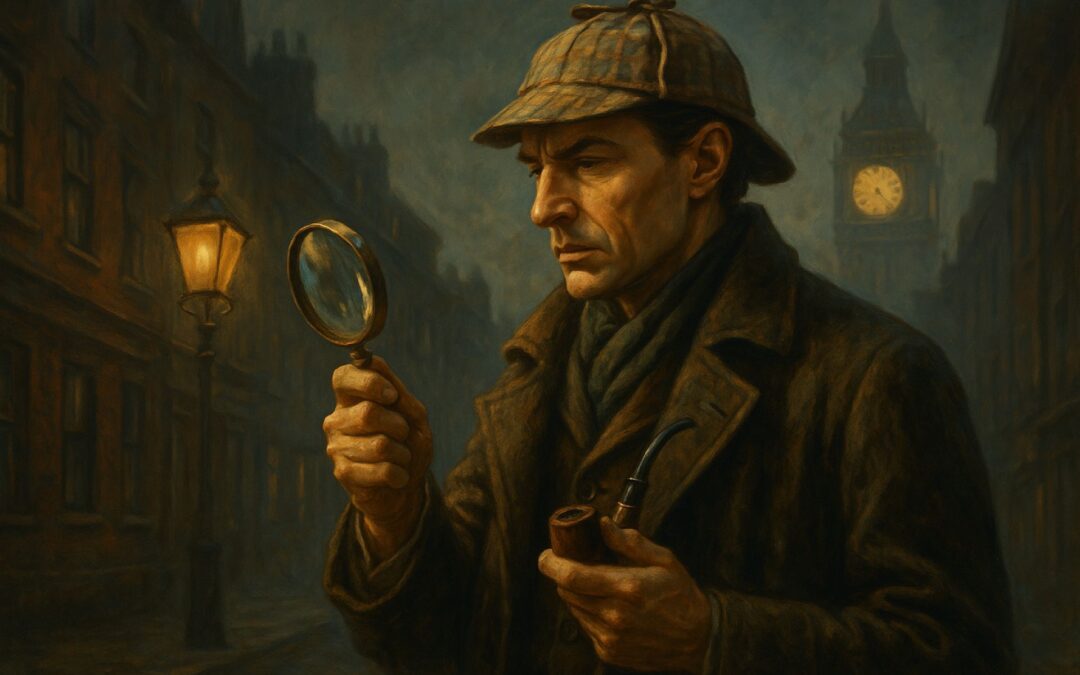
Few literary creations have stood the test of time with the enduring magnetism of Sherlock Holmes. Arthur Conan Doyle’s The Adventures of Sherlock Holmes does more than spin tales of crime and deduction—it opens a window into the psychology of deceit, the fragility of human motives, and the brilliance of reason cutting through the fog of mystery. Each case is a miniature stage where greed, love, betrayal, and justice collide, and Holmes, with his unmatched intellect, restores order to chaos.
From aristocrats fearing scandal to beggars hiding secret lives, these stories remind us that beneath every façade lies a truth waiting to be uncovered. What follows is an in-depth exploration of these adventures, revealing why Holmes is not just a detective but a symbol of clarity in a world of shadows.

A Scandal in Bohemia
The story opens with Dr. Watson reminding us of Holmes’s singular detachment from romance. To the great detective, women were subjects of analysis, not affection. Yet one woman—the woman—would forever be remembered by Holmes: Irene Adler. Not as a lover, but as an equal who bested him at his own game.
The case arrives with high drama. A masked nobleman enters 221B Baker Street, his disguise too elaborate to fool Holmes. With dry amusement, Holmes unmasks him as Wilhelm Gottsreich Sigismond von Ormstein, the hereditary King of Bohemia. The king’s problem is not one of politics but of scandal. Years earlier, he had shared a passionate liaison with Irene Adler, a celebrated opera singer of uncommon charm and intelligence. Now, as he prepares to wed a Scandinavian princess from a puritanical royal house, the existence of a compromising photograph threatens to ruin the match.
The king admits that every possible stratagem has already been attempted—burglary, bribes, threats—all to no avail. Adler guards the photograph zealously, and the king’s fear is that she will use it to expose him. He offers Holmes a staggering sum to retrieve it, but Holmes, ever motivated more by intellectual challenge than money, accepts with cool assurance.
Holmes begins his investigation with characteristic disguise, donning the persona of a stable groom to watch Adler’s residence. He observes her daily habits and discovers that she is about to marry a barrister, Godfrey Norton. In a twist of irony, Holmes himself is dragged into the wedding as a witness, his role in her life shifting from spy to participant. It is here that Holmes recognizes Adler’s decisiveness—she is not the idle temptress of the king’s memory, but a woman of action, secure in her independence.
That evening, Holmes concocts one of his most famous ruses. Arranging a staged brawl outside Adler’s home, he allows himself to be injured in the scuffle. Taken inside by Adler, he signals Watson to throw a smoke rocket through the window and cry “Fire!” In the panic, Adler instinctively rushes to safeguard her most precious possession. Holmes observes her concealment and thus identifies the hiding place of the photograph.
Victory, however, is fleeting. As Holmes and Watson depart, they are shadowed by a youth in the street. The following morning, when Holmes escorts the king to retrieve the photograph, they find Adler gone. She has fled with her new husband, leaving only a letter and a different photograph of herself. In the letter, Adler reveals that she had suspected Holmes’s involvement, having disguised herself as the boy who followed him the night before. She assures the king she has no desire to use the photograph, now secure with her, and that she will trouble him no further.
The king, relieved yet humbled, offers Holmes whatever reward he wishes. Holmes asks only for Adler’s photograph—a token of respect, a tribute to the one mind that triumphed over his. For Watson, and for us, this story crystallizes Holmes’s rare admiration. Irene Adler is not a conquest but a reminder that even the sharpest intellect can be undone by foresight, intuition, and dignity.
The Red-Headed League
Jabez Wilson, a stout pawnbroker with a shock of brilliant red hair, steps into Baker Street with a tale as absurd as it is suspicious. He explains to Holmes and Watson that he had been recruited into something called The Red-Headed League, a peculiar society that offered generous pay for a seemingly pointless task: copying out the Encyclopedia Britannica by hand. The only condition? He must have fiery red hair, a detail that both bemused and intrigued him. For weeks, Wilson dutifully transcribed, earning more money than his modest business ever provided. Then, without warning, he arrived one morning to find a sign on the office door: The League is dissolved. No explanation, no forwarding address, nothing but confusion.
Holmes listens with fascination, while Watson chuckles at the sheer ridiculousness of the scheme. But to Holmes, the strange often conceals the sinister. He questions Wilson about his shop, his assistant, and the surrounding area. Holmes’s keen attention zeroes in on one detail: the assistant, a man named Vincent Spaulding, who seemed overly eager to secure Wilson the league position. With little more than this thread, Holmes resolves to visit the scene himself.
Outside Wilson’s pawnshop, Holmes taps the pavement with his cane, measuring its firmness, while noting the geography of the street. To Watson, these gestures seem cryptic, but to Holmes they reveal volumes. The pawnshop, he realizes, sits adjacent to a bank—an irresistible target for men with criminal ambition. The League, then, was no eccentric fellowship; it was a smokescreen to occupy Wilson while Spaulding and his accomplices dug a tunnel toward the bank vault.
Holmes, with his usual composure, predicts the burglary will occur that very night. He gathers Watson, Inspector Jones of Scotland Yard, and Mr. Merryweather, the bank director, for a clandestine vigil in the cellar. Hours crawl by in tense silence until the sound of scraping and digging erupts from beneath the floor. Suddenly, two figures emerge—John Clay, a notorious criminal mastermind, and his partner—only to be met with Holmes’s trap. The arrest is swift and conclusive, the vault preserved, and the absurdity of the Red-Headed League revealed as a brilliant deception.
What seemed laughable at first becomes one of Holmes’s most dazzling displays of deduction. To the untrained eye, it was a tale of eccentric employers and idle scribbling; to Holmes, it was the mask of a sophisticated crime. The contrast between trivial appearances and profound reality is the essence of his genius—and the downfall of those who underestimate it.
A Case of Identity
On an ordinary afternoon, Holmes and Watson are interrupted by the frantic knocking of a young woman, Miss Mary Sutherland. She bursts into their chambers, her distress plain: the man she was to marry, Hosmer Angel, has vanished without explanation. Her heart is in turmoil, her eyes searching Holmes for certainty where life has delivered confusion.
Mary’s story is both peculiar and pitiful. She is a typist, dutiful and modest, who lives under the guardianship of her mother and stepfather, James Windibank. Windibank is a man scarcely older than Mary herself, a fact Holmes seizes upon instantly. More telling is his control over Mary’s modest inheritance, a sum she would lose the moment she marries. Windibank discourages her social outings, yet when she attends a ball alone, she encounters Hosmer Angel. Gentle, mysterious, and attentive, he sweeps her into a courtship that seems heaven-sent.
Yet beneath this romance lies a series of curious details. Hosmer insists that all his letters be typewritten, as though to mask his handwriting. He appears only when Windibank is away. He is vague about his occupation, his circumstances, his future. And then, on the day of their wedding, as Mary waits in her bridal dress, he simply disappears into the London fog, never to return.
Holmes listens with outward detachment but inward precision. He gathers the fragments—typed letters, elusive presence, coinciding absences—and arranges them into an unshakable conclusion: Hosmer Angel never existed as an independent man. He was Windibank himself in disguise, using tinted glasses and false whiskers, concocting an elaborate deception to prevent Mary from marrying and thus keep her inheritance under his control.
When Holmes confronts Windibank, the man smirks with arrogance, admitting that Mary is too gullible to ever suspect. His audacity enrages Holmes, who predicts coldly that Windibank’s schemes will eventually drive him to the gallows. Yet Holmes refrains from exposing the truth to Mary. His reasoning is uncharacteristically compassionate: to rip away her illusion would be to inflict a cruelty deeper than her current sorrow. Better, Holmes thinks, for her to continue believing in a lost love than to live with the knowledge that her stepfather betrayed her trust so profoundly.
For once, Holmes chooses silence over revelation. Watson, ever the moral counterpoint, perceives the detective’s calculation as both merciful and harsh. The case leaves an aftertaste of unease, for justice is not served in any courtroom, nor is Mary freed from her delusion. Instead, it is a reminder of the limits of reason in matters of the heart, and of Holmes’s ability to weigh truth against kindness—even when the scales hang unevenly.
The Boscombe Valley Mystery
News of a brutal killing draws Holmes and Watson away from London into the countryside, where the stillness of Boscombe Valley has been ruptured by violence. Charles McCarthy, a landowner of questionable repute, has been found dead near a woodland pool. His son, James, stands accused of murder. The evidence appears damning: witnesses saw the two men quarreling, a maid swears she glimpsed James threatening his father, and James himself confesses he argued with him shortly before the killing. The village is already whispering of patricide.
Lestrade of Scotland Yard, confident of the case, invites Holmes more as a courtesy than a necessity. Yet Holmes’s instincts bristle at the neatness of the accusation. Arriving on the scene, he scrutinizes the ground with the intensity of a hawk. His observations overturn assumptions: alongside the tracks of father and son lies a third set of footprints, smaller and fainter, belonging to another man. The crime, Holmes suspects, is not as straightforward as Lestrade believes.
As Holmes and Watson question those closest to the victim, a new dimension emerges. Alice Turner, daughter of the reclusive John Turner, insists that James is innocent. She pleads for Holmes’s intervention, revealing her affection for James. The young man, however, has been evasive about his personal life. Pressed by Holmes, he admits he once married a barmaid in secret, a union kept hidden from his father. The revelation complicates the family dynamics but does not explain the murder. Holmes persists, following the faintest of trails until the truth surfaces.
The true killer is John Turner himself. Decades earlier, in the harsh goldfields of Australia, Turner had been part of a gang that committed a violent robbery. The driver of the convoy spared was none other than Charles McCarthy, who thereafter held Turner in a chokehold of blackmail. Turner, now wealthy from his English estate, paid McCarthy off with land and money. When McCarthy sought to force a marriage between his son and Alice, Turner’s daughter, Turner’s fury broke through years of silent suffering. Rather than allow his child to be bound to a corrupt legacy, he struck McCarthy down by the pool.
Turner, worn down by illness and guilt, provides Holmes with a signed confession, but the detective withholds it, vowing only to reveal it if James cannot be acquitted by other means. Holmes’s strategic objections during the trial raise enough doubt to secure James’s freedom. Turner dies shortly after, his secret safe, his daughter’s honor intact.
Justice here is not of the courtroom but of circumstance—an equilibrium Holmes often prefers. He knows the law is blunt, whereas truth, in all its nuance, requires a more delicate hand. In Boscombe Valley, it is not the gallows but compassion, tempered with discretion, that resolves the crime.
The Five Orange Pips
The case begins in the gloom of a stormy London evening, when a nervous young man named John Openshaw arrives at Baker Street. His story is strange, his manner desperate. Two men in his family—first his uncle, then his father—have died under mysterious circumstances. Both deaths were preceded by the arrival of an envelope containing five dried orange seeds, accompanied by the chilling letters “K.K.K.” Now, John himself has received the same grim token, and he fears he is marked for death.
Holmes listens intently, piecing together fragments of history that others had dismissed. John’s uncle, a retired colonel who had fought for the Confederacy in the American Civil War, returned to England years earlier with a locked trunk of papers and a shadowy past. After the first envelope arrived from India, the colonel frantically burned some of those papers—only to be found dead days later, drowned in his own garden pool. Years later, John’s father received a similar warning, this time from Dundee, and he too perished soon after. The local police, bewildered and indifferent, attributed the deaths to accident or misfortune. Only Holmes sees the deliberate pattern.
With cold clarity, Holmes connects the dots: the letters “K.K.K.” stand for the Ku Klux Klan, a secret society notorious for its ruthless vengeance. The colonel’s mysterious trunk, likely containing incriminating documents about the group’s operations, had made him a target. By destroying the papers, he sealed his fate, and his family inherited not wealth but a legacy of terror.
Holmes advises John to act quickly—publish a notice that the papers are destroyed, placate his unseen adversaries, and take precautions against further attack. But before his advice can be carried out, tragedy strikes once again. News arrives that John Openshaw has been found dead, his body floating in the Thames. Holmes’s fury is uncharacteristic, his mask of detachment cracking under the weight of outrage. This is no puzzle now—it is personal.
Driven by vengeance, Holmes investigates shipping records and identifies the killers’ vessel: the Lone Star, a schooner bound for America. With grim precision, he sends them their own medicine: an envelope containing five orange pips. He then alerts the authorities in Savannah, ensuring they will be apprehended when the ship arrives. But fate intervenes in a darker fashion. The Lone Star never makes port, swallowed by the sea in a storm, with no survivors. Only a fragment of wreckage bearing its initials drifts back.
The case leaves Holmes unsettled. He has solved the riddle, traced the culprits, even secured their destruction—yet he has not saved his client. The bitter irony lingers: knowledge and justice came too late for John Openshaw. It is a rare moment when Holmes confronts the limits of his own brilliance, where truth is uncovered but tragedy remains unavoidable. The five orange pips, so small and harmless in appearance, stand as a symbol of fate’s cruel inevitability and the merciless reach of vengeance.
The Man with the Twisted Lip
On a humid London night, Watson receives a frantic summons from the wife of a patient. She begs him to fetch her husband from an opium den, a place thick with shadows and despair. As Watson ventures into this underworld, he stumbles upon Holmes—disguised, as usual, in rags and grime, mingling among the addicts. Holmes, however, is not there for pleasure or pity. He is deep in a case, one that balances on the border between the sordid and the respectable.
The matter concerns Neville St. Clair, a man of good standing, a journalist with a comfortable home, a wife, and children. One day, Mrs. St. Clair swears she sees her husband at the window of that very opium den. He appears pale, desperate, and then vanishes before her eyes. The police investigate but find only a beggar named Hugh Boone, a filthy, twisted-lipped vagrant notorious in the area. In the room, they discover clothing and traces suggesting St. Clair was indeed there, but the man himself has vanished. Later, his coat is dragged from the river, weighted with coins, as though to confirm the worst—that he has been murdered.
Mrs. St. Clair refuses to believe her husband dead, convinced that Hugh Boone holds the key. The police, with less sentiment, arrest the beggar, certain he is responsible. Holmes, however, remains unsatisfied. The puzzle is too neat, too staged. Why would a criminal leave such convenient clues? Why would St. Clair’s disappearance align so precisely with Boone’s presence?
The solution is both startling and grimly ironic. Holmes confronts Boone in his cell and, with a sponge and basin, washes away the grime of deception. Beneath the dirt and disfigurement lies none other than Neville St. Clair himself. The respectable journalist and the despised beggar are one and the same. Years earlier, while reporting on the conditions of London’s underclass, St. Clair discovered that begging was more lucrative than journalism. With a little makeup, rags, and practiced contortions, he became Hugh Boone, earning in a day what he once made in weeks. The double life funded his comfortable household, unknown even to his wife.
Holmes forces St. Clair to confront his deception, warning that the masquerade must end. Respectability, Holmes insists, cannot coexist with fraud. St. Clair agrees to abandon his beggar’s guise and devote himself to honest work, grateful that Holmes keeps the truth concealed from the public. The case closes not with triumph, but with an uneasy reflection: the line between dignity and disgrace is thinner than society admits, and sometimes, beneath the rags of a beggar, lies the face of a gentleman.
The Blue Carbuncle
Christmas morning finds Baker Street in an unusually festive air. Watson arrives to exchange greetings and discovers Holmes scrutinizing a battered old hat with the intensity of a jeweler studying a diamond. Alongside it rests a goose—hardly the usual object of detective interest. Yet Holmes, in his characteristic manner, extracts a wealth of deductions from the hat: the owner is middle-aged, once prosperous but now in decline, neglectful of his appearance, and weighed down by private anxieties. To Watson, the exercise seems a parlor trick. To Holmes, it is the seed of a case.
The goose, it turns out, harbors more than Christmas dinner. A man named Peterson, who had retrieved it after a street scuffle, returns breathless with news: while preparing the bird, his wife discovered a dazzling gem within its crop. It is no ordinary stone but the Blue Carbuncle, recently stolen from the Countess of Morcar, a theft that has scandalized the city. The police, eager for a culprit, have already arrested a workman at the hotel where the gem was taken. But the evidence is circumstantial, and Holmes suspects a deeper plot.
Patiently, Holmes traces the path of the goose. He places a notice in the papers, summoning Henry Baker, the original owner of the hat. When Baker arrives, Holmes swiftly dismisses him as a suspect. The man’s shock at the missing bird is genuine; he knew nothing of the jewel it carried. Directed by Baker, Holmes follows the chain of sellers: from the goose club where Baker purchased it, to the dealer who supplied the birds, and finally to the breeder. At each step, irritation and resistance yield to Holmes’s persistence, until he uncovers the true link in the chain.
The trail leads to James Ryder, head attendant at the hotel. Ryder, trembling and broken under Holmes’s piercing gaze, confesses the theft. He and the Countess’s maid had plotted to steal the gem and frame an innocent repairman. But in his panic after the theft, Ryder concealed the jewel in the crop of a goose he intended to take for Christmas dinner. In the ensuing confusion, the wrong bird was delivered, and the carbuncle nearly disappeared into obscurity.
Holmes faces a moral quandary. Ryder, a pitiful figure more coward than criminal mastermind, begs for mercy. Holmes considers the case: the real thief is exposed, the innocent repairman will be freed, and Ryder’s terror may serve as a punishment greater than any prison sentence. With cold pragmatism, he releases the man, remarking that his own conscience and fear will hound him more relentlessly than the law. The jewel is restored, the scandal averted, and Holmes returns to his pipe, satisfied that justice—if not legality—has been served.
This case, set against the backdrop of Christmas, reveals Holmes at his most human. His intellect unmasks deception as always, but it is his decision to temper justice with mercy that lingers. The Blue Carbuncle is less a story of crime and punishment than a meditation on conscience, folly, and the strange, circuitous paths by which truth comes to light.
The Speckled Band
At dawn, a pale and trembling young woman named Helen Stoner arrives at Baker Street. Her desperation is immediate, her voice unsteady as she recounts her plight. She lives at Stoke Moran with her stepfather, Dr. Grimesby Roylott, a towering, violent man descended from a once-noble but degenerate family. Known for his fiery temper, his friendships with gypsies, and his fondness for exotic animals like a cheetah and a baboon, Roylott casts a menacing shadow over the crumbling estate. Helen’s fear is sharpened by memory: two years earlier, her twin sister Julia, on the eve of marriage, had died in her bed, her final words a cryptic cry—“The speckled band!” Now Helen herself is engaged, and Roylott insists she move into Julia’s old chamber. She is convinced her life is in imminent danger.
Holmes listens without interruption, his sharp gaze flickering at each unsettling detail. He investigates with Watson at his side, first stopping at the courthouse to examine Helen’s late mother’s will. It reveals that the daughters would inherit a large sum upon marriage, a fortune that Roylott has every incentive to keep within his grasp. Motive is clear: financial gain hidden beneath paternal authority.
Arriving at Stoke Moran, Holmes and Watson find a house that mirrors its master—decayed, oppressive, yet dangerous. The renovations that forced Helen into her sister’s old room appear needless, but the detective notes every oddity. The bed is bolted to the floor, immovable by design. A ventilator connects the room not to the open air but directly to Roylott’s adjoining chamber. A bell rope hangs beside the bed, yet it is a sham, unattached to any bell. Holmes’s mind assembles the clues into a sinister architecture of murder.
That night, Holmes and Watson take Helen’s place in the death room. The silence of the countryside presses in, broken only by the faint rustle of nocturnal life. Hours pass in stifling tension. Suddenly, a faint hiss slices through the stillness. Holmes springs up, striking furiously at the bell rope with his cane. A moment later, a terrible cry echoes from Roylott’s room. When Holmes and Watson rush inside, they find him dead, his face twisted in agony, and coiled around his brow—the murderer itself—a venomous swamp adder, its scales marked like a speckled band.
Holmes explains the grisly ingenuity of the scheme. Roylott, unwilling to lose the fortune tied to his stepdaughters, trained the snake to slither through the ventilator and down the dummy rope, striking the sleeping victim. Julia’s cryptic last words now make sense: she had glimpsed the creature in the dimness before it killed her. Roylott, waiting to reclaim the snake after its work, became its final victim when Holmes’s intervention drove it back into his own chamber.
The case is one of Holmes’s darkest triumphs. It reveals not only his brilliance in unraveling the seemingly inexplicable, but also the chilling extremes of human greed. Justice here is poetic: the killer slain by the very weapon he forged, the serpent of his own making turning against him. For Helen, freedom is restored; for Holmes, the satisfaction lies not in applause, but in the quiet certainty that truth has once again prevailed.
The Engineer’s Thumb
This grim tale begins with Dr. Watson treating a patient who arrives pale, bleeding, and clutching the stump of a hand where his thumb once was. The man is Victor Hatherley, a young hydraulic engineer whose career has been marked more by ambition than prudence. His bizarre story spills out in gasps: he had been summoned by a mysterious client to perform what seemed like straightforward work, but the commission led him into a trap designed not just for secrecy but for his destruction.
Hatherley explains that he was approached by Colonel Lysander Stark, a severe man with a foreign accent, who offered him an unusually large fee to inspect a hydraulic press in a secluded country house. From the outset, unease prickled. The carriage that bore him to the estate had its windows covered, preventing him from learning the location. The house itself seemed oddly shuttered, its servants evasive, its corridors heavy with silence.
The colonel revealed a towering hydraulic press, claiming it was used to compress Fuller’s earth into bricks. But Hatherley’s trained eye caught discrepancies: the powder around the machine bore metallic traces, not mineral ones. The supposed Fuller’s earth business was a lie. Realizing he had stumbled upon an operation of far greater secrecy—counterfeiting—he questioned Stark. The colonel’s response was swift and murderous.
Hatherley was attacked, narrowly escaping the cleaver that severed his thumb. Fleeing through the house, he was aided by a terrified woman who whispered warnings, urging him to save himself. In his desperate scramble, he upset a lamp, setting the press room ablaze. The fire spread rapidly, and though Hatherley staggered away wounded, the building and its criminal machinery went up in flames.
Holmes, upon hearing the tale, seizes upon the smallest details: the length of the carriage ride, the shadows through the frosted windows, the peculiarities of the press itself. He deduces the exact region of the house and leads Watson and the police there. But when they arrive, they find nothing but ruins—the fire had consumed it, erasing evidence and allowing the criminals to flee with their heavy chests of counterfeit wealth.
The case ends not with triumph but with a grim reminder. Hatherley, young and reckless, pays the price of his curiosity with permanent mutilation. The counterfeiters escape, though their operations are crippled. Holmes, cool as ever, remarks that Hatherley has gained at least one lesson: to temper ambition with caution. For Watson, and for us, the image of the engineer’s maimed hand lingers—an emblem of how easily human ingenuity can be twisted into peril when greed and secrecy take hold.
The Noble Bachelor
London society is stirred into scandal when Lord St. Simon, one of its most eligible noblemen, seeks Holmes’s aid after his bride disappears on the very day of their wedding. The case begins with grandeur: a ceremony attended by the city’s elite, whispers of a fine match between aristocracy and American wealth. Yet beneath the glittering veneer lies tension. Hattie Doran, the bride, behaves strangely after the vows—aloof, agitated, as though wrestling with secrets too heavy for a wedding day. Moments later, she retreats to her chamber, and when attendants enter, she is gone. Her bridal dress and wedding ring are discovered abandoned on the banks of the river.
Lord St. Simon presents himself at Baker Street wounded in pride rather than heart. To him, this is less a tragedy of love than an insult to his honor. Watson and Lestrade, following conventional lines of thought, assume elopement or even foul play. Holmes, however, treats the matter with detached curiosity, probing details with his usual incisiveness. He inquires about the bouquet, which Hattie dropped during the ceremony. A man in the first pew retrieved it—Frank Moulton. His name, innocuous at first, becomes the key to unraveling the mystery.
Holmes pursues the thread with quiet confidence, tracing Hattie’s movements after the ceremony. His search culminates in a modest London hotel, where he finds the missing bride not in distress but in serenity, reunited with the very man who had collected her bouquet. The revelation is startling: Frank Moulton is not a stranger but Hattie’s true husband. They had married years earlier in California, before Moulton disappeared in pursuit of fortune. News of his death reached her, and in her grief, she allowed herself to be persuaded into a second marriage with Lord St. Simon. But fate returned Moulton to her just in time—alive, faithful, and determined to reclaim her.
The mystery resolves not with crime but with irony. Hattie had sought to avoid scandal by leaving quietly, but her actions only inflamed gossip. Confronted by Holmes, she and Moulton tell their story honestly, choosing dignity over deception. Lord St. Simon, humiliated yet unable to claim true injury, is left to brood over his misfortune. Holmes, unmoved by the trappings of nobility, regards the case as simple—an affair of the heart disguised in the garments of scandal.
In this episode, Doyle strips away the pomp of aristocracy and exposes a truth Holmes values far more than titles or appearances: love, loyalty, and honesty outweigh social standing. What to the newspapers appears a sensational disgrace, to Holmes is merely the straightforward reassertion of genuine bonds.
The Beryl Coronet
The case arrives at Baker Street with an unusual air of desperation. Alexander Holder, a respected banker of London, bursts into Holmes’s chambers pale and trembling, clutching the remains of a once-glorious treasure: the Beryl Coronet. The coronet, a priceless piece of regalia encrusted with rare jewels, had been entrusted to Holder as collateral for a substantial loan to a prominent aristocrat. Knowing the immense responsibility he bore, Holder chose not to leave the coronet in the bank’s vault but to safeguard it within his own home. It was a decision that would lead him into a nightmare.
In the dead of night, Holder hears a faint noise and rushes from his room, only to discover his son, Arthur, standing before him with the coronet in his hands. Two of the precious beryls are missing, the coronet bent in a grotesque arc. To Holder, the evidence is damning: his son, wayward and impetuous, must have attempted to steal the gems. Arthur, however, refuses to explain himself, even when threatened with disgrace and ruin. His silence condemns him in his father’s eyes, but not in Holmes’s.
Holmes listens with calm detachment, probing details Holder overlooked. He inspects the coronet, noting its unnatural bend. No single man could have forced the gold into such a contorted shape unaided. Outside the house, Holmes observes footprints in the snow beneath the window—traces that suggest not a lone thief but accomplices working together. The pattern of evidence points away from Arthur’s guilt.
Holmes begins to consider other members of the household. He questions Holder’s niece, Mary, who has long lived under his roof. A seemingly gentle and affectionate young woman, she harbors a secret attachment to Sir George Burnwell, a man of reputation as polished as his heart is corrupt. Holmes uncovers that Burnwell had lured Mary into betrayal, persuading her to help him steal the coronet. Arthur had caught them in the act and, in his attempt to prevent the theft, struggled with Burnwell. The damage to the coronet was the result of this desperate clash. Arthur’s silence, Holmes realizes, is born of love—he will not expose his cousin, even at the cost of his own freedom.
Though Holmes identifies the true culprits, Burnwell and Mary vanish, taking the missing jewels with them. The law cannot touch what it cannot reach, and justice here is incomplete. Yet Holmes restores Holder’s faith in his son, proving Arthur’s innocence and clearing his name. The coronet, though bent and diminished, becomes a symbol of resilience: tarnished by betrayal, but not wholly destroyed.
This case reveals another facet of Holmes’s craft. He is not only a solver of riddles but a restorer of dignity, lifting the shadow of shame from an innocent man. The Beryl Coronet teaches that guilt often hides beneath the mask of respectability, and that love—whether blind, misplaced, or steadfast—can drive men and women alike to perilous extremes.
The Copper Beeches
The tale begins with a visit from Miss Violet Hunter, a governess of intelligence and quiet determination. She has been offered a post by a certain Mr. Jephro Rucastle of the Copper Beeches, a country estate. The salary is extravagant—far more than her skills alone would command—but the conditions are odd, almost theatrical. She must cut her long hair short. She must wear a specific blue dress at her employer’s request. At times, she must sit in a particular chair in front of a window, her back to the outside world. Violet, uneasy, seeks Holmes’s counsel. He urges caution but also encourages her to accept, on the condition that she contact him if matters take a sinister turn.
Once installed at the Copper Beeches, Violet quickly finds her situation as unsettling as she feared. The child she is hired to teach, a pale and cruel little girl, torments animals and shows no affection. The household servants, Mr. and Mrs. Toller, are coarse and unpredictable, the husband often drunk, his temper violent. Most disturbing of all is Mr. Rucastle himself. Outwardly genial, he masks a menacing edge, his moods swinging between cheer and rage. Violet notices his unnatural insistence on her appearance—the cropped hair, the blue dress, the staged seating before the window—and begins to suspect she is being used as a decoy.
Her suspicions sharpen when she discovers a lock of hair in a drawer identical to her own. Later, she finds her own severed hair has been placed back in her belongings, as if the act were meant to deceive someone at a distance. Stranger still is the forbidden wing of the house, its windows shuttered, its doors locked. Violet’s unease grows until one evening she seizes her chance. With Toller insensible from drink, she steals the keys and ventures into the darkened passage. Behind one door she glimpses a shadowy figure—then suddenly, Rucastle himself appears, his anger barely contained.
Terrified, Violet writes to Holmes. He and Watson hasten to the Copper Beeches, arriving to unravel the deception. Holmes pieces the mystery together: Rucastle has been keeping his grown daughter, Alice, prisoner in the locked wing. Years earlier, Alice had fallen in love and wished to marry. Her mother’s will had left her a fortune, one Rucastle controlled only while she remained unmarried. When she resisted signing over her inheritance, he confined her, spreading rumors of her illness. To mislead her suitor, he hired Violet to sit by the window, her cropped hair and similar figure convincing the poor man that Alice had spurned him.
The scheme collapses when Holmes forces entry. Alice, weakened by illness yet determined, has already escaped to her beloved’s care. Enraged at his failure, Rucastle unleashes his half-starved mastiff on Holmes and Watson. But the beast, maddened with hunger, turns on its master instead. In the struggle, Watson is forced to shoot it, leaving Rucastle crippled and broken, dependent on his second wife’s reluctant care.
The case closes with justice grimly served. Alice is free, reunited with her suitor, and Violet, having braved the ordeal, finds success as the headmistress of a girls’ school. Holmes, despite Watson’s suspicions of a budding romance, shows no sentimental attachment to Violet. His admiration for her courage is genuine, but his heart remains wedded only to deduction. For Watson, however, and for the reader, the case lingers as a chilling portrait of domestic tyranny and the quiet resilience of those who resist it.
Conclusion
The Adventures of Sherlock Holmes is more than a collection of mysteries—it is a gallery of human behavior laid bare. We encounter kings undone by their indiscretions, stepfathers corrupted by greed, lovers reunited against all odds, and criminals who collapse under the weight of their own schemes. Through it all, Holmes emerges not merely as a solver of puzzles, but as a moral force who balances justice with compassion, intellect with restraint.
Doyle’s stories endure because they do not simply resolve crimes; they illuminate the hidden struggles and desires that make us human. To journey with Holmes and Watson is to be reminded that truth, no matter how deeply concealed, always leaves its trace—and that there is wisdom, and even mercy, in the art of uncovering it.