
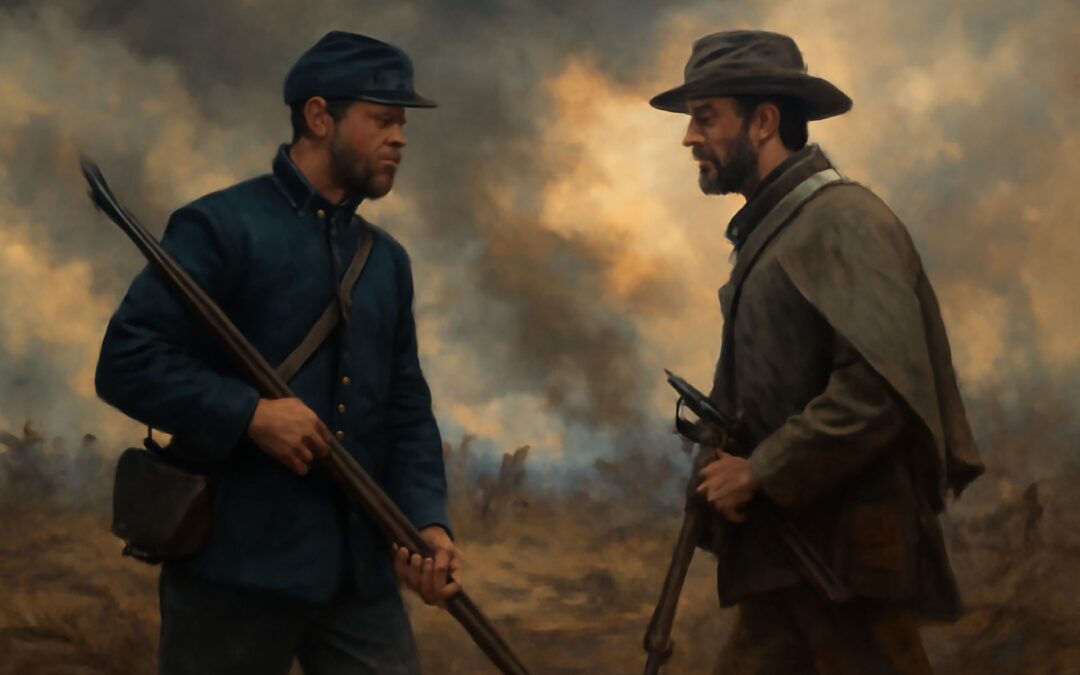
The American Civil War remains the most defining conflict in the nation’s history—a four-year struggle that reshaped the identity, laws, and moral foundation of the United States. It began with decades of tension between two incompatible visions of America: one industrial and forward-looking, the other rooted in slavery and plantation wealth. When compromise finally collapsed, the country descended into a war so devastating that more Americans died in it than in all previous U.S. wars combined.
This article traces the full arc of that conflict—from the simmering divisions that pushed the country to its breaking point, to the rise of leaders like Lincoln, Grant, and Lee, to the pivotal battles that changed the nation’s fate. It recounts the human cost, the turning points, the tragedies, and ultimately the rebirth of a fractured Union. The Civil War was not merely a clash of armies; it was a struggle over the meaning of America itself.
A Nation on the Brink
By the mid-19th century, the United States was a single republic only on paper. In practice, it was two incompatible civilizations locked inside the same borders. The North was transforming at a pace never before seen in American history. Factories multiplied, cities grew into dense industrial hubs, and railroads stitched together distant states with steel and steam. Immigrants poured into northern ports, fueling a booming labor market built on wages rather than bondage. The North saw itself as a modern nation—dynamic, fast-moving, and ready for a future shaped by innovation and industry.
The South existed in a different world entirely. Its wealth came from fertile soil and sprawling plantations that produced cotton at a massive scale. But cotton had a hidden engine: the forced labor of four million enslaved people. That system wasn’t just an economic model; it was the core of Southern political identity and cultural pride. To Southern elites, slavery was not merely an institution—it was the foundation of their society, the source of their prosperity, and, in their view, the natural order of things.
Every time a territory applied for statehood, it threatened to tip the national balance. The question—free or slave?—was not abstract. It determined control of Congress, control of federal policy, and control of the country’s future. The North feared the spread of slavery into the West, while the South feared losing its influence and being surrounded by states that rejected its social and economic system.
Compromises temporarily papered over the divide. The Missouri Compromise of 1820 created a line separating slave and free territories. The Compromise of 1850 attempted to calm tensions by admitting California as a free state while strengthening laws that forced the return of escaped enslaved people. Each compromise was a bandage on a wound that kept reopening. The nation wasn’t healing. It was bleeding out slowly. And by the time the 1860 election approached, the country stood on the edge of collapse.
The Election of 1860: Lincoln’s Arrival
Abraham Lincoln’s rise to power was the antithesis of the political aristocracy that had long dominated American leadership. Born in poverty in a Kentucky log cabin, he spent his childhood chopping wood, working odd jobs, and reading anything he could get his hands on. He had less than a year of formal schooling yet educated himself through relentless study. Lincoln’s early life was a story of resilience—loss, hard labor, and determination forged his worldview long before he entered politics.
His reputation for honesty became legendary. Lincoln once walked miles to return a few cents of accidental overcharge to a customer. Small moments like these built his public image as “Honest Abe,” a man whose word meant something in an era when political corruption was common. But it was his moral stance—firm opposition to the expansion of slavery—that defined him as a political force.
Lincoln did not call for the immediate abolition of slavery in the states where it existed. Instead, he believed the nation could find stability only by stopping its spread into new territories. This position, moderate by today’s standards, was perceived by the South as a direct attack on their very existence. Slavery wasn’t merely a labor system—it was the foundation of their political power. If new states entered the Union as free states, the South would lose control of Congress, lose national influence, and eventually face a future where their way of life was outnumbered and overruled.
When Lincoln won the presidency in 1860 without a single Southern electoral vote, the message to Southern leaders was unmistakable: they no longer had a path to dominate national politics. The political center of gravity had shifted northward. In their eyes, the Union they had helped build was slipping away from them.
Secession: The Confederacy Forms
Lincoln’s election acted as a spark in a room already filled with gunpowder. Just weeks after the results were announced, South Carolina voted to secede from the Union—the first state to do so. Its leaders issued declarations arguing that the federal government no longer protected their rights, particularly the right to maintain and expand slavery. For them, secession wasn’t rebellion; it was self-preservation.
Soon, a chain reaction swept across the South. Mississippi, Florida, Alabama, Georgia, Louisiana, and Texas followed South Carolina’s lead. Together, they formed the Confederate States of America, a new nation built explicitly to safeguard slavery as its cornerstone. Their constitution protected the institution outright, removing any ambiguity about the purpose of their secession.
Jefferson Davis, a former U.S. senator and Secretary of War, became the Confederacy’s president. Leaders across the South felt vindicated—they believed they had taken a stand to preserve their sovereignty and defend an economy they saw as essential. Their departure was not a reluctant one; it was celebrated by many Southern elites as a bold act of independence.
Lincoln, still weeks away from taking office, watched a nation unravel. He refused to recognize the Confederacy’s legitimacy and remained firm in his belief that no state had the constitutional right to secede. To him, the Union was perpetual—an unbreakable bond established by the founders.
Yet as the Confederacy grew, the Union fractured. Federal forts throughout the South suddenly sat on foreign soil. Tensions climbed higher, and the question was no longer if conflict would erupt, but where the first shot would be fired.
Fort Sumter and the Start of the War
Fort Sumter, located in Charleston Harbor, South Carolina, was one of the last remaining Union outposts in the South. As Southern states seceded and formed their own government, they took control of most federal property within their borders, but Fort Sumter remained under Union control. Its strategic location at the entrance to Charleston Harbor made it a symbol of federal authority in a region that no longer recognized that authority.
South Carolina, the first state to secede, demanded that the Union abandon the fort. When Major Robert Anderson, the Union commander at Fort Sumter, refused to surrender, the Confederacy saw it as a direct challenge. The Confederate government, led by President Jefferson Davis, knew that it had to act decisively. Charleston, with its large Confederate support base, was a crucial city. To let Fort Sumter remain in Union hands would signal to the rest of the South that the Confederacy’s authority was not absolute.
On April 12, 1861, Confederate General P.G.T. Beauregard ordered his artillery to open fire on the fort. The bombardment lasted for 34 hours, with Confederate guns relentlessly pounding the fortifications. The Union soldiers, caught off guard and with limited supplies, held out bravely. But on April 13, Anderson, realizing that further resistance would lead to unnecessary bloodshed, surrendered the fort.
Remarkably, despite the intense cannon fire, there were no casualties during the assault. But the damage had been done. The Confederacy had fired the first shots of the war, and the United States was now irrevocably drawn into the conflict. Lincoln responded swiftly, calling for 75,000 volunteers to suppress the rebellion. His call to arms ignited passions in the North, but it also escalated the conflict, pushing four more Southern states—Virginia, Arkansas, Tennessee, and North Carolina—into secession. The war that had been simmering for decades was now an undeniable reality.
The Battle of Bull Run: A Shocking Beginning
The Battle of Bull Run, fought on July 21, 1861, was the first major battle of the Civil War. Union forces, under the command of General Irvin McDowell, marched toward Confederate-held Manassas, Virginia, hoping to crush the Southern army and end the rebellion quickly. Many in the North, including civilians, believed that a decisive victory would restore the Union. The public was eager for a swift resolution to the conflict, and the Union army, though untested, was expected to easily overpower the Confederacy.
In the early stages of the battle, the Union army had some success. They pushed back the Confederate forces, and it seemed as though victory was within reach. However, the Confederates, under the leadership of General Pierre G.T. Beauregard and General Joseph E. Johnston, held firm. Confederate reinforcements, led by the newly arrived General Thomas “Stonewall” Jackson, turned the tide of the battle. Jackson’s troops stood their ground in the face of heavy Union assault, earning him the nickname “Stonewall” for his unyielding defense.
The momentum quickly shifted in favor of the Confederacy. As Union forces began to retreat, panic spread throughout their ranks. The retreat turned into a chaotic rout, with soldiers fleeing the battlefield in disarray. Civilians who had come to watch the battle from nearby Washington, D.C., also found themselves caught up in the confusion, fleeing for their lives.
The Confederacy’s victory at Bull Run was a devastating blow to the Union. It shattered the North’s confidence and destroyed any illusions that the war would be a quick or easy victory. For the South, it was a morale-boosting triumph. Yet, despite the victory, the Confederate forces failed to follow up on their success. The Union army had been badly beaten, but the war was far from over. Bull Run marked the beginning of a long and brutal conflict that would test the will of both sides.
Grant’s Rise: Unconditional Surrender
While the war’s early battles in the East were dominated by the failure of Union generals to secure decisive victories, the Western theater of the war began to see the rise of a new and formidable leader: Ulysses S. Grant. Grant, a relatively unknown and underappreciated officer at the start of the war, quickly earned a reputation for his unrelenting pursuit of victory.
Grant’s first major success came in February 1862, when he captured Fort Henry and Fort Donelson in Tennessee. The fall of these forts was a significant blow to the Confederacy, as they were key strategic points along the Tennessee and Cumberland Rivers. Grant’s demand for “unconditional and immediate surrender” from the Confederate commanders at Fort Donelson made headlines and solidified his growing reputation as a determined and relentless commander.
The victory at Fort Donelson marked the beginning of Grant’s rapid ascent. His refusal to negotiate or settle for anything less than total victory would become a defining characteristic of his leadership style. Unlike many of his counterparts, Grant was not deterred by setbacks or the heavy casualties that came with war. He understood that the key to defeating the Confederacy was not just defeating its armies but wearing them down, breaking their will to fight, and forcing them to concede.
Grant’s next major test came at the Battle of Shiloh in April 1862. Confederate General Albert Sidney Johnston launched a surprise attack on Grant’s troops near the Tennessee River, and for a moment, it seemed that the Union army might collapse. Grant’s forces were pushed back, and many feared that he might be defeated. But Grant’s resolve remained unshaken. Reinforcements arrived overnight, and by the second day of fighting, Grant launched a counteroffensive, forcing the Confederates to retreat.
The Battle of Shiloh resulted in more than 23,000 casualties, more than any previous American battle. Despite the staggering losses, Grant was undeterred. He understood that war was not about avoiding casualties, but about achieving victory at all costs. His tenacity in the face of such destruction earned him the respect of his superiors and the soldiers under his command. Grant’s approach to warfare—uncompromising, aggressive, and relentless—would shape the outcome of the war in the years to come. He had proven that he was the leader the Union needed to win the war.
The Battle of Antietam: America’s Bloodiest Day
By the fall of 1862, the Confederacy was riding a wave of confidence. Robert E. Lee had taken the bold step of invading the North, hoping that a major victory on Union soil would shatter Northern morale and possibly earn European recognition. His army crossed into Maryland, spreading alarm throughout the Union. But fate intervened in a way almost too improbable to believe: a Union soldier discovered a lost copy of Lee’s detailed battle plans, wrapped around three cigars in an abandoned Confederate campsite. The Union suddenly had the Confederacy’s entire blueprint in hand.
Armed with this extraordinary advantage, Union General George McClellan moved his army to confront Lee near Sharpsburg, Maryland. What followed on September 17, 1862, became the bloodiest single day in American history.
The battle unfolded in phases, each more brutal than the last. At dawn, Union forces surged into the Cornfield, a peaceful patch of farmland that quickly transformed into a killing ground. Soldiers described the volleys of musket fire as so thick that the air itself seemed to shimmer. Men fell in waves, and the field changed hands repeatedly as both sides poured in reinforcements. After just a few hours, thousands lay dead or wounded among the trampled stalks.
Next came Bloody Lane, a sunken road where Confederate soldiers dug in and unleashed devastating fire on advancing Union troops. Union forces charged again and again, each time cut down by the withering Confederate defense. Eventually, Union soldiers flanked the lane and fired into the packed Confederate ranks from above. The road became a trench filled with bodies, stacked so densely that witnesses described it as a “slaughter pen.”
The final phase of the battle took place at Burnside’s Bridge, where Union forces attempted to cross Antietam Creek. Confederate sharpshooters held the high ground and turned the crossing into a deadly bottleneck. After hours of fierce fighting, the Union finally pushed across—but by then, Confederate reinforcements had arrived to stabilize Lee’s line.
By sunset, more than 23,000 Americans were dead, wounded, or missing. Antietam was tactically inconclusive—Lee withdrew, and McClellan failed to pursue. But strategically, it was a turning point. The Union held the field, and Lee’s invasion was halted.
More importantly, the battle gave Lincoln the opportunity he had been waiting for. With the Confederates pushed back, he announced the Emancipation Proclamation, transforming the war from a conflict over union into a fight for freedom itself.
The Emancipation Proclamation: A Turning Point
On January 1, 1863, President Abraham Lincoln issued the Emancipation Proclamation—one of the most consequential documents in American history. It declared that all enslaved people in Confederate-held territory “shall be then, thenceforward, and forever free.” While it did not immediately free all enslaved people, its symbolic and strategic power was enormous.
First, it redefined the purpose of the war. The Union was no longer fighting solely to preserve the nation. It was now fighting for human liberty. This moral repositioning rallied Northern support and undermined Confederate claims that their cause was rooted only in states’ rights.
Second, it opened the door for Black enlistment in the Union army. Nearly 200,000 Black soldiers and sailors eventually joined the war effort, adding crucial manpower at a time when the North desperately needed it. Their service was transformative—not just militarily, but socially—challenging racist assumptions and proving their courage on the battlefield.
Third, the proclamation slammed the door on European intervention. Britain and France, which had considered assisting the Confederacy, could no longer justify supporting a government fighting to preserve slavery. Public opinion in Europe overwhelmingly sided with emancipation, making any alliance with the Confederacy politically toxic.
Finally, the proclamation delivered a psychological blow to the South. Enslaved people across Confederate territory heard the news and saw the advancing Union armies as liberators. Thousands fled plantations, weakening the Southern labor force and fueling the Union war effort.
Lincoln understood that the proclamation would forever change America’s moral landscape. “If my name ever goes into history,” he said, “it will be for this act.” He was right. It became the turning point that reshaped the nation’s identity and carried the Union into the next phase of the war with renewed purpose.
The Battle of Gettysburg: A Union Victory
By the summer of 1863, Robert E. Lee made another daring decision: he would invade the North again. His goal was to force a decisive victory on Union soil, crush Northern morale, and possibly bring the war to an end. His 75,000-man army moved into Pennsylvania, unaware that Union forces under General George Meade were closing in.
The two armies collided unexpectedly near the town of Gettysburg on July 1, 1863. What began as a skirmish escalated rapidly. Confederate forces gained the upper hand, pushing Union troops through the town and onto defensive positions along Cemetery Ridge. As night fell, the Confederates believed they were on the verge of another major victory.
Day two brought chaos on a massive scale. Lee launched a series of powerful assaults on both Union flanks. One of the fiercest battles took place at Little Round Top, a rocky hill whose fall could have unraveled the entire Union line. Colonel Joshua Chamberlain and the 20th Maine held the position against repeated Confederate attacks. When their ammunition ran out, Chamberlain ordered a bayonet charge down the hillside—a desperate and astonishing maneuver that succeeded in driving the Confederates back and saving the Union flank.
Meanwhile, brutal fighting erupted at places like Devil’s Den, the Wheatfield, and Cemetery Hill. The day ended with staggering casualties but a resilient Union line that refused to break.
On the third day, Lee made his boldest gamble yet: a frontal assault on the center of the Union line. This attack—later known as Pickett’s Charge—saw nearly 12,000 Confederate soldiers march across open fields under relentless Union artillery and rifle fire. The Confederates were shattered. Only a fraction of the attacking force returned.
General Lewis Armistead briefly broke through the Union line, placing his hand on a Union cannon in a final, symbolic moment of defiance before being fatally wounded. It was the high-water mark of the Confederacy—the closest Lee ever came to winning the war.
The three-day battle produced roughly 50,000 casualties, making it the deadliest engagement of the Civil War. Gettysburg ended Lee’s invasion and turned the momentum firmly toward the Union. It was a psychological victory as much as a military one, proving that the Confederacy was not invincible and that the Union, when well led, could withstand even Lee’s audacity.
Gettysburg, paired with the Union victory at Vicksburg the very next day, marked the turning point of the war. From here on, the Confederacy would fight on the defensive, slowly squeezed by the Union’s growing strength.
Sherman’s March to the Sea: Total War
After the twin Union victories at Gettysburg and Vicksburg in 1863, the Confederacy was no longer advancing—it was surviving. Ulysses S. Grant, newly promoted to command all Union armies, understood that the war would not end through traditional battles alone. The Confederacy had to be stripped of its capacity and will to resist. For this, he turned to his most unorthodox general: William Tecumseh Sherman.
Sherman believed in a concept he called total war—the idea that victory required breaking not just the enemy’s army, but the society supporting it. To Sherman, war was a force of nature: cruel, overwhelming, and decisive. “The crueler it is, the sooner it will be over,” he said. His approach was not targeted at civilians but at the systems that enabled the Confederate war effort—railroads, factories, farms, and supply lines.
In the summer of 1864, Sherman captured Atlanta after a brutal campaign through northern Georgia. The fall of Atlanta sent shockwaves across the South and reinvigorated Northern morale just weeks before Lincoln’s re-election. With Atlanta secured, Sherman prepared for one of the most daring operations of the entire war: a march straight to the Atlantic coast, through the heart of Georgia, without any supply lines connecting him to the North.
On November 15, Sherman’s 60,000 men set out in two massive columns, covering a front nearly 60 miles wide. They moved like a slow, unstoppable tide. Railroads were torn up and twisted into “Sherman’s neckties.” Cotton gins and factories were burned. Warehouses were emptied. Bridges, mills, and depots were destroyed. It was a systematic dismantling of the Confederate war machine.
Everywhere the army marched, enslaved people fled plantations and joined the column—thousands at a time. For them, Sherman’s army was not an invading force but a liberating one. The march became both a military operation and a moving line of self-emancipation. Songs of freedom echoed behind the marching columns.
Confederate forces were unable to confront Sherman directly. He moved too fast and struck too broadly, slipping between Confederate armies and cutting off the economic arteries of the South. Unlike the grinding trench warfare around Richmond, Sherman’s march was mobility and shock—psychological warfare combined with logistical destruction.
On December 21, 1864, Sherman reached Savannah. Instead of resistance, he found the city undefended. He wired Lincoln a now-famous message: “I beg to present you as a Christmas gift the city of Savannah.” The march had carved a 300-mile scar across Georgia and signaled to the Confederacy that the end was inevitable.
Sherman didn’t stop there. After resting and resupplying, he turned north into South Carolina—the birthplace of secession—intent on breaking the last remnants of Confederate resolve. The message was clear: the Confederacy could not hide, could not escape, and could not recover. The war was entering its final phase.
The Fall of Richmond: The End of the Confederacy
By early 1865, the Confederacy was running out of everything—men, food, ammunition, horses, clothing, and hope. Grant’s relentless Overland Campaign had driven Lee’s army into defensive trenches around Petersburg, just south of the Confederate capital of Richmond. For nine months, Lee’s army clung to life while Grant tightened the noose, severing rail lines and choking off supplies.
The South was collapsing from within. Soldiers deserted to find food for their starving families. Civilians in Richmond survived on meager rations. Confederate currency was nearly worthless. The government’s ability to sustain the war had disintegrated.
In March, Grant launched a final series of coordinated attacks. Sherman was marching up through the Carolinas, crushing the last Confederate forces in the region. Grant simultaneously pressed Lee from the east and south. At Five Forks on April 1, 1865, Union troops broke through the Confederate defenses, cutting the last major supply line into Petersburg.
Lee knew the position was no longer tenable. On April 2, he sent word to President Jefferson Davis: Richmond must be evacuated. The Confederate government fled the city in haste, destroying supplies and warehouses to prevent them from falling into Union hands. But the fires roared out of control, spreading across Richmond and engulfing blocks of the city in flames. Residents fled through streets filled with smoke, collapsing buildings, and burning embers falling from the sky. It was the symbolic self-destruction of the Confederacy’s capital.
Union forces entered Richmond the next day. The city that had once declared itself the heart of a new nation lay in ruins. Crowds of newly freed Black residents cheered the arrival of Union troops, realizing that the war—and slavery—was ending.
Meanwhile, Lee attempted one last escape. With roughly 30,000 exhausted, starving soldiers, he fled west, hoping to link up with remaining Confederate forces and continue the fight. But Grant anticipated every move. Union cavalry cut off the routes ahead of Lee, while infantry closed in from behind.
For miles, the Confederate retreat became a slow-motion collapse. Soldiers scavenged for food, pulling bark off trees and boiling scraps of leather. Entire regiments dissolved as men surrendered or deserted. The Southern armies were not just beaten—they were broken.
By early April, Lee was surrounded. There were no more roads to take, no supplies to reach, and no reinforcements coming. The Confederacy had lost its capital, lost its army’s strength, and lost any hope of prolonging the war.
All that remained was surrender.
Appomattox: The End of the Civil War
By April 1865, Robert E. Lee’s Army of Northern Virginia—once the pride of the Confederacy—was reduced to a starving, exhausted remnant. With Richmond fallen and Confederate supply lines severed, Lee’s only hope was to escape west, link up with General Joseph E. Johnston in North Carolina, and attempt one final stand. But Grant anticipated every movement. Union cavalry under Philip Sheridan raced ahead, cutting off roads and capturing supply trains, while infantry pressed relentlessly from behind.
As Lee’s army retreated, the scenes grew increasingly desperate. Men collapsed from hunger. Horses fell dead along the roadside. Units dissolved as soldiers surrendered in small groups or simply walked away, knowing the war was lost. Officers tried to keep discipline, but even they understood the truth—they were fighting for a cause that no longer had an army, a capital, or a future.
On April 8, Union forces blocked the last usable road near the village of Appomattox Court House. Lee ordered one final breakout attempt on the morning of April 9, hoping that his infantry could punch through long enough for the army to escape. His cavalry charged forward and initially had some success. But then they saw what lay beyond the ridge: lines and lines of Union infantry waiting silently, rifles at the ready. The Confederate advance stalled. There would be no escape.
Lee understood. Further fighting would mean nothing but useless death. He sent word to Grant requesting a meeting.
The contrast between the two generals was stunning. Lee arrived immaculate in his finest dress uniform, polished sword at his side—a final assertion of dignity and honor. Grant, by contrast, arrived wearing a mud-splattered private’s coat, unaware that he was about to enter one of the most iconic scenes in American history.
Inside the McLean farmhouse, the two men spoke quietly. They reminisced briefly about the Mexican-American War—two veterans meeting under the shadow of a nation’s suffering. Then Grant offered terms so generous they stunned even Lee. Confederate soldiers would be allowed to return home. Officers could keep their sidearms. Cavalrymen and artillerymen could keep their horses, knowing they would need them for spring planting. Most importantly, no one would be punished for treason.
Lee read the terms slowly, tears forming in his eyes. “This will have a very happy effect on my army,” he said, moved by the humanity of the gesture.
Before leaving, Lee asked if Grant could supply rations for his starving men. Grant immediately ordered 25,000 meals delivered.
As Lee mounted his horse to return to his troops, Union soldiers silently removed their hats in respect. When he reached his men, many broke down and wept, reaching for his hand as he passed. Without speaking, Lee simply removed his hat and saluted them.
The Civil War—America’s bloodiest, most defining conflict—was effectively over.
The Assassination of Lincoln: A Tragic End
The nation barely had time to absorb the joy of peace before it was struck by one of the darkest moments in its history. On April 14, 1865—just five days after Lee’s surrender—President Abraham Lincoln attended a play at Ford’s Theatre in Washington, D.C. It was meant to be a rare moment of relaxation after four years of relentless leadership through war.
John Wilkes Booth, a well-known actor and ardent Confederate sympathizer, saw Lincoln’s presence at the theater as an opportunity. He believed that killing the president would revive the Confederate cause or at least avenge its defeat. Booth slipped into the presidential box shortly after 10 p.m., aimed a pistol at the back of Lincoln’s head, and fired a single shot.
Lincoln never regained consciousness.
The theater erupted in chaos. Booth leapt onto the stage, breaking his leg in the fall, and shouted “Sic semper tyrannis!”—“Thus always to tyrants.” He escaped into the night, triggering one of the largest manhunts in American history.
Lincoln was carried across the street to a boarding house, where doctors worked through the night, knowing the wound was fatal. Cabinet members, soldiers, and friends gathered around his bed. At 7:22 the next morning, Abraham Lincoln died.
The timing made the tragedy unbearable. Lincoln had preserved the Union, ended slavery’s expansion, and issued the Emancipation Proclamation. He had just witnessed the peace he spent four years fighting to secure. Yet he never saw Reconstruction, never guided the nation through healing, never witnessed the full impact of his legacy.
The country mourned deeply. Black Americans in particular grieved as though they had lost a father. Crowds followed his funeral train for 1,600 miles, lining the tracks from Washington to Springfield, Illinois.
Lincoln’s assassination was not only a personal tragedy—it altered the course of American history. Without his steady leadership, Reconstruction became chaotic, vengeful, and incomplete. The nation lost the one man who might have repaired the country with compassion instead of division.
His legacy, however, endured. Lincoln had preserved the Union through its darkest hour, struck a mortal blow against slavery, and pushed America closer to the ideals of its founding creed: that all people are created equal.
Conclusion
When the guns finally fell silent in 1865, the United States emerged forever transformed. The Confederacy collapsed, slavery was shattered, and the Union—bloodied but unbroken—stepped into a new era with a renewed sense of purpose. Yet the victory came at immense cost: more than 600,000 lives lost, entire cities burned, and families torn apart. And just as the country began to heal, it lost the man who had guided it through its darkest hour. Lincoln’s assassination cast a long shadow over the fragile peace that followed.
Still, the Civil War gave the nation a second chance to live up to its founding ideals. It redefined freedom, expanded the promise of equality, and set the stage for the long, unfinished struggle for civil rights. The war’s legacy endures in the landscape, in the laws, and in the unresolved debates that continue to shape the American experience. It remains a reminder of both the nation’s greatest conflict and its greatest opportunity for renewal.