
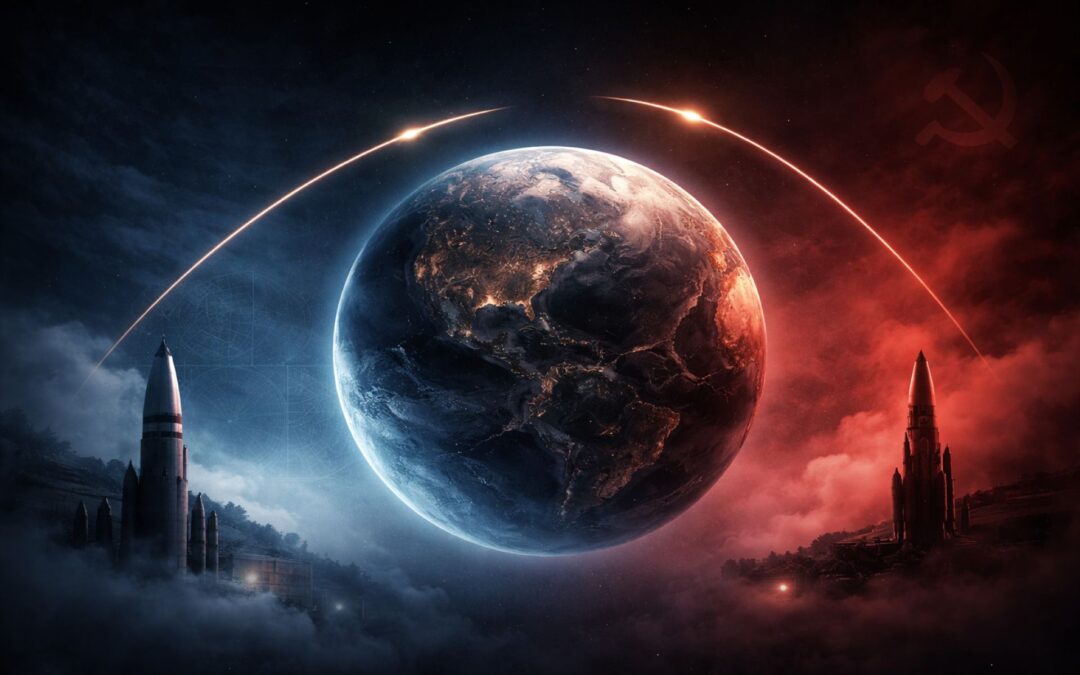
Introduction: A Peace That Wasn’t Peace
In 1945, the world exhaled.
Nazi Germany had surrendered. Imperial Japan would soon follow. Cities that had burned for six years filled with celebration. London danced. New York flooded with confetti. Moscow erupted in relief. After tens of millions dead, humanity believed it had survived its darkest chapter.
But beneath the celebration, a new conflict was already forming.
The alliance that defeated Hitler was never built on trust. It was built on necessity. The United States, the Soviet Union, and Britain had united against a common enemy. Once that enemy disappeared, so did the glue holding them together. What remained were two superpowers with incompatible visions of how the world should work.
The United States emerged from World War II wealthy, industrially dominant, and in possession of the atomic bomb—the most destructive weapon ever created. It championed capitalism, free markets, democracy, and individual liberty.
The Soviet Union emerged victorious but devastated. It had lost roughly 27 million people in the war. Entire regions were flattened. Security, not liberty, became its obsession. Under Joseph Stalin, Moscow sought buffer states, centralized control, and the global spread of communism as both ideology and shield.
Each side viewed the other not as a rival, but as an existential threat.
Over the next 45 years, this tension would harden into the Cold War—a sustained state of ideological confrontation, nuclear brinkmanship, proxy wars, espionage, propaganda, and technological competition. It would divide continents, build walls through cities, and stockpile enough weapons to destroy human civilization several times over.
And yet, despite coming closer to nuclear annihilation than most people realize, the Cold War ended without a single atomic weapon being used after 1945.
It was not peace.
It was a balance of terror—maintained by deterrence, fragile diplomacy, and at critical moments, by individual decisions made under unbearable pressure.
To understand the Cold War is to understand how close the modern world came to ending itself—and why it didn’t.
The Fragile Alliance Breaks (1945–1947)
When World War II ended, Europe was physically shattered and politically unstable. Governments had collapsed. Economies were in ruins. Millions were displaced. Into that vacuum stepped two powers with radically different visions for the future.
On one side stood the United States.
America had avoided the physical destruction that consumed Europe and Asia. Its factories were intact. Its economy was booming. And in 1945, it alone possessed the atomic bomb. This combination of economic strength and military supremacy gave Washington unprecedented global influence.
On the other side stood the Soviet Union.
The USSR had absorbed the brunt of Nazi aggression. Entire cities were leveled. Roughly 27 million Soviet citizens had died. For Joseph Stalin, security was not abstract—it was survival. Twice in three decades, foreign armies had invaded Russia through Eastern Europe. His solution was straightforward: ensure it never happened again.
The problem was that security for the Soviets meant dominance over Eastern Europe.
At wartime conferences in Yalta and Potsdam, Allied leaders discussed postwar arrangements. On paper, they agreed to democratic elections in liberated territories. In practice, the Red Army was already stationed across much of Eastern Europe. Soviet-backed governments soon emerged in Poland, Romania, Bulgaria, Hungary, and later Czechoslovakia.
These were not open democratic systems. Opposition leaders were sidelined, arrested, or eliminated. Communist parties consolidated power under Moscow’s guidance.
In Washington, this looked less like defensive security and more like expansion.
President Harry Truman—who had assumed office suddenly after Franklin Roosevelt’s death—approached the Soviets with growing suspicion. Unlike Roosevelt, who believed cooperation with Stalin might be possible, Truman viewed Soviet actions as aggressive and ideological.
The mistrust hardened in 1946 when former British Prime Minister Winston Churchill delivered a speech in Missouri declaring that an “Iron Curtain” had descended across Europe—from the Baltic Sea to the Adriatic. The phrase captured what many in the West already felt: Europe was splitting into two hostile spheres.
The Soviet Union dismissed the accusation as Western propaganda. But from Moscow’s perspective, American economic and military power was equally threatening. The atomic monopoly, capitalist influence, and calls for democratic elections near Soviet borders all appeared designed to encircle and undermine them.
By 1947, the wartime alliance had effectively dissolved.
The United States articulated a new policy: containment. Rather than trying to overthrow communism where it already existed, America would prevent it from spreading further. The Truman Doctrine pledged support to nations resisting communist influence. The Marshall Plan poured billions of dollars into rebuilding Western Europe—not only as humanitarian aid, but as a strategic defense against instability that could invite communist movements.
The Cold War had not begun with gunfire between superpowers.
It began with ideology, fear, power vacuums, and incompatible definitions of security. Two nations that had once fought side by side now stood opposite each other—armed, suspicious, and convinced that history was on their side.
The fragile alliance was over. A divided world was taking shape.
Containment and the Division of Europe
As mistrust hardened into doctrine, Europe became the first major battleground of the Cold War—not through open war between superpowers, but through political pressure, economic strategy, and strategic positioning.
The Soviet Union moved quickly across Eastern Europe. Backed by the Red Army, communist governments consolidated control in Poland, Hungary, Romania, Bulgaria, and eventually Czechoslovakia. Opposition parties were marginalized or outlawed. Elections, where held, were tightly controlled. Secret police forces enforced loyalty.
From Moscow’s perspective, these states were defensive buffers—insurance against another catastrophic invasion from the West.
From Washington’s perspective, they were evidence of systematic expansion.
In response, the United States formalized containment. The Truman Doctrine in 1947 pledged American support to any nation resisting communist pressure. Shortly after, the Marshall Plan committed over $12 billion to rebuild Western European economies. Officially, it was economic recovery aid. Strategically, it was a firewall against instability that might empower communist movements.
Western Europe recovered rapidly. Eastern Europe, aligned with the Soviet bloc, rejected Marshall Plan assistance and integrated into Moscow’s economic sphere.
Nowhere did this division become more dangerous than in Germany.
After the war, Germany was divided into four occupation zones: American, British, French, and Soviet. Berlin, the former Nazi capital, was also divided—even though it sat deep inside the Soviet zone.
This created an unstable anomaly: West Berlin became a democratic enclave surrounded by communist territory.
In 1948, tensions reached a breaking point. The Western Allies introduced a new currency in their zones to stabilize the German economy. Stalin viewed this as a step toward creating a separate West German state—one aligned against him.
His response was calculated and aggressive.
Soviet forces blockaded all ground access to West Berlin. Roads, railways, and canals were cut off. Nearly two million people were isolated from food, fuel, and medicine. The message was clear: abandon West Berlin or risk escalation.
The Western powers faced a dilemma. Forcing the blockade open by military means could trigger direct war with the Soviet Union. Abandoning the city would signal weakness and undermine containment.
Instead, they chose a third option.
The Berlin Airlift.
For nearly a year, American and British planes flew around the clock, delivering coal, food, and supplies to sustain the city. At peak capacity, planes landed every few minutes. It was an extraordinary logistical effort—and a powerful demonstration of resolve without direct confrontation.
Stalin eventually lifted the blockade in 1949.
The first major crisis of the Cold War had ended without gunfire between superpowers. But its consequences were permanent. Germany formally split into two states: the Federal Republic of Germany (West Germany) and the German Democratic Republic (East Germany).
Soon after, NATO was formed as a collective defense alliance among Western nations. In response, the Soviets would later form the Warsaw Pact.
Europe was no longer simply recovering from World War II.
It was now divided into armed camps, locked in a standoff that would define the next four decades.
The Nuclear Arms Race and Mutual Assured Destruction
While Europe divided along political lines, a far more dangerous competition was unfolding in laboratories and missile silos.
In 1945, the United States held a decisive advantage: it possessed the atomic bomb. The destruction of Hiroshima and Nagasaki had demonstrated a weapon unlike anything in human history. For a brief moment, Washington had nuclear monopoly—and with it, unmatched strategic leverage.
That monopoly did not last long.
In 1949, the Soviet Union successfully detonated its first atomic bomb. American intelligence had underestimated how quickly Moscow would catch up. Soviet espionage had accelerated their program, providing crucial information about U.S. research.
The balance of power shifted overnight.
Now both superpowers had the ability to devastate cities with a single weapon. But instead of stabilizing tensions, nuclear parity intensified them.
The race escalated.
By the early 1950s, both sides developed hydrogen bombs—thermonuclear weapons exponentially more powerful than the bombs dropped on Japan. These devices were not measured in kilotons, but in megatons. Entire metropolitan regions could vanish in seconds.
Missile technology advanced rapidly. Strategic bombers gave way to intercontinental ballistic missiles (ICBMs). Submarines capable of launching nuclear weapons from beneath the oceans ensured that even a surprise attack could not eliminate a nation’s ability to retaliate.
Out of this terrifying logic emerged a doctrine with a chilling acronym: MAD—Mutual Assured Destruction.
The principle was simple. If one side launched nuclear weapons, the other would respond with equal or greater force. Both societies would be annihilated. No one would win. There would be no recovery.
Paradoxically, this insanity created stability.
Because if pressing the button guaranteed your own destruction, then the rational move was restraint. Nuclear weapons became less tools of war and more instruments of deterrence. Their power lay not in use, but in the threat of use.
Yet the psychological consequences were immense.
Civil defense drills became routine. Children practiced “duck and cover.” Governments built fallout shelters. Military planners modeled extinction scenarios. Humanity lived under a permanent shadow—the knowledge that civilization could end in less time than it took to boil water.
By the 1960s, both sides had accumulated thousands of warheads—enough to destroy the planet several times over. The question was no longer whether either side could win a nuclear war.
It was whether leaders, systems, and human judgment could prevent one from ever starting.
The nuclear arms race did not produce immediate catastrophe.
But it ensured that every crisis from that point forward carried the risk of irreversible escalation.
The Cold War Turns Hot: Korea
Until 1950, the Cold War had remained largely a standoff—economic pressure, political maneuvering, and nuclear threats without direct battlefield confrontation between the superpowers.
That changed on the Korean Peninsula.
At the end of World War II, Korea—formerly occupied by Japan—was divided along the 38th parallel. Soviet forces accepted Japan’s surrender in the north; American forces did so in the south. What was meant to be temporary hardened into permanence.
Two rival states emerged.
In the north, Kim Il-sung established a communist regime backed by Moscow. In the south, Syngman Rhee led an anti-communist government supported by Washington.
Both claimed legitimacy over the entire peninsula.
In June 1950, North Korean forces crossed the 38th parallel in a surprise invasion. Backed by Stalin and equipped with Soviet weapons, they advanced rapidly, pushing South Korean forces—and the small number of American troops stationed there—into a shrinking perimeter near the southern port of Pusan.
The United States responded under the banner of the United Nations, framing the conflict as collective resistance to aggression. Containment was now being tested in real time.
American-led forces launched a bold counterattack at Inchon, cutting off North Korean supply lines and reversing the tide. Within months, UN troops advanced northward, driving North Korean forces almost to the Chinese border.
That move proved decisive.
China, newly under communist leadership after Mao Zedong’s victory in 1949, viewed the presence of hostile forces near its border as unacceptable. Hundreds of thousands of Chinese troops poured into Korea, overwhelming American lines and forcing a brutal retreat.
The war settled into a grinding stalemate near the original dividing line.
At one point, General Douglas MacArthur, commanding UN forces, publicly advocated expanding the war into China—and even suggested the possible use of nuclear weapons. President Harry Truman rejected the proposal. Escalation risked direct war with China and potentially the Soviet Union.
When MacArthur continued to challenge civilian leadership publicly, Truman removed him from command. The message was clear: nuclear weapons were not to be used lightly, even in the face of military frustration.
After three years of brutal combat, an armistice was signed in 1953. The border remained near the 38th parallel—almost exactly where it had begun.
The cost was staggering: approximately 36,000 American soldiers killed, over two million Korean civilians and soldiers dead, and vast destruction across the peninsula.
The Korean War demonstrated something fundamental about the Cold War.
It could turn hot—but not into direct superpower war.
The United States and Soviet Union avoided fighting each other directly. Instead, they supported opposing sides in regional conflicts. This model—proxy war—would define much of the Cold War’s violence.
The Korean Peninsula remains divided to this day.
The Cold War had proven it was not merely ideological tension or nuclear brinkmanship.
It was a global struggle capable of spilling real blood.
Khrushchev, Sputnik, and the Space-Missile Race
When Joseph Stalin died in 1953, the world held its breath.
For nearly three decades, he had ruled the Soviet Union through fear, purges, and absolute control. His death created uncertainty—but also opportunity. After a brief power struggle, Nikita Khrushchev emerged as the new Soviet leader.
Unlike Stalin, Khrushchev did not rely solely on terror. In a stunning 1956 speech, he denounced Stalin’s crimes and cult of personality. He spoke of “peaceful coexistence” with the West—suggesting that communism and capitalism might compete without direct war.
But peaceful coexistence did not mean weakness.
That same year, when Hungary attempted to break free from Soviet control, Khrushchev sent tanks into Budapest. The uprising was crushed within days. Thousands were killed. The message was unmistakable: the Soviet Union would not tolerate the loss of its satellite states.
While Eastern Europe remained firmly under Moscow’s control, a different kind of competition began to capture global attention.
In 1957, the Soviet Union launched Sputnik—the world’s first artificial satellite—into orbit.
Technically, it was a small metal sphere that transmitted a steady radio signal. Strategically, it was a seismic shock. If the Soviets could launch a satellite into space, they could launch nuclear warheads across continents.
For Americans, the beeping signal from orbit represented vulnerability. It suggested that the USSR might have superior missile technology. Panic spread through political circles and the public alike.
The Space Race was born.
But beneath the spectacle of rockets and astronauts lay a military reality: space technology and missile technology were inseparable. Intercontinental ballistic missiles capable of delivering satellites could also deliver nuclear warheads.
The Soviets scored early symbolic victories. They sent the first animal into orbit. The first human—Yuri Gagarin—circled the Earth in 1961. They achieved the first spacewalk. Each milestone reinforced the perception of Soviet momentum.
The United States responded with ambition.
In 1961, President John F. Kennedy announced that America would land a man on the moon and return him safely to Earth before the decade’s end. It was a technological gamble and a geopolitical statement. The Cold War would not be won solely through military buildup—it would also be won through scientific achievement and global prestige.
At the same time, nuclear arsenals continued to expand. Missile ranges increased. Launch times shortened. Warning systems became more automated. The margin for error narrowed.
The Cold War was no longer confined to Europe or Asia.
It now extended into outer space.
Competition had become multidimensional—military, ideological, technological, and symbolic. Each side sought proof that its system—capitalist democracy or state socialism—represented the future of humanity.
And as both powers demonstrated their ability to reach the heavens, the unspoken implication remained clear:
They could also reach each other.
Berlin Divided: The Wall as a Symbol
By the early 1960s, Berlin had become the most visible fault line of the Cold War.
West Berlin, though surrounded by communist East Germany, remained aligned with the Western powers. It was a democratic enclave inside the Soviet sphere—prosperous, open, and visibly different from the system across the border.
That contrast became a problem for East Germany.
Throughout the 1950s, millions of East Germans fled westward, many through Berlin, where the border remained relatively porous. Doctors, engineers, teachers, and skilled workers left in waves. It was a slow bleed of talent and legitimacy.
For Soviet leadership, the flow of refugees was more than an economic issue—it was a political embarrassment. If communism was superior, why were so many risking everything to escape it?
In August 1961, the answer came in concrete and barbed wire.
Overnight, East German authorities sealed the border. Streets were cut in half. Rail lines were severed. Families found themselves separated with no warning. What began as barbed wire quickly transformed into a fortified barrier: concrete walls, guard towers, floodlights, anti-vehicle trenches, and soldiers with orders to shoot.
The Berlin Wall had risen.
Officially, it was described as an “anti-fascist protective barrier.” In reality, it was designed to keep people in.
At least 140 people were killed attempting to cross. Some were shot while climbing. Others drowned in canals or died from injuries sustained during escape attempts. Each death reinforced the wall’s purpose: deterrence through fear.
For the West, the Wall became the most potent symbol of the Cold War. It represented division—not just of a city, but of Europe, ideology, and the human experience.
In 1963, President John F. Kennedy visited West Berlin. Standing before a crowd near the Wall, he delivered a speech that echoed around the world. He declared solidarity with the people of Berlin and emphasized that no democratic society had ever needed to imprison its own citizens to survive.
The message was clear: freedom might be imperfect, but it did not require walls.
The Berlin Wall stabilized the immediate refugee crisis. It also hardened the division of Germany into a long-term reality. Armed checkpoints stood only meters apart. American and Soviet tanks once faced each other at close range during tense standoffs.
Berlin was no longer merely a divided city.
It was the physical embodiment of the Cold War—a concrete reminder that the ideological struggle between East and West was not abstract. It shaped borders, lives, and futures.
And within a year of its construction, the world would face a crisis even more dangerous than Berlin.
Thirteen Days That Nearly Ended the World
In October 1962, the Cold War came closer to nuclear war than at any other moment in history.
The crisis began 90 miles off the coast of Florida.
In 1959, Fidel Castro’s revolution had transformed Cuba into a communist state. For the United States, the presence of a Soviet-aligned government in the Western Hemisphere was alarming. In 1961, the CIA backed a failed invasion at the Bay of Pigs in an attempt to overthrow Castro. The operation collapsed, strengthening Cuba’s ties to Moscow.
Soviet leader Nikita Khrushchev saw opportunity.
If the United States had nuclear missiles stationed in Turkey—within striking distance of the Soviet Union—why not place Soviet missiles in Cuba? The move would rebalance strategic pressure and protect a vulnerable ally.
In October 1962, American U-2 spy planes photographed missile construction sites in Cuba. The images were unmistakable: medium- and intermediate-range nuclear missiles capable of striking Washington, New York, and much of the eastern United States within minutes.
President John F. Kennedy faced an agonizing decision.
An immediate airstrike might eliminate the missiles—but it could kill Soviet personnel and trigger retaliation in Europe. A full invasion risked escalation. Doing nothing was politically and strategically unacceptable.
Kennedy chose a naval blockade—carefully labeled a “quarantine”—to prevent further Soviet shipments to Cuba. He addressed the nation on live television, revealing the existence of the missiles and demanding their removal.
The world held its breath.
American forces went to DEFCON 2, the highest alert level ever reached. Strategic bombers armed with nuclear weapons patrolled the skies. Soviet ships steamed toward the blockade line.
Then came October 27—often called “Black Saturday.”
An American U-2 plane was shot down over Cuba. Military commanders pressed for retaliation. At the same time, U.S. destroyers detected a Soviet submarine near the blockade. Unaware that the depth charges being dropped were warning signals, the submarine’s captain believed war might have already begun.
On board was a nuclear torpedo.
Launching it required the agreement of three officers. Two were prepared to fire. The third—Vasili Arkhipov—refused.
He argued that they lacked confirmation of war. He insisted on surfacing and seeking clarification instead of launching a nuclear weapon that would almost certainly trigger full-scale retaliation.
His refusal prevented escalation.
Meanwhile, secret negotiations unfolded. Khrushchev agreed to remove the missiles from Cuba. In return, the United States publicly pledged not to invade Cuba and privately agreed to remove its own nuclear missiles from Turkey.
After thirteen days, the crisis ended.
No missiles were launched. No cities were destroyed. But the lesson was unmistakable: miscalculation, miscommunication, or panic could have ended civilization.
In the aftermath, Washington and Moscow installed a direct hotline to reduce the risk of future misunderstandings. Both sides recognized that brinkmanship had nearly gone too far.
The Cuban Missile Crisis demonstrated the terrifying logic of the Cold War.
Deterrence worked—but only because, at critical moments, leaders chose restraint over pride, and one exhausted officer in a submarine chose caution over catastrophe.
Proxy Wars and Globalized Tension
After the Cuban Missile Crisis, both superpowers understood the catastrophic risks of direct confrontation. Nuclear war was unwinnable. Yet ideological competition did not disappear.
Instead, it shifted outward.
The Cold War became global—not through superpower battles against each other, but through proxy wars fought in developing nations across Asia, Africa, and Latin America. These conflicts were local in geography but international in consequence.
The most consequential of these was Vietnam.
Following World War II, Vietnam sought independence from French colonial rule. Communist leader Ho Chi Minh emerged as a dominant force in the nationalist movement. After the French were defeated in 1954, Vietnam was temporarily divided at the 17th parallel—communist North Vietnam and anti-communist South Vietnam.
Elections intended to reunify the country never occurred.
The United States, guided by the Domino Theory—the belief that if one nation fell to communism its neighbors would follow—deepened its involvement to prevent a communist takeover of the South.
What began as advisory support escalated into full military intervention.
American forces faced a different kind of war than Korea. Vietnam was a guerrilla conflict. The Viet Cong blended into civilian populations, used jungle terrain to their advantage, and relied on irregular tactics rather than conventional battlefield formations. Superior firepower did not translate into decisive control.
The war dragged on.
At its peak, over 500,000 American troops were stationed in Vietnam. Television brought graphic images of combat into living rooms across the United States, fueling domestic opposition. The conflict fractured American society and sparked massive protests.
The human toll was staggering: over 58,000 American soldiers killed and an estimated two million Vietnamese dead, along with immense civilian suffering.
In 1975, after years of gradual American withdrawal, North Vietnamese forces captured Saigon. Vietnam reunified under communist rule.
For the United States, Vietnam was a strategic and psychological blow. It demonstrated that containment could falter and that military superiority did not guarantee political victory.
Yet Vietnam was only one theater.
Across Latin America, the Middle East, and Africa, Cold War dynamics shaped coups, revolutions, and civil wars. The superpowers funded, armed, and trained allied governments or insurgent groups. Often, local populations bore the consequences of global rivalry.
These proxy conflicts allowed Washington and Moscow to compete without directly attacking each other. But they ensured that the Cold War was anything but cold for millions caught in the crossfire.
By the early 1970s, exhaustion and economic pressure encouraged both sides to reconsider constant escalation.
A new phase emerged—one defined less by confrontation and more by cautious recalibration.
Détente and Strategic Recalibration
By the late 1960s, both superpowers were strained.
The United States was politically divided and economically pressured by the Vietnam War. The Soviet Union faced stagnating growth and rising military expenditures. Nuclear arsenals had reached levels capable of planetary destruction many times over.
Escalation had limits.
Out of this fatigue emerged détente—a period of reduced tensions and pragmatic diplomacy during the 1970s. The word, French for “relaxation,” captured a shift in tone rather than an end to rivalry.
Under President Richard Nixon and his National Security Advisor Henry Kissinger, the United States adopted a strategy of realpolitik—prioritizing strategic balance over ideological confrontation.
One of the most surprising developments was the opening to China.
Though both communist, China and the Soviet Union had grown hostile toward each other. Nixon exploited this split. In 1972, he visited Beijing, meeting with Mao Zedong and beginning normalization of relations between the United States and China.
The move altered the global balance. Moscow now faced the prospect of diplomatic isolation and greater pressure from two major powers instead of one.
At the same time, Washington and Moscow pursued arms control agreements.
The Strategic Arms Limitation Talks (SALT I) led to treaties that capped certain categories of nuclear weapons. The Anti-Ballistic Missile (ABM) Treaty limited missile defense systems, reinforcing the logic of Mutual Assured Destruction: neither side would attempt to shield itself completely from retaliation, preserving deterrence stability.
Symbolism mattered too.
In 1975, American and Soviet spacecraft docked together in orbit during the Apollo-Soyuz mission. Images of astronauts shaking hands in space suggested cooperation was possible—even between rivals armed with thousands of warheads.
For a moment, the Cold War appeared manageable.
But détente had limits.
Suspicion never disappeared. Proxy conflicts continued in various regions. Hardliners on both sides criticized concessions as weakness. Economic problems deepened within the Soviet system.
The underlying ideological divide remained unresolved.
By the end of the decade, a new event would shatter the fragile calm and return the Cold War to open confrontation.
Afghanistan and the Return of Confrontation
In December 1979, the Soviet Union sent tens of thousands of troops into Afghanistan.
Officially, it was a limited intervention to stabilize a friendly government facing internal unrest. In reality, it marked a dramatic expansion of Soviet military involvement beyond Eastern Europe—and signaled the collapse of détente.
Afghanistan quickly became the Soviet Union’s Vietnam.
The invasion triggered fierce resistance from Afghan fighters, known as the mujahideen. These groups used guerrilla tactics, mountainous terrain, and local knowledge to wear down Soviet forces. The United States, along with Pakistan and other allies, supplied weapons, funding, and training to the insurgents—including advanced anti-aircraft missiles that neutralized Soviet helicopters.
What Moscow expected to be a quick stabilization mission turned into a grinding war of attrition.
The costs mounted: thousands of Soviet soldiers killed, billions spent, and growing domestic dissatisfaction. Internationally, the invasion was condemned. The United States boycotted the 1980 Moscow Olympics and intensified sanctions.
The Cold War had re-entered a confrontational phase.
When Ronald Reagan became U.S. president in 1981, he rejected the cautious tone of détente. He described the Soviet Union as an “evil empire” and called for renewed military strength. Defense spending surged. New American missiles were deployed in Europe to counter Soviet systems.
Perhaps most controversially, Reagan announced the Strategic Defense Initiative (SDI), often nicknamed “Star Wars.” The proposal envisioned a space-based missile defense shield capable of intercepting incoming nuclear warheads.
Many experts doubted its technical feasibility. But for Soviet leaders, uncertainty was enough. If the United States developed even a partial defensive shield, it could undermine the logic of deterrence and neutralize Soviet retaliation capacity.
The arms race intensified once more.
Yet beneath the surface, the Soviet Union was weakening. Its economy stagnated. Consumer goods were scarce. The war in Afghanistan drained resources and morale. Leadership instability compounded the crisis—three Soviet leaders died in quick succession during the early 1980s.
The system was under strain.
What began as a confident superpower projecting force into Afghanistan would end as a warning sign of deeper structural decay. Within a decade, the pressures unleashed during this renewed confrontation would contribute directly to the unraveling of the Soviet state itself.
Gorbachev and the Unraveling of the Soviet System
In 1985, a new figure rose to power in Moscow: Mikhail Gorbachev.
At 54, he was significantly younger than his predecessors. He inherited a superpower burdened by economic stagnation, military overextension, and declining public faith. The Soviet model—central planning, heavy industry dominance, rigid political control—was no longer delivering growth or legitimacy.
Gorbachev understood that reform was not optional.
He introduced two defining policies: Perestroika (restructuring) and Glasnost (openness).
Perestroika aimed to modernize the Soviet economy by introducing limited market mechanisms and decentralization. Glasnost allowed greater freedom of expression, reduced censorship, and encouraged public discussion of systemic failures—including Stalin-era crimes and contemporary corruption.
The intention was to save socialism by making it more flexible.
Instead, the reforms exposed how brittle the system had become.
As censorship loosened, criticism surged. Nationalist movements gained momentum in Soviet republics. Eastern European states watched closely. The grip that had once required tanks now relied on consent—and consent was eroding.
At the same time, Gorbachev shifted foreign policy.
Recognizing the unsustainable cost of the arms race, he engaged directly with Ronald Reagan. Despite ideological differences, the two leaders developed a working relationship. In 1987, they signed the Intermediate-Range Nuclear Forces (INF) Treaty, eliminating an entire category of nuclear missiles.
For the first time in the Cold War, both sides agreed not just to limit weapons—but to reduce them.
Even more significant was what Gorbachev did not do.
When Eastern European states began pushing for reform in the late 1980s, Moscow refrained from military intervention. Poland held semi-free elections in 1989, and the communist government lost decisively. Hungary opened its border with Austria. In Czechoslovakia, the Velvet Revolution unfolded largely peacefully.
The pattern was unmistakable: the Soviet Union would no longer enforce its will through force.
The Brezhnev Doctrine—which had justified military intervention to preserve socialism—was effectively dead.
In June 1987, standing at the Brandenburg Gate in West Berlin, Ronald Reagan had challenged Gorbachev directly: tear down this wall.
Two years later, history moved faster than anyone expected.
Gorbachev’s reforms were intended to revitalize the Soviet system.
Instead, they loosened the very structures that held it together.
The Cold War was approaching its end—not through nuclear war or military defeat, but through internal transformation and political unraveling.
The Fall of the Wall and the End of the USSR
In 1989, events began accelerating beyond anyone’s control.
Across Eastern Europe, communist regimes collapsed in rapid succession. Poland’s Solidarity movement gained power through elections. Hungary dismantled border barriers with Austria. Czechoslovakia’s Velvet Revolution unfolded with minimal violence. Even Romania’s dictatorship fell in dramatic and chaotic fashion.
The Soviet Union did not intervene.
For decades, uprisings in Eastern Europe had been met with tanks. This time, Gorbachev chose restraint. Whether out of principle, pragmatism, or lack of capacity, Moscow allowed its satellite states to determine their own futures.
Then came Germany.
On November 9, 1989, amid bureaucratic confusion and mounting public pressure, East German officials announced that citizens would be allowed to cross the border. Crowds surged toward checkpoints. Guards, unsure of their orders and unwilling to escalate, eventually opened the gates.
People climbed onto the Berlin Wall. They embraced strangers from the other side. They chipped away at concrete with hammers. A structure that had symbolized division for nearly three decades was suddenly irrelevant.
Within a year, Germany reunified.
The Warsaw Pact dissolved. Soviet troops withdrew from Eastern Europe. One by one, Soviet republics declared independence—Lithuania, Latvia, Estonia, Ukraine, Georgia, and others.
Inside the USSR, political authority fractured. Hardliners attempted a coup against Gorbachev in August 1991, but the effort failed. The coup weakened central power further and strengthened leaders within individual republics, particularly in Russia.
By December 1991, the Soviet Union formally ceased to exist.
The red flag over the Kremlin was lowered and replaced with the Russian tricolor. Fifteen independent states emerged from what had once been a global superpower.
The Cold War ended not with nuclear devastation, but with systemic collapse.
For nearly 45 years, two rival blocs had armed themselves with enough weapons to destroy humanity many times over. They had fought indirectly across continents, divided cities with walls, and brought the world to the edge of annihilation.
Yet when it concluded, it did so without a final battle between the superpowers.
The balance of terror gave way to a unipolar moment dominated by the United States. But the geopolitical landscape shaped during those decades—NATO expansion, nuclear proliferation concerns, regional instability—continued to define international relations long after the Cold War’s official end.
The world had avoided nuclear apocalypse.
But it had not emerged unchanged.
Conclusion: How Close We Came
The Cold War is often remembered as a period of “peace” between great powers.
But it was not peace in any traditional sense. It was a sustained state of armed tension, defined by ideological hostility, nuclear brinkmanship, espionage, proxy wars, and constant preparation for catastrophe.
For 45 years, the United States and the Soviet Union stood opposed—each convinced that the other’s system posed an existential threat. They divided Europe, fought indirect wars in Asia and beyond, and built arsenals capable of ending civilization in minutes.
The logic that governed this era was paradoxical.
Nuclear weapons made total war unthinkable. Yet they also made every crisis potentially apocalyptic. The doctrine of Mutual Assured Destruction stabilized the superpower relationship precisely because it guaranteed annihilation if either side miscalculated.
At critical moments, restraint—not aggression—preserved the world.
When Truman refused to expand the Korean War with nuclear weapons.
When Kennedy chose blockade over immediate airstrike during the Cuban Missile Crisis.
When Vasili Arkhipov refused to authorize a nuclear torpedo launch.
When Gorbachev chose reform and non-intervention over repression.
The Cold War was shaped not only by systems and strategies, but by human judgment under extraordinary pressure.
Its end reshaped the global order. The collapse of the Soviet Union ushered in a new geopolitical era—one marked by American dominance, NATO expansion, and evolving power centers. Yet many contemporary tensions—from Eastern Europe to nuclear proliferation concerns—trace their roots to Cold War alignments and decisions.
Most importantly, the Cold War demonstrated something sobering.
Humanity came dangerously close to self-destruction—not once, but repeatedly. That it survived was not inevitable. It was contingent, fragile, and at times dependent on individuals who chose caution over escalation.
The red button was never pressed.
But history shows how close it came.