
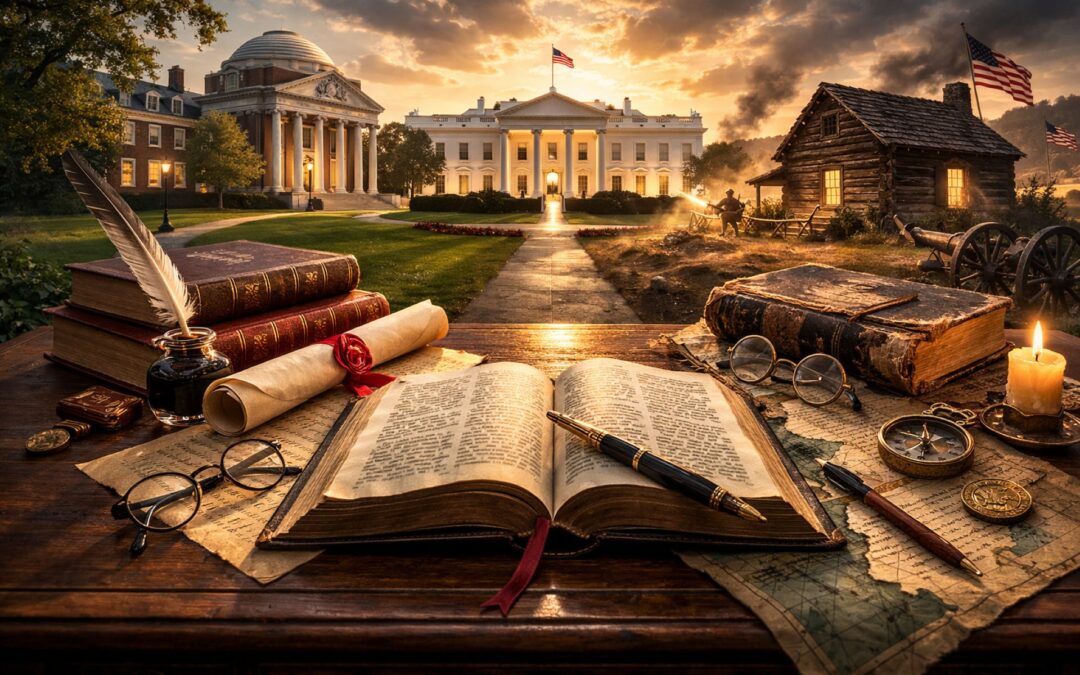
Introduction: Does Education Predict Presidential Greatness?
From Ivy League prodigies to frontier self-starters, the educational backgrounds of American presidents tell a story far more complex than simple academic ranking. Some mastered Latin and Greek at elite colonial colleges. Others barely had access to formal schooling at all. A few earned advanced degrees from the most prestigious institutions in the country. Several taught themselves law by candlelight.
Yet all of them reached the same office.
The presidency of the United States has never required a diploma from a specific university. In fact, it has never required any formal education at all. Unlike many modern political systems, the U.S. Constitution sets no academic threshold for its highest office. What matters is not where a president studied, but how they learned — and how they applied that learning to power.
Over nearly 250 years, presidential education has evolved alongside the country itself. In the 18th century, education was rare and elite. In the 19th century, apprenticeship and self-instruction shaped many leaders. By the 20th and 21st centuries, elite universities and law schools became common stepping stones to national power.
But academic pedigree has never guaranteed success — nor has its absence guaranteed failure.
To understand the education of every U.S. president is to understand something deeper: how America has defined intelligence, leadership, and merit across generations.
The Founding Generation: Classical Education and Self-Taught Brilliance
The earliest American presidents were shaped by two very different educational paths: elite classical training and rigorous self-instruction. Together, they set the intellectual tone for the new republic.
Elite Colonial Colleges and Enlightenment Thinking
Several of the founding presidents came through institutions that were, at the time, among the most prestigious in British North America.
John Adams entered Harvard University at just 15 years old. There, he immersed himself in classical studies — Latin, rhetoric, philosophy, and history — before reading law under an attorney, the standard path to legal practice in the 18th century. His sharp debating skills and structured thinking later defined his political style.
Thomas Jefferson studied law at College of William & Mary, where Enlightenment philosophy left a deep imprint on his worldview. Jefferson’s intellectual range was extraordinary: architecture, languages, science, agriculture, political theory. He later founded the University of Virginia, personally designing its campus — a physical embodiment of his belief in education as the foundation of republican government.
James Madison attended the Princeton University (then the College of New Jersey), completing a demanding classical curriculum in just two years. Madison’s education in political theory, theology, and history helped prepare him to become the chief architect of the U.S. Constitution.
For these men, education was not vocational. It was philosophical. Classical learning trained them to reason abstractly, argue persuasively, and think in constitutional terms. Their presidency reflected that formation: law-driven, text-focused, institution-building.
The Self-Taught Revolutionary
In contrast stood George Washington, whose formal schooling was minimal. After his father’s death, his education effectively ended. There was no college, no legal training, no classical immersion.
Instead, Washington educated himself through practice. He became a surveyor, mastering mathematics and land measurement. He studied military strategy independently. He learned leadership not in lecture halls, but in the field — first during the French and Indian War, and later as commander of the Continental Army.
Washington represents a different model of intelligence: disciplined, observational, strategic. His authority came less from theoretical brilliance and more from applied judgment. In a young nation suspicious of aristocratic elitism, this mattered.
Intellectual Diplomats of the Early Republic
The next generation produced perhaps the most academically formidable president of the early republic: John Quincy Adams.
Raised in Europe while his father served as a diplomat, Adams grew up multilingual and cosmopolitan. He later accelerated through Harvard and launched a career defined by diplomatic precision and scholarly rigor. His lifelong habit of diary writing — thousands of pages — reflects a mind obsessed with reflection and analysis.
If Washington embodied practical leadership and Jefferson philosophical breadth, Adams represented intellectual intensity.
Together, the founding presidents reveal a crucial truth: the early republic valued both classical scholarship and disciplined self-education. The presidency was not yet professionalized. It was shaped by character, intellect, and circumstance — whether cultivated in elite colleges or forged through necessity.
Frontier America: Self-Made Presidents and Practical Learning
As the United States expanded westward in the 19th century, the presidency began to reflect a broader, rougher America. Formal education became less uniform. Colleges existed, but access was limited. Many future presidents relied on apprenticeships, military service, and relentless self-study instead of structured academic training.
This era produced some of the most self-made leaders in American history.
Minimal Schooling, Maximum Ambition
Andrew Jackson grew up on the frontier with little formal education beyond elementary school. Orphaned at a young age, he taught himself law while working as a schoolteacher. His real education came through hardship, military campaigns, and political combat. Jackson’s presidency reflected that background: combative, instinct-driven, and deeply populist.
Martin Van Buren never attended college at all. He left formal schooling at 14 and apprenticed in a law office, grinding through legal work for years before being admitted to the bar. Van Buren’s skill was not academic theory but political organization — he became one of the architects of modern party politics.
Zachary Taylor also lacked higher education. Poor grades and no college attendance did not stop him from rising through the military ranks. His presidency was built almost entirely on battlefield reputation rather than intellectual credentials.
In frontier America, ambition and grit often mattered more than academic polish.
The Lawyer’s Apprenticeship Model
Before formal law schools became dominant, “reading law” under a practicing attorney was common. Many presidents followed this path, bypassing universities altogether.
Grover Cleveland left school early and studied law while clerking in a Buffalo office. Through discipline and persistence, he moved from lawyer to mayor to governor to president — without ever earning a college degree.
Millard Fillmore similarly educated himself by devouring books and apprenticing in law. Despite lacking a formal college background, he later helped establish the University of Buffalo, reflecting a belief in education even if he did not personally benefit from it.
For much of the 19th century, this apprenticeship route functioned as a parallel education system — practical, professional, and intensely self-directed.
Abraham Lincoln and the Power of Self-Education
No president better represents the frontier intellectual than Abraham Lincoln.
Lincoln had less than a year of formal schooling spread across his entire childhood. Yet he developed into one of the most eloquent and analytically sharp leaders in American history. He read constantly — Shakespeare, the Bible, Euclidean geometry — sometimes walking miles to borrow books.
Lincoln’s education was not institutional; it was obsessive and self-imposed. He sharpened his reasoning through logic and mathematics, refined his rhetoric through literature, and trained his legal mind by studying casebooks independently before passing the Illinois bar.
His presidency demonstrates a crucial lesson: intellectual depth can be self-built. Formal credentials may provide structure, but disciplined curiosity can create extraordinary capacity.
By the mid-19th century, the presidency had clearly expanded beyond elite college graduates. It now included soldiers, clerks, self-taught lawyers, and political organizers. America’s educational diversity was becoming political diversity — and the White House reflected it.
The Rise of the Elite University Pipeline
By the late 19th and early 20th centuries, the presidency began to reflect a more institutional America. Universities expanded. Law schools formalized. Professional credentials became more common. While self-made leaders never disappeared, elite colleges increasingly served as gateways to national power.
The presidency was slowly becoming professionalized.
Harvard, Yale, and the Credentialed Class
Several presidents of the modern era passed through America’s most prestigious universities.
Theodore Roosevelt graduated from Harvard University with honors. Though restless by temperament, Roosevelt was a voracious reader whose intellectual curiosity extended from history to natural science. His education blended elite schooling with personal intensity.
William Howard Taft graduated second in his class at Yale University before attending Cincinnati Law School. Taft’s formal legal training shaped his methodical, constitutional approach to governance — and later led him to become Chief Justice of the United States.
John F. Kennedy also graduated from Harvard. His senior thesis, later published as a book, reflected an early interest in foreign policy — an area that would define his presidency.
In more recent decades, the Ivy League pipeline became even more visible:
- George H. W. Bush — Yale
- George W. Bush — Yale and Harvard Business School
- Barack Obama — Columbia University and Harvard Law School
By the late 20th century, attendance at elite institutions had become increasingly common among presidential candidates. Academic pedigree signaled discipline, networks, and access to powerful social circles.
The Scholar-President
One president stands apart for sheer academic immersion: Woodrow Wilson.
Wilson earned a PhD in political science from Johns Hopkins University and later became president of Princeton University. He entered the White House not as a soldier or lawyer first, but as an academic.
Wilson’s presidency reflected that background: structured, theoretical, deeply focused on institutional design. His vision for the League of Nations, for example, was rooted in political theory and international governance models rather than military instinct.
He represents the high point of the “intellectual presidency” — the idea that academic expertise itself could guide national leadership.
Law Schools and the Professional Political Class
As the 20th century progressed, legal education became the most common stepping stone to the Oval Office. Presidents increasingly held law degrees from top institutions:
- Bill Clinton — Yale Law School
- Richard Nixon — Duke Law School
- Lyndon B. Johnson — legal training, though unfinished formal law degree
- Barack Obama — Harvard Law School
The presidency gradually became less a frontier prize and more a culmination of professional political training. Law school, in particular, sharpened skills in argumentation, constitutional reasoning, and institutional navigation — all central to executive leadership.
By the modern era, the idea of a president without higher education began to feel increasingly rare.
Yet credentials alone did not determine effectiveness. Some of the most academically accomplished presidents struggled politically. Others with less impressive academic records demonstrated formidable political intelligence.
The university pipeline strengthened — but it never became destiny.
Military Academies and War-Shaped Leaders
While elite universities and law schools became common pathways to the presidency, another powerful educational institution shaped several American leaders: the military academy.
For some presidents, leadership training did not come from lecture halls or legal texts, but from drill fields, engineering manuals, and battlefield command.
West Point and the Engineering Mind
The United States Military Academy at West Point has produced two presidents whose education was grounded in mathematics, engineering, and military science.
Ulysses S. Grant graduated from United States Military Academy in the middle of his class. While not academically dominant, Grant absorbed the academy’s emphasis on discipline, logistics, and strategic calculation. During the Civil War, those traits translated into calm battlefield decision-making and relentless operational pressure against Confederate forces.
Dwight D. Eisenhower also trained at West Point, graduating from the famous “class the stars fell on,” which produced an unusually high number of future generals. Eisenhower’s education emphasized engineering precision and coordinated planning — skills he later applied as Supreme Allied Commander in World War II and as president during the Cold War.
West Point’s influence is distinct. It does not produce philosophers or courtroom debaters. It produces systems thinkers — leaders trained to manage large-scale operations under pressure.
The Naval and Technical Presidents
Military education extended beyond West Point.
Jimmy Carter graduated from the United States Naval Academy and later trained in the Navy’s elite nuclear propulsion program. Carter’s technical education in engineering and nuclear systems was among the most specialized of any president. His early career demanded mathematical rigor, procedural discipline, and high-stakes responsibility.
Even presidents without academy training were shaped by war as an educational force. Military service provided leadership training that no classroom could replicate.
For leaders like Grant, Eisenhower, and Carter, education was inseparable from command. It fused theory with execution.
The military pathway highlights an important distinction in presidential education: liberal arts training builds rhetorical and philosophical strength, while military academies build logistical and strategic competence.
Both forms produce intelligence — but of different kinds.
And in moments of national crisis, the presidency has often leaned toward leaders whose education prepared them not merely to argue, but to coordinate, command, and decide under pressure.
Memory, Rhetoric, and Intellectual Style
Formal education tells only part of the story. Equally important is intellectual style — how presidents processed information, argued ideas, remembered detail, and persuaded others.
Some were known for raw cognitive power. Others excelled in emotional intelligence, communication, or political instinct. The presidency has rewarded multiple kinds of intelligence.
The Presidents Known for Intellectual Firepower
Several presidents developed reputations for extraordinary mental capacity.
Thomas Jefferson embodied Renaissance-style breadth. Fluent in multiple disciplines, he read constantly and thought structurally about politics and architecture alike.
John Quincy Adams demonstrated rare linguistic fluency and analytical discipline. His voluminous diary reflects a mind constantly dissecting events and ideas.
James Garfield may have been the most academically gifted president of the 19th century. A former college professor, he reportedly could write in Latin with one hand and Greek with the other. He even published an original proof of the Pythagorean theorem while serving in Congress — an unusual achievement for any politician.
These presidents reflect the archetype of the scholar-statesman: intellectually restless, academically capable, and comfortable in abstraction.
The Political Intuitives
Not all presidents were defined by academic brilliance. Some excelled in instinct and interpersonal awareness.
Lyndon B. Johnson was famous for his ability to read a room instantly. His “Johnson Treatment” — an intense mix of persuasion, pressure, and personal insight — relied less on theory and more on psychological acuity.
Andrew Johnson and Warren G. Harding were not celebrated for intellectual depth. Yet both navigated political systems through relationship-building and populist appeal.
Political intelligence often functions differently from academic intelligence. It depends on timing, persuasion, and coalition-building — skills rarely measured in classrooms.
Charisma Versus Credentials
Modern presidents further illustrate this divide.
Ronald Reagan, though college-educated, became known primarily for rhetorical clarity and communication skill rather than scholarly depth. His ability to frame complex policy issues in simple language reshaped political messaging.
Bill Clinton combined elite academic credentials with extraordinary memory and conversational fluency. He could absorb briefing materials rapidly and recall minute details in discussion.
Donald Trump leveraged marketing instinct and media presence, demonstrating a different kind of political intelligence centered on branding and crowd dynamics.
Joe Biden built his career on relationship networks and legislative negotiation rather than academic distinction, reflecting a style grounded in experience and coalition management.
Across American history, the presidency has accommodated scholars, soldiers, lawyers, and communicators. Intellectual style varies widely.
Some presidents dazzled with classical knowledge. Others commanded with strategic clarity. Some persuaded through logic; others through emotional resonance.
Education provides tools. But how those tools are used — analytically, strategically, or rhetorically — ultimately shapes leadership far more than the diploma itself.
Education Across Eras: What Changed Over Time?
Presidential education did not evolve in isolation. It mirrored the broader development of American society — from a small agrarian republic to an industrial power to a global superpower.
As the country changed, so did the meaning of education.
18th Century: Education as Elite Privilege
In the founding era, college education was rare. Institutions like Harvard University, College of William & Mary, and Princeton University served a narrow elite.
A classical education — Latin, Greek, philosophy, theology — signaled status and intellectual legitimacy. But access was limited to wealthy families or exceptional students. Many Americans, including future leaders like George Washington, simply did not have the opportunity for extended schooling.
Education during this era was less about professional training and more about moral and philosophical formation.
19th Century: Apprenticeship and Expansion
As the nation expanded westward, higher education remained limited. Colleges multiplied, but frontier conditions made formal schooling inconsistent.
The apprenticeship model thrived. Reading law under a practicing attorney was common. Presidents such as Abraham Lincoln and Grover Cleveland entered public life through self-study and professional mentorship rather than university systems.
This era valued practicality. Leadership credentials often came from military service, courtroom experience, or political organizing rather than academic distinction.
Education was becoming more available — but it was not yet standardized.
20th Century: Institutional Professionalization
By the early 20th century, American higher education had expanded dramatically. Law schools formalized training. Graduate degrees became more common. Universities emerged as national prestige markers.
Presidents such as Woodrow Wilson (PhD) and John F. Kennedy (Harvard) reflected a system in which elite institutions increasingly served as pipelines to political power.
Military academies like United States Military Academy and United States Naval Academy produced technically trained leaders suited for global conflict and modern warfare.
The presidency itself became more complex — requiring bureaucratic management, constitutional literacy, and international coordination. Formal education aligned more closely with institutional demands.
21st Century: Credential Politics and Media Intelligence
In the modern era, nearly all presidents have held college degrees, many from elite universities. Academic pedigree now plays a visible role in political branding.
Yet something else has emerged alongside credentials: media intelligence.
Modern presidents must master television, digital communication, and public narrative management. Charisma, message discipline, and adaptability matter as much as formal education.
The presidency today demands a hybrid skill set:
- institutional literacy
- legal and constitutional understanding
- economic awareness
- media fluency
- emotional intelligence
The diploma is almost expected. But it is no longer sufficient.
Across nearly two and a half centuries, one pattern stands out: presidential education has tracked America’s evolution.
From classical scholarship to frontier grit, from apprenticeship law offices to Ivy League campuses, from military academies to media studios — each era shaped the type of learning that seemed most relevant to power.
But the office itself has always tested something deeper than academic record.
Does Formal Education Actually Matter?
If presidential history proves anything, it is that formal education alone does not determine success in office.
Some of the most academically accomplished presidents struggled politically. Woodrow Wilson brought a PhD-level understanding of political theory into the White House, yet failed to secure U.S. entry into the League of Nations. John Quincy Adams possessed extraordinary intellectual depth, but his presidency was widely viewed as politically ineffective.
Conversely, leaders with limited formal schooling reshaped the nation. Abraham Lincoln, largely self-educated, guided the country through civil war and preserved the Union. Andrew Jackson, with minimal academic polish, transformed American political participation and redefined executive power.
Academic excellence does not automatically translate into coalition-building skill. Nor does a modest academic record imply limited capacity for leadership.
Education Versus Temperament
Presidential success often hinges less on where someone studied and more on temperament:
- Can they manage crisis calmly?
- Can they persuade divided factions?
- Can they absorb vast information and make decisions under pressure?
Dwight D. Eisenhower exemplified managerial composure shaped by military coordination rather than philosophical abstraction. Lyndon B. Johnson relied on political force of personality and strategic persuasion to pass landmark civil rights legislation.
Education builds analytical tools. Temperament determines how those tools are used.
Intelligence Beyond the Classroom
Intelligence in the presidency appears in multiple forms:
- Analytical intelligence — constitutional reasoning, policy design
- Strategic intelligence — long-term planning, geopolitical calculation
- Emotional intelligence — reading opponents and allies
- Communicative intelligence — framing issues for public understanding
Ronald Reagan demonstrated communicative clarity. Bill Clinton showed remarkable memory and policy absorption. George Washington embodied disciplined strategic judgment despite limited schooling.
No single educational background monopolizes these traits.
The presidency ultimately measures applied intelligence — not academic ranking.
A diploma can signal discipline, privilege, or access. It can open doors and build networks. But once in office, presidents are judged not on transcripts, but on decisions.
History suggests that leadership emerges from a combination of learning, experience, character, and context. Education shapes the mind. Power tests it.
Conclusion: There Is No Single Path to Power
Across nearly 250 years, American presidents have emerged from radically different educational worlds.
Some mastered Latin at colonial colleges. Others barely attended school. Some earned doctorates and law degrees from elite universities. Others read borrowed books by firelight. Some were trained engineers and military planners. Others were lawyers, professors, actors, businessmen, or career politicians.
Yet all arrived at the same office.
The history of presidential education reveals a broader truth about American leadership: intelligence is multidimensional. Academic rigor matters. So does discipline. So does emotional awareness, strategic instinct, communication skill, and resilience under pressure.
In the 18th century, education signaled elite status. In the 19th century, self-made grit carried weight. In the 20th century, institutional credentials became more common. In the 21st century, media fluency joins formal education as a critical requirement.
But at no point did a single educational formula guarantee success.
The presidency does not test how well someone performed in a classroom. It tests how effectively they apply knowledge in moments of consequence — in war, economic crisis, political division, and global negotiation.
From self-taught surveyors to Ivy League scholars, from frontier lawyers to constitutional theorists, the educational story of American presidents ultimately reflects the country itself: diverse, evolving, and shaped by opportunity as much as pedigree.
There has never been one path to the White House. And history suggests there never will be.