
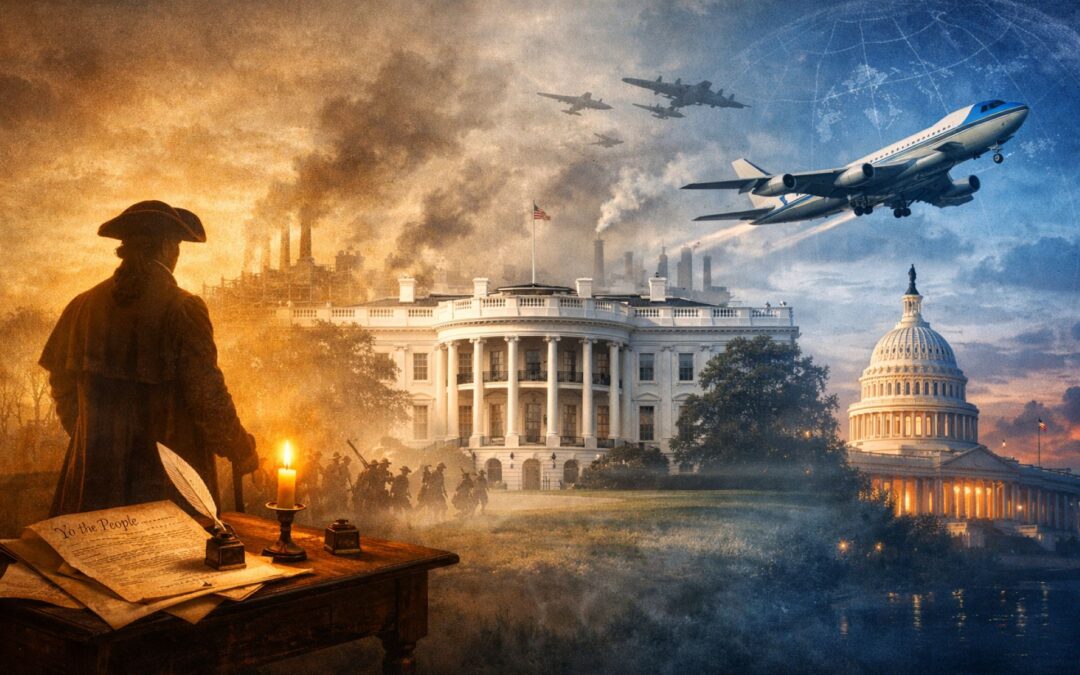
The story of the United States presidency is not simply a sequence of elections. It is the story of how a single office evolved from a cautious experiment in republican government into the most powerful political position on Earth.
When the Constitution was written, the presidency was intentionally limited. The founders feared kings. They feared concentrated power. They feared tyranny disguised as leadership. And yet, over more than two centuries, the office expanded—sometimes slowly, sometimes dramatically—usually in response to crisis.
Wars expanded executive authority. Economic collapses demanded bold intervention. Territorial ambition reshaped the continent. Social movements forced moral reckonings. Global conflicts transformed the president into a commander of superpower strategy. And modern media turned presidents into symbols, lightning rods, and cultural forces in ways the founders could never have imagined.
Some presidents preserved the Union. Some nearly tore it apart. Some built institutions that still shape daily American life. Others revealed the fragility of the system. A few fundamentally redefined what the presidency could do.
To understand how the United States became the richest and most powerful nation in modern history, you have to understand how the presidency grew alongside it—through invention, expansion, reform, crisis, scandal, and reinvention.
The history of U.S. presidents is not just a timeline of men in office. It is the story of America itself.
Inventing the Presidency (1789-1824)
When George Washington took office in 1789, there was no blueprint for what a president should be. The Constitution outlined powers, but it did not define customs. It did not describe tone. It did not explain how authority should look in practice. Washington had to invent the presidency from scratch.
He established a cabinet to advise him. He enforced the idea of civilian control over the military. Most importantly, after serving two terms, he voluntarily stepped down—setting a precedent that lasted nearly 150 years. In a world accustomed to monarchs clinging to power, that peaceful transfer of authority defined the character of the republic.
His successor, John Adams, inherited a fragile nation entangled in European conflict. Tensions with France escalated into an undeclared naval conflict. Fearing subversion at home, Adams signed the Alien and Sedition Acts, which expanded federal power and restricted speech critical of the government. The backlash was swift. The presidency had already become a battleground over civil liberties and executive authority.
Then came Thomas Jefferson, who doubled the size of the nation through the Louisiana Purchase. For $15 million, the United States acquired 828,000 square miles of territory from France. It was a bold expansion of presidential initiative—ironically executed by a leader who favored limited government. Jefferson also commissioned the Lewis and Clark expedition and envisioned an agrarian republic of independent citizens. Yet his legacy remained deeply complicated by slavery, exposing the contradictions embedded in the young nation.
Under James Madison, the country faced the War of 1812. British forces burned Washington, including the White House itself. The conflict tested whether the United States could survive as a sovereign power. When American forces held firm and the war ended in stalemate, national pride surged. The presidency had endured its first existential crisis.
James Monroe presided over what became known as the “Era of Good Feelings,” a period of relative political unity after the collapse of the Federalist Party. But his most lasting contribution was the Monroe Doctrine, which warned European powers against interfering in the Western Hemisphere. With a single declaration, the presidency began asserting a long-term vision of American influence abroad.
By the 1820s, the office had transformed from a cautious experiment into a symbol of national direction. It was no longer merely administrative. It was ideological. It shaped domestic policy, foreign affairs, and the identity of the republic itself.
The presidency had been invented. Now it would be tested.
Inventing the Presidency (1789–1824)
George Washington and the Creation of the Office
When George Washington took office in 1789, the presidency was an untested constitutional experiment. The framers had deliberately avoided creating a monarchy, yet they needed an executive strong enough to govern. Washington defined how that balance would work in practice.
He established the first presidential cabinet, enforced federal authority during the Whiskey Rebellion, and maintained neutrality in European conflicts. Most importantly, after two terms, he voluntarily stepped down. That decision institutionalized the peaceful transfer of power and set a precedent that shaped American political culture for generations.
Washington’s presidency proved that executive authority could exist without becoming tyranny.
Adams, Jefferson, and the Fight Over Federal Power
John Adams inherited mounting tensions with France and deep partisan division at home. Fearing foreign influence and internal dissent, he signed the Alien and Sedition Acts, expanding federal power and criminalizing certain forms of political speech. The backlash was immediate. The presidency had already become the focal point of debates over liberty and authority.
His successor, Thomas Jefferson, offered a different vision. Through the Louisiana Purchase, he doubled the size of the United States, acquiring vast western territories from France. It was one of the boldest executive actions in American history. Jefferson also commissioned the Lewis and Clark expedition and championed an agrarian republic. Yet his legacy was deeply entangled with slavery, exposing the moral contradictions embedded within the expanding nation.
The presidency had become both an ideological weapon and an engine of expansion.
Madison and the War of 1812
Under James Madison, the United States confronted its former colonial ruler once again. The War of 1812 tested the survival of the republic. British forces burned Washington, including the White House itself, symbolizing the fragility of the young nation.
Yet the country endured. The defense of Baltimore and the eventual peace settlement reinforced national identity. The presidency emerged from the conflict not weakened, but legitimized by resilience.
Monroe and the Doctrine of Hemispheric Control
James Monroe presided over a period of relative political unity known as the Era of Good Feelings. But his most enduring contribution was strategic. The Monroe Doctrine declared that European powers should no longer attempt to colonize or interfere in the Western Hemisphere.
Although American military power was still limited, the doctrine signaled long-term ambition. The presidency was no longer merely administrative. It was now asserting geopolitical boundaries.
By 1824, the presidency had evolved from a cautious constitutional experiment into a central instrument of national direction. The office had found its footing. The next era would test its limits.
Democracy Expands, the Nation Divides (1824–1860)
Andrew Jackson and Populist Power
The election of 1824 fractured the political system. Although Andrew Jackson won the popular vote, the House of Representatives selected John Quincy Adams as president. Jackson’s supporters denounced the outcome as a “corrupt bargain,” fueling a populist backlash that transformed American politics.
When Jackson won in 1828, he reshaped the presidency into a vehicle of mass democracy. He expanded the use of the veto, dismantled the Second Bank of the United States, and presented himself as the direct representative of the people rather than merely a constitutional officer. Executive authority became more forceful and personalized.
But Jackson’s legacy was also defined by the Indian Removal Act, which led to the forced relocation of Native American nations in what became known as the Trail of Tears. The presidency had become more powerful—and its decisions more consequential.
Manifest Destiny and Territorial Growth
Under James K. Polk, the presidency became the engine of continental expansion. Polk entered office with a clear agenda: acquire Oregon territory, annex Texas, secure California, lower tariffs, and establish an independent treasury. Within a single term, he accomplished each goal.
The Mexican–American War resulted in vast territorial gains, stretching the United States from coast to coast. The doctrine of Manifest Destiny framed expansion as inevitable and righteous. The presidency was now directing territorial ambition on a massive scale.
Yet expansion carried a cost. Every new territory raised the explosive question: would slavery expand with it?
Compromise and Collapse
As the nation expanded, political compromise grew increasingly fragile. The Compromise of 1850 attempted to balance free and slave states but included the Fugitive Slave Act, which intensified sectional outrage.
Under Franklin Pierce, the Kansas–Nebraska Act allowed territories to decide the slavery question through popular sovereignty. Instead of calming tensions, it ignited violence in “Bleeding Kansas,” a preview of national conflict.
By the time James Buchanan took office, southern states openly threatened secession. Buchanan declared secession illegal but claimed the federal government lacked authority to stop it. His inaction deepened the crisis.
By 1860, the presidency stood at the center of a nation unraveling. Expansion had strengthened America’s geography but fractured its politics. The next president would inherit not a divided debate, but a divided country.
Civil War and the Reinvention of America (1861–1877)
Abraham Lincoln and Wartime Authority
When Abraham Lincoln took office in 1861, seven southern states had already seceded. Within weeks, the Civil War began. The presidency was no longer an instrument of policy—it became an instrument of survival.
Lincoln expanded executive authority dramatically. He suspended habeas corpus, mobilized troops, and directed wartime strategy as commander-in-chief. His Emancipation Proclamation reframed the conflict from a war to preserve the Union into a war to end slavery. By supporting the Thirteenth Amendment, he helped ensure that abolition became permanent constitutional law.
The Civil War was the bloodiest conflict in American history, and it transformed the presidency. Executive power expanded under crisis, setting precedents for future wartime leadership. But just days after Union victory, Lincoln was assassinated—the first president killed in office. The burden of Reconstruction fell to his successor.
Reconstruction and Its Unraveling
Andrew Johnson clashed bitterly with Congress over how to rebuild the South. While Radical Republicans sought to protect the rights of newly freed African Americans, Johnson resisted expansive Reconstruction policies. His defiance led to his impeachment—the first in U.S. history. He narrowly avoided removal by a single Senate vote.
Under Ulysses S. Grant, federal power was used to enforce civil rights. Grant crushed the Ku Klux Klan, supported the Fifteenth Amendment granting Black men the right to vote, and attempted to stabilize Reconstruction governments in the South. His administration, however, was marred by corruption scandals that weakened public confidence.
The disputed election of 1876 led to a political compromise that installed Rutherford B. Hayes in exchange for withdrawing federal troops from the South. Reconstruction effectively ended. Southern states soon imposed Jim Crow laws, undoing many of the civil rights gains of the postwar years.
The Civil War had preserved the Union and abolished slavery, but the promise of equality remained fragile. The presidency had grown stronger through war, yet the limits of political will became painfully clear.
America had survived its greatest internal crisis. Now it would enter an era of industrial growth, economic upheaval, and rising global ambition.
Industrial Power and Reform (1877–1913)
The Gilded Age Presidency
After Reconstruction, the presidency entered an era often overshadowed by industrial magnates and political machines. Yet important structural reforms quietly reshaped federal governance.
Following the assassination of James A. Garfield, his successor Chester A. Arthur surprised critics by signing the Pendleton Civil Service Reform Act. The law replaced the corrupt spoils system with merit-based federal hiring, marking a significant step toward professional government administration.
Grover Cleveland built his reputation on vetoing wasteful spending and resisting political favoritism. He became the only president to serve two non-consecutive terms, reinforcing the idea that the presidency could be interrupted yet remain institutionally stable.
Meanwhile, industrial expansion transformed the American economy. Railroads, steel, oil, and banking consolidated into powerful trusts, often outpacing regulatory oversight.
McKinley and the Birth of American Imperialism
Under William McKinley, the United States emerged as an overseas imperial power. The Spanish–American War resulted in the acquisition of Puerto Rico, Guam, and the Philippines. The presidency was no longer confined to continental concerns; it now directed global strategy.
McKinley’s assassination in 1901 elevated a leader who would redefine the office entirely.
Theodore Roosevelt and the Modern Presidency
Theodore Roosevelt transformed the presidency into an active force for reform. He aggressively enforced antitrust laws, expanded national parks and conservation lands, and asserted American influence abroad, including facilitating construction of the Panama Canal.
Roosevelt believed the president should act decisively in the public interest unless explicitly forbidden by law. This philosophy expanded executive initiative and redefined the office as the steward of national welfare.
By the early twentieth century, the presidency had evolved into a proactive institution—capable of regulating industry, shaping global affairs, and mobilizing public opinion. The modern executive had arrived.
World War, Prosperity, and Collapse (1913–1933)
Woodrow Wilson and Global Idealism
Woodrow Wilson entered office during a period of progressive reform and left having reshaped both domestic finance and global diplomacy. He oversaw the creation of the Federal Reserve System and the Federal Trade Commission, strengthening federal oversight of the economy.
When World War I erupted in Europe, Wilson initially pledged neutrality. Eventually, he led the United States into the conflict, framing it as a fight to “make the world safe for democracy.” After the war, he championed the League of Nations, envisioning a new system of collective security. Yet the Senate rejected membership, revealing limits to presidential influence in foreign policy. A stroke late in his presidency further complicated governance, underscoring how fragile executive leadership could become.
The Roaring Twenties and Limited Government
The 1920s marked a retreat from wartime activism. Warren G. Harding promised a “return to normalcy,” but his administration became synonymous with corruption, most notably the Teapot Dome scandal.
His successor, Calvin Coolidge, embraced a philosophy of limited government and economic restraint. Coolidge believed prosperity thrived when federal interference was minimal. For much of the decade, economic growth and consumer expansion seemed to validate that approach.
Hoover and the Great Depression
The stock market crash of 1929 shattered the illusion of endless prosperity. Herbert Hoover confronted the Great Depression as unemployment soared and banks collapsed.
Hoover supported certain interventions but resisted large-scale federal relief programs, believing local institutions should lead recovery efforts. As economic suffering deepened, public confidence in his leadership collapsed. The presidency, which had appeared restrained and stable during prosperity, now seemed powerless in crisis.
By 1933, the nation demanded sweeping action. The next president would fundamentally transform the scale and reach of executive authority.
Crisis Leadership and the Superpower Presidency (1933–1961)
Franklin D. Roosevelt and the New Deal State
When Franklin D. Roosevelt took office in 1933, the American economy was in free fall. Banks were collapsing, unemployment hovered near 25 percent, and public confidence had evaporated. Roosevelt responded with speed and scale.
Through the New Deal, he expanded federal authority into areas previously untouched by Washington. Social Security, labor protections, banking regulations, and massive public works programs redefined the relationship between citizens and the federal government. The presidency became the central engine of economic recovery.
Then came World War II. After the attack on Pearl Harbor, Roosevelt mobilized American industry, armed the Allies, and directed a global war effort. By the time of his death in 1945, the United States had emerged not only victorious but dominant. The presidency had grown into the command center of a superpower.
Truman and the Atomic Age
Harry S. Truman assumed office with little preparation and immense responsibility. Within months, he authorized the use of atomic bombs on Hiroshima and Nagasaki, bringing World War II to a close but inaugurating the nuclear age.
Truman then laid the foundation for Cold War strategy: the Truman Doctrine, the Marshall Plan, and the creation of NATO. The presidency was now permanently embedded in global ideological conflict. Containment of communism would define American foreign policy for decades.
Eisenhower and Cold War Stability
Dwight D. Eisenhower brought military experience and steady leadership to a tense geopolitical landscape. He ended the Korean War, expanded America’s nuclear deterrent, and authorized the construction of the Interstate Highway System, reshaping domestic infrastructure.
In his farewell address, Eisenhower warned of the growing influence of the “military-industrial complex.” The presidency had become intertwined with defense strategy, intelligence networks, and global alliances.
By 1961, the office had evolved beyond anything imagined in 1789. The president was no longer simply a national executive. He was the leader of the free world, steward of nuclear power, and central architect of economic and military policy.
The next era would test that power under the pressures of social revolution and political upheaval.
Turbulence, Reform, and Resignation (1961–1980)
Kennedy and the New Frontier
John F. Kennedy entered office projecting youth, confidence, and ambition. He launched the space race with a pledge to land a man on the moon and navigated one of the most dangerous confrontations of the Cold War during the Cuban Missile Crisis. For thirteen days in 1962, nuclear war seemed possible. The presidency had become the fulcrum of global survival.
Yet his administration also stumbled, most notably with the failed Bay of Pigs invasion. In November 1963, Kennedy was assassinated in Dallas, shocking the nation and reinforcing how vulnerable even the most powerful office could be.
Johnson’s Great Society and Vietnam
Lyndon B. Johnson used his legislative mastery to push through sweeping domestic reforms. The Civil Rights Act, Voting Rights Act, Medicare, and Medicaid reshaped American society. His “Great Society” sought to eradicate poverty and racial injustice.
At the same time, Johnson escalated U.S. involvement in Vietnam. What began as containment strategy evolved into a prolonged and costly war. Mounting casualties and televised combat eroded public trust. The presidency, once seen as a stabilizing force, became the focal point of national protest and division.
Nixon and Watergate
Richard Nixon achieved significant diplomatic breakthroughs, including opening relations with China and pursuing détente with the Soviet Union. Domestically, he created the Environmental Protection Agency and signed major regulatory reforms.
But the Watergate scandal eclipsed those achievements. A break-in at Democratic Party headquarters and the subsequent cover-up revealed abuses of executive power. When taped conversations confirmed obstruction efforts, Nixon resigned—the only president in American history to do so. The limits of presidential authority had been publicly and painfully exposed.
Carter and Crisis of Confidence
Jimmy Carter campaigned on integrity in the aftermath of Watergate. His administration prioritized human rights in foreign policy and brokered the Camp David Accords between Egypt and Israel.
Yet economic stagnation, high inflation, energy shortages, and the Iran hostage crisis defined public perception of his presidency. As confidence in leadership faltered, Americans once again sought decisive change.
By 1980, the presidency stood at a crossroads. The public demanded strength, clarity, and renewal. A conservative realignment was about to reshape American politics—and the office itself.
Conservative Resurgence and Post-Cold War America (1980–2001)
Reagan and the End of the Cold War
Ronald Reagan entered office promising to restore American strength and confidence. He cut taxes, reduced domestic regulations, and increased military spending, reshaping the federal government’s economic philosophy. His rhetoric framed the Soviet Union as an “evil empire,” signaling a hardline stance in the Cold War.
Yet Reagan also engaged in diplomacy. By the end of his presidency, relations with Soviet leader Mikhail Gorbachev had improved, arms reduction treaties were signed, and the Cold War began to thaw. When the Berlin Wall fell in 1989, the global order shifted. The presidency had guided the United States through ideological confrontation into a new unipolar moment.
George H. W. Bush and Gulf War Leadership
George H. W. Bush inherited a transforming world. The Soviet Union collapsed during his term, formally ending the Cold War. In 1991, after Iraq invaded Kuwait, Bush assembled a broad international coalition and launched Operation Desert Storm. The swift victory demonstrated American military supremacy in the post-Cold War era.
Bush emphasized stability and coalition-building, but economic recession at home weakened public support.
Clinton and the 1990s Boom
Bill Clinton presided over economic expansion fueled by technological innovation and globalization. The federal budget moved into surplus, and unemployment declined. The presidency during the 1990s appeared focused more on economic management than existential crisis.
However, the Monica Lewinsky scandal led to Clinton’s impeachment by the House of Representatives. He was acquitted by the Senate and completed his term, but the episode deepened partisan polarization. The presidency had once again become a battlefield for institutional conflict.
By 2001, the United States stood as the world’s sole superpower. Yet the relative stability of the 1990s would soon give way to a new era defined by terrorism, war, and intensifying political division.
Terror, Polarization, and the Modern Presidency (2001–Present)
George W. Bush and the War on Terror
George W. Bush began his term amid a contested election, but the attacks of September 11, 2001 redefined his presidency overnight. The War on Terror led to the invasion of Afghanistan and, later, Iraq over claims of weapons of mass destruction that were never found.
Executive power expanded dramatically through national security legislation, surveillance programs, and military intervention. Trillions of dollars were spent, and American foreign policy became defined by prolonged conflict in the Middle East. By the end of his presidency, public fatigue with war and the 2008 financial crisis had eroded support.
Barack Obama and Crisis Governance
Barack Obama took office during the worst financial crisis since the Great Depression. His administration passed a large economic stimulus package and enacted the Affordable Care Act, significantly expanding access to healthcare.
Obama also authorized the operation that killed Osama bin Laden and oversaw the gradual economic recovery. Social change accelerated during his presidency, including the legalization of same-sex marriage nationwide. Yet political polarization intensified, and gridlock in Congress became routine. The presidency increasingly relied on executive orders when legislative compromise stalled.
Trump, Biden, and the Era of Polarization
Donald Trump entered office without prior political or military experience, signaling a shift toward outsider populism. His administration focused on tax reform, deregulation, conservative judicial appointments, and a confrontational style of governance that reshaped political norms.
The COVID-19 pandemic disrupted his final year in office, intensifying economic and political instability. The 2020 election deepened national division.
Joe Biden oversaw the nationwide vaccine rollout and passed large-scale spending legislation aimed at economic recovery and infrastructure. His presidency also included the withdrawal from Afghanistan, persistent inflation, and continued polarization.
Trump’s return to office marked the first non-consecutive presidential terms since Grover Cleveland, underscoring how cyclical and volatile modern American politics has become.
In the twenty-first century, the presidency operates under relentless media scrutiny, global interdependence, and internal division. The office commands immense authority, yet its legitimacy is constantly tested.
From Washington’s cautious precedent-setting to the modern superpower executive, the presidency has expanded, contracted, redefined itself, and endured. It remains the clearest mirror of the nation’s ambitions, crises, and contradictions.
Conclusion: The Presidency as America’s Mirror
From 1789 to the present, the presidency has evolved from a carefully restrained executive office into the central engine of American political life. What began as a constitutional experiment designed to avoid monarchy became the command post of a continental nation, then a global superpower.
Each era expanded the office in response to crisis. War strengthened executive authority. Economic collapse justified sweeping federal intervention. Territorial ambition pushed presidents into geopolitical strategy. Social upheaval forced moral and legislative transformation. Modern media amplified both influence and controversy.
Some presidents preserved the Union. Some redefined liberty. Some built institutions that still structure daily American life—Social Security, the Federal Reserve, the interstate highways, civil rights protections. Others exposed the fragility of democratic norms through scandal, overreach, or paralysis.
The presidency is not static. It reflects the fears, ambitions, divisions, and aspirations of the country itself. In moments of unity, it can mobilize national purpose. In moments of polarization, it becomes the focal point of conflict.
Over more than two centuries, one truth has remained constant: the office grows most powerful when the nation faces its greatest tests.
The history of U.S. presidents is therefore more than biography. It is the story of how a republic experiments with power—how it expands it, restrains it, abuses it, reforms it, and ultimately survives through it.