
The concept of time in Hindu cosmology unfolds as a vast river flowing endlessly through the universe. Spanning thousands of years, this cosmic flow has been categorized into four distinct epochs—Satya Yuga, Treta Yuga, Dvapara Yuga, and Kali Yuga. Each of these ages marks a different stage in the spiritual and material evolution of humanity.
Today, we stand at the edge of Kali Yuga, the darkest of these ages, a period destined to last 432,000 years. But what lies beyond the end of this age? What happens after the 432,000 years of Kali Yuga have passed? According to ancient texts, the world is poised for an extraordinary transformation, one that will reshape human existence in unimaginable ways.
The Essence of Kali Yuga
Kali Yuga, the final epoch in the Hindu cosmological framework, represents the dark age of decline, characterized by moral decay, ignorance, and societal breakdown. This age is the culmination of a cycle that began with the pristine Satya Yuga, where righteousness, virtue, and truth governed the lives of all beings. Over the course of the four yugas—Satya Yuga, Treta Yuga, Dvapara Yuga, and Kali Yuga—the world gradually moves from a state of spiritual purity to one of confusion, greed, and degradation. Kali Yuga is distinct in its pervasive sense of disorder and corruption, a direct result of humanity’s spiritual forgetfulness.
As the age progresses, humanity’s understanding of fundamental principles diminishes. The once-clear path to spiritual wisdom becomes obscured, and knowledge, instead of being a force for enlightenment, becomes a tool for power and control. In this age, the ability to discern truth from falsehood weakens, and people increasingly fall prey to the illusions of the material world. Spiritual practices that once guided individuals to higher states of consciousness lose their potency, as the collective human consciousness becomes more distracted and ego-driven. Intellectual pursuits, which in earlier yugas sought to unravel the mysteries of the universe, become shallow and self-serving.
At the societal level, Kali Yuga represents a collapse of social structures that were once sacred. The family unit, the cornerstone of civilization, fractures under the weight of egoism and personal ambition. In earlier ages, family life was based on mutual respect, love, and shared spiritual values. But as Kali Yuga progresses, the sacred bond between parents and children erodes. Children no longer revere their parents or elders, and wisdom passed down through generations is lost. The result is a society where individuals are isolated, each pursuing their own selfish desires without regard for the collective well-being.
Marriage, once considered a sacred covenant that linked individuals on a deep spiritual level, becomes reduced to a contractual agreement. The divine aspect of marriage, once centered on a shared spiritual journey, fades away, leaving behind an arrangement based on convenience or desire. As relationships become more superficial, spiritual compatibility is ignored in favor of physical attraction and fleeting emotions. This degradation of relationships leads to a breakdown in moral and ethical values, further contributing to the overall spiritual decline of humanity.
The environment, reflecting the imbalance within human society, suffers greatly during Kali Yuga. Climate patterns grow increasingly erratic, with weather conditions shifting unpredictably between devastating floods and severe droughts. These changes disrupt agricultural systems, leading to crop failures and food scarcity. The once- fertile lands that sustained entire civilizations wither, and famine spreads across regions that were once abundant with resources. Nature’s rebellion against human disregard for its harmony serves as a reminder of the consequences of mankind’s materialistic and self-centered way of life. Natural disasters intensify as the earth, unable to maintain equilibrium, lashes out at humanity, offering a glimpse of the impending collapse.
The Prophecy of Divine Intervention
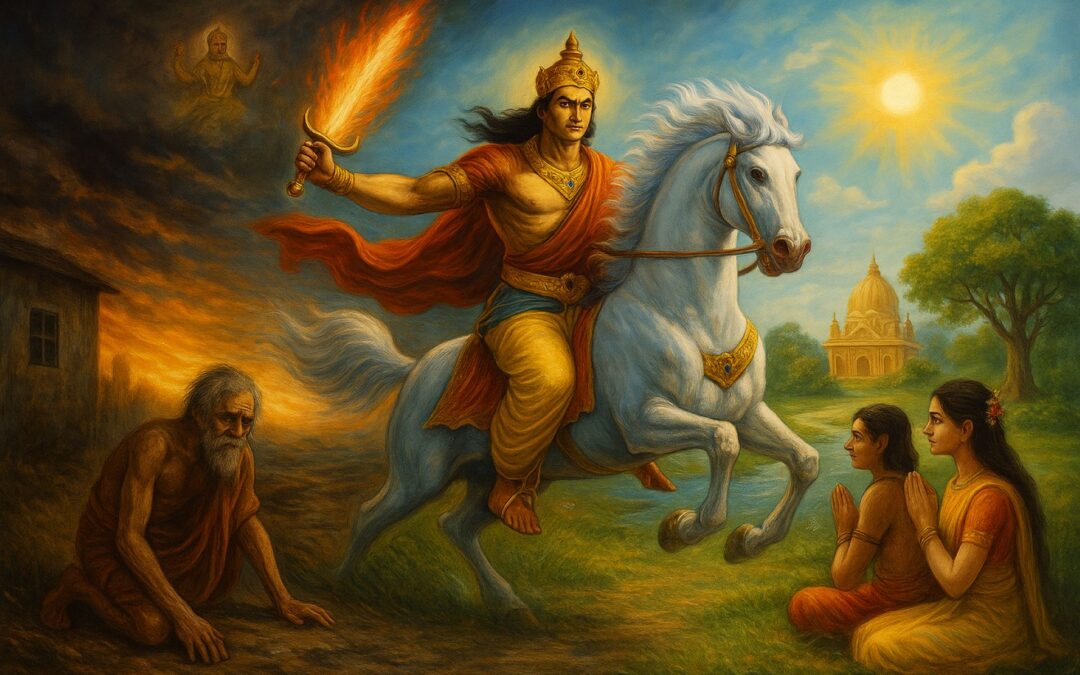
The conclusion of Kali Yuga is not simply a passive fading into destruction. According to Hindu scriptures, it is marked by a divine intervention that comes in the form of Kalki, the tenth and final avatar of Lord Vishnu. The arrival of Kalki signals the end of the age of darkness and the restoration of cosmic order. This avatar is unlike the previous ones, who appeared in humble forms or as animals, designed to guide and teach humanity. Kalki, by contrast, is a warrior of immense power, and his role is not one of instruction but of destruction.
Kalki’s mission is to bring an end to the rampant corruption, unrighteousness, and suffering that plague the world. The scriptures describe him as being born to virtuous parents in the village of Shambala, a place of spiritual purity that symbolizes hope for the world’s renewal. His appearance will be unlike any other, riding a powerful white horse named Devaduta, which represents purity and divine authority. Armed with a blazing sword of knowledge, Kalki will strike down the wicked and corrupt, those who have abandoned virtue in favor of power and material gain. His sword will not merely be a weapon of physical destruction, but a symbol of the divine knowledge that cuts through ignorance and restores clarity.
The power of Kalki will be overwhelming. Those who have lived lives of moral decay and spiritual negligence will be powerless before him. His arrival will bring a sudden and swift end to the forces of corruption that have long ruled the Earth. The wicked, who have manipulated society for their own gain, will find themselves utterly defeated. Kalki’s intervention will not be a gradual process but a decisive moment that brings a final end to the age of Kali Yuga and the darkness that has consumed it.
The scriptures describe Kalki’s actions as purifying the world through divine retribution. He will not come to teach or preach but to cleanse the Earth of the malevolent forces that have corrupted it. His role is to reset the cosmic balance, removing the forces of destruction and creating space for a new beginning. The world that has been sullied by corruption, greed, and ignorance will be destroyed, making way for the dawn of a new age—Satya Yuga.
The Dawn of Satya Yuga: A Return to Truth
The transition from Kali Yuga to Satya Yuga will be a rapid and transformative process, marking a complete reversal of the degeneration that has taken place over the course of the previous age. While Kali Yuga is characterized by moral and spiritual decay, Satya Yuga represents a return to truth, purity, and spiritual enlightenment. It is the golden age where humanity will rediscover its deepest connection to the divine and to one another.
As Satya Yuga dawns, the human experience will undergo a radical shift. The most notable change will be the significant increase in human lifespan. During this age, people will live for thousands of years in perfect health. The concept of aging and disease, which have defined the human experience for millennia, will become a distant memory. People’s bodies will remain youthful and strong, and sickness will be almost nonexistent. With the absence of disease, the fear of death will dissipate, and human beings will live long, fulfilling lives dedicated to spiritual growth and understanding.
The reorganization of society in Satya Yuga will also be profound. Gone will be the values of materialism and personal gain that dominated Kali Yuga. Instead, society will be founded on spiritual principles of truth, righteousness, and justice. Individuals will act out of compassion and love, with a deep understanding of their interconnectedness to one another and the world around them. The notion of private ownership will fade, as people will no longer see themselves as separate from others but as part of a greater whole.
The emphasis on material wealth will be replaced by the pursuit of knowledge, wisdom, and spiritual fulfillment. People will no longer be driven by ego or the desire for status; instead, they will seek to live in harmony with natural law. Resources will be shared freely, as the understanding of mutual dependence becomes clear. The need for legal systems, with their complex rules and regulations, will diminish, as people will naturally act in accordance with the divine laws that govern the universe. Trust, honesty, and compassion will define human relationships, and society will thrive under the guidance of these eternal principles.
In Satya Yuga, human beings will have a deep, intrinsic understanding of the divine. Spiritual practices will be central to daily life, and all actions will be performed with the awareness of the interconnectedness of all life. The pursuit of personal enlightenment will be a collective endeavor, with every individual striving for higher states of consciousness and moral purity. The new age will be one of peace, harmony, and spiritual unity, where the light of truth dispels the darkness that had once consumed the world.
The Cyclical Nature of Time: A Vision Beyond Linear Progress
The Hindu vision of time offers a perspective that stands in stark contrast to the linear, progressive view of time often held in modern societies. Instead of seeing time as an unbroken forward movement, the ancient wisdom of the yugas portrays time as a cyclical process, one that repeats itself in an eternal rhythm. In this view, civilizations rise and fall not due to the accumulation of material wealth or technological advancement, but because of their alignment—or misalignment—with cosmic laws and spiritual principles.
Each yuga represents a different stage in the cycle of cosmic evolution. As time progresses through the four yugas, humanity moves through phases of increasing spiritual purity and degradation. Satya Yuga represents the highest point in this cycle, a time when truth, righteousness, and spiritual knowledge prevail. In contrast, Kali Yuga is the lowest point, where ignorance, materialism, and corruption reign supreme. However, this descent is not the end. Just as Kali Yuga marks the collapse of one age, it also sets the stage for the rebirth of a new world in Satya Yuga.
This cyclical understanding of time offers profound insight into the nature of existence. Rather than viewing human history as a linear trajectory that progresses toward a definitive end, the yugas suggest that time is an endless flow of creation, destruction, and renewal. Each cycle offers an opportunity for growth and transformation. When one civilization or epoch falls into decay, the seeds of the next rise from the ashes. This vision of time encourages resilience and hope, knowing that even in the darkest moments, there is the possibility for renewal and rebirth.
For those who live through the dark ages, the knowledge that a new age is on the horizon offers comfort. Even as Kali Yuga reaches its peak, the transition to Satya Yuga is already unfolding. The cosmic cycles continue unabated, reminding humanity that no period of darkness lasts forever. Every end is followed by a new beginning, and the potential for transformation remains inherent in the universe’s grand design.
The Eternal Dance of Destruction and Creation
In Hindu cosmology, destruction and creation are not opposing forces but are intertwined in an eternal dance. The cyclical nature of the yugas demonstrates that every act of destruction is followed by an act of creation, and every act of creation is followed by destruction. This dynamic ensures that the universe remains in balance, perpetually renewing itself. The destruction that occurs at the end of Kali Yuga is not a sign of finality or hopelessness, but a necessary step in the cycle of regeneration.
When the forces of corruption and unrighteousness reach their peak, divine intervention, in the form of Kalki, ushers in a new era. This destruction is not random or chaotic; it is purposeful, aimed at resetting the cosmic order. As Kalki eliminates the forces that have polluted the world, he makes way for the creation of a new world—one founded on truth, virtue, and spiritual wisdom. The old, imperfect world makes way for the new, where humanity lives in harmony with the divine laws of nature.
This cycle of destruction and creation is a constant in the universe, a reminder that nothing is permanent. Each yuga represents a different phase in this dance, and with every cycle, there is an opportunity for rebirth. The ultimate message of the yugas is that even in the face of destruction, there is hope for renewal. The universe, in its infinite wisdom, continues to evolve, creating new worlds and civilizations that reflect higher spiritual truths.
In this eternal dance, humanity plays a crucial role. The choices made during each age—whether to embrace virtue or succumb to corruption—determine the direction of the next cycle. While the end of Kali Yuga marks a period of destruction, it is also the beginning of a new creation, where the forces of truth and righteousness will once again rise to guide humanity toward enlightenment. This cyclical process ensures that, no matter how far humanity falls, there is always the potential for redemption and spiritual awakening.