
The 1920s stand as an era like no other in American history — a decade that embodied the promise of freedom, boundless prosperity, and unbridled cultural change. Yet beneath the glitz and jazz, the American Dream showed subtle fractures that would soon widen, testing the nation’s core. F. Scott Fitzgerald’s The Great Gatsby emerged as a prophetic beacon in this turbulent period, offering both a warning and a flicker of hope for an ideal long cherished but perilously slipping away.
Automobiles, movies, and the radio revolutionized life, expanding the boundaries of everyday experience. This consumer culture birthed a cult of celebrity, with Fitzgerald and his wife Zelda at the epicenter—glamorous icons who personified the Jazz Age’s wild, exuberant spirit. Yet beneath this glimmering veneer, the Roaring Twenties were restless and restless with contradictions.
Despite Fitzgerald’s earlier successes, The Great Gatsby was initially a commercial failure. Critics panned it; sales faltered. Behind the scenes, tragedy loomed. The crash of 1929 would shatter the economy, and the Fitzgeralds, once symbols of brilliance and glamour, spiraled into personal ruin. But the novel’s resonance only deepened with time, becoming a timeless meditation on aspiration, illusion, and loss.


The Man Behind the Myth: F. Scott Fitzgerald’s Origins and Aspirations
F. Scott Fitzgerald’s early life is a study in contrasts, shadows, and aspirations shaped by social exclusion and longing. Born in 1896 in St. Paul, Minnesota, Fitzgerald’s heritage as an Irish-American placed him on the fringes of the dominant social elite. At the turn of the 20th century, America’s upper echelons were predominantly composed of Anglo-Saxon Protestant families, the so-called WASPs, who jealously guarded their social turf. Being Irish-American, Fitzgerald was burdened with an outsider’s status—a label that branded him with the stigma of ethnic and cultural “otherness” in an era of pervasive social stratification and prejudice.
His father’s repeated failures in business cast a long shadow of instability and financial insecurity over Fitzgerald’s formative years. Though his father had once been a salesman, his ventures consistently floundered, leaving the family’s prospects uncertain and socially precarious. The Fitzgeralds teetered on the margins of middle class, acutely aware of the gulf between their status and the gilded lives that surrounded them. This background fostered in young Scott a profound sensitivity, a consciousness of class divisions that would permeate his later work.
Amidst this environment, a wealthy aunt emerged as a crucial benefactor, underwriting Fitzgerald’s education and enabling him to attend Princeton University—an institution that epitomized the East Coast establishment and aristocracy. Princeton was no mere academic setting; it was a crucible of privilege, a bastion where lineage, wealth, and social pedigree determined one’s place in the hierarchy. For Fitzgerald, this was a world both intoxicating and alien. He found himself navigating the glittering halls and manicured lawns of privilege, gaining entrée into elite social circles while acutely aware of his own tenuous position.
At Princeton, Fitzgerald’s preoccupation with belonging overshadowed his scholarly pursuits. His fascination with the campus’s social life—its parties, clubs, and pageantry—became a defining focus. The Triangle Club, a prestigious student theater troupe, became a sanctuary for his creative energies, offering him the chance to perform and write, cultivating the storytelling skills that would later hallmark his novels. Contributions to the Nassau literary magazine further established his reputation as a gifted writer, blending wit with poetic sensibility.
Yet beneath this cultural immersion lay a simmering tension: Fitzgerald’s financial limitations prevented him from fully inhabiting the lifestyle he admired. His ambitions were grand, but his means were modest—a discrepancy that deepened his sense of social alienation. This internal struggle crystallized in his romantic pursuits, particularly with Ginevra King, a dazzling socialite whose allure was inseparable from her wealth and status. The rejection he suffered—most famously encapsulated in her father’s chilling assertion, “Rich girls don’t marry poor boys”—left an indelible scar, shaping his vision of the American Dream as not merely an economic goal but a social conquest fraught with barriers.
This formative mix of outsider status, artistic talent, and yearning for acceptance set the stage for Fitzgerald’s lifelong exploration of class, ambition, and disillusionment—themes that would be woven intricately into the fabric of The Great Gatsby.
From Heartbreak to Stardom: The Zelda Chapter and Early Triumphs
Fitzgerald’s trajectory from heartbroken student to literary sensation is entwined with the figure of Zelda Sayre, whose entrance into his life marked both a personal and cultural turning point. After his expulsion from Princeton—a blow that forced him to reevaluate his path—Fitzgerald enlisted in the army during World War I, seeking the kind of heroic identity that might redefine his prospects and prove his worth.
While stationed as a second lieutenant at an army post in Alabama, Fitzgerald encountered Zelda at a country club dance. Zelda was a force of nature: vivacious, rebellious, and emblematic of a new womanhood that challenged Victorian restraint. Her spirit mirrored the frenetic energy of the Jazz Age—a time of social upheaval, liberated mores, and relentless pursuit of pleasure. Zelda’s refusal to marry Fitzgerald until he demonstrated financial stability encapsulated the era’s pragmatic romanticism. Love was inseparable from economic security, a transactional dance where affection was weighed against material promise.
Driven by this challenge, Fitzgerald channeled his restless energy into his writing. His debut novel, This Side of Paradise, published in 1920, exploded onto the literary scene. It was an unflinching portrait of postwar youth—disillusioned, reckless, and searching for identity amid the shifting sands of tradition and modernity. The novel’s candid exploration of love, ambition, and social change resonated powerfully with a generation redefining itself.
The success of This Side of Paradise was meteoric. Fitzgerald became an overnight celebrity, hailed as the voice of his generation. The novel’s instant popularity validated his literary talents and transformed him into a cultural icon. Riding this wave, Fitzgerald and Zelda married just a week after publication—a union that symbolized the intoxicating promise and peril of the Jazz Age.
Their marriage was both a fairy tale and a tragedy in the making. The couple embodied the Roaring Twenties’ glamour, spending lavishly on travel, parties, and fashion, their lives a carousel of excitement and excess. Yet this dazzling exterior masked underlying tensions: Zelda’s free-spiritedness often clashed with Fitzgerald’s insecurities; their mutual struggles with mental health and addiction foreshadowed the collapse to come.
Together, they became the quintessential Jazz Age couple—icons of a decade that celebrated freedom, modernity, and defiance of convention. But their story also illuminated the fragility of dreams built on glittering façades, a prelude to the disillusionment that The Great Gatsby would so hauntingly capture.
Gatsby and Fitzgerald: Parallels of Dreams and Disillusionment
Jay Gatsby’s story in The Great Gatsby is, in many ways, a literary echo of Fitzgerald’s own life—a reflection of ambition, heartbreak, and the complex dance between aspiration and reality. Both Gatsby and Fitzgerald emerged from modest, unremarkable beginnings, driven by an almost desperate desire to transcend their origins and enter a world glittering with wealth, privilege, and acceptance. This shared background injects a personal intensity into Gatsby’s narrative, rendering it more than a mere fictional tale—it becomes a poignant meditation on the American Dream’s promises and pitfalls.
Gatsby’s obsession with Daisy Buchanan mirrors Fitzgerald’s infatuations with his “golden girls”—Ginevra King and Zelda Sayre—who symbolized the dazzling yet unattainable world of old money and social prestige. These women were not merely romantic interests; they were embodiments of status, sophistication, and the cultural ideals Fitzgerald yearned for but found perpetually out of reach. Both Ginevra and Zelda initially rejected Fitzgerald, their refusals rooted explicitly in his lack of wealth and social standing. This painful reality—“rich girls don’t marry poor boys”—became a recurring motif in Fitzgerald’s life and fiction, shaping his portrayal of class barriers as nearly insurmountable.
The character of Daisy, then, emerges as a composite of these two women, encapsulating the allure and elusiveness of the American Dream. She is youthful, radiant, and wrapped in an aura of privilege, yet beneath this exterior lies a troubling shallowness and moral ambiguity. Fitzgerald’s depiction suggests that the Dream itself is a glittering illusion—beautiful and seductive on the surface but hollow underneath. This tension between surface allure and inner emptiness permeates the novel, exposing the dissonance between aspiration and reality that defined the Jazz Age.
Moreover, the “golden girl” archetype represents not only personal romantic desire but also the broader social aspirations of upward mobility. Gatsby’s relentless pursuit of Daisy is inseparable from his quest for acceptance, legitimacy, and success in a rigidly stratified society. Yet, as Fitzgerald reveals, the Dream is ultimately unattainable for those outside the entrenched elite, and the idealized love Gatsby pursues is a mirage, shimmering just beyond grasp.
Characters as Symbols: A Microcosm of 1920s America
Fitzgerald’s cast in The Great Gatsby is not merely a collection of individuals but a symbolic mosaic that captures the fractured social landscape of 1920s America. Each character embodies a facet of the era’s cultural contradictions, class struggles, and moral complexities, turning the novel into a vibrant social commentary as much as a personal story.
Nick Carraway, the narrator, functions as the moral compass and critical observer. A Midwesterner by birth, Nick represents traditional American values: honesty, integrity, and a grounded sense of decency. His perspective bridges the worlds of old and new money, providing readers with an outsider’s clear-eyed view of the decadence and decay surrounding him. Nick’s ambivalence—both drawn to and repelled by the East Coast’s opulence—mirrors the reader’s own conflicted response to the Jazz Age’s excesses.
Jay Gatsby stands as the enigmatic centerpiece: the quintessential self-made man whose lavish lifestyle, mysterious wealth, and romantic idealism capture the essence of the American Dream’s allure and ambiguity. He embodies the paradox of aspiration and artifice—his grand parties and ostentatious mansion serve both as symbols of success and shields masking a past shrouded in secrecy and moral compromise.
Daisy Buchanan is the elusive, shimmering ideal—beautiful and ethereal, yet fraught with contradictions. Her voice, famously described as “full of money,” epitomizes the seductive power of wealth and social status. Daisy is at once desired and destructive, representing the dream’s fragility and the human cost of its pursuit.
Tom Buchanan is a stark counterpoint: the brutish, arrogant embodiment of inherited privilege and moral bankruptcy. His physicality—a hulking presence—and his aggressive entitlement symbolize the entrenched power structures that resist change and protect their dominion through coercion and cruelty.
Jordan Baker, the cynical professional golfer, represents the emerging modern woman—independent, competitive, and morally ambiguous. Her presence underscores the shifting gender norms and the new social freedoms that characterized the decade, though her corruption hints at the era’s ethical erosion.
Finally, Myrtle and George Wilson portray the tragic underside of the American Dream. Myrtle’s desperate quest for escape from poverty and George’s impotent despair highlight the crushing realities faced by those outside the elite circles. Their doomed fate amidst the desolate “valley of ashes” contrasts starkly with the glittering world of the Eggs, exposing the stark inequalities and social fragmentation beneath the surface glamour.
The Setting: Geography as Metaphor for Class and Division
Fitzgerald’s use of Long Island’s geography in The Great Gatsby is far from incidental; it is a meticulously crafted metaphor for the social divisions and cultural tensions that define the novel’s world.
West Egg, with its sprawling mansions and garish displays of wealth, symbolizes the nouveau riche—the self-made millionaires who, despite their fortunes, remain outsiders to the traditional elite. Gatsby’s mansion, with its lavish parties and ostentatious architecture, epitomizes this restless striving and the conspicuous consumption that defined the Jazz Age’s new money. West Egg residents are often portrayed as eager, noisy, and lacking the social refinement associated with inherited wealth, embodying both the promise and the vulgarity of the American Dream.
In stark contrast, East Egg represents the bastion of old money: families whose wealth and status are inherited, stable, and socially entrenched. The Buchanans’ elegant Georgian mansion and their stately lifestyle epitomize tradition, exclusivity, and a sense of entitlement rooted in lineage rather than achievement. East Egg is suffused with a sense of permanence and disdain for the restless ambitions of the nouveau riche across the bay.
The bay that separates the two Eggs is a physical and symbolic divide, representing the chasm between these social strata. It functions as a watery barrier, impassable and cold, reflecting the rigid class distinctions that Gatsby can never truly bridge. The green light atop Daisy’s dock, visible from Gatsby’s estate, becomes a luminous symbol of longing and unattainable desire—a beacon across the divide that Gatsby eternally reaches for but can never grasp.
Fitzgerald’s geography also extends beyond the Eggs. The “valley of ashes,” a bleak industrial wasteland between West Egg and New York City, represents moral decay and the grim realities of working-class life, standing in stark contrast to the opulence of the islands. New York City itself, depicted as a place of reckless energy and moral ambiguity, serves as a crucible where the facades of civility dissolve amid greed and corruption.
Through this spatial arrangement, Fitzgerald maps the social hierarchies and moral tensions of his time, using geography not just as a backdrop but as an active symbol that shapes character and narrative. The physical divisions reinforce the themes of exclusion, aspiration, and the elusive nature of belonging central to the novel’s tragic trajectory.
Poetic Influences and Symbolism: The Literary Tapestry
Fitzgerald’s The Great Gatsby is not simply a novel—it is a masterclass in lyrical prose that interweaves poetic influence and rich symbolism to elevate the narrative beyond mere storytelling into the realm of art. The author’s deep engagement with classical poetry, particularly the English Romantic tradition, permeates the text, infusing it with a cadence and resonance that reward close reading.
John Keats stands out as Fitzgerald’s paramount poetic muse. The influence of Keats’ Ode on a Grecian Urn and Ode to a Nightingale is unmistakable, both in tone and thematic content. Fitzgerald openly admitted to borrowing phrasing and imagery from these works, acknowledging how the Romantic preoccupation with beauty, transience, and the eternal shaped his own literary vision. The title of Fitzgerald’s later novel, Tender is the Night, is a direct lift from a Keatsian stanza, underscoring the fragile, ephemeral quality of youth and desire that threads through his oeuvre.
Beyond Keats, Fitzgerald’s reading of Milton, Byron, and Shelley further enriches his prose. The grandeur and intensity of Milton’s epic, Byron’s brooding Romanticism, and Shelley’s visionary idealism ripple beneath the surface of Gatsby, coloring its moods and deepening its symbolic texture. This poetic foundation allows Fitzgerald to push prose toward poetry, embedding layers of meaning within his descriptions, dialogue, and narrative rhythm.
Color symbolism in The Great Gatsby is both intricate and intentional. Fitzgerald’s palette vibrates with hues that evoke mood, character, and thematic undercurrents. Daisy’s white dress is not a mere costume but a symbol saturated with connotations of purity, innocence, and social status—a fragile façade concealing complexity and moral ambiguity. Gatsby’s pink suit, shimmering silver shirt, and gold tie combine to paint him as a figure both flamboyant and surreal, a man whose self-crafted image teeters between reality and fantasy.
Throughout the novel, color motifs recur: the blue gardens suggest tranquility tinged with melancholy; yellow, particularly in Gatsby’s Rolls-Royce and the “yellow cocktail music,” evokes wealth, excess, and the corrosive nature of materialism; crimson rooms recall passion and violence. Even minor details—chauffeurs in robin’s egg blue uniforms, shirts with coral and lavender stripes, monograms in Indian blue—serve to create a vivid, almost hallucinatory tableau of the Jazz Age’s sensory overload.
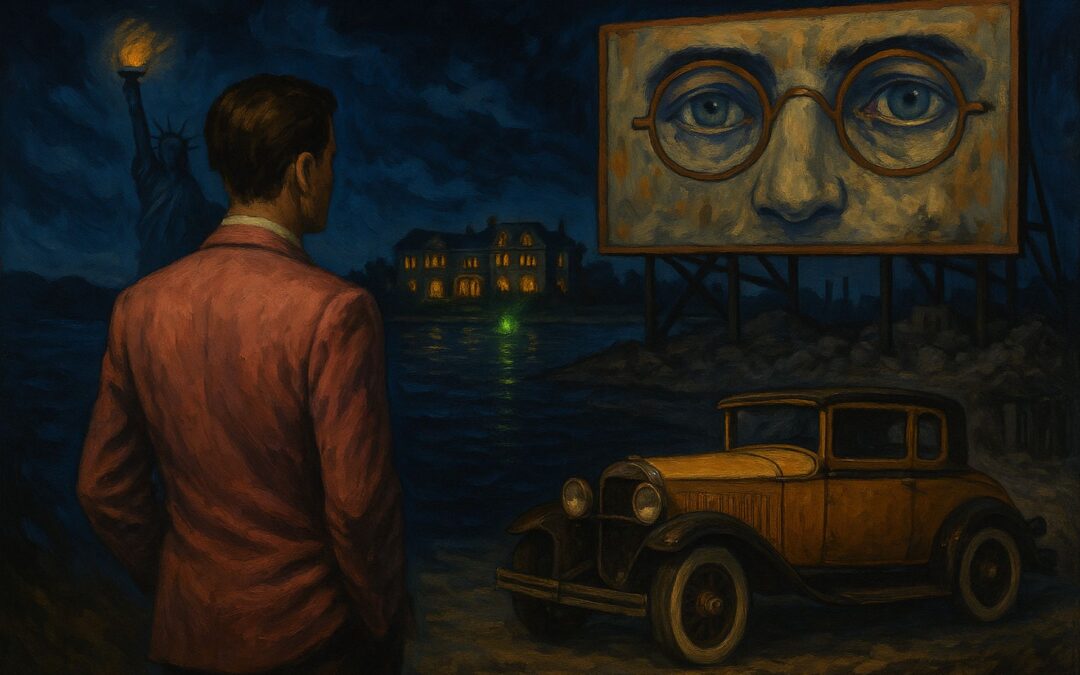
Perhaps the most haunting symbol is the faded eyes of Dr. T.J. Eckleburg, painted on a dilapidated billboard overlooking the valley of ashes. These bespectacled eyes loom like a fractured god, a secularized moral witness that watches over the moral wasteland below. Rather than divine justice or mercy, the eyes symbolize the hollow gaze of capitalism, consumerism, and spiritual emptiness—a world where traditional morality has been eroded by the relentless pursuit of wealth.
Time, Memory, and the Elusive Past
Time pulses at the heart of The Great Gatsby, operating as both a thematic concern and a structural device. Fitzgerald’s narrative is fixated on the tension between the past and the present—the yearning to reclaim lost innocence and the impossibility of reversing time’s relentless flow.
Gatsby’s tragic flaw is his obsessive desire to erase the years that separate him from Daisy and to reconstruct a past that never existed as he imagines it. His longing to “repeat the past” is emblematic of the human impulse to recapture lost moments, to mend fractures in identity and history. Yet Fitzgerald’s narrative insists on the futility of such efforts. The moment in which Gatsby almost knocks over a mantel clock during his reunion with Daisy is rich with symbolism—it suggests that time is a fragile but unstoppable force, not to be toyed with or reset.
The novel’s language is saturated with references to time: precise hours, fleeting moments, long summers, and anticipations of “day after tomorrow” create a temporal texture that mirrors the characters’ anxieties and hopes. This relentless invocation of time reinforces the central conflict—between the desire for permanence and the reality of change.
Geographically and morally, the Midwest represents a kind of temporal sanctuary for Fitzgerald. It embodies the values of honesty, optimism, and renewal—qualities increasingly eroded by the materialism and decadence of the East Coast. Nick Carraway’s eventual return to the Midwest signals a rejection of the hollow modernity he has witnessed and a quest for grounding amid moral chaos.
The temporal preoccupations in Gatsby underscore a broader cultural tension of the 1920s: a generation haunted by the trauma of World War I and uncertain about the promises of progress and modernity. Fitzgerald captures this collective unease through Gatsby’s personal tragedy, making the novel a meditation on memory, loss, and the impossibility of recapturing an idealized past.
The Green Light: A Multifaceted Symbol of Desire and Disillusionment
The green light at the end of Daisy’s dock is one of literature’s most evocative and enigmatic symbols, encapsulating the novel’s central themes of yearning, hope, and the elusive nature of the American Dream.
For Gatsby, the green light is a luminous beacon that represents Daisy herself—a distant, shimmering ideal he strives toward with unwavering devotion. Its green hue evokes the vitality of spring, renewal, and growth, symbolizing the possibility of new beginnings and the promise of a life transformed by love and success.
Yet the light is also perpetually obscured by the “mist of the bay,” a metaphorical barrier that emphasizes the unattainability of Gatsby’s dream. This foggy distance renders the light both tantalizing and frustratingly out of reach, underscoring the fundamental tension between desire and reality.
The symbolism of green extends beyond personal longing. It is deeply entwined with money, envy, and material aspiration—the “green” of currency that fuels much of the novel’s social dynamics. The green light thus operates on multiple levels: as a symbol of hope, romantic idealism, and the corrosive influence of wealth and greed.
Critics and readers alike have debated the green light’s meaning endlessly. Some see it as the quintessential emblem of the American Dream itself: a shining goal that promises fulfillment but is forever elusive. Others interpret it more narrowly, as Gatsby’s obsessive fixation on Daisy, blinding him to the impossibility of their reunion.
What emerges from these interpretations is a complex portrait of aspiration—hope tempered by disillusionment, possibility shadowed by futility. The green light captures the paradox at the novel’s core: the human capacity to dream and yearn, even in the face of insurmountable odds, and the tragic cost of pursuing illusions that may never materialize.
The Contradictions of Gatsby and the Dream
Jay Gatsby stands as the quintessential embodiment of the American Dream—his life a dazzling narrative of reinvention, ambition, and relentless hope. Yet beneath the shimmering surface lies a labyrinth of contradictions that complicate any simplistic reading of his character or his success. Gatsby’s rise from impoverished origins to extravagant wealth is the archetypal rags-to-riches story, a testament to the possibilities of America’s mythic promise. But this ascent is shadowed by moral ambiguity and societal exclusion, revealing the Dream’s darker underside.
Gatsby’s fortune, acquired through bootlegging and other illicit dealings during Prohibition, complicates the purity of his success. While his wealth is immense, it is not “clean” by traditional standards, placing him perpetually outside the realm of accepted respectability. This tension between appearance and reality defines Gatsby’s existence. He throws lavish parties, dons flamboyant attire, and inhabits a mansion designed to impress, yet his origins and methods remain cloaked in secrecy. The ostentation serves both as a declaration of triumph and a shield against the social snobbery of the established elite.
His romantic idealism adds another layer of contradiction. Gatsby’s obsession with Daisy is less about the woman herself than what she represents: a lost past, ultimate acceptance, and the fulfillment of a grand personal dream. Yet Daisy, like the Dream, is ultimately elusive and flawed. Gatsby’s vision is suffused with nostalgia and fantasy, blinding him to the reality of Daisy’s shallowness and moral ambivalence.
The final moments of Gatsby’s story crystallize these complexities. His decision to take the blame for Myrtle Wilson’s death, despite his ambiguous role in the tragedy, reflects a quixotic nobility tinged with naivety. It is an act that defies the self-interest one might expect from a man of his background and ambitions, revealing a tragic dimension to his character. Yet even in death, Gatsby remains isolated and unacknowledged—Daisy never calls, she does not attend his funeral, and his legacy is left to Nick’s solitary remembrance.
This juxtaposition—between wealth and crime, idealism and reality, hope and disillusionment—renders Gatsby a profoundly modern figure. He encapsulates the American Dream’s promise and peril: the allure of reinvention shadowed by the inescapable realities of class, morality, and human frailty.
The Eyes of Dr. T.J. Eckleburg: God, Capitalism, and Moral Decay
Among the novel’s most haunting and enduring images are the eyes of Dr. T.J. Eckleburg, a faded, bespectacled visage painted on a dilapidated billboard overlooking the desolate “valley of ashes.” These eyes loom like a fractured god, a symbol heavy with multiple interpretations that resonate throughout the narrative.
At first glance, the eyes appear to serve as a kind of moral overseer, an omnipresent witness to the unfolding tragedy and ethical collapse among the characters. The billboard’s position above the wasteland—a bleak industrial dumping ground—reinforces this impression, as if the eyes are watching over a land spiritually and physically degraded.
Yet Fitzgerald imbues this symbol with ambiguity. The eyes lack traditional divine authority or compassion; they are disconnected from religious morality and instead tied to the relentless gaze of capitalism and consumer culture. The billboard advertises an oculist, a commercial enterprise, suggesting that the godlike vision it represents is warped and commodified.
This secularization of the divine points to the novel’s broader critique: traditional values—family, faith, honesty—have been supplanted by money and materialism, which have become the new, ruthless deities. The eyes’ impersonal stare embodies the hollow, godless world Fitzgerald portrays—a society obsessed with wealth accumulation at the expense of spiritual and moral integrity.
George Wilson’s desperate invocation of the eyes as “God” underscores the desperation of those trapped in this moral wasteland, seeking justice or redemption in an indifferent world. The eyes watch but do not intervene, symbolizing the impotence of higher powers in the face of human greed and corruption.
Ultimately, the Eyes of Dr. T.J. Eckleburg crystallize the novel’s vision of moral decay—where capitalism’s cold gaze replaces the warmth of human conscience, and the pursuit of wealth eclipses all other values.
The Tragedy of the Fitzgeralds and the Legacy of The Great Gatsby
The personal lives of F. Scott and Zelda Fitzgerald intertwine tragically with the themes of excess, ambition, and decline that permeate The Great Gatsby. Despite the novel’s prophetic insights and artistic brilliance, the Fitzgeralds themselves became casualties of the very era they immortalized.
After the novel’s publication in 1925, Fitzgerald’s life spiraled amid financial difficulties, mounting debts, and deteriorating health exacerbated by chronic alcoholism. His struggle to maintain literary relevance coincided with the fading of the Jazz Age’s exuberance and the onset of the Great Depression. Zelda’s own mental health declined sharply, culminating in her institutionalization and tragic death in a fire at a mental hospital.
At the time of Fitzgerald’s death in 1940, The Great Gatsby had sold barely 21,000 copies—a commercial failure that belied its profound artistic achievement. His final royalty check was for just seven copies sold in the first half of that year, a poignant testament to the novel’s initial obscurity.
Yet over the ensuing decades, the novel’s stature grew exponentially. It is now regarded as a cornerstone of American literature, selling over 30 million copies worldwide and shaping countless interpretations of the American Dream. Fitzgerald’s fears that America had lost its way have only heightened the novel’s resonance, its cautionary tale becoming a timeless reflection on ambition, morality, and the human condition.
Despite his personal and professional tragedies, Fitzgerald understood The Great Gatsby as his masterpiece—an enduring work that distilled the hopes and failures of a generation. Through the novel, he offered not only a critique of the 1920s but a meditation on the fragility of dreams and the persistence of hope amid disillusionment, leaving a legacy that continues to captivate and challenge readers around the world.