
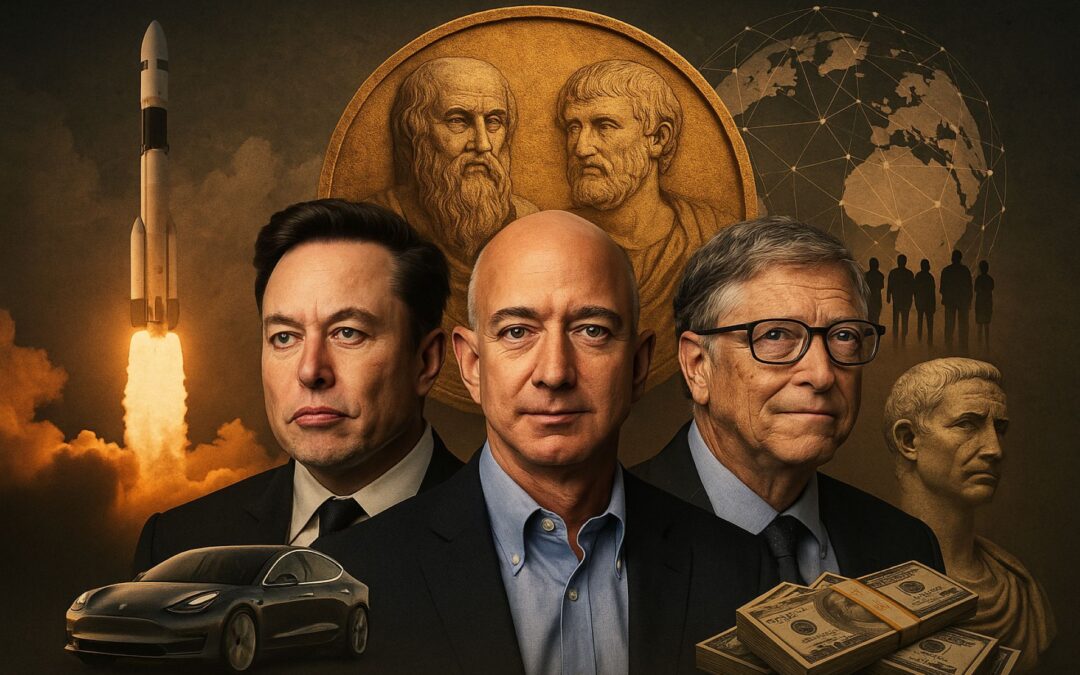
Plato, Aristotle, Genghis Khan, and Alexander the Great—names etched into history for over two millennia. Their legacies continue to shape the way we live, think, and organize societies today. These figures didn’t just exist; they transformed the trajectory of humankind in ways so profound that centuries later, their stories still resonate. The pressing question is: are we witnessing the birth of similar legends in our own era? When future generations look back 2,500 years from now, will they celebrate the pioneers behind space travel, electric vehicles, and global digital connectivity? Or will they lament a generation that wrecked the planet or, worse, faded into obscurity, their feats deemed dull and inconsequential?
To dissect the true imprint modern billionaires leave on humankind, we must ask five essential questions: How profoundly do their actions transform thought, behavior, or survival? Do they alter the course or structure of human life? Do they fulfill genuine human needs? Do they inspire curiosity, movement, or action? And finally, will their contributions be remembered, taught, or expanded upon long after they’re gone?
Measuring Impact: The Yardsticks of History
When we evaluate the true impact of individuals on humankind, we’re essentially measuring how deeply they’ve altered the fabric of human existence. The greats—Plato, Aristotle, Hippocrates, Julius Caesar, Newton—didn’t just make ripples; they created tectonic shifts. Take Hippocrates, often called the father of medicine. Before him, illness was a supernatural mystery, a punishment from gods. He shattered that paradigm by arguing illness had natural causes rooted in the body and environment. This insight wasn’t a mere scientific footnote—it revolutionized humanity’s approach to health, fostering centuries of medical advancement and saving countless lives. It reshaped how societies cared for their people and laid the groundwork for the empirical methods that define modern science.
Similarly, Julius Caesar didn’t just conquer territories; he rewrote governance itself. By ending the Roman Republic and ushering in the Roman Empire, he altered political structures, legal systems, and power dynamics that influenced Western civilization for millennia. His actions redefined leadership, authority, and citizenship, setting precedents still echoed in modern government frameworks.
Newton’s laws of motion and universal gravitation didn’t just explain physical phenomena—they laid the blueprint for the Industrial Revolution and the technological marvels that followed. Without his principles, we wouldn’t have modern engineering, space exploration, or even the smartphones we use daily.
Plato’s philosophical contributions shaped ethics, epistemology, and political theory. His allegories and dialectics are still studied because they articulate fundamental questions about justice, reality, and knowledge—questions that remain central to human thought.
When we juxtapose these monumental contributions with the achievements of today’s billionaires, it becomes clear that true historical impact transcends wealth or fame. It is about transforming thought, behavior, survival, and social structures at a foundational level. The five questions posed—on transformation of thought or survival, alteration of human life’s structure, fulfillment of deep human needs, inspiring movement or action, and enduring remembrance—serve as the compass to gauge whether current figures will be remembered in the same breath as these timeless icons.
Capital and Data: The New Currency of Influence
In our era, influence doesn’t flow from conquest or profound philosophical ideas but from a more intangible yet pervasive currency: capital and data. The richest individuals wield immense financial power, commanding technologies and platforms that touch billions daily. Amazon’s revolution of e-commerce and cloud computing reshaped consumer behavior and enterprise infrastructure worldwide. Similarly, financial tech companies like Square and Ripple democratized access to banking for millions who were previously unbanked, shifting the landscape of global finance.
However, unlike the tangible legacies of ancient conquerors or Renaissance inventors, capital and data are ethereal forces. They’re less about cultural or scientific grandeur and more about systemic influence—changing how economies function, how information flows, and how societies interact on a fundamental level. This new currency operates through algorithms, data analytics, platform monopolies, and digital ecosystems, often invisible but undeniably powerful.
Peter Thiel’s observation about trading “flying cars for 140 characters” encapsulates the ambivalence many feel toward this era. Where once billions were funneled into monumental projects like the space race, genome sequencing, or eradicating disease, now the smartest minds and deepest pockets often funnel resources into refining social media platforms, harvesting data, and optimizing user engagement—sometimes at the cost of societal well-being.
This pivot toward attention economies and data-driven marketing has sparked concerns about addiction, misinformation, and privacy erosion. It raises critical questions about whether today’s innovations will inspire reverence or regret in the long term. Will the digital scaffolding we build now be seen as the foundation for a new age of enlightenment, or as a gilded cage distracting humanity from grander ambitions?
Despite the less glamorous nature of capital and data compared to mythic conquests or artistic masterpieces, they represent the arteries through which modern influence pulses. Understanding their scope is essential to contextualizing the real impact that today’s billionaires have on the future of human civilization.
The Extractors: Wealth Without Legacy
Among the pantheon of modern billionaires, there exists a distinct group whose wealth stems less from creating value and more from extracting it. These are the extractors—individuals and firms that capitalize on systemic vulnerabilities, financial loopholes, or distressed assets, often without generating lasting contributions to society. Their modus operandi revolves around strategic acquisitions of debt, manipulating legal frameworks, or betting against markets, profiting from economic turmoil rather than innovation or service.
Paul Singer’s Elliot Management exemplifies this category. By purchasing Argentina’s sovereign debt at deeply discounted prices, Singer’s firm gained the leverage to enforce full repayment through aggressive litigation, effectively stalling Argentina’s economic recovery. This strategy, while lucrative, arguably impedes the nation’s ability to rebuild infrastructure and provide for its citizens, illustrating how extraction can create short-term gain for a few at the expense of many.
Similarly, John Paulson amassed billions by predicting and profiting from the collapse of the housing market. While his financial acumen is undeniable, his role was that of an opportunistic speculator rather than a builder of economic value. These tactics do not produce new goods, services, or knowledge; instead, they capitalize on market failures and distress.
The impact of extractors is largely insular, confined within the walls of high finance and legal battlegrounds. Their influence rarely trickles down to widespread societal benefit, and their legacies often dissipate with their fortunes. Without purposeful philanthropy or reinvestment into societal progress, their names risk fading from collective memory, overshadowed by those who tangibly transform human life.
The Copycats and Ghost Billionaires: Incremental and Invisible Impacts
Another segment of billionaires occupies a more ambiguous space in the landscape of influence—the copycats and ghost billionaires. Copycats are entrepreneurs who build rapid-growth businesses by replicating existing models rather than innovating fundamentally new concepts. Ride-sharing apps, food delivery platforms, and many e-commerce clones fall into this category.
While these companies undeniably add layers of convenience to everyday life, their innovations tend to be incremental rather than revolutionary. For instance, Uber transformed how urban populations access transportation, replacing traditional taxi dispatch systems with app-based rides. Yet, Uber was not the pioneer of ride-sharing; its model has proven easily replicable, and numerous competitors worldwide have adopted similar approaches. The convenience offered often amounts to marginal improvements in user experience rather than paradigm shifts in societal functioning.
Ghost billionaires, meanwhile, inherit vast wealth without generating new value. Their fortunes are continuations of dynastic legacies in sectors like fashion, luxury goods, and oil. These inherited fortunes sustain status quos rather than catalyzing progress. Similarly, many crypto one-hit wonders and niche industrial magnates, while financially successful, tend not to influence broader societal narratives or inspire widespread change.
Together, copycats and ghost billionaires embody legacies that are incremental, often invisible in the grand sweep of history. They may impact markets and consumer habits but rarely alter cultural or scientific trajectories. Their stories might be footnotes rather than chapters in the annals of human progress.
The Bad Legacy: Billionaires Fuelling Harm
While some billionaires build legacies of innovation and philanthropy, others leave behind a trail of damage that affects ecosystems, societies, and the very fabric of human life. The richest 1% of humanity is responsible for a staggering disproportionate share of carbon emissions—surpassing the combined output of the poorest 66%. This extreme inequality in environmental impact underscores how the behaviors and investments of a tiny elite shape the global climate crisis.
Industries tied to fossil fuels, fast fashion, mining, and certain agricultural practices are central culprits. Fossil fuels, for instance, powered the industrial revolution, electrified cities, and enabled the digital age. Yet today, they are the primary drivers of climate change, causing rising temperatures, extreme weather events, and sea-level rise that threaten millions of lives and livelihoods. Furthermore, fossil fuel interests have historically been entangled with corruption, geopolitical conflict, and human rights abuses, deepening their negative imprint on society.
Fast fashion’s rapid production cycles encourage overconsumption and generate immense waste, exploiting laborers under harsh conditions while damaging ecosystems through pollution and resource depletion. Mining operations often displace communities, pollute water sources, and degrade landscapes, compounding social injustice alongside environmental harm.
Social media platforms, while possessing enormous mobilizing power, have had a complicated relationship with societal health. Initially envisioned as tools for global connection and democratization of information, companies like Facebook (now Meta) shifted toward algorithms optimized for user engagement and advertising revenue. This shift fostered echo chambers, misinformation, and political polarization, enabling manipulation and the erosion of trust in democratic institutions. The spread of false information and hostile discourse has tangible consequences—from influencing elections to fomenting social unrest.
Traditional media empires, such as Rupert Murdoch’s News Corp and Fox News, wield powerful influence but have often prioritized sensationalism and partisan narratives over fostering informed, constructive public discourse. The media’s failure to educate or inspire positive change leaves a vacuum, further contributing to societal fragmentation.
Taken together, these billionaires and their industries contribute to systemic harms that undermine global stability, environmental sustainability, and social cohesion. Their legacy risks being remembered not for progress, but for aggravating crises that future generations must confront.
The Good Legacy: Billionaires Building for Humanity
Amidst this landscape of mixed impacts, a cadre of billionaires strive to harness their wealth and influence to push humanity forward. Their actions reveal a commitment to addressing foundational challenges that threaten survival, equity, and knowledge.
Bill Gates stands out as a seminal figure in this regard. Through the Bill & Melinda Gates Foundation, he has channeled vast resources into eradicating diseases like polio and malaria, improving global health infrastructure, and enhancing educational access. Although the Foundation’s clinical trials and initiatives have faced criticism for their methods or scope, the partnerships it forges with governments, NGOs, and the World Health Organization underscore a systemic approach to global health that transcends profit motives.
Elon Musk, despite being a polarizing figure, spearheads ventures that tackle climate change, space exploration, and neuroscience. Tesla’s mass production of electric vehicles challenges the fossil-fuel status quo, accelerating the transition to sustainable energy. SpaceX redefines humanity’s aspirations beyond Earth, pioneering reusable rockets and ambitious plans for Mars colonization. Neuralink’s efforts to develop brain-computer interfaces, while still nascent, promise to revolutionize medicine and human interaction with technology.
Other philanthropic titans like MacKenzie Scott redefine generosity by swiftly directing billions to underserved communities, often with minimal bureaucracy, empowering grassroots organizations. George Soros’s Open Society Foundations support education, human rights, and democratic governance worldwide, promoting accountability and social justice. Jamsetji Tata’s legacy blends entrepreneurship with philanthropy, having historically funded education, healthcare, and infrastructure in India, embodying socially conscious capitalism. Warren Buffett’s pledge to donate the vast majority of his fortune exemplifies a commitment to wealth redistribution that fuels societal progress.
These billionaires echo the historical role of the Medici family, whose patronage during the Renaissance financed artists, scientists, and thinkers like Michelangelo, Da Vinci, and Galileo. Their support created a cultural and scientific flowering that transformed civilization. Today’s philanthropic billionaires similarly invest in knowledge, health, equity, and innovation, creating ripples that will endure far beyond their lifetimes and inspire future generations to build upon their foundations.
Building Momentum for a Sustainable Future
The true power of positive legacy lies not just in isolated acts of generosity or innovation but in creating self-reinforcing momentum that propels humanity toward a sustainable and equitable future. When billionaires invest in clean energy infrastructure, for example, they aren’t merely funding solar panels or wind farms; they’re architecting a fundamental shift in how societies power themselves. This transition reduces reliance on finite, polluting resources, diminishes geopolitical tensions over scarce commodities, and mitigates the devastating effects of climate change such as mass displacement, food insecurity, and conflict.
Similarly, expanding access to education in rural or underserved communities has transformative ripple effects. Education empowers individuals with knowledge, skills, and critical thinking abilities that catalyze economic development, foster civic engagement, and break cycles of poverty. When a population gains the ability to innovate, govern responsibly, and adapt to changing circumstances, the entire society becomes more resilient and prosperous.
These investments compound over time. Unlike short-term charitable giving or isolated inventions, building infrastructure and systems creates platforms upon which future generations can stand taller. For example, a well-educated child in a remote village may grow to become a scientist, educator, or entrepreneur who drives local and global progress. Clean energy initiatives reduce health burdens from pollution and create jobs, reinforcing societal stability and growth.
The most profound legacies are thus less about singular achievements and more about cultivating ecosystems of survival, knowledge, and innovation. They enable more people to live longer, think clearer, and pass on wisdom to descendants—ensuring the human story continues with increasing richness. This kind of momentum transcends morality; it’s a strategic imperative for civilization’s endurance.
The Choice Ahead: What Kind of Billionaire Will History Remember?
As immense wealth consolidates in the hands of a few, the choices these individuals make carry outsized consequences for humanity’s trajectory. Wealth, inherently neutral, becomes a tool that can either build or erode societal foundations. The pivotal question is: will billionaires steward their resources with foresight and responsibility, or will they hoard riches as trophies for themselves and their descendants?
History remembers those who transcend self-interest to create enduring systems, institutions, and solutions. These are the billionaires who invest not just in products or markets, but in health, education, environmental sustainability, and equitable access. They build organizations that outlive them, empower others to innovate, and tackle existential risks threatening human survival.
This path demands humility—recognizing that individual fortunes rest upon collective systems and that true legacy is measured in impact, not balance sheets. It requires long-term vision to address problems whose solutions may only bear fruit generations later. It demands courage to challenge entrenched interests and disrupt profitable yet harmful industries.
Conversely, those who prioritize accumulation without accountability risk leaving legacies of inequality, environmental degradation, and social unrest. Their names may be etched briefly in news headlines but fade in historical memory, overshadowed by the enduring contributions of those who forged progress.
The narrative of wealth and influence is still being written. The billionaires who harness their power as a force for good will be celebrated as architects of a new era—visionaries who understood that true strength lies not in possessions, but in uplifting humanity itself.
Conclusion
The impact of modern billionaires on humankind is a spectrum—ranging from the transient and incremental to the profound and transformative. While some enrich humanity and chart new frontiers of knowledge and survival, others contribute little beyond financial maneuvering or, worse, accelerate societal harm.
In the grand tapestry of history, those who wield wealth as a tool for solving fundamental problems and uplifting others will leave footprints that future generations can follow. As wealth concentrates ever further, the responsibility to steer this power toward a lasting, positive legacy has never been greater.
The question remains: which billionaires will history celebrate, and which will it forget? And more importantly, what kind of legacy will you choose to build?