
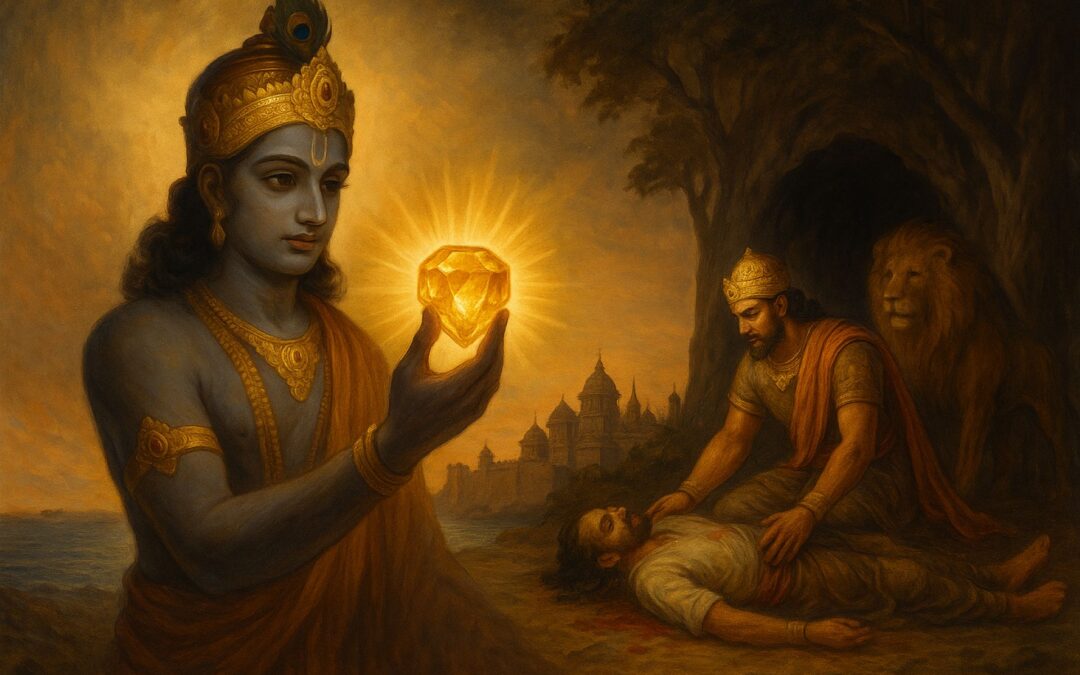
Deep within the heart of ancient India, a tale unfolds about a mystical gem that could bestow both unparalleled fortune and disastrous destruction. Known as the Syamantaka, this jewel, blessed by Surya—the Sun God—was said to possess a radiance that rivaled the sun itself.
More than just an object of beauty, the Syamantaka was endowed with the extraordinary ability to produce 77 kilograms of pure gold every day. But as with all great power, its possession came with heavy consequences. This is the story of how the Syamantaka transformed the life of Lord Krishna and shaped the fate of many others.
The Kingdom of Dwarka: Prosperity and Greed
Dwarka, a city built upon the principles of peace, justice, and prosperity, was the crown jewel of ancient India. Nestled along the western coast, it was a vibrant hub where culture, trade, and knowledge flourished under the enlightened rule of Lord Krishna. Known for its grand architecture, bustling marketplaces, and the unwavering moral compass of its inhabitants, Dwarka represented the epitome of a righteous kingdom—a place where wisdom reigned supreme. Krishna, revered for his intellect, compassion, and divine prowess, governed the kingdom with a steady hand, ensuring the welfare of all its people. His rule was not characterized by fear or force, but by a deep-rooted sense of justice and an unwavering commitment to his subjects.
At the heart of this flourishing kingdom lay its extraordinary prosperity, which was not built on mere wealth but on virtue. Krishna, being the epitome of dharma (righteousness), inspired a society where righteousness, respect for others, and truth prevailed. The land’s natural resources were abundant, and trade flourished with neighboring kingdoms. But beyond material wealth, it was the knowledge, culture, and values of Dwarka that made it the envy of the world. The kingdom became synonymous with peace, wisdom, and prosperity. However, as with every story of grandeur, beneath the surface lay human nature’s complexities—pride, greed, and the quest for power.
Satrajit, a nobleman in Dwarka, was a figure of immense wealth and influence. He was known for his generosity, but his wealth had grown exponentially due to a divine gift from Surya, the Sun God. Surya, impressed by Satrajit’s piety and devotion, gifted him the Syamantaka—a gem of unimaginable power. This jewel was unlike anything ever seen before, glowing with an intensity that rivaled the very sun itself. The Syamantaka was said to have the ability to produce 77 kilograms of pure gold each day, an astonishing gift that could make anyone the wealthiest person in the land. Each day, the gem would work its magic, creating an amount of gold that could dwarf the wealth of even the most prosperous kingdoms. For Satrajit, this gift was both a blessing and a curse.
The moment Satrajit received the Syamantaka, his life took a drastic turn. What was once a humble and gracious man began to succumb to the intoxicating allure of wealth. The daily production of gold, though an immense blessing, began to feed his ego. No longer content with the wealth he already possessed, Satrajit’s desire for more grew insatiable. The Syamantaka became not just a symbol of his prosperity, but of his pride. He reveled in his newfound status as one of the richest men in Dwarka, surrounding himself with lavish luxuries, and elevating himself above the common folk. His arrogance started to show, and his actions began to cloud his judgment.
As whispers began to circulate that Lord Krishna, the revered king of Dwarka, might be interested in the Syamantaka, Satrajit’s fear took root. The very notion that Krishna, his king and ruler, could desire the gem for himself filled Satrajit with suspicion. The relationship between Krishna and Satrajit, though cordial, was now strained by the weight of this newfound wealth. Satrajit’s pride made him believe that Krishna’s request for the Syamantaka was a sign of weakness, a threat to his status and control. This suspicion gave birth to a deep mistrust. Rather than address the matter directly with Krishna, Satrajit decided to take matters into his own hands.
In a move that would prove to be disastrous, Satrajit entrusted the Syamantaka to his brother, Prasena, believing that it would be safer with him. His thinking was clouded by fear and the need to protect his treasure. In doing so, Satrajit inadvertently set off a sequence of tragic events that would unravel the peace and prosperity of Dwarka.
A Tragic Loss and the Search for the Truth
The decision to send the Syamantaka away with Prasena, though driven by caution, quickly spiraled into tragedy. Prasena, who had always lived in his brother’s shadow, now found himself entrusted with the most powerful and valuable object in all of Dwarka. Wearing the Syamantaka around his neck, he set off for a hunting trip in the wilderness, oblivious to the dark fate that awaited him. The kingdom, still basking in its prosperity, seemed untouchable—but in the quiet of the forest, forces beyond the control of any man were already in motion.
Hours passed, and as the day wore on, Prasena failed to return. His absence sparked anxiety among the citizens of Dwarka, and soon it became clear that something was terribly wrong. The forest, a place of untamed wilderness, had claimed many before, but Prasena’s disappearance was different. This was no simple hunting accident. The anxiety turned to fear, and as the sun dipped below the horizon, the kingdom was engulfed in darkness—not just from the absence of light, but from the uncertainty that now loomed over it.
As search parties scoured the dense forest, hoping to find signs of Prasena’s whereabouts, the air was thick with tension. The people of Dwarka feared the worst, but no one could have imagined the grim reality that awaited them. Finally, after what seemed like an eternity, Prasena’s lifeless body was discovered. It lay motionless, surrounded by a haunting silence, and the Syamantaka was nowhere to be found. The jewel, which had once symbolized wealth, prosperity, and divine favor, was lost.
The kingdom was rocked by shock, grief, and confusion. But it was not just the loss of Prasena that shook the foundations of Dwarka—it was the loss of the Syamantaka, a gem that had brought Satrajit unimaginable wealth. The tragedy was now compounded by a wave of rumors and accusations. The whispers began almost immediately. The people of Dwarka, already shaken by Prasena’s death, began to point fingers. In a kingdom where Lord Krishna was both revered and loved, the mere suggestion that he had a hand in Prasena’s death sent ripples of distrust through the air.
Rumors spread like wildfire, fueled by paranoia and fear. The theory that Krishna had orchestrated Prasena’s death to claim the Syamantaka took root, gaining traction among those who were already disillusioned with the ruling elite. The kingdom’s admiration for Krishna, which had once been unshakeable, was now tainted by suspicion. Krishna, a leader renowned for his fairness and wisdom, found himself caught in the whirlwind of these rumors.
For Lord Krishna, this was not just a matter of personal reputation; it was a matter of righteousness. His name, his integrity, and the trust of his people were on the line. He knew that if the truth was not uncovered, the entire kingdom would be thrown into chaos. Krishna understood that he had to take matters into his own hands. As the rightful ruler of Dwarka and a man of unyielding principles, Krishna could not allow the rumors to linger unchecked. His pursuit of the truth began in the forest where Prasena had vanished.
Krishna’s journey into the forest was not just an investigation—it was a quest for justice. His mind, sharp as ever, followed the faintest of tracks, knowing that every detail could reveal the key to unlocking the mystery. As he ventured deeper into the forest, he realized that the events of that fateful day were not as simple as they first appeared. The tracks led him not just to the place where Prasena had fallen, but to a dark and mysterious cave—a place where truth and deception would clash, revealing a hidden power that had been unseen for centuries.
The mystery of the Syamantaka was only beginning to unfold, and the consequences of its discovery would shake the very foundation of Dwarka.
The Epic Battle with Jambavan
The discovery of the cave marked the beginning of a new chapter in Krishna’s quest to unravel the mystery behind the Syamantaka. The tracks led him to an unassuming yet dark entrance, surrounded by dense foliage. As he stepped into the cave, the air grew thick with a sense of ancient power. Within the shadows, the mighty figure of Jambavan awaited him—an ancient bear king who had long ago been a companion to Lord Rama, Krishna’s former incarnation. Jambavan, a warrior of legendary strength and unmatched combat skills, was not a stranger to battle. His towering presence, marked by his thick fur and regal stature, made him a formidable opponent, and Krishna knew this would be no ordinary confrontation.
The cave, a natural fortress, became the arena for a battle unlike any other. Krishna, the divine incarnation of Vishnu, approached with his usual calm and resolute demeanor, but Jambavan, though initially unaware of Krishna’s true identity, was determined to protect what he had claimed as his own. The Syamantaka had become not just a jewel, but a symbol of strength and power, and Jambavan’s loyalty to it ran deep. After all, the gem had saved his people and sustained his kingdom for generations. To him, it was a sacred object, something that could not be relinquished without a fight.
The battle began with a thunderous clash, as Krishna and Jambavan exchanged blows in the darkness of the cave. The intensity of their struggle was beyond comprehension, with each strike shaking the very foundations of the earth beneath them. Krishna’s blows were precise, infused with divine power, while Jambavan’s raw strength and animalistic instincts made him a relentless force. The cave echoed with the sounds of their battle, the crash of their blows reverberating through the mountain.
Despite his divine nature, Krishna found himself in a prolonged fight, his opponent refusing to relent. Jambavan, though surprised by Krishna’s power, remained steadfast in his desire to keep the gem from being taken. Days turned into weeks as the two warriors fought in an almost surreal display of skill, endurance, and divine strength. The cave became a battleground, a place where two legends clashed—not for revenge, but for a higher understanding of power and loyalty.
As the battle continued, Krishna’s strength only seemed to grow, his every movement becoming more fluid and graceful, while Jambavan’s resolve began to waver. Krishna, ever the wise one, did not just rely on force but also on strategy, knowing that to win this fight, he had to show Jambavan something beyond the physical. Slowly, as the days dragged on, Jambavan began to sense something familiar in Krishna’s movements—the same divine aura, the same strength that he had once witnessed in Lord Rama. The pieces began to fall into place for the ancient bear king.
Finally, after days of relentless combat, Jambavan had an epiphany. In a flash of recognition, he realized that the man he was fighting was not just any warrior—this was none other than Lord Krishna, the reincarnation of Lord Rama. The shock of this realization overwhelmed him, as Jambavan understood that he had been fighting not just a king, but the very divine being he had once served with devotion. His heart filled with awe and remorse for his actions.
In an act of complete surrender, Jambavan fell to his knees, his fierce pride giving way to a deep sense of humility. He pleaded for forgiveness from Krishna, apologizing for his ignorance and the battle he had waged. It was in that moment that Jambavan realized the true meaning of loyalty—not to a gem or a kingdom, but to the divine itself. His devotion to Lord Rama had been rekindled in his recognition of Krishna, and with that, he returned the Syamantaka to its rightful owner.
But Jambavan’s act of repentance did not end with the return of the gem. In a gesture of profound respect and humility, Jambavan offered his daughter, Jambavati, in marriage to Krishna. This act not only sealed the bond between the two but also demonstrated the deep reverence that Jambavan felt for Krishna. This marriage would later prove to be one of the many that solidified Krishna’s role as a divine leader and protector.
The battle between Krishna and Jambavan had transcended the physical realm. It became a lesson in humility, devotion, and the understanding of true power. The Syamantaka, once a symbol of greed and destruction, had now been reclaimed by Krishna, but it was no longer a source of material wealth—it had become a symbol of divine wisdom and righteousness.
Redemption and a Noble Act
With the Syamantaka now safely returned to Krishna, the implications of this event rippled through Dwarka. The kingdom, which had been marred by rumors and accusations, could now breathe a sigh of relief. Krishna, through his wisdom, had cleared his name and restored peace. He had not only recovered the gem but also demonstrated his ability to lead with honor and humility. However, his actions did not stop at recovering the Syamantaka and settling the matter of his reputation. Krishna’s nobility extended far beyond his personal interests.
Krishna’s next move was nothing short of remarkable. Instead of keeping the Syamantaka for himself—a treasure of immense power and wealth—he made a decision that would resonate for generations to come. Krishna chose to return the Syamantaka to Satrajit, its original owner, despite the betrayal and tragedy that had unfolded. This act was not born from a desire for glory or control but from a deep understanding of the value of compassion and righteousness. Krishna understood that the gem’s power was far too great for any one person to hold. It was not a possession to be coveted but a responsibility to be borne.
When Krishna returned the Syamantaka to Satrajit, it was not an act of submission but one of grace. Krishna’s gesture was a powerful lesson in humility and leadership, showing that true greatness lies not in possessing power but in using it for the greater good. The return of the gem served as a mirror to Satrajit, reflecting the consequences of his pride and the misplaced fear that had driven him to distrust his own king.
Satrajit, overwhelmed by Krishna’s generosity and wisdom, was filled with deep shame. His initial actions had led to the death of his brother, the betrayal of Krishna, and the ensuing chaos. But Krishna’s magnanimity stirred something within him. Satrajit realized that his desire to hoard the Syamantaka had blinded him to the true nature of wealth and power. It was not in the physical possession of gold or jewels that one found greatness, but in the righteousness and integrity of one’s actions.
Filled with remorse and gratitude, Satrajit offered not just the Syamantaka back to Krishna, but also his daughter, Satyabhama, in marriage. This offer was not just a token of gratitude but an acknowledgment of Krishna’s superior character. Satrajit recognized that Krishna’s greatness lay not in his ability to command power, but in his unwavering sense of duty, justice, and righteousness. By offering his daughter, Satrajit hoped to atone for the mistakes of his past and to honor Krishna’s nobility.
However, Krishna, in his infinite wisdom, declined to take the gem for himself. Instead, he accepted the gesture with grace but left the decision in Satrajit’s hands, allowing him to reflect on the choices he had made and the lessons he had learned. This act of forgiveness and nobility only further cemented Krishna’s reputation as a wise and compassionate leader.
Yet, Krishna’s actions did not end with the restoration of peace in Dwarka. He knew that the Syamantaka, like all power, was not meant to be hoarded. And so, he returned it to its rightful place with a divine understanding: true greatness lies in knowing when to relinquish control, to step aside, and to trust that righteousness will prevail.
The Fate of the Syamantaka
The tale of the Syamantaka did not end with its return to Krishna or Satrajit. Despite Krishna’s wisdom and his selfless acts, the jewel’s power continued to wreak havoc. Its ability to create gold was both a blessing and a curse—one that led to a vicious cycle of greed, betrayal, and destruction. Though Krishna had taken the gem into his custody to prevent further harm, its power remained a source of temptation for those around it.
The desire for the Syamantaka’s wealth grew exponentially, and eventually, Satrajit, the man who had originally owned it, fell victim to his own allies. Those closest to him, driven by a thirst for power and gold, conspired against him. Satrajit was murdered in cold blood by the very people he had trusted. His death, motivated by greed for the Syamantaka, was a cruel reminder of the destructive nature of unchecked desire.
The gem then passed through several hands, each time causing discord and chaos. It was clear that no mortal could safely wield such power. The Syamantaka’s ability to produce gold was too great a temptation, and each person who came into possession of it was eventually consumed by the curse it carried. The wealth it generated was not a blessing but a harbinger of ruin.
Finally, the Syamantaka found its way back to Lord Krishna, who understood that its power could not be allowed to fall into the wrong hands again. In a final act of wisdom, Krishna accepted guardianship of the Syamantaka, not for personal gain, but to protect the world from the destruction it could cause. Krishna’s acceptance of the gem symbolized his ultimate understanding: that true power lies not in accumulation, but in stewardship.
Despite Krishna’s guardianship, the Syamantaka’s fate remains uncertain. Some say it lies buried beneath the ruins of Dwarka, lost beneath the ocean, waiting for the right moment to resurface. Others claim that it has been transformed into the Kinor Diamond, now held as a treasure by foreign hands. But the true fate of the Syamantaka is a mystery that has endured for centuries. Its story serves as a timeless reminder that power, when unchecked by wisdom, can lead to devastation. The gem may be lost, but the lessons it teaches about greed, responsibility, and true wealth continue to resonate through the ages.