
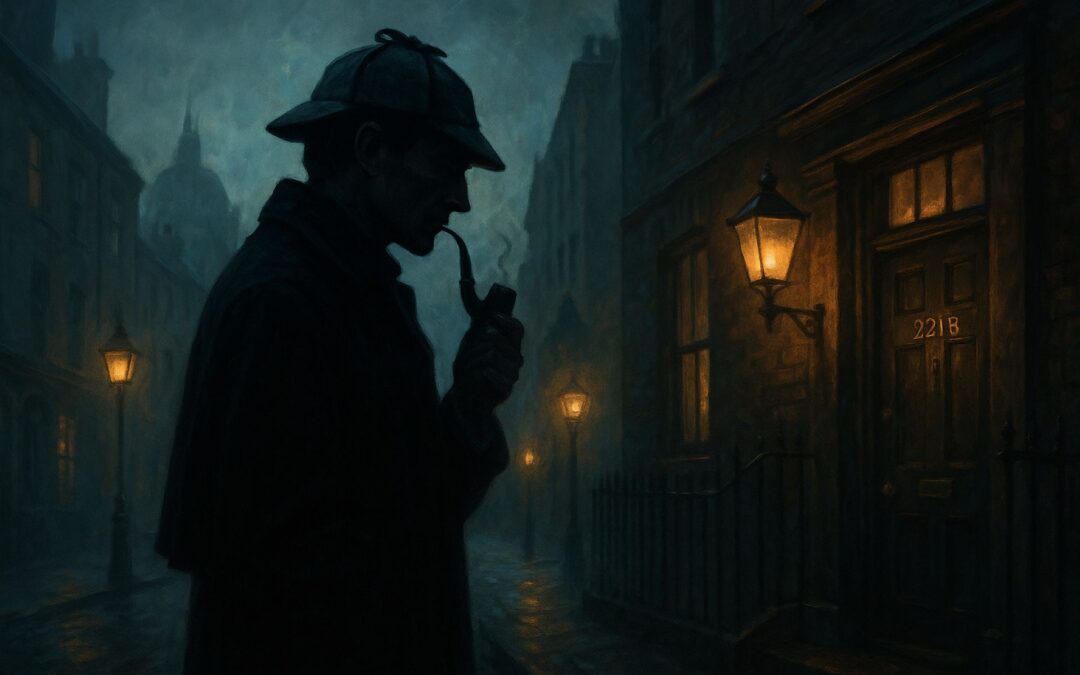
When The Return of Sherlock Holmes was published in 1905, readers experienced something rare in literature—the resurrection of a legend. For a decade, the world believed Holmes had perished at the Reichenbach Falls. Arthur Conan Doyle, pressured by public demand and enticed by his publisher, revived the detective in a collection of thirteen stories that not only restored his presence but deepened his myth.
These tales mark a new era: Holmes is more seasoned, his cases often darker, his moral compass tested in ways earlier adventures never dared. We find him unraveling cryptic ciphers, exposing political conspiracies, sparing guilty lovers, and confronting criminals who embody both cunning and cruelty. Together, these stories showcase Holmes at the height of his powers, standing at the intersection of intellect, justice, and humanity.

The Adventure of the Empty House
London in 1894 is unsettled by the mysterious death of Ronald Adair, a quiet young aristocrat found dead in his locked room. The newspapers report that Adair was killed by a gunshot wound to the head, with no sign of robbery. On the table beside him lay piles of money and playing cards, suggesting he had been engaged in a late-night game. The case puzzles the city — why would anyone murder a man who seemingly had no enemies?
Dr. Watson, now widowed and practicing medicine once again, passes the familiar streets near Baker Street when he nearly collides with a tall, cloaked stranger. To his astonishment, it is Sherlock Holmes — alive. Holmes reveals that his supposed death at Reichenbach Falls, years earlier, was a necessary ruse. He had escaped Moriarty’s clutches and spent years traveling in Tibet, Persia, and France while dismantling Moriarty’s network. Only now, with his enemies weakened, could he safely return to London. The reunion between Holmes and Watson is one of the most emotional moments in the canon, showing both Watson’s loyalty and Holmes’s rare warmth.
Holmes turns quickly to the Adair case. He explains that Adair was likely killed because he had uncovered a card-cheating scheme in which he was unwillingly entangled. Adair was honest, but the circle he played with included dangerous men who would not hesitate to silence him. Holmes suspects Colonel Sebastian Moran, the most skilled of Moriarty’s surviving lieutenants, and a crack shot renowned for big-game hunting.
Holmes sets a trap. He places a wax effigy of himself in the window of 221B Baker Street, moving it periodically with strings to mimic a living silhouette. From a deserted house across the street, Holmes and Watson lie in wait. As midnight approaches, the creak of floorboards signals their quarry. A rifle barrel emerges from the darkness, aimed at the figure in the window. In an instant, Holmes and Inspector Lestrade pounce, capturing Moran as he attempts to flee.
The weapon he carries astonishes them — an air rifle, custom-built by a German gunsmith, capable of firing silently and at long range. Holmes explains that Moran used this very rifle to kill Adair, preventing him from exposing the cheating ring. The same rifle was now trained on Holmes, who would have been the next victim had his ruse not succeeded.
The case ends with Moran arrested, Holmes’s reputation restored, and the great detective fully reinstalled in Baker Street. But the story resonates beyond its mystery. It is a tale of resurrection, of loyalty rekindled, and of the thin line between genius and danger. Moran, a man of skill but corrupted purpose, mirrors what Holmes might have become had he used his gifts for evil.
The Adventure of the Norwood Builder
One summer morning, Holmes and Watson are disturbed by the arrival of a frantic young lawyer named John Hector McFarlane. Breathless and pale, McFarlane insists he is being hunted for a murder he did not commit. The police are on his trail, and Inspector Lestrade has already issued a warrant for his arrest. McFarlane begs Holmes to hear his side before the law condemns him.
McFarlane’s story is strange. The previous day he had been called to the home of Jonas Oldacre, a reclusive and rather unpleasant builder from Norwood. To his astonishment, Oldacre produced a will leaving his entire estate to McFarlane, a man he barely knew. McFarlane admits he was puzzled, but Oldacre claimed he wanted to reward the son of a woman he once knew. McFarlane drew up the necessary papers and left that evening. Now Oldacre has vanished, and McFarlane stands accused of murdering him to secure the inheritance.
The evidence against McFarlane seems overwhelming. Bloodstains mark Oldacre’s house, and McFarlane’s walking stick was found at the scene. Burned remains in the fireplace are said to be Oldacre’s. Lestrade, brimming with certainty, arrests McFarlane in Holmes’s very sitting room.
Holmes, however, is unconvinced. He notices the case is too neat. The clues appear staged, as if someone laid a trap for the young lawyer. Holmes examines Oldacre’s house and sees signs of deliberate trickery: the blood is suspiciously smeared, the fire was used clumsily, and the remains in the hearth are not human but animal. He becomes convinced Oldacre is alive and hiding nearby.
In a climactic scene, Holmes has the house searched again. At first, nothing is found. But Holmes notices an oddly placed lumber stack. When the police pry it open, they discover Oldacre himself, cowering and furious. His scheme is laid bare. Years ago, McFarlane’s mother rejected his marriage proposal. Out of spite, Oldacre planned to destroy her son’s life by faking his own death and framing McFarlane for the crime.
The revelation clears McFarlane’s name instantly. Lestrade, embarrassed but grudgingly respectful, admits Holmes’s brilliance once again. Oldacre, once thought a victim, is exposed as the true villain — proof of Holmes’s maxim that appearances, however convincing, often conceal deeper deception.
The Adventure of the Dancing Men
Hilton Cubitt, a country squire from Norfolk, visits Baker Street with a puzzle that seems almost childlike at first glance. He hands Holmes a scrap of paper covered in strange little drawings—stick figures sketched in playful poses, almost like children playing a game. Yet his wife, Elsie, is terrified by them. She refuses to explain their meaning, saying only that they recall a past she wishes to forget.
Cubitt is a devoted husband. He married Elsie in good faith after she moved from America, and though she confessed before their marriage that her past contained a shadow, she begged him never to press her for details. He agreed, trusting in her love. But now these “dancing men” notes have begun to appear on his property—chalked on the garden wall, slipped under doors, drawn crudely on scraps of paper. Each one unsettles Elsie more than the last.
Holmes studies the figures carefully. The little men are not mere doodles—they repeat certain shapes and patterns. Holmes realizes they are a substitution cipher: each stick figure stands for a letter. He begins to crack the code, piecing together the hidden words. The first messages are simple—childlike greetings and names—but Holmes senses menace beneath their playfulness.
Despite Holmes’s warning to keep him informed immediately, Cubitt delays sending new messages. When another note arrives, Holmes deciphers it as a direct threat. He rushes with Watson to Norfolk, but they arrive too late. Tragedy has struck: Hilton Cubitt is found dead from a gunshot wound in his study, and Elsie lies nearby, gravely wounded but alive.
Holmes reconstructs the crime. From the arrangement of the furniture and the angle of the bullet holes, he deduces that a third party was present, firing from outside the window. The coded messages lead Holmes to the culprit: Abe Slaney, a notorious criminal from Chicago and Elsie’s former suitor. He had followed her to England, determined to force her back into his life. The dancing men were his way of communicating privately, knowing only Elsie would understand.
Holmes sets a clever trap. Sending a message in the dancing men’s code, he lures Slaney to the Cubitt home. When the criminal arrives, confident he is meeting Elsie, he is arrested by the waiting Holmes and police. Slaney confesses: Elsie had refused him once more, and in the struggle, Hilton Cubitt was shot dead.
Elsie survives but is left broken-hearted, her husband’s trust and devotion repaid only with sorrow. The story ends not with triumph but with grief. Holmes, usually so impassive, is deeply moved. His genius has solved the cipher, unmasked the killer, and secured justice, but nothing can restore the simple happiness of the Cubitts’ marriage.
The Adventure of the Solitary Cyclist
Violet Smith, a young governess of rare beauty and poise, comes to Baker Street with a tale that mixes gratitude with dread. Recently, she accepted a position at Chiltern Grange, a country estate in Hampshire, teaching music to the daughter of two men who share the household, Mr. Carruthers and Mr. Woodley. Carruthers, though stern and watchful, has treated her with kindness, even pressing her to ride his horse instead of cycling to the station. Woodley, on the other hand, is coarse, overbearing, and openly lecherous—an object of Violet’s disgust.
At first, all seemed harmless enough. But then Violet noticed something strange: every Saturday when she cycled home to her mother, a solitary man would follow her at a distance, also on a bicycle. No matter what route she took, he was there. He never approached, never spoke, only shadowed her in silence. Though Carruthers assured her she was safe, Violet grew uneasy.
Holmes listens intently. He suspects that her shadow has less to do with menace than with guardianship, but he promises to investigate. A few days later, Holmes and Watson travel to Hampshire themselves. On a country road, they spot Violet cycling—and sure enough, the solitary cyclist is behind her. Holmes and Watson pursue him, but he escapes with speed, confirming the mystery runs deeper.
Holmes digs further into Violet’s circumstances. Her father had recently died in South Africa, leaving her a modest inheritance. That fortune, he suspects, is the key. The Carruthers-Woodley household, with its odd companionship, suddenly takes on a darker hue. Carruthers appears infatuated with Violet, while Woodley seems bent on coercion.
The climax comes swiftly. Violet is suddenly missing. Holmes, Watson, and Lestrade rush to a village inn, where Woodley, drunk and violent, has attempted to force Violet into marriage by dragging her before a clergyman. Carruthers arrives in hot pursuit, furious that Woodley has betrayed their pact. But Holmes arrives first, halting the farce and rescuing Violet.
The solitary cyclist is unmasked—not an enemy but a protector. Carruthers, though guilty of selfish intentions, had genuinely cared for Violet’s safety and followed her at a distance to shield her from Woodley’s advances. His duplicity lies in silence: he should have spoken, but instead let Violet live in fear. Woodley, meanwhile, faces justice.
The story closes on a note both grim and bittersweet. Violet is safe, her inheritance intact, but her trust has been tested by men who sought to own or guard her for their own reasons. Holmes, as ever, cuts through the disguises of affection and guardianship, showing that good intentions warped by secrecy are scarcely less dangerous than outright villainy.
The Adventure of the Priory School
Dr. Thorneycroft Huxtable, an earnest and harried schoolmaster, arrives at Baker Street in a state of panic. He is the head of the Priory School, a prestigious institution, and has come to beg Holmes’s help in a case that threatens scandal at the highest levels of society. The young Lord Saltire, son of the powerful Duke of Holdernesse, has vanished from the school. Along with him, one of the masters—a German named Heidegger—has disappeared as well. Huxtable fears ruin if the boy is not recovered quickly.
Holmes takes the case immediately, intrigued by the stakes. He and Watson travel to the north of England, where they learn the details. The boy’s room showed no signs of forced entry, but his bicycle is gone. Soon after, Heidegger was discovered missing too, his own bicycle also absent. Searchers scoured the countryside until, grimly, Heidegger’s body was found on the moors, battered and lifeless.
Holmes examines the scene. The bicycle tracks confuse the searchers: they seem to multiply and cross, with cow tracks mingling oddly among them. But Holmes notices something others do not—the cow tracks are false. They were stamped deliberately with a special shoe to disguise hoofprints. Further, Holmes remarks that one of the “bicycle” tracks is inconsistent with an actual rider—it suggests a cycle being wheeled along, not pedaled.
Holmes and Watson’s search leads them to a lonely inn where suspicious travelers were said to have passed. By careful deduction, Holmes links the false cow tracks to a horse ridden by someone who sought to confuse pursuers. The truth, when Holmes announces it, is both scandalous and tragic.
James Wilder, the Duke’s illegitimate son, had orchestrated the kidnapping. Jealous of young Lord Saltire, he hoped to remove the legitimate heir and force his father to elevate him. Wilder manipulated events and enlisted the help of the family’s secretary, Reuben Hayes, a man of violent temper who ultimately killed Heidegger when the master pursued too closely. Lord Saltire, terrified and miserable, was concealed in a remote hiding place.
The Duke, though not directly guilty, is revealed to have known more than he admitted. His desire to protect Wilder’s reputation led him to conceal facts that could have saved Heidegger’s life. Holmes, in one of his sharpest rebukes, reminds the Duke that honor cannot be preserved through deceit.
In the end, Lord Saltire is rescued, Wilder is disgraced, and Reuben Hayes is condemned for murder. But the affair leaves a sour taste. A boy’s safety was bartered for power, and a teacher’s loyalty was repaid with death. Even Holmes, usually exultant in victory, feels the weight of human weakness pressing upon him.
The Adventure of Black Peter
It is a hot summer when Holmes receives an unusual request. Inspector Stanley Hopkins, one of the younger policemen who admires Holmes’s methods, comes to Baker Street with a case that has left him baffled. A retired sea captain named Peter Carey—nicknamed Black Peter for his violent temper and dark reputation—has been found brutally murdered in his isolated cabin, skewered to the wall by a harpoon.
Holmes and Watson travel with Hopkins to the scene. The cabin is small, scarcely more than a shed, but inside it is packed with signs of Carey’s harsh nature: rough furniture, sea charts, a tobacco pouch carved from a whale’s tooth. His body is grotesquely pinned against the wall, blood soaking into the boards. A bottle of rum and two glasses sit on the table, suggesting Carey had a visitor the night he died.
Holmes immediately notes several odd details. Carey was a powerful man, yet the killer must have possessed enormous strength to drive a harpoon through him. Few weapons are so personal, so savage. Holmes suspects the murderer is no ordinary criminal but someone with experience in whaling or seafaring.
Hopkins produces a notebook found at the scene, marked with the initials “J.H.N.” It contains cryptic entries relating to securities and finance. Holmes guesses that Carey’s past may have caught up with him—his voyages had long been rumored to include smuggling and piracy.
Soon after, a young man named John Hopley Neligan is arrested. He is the son of a banker who vanished years earlier during a scandal involving stolen securities. Neligan claims he only went to Carey’s cabin to search for papers that might clear his father’s name. Hopkins believes he is lying and charges him with the murder.
Holmes, however, is unconvinced. He arranges a clever trap. Disguised as a harpoon buyer, Holmes advertises for skilled men in the trade. When Patrick Cairns, a burly harpooner, answers the call, Holmes engages him in conversation. Cairns demonstrates how a man could drive a harpoon through a body in one stroke—and in that moment, Holmes springs the trap. Cairns confesses: years earlier, he and Carey had been partners in a crime involving stolen securities. When Cairns confronted Carey over his share, Carey turned violent, and Cairns killed him in self-defense—albeit with terrifying force.
The case clears Neligan of suspicion, though the mystery of his father’s vanished fortune remains unsolved. For Hopkins, it is another lesson in the importance of patience and detail; for Holmes, it is a reminder that the sea breeds men as dangerous as any Moriarty.
The Adventure of Charles Augustus Milverton
Of all the criminals Holmes ever encountered, he confesses to Watson that he despises none more than Charles Augustus Milverton—the “king of blackmailers.” Unlike violent murderers or cold-blooded thieves, Milverton profits by destroying reputations. He hoards secrets, collects compromising letters, and squeezes his victims for money or favors until their lives collapse. Holmes compares him to a venomous reptile, one who slithers in drawing rooms rather than alleys.
Lady Eva Blackwell, a young aristocrat engaged to a prominent nobleman, is Milverton’s latest target. Years earlier, she had written passionate letters to a lover. Milverton now possesses them and threatens to reveal them unless she pays an exorbitant sum. Exposure would ruin her marriage prospects and devastate her family’s honor. She begs Holmes for help.
Holmes attempts a direct confrontation. He and Watson visit Milverton at his Hampstead residence. The blackmailer receives them with oily charm, his sharp eyes gleaming with malicious pleasure. Holmes tries to negotiate, appealing to his sense of decency—an appeal Milverton mocks. The man is utterly without conscience; he declares that exposing people is his “profession” and sneers at the very idea of mercy. When Holmes threatens him, Milverton calmly promises to retaliate with ruin.
Outmaneuvered legally, Holmes chooses illegality. Disguising himself as a plumber, he courts Milverton’s maid and extracts the layout of the house. One winter night, Holmes and Watson break into the Hampstead mansion, slipping silently through shadowed corridors until they reach Milverton’s study. There, in a locked safe, lie the letters and documents that have ruined countless lives.
But fate intervenes. Just as Holmes cracks open the safe, footsteps approach. Holmes and Watson hide behind a curtain as Milverton enters. He is not alone. A veiled woman confronts him—one of his past victims. With cold rage, she accuses him of having destroyed her life and driven her husband to ruin. Milverton mocks her too, laughing in her face. In a moment of icy resolve, the woman draws a revolver and shoots him dead. He collapses without a sound, the king of blackmailers silenced by poetic justice.
Holmes and Watson remain hidden, horrified yet awed. When the woman departs, they emerge, finish gathering the incriminating letters, and burn them all in the fireplace. For once, Holmes does not seek to reveal the truth. Instead, he and Watson slip out into the night, leaving the police to puzzle over Milverton’s corpse.
The case is one of Holmes’s rare moral ambiguities. He breaks the law, witnesses murder, and protects the killer’s identity. But to Holmes, Milverton’s death is no crime—it is the end of a monster who thrived on human misery. In this story, justice arrives not in a courtroom but in the quiet hand of a victim who refused to be destroyed.
The Adventure of the Six Napoleons
Inspector Lestrade arrives at Baker Street with a case that seems almost comical at first. Across London, plaster busts of Napoleon Bonaparte are being smashed in a series of nighttime attacks. Nothing is stolen, nothing else is disturbed—just the busts, purchased from various shops and homes, all shattered to pieces. The vandalism appears senseless, yet its persistence troubles the police.
Holmes, amused but intrigued, accompanies Lestrade to one of the crime scenes. In the drawing room of a respectable household, the shattered remains of a Napoleon bust lie scattered on the carpet. Holmes bends over the fragments with unusual intensity, noting the precision with which the bust was targeted. This was not random vandalism—it was a search.
The mystery darkens when the body of a man is discovered in a suburban street, stabbed to death near the site of yet another bust-breaking. The dead man is identified as Pietro Venucci, a member of an Italian criminal gang. Now Holmes is certain: behind the smashed busts lies not madness, but organized crime.
Patiently, Holmes reconstructs the sequence of bust purchases, tracing them back to their manufacturer. He learns that six identical busts of Napoleon had been cast, all sold to different buyers. One by one, the unknown criminal has hunted them down, shattering each in turn. Why Napoleon? Holmes explains: the busts are not the goal—their contents are. Something has been hidden inside one of them, and the vandal will not stop until he finds it.
Holmes arranges to intercept the final bust. He, Watson, and Lestrade wait in ambush. Sure enough, a man enters and smashes it with a hammer. Before he can flee, they seize him. He is Beppo, an Italian workman who had once been employed at the plaster factory. When arrested, Holmes smashes the last fragment himself—and from within falls a glittering pearl, the famous black pearl of the Borgias, stolen years earlier.
Beppo had hidden the pearl inside the wet plaster of one bust while pursued by police. Later, released from prison, he sought to recover it by tracking down every copy of the batch. His violent desperation led to Venucci’s murder, and his obsession left a trail of shattered Napoleons across London.
The case concludes in triumph, with Lestrade admitting Holmes’s brilliance before Watson’s eyes. Yet it is more than a clever puzzle. Holmes has turned a seemingly absurd series of petty crimes into the unraveling of an international jewel theft. The smashed busts, absurd to all others, were to Holmes the footprints of a patient and desperate criminal.
The Adventure of the Three Students
One afternoon, Holmes and Watson are visited by a nervous don from St. Luke’s College, a respectable university town. The don explains that a scandal threatens his career and the reputation of the college. Tomorrow is the examination for an important classical scholarship, and somehow, someone has tampered with the examination papers. He begs Holmes to identify the culprit discreetly, so the matter can be resolved without ruining the school’s honor.
The don explains what happened: he had briefly left his study, where the exam proofs were kept locked in a desk. When he returned, he noticed the desk drawer slightly open and the papers disturbed. No one else had been in the room—except possibly one of the three students who lived in nearby chambers. Each student had an opportunity to pass the don’s study within that narrow window of time.
The suspects are three very different young men:
- Gilchrist, a fine athlete, tall and strong, widely admired for his rugby and track feats.
- Daulat Ras, a quiet and diligent Indian student, wholly devoted to his studies.
- Miles McLaren, a brilliant but reckless young man with a reputation for dissipation and temper.
Holmes begins his investigation in the study itself. He notices small but telling details: a cut in the carpet near the desk, a tiny lump of clay smeared on the floor, and the positioning of the exam papers. To others, these seem meaningless. To Holmes, they are signposts. The clay, he observes, comes from running shoes, not ordinary boots. The cut in the carpet suggests the toe of a spiked shoe accidentally dug in as the intruder bent over the desk.
Holmes asks to meet each of the three students. His sharp eyes miss nothing. Gilchrist, the athlete, seems honorable but troubled. Ras maintains his composure and insists he would never dishonor himself. McLaren, bristling with defiance, barely conceals his contempt for the entire process.
Later, Holmes calls the don and Watson together to deliver his conclusion. The culprit was Gilchrist, the athlete. He had entered the room, seen the papers, and in a moment of weakness examined them. The clay from his athletic shoes gave him away, as did the mark in the carpet. Yet Holmes emphasizes that Gilchrist is not a hardened criminal but a young man who faltered once, led astray by temptation and pride.
Gilchrist breaks down and confesses, overcome with shame. He explains that he had already achieved distinction in sport and wanted to crown his career with academic triumph. But the guilt gnawed at him the moment he looked at the papers. His confession spares the don a scandal, and Holmes ensures the matter is kept quiet. Gilchrist withdraws from the university, leaving to join the army and redeem himself in service.
Holmes reflects that the case was not one of crime but of human frailty. The smallest clues—a smear of clay, a bent carpet thread—had unmasked a great secret. Yet instead of triumph, the detective’s tone is one of compassion, recognizing that genius in detection must be matched by understanding of human weakness.
The Adventure of the Golden Pince-Nez
On a blustery autumn morning, Inspector Stanley Hopkins once again seeks Holmes’s help. He arrives at Baker Street visibly perplexed, presenting what appears at first to be a straightforward murder but which he admits is beyond him. The victim is Willoughby Smith, a young secretary employed by an elderly recluse, Professor Coram. Smith was found stabbed to death in the professor’s study, clutching in his hand a curious clue: a pair of golden pince-nez spectacles.
Holmes and Watson travel to Yoxley Old Place, the professor’s gloomy country home. They meet Coram himself, a frail old man confined to his chair, coughing violently and swaddled in blankets. His rooms are filled with books and papers, the air heavy with illness. Coram claims he has no idea why anyone would wish to harm Smith, who had been a devoted assistant.
Holmes begins his methodical search. He examines the study: the papers on the desk are disturbed, and the footprints on the carpet suggest a hurried struggle. The pince-nez spectacles, delicate and finely made, are examined next. Holmes notes their unusual design: they are for a woman, fitted with a strong prescription for shortsightedness, and the nosepiece indicates they belong to someone of refined features. The tiny traces of rouge on the frame confirm it.
The investigation intensifies. Witnesses report seeing no intruders, but Holmes realizes that the layout of the house, with its French windows opening to the garden, makes entry simple. He grows certain that the killer was not a man but a woman—someone who had come secretly to the professor’s study and been surprised by Smith. The secretary tried to stop her, and in the struggle she stabbed him, leaving behind the spectacles.
Holmes sets a subtle trap. Knowing the woman is likely still hiding nearby, he instructs the servants to search the house from top to bottom. Sure enough, they find a woman concealed in one of the corridors, weak and exhausted. When brought before Holmes, she collapses into confession. Her name is Anna. She is Professor Coram’s estranged wife.
Her story is one of tragedy. Years before, she had been involved in revolutionary movements in Russia. Coram himself, though now posing as a harmless scholar, had once betrayed her comrades to the authorities, leading to their deaths. Anna came to Yoxley Old Place to retrieve incriminating documents that could expose him. She had no wish to kill Smith—his death was the accidental result of his attempt to restrain her.
Anna, already dying of consumption, does not live long after her confession. In her final words, she expresses regret and bitterness, while Coram himself is left broken and disgraced, the sins of his past finally brought into light.
For Holmes, the case is less about the thrill of deduction than the sorrow of human lives twisted by betrayal, politics, and revenge. A pair of spectacles—so easily overlooked—proved the key to unraveling a hidden history of love, treachery, and ruin.
The Adventure of the Missing Three-Quarter
It is the height of rugby season when Holmes is summoned to Cambridge by Cyril Overton, captain of the university’s team. Overton is frantic: his star player, Godfrey Staunton—the “three-quarter” upon whom the entire strategy depends—has vanished on the eve of the decisive match against Oxford. Without him, Cambridge faces certain defeat.
Holmes listens carefully. Staunton is not only a fine athlete but the nephew of Lord Mount-James, a wealthy, miserly nobleman. Overton can think of no reason for his disappearance, save perhaps an urgent message that arrived for Staunton just before he vanished. Witnesses saw him receive a telegram during training; afterward, he left in a hurry and never returned.
Holmes begins by tracing the telegram. It was sent from London by a man who signed only his initials. The cab driver who picked Staunton up recalls dropping him at a house in the suburbs, but no further trace can be found. At every step, Holmes meets evasions. Staunton’s relatives, including Lord Mount-James, are tight-lipped and more concerned about inheritance than the young man’s fate.
Pursuing the trail with Watson, Holmes uncovers the involvement of a certain Dr. Leslie Armstrong, a well-known physician in Cambridge. Armstrong is reputed to be upright and learned, but Holmes’s instincts tingle. Why has Armstrong been making secretive journeys late at night in his brougham? Who has he been visiting?
Holmes and Watson shadow the doctor. After several failed attempts, Holmes deploys one of his cleverest ruses: he hires a local errand-boy with a swift bicycle to tail the carriage whenever it leaves Armstrong’s home. One night, the boy reports the carriage traveling to a lonely cottage outside town.
There Holmes finds the truth. Inside lies Godfrey Staunton, weary and grief-stricken, by the bedside of his young wife. Unknown to all but a handful, Staunton had secretly married a woman of lower social standing. When she fell gravely ill, the urgent telegram summoned him. He abandoned the rugby team not out of cowardice but out of love and duty.
Tragically, Holmes and Watson arrive too late to save her. She dies as they watch, her last moments shared with her devastated husband. Staunton, now broken, explains that he kept the marriage secret for fear of his uncle’s wrath and disinheritance. He would rather face disgrace than see his beloved denied his care at the end.
The case closes without triumph. There is no crime, no villain to expose—only the sorrow of a young man torn between family ambition and the private choice of his heart. Overton must face Oxford without his champion, and Holmes, usually exultant in victory, remarks quietly to Watson that the affairs of the heart often prove the most inscrutable puzzles of all.
The Adventure of the Abbey Grange
It is a bitter winter’s morning when Holmes wakes Watson with an urgent summons: Inspector Stanley Hopkins has sent word of a brutal murder at Abbey Grange, the country estate of Sir Eustace Brackenstall. The case, Holmes insists, cannot wait. Watson, still half asleep, hurries to dress, and soon the two are speeding by train through the frosty countryside.
At the manor, they are met by Hopkins, brimming with confidence. He believes the crime to be the work of the notorious Randall gang, burglars who have been terrorizing the district. Holmes, however, prefers to judge for himself.
Lady Brackenstall, pale and shaken, sits before them. She recounts the horror of the night before. The household had retired when she was startled by three masked men breaking into the dining room. They tied her to a chair with the bell rope and demanded valuables. When her husband, Sir Eustace, stormed in, a violent struggle broke out. The burglars bludgeoned him with a poker, killing him instantly. They drank the wine from the table, rifled through silver, and fled. Lady Brackenstall shows them the marks on her wrists from the ropes, the overturned furniture, the bloodied poker.
The story seems plausible—too plausible. Holmes inspects the dining room. The scene is chaotic but contrived. The rope knots are neat and sailor-like, too precise for random thugs. The wineglasses show signs of careful use, not the hurried swilling of panicked criminals. Holmes lifts one glass and notes the faint trace of a lip, without the moustache hairs that Sir Eustace’s would have left. Something is amiss.
The servants, loyal to Lady Brackenstall, whisper their support of her story. Yet Holmes senses a deeper truth. He inquires further into the Brackenstall marriage and learns that Sir Eustace was a cruel, violent drunkard. Lady Brackenstall, beautiful and young, had suffered bitterly under his tyranny. Rumors of his brutality had reached even the villagers.
Holmes continues piecing the puzzle until the final thread clicks into place. He reveals the truth: there were no burglars. The death of Sir Eustace was the result of a struggle with Lady Brackenstall’s lover, Captain Croker, a gallant seaman. Croker had come to the house, desperate to protect her. In the heat of confrontation, Sir Eustace attacked him, and in the struggle Croker struck the fatal blow. Together, he and Lady Brackenstall staged the burglary scene to conceal the truth.
Hopkins, eager for an easy arrest, is stunned by Holmes’s revelation. Yet Holmes makes a decision rarely seen in his career. He refuses to expose Croker. To him, justice has already been served. Sir Eustace was a brute whose death saved his wife from a lifetime of torment. Croker acted not with malice but with chivalry. Holmes tells Watson quietly that sometimes the strict letter of the law must bend before the spirit of justice.
The case ends with Croker free, Lady Brackenstall safe, and the police baffled. Holmes, gazing out at the cold winter landscape, reflects that truth is not always the same as justice—and sometimes compassion must guide the hand of the detective more than deduction.
The Adventure of the Second Stain
One morning at Baker Street, Holmes and Watson receive two of the most distinguished visitors imaginable: the Prime Minister himself and the Secretary for European Affairs. Their presence signals a crisis that could shake the British Empire to its core. A top-secret diplomatic letter has been stolen from the Secretary’s dispatch box. If exposed, the letter could spark war with a major European power. The officials are desperate—recovery is essential, but discovery would be disastrous.
Holmes accepts the challenge, warning that he cannot guarantee discretion if murder or scandal emerges. The statesmen, grim but resigned, place their trust in him.
Holmes begins by studying the dispatch box. There are no signs of forced entry, but the key was briefly left unattended. The theft, he reasons, must have been carried out by someone with access to the Secretary’s household. His suspicions fall on Eduardo Lucas, a known foreign agent who lives in London and has long been watched by the police.
The case takes a dark turn. That very night, Lucas is found dead in his own home, stabbed during a quarrel with a woman. The newspapers paint it as a crime of passion, but Holmes senses deeper intrigue. He and Watson visit the crime scene, where Lestrade explains that Lucas’s mistress, driven by jealousy, surprised him with another woman and struck him down.
Yet Holmes notices inconsistencies. Bloodstains are misplaced, a carpet has been shifted, and one corner of the room looks curiously disturbed. He deduces that a second struggle occurred after Lucas’s death—someone else entered, searching for the stolen letter.
Holmes’s suspicion proves right. Returning later, he insists on lifting the carpet in that corner. Beneath it lies a secret compartment in the floor, and inside, carefully concealed, is the missing letter. Holmes surmises that Lucas’s mistress killed him in rage, unaware of the document’s importance. Later, Lucas’s co-conspirators ransacked the room but failed to discover the hidden compartment.
With quiet efficiency, Holmes restores the letter to the Prime Minister, averting international disaster. No trial, no headlines—only silence. Holmes reminds Watson that the world will never know how close it came to war, nor how a nation’s peace once rested on a bloodstained scrap of paper hidden beneath a carpet.
The case closes with a characteristic Holmesian irony: the gravest threats often depend on the smallest details, and history itself may turn on a forgotten corner of a rug.
Conclusion
The Return of Sherlock Holmes is more than a revival—it is a reaffirmation of why the detective endures. Each case demonstrates Doyle’s genius for weaving intrigue out of the everyday: a smashed bust, a coded stick figure, a missing rugby player. Yet beneath the puzzles lies something richer—questions of morality, compassion, and the limits of law.
Holmes solves crimes with cold precision, but he also reveals flashes of warmth, irony, and mercy. By the end of the collection, the detective is not just restored to Baker Street but transformed into an enduring symbol of reason in an unpredictable world. The stories remind us that deduction may solve mysteries, but it is character that renders Holmes unforgettable.