
The rise of Adolf Hitler remains one of the most unsettling political transformations in modern history. Within little more than a decade, an obscure failed artist and fringe political agitator rose to become the absolute ruler of one of the most powerful nations in Europe. His ascent ultimately plunged the world into the deadliest conflict in human history and led to the systematic murder of millions. Yet Hitler did not seize power overnight, nor did he emerge from nowhere. His rise was the result of a complex convergence of personal ambition, ideological radicalization, national humiliation, economic catastrophe, and political miscalculation.
At the center of this story stands a man whose early life gave little indication that he would someday dominate Europe. Born in 1889 in the Austro-Hungarian Empire, Adolf Hitler grew up in an unstable household shaped by a harsh father, a deeply devoted mother, and a childhood marked by both privilege and frustration. As a young man, he dreamed of becoming an artist, but repeated failures and rejection pushed him into poverty and bitterness. During these formative years, particularly while living in Vienna, he absorbed the racial ideologies, nationalist myths, and conspiratorial politics that were circulating widely in the political culture of Central Europe at the time.
The First World War became the turning point in Hitler’s life. Like many young men of his generation, the war provided him with purpose, identity, and belonging. Serving in the German army gave him a sense of camaraderie and national mission that had previously been absent from his drifting existence. When Germany was defeated in 1918, the collapse of the empire and the humiliating terms imposed by the Treaty of Versailles filled him with rage. For Hitler, the defeat was not merely a military loss but a betrayal carried out by internal enemies whom he blamed for weakening Germany from within.
Germany after the war was a nation in crisis. The old imperial government had collapsed and been replaced by the fragile democratic system known as the Weimar Republic. This new state struggled to survive amid political violence, economic instability, and deep social divisions. Hyperinflation wiped out the savings of ordinary citizens. Radical movements on both the left and the right competed for influence. Many Germans felt humiliated by the harsh peace terms and believed their country had been unfairly punished by the victorious powers.
It was within this volatile environment that Hitler discovered his greatest talent: the ability to move crowds with fiery speeches that promised national revival and simple solutions to complex problems. He joined a small extremist political group that would eventually become the National Socialist German Workers’ Party, more commonly known as the Nazi Party. Through propaganda, paramilitary intimidation, and relentless messaging about restoring Germany’s greatness, Hitler gradually transformed this marginal movement into a powerful political force.
However, Hitler’s rise cannot be explained solely by his charisma or ideology. Structural crises played a decisive role. The Great Depression, which struck Germany with devastating force after 1929, shattered public confidence in democracy and drove millions of desperate voters toward political extremes. Conservative elites who feared communism believed they could manipulate Hitler and use his popularity for their own purposes. Instead, they handed him the keys to power.
Once appointed chancellor in 1933, Hitler moved with astonishing speed. Using political violence, legal manipulation, and fear, he dismantled Germany’s democratic institutions and replaced them with a totalitarian dictatorship. Within months, political opponents were imprisoned, civil liberties were eliminated, and the foundations of a police state were firmly in place.
The story of Hitler’s rise is therefore not just the biography of a dictator. It is also the story of a society in turmoil, of institutions that failed to defend themselves, and of how economic despair and political fear can open the door to authoritarian power. Understanding how this transformation happened is essential, because it reveals a sobering truth: the collapse of democracy rarely occurs in a single dramatic moment. Instead, it unfolds gradually, through a series of crises, compromises, and miscalculations that allow extremism to move from the margins to the center of power.
A Troubled Beginning: Hitler’s Early Life in Austria
Adolf Hitler was born on April 20, 1889, in the small border town of Braunau am Inn in the Austro-Hungarian Empire. The town sat directly on the frontier between Austria and Germany, a geographical detail that would later acquire symbolic meaning in Hitler’s life. The border represented more than a political boundary—it represented the cultural division between Austrian imperial identity and German nationalism. From an early age, Hitler would come to identify strongly with the idea of a unified German people.
His family life, however, was far from stable. Hitler’s father, Alois Hitler, had risen from humble beginnings to become a mid-level customs official in the Austro-Hungarian civil service. Alois had been born out of wedlock and later adopted the surname “Hitler” from his stepfather. Although he eventually achieved a respectable government position, he carried a reputation for harsh discipline and volatile temper.
The household Alois created reflected that personality. He was authoritarian, strict, and often unpredictable in his punishments. Family members and later biographical accounts frequently described him as domineering and quick to anger. Alois expected obedience and had clear expectations for his son’s future: Adolf was supposed to follow in his footsteps and pursue a career as a civil servant.
Adolf Hitler had very different ambitions.
The Family Environment and an Authoritarian Father
The relationship between Adolf and his father was tense almost from the beginning. Alois believed strongly in order, discipline, and conventional success. Adolf, by contrast, showed early signs of stubborn independence and imagination. He resisted his father’s authority and rejected the idea of a bureaucratic career.
The clash between father and son became one of the defining tensions of Hitler’s childhood. When Alois tried to push Adolf toward the path of government service, the young boy reacted with open defiance. He dreamed instead of becoming an artist or architect, imagining a life devoted to creative expression rather than bureaucratic routine.
This conflict intensified as Adolf grew older. School reports show that while he performed well academically during his early years, his performance began to deteriorate in adolescence. Teachers noted that he was capable but increasingly uninterested in subjects that did not capture his imagination. Instead, he devoted much of his attention to drawing and reading historical or adventure literature.
Alois viewed these interests as impractical and responded with anger. The strict discipline he imposed on Adolf created a home environment filled with confrontation. The constant struggle for authority between father and son would shape Hitler’s personality, reinforcing his tendency toward stubbornness, resentment, and emotional intensity.
A Protective Mother and Emotional Dependence
If Hitler’s relationship with his father was defined by conflict, his relationship with his mother Clara was defined by deep attachment.
Clara Hitler was gentle, protective, and intensely devoted to her son. Before Adolf’s birth, several of her children had died in infancy, which made her especially protective of the surviving child. Adolf quickly became the center of her emotional world, and she frequently shielded him from the harsher aspects of his father’s temper.
This dynamic created a powerful emotional contrast within the household. Alois represented authority, discipline, and control, while Clara represented affection and comfort. Adolf gravitated toward his mother and depended heavily on her support.
The result was a child who experienced both severe discipline and intense maternal protection. Many historians believe this combination contributed to Hitler’s complicated psychological development. He learned to resent authority when it constrained him while simultaneously seeking admiration and emotional validation.
The strength of this bond became painfully clear years later when Clara fell ill with cancer. Hitler remained deeply devoted to her during her illness, and her eventual death would profoundly affect him.
Early Personality Traits and Emerging Interests
Despite the tensions at home, Hitler’s early childhood contained many ordinary experiences. He attended several elementary schools as the family moved from town to town due to his father’s job. During these years, teachers initially described him as capable and well behaved.
He also developed interests that would stay with him for the rest of his life. Hitler loved stories of heroism, frontier adventures, and military conflict. He organized games with other children that revolved around war scenarios and dramatic storytelling. These imaginative activities reflected a growing fascination with power, struggle, and victory.
Another early influence was nationalism. The region where Hitler grew up contained many people who considered themselves culturally German despite living within the multinational Austro-Hungarian Empire. National identity was therefore a politically charged topic, and debates about German unity were common.
Hitler quickly absorbed these ideas. Even as a schoolboy he showed strong sympathy for German nationalism and opposition to the Habsburg imperial system that governed Austria-Hungary. This sentiment would later become a core element of his political worldview.
Tragedy also touched his childhood. One of his younger brothers died of measles when Adolf was ten years old, an event that reportedly affected him deeply. Around this time, observers began noticing changes in his behavior. He became more withdrawn and introspective, sometimes wandering alone or spending long periods in quiet reflection.
As adolescence approached, Hitler’s life entered a period of uncertainty. His academic performance declined, his relationship with his father remained tense, and his ambitions for an artistic career seemed increasingly unrealistic. Yet these frustrations also fed a growing sense that he was somehow destined for something greater than the ordinary life expected of him.
The turning point came with the death of his father in 1903. The authoritarian figure who had dominated his childhood was suddenly gone, leaving the teenage Hitler free to pursue his own path.
What that path would become, however, remained entirely unclear.
Failure and Radicalization: Vienna and the Birth of an Ideology
After the death of his father, Adolf Hitler entered a period of drifting uncertainty. Freed from the authority that had once tried to shape his future, he abandoned the idea of following a traditional career path and instead focused on his dream of becoming an artist. For a time, it seemed possible that he might pursue a creative life. Yet the years that followed would prove to be some of the most decisive—and destructive—in the formation of his worldview.
Between 1907 and 1913, Hitler lived primarily in Vienna, one of the largest and most politically volatile cities in Europe at the time. Vienna was the capital of the Austro-Hungarian Empire, a vast multinational state that included Germans, Hungarians, Czechs, Slovaks, Poles, Jews, Croats, and many other ethnic groups. The city itself was a cultural center filled with art, architecture, and intellectual debate. But beneath the grandeur lay deep social tensions. Economic inequality, ethnic rivalry, and radical political movements were increasingly shaping the city’s political atmosphere.
For the young Hitler, Vienna became both a place of personal failure and ideological transformation. It was here that the frustrated ambitions of an aspiring artist gradually merged with the racial nationalism and antisemitic politics that would later define his ideology.
The Rejected Artist
In 1907, at the age of eighteen, Hitler traveled to Vienna with the hope of enrolling in the prestigious Academy of Fine Arts. He believed strongly in his artistic talent and expected acceptance to confirm his destiny as a painter or architect.
The academy’s admissions committee disagreed.
Hitler’s application was rejected after the entrance exam. While the evaluators acknowledged some skill in architectural drawing, they judged that his work lacked the human figures and creative composition required for fine art training. The rejection struck him as a devastating personal blow. Instead of questioning his own abilities, he blamed the decision on misunderstanding and vowed to try again.
Soon afterward, another tragedy occurred. Hitler returned home to care for his mother Clara, whose health had deteriorated rapidly due to cancer. He remained with her during her final months, and when she died later that year, the loss deeply affected him. Doctors who treated Clara later remarked on the intensity of Hitler’s grief.
With both parents gone and no clear path forward, Hitler returned to Vienna in 1908 to attempt admission to the academy again. This time he was rejected even earlier in the process.
The second rejection effectively destroyed his dream of becoming a professional artist.
Poverty and Life on the Margins
Without a stable income or family support, Hitler’s situation deteriorated quickly. Over the next several years, he drifted through Vienna with little direction or security. For a time he lived in cheap lodging houses and eventually in homeless shelters.
To survive, he sold small watercolor paintings and postcards depicting buildings and city scenes. While these works were technically competent, they brought in only modest earnings and provided no path toward a stable career.
The experience of poverty had a powerful psychological impact on him. Living among other struggling workers, unemployed laborers, and migrants exposed him to the harsh realities of urban life. Vienna’s shelters and low-income neighborhoods were filled with people from many ethnic backgrounds, reflecting the diverse population of the empire.
Rather than developing empathy for this diversity, Hitler reacted with resentment. His frustrations about personal failure increasingly merged with broader social grievances. He began interpreting the difficulties he faced as evidence of a wider struggle between competing groups within society.
Vienna’s Political Climate
Vienna at the beginning of the twentieth century was a breeding ground for radical political ideas. Nationalism, antisemitism, and racial theories circulated widely in newspapers, pamphlets, and political speeches. Some political leaders openly promoted the idea that society was locked in a struggle between races or ethnic groups.
One of the most influential figures in Vienna during this time was the city’s mayor, Karl Lueger, whose political success relied heavily on populist rhetoric and antisemitic messaging. Lueger’s movement blamed Jews and other minorities for economic and social problems, appealing to the frustrations of lower and middle-class voters.
These ideas were not confined to fringe groups. Antisemitism was widespread across many segments of European society during this period. Conspiracy theories about Jewish influence in finance, media, and politics circulated broadly, reinforcing a culture of suspicion and resentment.
Hitler consumed these ideas eagerly. During his years in Vienna, he read nationalist literature, political pamphlets, and newspapers that promoted racial hierarchies and ethnic conflict. Over time, he became convinced that human history was fundamentally a struggle between races and that the German people represented the highest form of civilization.
Within this worldview, Jews were cast as the primary enemy. Hitler absorbed and radicalized existing antisemitic theories, believing that Jews were responsible for both capitalism’s perceived corruption and socialism’s revolutionary movements. In his mind, these contradictory accusations formed part of a single conspiracy.
At the same time, he developed an intense hatred of the Austro-Hungarian Empire itself. The empire’s multinational structure—where many ethnic groups shared power—stood in direct opposition to the nationalist idea that each people should have its own unified state. Hitler instead embraced the concept of a “Greater Germany,” a nation that would unite all German-speaking populations under one political authority.
From Vienna to Munich
By the early 1910s, Hitler had become deeply committed to these ideological beliefs. Yet he remained a marginal figure—an unemployed drifter without political influence or clear purpose.
In 1913, he left Vienna and moved to Munich in Germany. The decision was partly motivated by his admiration for German culture and nationalism, and partly by a desire to avoid military service in the Austro-Hungarian army.
At the time, however, this move did not appear historically significant. Hitler was simply another struggling young man searching for opportunity in a new city.
But within a year, Europe would be transformed by an event that reshaped millions of lives—including Hitler’s.
In 1914, the assassination of an Austrian archduke in Sarajevo triggered a chain reaction of alliances and declarations of war that plunged the continent into the First World War. For many young men, the war meant destruction and loss.
For Adolf Hitler, it provided something he had never truly found before: purpose.
War as Identity: World War I and Hitler’s Transformation
When the First World War began in August 1914, Europe was swept by a wave of patriotic enthusiasm. Crowds gathered in city squares, newspapers proclaimed the coming of a great national struggle, and thousands of young men rushed to enlist in their respective armies. For Adolf Hitler, the outbreak of war was a moment that transformed his life.
Until that point, Hitler had been a drifting figure—an unsuccessful artist, an impoverished resident of Vienna’s shelters, and later a struggling newcomer in Munich. The war offered something he had lacked for years: a clear identity and a sense of belonging. For the first time, he felt connected to a larger national mission.
Hitler quickly volunteered for service in the German army. Although he had been born in Austria, the Bavarian authorities accepted him into a regiment. Like many young men of the era, he viewed the war as an opportunity to prove himself and serve what he considered the true German nation.
The Brotherhood of War
Military life provided Hitler with a structure and camaraderie that had been absent from his earlier years. As a soldier on the Western Front, he served primarily as a dispatch runner—a dangerous position responsible for carrying messages between units under heavy fire.
The role exposed him to constant danger. Runners often had to cross open ground or move through trenches during artillery bombardments in order to deliver orders. Many soldiers in this position were killed, yet Hitler survived numerous close calls.
Within the regiment, he gained a reputation as a disciplined and committed soldier. He formed strong bonds with fellow troops and appeared to thrive in the environment of military hierarchy and shared hardship. The strict order of army life suited his personality far more than the uncertainty and independence of civilian existence.
For Hitler, the war became more than a national duty; it became a defining personal experience. The sense of brotherhood among soldiers reinforced his belief in collective struggle and sacrifice for the nation.
Heroism, Injury, and Personal Myth
During the war, Hitler received several military decorations for bravery, including the Iron Cross First Class—an award relatively rare for a soldier of his rank. The recognition reinforced his belief that he was contributing meaningfully to Germany’s cause.
Yet the war also exposed him to the brutal realities of industrialized conflict. The Western Front was characterized by trench warfare, constant artillery bombardment, and staggering casualties. Entire offensives could result in tens of thousands of deaths with little territorial gain.
In 1916, Hitler was wounded during the Battle of the Somme when an artillery shell exploded near his position, injuring his leg. He spent time recovering in a German hospital before returning to active duty.
Two years later, near the end of the war, he was temporarily blinded by a British gas attack. While recovering in another hospital, he received the news that Germany had surrendered.
The Trauma of Defeat
Germany’s defeat in November 1918 shocked many soldiers at the front. For years, German propaganda had emphasized strength, endurance, and eventual victory. Soldiers who had endured immense sacrifice often believed that the war effort was still holding firm.
When the armistice was announced, many struggled to reconcile their personal experiences with the sudden collapse of the German Empire.
For Hitler, the defeat was profoundly traumatic. The war had given him purpose, identity, and belonging. Now the nation he had fought for was defeated, its monarchy had fallen, and the political order of Germany was being rapidly transformed.
The Treaty of Versailles, signed in 1919, imposed harsh conditions on Germany. The country lost significant territory, was forced to reduce the size of its military, and was required to pay enormous reparations to the victorious Allied powers. Many Germans viewed these terms as humiliating and unjust.
In the chaotic political atmosphere that followed the war, conspiracy theories flourished. One particularly influential narrative became known as the “stab-in-the-back” myth. According to this claim, Germany had not truly been defeated on the battlefield but had been betrayed by internal enemies—politicians, revolutionaries, and minority groups who supposedly weakened the war effort.
Although the claim had little basis in reality, it gained widespread popularity among nationalist groups.
Hitler embraced this myth completely. In his view, Germany’s defeat was not simply a military loss but the result of betrayal by those he already distrusted. The anger and resentment created by this belief hardened his political outlook and intensified his hostility toward perceived enemies of the nation.
The collapse of the old imperial system also opened a new political landscape. Germany was now governed by a fragile democratic republic, struggling to manage economic instability, political violence, and deep ideological divisions.
For many veterans returning from the war, the transition to civilian life proved difficult. Millions of soldiers faced unemployment, social unrest, and a sense that the sacrifices of the war had been wasted.
Hitler was among them.
Yet unlike most veterans, his path after the war would lead directly into politics—and ultimately toward power.
Chaos After War: Germany’s Crisis and Political Extremism
The end of the First World War left Germany in a state of political and social upheaval. The imperial government that had ruled the country for decades collapsed almost overnight in the final days of the conflict. In its place emerged a new democratic system known as the Weimar Republic, named after the city where the new constitution was drafted.
Although the Weimar Republic represented Germany’s first experiment with democracy, it was born under extremely difficult circumstances. The government inherited the consequences of military defeat, economic hardship, and a deeply divided society. Many Germans associated the new democratic leadership with national humiliation rather than renewal.
These conditions created fertile ground for political extremism.
The Weakness of the New Democracy
The new German republic faced immediate challenges to its legitimacy. Many conservatives, monarchists, and nationalist groups rejected democracy altogether, believing that the old imperial system had provided stronger leadership. At the same time, revolutionary socialist and communist movements attempted to reshape Germany along the lines of the Russian Revolution that had occurred in 1917.
The result was a political landscape filled with competing ideologies and constant instability. Violent uprisings and attempted coups became common during the early years of the republic. Armed groups formed across the political spectrum, and street battles between rival factions frequently erupted in major cities.
The democratic government struggled to maintain authority. Coalition governments changed frequently because no single political party could command a stable majority in parliament. Political fragmentation made it difficult to pass legislation or address the country’s growing economic problems.
For many citizens, democracy appeared chaotic and ineffective.
Hyperinflation and National Humiliation
Economic instability intensified these political tensions. The Treaty of Versailles had imposed enormous reparations payments on Germany as compensation for the destruction caused during the war. The German government faced the difficult task of paying these debts while simultaneously rebuilding a shattered economy.
In an attempt to meet financial obligations and cover government expenses, the state began printing large quantities of money. At first this seemed like a temporary solution, but the policy quickly spiraled out of control.
The result was one of the most dramatic episodes of hyperinflation in modern history.
As the supply of currency increased, the value of the German mark collapsed. Prices rose rapidly, and everyday goods became increasingly expensive. Eventually the inflation rate became so extreme that prices changed several times within a single day.
The consequences for ordinary citizens were devastating. Savings that families had accumulated over decades became worthless almost overnight. Middle-class households who had once lived comfortably suddenly found themselves unable to afford basic necessities.
By late 1923, the value of the currency had fallen to such an extent that enormous stacks of banknotes were required to purchase simple items like bread. Workers were sometimes paid multiple times a day so they could rush to spend their wages before prices increased again.
The economic chaos destroyed public confidence in the government’s ability to manage the country’s finances.
The Ruhr Occupation and National Rage
Germany’s economic crisis worsened further when the country struggled to meet its reparations obligations. In response, France and Belgium took direct action.
In 1923, French and Belgian troops occupied the Ruhr region, Germany’s most important industrial area. The goal was to seize coal and other industrial resources as compensation for unpaid reparations.
The occupation sparked outrage across Germany. Many Germans viewed the presence of foreign troops controlling their factories as a national humiliation. The German government encouraged passive resistance among workers, who went on strike rather than cooperate with the occupying forces.
While this protest demonstrated national unity, it also intensified the economic crisis. Industrial production declined, and the government continued printing money to support striking workers, accelerating the hyperinflation that was already devastating the economy.
Political radicals on both the left and the right attempted to exploit the chaos. Communist revolutionaries hoped to overthrow the republic and establish a socialist state, while nationalist groups argued that democracy had failed and that only strong authoritarian leadership could restore stability and national pride.
Within this environment of crisis, anger, and uncertainty, extremist movements found a receptive audience.
For Adolf Hitler, the situation appeared to present a historic opportunity. Germany was politically divided, economically crippled, and emotionally wounded by defeat and humiliation. Large numbers of citizens were searching for someone who could promise order, strength, and national revival.
Hitler believed he could be that person.
His entry into politics would soon reveal that his greatest weapon was neither military experience nor ideological originality. It was his ability to speak—to transform frustration and resentment into powerful political energy.
Discovering His Talent: Hitler the Political Speaker
After the First World War ended, Adolf Hitler faced the same uncertainty that confronted millions of demobilized soldiers across Europe. Germany’s military had to be drastically reduced under the terms of the Treaty of Versailles, leaving many veterans without a clear place in civilian society. Hitler, however, managed to remain connected to the army in an unusual role.
Rather than immediately returning to civilian life, he stayed on as a political informant working for the German military authorities. The army leadership was deeply concerned about the spread of revolutionary socialist and communist movements that had appeared across Germany after the war. To monitor potential threats, they assigned certain soldiers to attend political meetings and report on organizations that might be planning radical activity.
It was during this assignment that Hitler unexpectedly discovered the talent that would eventually propel him to power.
Army Informant Turned Party Member
In 1919, Hitler was ordered to observe a small political group known as the German Workers’ Party. The organization was tiny and largely unknown, consisting of only a handful of members who gathered in beer halls to discuss nationalist and anti-communist ideas.
During one meeting, a participant proposed that Bavaria should separate from Germany. Hitler, who strongly believed in German national unity, reacted passionately and launched into an angry rebuttal. His response impressed the party’s founder and several other members, who were struck by his intensity and rhetorical ability.
Instead of merely reporting on the organization, Hitler was invited to join it.
At the time, the party was insignificant. Yet Hitler immediately recognized its potential as a platform for political expression. The party’s nationalist ideology aligned closely with the beliefs he had developed during the war and his years in Vienna. For the first time, he found an environment where his anger, resentments, and ideological convictions were not only accepted but encouraged.
The Birth of the Nazi Party
Once inside the organization, Hitler quickly became one of its most active members. He soon realized that the group needed a stronger identity and more effective messaging if it hoped to attract supporters.
To broaden its appeal, the party adopted a new name: the National Socialist German Workers’ Party. The lengthy title was designed to appeal to multiple audiences at once. The term “national” emphasized German unity and patriotism, while “socialist” was intended to attract workers who might otherwise support left-wing movements.
Over time, the name was shortened to a simpler and more recognizable form: the Nazi Party.
Hitler also understood the power of symbols and visual identity. The party adopted the swastika as its emblem and used bold red-and-white banners to create a striking and memorable political brand. These symbols helped transform the party from a small discussion group into a movement capable of attracting public attention.
Propaganda and Mass Persuasion
While the party’s ideology borrowed heavily from existing nationalist and antisemitic movements, what truly distinguished it was Hitler himself.
Hitler proved to be an extraordinarily effective public speaker. His speeches followed a distinctive pattern. He often began slowly, describing the hardships faced by ordinary Germans and the injustices inflicted on the nation after the war. As the speech progressed, his tone intensified, building emotional momentum until the crowd was swept up in a sense of anger and collective purpose.
He spoke with theatrical intensity, using dramatic gestures and powerful language to create a feeling that Germany was locked in a life-or-death struggle for survival. By identifying clear enemies—political opponents, minority groups, and the democratic government—he offered audiences simple explanations for complex problems.
This style of communication proved highly effective. In a society suffering from economic hardship and political instability, many listeners were eager to hear a message that promised national rebirth and decisive leadership.
Crowds attending Nazi meetings began to grow rapidly. What had started as a small group of political activists soon began attracting larger audiences drawn by Hitler’s fiery rhetoric.
Yet political speeches alone were not enough to build a powerful movement. The early Nazi Party also relied heavily on intimidation and street violence.
Like many political organizations in Germany during the early 1920s, the Nazis formed a paramilitary wing known as the Storm Detachment, or SA. Its members were responsible for protecting party meetings, disrupting opponents’ events, and demonstrating the movement’s willingness to use force.
Street clashes between Nazi supporters and communist groups became increasingly common in German cities. These confrontations helped create an atmosphere of constant political tension while also giving the Nazis publicity and visibility.
Within a few years, Hitler had transformed himself from an obscure former soldier into the dominant figure of a rapidly growing extremist movement.
However, he was not content with simply participating in politics.
By 1923, Hitler believed the moment had arrived to seize power outright.
The First Attempt at Power: The Beer Hall Putsch
By the early 1920s, Adolf Hitler had become the dominant figure within the Nazi Party. His speeches attracted increasingly large crowds, and the party’s paramilitary wing—the SA—was expanding rapidly. Germany itself was in chaos. Hyperinflation was destroying the economy, political violence was widespread, and the government of the Weimar Republic appeared weak and unstable.
To Hitler and his supporters, the situation seemed ripe for revolution.
Inspired by recent political developments elsewhere in Europe, particularly Benito Mussolini’s successful “March on Rome” in Italy in 1922, Hitler began to believe that a determined nationalist movement could overthrow the German government and seize power through force.
This belief would lead to the first dramatic attempt to establish Nazi rule.
Inspired by Fascist Movements
Mussolini’s rise to power had demonstrated that a radical political movement could exploit national crisis and seize control through a show of force. Hitler studied this example closely. Mussolini had marched his supporters toward the Italian capital, intimidating the government into appointing him prime minister.
Hitler imagined a similar strategy in Germany.
Bavaria, where Munich was located, had become a center of nationalist and right-wing political activity. Many conservative leaders in the region opposed the democratic government in Berlin and were sympathetic to authoritarian solutions. Hitler believed that if he could rally Bavarian leaders and mobilize nationalist forces, he could begin a march toward Berlin that would topple the Weimar government.
In November 1923, he decided to act.
The Failed Coup
On the evening of November 8, 1923, Hitler and a group of armed Nazi supporters stormed a large political meeting being held in a Munich beer hall. Several prominent Bavarian officials were present, including the region’s political and military leaders.
Hitler interrupted the gathering, fired a pistol into the air, and declared that a national revolution had begun. He attempted to force the Bavarian leaders to support his plan to overthrow the German government.
For a brief moment, it appeared that the coup might succeed. Confusion reigned in the beer hall, and some officials initially appeared willing to cooperate under pressure.
But the situation quickly unraveled.
By the following morning, the Bavarian authorities had regrouped and ordered the police and army to suppress the uprising. Hitler and his supporters attempted to march through the streets of Munich, hoping that police and soldiers would join their cause.
Instead, the police blocked their path.
When the two groups confronted each other, gunfire erupted. Several Nazi supporters were killed, and the attempted coup collapsed almost immediately. Hitler himself fell during the chaos and dislocated his shoulder before fleeing the scene.
Within days, he was arrested and charged with treason.
Prison, Propaganda, and Mein Kampf
The failed coup could have ended Hitler’s political career. Treason was a serious crime that carried the possibility of life imprisonment. However, the trial turned out to be an unexpected opportunity.
Many judges and officials in Bavaria held nationalist sympathies and were not entirely hostile to Hitler’s ideology. Instead of treating him simply as a criminal, they allowed him considerable freedom to speak during the proceedings.
Hitler used the courtroom as a political stage.
During the trial, he delivered long speeches defending his actions and presenting himself as a patriot who had tried to rescue Germany from weak leadership. Newspapers across the country reported extensively on the trial, giving Hitler a level of national publicity he had never previously enjoyed.
In the end, the court sentenced him to five years in prison. In reality, the punishment was far lighter than it appeared. Hitler served only about nine months in a relatively comfortable prison facility.
During this time, he began writing a book that would later become infamous: Mein Kampf (“My Struggle”).
The book outlined many of the ideas that would later shape Nazi policy. It described Hitler’s worldview, including his belief in racial hierarchy, his intense antisemitism, and his vision of expanding German territory to provide “living space” for the German people.
Perhaps more importantly, the failure of the Beer Hall Putsch convinced Hitler of a crucial strategic lesson.
Attempting to seize power through immediate revolution had failed. Germany’s political system, despite its weaknesses, was still strong enough to crush a poorly organized uprising.
If the Nazis were going to take control of the country, they would need a different strategy.
Instead of overthrowing the system by force, Hitler decided that he would use the system itself—winning power through elections and then dismantling democracy from within.
For several years after his release from prison, however, that goal seemed distant. The Nazi Party remained a marginal political force, and most Germans were still unwilling to support such a radical movement.
Yet the calm of the mid-1920s would not last.
A new global crisis was approaching—one that would shake the foundations of the German economy and transform the political landscape entirely.
Years of Irrelevance: Why the Nazis Initially Failed
After Adolf Hitler was released from prison in 1924, the immediate revolutionary moment that had seemed possible during the Beer Hall Putsch had passed. Germany, which had been in chaos during the early 1920s, began to stabilize. The economic crisis of hyperinflation was brought under control, foreign investment started flowing into the country, and the political climate became somewhat calmer.
For a time, it appeared that extremist movements like the Nazis might fade into political obscurity.
During the middle years of the decade, the Weimar Republic experienced a brief period of relative stability often referred to as the “Golden Twenties.” While Germany still faced significant structural problems, the worst of the immediate postwar turmoil had subsided. International agreements helped restructure Germany’s reparations payments, and American loans provided much-needed capital to revive industry and infrastructure.
As economic conditions improved, many Germans regained a sense of cautious optimism. The urgency that had fueled radical political movements diminished, and voters were less inclined to support extremist parties promising revolution.
In this environment, the Nazi Party struggled to gain traction.
Political Extremism on the Margins
Despite the national publicity Hitler had gained during his trial, the Nazi movement remained relatively small. Many Germans viewed the party as dangerous, overly aggressive, and politically irresponsible. Its paramilitary violence, intense nationalism, and racist rhetoric made it appear extreme even by the turbulent standards of the time.
In the national elections of 1928, the Nazi Party received only a tiny share of the vote. It won roughly two percent of the electorate, securing just a handful of seats in the German parliament. Compared to the major political parties of the time—such as the Social Democrats, the Catholic Center Party, and various conservative groups—the Nazis remained a fringe movement.
For most of the German population, Hitler was still a marginal figure.
Many voters distrusted the movement’s confrontational style. Nazi rallies often featured shouting, dramatic displays of symbolism, and clashes with political opponents. While these tactics energized committed supporters, they also intimidated many potential voters who preferred stability over agitation.
At the same time, Germany’s economic recovery reduced the appeal of radical promises. When people have jobs, functioning markets, and stable prices, they tend to support moderate political solutions rather than revolutionary ones.
Rebuilding the Movement
Although the Nazi Party remained politically weak during this period, Hitler used the years following his imprisonment to reorganize and strengthen the movement.
First, he imposed strict discipline and centralized authority within the party. Having witnessed how internal disagreements could weaken political organizations, Hitler structured the Nazis around the principle of absolute leadership. His authority as party leader was unquestioned, and major decisions flowed directly from him.
Second, the party expanded its organizational network across Germany. Local branches were established in towns and cities throughout the country, allowing the movement to recruit members and build grassroots support. These regional groups helped spread Nazi propaganda and maintain a visible presence even when the party lacked national political influence.
Third, the Nazis refined their propaganda strategy. The party developed a sophisticated system of messaging designed to appeal to different segments of German society. Speeches and publications emphasized themes of national pride, economic recovery, and opposition to communism.
The Nazis also continued to rely on paramilitary organizations. The SA, which had already played a role in the failed coup of 1923, continued to grow during the late 1920s. Its members marched in uniform, protected party meetings, and often intimidated political opponents. These displays of strength helped project the image of a movement ready to impose order in a country many people perceived as chaotic.
Even though electoral success remained limited, Hitler was quietly building the infrastructure necessary for a future political breakthrough.
Waiting for Opportunity
By the end of the 1920s, the Nazi Party had become a well-organized political movement with a clear ideological message and a growing membership base. However, it still lacked the broad public support required to compete with Germany’s major political parties.
For the moment, the democratic system appeared stable enough to contain extremist forces.
But this stability depended heavily on fragile economic conditions. Germany’s recovery was built partly on foreign loans, particularly from the United States. If those financial flows were interrupted, the country’s economic foundation could quickly collapse.
In 1929, that is exactly what happened.
The Wall Street crash in the United States triggered a global financial crisis that would devastate economies across the world. For Germany, which depended heavily on American credit, the consequences were catastrophic.
The crisis destroyed the fragile prosperity of the 1920s and plunged millions of Germans into unemployment and poverty.
In the chaos that followed, extremist movements that had once seemed marginal suddenly found themselves at the center of political life.
The Great Depression: The Crisis That Changed Everything
The political fortunes of Adolf Hitler and the Nazi Party changed dramatically after 1929. For most of the 1920s, the movement had struggled to gain widespread support. Germany’s economy had stabilized, democratic institutions were functioning, and voters largely preferred moderate political parties over extremist alternatives.
All of that changed when the global economy collapsed.
The event that triggered the transformation was the Wall Street Crash of October 1929. What began as a financial collapse in the United States quickly spread across the world, triggering a chain reaction of bank failures, business closures, and mass unemployment.
For Germany, the consequences were particularly severe.
The Wall Street Crash and Germany’s Economic Collapse
During the 1920s, Germany’s economic recovery had depended heavily on loans from American banks. These loans helped stabilize the currency, rebuild infrastructure, and support industrial production. In many ways, Germany’s recovery was built on borrowed money.
When the American financial system collapsed, those loans were suddenly withdrawn.
American banks demanded repayment, and new credit became nearly impossible to obtain. German banks, already under pressure, began to fail. Businesses lost access to financing and were forced to shut down or drastically reduce operations.
Industrial production fell sharply. Factories closed, exports declined, and investment dried up. Within a short time, the fragile economic recovery of the 1920s had completely unraveled.
Mass Unemployment and Social Despair
As businesses collapsed, millions of workers lost their jobs. Unemployment rose at an alarming pace. By the early 1930s, roughly six million Germans were unemployed—an enormous number in a country of around sixty million people.
For many families, the economic crisis meant sudden and devastating poverty. Workers who had once supported their households found themselves unable to pay rent or buy food. Lines for soup kitchens and unemployment benefits grew longer, while government resources became increasingly strained.
The psychological effects were just as significant as the economic damage. Large segments of the population lost faith in the ability of the democratic government to manage the crisis. The Weimar Republic had already struggled with political fragmentation and instability; now it appeared incapable of solving the nation’s most urgent problems.
Fear, anger, and desperation spread across the country.
Extremism Becomes Attractive
Economic despair tends to weaken political moderation. When people believe that existing institutions cannot provide security or opportunity, they become more willing to consider radical alternatives.
This dynamic played directly into the hands of extremist political movements.
On the far left, the Communist Party argued that capitalism had failed and that Germany should follow the revolutionary path taken by the Soviet Union. On the far right, the Nazis offered a very different solution: authoritarian leadership, national unity, and the promise of restoring Germany’s strength.
The Nazi message was carefully designed to resonate with people experiencing economic hardship. Hitler portrayed the crisis as the result of incompetent democratic politicians and corrupt elites. He promised to rebuild the economy, eliminate unemployment, and restore national pride.
Equally important, the Nazis offered many voters something emotionally powerful: a simple explanation for their suffering. Instead of confronting the complex global causes of the economic collapse, Nazi propaganda blamed specific groups for Germany’s problems and portrayed Hitler as the leader capable of rescuing the nation.
As the crisis deepened, more and more voters turned toward political extremes.
Election results reflected this shift. The Nazi Party’s support grew rapidly as the early 1930s progressed. In successive elections, the movement transformed from a marginal political group into one of the largest parties in Germany.
Millions of citizens who had never previously supported extremist politics began voting for the Nazis. Some were attracted by Hitler’s nationalist message, others by his promises of economic recovery, and still others simply by the desire for decisive leadership in a time of uncertainty.
Within a few years, the Nazis had become the single largest party in the German parliament.
This rapid rise did not mean that Hitler had yet achieved absolute power. Germany remained a democracy, and the presidency was still held by the respected First World War general Paul von Hindenburg.
Yet the political balance of the country had changed dramatically.
The economic catastrophe of the Great Depression had destroyed the stability of the Weimar Republic and created an environment in which extremist movements could flourish.
Hitler was now closer to power than ever before.
Democracy’s Fatal Mistake: Hitler’s Legal Path to Power
By the early 1930s, the Nazi Party had transformed from a fringe political movement into the largest political party in Germany. The economic devastation of the Great Depression had shattered public confidence in the democratic system, and millions of voters were now willing to support radical alternatives.
Yet even at this point, Adolf Hitler had not seized control of the state. Germany remained a republic governed by constitutional law, and the presidency was still held by the widely respected World War I hero Paul von Hindenburg. Hitler’s path to power would therefore unfold not through a violent revolution, but through a series of political maneuvers carried out within the existing democratic system.
Ironically, it was the weakness of that system—and the miscalculations of Germany’s conservative elites—that ultimately allowed Hitler to take control.
Electoral Breakthrough
The economic crisis dramatically altered German voting behavior. As unemployment and poverty spread across the country, moderate political parties lost support while extremist movements gained momentum.
The Nazi Party capitalized on this shift with remarkable speed. In the elections of 1930, the Nazis made a massive breakthrough, increasing their share of the vote from a small fringe presence to one of the largest blocs in the national parliament. Within two years, they had become the single largest political party in Germany.
This success did not mean that the majority of Germans supported Hitler personally. Many voters still viewed him with suspicion. But the fragmented political landscape meant that no other party could command a stable governing majority.
Parliament became increasingly dysfunctional. Coalition governments collapsed repeatedly, and the country was effectively governed through emergency decrees issued by President Hindenburg. These decrees allowed the government to bypass parliament when necessary, but they also weakened democratic norms and concentrated power in the executive branch.
This instability created the conditions in which political elites began considering extraordinary solutions.
Conservative Miscalculation
Many of Germany’s traditional conservative leaders feared the growing influence of communism. The Communist Party had also gained support during the economic crisis, and conservative politicians worried that a socialist revolution might occur if the political system collapsed entirely.
To prevent this outcome, some influential figures began exploring the possibility of bringing Hitler into government.
Their reasoning was simple—and disastrously flawed. Hitler was undeniably popular with large segments of the population. If he could be incorporated into a conservative-led government, they believed, his mass support could stabilize the political system while experienced politicians maintained real control behind the scenes.
One of the key figures behind this strategy was Franz von Papen, a conservative politician who had briefly served as chancellor. Papen and several industrial leaders believed they could harness Hitler’s popularity without allowing him to dominate the government.
They convinced President Hindenburg that appointing Hitler as chancellor might be the best way to restore political stability.
Hindenburg initially resisted the idea. He reportedly viewed Hitler as an uncouth and dangerous radical. However, as political paralysis continued and pressure from conservative elites increased, the president eventually relented.
On January 30, 1933, Adolf Hitler was appointed chancellor of Germany.
Hitler Becomes Chancellor
At the time of his appointment, Hitler did not yet possess dictatorial power. His position was technically limited by the structure of the government. The cabinet included several conservative politicians who believed they could control him, and the constitution of the Weimar Republic remained formally in place.
To many observers, the appointment appeared to be just another political compromise within Germany’s unstable parliamentary system.
However, the assumption that Hitler could be controlled would prove to be one of the most catastrophic political miscalculations in modern history.
Once inside the government, Hitler immediately began using every available tool to strengthen his position. He understood that power, once obtained, had to be consolidated quickly before opponents could organize resistance.
Within weeks, a dramatic event would provide him with the opportunity to transform his political authority into something far more dangerous.
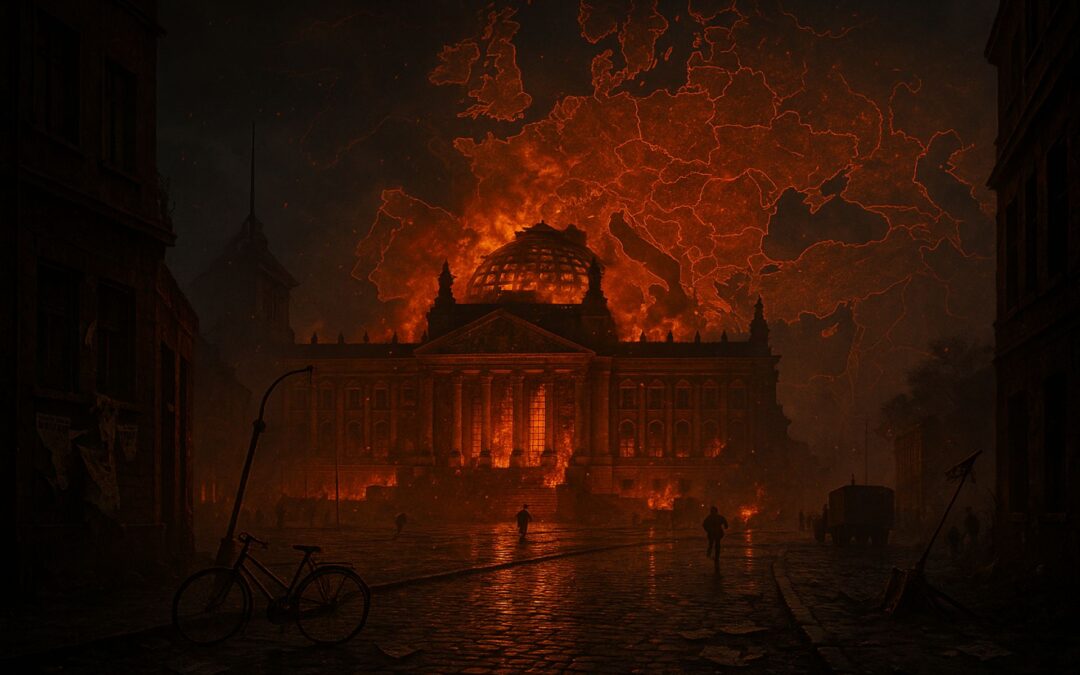
In February 1933, the German parliament building—the Reichstag—was set on fire.
The crisis that followed would mark the beginning of the end for German democracy.
From Chancellor to Dictator in Months
When Adolf Hitler became chancellor in January 1933, Germany was still formally a democratic state. The constitution of the Weimar Republic remained in force, multiple political parties existed, and Hitler’s government included several conservative politicians who believed they could restrain him.
But Hitler had no intention of governing within the limits of democracy. His goal was the complete destruction of the political system that had brought him to power. Once in office, he moved with extraordinary speed to dismantle the institutions that could oppose him.
A dramatic crisis in February 1933 gave him the opportunity he needed.
The Reichstag Fire Crisis
On the night of February 27, 1933, the Reichstag building—the seat of Germany’s parliament—was engulfed in flames. The fire caused widespread shock and confusion across the country. Authorities quickly arrested a Dutch communist named Marinus van der Lubbe at the scene, and the Nazi government immediately blamed the incident on a communist conspiracy to overthrow the state.
Historians continue to debate whether the Nazis themselves were involved in starting the fire or whether it was truly the work of a lone radical. Regardless of its origins, Hitler wasted no time exploiting the crisis for political advantage.
The day after the fire, Hitler persuaded President Hindenburg to sign an emergency decree suspending key civil liberties guaranteed by the constitution. The decree allowed the government to arrest individuals without trial, censor publications, and suppress political organizations deemed dangerous to the state.
These emergency powers effectively dismantled the legal protections that had previously shielded citizens from arbitrary government action.
The main target of this crackdown was the Communist Party. Thousands of communists were arrested, their newspapers were shut down, and their political activities were banned. Many were sent to newly established detention facilities that would later evolve into the first concentration camps.
With one major political rival suddenly removed from the political landscape, the Nazis moved quickly to secure even greater authority.
The Enabling Act
Despite the repression of their opponents, the Nazis still lacked complete control of the government. Parliament remained the formal legislative body, and Hitler could not rule without its approval.
To solve this problem, Hitler introduced a proposal known as the Enabling Act. This law would allow the government to pass legislation without parliamentary approval, effectively transferring legislative power from the Reichstag to Hitler’s cabinet.
In practical terms, the Enabling Act would give Hitler the ability to rule by decree.
Passing the law required a two-thirds majority in parliament. To secure that majority, the Nazis combined intimidation with political maneuvering. Communist deputies had already been arrested or prevented from attending sessions, and SA paramilitary units surrounded the parliamentary building during the vote, creating an atmosphere of fear and pressure.
Most conservative and centrist parties ultimately supported the measure, believing it was necessary to restore order in a time of crisis. Only the Social Democratic Party voted against it.
On March 23, 1933, the Enabling Act was approved.
With that single vote, Germany’s democratic system effectively ceased to function. Hitler now had the legal authority to enact laws without parliamentary consent, bypass the constitution, and reshape the state according to his will.
The Birth of the Police State
Once the Enabling Act had passed, the transformation of Germany accelerated rapidly.
Political opposition was systematically dismantled. Communist and socialist organizations were outlawed, and other political parties were pressured into dissolving themselves. Within a few months, Germany had become a one-party state dominated entirely by the Nazi Party.
The regime also created institutions designed to enforce loyalty and suppress dissent. One of the most feared organizations was the Gestapo, the secret state police responsible for identifying and arresting individuals suspected of opposing the regime.
Meanwhile, the first concentration camps were established to detain political prisoners. These camps initially held communists, socialists, trade union leaders, and other opponents of the Nazi government.
Civil liberties disappeared almost overnight. Freedom of speech, freedom of the press, and freedom of assembly were effectively abolished. Newspapers were placed under strict control, ensuring that public information aligned with Nazi propaganda.
The transformation of Germany from democracy to dictatorship occurred with astonishing speed. In less than two months after becoming chancellor, Hitler had acquired the power to govern without meaningful legal restraint.
Yet one significant obstacle still remained.
Within the Nazi movement itself existed a powerful paramilitary organization—the SA—whose leadership had ambitions that threatened the support of the traditional German military.
To secure his position completely, Hitler would soon turn against members of his own movement.
Consolidating Absolute Power
By mid-1934, Adolf Hitler had effectively dismantled Germany’s democratic institutions. Political parties had been eliminated, civil liberties had been suspended, and the Nazi regime controlled the machinery of government. Yet despite these sweeping changes, Hitler’s hold on power was not completely secure.
Two important groups still held significant influence: the traditional German military leadership and the Nazi Party’s own paramilitary organization, the SA (Storm Detachment). Tension between these groups created a political problem that Hitler would resolve with ruthless violence.
The events that followed would eliminate his remaining rivals and secure his position as the uncontested leader of Germany.
The Night of the Long Knives
The SA had played a crucial role in Hitler’s rise. Its members had protected Nazi meetings, intimidated political opponents, and helped project the image of a militant movement capable of imposing order on Germany’s chaotic political landscape.
By the early 1930s, however, the organization had grown enormously. Its membership reached into the millions, far larger than the official German army. The SA’s leader, Ernst Röhm, believed that the organization should eventually replace the traditional military and become the dominant armed force of the Nazi state.
This idea alarmed Germany’s professional military leadership. The army’s officers viewed the SA as an undisciplined political militia and feared losing their authority if Röhm’s ambitions were realized.
For Hitler, maintaining the loyalty of the army was essential. The military represented one of the few institutions capable of challenging his power. If the army turned against him, his regime could collapse.
To secure the army’s support, Hitler made a decisive and brutal choice.
In late June 1934, he ordered a sweeping purge of the SA leadership. Over the course of several days, Nazi security forces arrested and executed Ernst Röhm and many other SA officials. The killings extended beyond the SA itself; political opponents, critics of the regime, and individuals with personal disputes against Hitler were also targeted.
The purge became known as the Night of the Long Knives.
Estimates vary, but roughly two hundred people were killed during the operation. The violence shocked many observers, yet it also sent a powerful message: Hitler was willing to eliminate anyone who threatened his authority, even former allies.
Securing the Loyalty of the Army
The purge achieved its primary objective. Germany’s military leadership, relieved that the SA would not replace them, pledged their loyalty to Hitler.
This alliance proved decisive. The army’s support ensured that no organized force remained capable of resisting the Nazi regime. Hitler had demonstrated that he would protect the military’s status while simultaneously asserting his dominance over the political system.
The final step toward absolute power occurred shortly afterward.
In August 1934, President Paul von Hindenburg died. With the office of president suddenly vacant, Hitler moved quickly to consolidate his authority.
Rather than allowing a new presidential election, he merged the positions of president and chancellor into a single office. He adopted the title Führer, meaning “leader,” and declared himself the supreme authority of the German state.
The German military was required to swear a personal oath of loyalty directly to Hitler rather than to the constitution or the nation.
This oath symbolized the complete transformation of Germany’s political system. Authority no longer rested in institutions or laws—it rested in one individual.
The Führer State
With opposition eliminated and the military pledged to his leadership, Hitler now exercised total control over Germany.
The government operated according to the principle known as the Führerprinzip, or “leader principle.” Under this system, authority flowed downward from Hitler through a hierarchy of loyal officials. Decisions were expected to reflect the will of the Führer, and questioning that authority was treated as disloyalty to the state.
The Nazi Party became inseparable from the government itself. Party officials held key administrative positions, and ideological loyalty became more important than professional expertise.
Political life outside the Nazi movement disappeared entirely. Trade unions were dissolved and replaced with state-controlled labor organizations. Cultural institutions, universities, and media outlets were gradually brought under strict ideological supervision.
By the end of 1934, Germany had been transformed into a dictatorship.
The process had unfolded in stages: political manipulation, legal changes, intimidation, and finally open violence. Each step removed another obstacle until Hitler’s authority became absolute.
With power consolidated at home, the Nazi regime began reshaping German society itself—seeking not only political control but also ideological domination over everyday life.
Life Under the Nazi Regime
Once Adolf Hitler had secured absolute political control by 1934, the Nazi regime began transforming German society at every level. The dictatorship did not rely solely on laws or institutions; it aimed to reshape how people thought, behaved, and understood their place within the nation. Politics, education, culture, and even private life were gradually brought under the influence of Nazi ideology.
The regime combined propaganda, social pressure, and state terror to create a society where opposition became nearly impossible. For many Germans, everyday life became deeply intertwined with the expectations of the Nazi state.
Propaganda and Mass Indoctrination
One of the regime’s most powerful tools was propaganda. The Nazis believed that controlling information and shaping public perception were essential for maintaining power.
Joseph Goebbels, who served as Minister of Propaganda, oversaw a vast system designed to influence public opinion. Newspapers, radio broadcasts, films, posters, and public events were carefully managed to promote the image of a strong, unified Germany under Hitler’s leadership.
The media consistently portrayed Hitler as a heroic and visionary figure who had rescued the country from chaos and humiliation. Massive rallies and carefully staged events reinforced this image, creating a powerful cult of personality around the Führer.
Propaganda also promoted the broader ideological themes of the regime: nationalism, racial hierarchy, obedience to authority, and the belief that Germany was destined for greatness.
By controlling cultural institutions and mass communication, the Nazi government attempted to ensure that citizens encountered its message everywhere—from newspapers and movies to schools and public celebrations.
Youth Indoctrination
The Nazi leadership understood that long-term control of society required shaping the beliefs of the next generation. Children and teenagers therefore became a central focus of the regime’s efforts.
The Hitler Youth organization was expanded into a nationwide program designed to train young people in Nazi ideology and prepare them for future roles within the state. Membership eventually became effectively mandatory.
Boys were encouraged to develop physical strength, discipline, and military readiness. Activities emphasized outdoor training, marches, and exercises meant to prepare them for eventual service in the armed forces.
Girls participated in a parallel organization that promoted a different set of ideals. Their education focused on domestic responsibilities and the expectation that they would eventually become mothers raising racially “pure” German children.
Through schools and youth organizations, the Nazi regime attempted to instill loyalty to Hitler and the state from an early age. Teachers were required to align their lessons with Nazi ideology, and subjects such as history and biology were rewritten to emphasize racial theories and nationalist narratives.
The goal was to create a generation that viewed Nazi beliefs as natural and unquestionable.
Terror and Surveillance
While propaganda encouraged voluntary support, the regime also relied heavily on intimidation and fear.
The secret state police, known as the Gestapo, monitored political activity and investigated suspected opposition to the government. Citizens who criticized the regime, associated with banned political groups, or even failed to display sufficient loyalty could face arrest.
Surveillance extended beyond formal institutions. Neighbors, coworkers, and even family members sometimes reported one another to authorities. The possibility of denunciation created an atmosphere in which many people avoided expressing dissenting views.
Concentration camps, which had initially been established to imprison political opponents, became symbols of the regime’s willingness to use extreme measures against perceived enemies. These camps were designed not only to detain prisoners but also to intimidate the broader population.
The message was clear: resistance to the Nazi state would be met with severe punishment.
The Escalation of Persecution
One of the most destructive aspects of Nazi rule was its systematic persecution of Jews and other groups deemed undesirable by the regime.
Early measures included economic boycotts of Jewish businesses, restrictions on employment, and the removal of Jews from positions in government, education, and professional fields. Over time, these policies became increasingly aggressive.
Jews were stripped of citizenship and basic legal rights. Public propaganda portrayed them as enemies of the German nation, reinforcing antisemitic stereotypes that had circulated in European society for decades.
The regime also targeted other groups, including political dissidents, disabled individuals, and those who did not conform to Nazi racial or social ideals. Programs of forced sterilization were implemented against people labeled as having hereditary physical or mental conditions.
These policies represented the early stages of a process that would later escalate into mass violence and genocide during the Second World War.
A Society Transformed
By the mid-1930s, Germany had become a fully authoritarian state. Political opposition had been crushed, civil liberties had disappeared, and the Nazi regime controlled nearly every major institution in the country.
Yet the dictatorship did not rely solely on fear. Many Germans supported the regime or at least accepted it, particularly as economic conditions improved and national pride appeared to be restored after the humiliations of the postwar period.
This combination of propaganda, coercion, and perceived national revival allowed the Nazi government to maintain its authority.
But Hitler’s ambitions extended far beyond controlling Germany itself.
The ideology that had shaped his worldview since his early years—belief in racial struggle, territorial expansion, and national dominance—would soon drive the country toward aggressive foreign policies.
Within a few years, those ambitions would ignite another global conflict far more destructive than the first.
Conclusion
The rise of Adolf Hitler illustrates how personal ambition, ideological extremism, and systemic crisis can combine to produce catastrophic historical outcomes. Hitler did not gain power solely because of his own abilities or because German society was uniquely predisposed to dictatorship. His rise depended on a complex set of circumstances that unfolded over decades.
His early life in Austria exposed him to nationalist and antisemitic ideas that shaped his worldview. The First World War gave him a sense of purpose and belonging, while Germany’s defeat intensified his resentment and desire for revenge. In the chaotic years that followed the war, political instability and economic hardship created an environment in which radical ideas could gain traction.
The Great Depression proved to be the decisive turning point. As unemployment soared and faith in democratic institutions collapsed, millions of Germans turned toward extremist movements promising decisive leadership and national renewal. The Nazi Party capitalized on this crisis through propaganda, mass mobilization, and Hitler’s powerful public speaking.
Equally important were the mistakes of Germany’s political elites. Conservative leaders who feared communism believed they could control Hitler by bringing him into government. Instead, they handed power to a man determined to destroy the democratic system entirely.
Once appointed chancellor, Hitler moved quickly and strategically. Through emergency decrees, legal manipulation, intimidation, and violence, he dismantled democratic institutions and established a dictatorship within months. By 1934, his authority was absolute.
The transformation of Germany into a totalitarian state demonstrates how fragile democratic systems can become during periods of extreme crisis. Economic collapse, political polarization, and institutional weakness can create opportunities for authoritarian leaders who promise simple solutions and national revival.
Understanding this process is essential not only for interpreting the history of the twentieth century but also for recognizing the conditions under which democratic societies can begin to erode.
Hitler’s rise serves as a reminder that the collapse of freedom rarely occurs in a single dramatic moment. More often, it unfolds gradually—through crises, compromises, and decisions that, taken together, allow authoritarian power to take root.