
Culture today feels unrecognizable compared to even a generation ago. Once upon a time, the world shared soundtracks, scandals, and spectacles—moments where everyone tuned in together. Now, the monoculture has fractured into endless niches. Metal fans age with their bands, gamers grow old with their franchises, and entire subcultures live parallel lives, rarely crossing. At the same time, our consumer world has been overtaken by what Venkatesh Rao calls “premium mediocre”—products and experiences wrapped in faux exclusivity that disguise their mediocrity. Add to that our personal challenge of navigating life’s unavoidable struggles, and a pattern emerges: whether in culture, consumption, or personal growth, the central question is no longer how to avoid discomfort, but how to choose the discomfort worth enduring.
The Jazzification of Everything
In the not-so-distant past, culture moved like a single, rolling tide. When a new sound hit the airwaves, everyone heard it. When a television show aired on one of the handful of channels, nearly the entire country tuned in. Michael Jackson performing at the Super Bowl wasn’t just a concert—it was an event shared simultaneously by millions, a moment you couldn’t avoid even if you wanted to. This was the power of the monoculture: one narrative, one soundtrack, one shared cultural fabric.
That world doesn’t exist anymore. What we have instead is something closer to the “Jazzification of everything.” Jazz is the perfect metaphor because of the trajectory it followed. In the 1930s and ’40s, jazz wasn’t just popular—it was synonymous with cool. Miles Davis, Duke Ellington, and Charlie Parker—these names weren’t niche, they were household. But as cultural tastes shifted, jazz slipped from the mainstream and into the margins. It didn’t disappear, though. It solidified into a subculture—intense, loyal, self-sustaining. Its fans aged with it, treasuring it more deeply even as the world moved on.
That same pattern now applies everywhere. Take heavy metal. Once branded the wild, rebellious sound of youth, today its audiences are mostly middle-aged. Fans in their forties and fifties still show up, grayer and maybe softer around the edges, but just as devoted. Their favorite bands are also older, and there’s an unspoken bond in growing older together. The music is less about novelty and more about continuity.
Electronic music shows the same dynamic. What was once assumed to be the soundtrack of teenagers on substances is now filled with adults who never left the scene. Their playlists have aged with them. They didn’t “move on” when a new genre arrived—they carried their niche forward, weaving it into the rhythms of adulthood.
It’s not limited to music. Video games, once associated with adolescence, now have fan bases that span generations. A kid who played Mario in the ’90s might still be immersed in the Mario universe today, perhaps even sharing it with their own children. Movie franchises like Star Wars or The Lord of the Rings illustrate the same point. They aren’t just entertainment—they’re cultural ecosystems that people live inside for decades.
Two dynamics make this possible. First, personalization. Algorithms now feed us more of what we already like. Instead of being forced into new tastes by scarcity—only five TV channels, only a few radio stations—we can stay in our bubble indefinitely. If you liked metal, Spotify ensures you never run out of metal. If you liked shooters, the next shooter game is queued up. Second, our tastes during adolescence tend to set in like wet cement. What you fall in love with between 18 and 25 often sticks for life. The digital world amplifies this stickiness by endlessly serving up more of the same.
The benefits are clear: depth, intimacy, a sense of belonging. Fans and artists co-evolve, growing older side by side. The downside is fragmentation. Where monoculture gave us collective highs and shared conversations, subcultures isolate us into parallel worlds. The result is what might be called the “balkanization of culture.” Each tribe has its own language, references, and heroes, while the larger sense of everyone experiencing the same thing together has evaporated.
We’ve traded breadth for depth. Instead of fleeting mass moments, we have enduring micro-communities. Instead of a cultural tide, we have countless cultural streams running alongside each other, rarely converging. It’s not better or worse—it’s simply different. A world where everything is jazz: no longer mainstream, but always alive.
Phones at Concerts: Escaping the Present
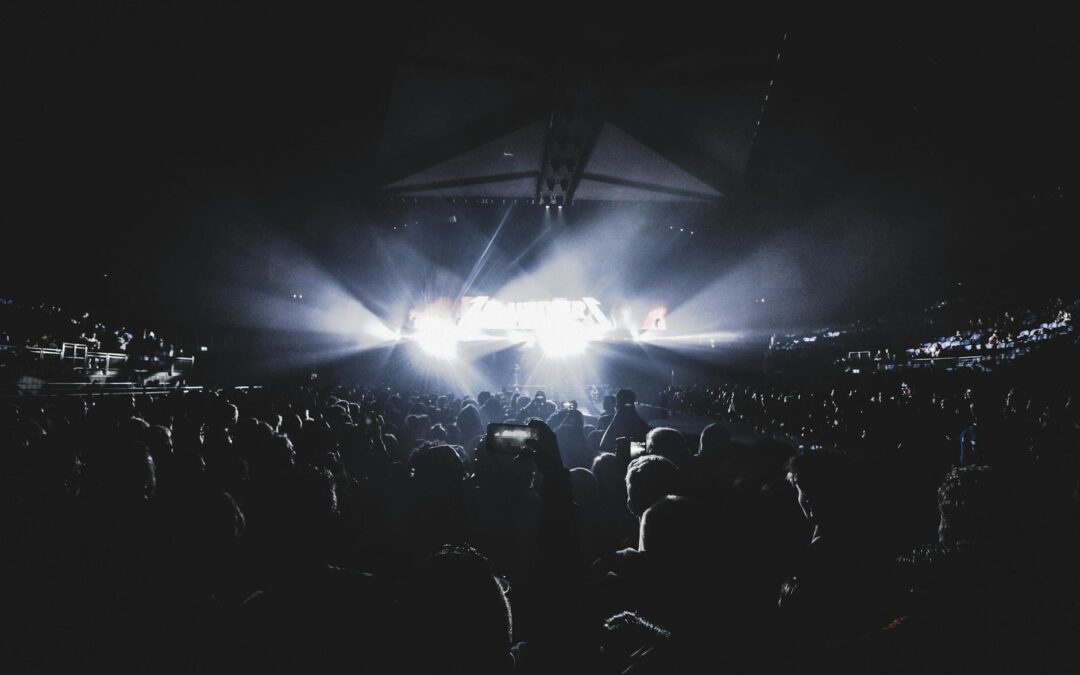
Go to any live show today and you’ll witness a strange choreography. During the opener, the crowd is attentive. People nod along, tilt their heads, maybe whisper to friends about whether they like the sound. No phones in the air—just raw observation. By the time the headliner walks onstage, the scene transforms. Arms shoot up, glowing screens fill the air, and suddenly half the audience is staring not at the performer, but at their own tiny rectangles.
At first glance, it seems harmless. People want to capture the memory, right? A quick clip to relive later. But if you look closer, it becomes clear that the phone is less about remembering and more about signaling. It’s a way to say: I was here, I’m part of this moment, look at me participating. The concert becomes not just a personal experience, but a performance for an invisible online audience.
The paradox is obvious: the more meaningful the moment, the less people actually inhabit it. For a transcendent song or once-in-a-lifetime guitar solo, people instinctively reach for their phones, pulling themselves out of the very magic they’re trying to preserve. And yet, almost no one re-watches those clips. They sit buried in digital storage, forgotten within weeks. The effort to immortalize ends up erasing the memory itself.
There’s also a deeper psychological layer. The phone functions as a buffer between the individual and the intensity of the experience. To truly give yourself over to music—to scream, sweat, cry, or dance without inhibition—requires vulnerability. It means letting go, losing control, surrendering to the moment. For many, that level of exposure is uncomfortable. So the phone becomes a shield, a way of “enjoying” without risking raw emotion.
Sociologists call this kind of behavior “social signaling.” It’s not enough to experience something privately; in a networked world, value is confirmed only when it’s displayed. Posting a story from the concert earns likes, replies, and recognition—it validates your belonging in the tribe. The irony is that the proof of belonging comes at the cost of the belonging itself. Instead of locking eyes with strangers as you all sing the same chorus, you’re busy cropping and captioning your screen.
Alcohol amplifies the pattern. As inhibitions lower, the phones come out even more. Selfies pile up in absurd quantities, as though each one will somehow make the moment more real. But rather than deepening the experience, the constant documentation dilutes it, transforming something visceral into something performative.
Psychologists like Nir Eyal call smartphones “digital pacifiers.” They soothe discomfort not just when we’re anxious or bored, but even when we’re elated. At a concert, the phone doesn’t just relieve awkwardness between songs—it dulls the sharp edge of joy itself. By recording instead of feeling, people sidestep the bittersweet reality that the moment is fleeting, that it will end. The phone says: Don’t face the impermanence—capture it, control it.
But that control is an illusion. The clip is never the same as the chorus reverberating through your chest, never as alive as the sweat dripping down your neck in the crowd, never as electric as the collective roar when the lights go dark. The more we try to hold on, the more we miss what’s right in front of us.
The Rise of “Premium Mediocre”
In earlier centuries, wealth was about access. Whoever could control scarce resources—grain, coal, oil, iron—controlled value. If you could provide what others lacked, you were indispensable. But as economies industrialized and globalized, abundance became the norm. Shelves overflowed with products. Supermarkets offered hundreds of variations of the same item. Coffee wasn’t rare, clothes weren’t rare, food wasn’t rare. When basic scarcity disappears, selling “things” alone is no longer enough.
Enter “premium mediocre,” a concept coined by Venkatesh Rao to describe a peculiar kind of consumer product or experience: ordinary at its core, but dressed up with just enough flair to feel exclusive. It’s not luxury, not necessity, but something in-between—a commodity wearing a velvet cape.
Think of the pumpkin spice latte. Strip away the marketing, and it’s flavored coffee with extra sugar. But it’s seasonal, it’s limited, it comes in a cup with your name scrawled across it and a foam heart on top. That manufactured scarcity and personalized packaging transforms mediocrity into a small ritual of indulgence. You know it’s ordinary, yet you still crave it.
Examples abound. Premium economy on an airplane—barely more legroom, but sold as an elevated travel experience. Chipotle, Cava, Sweetgreen—fast food disguised as artisanal dining. Subscription “pluses” that give you nothing but the same content with a different label. Streaming platforms releasing endless series that feel important, yet recycle the same tropes with shinier cinematography.
This is premium mediocre’s genius: it preys on our hunger for scarcity in a world where scarcity has been annihilated. Humans instinctively equate rarity with value. Marketers can’t make oil scarce again, but they can make you feel like your coffee is rare, your salad is rare, your airline seat is rare. The scarcity is manufactured, not inherent—but the effect is powerful enough to command higher prices.
The phenomenon doesn’t stop at food and consumer goods. It seeps into politics. Today’s leaders often don’t debate policy—they market personality. Instead of substance, we get word salads packaged as inspiration: emotional slogans that feel premium but resolve into mediocrity when inspected. In media, it looks like Netflix churning out endless “event” shows that feel urgent but are instantly forgettable. In entrepreneurship, it manifests as companies like WeWork, which sold itself not as office space but as a revolutionary community, complete with glossy branding and aspirational messaging. Behind the façade? Just desks.
This is where cynicism takes root. On some level, everyone knows that the packaging doesn’t match the substance. That pumpkin spice latte isn’t scarce, the “exclusive” vacation package is just a crowded tourist trap, the “innovation” app is just the fifteenth iteration of the same meditation tool. The disconnect between promise and reality leaves a residue of disappointment. And when that disappointment becomes the norm, whole generations begin to expect insincerity as the default.
Yet, paradoxically, we still play along. Premium mediocre works not because people are fooled, but because they want to believe—even temporarily—that they’re participating in something more than the ordinary. A $6 latte won’t change your life, but it signals aspiration. You may not own a penthouse, but you can afford a small luxury that whispers of a higher tier. It’s performance as much as consumption: a way to say, I’m trying, I’m on my way up, I belong here.
At its most benign, premium mediocre is harmless indulgence. At scale, though, it can siphon resources from true innovation. Why spend billions solving hard, structural problems—clean energy, sustainable agriculture, affordable housing—when it’s easier and more profitable to slap premium branding on the same old commodity? In this sense, premium mediocre is not just a consumer quirk but a cultural force, shaping what gets built and what gets ignored.
We live in a world increasingly defined by this tension. Beneath the artisanal toppings, behind the curated Instagrammable moments, much of modern life is just mediocre dressed as premium. The tragedy isn’t that we consume it—the tragedy is that we’ve come to accept it as normal.
Choosing Your Suck
Every human decision, no matter how trivial or monumental, carries a tax of discomfort. There is no path that spares you from paying. Avoid the gym, and you’ll pay with sluggishness, declining health, and creeping self-loathing. Show up at the gym, and you’ll pay with sore muscles, sweat, and the discipline it demands. Stay single, and you pay with solitude. Commit to a partner, and you pay with compromise and friction. Success hurts. Failure hurts. Even inertia hurts. The question is never if you’ll suffer—it’s which form of suffering you’re willing to accept.
This is what Mark Manson and Drew Birnie call “choosing your suck.” It’s a more grounded response to life than the endless chase for pain-free happiness or perfectly aligned meaning. Because that chase is itself premium mediocre: an illusion wrapped in shiny packaging. Real progress, real fulfillment, comes from leaning into the pain you’re uniquely equipped to bear.
Everyone is a masochist in some way. Writers endure the agony of staring at a blank page because they also savor the clarity that comes once the words finally arrive. Athletes embrace brutal training because the struggle itself brings a rush few other activities can match. Entrepreneurs tolerate rejection and financial risk because they secretly thrive on the uncertainty. What most people call “passion” is often just a more elegant word for this—the flavor of suffering you don’t entirely mind.
Avoidance, by contrast, is still a form of choice. Sitting on the couch, opting out of ambition, deciding “why bother?”—this is not freedom from suck. It is its own flavor of suck, one that compounds into stagnation, wasted potential, and the quiet misery of regret. Nihilism feels clever—“nothing matters, so why try”—but it collapses under its own weight. If nothing matters, then there’s also no reason not to try. You can just as easily flip the logic: “nothing matters, so why not risk everything?” Either way, you cannot escape the deal: life demands you endure something.
The trick is to recognize which form of pain becomes an ally. Some suffering corrodes you, leaving you weaker the longer you endure it. Other suffering forges you, like fire tempering steel. The gym’s pain is strengthening. The writer’s frustration sharpens thought. The difficult relationship, if chosen well, expands empathy and resilience. These are worthy sucks—the ones that carve out depth rather than hollow you out.
Modern culture muddies this distinction by offering counterfeit substitutes. Social media provides microdoses of validation that feel like meaning but dissolve within hours. Consumer indulgences deliver hits of “specialness” but never truly satisfy. These are the premium mediocre versions of meaning and happiness: quick comforts that avoid the real, difficult work of living. They soothe but don’t strengthen.
Choosing your suck is ultimately about agency. Instead of being passively dragged by the unavoidable pains of existence, you select the ones worth bearing. You decide: better the burn of effort than the ache of regret. Better the friction of growth than the dullness of avoidance. In a world built on illusions of comfort, the most honest choice you can make is to suffer deliberately.
Conclusion
We live in a world that no longer hands us a single script. Instead, we inhabit countless micro-worlds, each with its own rhythms and rituals. We sip pumpkin spice lattes, record concerts through glowing screens, and cling to the subcultures that feel like home. On the surface, it looks like fragmentation and fakery—but beneath it lies something honest. Meaning, whether cultural or personal, was never about perfection or universal approval. It was always about choosing. Choosing your tribe. Choosing your indulgences. Choosing the suck you’re willing to endure. Once you accept that everything comes with a cost, the question shifts from how do I avoid pain? to what’s worth the pain? That’s not cynicism—it’s clarity. And clarity is the closest thing we have to freedom.