
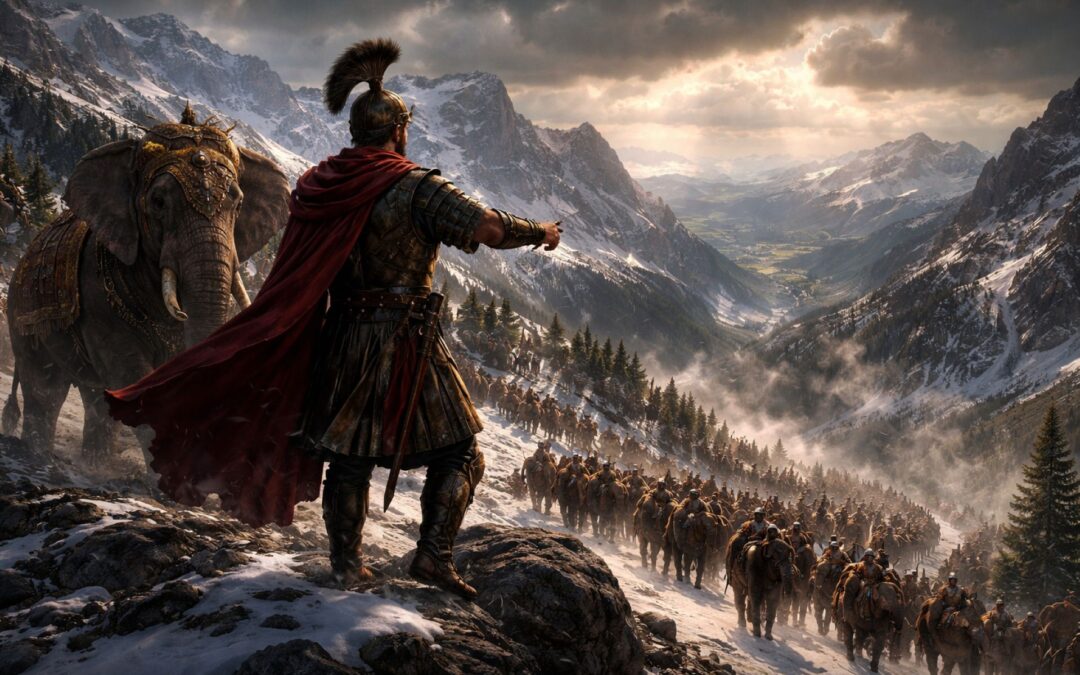
The Second Punic War (218–201 BC) was one of the most dramatic and consequential conflicts of the ancient world. Fought between the Roman Republic and the powerful city-state of Carthage, it transformed the balance of power in the Mediterranean and produced some of the most famous military campaigns in history.
At the heart of the war was the Carthaginian general Hannibal Barca, a commander whose bold strategy shocked the Roman world. Instead of waiting for Rome to attack Carthaginian territory, Hannibal led an army from Spain across southern Gaul and over the Alps into Italy, launching a daring invasion that few believed possible. Once in Italy, he inflicted a series of devastating defeats on Roman armies and came closer than anyone in centuries to destroying the Roman Republic.
Yet the war was not decided by Hannibal’s victories alone. Rome demonstrated an extraordinary ability to endure defeat, rebuild its armies, and adapt its strategy. Over nearly two decades of fighting, the conflict expanded far beyond Italy, stretching across Spain, Sicily, North Africa, and the wider Mediterranean. Eventually, Rome produced a commander capable of matching Hannibal’s brilliance: Publius Cornelius Scipio, later known as Scipio Africanus.
The Second Punic War ultimately became a struggle not only between two armies but between two systems of power. Hannibal’s genius threatened Rome’s survival, while Rome’s resilience allowed it to recover and eventually take the war to Carthage itself. The conflict culminated in the decisive Battle of Zama in 202 BC, where Scipio defeated Hannibal and ended Carthage’s challenge to Roman dominance.
Understanding the Second Punic War means understanding how one of history’s greatest generals nearly defeated Rome—and how Rome ultimately turned disaster into victory.
The Aftermath of the First Punic War
The origins of the Second Punic War cannot be understood without examining the consequences of the First Punic War (264–241 BC). That earlier conflict had fundamentally reshaped the balance of power in the western Mediterranean. When it began, Carthage was the dominant maritime power of the region, possessing a powerful navy, a wealthy commercial empire, and influence stretching across North Africa, Spain, and many Mediterranean islands. Rome, by contrast, was still primarily a land power expanding across the Italian peninsula.
The First Punic War changed that dynamic permanently. After more than two decades of brutal warfare, Rome emerged victorious. Carthage was forced to surrender Sicily, pay a massive indemnity to Rome, and acknowledge Roman dominance over the island. The victory not only gave Rome its first overseas territory but also demonstrated that the Republic could challenge and defeat a major Mediterranean power.
For Carthage, however, the defeat was catastrophic. The financial burden imposed by Rome was immense. The indemnity payments alone placed severe strain on the Carthaginian treasury, while the loss of Sicily removed one of the most important sources of revenue and grain supply for the Carthaginian state. But the immediate consequences were even more dangerous than the long-term economic losses.
The Mercenary War and Carthage’s Crisis
Carthage had traditionally relied heavily on mercenaries to fight its wars. Unlike Rome, which fielded armies composed primarily of its own citizens and allies, Carthage recruited soldiers from across the Mediterranean world—Libyans, Iberians, Gauls, Numidians, and many others. These troops formed the backbone of Carthaginian military power, but they also created a vulnerability. Mercenaries fought for pay, and if that pay failed to arrive, their loyalty could evaporate quickly.
When the First Punic War ended, Carthage faced the enormous task of paying thousands of mercenaries who had fought in the conflict. However, the state was nearly bankrupt due to the war indemnities owed to Rome. Unable or unwilling to pay the full wages that had been promised, the Carthaginian authorities attempted to negotiate reduced payments.
The result was a disaster.
In 241 BC, the unpaid mercenaries revolted. What began as a dispute over wages quickly escalated into a massive uprising known as the Mercenary War (sometimes called the Truceless War because of its extreme brutality). The rebels gathered support from discontented local populations in North Africa and soon threatened Carthage itself.
The war became one of the most savage conflicts of the ancient world. Both sides committed atrocities, and the fighting was relentless. At several points, the rebels came dangerously close to destroying the Carthaginian state entirely. The crisis was eventually resolved thanks to the leadership of one of Carthage’s most capable generals, Hamilcar Barca.
Hamilcar led the loyal Carthaginian forces in a brutal campaign that ultimately crushed the rebellion. Through a combination of military skill and ruthless tactics, he restored order and saved Carthage from collapse. But the experience left deep scars. The war demonstrated just how fragile Carthage’s position had become after its defeat by Rome.
Roman Opportunism and the Seizure of Sardinia
While Carthage struggled to survive the Mercenary War, Rome watched closely. The Roman Republic had no interest in allowing its former enemy to recover too quickly. Instead, Roman leaders took advantage of the crisis to strengthen their own position.
During the rebellion, the island of Sardinia—still under Carthaginian control—experienced its own unrest. Local rebels appealed to Rome for assistance. The Romans responded eagerly.
Despite the fact that Sardinia legally belonged to Carthage, Rome intervened and occupied the island. When Carthage attempted to protest or prepare resistance, Rome responded with a direct threat of war. Given Carthage’s exhausted condition after the Mercenary War, it had little choice but to submit.
Rome not only seized Sardinia and Corsica but also demanded additional financial payments from Carthage as the price of peace.
This episode was deeply humiliating for the Carthaginians. Even by the often ruthless standards of ancient diplomacy, Rome’s actions were widely seen as opportunistic and unjustified. Carthage had been unable to defend its possessions during a moment of internal crisis, and Rome had exploited that weakness without hesitation.
The Seeds of Revenge
By the mid-third century BC, the relationship between Rome and Carthage had become defined by resentment and mistrust. Rome had emerged stronger than ever, controlling Sicily, Sardinia, and Corsica while expanding its influence throughout the Mediterranean. Carthage, meanwhile, had been reduced to paying heavy tributes and had lost much of its former prestige.
Among the Carthaginian elite, few felt this humiliation more deeply than Hamilcar Barca.
Hamilcar had been one of Carthage’s most capable commanders during the First Punic War and the hero who had crushed the Mercenary War. He believed that Carthage’s defeat had been the result not of Roman superiority but of political weakness and poor leadership within Carthage itself. In his view, the city’s politicians had surrendered too quickly and failed to support the army effectively.
More importantly, Hamilcar was convinced that Carthage could not remain secure while Rome dominated the Mediterranean. If Carthage wished to restore its power and independence, it needed new sources of wealth, new armies, and eventually an opportunity to challenge Rome once again.
His solution lay to the west, in the rich and largely untapped lands of Iberia—modern Spain. There, he believed, Carthage could rebuild its strength, gather resources, and perhaps one day prepare for revenge.
That decision would change the course of Mediterranean history.
Hamilcar Barca and the Carthaginian Expansion into Spain
In the years following the Mercenary War, Carthage faced a difficult question: how could it recover its strength while burdened with heavy payments to Rome and stripped of key territories? The answer gradually emerged through the leadership of Hamilcar Barca, one of Carthage’s most capable generals and the architect of its postwar recovery.
Hamilcar believed that Carthage needed new sources of wealth and manpower if it hoped to regain its independence from Roman pressure. The city could not rely solely on its traditional trading networks, nor could it easily challenge Rome again without rebuilding its military strength. The solution he proposed was bold and ambitious: expand Carthaginian influence into the Iberian Peninsula.
The Strategic Importance of Iberia
Iberia (modern Spain and Portugal) was a region of enormous potential. It possessed rich natural resources, particularly silver mines that could generate vast amounts of wealth. The peninsula was also home to numerous tribal societies that could provide soldiers for Carthage’s armies.
From Hamilcar’s perspective, Iberia offered several advantages. First, its mineral wealth could help Carthage pay off the massive indemnities owed to Rome after the First Punic War. Second, control of the region would allow Carthage to build a new military base far from the political rivalries of the Carthaginian capital. Third, Iberia’s manpower could supply the soldiers needed to rebuild Carthage’s military power.
With the support of Carthage’s government, Hamilcar launched an expedition to Iberia around 237 BC. Over the next several years, he began a systematic campaign to expand Carthaginian influence throughout the region. Through a mixture of military conquest, alliances with local tribes, and the establishment of new settlements, Hamilcar gradually built a Carthaginian sphere of control that stretched across much of southern Spain.
This expansion transformed Iberia into the economic and military foundation of Carthage’s renewed power. Silver mines generated enormous wealth that was sent back to Carthage, helping to stabilize the city’s finances. Meanwhile, Iberian warriors joined Carthaginian forces, strengthening the army that would one day challenge Rome again.
Hannibal’s Childhood and the Oath Against Rome
Hamilcar’s campaign in Iberia was not simply an imperial project—it was also a family enterprise. Among those who accompanied him was his young son, Hannibal.
Hannibal was only a child when he left Carthage with his father. According to ancient historians, before departing for Spain, Hamilcar made the young boy swear an oath of eternal hostility toward Rome. Although the exact details of this story are uncertain, the tradition reflects a deeper truth: Hannibal grew up in an environment defined by resentment toward Rome and a determination to restore Carthage’s power.
Spain became Hannibal’s training ground. Instead of receiving a sheltered upbringing, he spent his youth in military camps and on campaign alongside experienced soldiers. He learned the art of warfare directly from his father while observing the challenges of governing newly conquered territories and negotiating alliances with tribal leaders.
This early exposure to warfare shaped Hannibal’s character and abilities. He grew accustomed to hardship, developed close relationships with the soldiers who served under his father, and gained first-hand experience in the complex politics of Iberia. By the time he reached adulthood, he was already regarded as a capable military leader.
The Rise of Carthaginian Power in Spain
Hamilcar’s work in Iberia laid the foundation for a new Carthaginian empire. However, his career ended suddenly when he was killed in battle around 228 BC during a campaign against local tribes. Leadership of the Iberian territories then passed to his son-in-law, Hasdrubal the Fair.
Hasdrubal continued the expansion but pursued a more diplomatic approach. Rather than relying solely on military conquest, he strengthened Carthaginian influence through alliances with Iberian tribes and the establishment of administrative structures that stabilized the region.
One of his most important achievements was the founding of a new capital city: Carthago Nova, or New Carthage (modern Cartagena). Strategically located along the Mediterranean coast, the city served as the political and military center of Carthaginian Spain. It also functioned as a major port, connecting Iberia with Carthage in North Africa and facilitating the movement of resources, troops, and supplies.
Under Hasdrubal’s leadership, Carthage’s position in Iberia grew stronger than ever. The region provided wealth, soldiers, and strategic depth that the Carthaginian state had lacked after the First Punic War.
Hasdrubal also negotiated a treaty with Rome designed to prevent conflict between the two powers. Known as the Ebro River Treaty, it established the Ebro River in northern Spain as the boundary between Roman and Carthaginian spheres of influence. Carthage agreed not to expand north of the river, while Rome implicitly recognized Carthaginian control over the territories to the south.
For the moment, this arrangement maintained an uneasy peace. But it also created a fragile balance that depended heavily on trust between two deeply suspicious rivals.
That balance would not last long.
In 221 BC, Hasdrubal was assassinated. Leadership of Carthaginian Spain then passed to the young Hannibal Barca. The soldiers in Iberia, many of whom had served with his father, enthusiastically supported his appointment.
At only twenty-six years old, Hannibal now commanded one of the most powerful armies in the western Mediterranean and controlled the wealth of Carthaginian Spain.
The stage was set for a confrontation that would soon engulf the Mediterranean world.
Rising Tensions Between Rome and Carthage
By the late third century BC, the uneasy peace between Rome and Carthage was becoming increasingly fragile. Carthage’s rapid recovery in Iberia alarmed Roman leaders, while Carthaginians continued to resent Rome’s opportunistic expansion after the First Punic War. Although treaties technically defined the limits of each power’s influence, both sides watched one another with deep suspicion.
What followed was a gradual escalation of tensions, fueled by competing interests in Spain and conflicting interpretations of diplomatic agreements. The situation would eventually center on a single city whose fate would trigger one of the greatest wars in ancient history.
The Ebro River Treaty
In an attempt to prevent open conflict, Rome and Carthage negotiated an agreement known as the Ebro River Treaty. The treaty established the Ebro River in northern Iberia as the boundary between the spheres of influence of the two powers.
Under the terms of the agreement, Carthage promised not to expand its authority north of the river. In return, Rome implicitly accepted Carthaginian control over the territories to the south, where Hamilcar and Hasdrubal had already built a growing empire. The treaty seemed to provide a stable framework that would allow both sides to avoid confrontation while pursuing their own interests.
However, the treaty left several important questions unresolved. Most importantly, it did not clearly define Rome’s rights to form alliances with cities located south of the Ebro River. This ambiguity would become a major source of conflict.
While Carthage continued consolidating its power in southern Iberia, Rome quietly expanded its diplomatic influence among local communities. These alliances were not always formal military commitments, but they placed Rome in a position to intervene in Spanish affairs when it chose.
The arrangement worked as long as neither side pushed the boundaries too far. But once Hannibal assumed command in Spain, that delicate balance began to break down.
The Strategic Position of Saguntum
At the center of the crisis was the city of Saguntum. Located on the eastern coast of Iberia, Saguntum lay south of the Ebro River and therefore technically within the Carthaginian sphere of influence according to the treaty. Yet despite its geographical position, the city had developed close ties with Rome.
Rome had supported Saguntum during an internal political conflict within the city, and over time the relationship evolved into a form of informal alliance. For Saguntum, Roman support offered protection against the growing power of Carthage in Spain. For Rome, the alliance provided a strategic foothold inside territory that Carthage considered its own.
From the Carthaginian perspective, this situation was deeply provocative. If Rome could freely establish alliances within Carthage’s sphere of influence, then the Ebro Treaty effectively meant nothing. For Hannibal, who had inherited both the leadership of Carthaginian Spain and his father’s hostility toward Rome, Saguntum represented a clear challenge to Carthaginian authority.
At first, Hannibal did not immediately attack the city. But tensions between Saguntum and neighboring tribes allied with Carthage continued to escalate. Disputes and border conflicts intensified, and Saguntum increasingly appealed to Rome for protection.
For Hannibal, the situation became impossible to ignore. Allowing Saguntum to remain a Roman ally inside Carthaginian territory would undermine his authority in Spain and weaken Carthage’s strategic position.
The Siege of Saguntum and the Road to War
In 219 BC, Hannibal decided to act.
He marched his army against Saguntum and began a full-scale siege of the city. The attack was a clear challenge to Rome’s influence in Spain and an action that Hannibal almost certainly understood could provoke war.
The siege lasted many months and was fiercely contested. The defenders of Saguntum resisted stubbornly, hoping that Rome would intervene to save them. Appeals were sent to the Roman Senate requesting immediate assistance.
Rome did respond diplomatically, sending envoys to Hannibal demanding that he halt the attack. Hannibal ignored the demand and continued the siege. Eventually, after roughly eight months of resistance, the city fell.
What followed was brutal. Saguntum was destroyed, and many of its inhabitants were killed or enslaved. The destruction of the city shocked the Roman world and created intense pressure within the Senate to respond decisively.
Rome sent a delegation to Carthage itself, demanding that Hannibal be handed over to them for punishment. Within the Carthaginian government, opinions were divided. Some political factions were wary of provoking Rome, while others supported Hannibal and saw the attack on Saguntum as justified.
The Roman envoys made their position clear. According to later historical accounts, the Roman representative declared that he held in the folds of his toga both peace and war, and asked the Carthaginians which they chose.
The Carthaginians replied that the choice was Rome’s to make.
The Roman envoy then released the folds of his toga and announced that he chose war.
With that declaration, the Second Punic War began.
Hannibal Takes Command
When Hannibal Barca assumed command of the Carthaginian armies in Spain in 221 BC, he inherited far more than a military position. He inherited the ambitions of his father Hamilcar, the political project of the Barcid family, and a growing Carthaginian empire in Iberia that had been built over nearly two decades. At just twenty-six years old, Hannibal found himself in charge of one of the most powerful military forces in the western Mediterranean.
Yet what made Hannibal’s leadership remarkable was not simply his authority or the resources at his disposal. It was the combination of personal charisma, military skill, and strategic imagination that allowed him to command fierce loyalty from his soldiers and pursue plans that few other generals would have dared attempt.
Hannibal’s Leadership and the Loyalty of His Army
From the beginning of his command, Hannibal demonstrated the qualities that would later make him one of history’s most famous military commanders. Ancient writers frequently emphasized his ability to inspire absolute loyalty among his troops. Unlike many commanders who maintained strict social distance from their soldiers, Hannibal shared the hardships of military life with the men under his command.
He endured the same long marches, harsh conditions, and dangers that his soldiers faced. He lived among them in the camps, fought alongside them in battle, and often placed himself in the most dangerous parts of the fighting. This behavior earned him immense respect from the diverse groups that made up his army.
Hannibal’s forces were far from uniform. They included Iberians from Spain, Libyans from North Africa, Numidian cavalry from the deserts, and Gauls from various tribal societies. Managing such a multinational army required careful leadership. Hannibal proved exceptionally skilled at coordinating these different groups, making effective use of their unique fighting styles while maintaining unity within the army.
Numidian cavalry, for example, became one of the most important components of his military system. These lightly armed horsemen were famous for their speed and maneuverability, and Hannibal used them to harass enemies, conduct reconnaissance, and outmaneuver opposing forces. Iberian infantry and Libyan heavy troops provided the backbone of his battle formations.
Hannibal also displayed remarkable psychological insight. He understood how morale could shape the outcome of battles and frequently employed dramatic gestures to inspire confidence among his soldiers. Whether delivering powerful speeches, rewarding bravery, or staging displays meant to remind his army what victory could bring, Hannibal cultivated an atmosphere in which his soldiers believed they were capable of achieving the extraordinary.
Strategic Preparations for War
Even before the destruction of Saguntum made war with Rome inevitable, Hannibal had begun preparing for the conflict. The Barcid leadership in Spain had spent years building the resources necessary to challenge Roman power, and Hannibal inherited an army that was experienced, battle-tested, and loyal to its commander.
Spain provided him with valuable assets. The silver mines supplied the funds needed to pay soldiers and maintain military operations. The region’s tribes offered a steady source of recruits, while New Carthage served as a secure administrative and logistical center for Carthaginian power in Iberia.
But Hannibal’s strategic thinking went beyond simply defending these territories. He recognized that fighting Rome in Spain or North Africa would likely favor the Romans in the long run. Rome possessed enormous manpower reserves through its alliances across Italy, and its political system had proven capable of sustaining prolonged wars.
If Carthage fought defensively, Rome could gradually overwhelm it.
Hannibal therefore developed a radically different strategy. Instead of waiting for Roman armies to invade Carthaginian territories, he would take the war directly into the Roman heartland. By invading Italy itself, he hoped to accomplish several goals at once.
First, he aimed to disrupt Rome’s system of alliances. Rome’s strength depended heavily on the loyalty of its Italian allies, who supplied soldiers and resources to Roman armies. If Hannibal could demonstrate Roman vulnerability by defeating Roman forces in Italy, he believed many of these allies might abandon Rome and join his cause.
Second, an invasion of Italy would shift the theater of war away from Carthaginian lands. Instead of defending Spain or North Africa, Hannibal could force Rome to fight on its own territory.
Finally, a dramatic invasion might shatter Roman morale and compel the Republic to negotiate peace. Ancient warfare often ended when one side suffered several major defeats, and Hannibal believed that decisive victories inside Italy might convince Rome that continuing the war was hopeless.
The plan was extraordinarily ambitious. To carry it out, Hannibal would have to march his army from Spain through southern Gaul and then cross the Alps into northern Italy—an undertaking that many would have considered impossible.
Yet Hannibal believed that the boldness of the strategy itself would give him an advantage. The Romans expected the war to follow familiar patterns, with battles fought in Spain or North Africa. They did not expect an invasion across the mountains that separated Italy from the rest of Europe.
In 218 BC, Hannibal began putting his plan into motion.
With an army that may have numbered close to one hundred thousand men, along with cavalry and war elephants, he marched north from Spain and crossed the Ebro River. The Second Punic War was no longer merely a diplomatic conflict between rival states. It had become a campaign of extraordinary daring that would soon bring one of the greatest armies of the ancient world directly to Rome’s doorstep.
Hannibal’s Invasion of Italy
Hannibal’s invasion of Italy remains one of the most daring and extraordinary military operations in history. Rather than confronting Rome in Spain or defending Carthaginian territories in Africa, Hannibal chose a strategy that would fundamentally alter the course of the war. His objective was nothing less than to carry the war directly into the Roman homeland, destabilize Rome’s alliance network, and force the Republic to fight on its own soil.
Executing such a plan required overcoming enormous logistical and geographical challenges. Hannibal’s army had to march thousands of kilometers across hostile territory, pass through regions controlled by independent tribes, cross major rivers, and ultimately traverse the towering barrier of the Alps—one of the most formidable mountain ranges in Europe. The campaign would test the endurance of Hannibal’s soldiers to the absolute limit.
The March Through Iberia and Gaul
In the spring of 218 BC, Hannibal set out from Spain with a large and diverse army. Ancient sources suggest that his force initially numbered close to 90,000 infantry and around 12,000 cavalry, accompanied by dozens of war elephants. The army consisted of a mix of Iberian and Libyan infantry, powerful cavalry units, and specialized troops recruited from various regions under Carthaginian control.
Hannibal first had to secure his route through Iberia. Some tribes resisted Carthaginian expansion, forcing Hannibal to fight several engagements before continuing his march. These early battles reduced his army’s numbers, but they also ensured that his rear would remain secure as he advanced toward Gaul.
After crossing the Pyrenees Mountains into southern Gaul (modern France), Hannibal faced a new set of challenges. The region was inhabited by numerous Celtic tribes, many of whom were suspicious of the large foreign army moving through their lands. Some tribes allowed Hannibal to pass peacefully, while others attacked his columns as they marched.
The situation became particularly dangerous when Hannibal approached the Rhône River. Roman commanders had begun to realize that Hannibal was moving toward Italy and attempted to intercept him before he could complete his journey. Roman forces under the consul Publius Cornelius Scipio moved north to block Hannibal’s advance.
Hannibal acted quickly. He organized a daring crossing of the Rhône River before the Roman army could arrive. Using rafts and boats constructed by his soldiers, he ferried his troops, horses, and even elephants across the river. The operation was chaotic and dangerous, but Hannibal succeeded in moving his army to the eastern bank.
When the Roman forces finally arrived, Hannibal had already slipped away. The opportunity to stop the invasion before it began had been lost.
The Legendary Crossing of the Alps
The most famous stage of Hannibal’s campaign was still ahead. To reach Italy from Gaul, Hannibal had to cross the Alps, a massive mountain range known for its treacherous terrain, unpredictable weather, and hostile inhabitants.
For the soldiers in Hannibal’s army, the journey into the mountains must have seemed terrifying. Many had never seen such landscapes before. The narrow passes, steep cliffs, and icy conditions made movement slow and dangerous. Supply lines were nonexistent, and food quickly became scarce.
Local tribes living in the mountain regions added to the danger. At various points along the route, these groups attacked Hannibal’s columns, launching ambushes from high ground and raining rocks and missiles down on the marching soldiers. Several of these attacks nearly destroyed sections of the Carthaginian army.
Despite these difficulties, Hannibal pushed forward. His leadership during the crossing was crucial. He personally supervised the movement of troops through the most dangerous sections of the mountains and reorganized his forces after each setback. At times, engineers had to carve paths through collapsed rock faces or build temporary roads along steep slopes to allow the army to pass.
The harsh conditions inflicted terrible losses. Soldiers froze in the cold, animals fell from cliffs, and many troops died from exhaustion or starvation. By the time the army finally descended from the mountains into the plains of northern Italy, its numbers had been dramatically reduced.
Ancient sources suggest that Hannibal began the campaign with roughly 100,000 men but arrived in Italy with perhaps only 20,000 infantry and around 6,000 cavalry. The war elephants, which had accompanied the army throughout the march, also suffered heavy losses.
Entering Italy
Although the crossing of the Alps had cost Hannibal dearly, the strategic impact of the achievement was enormous. No major army had ever attempted such a crossing before, and the Romans had not seriously expected an invasion from that direction.
When Hannibal’s battered army finally emerged into northern Italy in late 218 BC, the Roman Republic was stunned. The Carthaginian commander had successfully brought a foreign army into Roman territory by a route that the Romans had believed was effectively impassable.
Yet Hannibal’s position was still extremely dangerous. His army was exhausted and severely depleted. He was deep inside enemy territory with no direct supply line to Spain or Carthage. If the Romans could quickly assemble their forces and defeat him in battle, the entire invasion might collapse.
Hannibal understood that survival depended on gaining support from the peoples of northern Italy. Many Celtic tribes in the region had only recently been conquered by Rome and still resented Roman rule. Hannibal hoped that by defeating Roman armies and presenting himself as a liberator, he could persuade these groups to join his cause.
If he succeeded, he would gain the reinforcements and supplies necessary to continue his campaign.
The first test of this strategy would come soon after his arrival, when Roman forces moved to confront him near the rivers and plains of northern Italy. What followed would mark the beginning of one of the most astonishing sequences of battlefield victories in military history.
Hannibal’s Early Victories in Italy
When Hannibal descended from the Alps into northern Italy in late 218 BC, his army was battered and greatly reduced. Yet the strategic gamble of the Alpine crossing had already succeeded. The Carthaginian army now stood inside Roman territory, and the Romans had been caught off guard. What followed over the next two years would become one of the most remarkable sequences of military victories ever achieved by a single commander.
Despite the hardships his army had endured, Hannibal quickly demonstrated that it remained a formidable fighting force. Through superior battlefield tactics, excellent cavalry, and careful manipulation of terrain and enemy psychology, he inflicted a series of defeats on Roman armies that shook the Republic to its core.
The Battle of Ticinus
The first clash between Hannibal and Roman forces in Italy occurred near the Ticinus River in northern Italy. The Roman army in the region was commanded by the consul Publius Cornelius Scipio, who had previously attempted to intercept Hannibal in Gaul but had arrived too late.
Scipio advanced north to confront the Carthaginian army before Hannibal could consolidate his position. However, the engagement that followed was not a full-scale infantry battle but primarily a cavalry encounter.
Hannibal’s cavalry included highly skilled Numidian horsemen, whose speed and maneuverability gave them a significant advantage. These light cavalry units were experts at harassment tactics, darting in and out of combat while throwing javelins and disrupting enemy formations.
When the Roman and Carthaginian cavalry met near the Ticinus River, Hannibal’s forces quickly gained the upper hand. The Roman cavalry struggled to maintain formation under the pressure of the Numidian attacks. In the confusion of the fighting, Scipio himself was wounded.
According to later accounts, the consul’s young son—also named Publius Cornelius Scipio—rode into the battle to rescue his father and helped carry him to safety. This young officer would later become famous as Scipio Africanus, the man who would eventually defeat Hannibal.
The Battle of Ticinus ended with the Romans retreating. Although the engagement was relatively small, it had significant psychological consequences. Hannibal had won his first victory on Italian soil, and local Celtic tribes began to take notice.
The Battle of the Trebia
Following the Roman setback at Ticinus, Roman forces regrouped near the Trebia River. The Romans were now commanded by two consuls: the cautious Publius Cornelius Scipio and the more aggressive Tiberius Sempronius Longus.
The two commanders disagreed sharply about how to deal with Hannibal. Scipio believed that the Carthaginian general was too dangerous to confront directly and recommended waiting until the Roman army had fully recovered. Sempronius, however, was eager for battle and confident that Rome’s superior infantry could defeat Hannibal in open combat.
Hannibal quickly recognized this division among the Roman leadership and devised a plan to exploit it.
One cold winter morning, Hannibal sent his Numidian cavalry to provoke the Roman camp. The light horsemen harassed the Roman soldiers with hit-and-run attacks and insults designed to anger the enemy. As Hannibal had expected, Sempronius took the bait.
Without allowing his troops time to eat breakfast or properly prepare, Sempronius ordered the Roman army to pursue the Numidian cavalry. The Roman soldiers marched out of camp and crossed the freezing Trebia River, becoming wet, cold, and exhausted before the battle even began.
Meanwhile, Hannibal’s army had eaten, rested, and prepared for the engagement. He had also secretly positioned a hidden detachment of troops under the command of his brother Mago in a concealed position along the battlefield.
When the Roman army finally engaged the Carthaginian forces, the exhausted Roman soldiers struggled against Hannibal’s well-prepared troops. As the fighting intensified, Mago’s hidden force suddenly emerged from concealment and attacked the Roman rear.
The Romans found themselves surrounded and thrown into chaos. Hannibal’s cavalry once again dominated the battlefield, preventing the Romans from escaping or reorganizing. Thousands of Roman soldiers were killed, and the survivors fled in disorder.
The Battle of the Trebia was a devastating Roman defeat. For the second time in a matter of weeks, Hannibal had defeated a Roman army and strengthened his reputation among the Celtic tribes of northern Italy.
Celtic Alliances and the Expansion of Hannibal’s Army
Hannibal’s victories had the strategic effect he had hoped for. Many Celtic tribes in northern Italy had long resented Roman domination, and Hannibal’s successes convinced them that Rome might not be invincible after all.
As word of the Roman defeats spread, thousands of Celtic warriors joined Hannibal’s army. These reinforcements helped replenish the losses the Carthaginians had suffered during the Alpine crossing.
With his forces strengthened and Roman morale shaken, Hannibal began moving south into the Italian peninsula. His army grew more confident with each victory, and many Roman allies began to question whether Rome could truly protect them.
For the Roman Republic, the situation was becoming increasingly dangerous. Hannibal had not only invaded Italy but had already demonstrated his ability to defeat Roman armies in battle.
The next encounter between Hannibal and the Romans would prove even more catastrophic. In the following year, a Roman army would march directly into one of the most famous ambushes in military history—at Lake Trasimene.
The Disaster at Lake Trasimene
After his victories at Ticinus and Trebia, Hannibal had firmly established himself as a major threat inside Italy. Roman armies had already suffered serious defeats, and many of the Celtic tribes in northern Italy had begun joining his side. Yet Hannibal’s position was still precarious. He remained deep in enemy territory with limited supplies and no direct line of reinforcement from Carthage. To sustain his campaign, he needed to keep moving and, above all, continue defeating Roman armies.
The next phase of the war would demonstrate Hannibal’s mastery of battlefield deception and ambush tactics. It would also lead to one of the most devastating defeats Rome had ever experienced.
Hannibal’s Strategic Movement into Central Italy
In 217 BC, Hannibal decided to move south from the Po Valley into central Italy. His goal was both practical and strategic. The fertile lands of central Italy offered opportunities for resupply, and advancing further into the peninsula would bring him closer to Rome’s most important allies. If Hannibal could persuade these communities to defect, Rome’s entire alliance system might begin to collapse.
However, the route south was not straightforward. Roman armies had positioned themselves along the most direct paths, hoping to block Hannibal’s movement. Rather than attacking these fortified positions directly, Hannibal chose a far more difficult path through the marshlands of the Arno River valley.
The march through the marshes was a brutal ordeal. Soldiers had to slog through flooded terrain for days with little opportunity to rest. Many suffered from disease, exhaustion, and starvation. Pack animals died in large numbers, and the army endured severe hardships.
Even Hannibal himself was affected by the journey. During the march he developed a severe eye infection, which eventually left him blind in one eye. Despite these difficulties, the Carthaginian army managed to bypass the Roman positions and emerge into the rich lands of Etruria.
Once there, Hannibal began devastating the countryside. Farms were burned, crops destroyed, and villages plundered. These actions served a strategic purpose: they forced the Romans to respond. Hannibal understood that Roman commanders would feel compelled to defend their territory and pursue him.
Flaminius Takes the Bait
The Roman army in the region was commanded by the consul Gaius Flaminius. Flaminius was an experienced politician and military leader, but he was also known for his aggressive temperament and his desire for decisive action.
When news reached Flaminius that Hannibal was ravaging the countryside of central Italy, he quickly moved his army to intercept the Carthaginians. Hannibal recognized that Flaminius’s eagerness to engage made him vulnerable to manipulation.
Using his network of scouts and spies, Hannibal carefully observed the movements of the Roman army. He then selected a battlefield that would allow him to execute a devastating ambush.
The chosen location lay near the northern shore of Lake Trasimene. The area included a narrow pass between the lake and the surrounding hills, forming a natural corridor through which Flaminius’s army would have to march.
The Ambush at Lake Trasimene
During the night before the battle, Hannibal secretly positioned his forces along the hills overlooking the narrow pass. His troops hid among the wooded slopes and concealed themselves carefully to avoid detection by Roman scouts.
The plan relied on surprise. Hannibal allowed a portion of his army to move openly through the pass, creating the illusion that his entire force was retreating ahead of the Romans. Flaminius, believing that he was pursuing a withdrawing enemy, ordered his army to advance.
Early the next morning, as the Roman army entered the narrow passage along the lake, a thick fog rose from the water and spread across the battlefield. Visibility dropped dramatically.
The Roman soldiers marched forward unaware that Hannibal’s forces surrounded them.
At the signal to attack, Carthaginian troops charged down from the hills on both sides of the pass. Other units attacked from the rear, cutting off the Roman army’s retreat. Flaminius and his soldiers suddenly found themselves trapped between the lake and the attacking Carthaginians.
The battle quickly descended into chaos. Roman formations collapsed as soldiers struggled to understand what was happening in the fog. Many troops were pushed toward the lakeshore, where they were either cut down by Carthaginian soldiers or drowned in the water while attempting to escape.
Flaminius himself was killed during the fighting. According to ancient accounts, he was slain by a Celtic warrior whose homeland had been conquered by Rome years earlier.
Within only a few hours, the Roman army had been completely destroyed.
Rome Faces Catastrophe
The defeat at Lake Trasimene was one of the worst disasters Rome had ever suffered. Approximately fifteen thousand Roman soldiers were killed during the battle, and thousands more were captured. Another Roman cavalry force sent to assist Flaminius was intercepted and defeated soon afterward.
News of the catastrophe sent shockwaves through the Roman Republic. For the second time in less than a year, an entire Roman army had been wiped out by Hannibal.
The Carthaginian general now stood less than a hundred miles from Rome itself. Panic spread throughout the city as citizens feared that Hannibal might march directly on the capital.
Faced with a crisis of unprecedented scale, the Romans turned to an emergency measure that had rarely been used in their political system.
They appointed a dictator.
The Fabian Strategy and Rome’s Survival
The catastrophic defeat at Lake Trasimene forced Rome to confront a grim reality: Hannibal was unlike any enemy the Republic had ever faced. In just two years he had invaded Italy, destroyed multiple Roman armies, and demonstrated an uncanny ability to outmaneuver Roman commanders. If Rome continued fighting him using its traditional methods—marching large armies directly into battle—more disasters were likely.
Recognizing the severity of the crisis, the Roman Senate invoked one of the Republic’s most extraordinary political mechanisms. In times of extreme danger, Rome could temporarily suspend its normal system of dual consuls and grant near-total authority to a single individual known as a dictator. This office was not the same as the modern concept of dictatorship; it was intended to last only six months and existed solely to allow decisive leadership during emergencies.
In 217 BC, the man chosen for this role was Quintus Fabius Maximus.
The Appointment of Fabius Maximus
Fabius Maximus was a respected Roman statesman and experienced military leader. He belonged to one of Rome’s oldest and most prestigious families and had already held several important political offices. Unlike some Roman commanders who relied on bold attacks and battlefield glory, Fabius was known for his caution and discipline.
When he assumed the dictatorship, Fabius faced an extremely difficult situation. Hannibal’s army was roaming through Italy largely unopposed, destroying crops and plundering settlements. Roman allies were beginning to doubt whether the Republic could protect them. The temptation to confront Hannibal immediately and win a decisive victory was enormous.
However, Fabius reached a very different conclusion.
After studying Hannibal’s previous victories, he recognized that the Carthaginian general excelled at battlefield tactics. Hannibal repeatedly used ambushes, clever positioning, and superior cavalry to trap Roman armies and destroy them. Meeting him in open battle under those conditions would likely produce another Roman disaster.
Instead, Fabius proposed a strategy that was radically different from traditional Roman warfare.
The Strategy of Delay and Attrition
Rather than fighting Hannibal directly, Fabius decided to avoid major battles altogether. His plan was to follow Hannibal’s army closely while preventing it from gaining supplies and reinforcements.
Roman forces shadowed the Carthaginian army from a distance, occupying high ground and fortified positions where Hannibal could not easily attack them. They harassed Carthaginian foraging parties, destroyed food supplies that Hannibal might use, and slowly tightened the pressure around the invading army.
The strategy relied on a simple but powerful idea: Hannibal was operating deep inside enemy territory with limited manpower. If the Romans avoided catastrophic defeats and gradually wore down his army, the Carthaginians would eventually become too weak to continue their campaign.
This approach required patience and discipline. It also demanded that Roman commanders resist the powerful cultural instinct to seek immediate battle. Roman military tradition celebrated bold attacks and heroic victories. Avoiding combat, especially while Hannibal ravaged the countryside, felt humiliating to many Romans.
But from a strategic perspective, Fabius’s plan had clear logic. Rome possessed enormous reserves of manpower and resources compared to Hannibal’s expeditionary force. Time favored Rome, not Carthage.
Hannibal’s Attempts to Force Battle
Hannibal quickly realized what Fabius was doing, and he understood the danger it posed. If the Romans refused to fight him, his ability to destroy Roman armies—the very thing that kept his campaign alive—would disappear.
To counter the Fabian strategy, Hannibal attempted to provoke the Romans into battle.
He marched through fertile regions of Italy, burning farms and villages in full view of the Roman army. These acts were intended to anger Roman soldiers and pressure their commanders to attack. For Roman citizens watching their lands destroyed, the urge to retaliate must have been overwhelming.
Yet Fabius refused to take the bait.
At one point, Hannibal managed to maneuver his army into the rich agricultural region of Campania. Roman forces moved to block the mountain passes and trap the Carthaginians in the valley. For a moment, it seemed possible that Hannibal might be cut off and starve.
Hannibal, however, demonstrated his characteristic ingenuity. During the night, he ordered torches to be tied to the horns of hundreds of cattle. The animals were then driven toward the mountain passes. From a distance, the moving lights appeared to be a large army attempting to escape.
Roman soldiers rushed to intercept what they believed was the Carthaginian force. While they were distracted by the torch-lit herd, Hannibal quietly marched his army through another pass and escaped the trap.
The maneuver became one of the most famous examples of Hannibal’s creativity and deception.
“Fabius the Delayer”
Despite the strategic sense of Fabius’s approach, his policy was deeply unpopular in Rome. Many citizens viewed the avoidance of battle as cowardice. Hannibal’s continued presence in Italy, combined with the destruction of Roman lands, created immense frustration.
Roman politicians and soldiers began mocking the dictator with the nickname “Cunctator,” meaning “the Delayer.” The title was originally intended as an insult, suggesting that Fabius lacked courage or initiative.
In reality, his strategy was preserving the Roman state.
By refusing to engage Hannibal on favorable terms, Fabius prevented the kind of catastrophic defeats that had already destroyed several Roman armies. His policy gave Rome time to rebuild its forces and recover from the shock of earlier disasters.
Modern historians often refer to this approach as the Fabian Strategy, a form of warfare based on attrition, harassment, and patience rather than decisive battles. The concept has influenced military thinking for centuries and remains a recognized strategic principle even today.
However, in the politics of ancient Rome, patience was difficult to sustain. Fabius’s six-month term as dictator eventually ended, and many Roman leaders were eager to abandon his cautious approach.
They believed that Hannibal could still be defeated through a massive show of force.
The result would be the most famous and devastating battle of the entire war.
The Battle of Cannae
By 216 BC, the Roman Republic had endured two catastrophic defeats at the hands of Hannibal—first at Trebia and then at Lake Trasimene. The Fabian strategy had temporarily stabilized the situation, but it had also frustrated many Romans. Avoiding battle might preserve the army, but it did not satisfy Rome’s desire for decisive victory. Political pressure steadily mounted to confront Hannibal directly and crush the invading army once and for all.
The Roman Senate decided to assemble the largest army it had ever fielded. If Hannibal could defeat smaller Roman forces through clever tactics, the solution, many believed, was simply overwhelming numbers.
The decision led to one of the most famous battles in military history.
Roman Strategy and the Massive Consular Army
For the campaign of 216 BC, Rome raised an enormous force—possibly around 80,000 infantry and 6,000 cavalry. This army was nearly twice the size of the typical Roman field force and represented an extraordinary mobilization of manpower. Soldiers were drawn not only from Rome itself but also from allied communities throughout Italy.
Command of this massive army was shared between the two Roman consuls of the year: Lucius Aemilius Paullus and Gaius Terentius Varro.
The two men represented very different approaches to warfare. Paullus was cautious and experienced, aware of the danger posed by Hannibal’s tactics. Varro, by contrast, was aggressive and confident that Rome’s numerical superiority would guarantee victory.
Roman command tradition required that the two consuls alternate leadership of the army each day. This system could function well when commanders cooperated, but it often created confusion when they disagreed.
The Roman army marched into southern Italy, where Hannibal had positioned his forces near the town of Cannae in Apulia. The location was strategically important because it served as a Roman supply depot, and controlling it allowed Hannibal to threaten Roman logistics.
Both sides understood that a major battle was approaching.
Hannibal’s Tactical Preparation
Although Hannibal’s army was much smaller than the Roman force—perhaps around 40,000 infantry and 10,000 cavalry—it remained highly experienced. Many of the soldiers had fought with him for years and had already defeated Roman armies multiple times.
Hannibal carefully chose the battlefield. The terrain near Cannae was relatively open, allowing his cavalry to maneuver effectively. He also arranged his army in a formation that would become legendary in military history.
Rather than forming a straight line like most armies, Hannibal deliberately placed his weakest troops—primarily Iberian and Gallic infantry—in the center, arranged in a slight outward curve. Behind them stood his strongest troops, the elite Libyan infantry, positioned on both flanks.
His cavalry was placed on the wings of the formation. The left wing consisted of heavy cavalry under the command of Hasdrubal, while the right wing contained the fast-moving Numidian horsemen.
This unusual deployment was designed to manipulate the Roman advance.
The Double Envelopment
When the battle began, the Roman army advanced aggressively. Their infantry was packed into an unusually deep formation, intended to punch directly through Hannibal’s center with overwhelming force.
As the Roman soldiers surged forward, they smashed into Hannibal’s curved center line. Just as Hannibal had planned, the weaker troops in the center slowly gave ground under the pressure. The curved formation gradually bent inward as the Romans pushed forward.
From the Roman perspective, it appeared that their attack was succeeding. They believed they were breaking the Carthaginian line.
In reality, they were being drawn into a trap.
As the Roman infantry pressed deeper into the Carthaginian formation, Hannibal’s Libyan infantry on the flanks pivoted inward and attacked the exposed Roman sides. At the same time, the Carthaginian cavalry achieved decisive victories on both wings of the battlefield.
Hasdrubal’s heavy cavalry defeated the Roman cavalry on one flank and then swept across the battlefield to assist the Numidian horsemen on the other side. With the Roman cavalry driven from the field, the Carthaginian cavalry circled behind the Roman infantry.
The Roman army now found itself surrounded on all sides.
This maneuver—known as a double envelopment—allowed Hannibal’s smaller army to encircle and compress a much larger enemy force.
The Destruction of the Roman Army
Once the encirclement was complete, the Roman army was trapped in a dense mass of soldiers with no room to maneuver. The tightly packed formations that had been intended to break through the Carthaginian line now prevented the Romans from defending themselves effectively.
The slaughter lasted for hours.
Roman soldiers were unable to retreat or reorganize, and many could barely lift their weapons in the crowded conditions. Hannibal’s troops attacked from all directions, gradually tightening the circle around the trapped army.
By the end of the battle, the scale of the disaster was staggering.
Ancient estimates suggest that between 60,000 and 70,000 Roman soldiers were killed in a single day. Thousands more were captured. Among the dead were numerous Roman senators, officers, and members of Rome’s aristocratic elite.
It was one of the bloodiest battles of the ancient world.
The Strategic Consequences of Cannae
The defeat at Cannae sent shockwaves throughout Italy. Entire Roman armies had been destroyed, and one of the Republic’s largest military forces had been annihilated in a matter of hours.
Many of Rome’s southern allies began reconsidering their loyalty. Several important cities—including Capua, the second-largest city in Italy—defected to Hannibal’s side. For the first time, it appeared possible that Rome’s entire alliance system might collapse.
Yet despite the catastrophic losses, the Roman Republic refused to surrender.
Instead, Rome began preparing for a long war of survival.
Rome Refuses to Surrender
The destruction of the Roman army at Cannae in 216 BC was one of the greatest military disasters in Roman history. Tens of thousands of soldiers had been killed in a single day, including many of Rome’s most experienced officers and members of the political elite. Entire legions had ceased to exist, and the shock of the defeat spread throughout the Roman world.
For many ancient states, such a catastrophe would have ended the war. Losing a major army often meant losing the ability to resist further invasion. Hannibal himself appears to have believed that after such a devastating victory, Rome might finally be forced to negotiate peace.
But Rome reacted very differently.
Rome’s Extraordinary Mobilization
In the aftermath of Cannae, panic initially spread through the Roman population. Citizens feared that Hannibal might march directly on the city itself. Refugees from the countryside poured into Rome seeking safety, and rumors circulated that the Republic was on the verge of collapse.
Yet the Roman Senate responded with remarkable determination. Instead of seeking negotiations, the Senate resolved to continue the war at all costs.
One of the first priorities was rebuilding the army. The losses at Cannae had been so severe that Rome struggled to find enough soldiers to replace the fallen legions. To compensate, the government implemented extraordinary measures.
The minimum age for military service was lowered, allowing younger citizens to enlist. Slaves were recruited into the army with the promise of freedom if they served well. Even criminals and debtors were offered the opportunity to fight in exchange for leniency.
These measures demonstrated the depth of Rome’s commitment to the war effort. The Republic was willing to mobilize every available resource rather than accept defeat.
At the same time, the Senate took harsh measures against those who considered abandoning the fight. Some Roman survivors of Cannae had reportedly discussed fleeing Italy rather than continuing the war. When a young officer named Publius Cornelius Scipio—later known as Scipio Africanus—learned of this plan, he confronted the group and forced them to swear an oath that they would never abandon Rome.
This moment symbolized the mentality that would define Rome’s response to the crisis: surrender was simply not an option.
Hannibal’s Strategic Dilemma
Despite his spectacular victory at Cannae, Hannibal faced a difficult strategic situation. His army had achieved extraordinary success on the battlefield, but he lacked the resources necessary to finish the war quickly.
One question has long intrigued historians: why did Hannibal not march directly on Rome after Cannae?
Several explanations have been proposed. First, Hannibal’s army was exhausted from the battle and had suffered its own casualties. Although his losses were far smaller than those of the Romans, his forces were still limited in number. Assaulting the heavily fortified city of Rome would have required siege equipment, supplies, and reinforcements that Hannibal did not possess.
Second, Hannibal’s strategy had never been centered on capturing Rome itself. Instead, he hoped that repeated defeats would cause Rome’s Italian allies to defect, gradually weakening the Republic until it was forced to negotiate peace.
In this respect, Cannae initially seemed to validate his approach.
After the battle, several important communities in southern Italy switched sides. The city of Capua joined Hannibal, as did a number of other towns and regions. Some Greek cities in southern Italy also abandoned their alliance with Rome.
However, the reaction was not as widespread as Hannibal had hoped. Many of Rome’s allies remained loyal despite the catastrophic defeat. The Latin colonies in particular stayed firmly committed to the Roman cause, continuing to provide soldiers and supplies.
This loyalty proved crucial. Rome’s alliance network allowed it to rebuild its armies far more quickly than Hannibal could replace his own troops.
The War Expands
As the war continued, it became clear that Hannibal’s victories alone would not be enough to force Rome’s surrender. Although he had inflicted enormous damage, the Roman state remained intact.
Meanwhile, Roman leaders began adapting their strategy. Instead of repeatedly confronting Hannibal in open battle, they returned to the principles of the Fabian strategy: avoiding direct engagements while gradually weakening the Carthaginian position.
At the same time, the Romans began expanding the war beyond Italy. They launched campaigns in other regions of the Mediterranean where Carthaginian power depended on territory and alliances.
Fighting intensified in Sicily, Spain, and the Adriatic world. These theaters would play an increasingly important role in the overall conflict.
For Hannibal, the next phase of the war would become far more complicated. While he continued to operate inside Italy, Roman armies were beginning to attack the broader foundations of Carthaginian power.
The struggle between the two great rivals was no longer confined to the Italian peninsula. It had become a truly Mediterranean war.
The Wider Mediterranean War
Although Hannibal’s victories in Italy dominate the popular memory of the Second Punic War, the conflict was never limited to the Italian peninsula. As the war progressed, it spread across multiple regions of the Mediterranean world. Rome understood that defeating Hannibal in Italy alone might not be enough to win the war. Instead, Roman leaders began attacking the broader network of territories and alliances that supported Carthaginian power.
This shift transformed the war into a complex, multi-front struggle fought in Spain, Sicily, the Adriatic, and North Africa. Control of these regions would ultimately prove crucial in determining the outcome of the conflict.
The Struggle for Sicily
Sicily had been the central battleground of the First Punic War and remained strategically vital during the second conflict. The island’s fertile farmland made it an important source of grain, and its location in the central Mediterranean allowed whoever controlled it to influence maritime trade routes and military movements.
At the beginning of the war, much of Sicily was under Roman control, but the powerful Greek city of Syracuse maintained a degree of independence while maintaining a loose alliance with Rome.
For many years, Syracuse had been ruled by King Hiero II, an experienced and pragmatic leader who had supported Rome during the First Punic War. His long reign helped maintain stability in Sicily and kept the city aligned with Roman interests.
However, Hiero’s death in 215 BC created political turmoil within Syracuse. A new leadership faction emerged that favored an alliance with Carthage. Encouraged by Hannibal’s victories in Italy, these leaders believed that Rome might soon be defeated and that siding with Carthage offered a better future.
Syracuse therefore broke its alliance with Rome and joined the Carthaginian side.
The Roman response was swift. Roman forces besieged the city in what became one of the most famous sieges of the ancient world. The defense of Syracuse was organized by the brilliant Greek mathematician and engineer Archimedes, who reportedly designed a variety of innovative defensive machines to repel Roman attacks.
Ancient sources describe powerful catapults, mechanical cranes capable of lifting enemy ships out of the water, and other remarkable devices that inflicted heavy losses on the Roman attackers. For a time, the ingenuity of Archimedes allowed Syracuse to resist the Roman siege.
Nevertheless, the Romans eventually captured the city in 212 BC after a prolonged struggle. During the chaotic aftermath of the conquest, Archimedes himself was killed, reportedly by a Roman soldier who did not recognize the famous scholar.
The fall of Syracuse restored Roman control over Sicily and eliminated one of Carthage’s most important potential allies in the region.
Macedon and the First Macedonian War
Hannibal’s victories in Italy also attracted the attention of another major power: the kingdom of Macedon in the eastern Mediterranean. Macedon was ruled by King Philip V, an ambitious monarch who saw an opportunity to expand his influence while Rome was struggling against Hannibal.
In 215 BC, Philip V concluded an alliance with Carthage. The agreement promised mutual cooperation against Rome, with Philip hoping to gain territory in the Adriatic region.
This development alarmed Roman leaders. If Macedon opened a new front against Rome, the Republic might be forced to fight a two-front war across the Mediterranean.
To prevent this scenario, Rome quickly sought allies among Greek states that feared Macedonian expansion. By forming a coalition of regional powers—including the Aetolian League—Rome managed to contain Philip’s ambitions.
The resulting conflict, known as the First Macedonian War, remained relatively limited in scale compared to the massive campaigns in Italy and Spain. However, it served an important strategic purpose: it prevented Macedon from providing meaningful assistance to Hannibal.
Philip V’s inability to intervene effectively meant that Hannibal would receive far less external support than he had hoped.
Fighting in Spain
While the struggle in Italy continued, Spain emerged as another crucial theater of war. Carthage’s power in Iberia had been built over decades by Hamilcar Barca and his successors, and the region provided both wealth and soldiers for the Carthaginian war effort.
Rome understood that weakening Carthaginian control in Spain could disrupt Hannibal’s supply lines and prevent reinforcements from reaching him in Italy.
Roman armies were therefore sent to Spain under the command of members of the Scipio family. These commanders attempted to challenge the Carthaginian presence and support local tribes hostile to Carthage.
The fighting in Spain proved intense and unpredictable. Both sides won victories and suffered losses as they competed for control of key cities, alliances, and resources. Carthaginian forces under Hannibal’s brothers—Hasdrubal Barca and Mago—worked to maintain the Barcid position in the region.
For several years, the struggle remained unresolved. However, the conflict in Spain would eventually produce one of the most important leaders of the entire war.
A young Roman commander who had already witnessed the disasters of the early war would soon rise to prominence.
His name was Publius Cornelius Scipio.
The Rise of Scipio Africanus
By the middle years of the Second Punic War, the conflict had reached a critical stage. Hannibal remained active in Italy, but the Roman Republic had gradually stabilized its position through persistence and strategic adaptation. Meanwhile, the struggle in Spain had become increasingly important, since the region served as the economic and military foundation of Carthage’s war effort.
It was in this theater that a young Roman commander would emerge as one of the most important figures of the war: Publius Cornelius Scipio, later known as Scipio Africanus.
Early Career and Military Reputation
Scipio was born into one of Rome’s most distinguished aristocratic families, the Cornelii Scipiones. His father, Publius Cornelius Scipio, had been one of the Roman consuls who first attempted to stop Hannibal’s invasion of Italy in 218 BC. As a young man, Scipio had already witnessed the early disasters of the war firsthand.
According to Roman tradition, Scipio had even been present during the Battle of Ticinus, where he reportedly helped rescue his wounded father during the cavalry engagement with Hannibal’s forces. Although details of the episode may have been embellished by later historians, the story illustrates how closely Scipio’s early life was tied to the unfolding conflict.
The most formative experience of his youth likely came at the Battle of Cannae in 216 BC. Scipio served as a junior officer in the Roman army during that catastrophic defeat. When the Roman forces were surrounded and destroyed by Hannibal’s army, Scipio managed to escape with a small group of survivors.
In the chaotic aftermath of the battle, rumors spread that some Roman nobles were considering abandoning Italy entirely and seeking refuge abroad. According to ancient accounts, the young Scipio confronted the group and forced them to swear an oath that they would never desert Rome. Whether entirely accurate or not, the story reflects the reputation Scipio quickly developed for courage and determination.
Over the following years, Scipio gained further military experience while Rome continued its struggle against Hannibal.
Appointment to Command in Spain
In 211 BC, the Roman war effort in Spain suffered a severe setback. Two Roman commanders—Publius Cornelius Scipio (the elder) and his brother Gnaeus Scipio—were both killed in separate battles against Carthaginian forces. Their deaths left the Roman position in Spain in a dangerously weakened state.
The Roman Senate faced a difficult problem. Spain was too important to abandon, but sending a capable commander there was risky. Carthaginian armies were still strong in the region, and previous Roman leaders had suffered disastrous defeats.
Surprisingly, the solution came in the form of the young Publius Cornelius Scipio.
In 210 BC, at only twenty-four or twenty-five years old, Scipio volunteered to take command of the Roman forces in Spain. His youth made many senators hesitant. In Roman politics, important military commands were usually reserved for experienced statesmen who had already held high offices.
Yet few other candidates were willing to accept the challenge. The Senate ultimately approved Scipio’s appointment, granting him proconsular authority and sending him to Spain with the mission of restoring the Roman position.
From the beginning of his campaign, Scipio demonstrated a combination of boldness and strategic creativity that would define his career.
Unlike many Roman commanders who relied heavily on traditional tactics, Scipio studied his enemies carefully and showed a willingness to adapt his methods. He also understood that victory in Spain would require more than battlefield success. He needed to win the loyalty of local tribes, disrupt Carthaginian alliances, and strike directly at the economic foundations of Carthaginian power.
Scipio’s leadership style also differed from many Roman generals. Like Hannibal, he possessed strong personal charisma and the ability to inspire loyalty among his troops. He treated his soldiers with respect, shared their hardships, and cultivated a reputation for both bravery and generosity.
These qualities helped him build confidence within the Roman army in Spain, which had previously suffered from a series of defeats.
Within a short time, Scipio began preparing a bold campaign that would dramatically alter the course of the war in Iberia.
His first target would be one of the most important cities in the Carthaginian empire: New Carthage.
The Roman Reconquest of Spain
When Publius Cornelius Scipio arrived in Spain in 210 BC, the Roman position in the region was fragile. Carthaginian forces still controlled much of the Iberian Peninsula, and the deaths of the previous Roman commanders had weakened Roman influence among the local tribes. Carthage maintained several armies in Spain under experienced generals, including Hannibal’s brothers Hasdrubal and Mago.
However, Scipio quickly realized that the Carthaginian position had an important vulnerability. Their armies were widely separated across the peninsula, making it difficult for them to concentrate their forces quickly. If Scipio could strike decisively before these armies could unite, he might disrupt Carthaginian control of Spain.
Rather than beginning with cautious maneuvers, Scipio chose a bold strategy: he would attack the political and logistical center of Carthaginian power in Spain.
The Capture of New Carthage
Scipio’s first major objective was New Carthage (Carthago Nova), the capital of Carthaginian Spain. The city served as the administrative center of Carthaginian authority in Iberia and functioned as a vital port linking Spain to Carthage in North Africa. It also contained large supplies of weapons, treasure, and hostages taken from various Iberian tribes—people whose loyalty Carthage sought to guarantee.
Capturing the city would deal a devastating blow to Carthaginian influence in the region.
In 209 BC, Scipio launched a sudden attack on New Carthage. The Carthaginian armies stationed elsewhere in Spain were too far away to respond immediately, leaving the city relatively isolated.
The city itself appeared well defended. Its walls were strong, and natural barriers protected several sides of the settlement. However, Scipio gathered intelligence about the terrain and learned of a critical weakness: the lagoon behind the city became shallow during certain times of the day, allowing troops to cross it.
During the Roman assault, Scipio ordered part of his army to attack the city’s main walls, drawing the defenders’ attention. Meanwhile, a separate group of Roman soldiers crossed the shallow lagoon and reached a lightly defended section of the city wall. They climbed the defenses and opened the gates from inside.
The Roman army flooded into the city.
The capture of New Carthage was a stunning success. The Romans seized enormous quantities of weapons, treasure, and supplies. Even more importantly, they freed the hostages taken from Iberian tribes. Scipio treated these individuals with generosity and returned many of them to their communities.
This act had powerful political consequences. Many Iberian tribes began shifting their allegiance to Rome, believing that Scipio offered a more reliable partnership than the Carthaginians.
The Battle of Baecula
The loss of New Carthage forced Carthaginian commanders in Spain to respond. Hasdrubal Barca, Hannibal’s brother, gathered his forces and prepared to confront the Roman army.
In 208 BC, the two armies met near the town of Baecula.
Hasdrubal positioned his troops on a strong defensive ridge, hoping to force the Romans into a difficult uphill assault. Scipio, however, carefully studied the terrain and launched a coordinated attack designed to outmaneuver the Carthaginian defenses.
Roman troops advanced up the slopes in multiple directions, gradually overwhelming the Carthaginian positions. Although the battle ended in a Roman victory, Hasdrubal managed to withdraw much of his army and escape northward.
This development worried Roman leaders. Hasdrubal intended to march to Italy and reinforce Hannibal, which could dramatically shift the balance of the war. While Roman forces attempted to intercept him, Hasdrubal ultimately succeeded in crossing into Gaul and moving toward the Italian peninsula.
Even so, Scipio’s victory at Baecula further weakened Carthaginian control of Spain and strengthened Rome’s position in the region.
The Battle of Ilipa
The decisive confrontation in Spain occurred in 206 BC near the town of Ilipa.
By this time, the Carthaginians had assembled a large army in an attempt to reclaim the initiative in Iberia. Scipio understood that defeating this force would effectively end Carthaginian power in Spain.
In the days leading up to the battle, Scipio employed a clever deception. For several mornings he deployed his troops in a conventional formation, with Roman legions in the center and allied forces on the wings. The Carthaginian commanders grew accustomed to this pattern.
On the day of the decisive battle, Scipio reversed the arrangement. The Roman legions—his strongest troops—were placed on the wings, while the allied units held the center.
When the battle began, the Roman wings advanced rapidly and attacked the Carthaginian flanks. At the same time, the Carthaginian center—expecting to face the Roman legions—found itself confronting allied troops instead.
The sudden shift disrupted the Carthaginian battle plan. As Roman forces pressed the attack from the flanks, the Carthaginian army began to collapse.
The Battle of Ilipa ended in a decisive Roman victory. Carthaginian forces were shattered, and their remaining commanders were forced to withdraw from Spain.
The Collapse of Carthaginian Power in Spain
With the defeat at Ilipa, Carthage effectively lost control of the Iberian Peninsula. The region that had once provided Hannibal with soldiers, wealth, and strategic depth was now firmly in Roman hands.
This transformation had enormous consequences for the wider war. Spain had been one of Carthage’s most valuable possessions, and its loss deprived Hannibal of critical reinforcements and resources.
At the same time, Scipio’s success elevated his reputation throughout the Roman world. His bold campaigns had achieved what many Roman commanders had failed to accomplish for years: the destruction of Carthaginian power in Iberia.
The young general had demonstrated a level of strategic creativity and leadership that rivaled even Hannibal himself.
The next stage of the war would bring these two extraordinary commanders closer to direct confrontation.
Hannibal’s Declining Position in Italy
While Rome was steadily gaining ground in Spain under the leadership of Scipio, Hannibal’s position in Italy was gradually becoming more difficult. After the stunning victory at Cannae, it had once seemed possible that Rome’s alliance system might collapse and that the Republic would eventually be forced to negotiate peace. Several important cities had defected, and Hannibal’s presence in southern Italy posed a constant threat.
However, as the years passed, the strategic balance slowly began to shift in Rome’s favor. The Roman state had survived its worst crisis and adapted its strategy. Instead of seeking decisive battles with Hannibal, Roman armies increasingly focused on isolating him, weakening his allies, and attacking Carthaginian power elsewhere in the Mediterranean.
Hannibal remained a formidable commander and continued to win smaller engagements, but the broader conditions necessary for a Carthaginian victory were gradually disappearing.
The Loss of Allies
Hannibal’s entire strategy in Italy depended on persuading Rome’s allies to abandon the Republic. Rome’s power was built on an extensive network of allied communities across the Italian peninsula. These allies provided soldiers, resources, and strategic depth that allowed Rome to raise massive armies.
After Cannae, several important cities defected to Hannibal. Capua, the second-largest city in Italy, joined his cause, as did a number of communities in southern Italy. In Sicily, the powerful city of Syracuse had also shifted toward the Carthaginian side.
Yet the number of defections was far smaller than Hannibal had hoped.
Many Italian allies remained loyal to Rome despite the catastrophic defeats. The Latin colonies in particular continued to support the Republic. These communities had strong political and military ties to Rome and were less willing to risk the consequences of rebellion.
As Roman armies recovered and reorganized, they began systematically targeting the cities that had defected. Over time, Roman forces reconquered many of these territories.
The fall of Capua in 211 BC was especially significant. After a long siege, Roman armies captured the city and imposed harsh punishments on its leadership for abandoning the Republic. The message was clear: Rome would not tolerate disloyalty, and the consequences of defection would be severe.
These actions discouraged other communities from joining Hannibal and gradually restored Roman authority across large parts of Italy.
The Death of Hasdrubal
Hannibal’s situation worsened further when a long-awaited reinforcement attempt ended in disaster.
After the Roman victories in Spain, Hannibal’s brother Hasdrubal Barca attempted to replicate the earlier Alpine crossing and bring a new Carthaginian army into Italy. If successful, this maneuver could have dramatically changed the war. A second Carthaginian army joining Hannibal might have allowed the brothers to combine their forces and challenge Roman power once again.
Hasdrubal successfully crossed the Alps in 207 BC and began marching south through northern Italy to link up with Hannibal.
However, Roman intelligence intercepted messages revealing the plan. Roman commanders moved quickly to intercept Hasdrubal before he could unite with his brother.
The resulting battle took place at the Metaurus River in northern Italy.
The Roman army defeated Hasdrubal’s forces in a fierce engagement. During the fighting, Hasdrubal himself was killed. According to ancient accounts, the Romans later threw his severed head into Hannibal’s camp as a grim signal that the reinforcement army had been destroyed.
For Hannibal, the moment must have been devastating. The arrival of his brother had represented the best chance of reviving the Carthaginian campaign in Italy. With Hasdrubal dead and his army destroyed, that possibility vanished.
The Collapse of Carthaginian Strategy
By the late stages of the war, Hannibal’s army was increasingly isolated in southern Italy. Although he remained undefeated in open battle against Roman forces, he lacked the manpower necessary to expand his operations or achieve a decisive breakthrough.
Meanwhile, Rome continued strengthening its position elsewhere. Roman armies had eliminated Carthaginian power in Spain, restored control over Sicily, and prevented Macedon from effectively supporting Hannibal.
These developments steadily eroded the foundations of Carthage’s war effort.
Hannibal himself continued to demonstrate remarkable skill, maintaining his army in hostile territory for more than a decade. Few commanders in history have sustained such a long campaign so far from home. Yet the strategic situation had shifted decisively against him.
While Hannibal remained in Italy, a new Roman plan was beginning to take shape.
Instead of trying to defeat Hannibal where he was strongest, Rome would bring the war directly to Carthage itself.
Scipio’s Invasion of North Africa
By the early years of the second century BC, Rome had regained the strategic initiative in the war. Hannibal was still operating in southern Italy, but his position had become increasingly isolated. Carthaginian power in Spain had collapsed, Sicily had returned firmly to Roman control, and Roman diplomacy had prevented meaningful foreign support from reaching Hannibal.
At this moment, Publius Cornelius Scipio proposed a bold new strategy that would fundamentally change the direction of the war.
Instead of continuing the struggle in Italy, Scipio argued that Rome should carry the war directly to Carthage itself. By invading North Africa, Rome could threaten the Carthaginian homeland and force Hannibal to abandon his campaign in Italy.
The plan was daring and controversial. But if successful, it could end the war.
Opposition in Rome
Scipio’s proposal faced significant resistance within the Roman Senate. Many experienced Roman politicians were wary of launching a major overseas expedition while Hannibal’s army remained active in Italy. The memory of earlier disasters—especially Cannae—was still fresh.
Some senators believed that Scipio’s plan was too risky. If the Roman army in Africa were defeated, the Republic might find itself fighting two powerful enemies at once: Hannibal in Italy and Carthaginian forces defending their homeland.
Others, however, believed that the war had reached a stalemate in Italy. Hannibal had proven extremely difficult to defeat on Italian soil, and Roman armies had spent years attempting to weaken him without delivering a final blow.
Scipio argued that the best way to break this deadlock was to threaten Carthage directly. If Roman armies appeared in North Africa, the Carthaginian government would be forced to recall Hannibal from Italy to defend the city.
Eventually, the Senate approved Scipio’s plan. In 205 BC he was elected consul and granted permission to prepare an expedition to Africa.
Alliance with Masinissa
Before launching his invasion, Scipio focused on building alliances in North Africa that could weaken Carthage from within.
One of the most important figures in this effort was Masinissa, a Numidian prince whose cavalry had previously fought for Carthage during the war in Spain. Numidia, located in modern-day Algeria and Tunisia, was famous for its exceptional cavalry, which had long served as a crucial component of Carthaginian armies.
Masinissa had become involved in a power struggle within Numidia and eventually decided to support Rome instead of Carthage. Scipio recognized the enormous strategic value of this alliance.
Numidian cavalry were among the finest light horsemen in the ancient world. Their speed, mobility, and skill in mounted combat made them exceptionally effective on the battlefield. By securing Masinissa’s support, Scipio ensured that Rome would possess a cavalry force capable of challenging Carthage’s traditional advantage in mounted warfare.
The alliance also created political instability within North Africa, forcing Carthage to divide its attention between external threats and regional rivalries.
The Defeat of Syphax and Hasdrubal Gisco
In 204 BC, Scipio finally launched his invasion of North Africa. Roman forces landed near the Carthaginian homeland and began establishing a secure base of operations.
Carthage responded by assembling an army to confront the Roman invaders. This force included Carthaginian troops under the command of the general Hasdrubal Gisco as well as the army of the Numidian king Syphax, who had allied himself with Carthage.
The combined Carthaginian and Numidian armies outnumbered Scipio’s forces, creating a serious challenge for the Roman commander.
Once again, Scipio relied on strategic ingenuity.
During the campaign, he launched a surprise night attack against the enemy camps. Roman troops set fire to the Carthaginian and Numidian encampments, creating chaos among the defending armies. Many soldiers were killed in the confusion, while others fled in panic.
The destruction of the camps severely weakened the Carthaginian position. In subsequent battles, Roman forces defeated the remaining armies of Hasdrubal Gisco and Syphax. The Numidian king was eventually captured, and Masinissa was restored as the ruler of Numidia with Roman support.
These victories dramatically strengthened the Roman position in North Africa.
Carthage Calls Hannibal Home
The Roman invasion created a crisis for the Carthaginian government. For years, Hannibal had remained their greatest hope for victory while operating in Italy. But now the Roman army threatened Carthage itself.
Faced with the danger of losing their homeland, the Carthaginian authorities made a difficult decision.
They ordered Hannibal to return from Italy.
After nearly fifteen years of campaigning on Italian soil, Hannibal prepared to leave the peninsula where he had achieved some of the greatest victories of his career. The long campaign that had once threatened the existence of the Roman Republic was finally coming to an end.
Yet the war itself was not over.
Hannibal returned to North Africa determined to defend Carthage one last time. The stage was now set for the final confrontation between two of the greatest commanders of the ancient world.
The Battle of Zama
By 202 BC, the Second Punic War had reached its final stage. After years of fighting across the Mediterranean, the conflict had come full circle. Hannibal, who had once invaded Italy and threatened the Roman Republic at its core, had now been recalled to defend Carthage itself.
The Roman army in North Africa, led by Publius Cornelius Scipio, had already achieved significant victories and established strong alliances in the region. Carthage’s political leaders understood that if the Roman army remained in Africa, the survival of the city itself was at risk.
For the first time in the entire war, the two greatest commanders of the conflict—Hannibal and Scipio—would face each other directly on the battlefield.
Hannibal’s Return to Africa
After nearly fifteen years campaigning in Italy, Hannibal returned to Carthage with the remaining veterans of his army. These soldiers had followed him across the Alps, fought in the great battles of Trebia, Trasimene, and Cannae, and survived one of the most extraordinary military campaigns in history.
However, Hannibal’s situation was very different from when he first invaded Italy.
Many of his veteran soldiers had been lost over the long years of war, and the army he brought back to Africa was relatively small. To strengthen his forces, Hannibal recruited new troops from among Carthage’s remaining resources, including mercenaries and recently raised soldiers.
He also gathered war elephants—animals that Carthage had often used to disrupt enemy formations.
Despite these preparations, Hannibal knew that the coming battle would be extremely difficult. The Roman army under Scipio was experienced, well supplied, and supported by Numidian cavalry under the command of Masinissa.
Before the battle took place, Hannibal reportedly requested a meeting with Scipio in an attempt to negotiate peace. According to ancient sources, the two commanders met in person and discussed possible terms for ending the war.
Scipio refused Hannibal’s proposals. Rome now held the advantage, and the Roman commander believed victory on the battlefield was within reach.
Preparing for Battle
The armies eventually met near the town of Zama in North Africa.
Hannibal arranged his forces in three lines. The first line consisted largely of mercenaries drawn from various regions of the Mediterranean. Behind them stood Carthaginian citizens and newly recruited troops. In the final line, Hannibal positioned his most experienced soldiers—the veterans who had served with him in Italy.
In front of the army he placed approximately eighty war elephants, hoping they would disrupt the Roman formations.
Scipio organized his army in a formation designed specifically to counter this threat. Instead of arranging his infantry in solid blocks, he created lanes between the Roman units. If the elephants charged forward, these corridors would allow them to pass through without breaking the Roman lines.
Scipio also relied heavily on his cavalry advantage. Roman and Numidian horsemen under Masinissa and the Roman commander Laelius were positioned on the flanks, ready to challenge the Carthaginian cavalry.
The Battle Begins
When the battle started, Hannibal sent his war elephants charging toward the Roman army. The sight and sound of the animals rushing forward could often terrify enemy soldiers and break their formations.
But Scipio’s preparations proved effective.
Roman soldiers sounded their trumpets and horns, creating loud noises that frightened many of the elephants. Some animals panicked and turned back toward the Carthaginian lines, causing confusion among their own troops. Others ran harmlessly through the lanes that Scipio had deliberately left between his infantry formations.
Meanwhile, the cavalry battle on the wings quickly turned in Rome’s favor. The combined Roman and Numidian cavalry defeated the Carthaginian horsemen and drove them from the field. They then pursued the fleeing enemy cavalry away from the battlefield.
The Final Clash
With the elephants neutralized and the cavalry temporarily absent, the infantry battle became the decisive phase of the engagement.
The first line of Hannibal’s army—the mercenaries—advanced to attack the Roman legions. The fighting was fierce, but the mercenaries eventually began to give ground under the pressure of the Roman infantry.
As they retreated, they attempted to fall back through the Carthaginian lines behind them. However, confusion erupted when the second line refused to open its ranks to allow the retreating troops to pass. The resulting disorder disrupted Hannibal’s formation and weakened the Carthaginian army’s cohesion.
Eventually, the Roman forces pushed through the first two lines and confronted Hannibal’s veteran soldiers. These troops had fought together for many years and offered the strongest resistance of the entire battle.
For a time, the outcome remained uncertain as the two sides fought in intense close combat.
Then the Roman cavalry returned.
After driving off the Carthaginian horsemen, the Roman and Numidian cavalry had regrouped and returned to the battlefield. They struck Hannibal’s army from behind, repeating the kind of encirclement tactic that Hannibal himself had used so effectively at Cannae.
Caught between the Roman infantry in front and the cavalry attacking from the rear, the Carthaginian army collapsed.
Hannibal’s Defeat
The Battle of Zama ended in a decisive Roman victory. Hannibal’s army suffered heavy losses, and the Carthaginian resistance was broken.
For the first time in his long career, Hannibal had been defeated in a major battle.
Scipio’s victory ended the Second Punic War and secured Rome’s dominance over the western Mediterranean. In recognition of his achievement, the Roman Senate awarded him the honorific title “Africanus,” commemorating his victory in Africa.
The war that had once threatened Rome’s very survival had now ended in Roman triumph.
The End of the Second Punic War
The defeat of Hannibal at the Battle of Zama in 202 BC effectively ended the Second Punic War. Carthage’s army had been destroyed, its greatest commander had been defeated, and Roman forces now stood victorious on African soil. With no realistic hope of continuing the conflict, the Carthaginian government had little choice but to seek peace.
For Rome, the war had been long, costly, and dangerous. The Republic had come closer to destruction than at any other time in its early history. Yet after nearly two decades of struggle, Rome now held the upper hand and was determined to ensure that Carthage would never again threaten its security.
Peace Terms Imposed on Carthage
Negotiations between the two sides produced a peace settlement that permanently weakened Carthage.
The terms imposed by Rome were severe. Carthage was required to surrender all territories outside of North Africa, including the valuable Iberian lands that had once supplied Hannibal’s armies with wealth and manpower. Spain, which had been the foundation of Carthaginian recovery after the First Punic War, now became firmly part of the Roman sphere of influence.
Carthage was also forced to give up its powerful navy. Most of its warships were surrendered to Rome and destroyed, leaving the city with only a small fleet permitted for defensive purposes. This restriction eliminated Carthage’s ability to challenge Roman naval dominance in the Mediterranean.
In addition to territorial and military losses, Carthage was required to pay a massive war indemnity to Rome. The payments were to be made over a period of fifty years, ensuring that the Carthaginian economy would remain under heavy financial pressure for decades.
Perhaps the most humiliating condition was political. Carthage was forbidden from declaring war without Rome’s permission. This clause effectively reduced the once-powerful city-state to the status of a subordinate power, unable to conduct independent foreign policy.
The Rise of Rome as Mediterranean Power
The consequences of the war extended far beyond the peace treaty itself. Rome emerged from the conflict as the dominant power in the western Mediterranean.
Before the war, Rome had been one of several competing states in the region. After the war, it possessed a vast network of territories and influence that stretched from the Italian peninsula across Sicily, Sardinia, Corsica, and Spain. The Republic now controlled key maritime routes and commanded enormous resources.
Equally important was the psychological transformation produced by the war. The Roman state had survived a prolonged crisis that had once seemed likely to destroy it. In doing so, Rome demonstrated a remarkable capacity for endurance, adaptation, and mobilization.
The Republic had rebuilt its armies after catastrophic defeats, maintained the loyalty of many allies, and eventually turned the tide of the conflict through strategic innovation.
For Carthage, the outcome was very different.
Although the city itself survived and remained an important commercial center, its power was permanently reduced. The loss of Spain deprived it of vital economic resources, and the restrictions imposed by Rome ensured that it could no longer act as an independent military power.
Carthage would recover economically in the decades that followed, but the political balance between the two rivals had changed forever.
Rome was now the dominant force in the western Mediterranean—and the path toward a wider Mediterranean empire had begun.
Legacy of the War
The Second Punic War left a profound legacy that shaped the future of the Mediterranean world for centuries. It was not simply a war between two rival powers; it was a conflict that tested the political systems, military institutions, and leadership of both Rome and Carthage. When the war ended, the balance of power in the ancient world had been fundamentally transformed.
The war also produced two of the most celebrated military figures in history—Hannibal Barca and Publius Cornelius Scipio Africanus—whose strategies and campaigns would be studied by generals long after the ancient world had disappeared.
Hannibal’s Reputation as a Military Genius
Hannibal’s reputation as one of history’s greatest military commanders was firmly established during the Second Punic War. His invasion of Italy alone stands as one of the most daring strategic operations ever attempted. The decision to march an army across the Alps and attack Rome from an unexpected direction demonstrated both boldness and imagination.
Once inside Italy, Hannibal repeatedly defeated Roman armies through superior tactics. His victories at Trebia, Lake Trasimene, and especially Cannae became classic examples of battlefield strategy. The double envelopment at Cannae, in which a smaller army surrounded and destroyed a much larger one, remains one of the most famous tactical maneuvers ever executed.
What made Hannibal particularly remarkable was his ability to command a diverse multinational army for many years while operating deep inside hostile territory. His forces included Iberians, Libyans, Gauls, Numidians, and other groups with very different cultural backgrounds and fighting traditions. Maintaining discipline and unity within such a force required exceptional leadership.
Despite these achievements, Hannibal ultimately failed to defeat Rome. His strategy depended heavily on persuading Rome’s Italian allies to abandon the Republic, but the majority of those allies remained loyal. Without widespread defections or significant reinforcements from Carthage, Hannibal’s victories could not be converted into final success.
Even so, his campaigns deeply impressed both ancient and modern observers. Roman historians themselves often acknowledged Hannibal’s brilliance, and later military leaders—from antiquity through the modern era—studied his tactics carefully.
Scipio Africanus and Rome’s Strategic Transformation
If Hannibal represented the peak of Carthaginian military genius, Scipio Africanus represented Rome’s ability to learn, adapt, and innovate.
Scipio’s campaigns in Spain demonstrated a strategic creativity that was unusual among Roman commanders of his time. His capture of New Carthage and his victories at Baecula and Ilipa destroyed Carthaginian power in Iberia and deprived Hannibal of crucial resources.
More importantly, Scipio showed that Rome could adopt some of the same flexibility and strategic thinking that had allowed Hannibal to achieve his earlier successes. Instead of relying solely on traditional Roman methods, Scipio studied his enemy’s tactics and incorporated new approaches into his own campaigns.
His decision to invade North Africa was the decisive strategic move of the war. By threatening Carthage directly, Scipio forced Hannibal to abandon Italy and return home, shifting the conflict to a battlefield where Rome held the advantage.
The victory at Zama confirmed Scipio’s reputation as one of Rome’s greatest generals. For defeating Carthage on its own soil, he was awarded the honorific title “Africanus,” a rare distinction that celebrated his achievements.
The Long-Term Consequences for Rome and Carthage
Beyond the careers of individual commanders, the Second Punic War had lasting consequences for the political and military landscape of the Mediterranean.
For Rome, the war marked the beginning of its rise as a dominant imperial power. The Republic gained control over Spain and consolidated its authority across the western Mediterranean. The enormous experience gained from years of large-scale warfare strengthened Rome’s military institutions and expanded its strategic ambitions.
After surviving Hannibal’s invasion, Rome emerged with greater confidence in its ability to confront powerful enemies. Within a few decades, Roman armies would begin expanding into the eastern Mediterranean, eventually bringing them into conflict with the Hellenistic kingdoms that had once dominated the region.
For Carthage, the war was a turning point in the opposite direction. Although the city remained economically active and would eventually recover some of its prosperity, its political and military independence had been severely restricted.
The rivalry between Rome and Carthage did not disappear entirely. Tensions between the two states would continue to grow in the decades after the war, eventually leading to another conflict.
In 149 BC, nearly fifty years after the end of the Second Punic War, Rome launched the Third Punic War. That final conflict ended with the complete destruction of Carthage and the permanent elimination of Rome’s greatest rival.
The Second Punic War therefore stands as one of the defining struggles of the ancient world—a conflict that reshaped the Mediterranean and paved the way for the rise of the Roman Empire.
Conclusion
The Second Punic War was one of the most dramatic and consequential conflicts in ancient history. For nearly two decades, Rome and Carthage fought a brutal struggle that stretched across the Mediterranean world—from the mountains of Spain and the plains of Italy to the cities of Sicily and the deserts of North Africa. Few wars in antiquity matched its scale, intensity, or the sheer brilliance of the commanders who fought it.
At the center of the story stands Hannibal Barca, whose invasion of Italy remains one of the most audacious military campaigns ever attempted. His victories at Trebia, Lake Trasimene, and Cannae demonstrated a level of tactical genius that stunned the Roman world and nearly brought the Republic to its knees. For years, he fought deep inside enemy territory with a multinational army, maintaining discipline and effectiveness under extraordinary conditions.
Yet the war also revealed the remarkable resilience of the Roman Republic. Even after catastrophic defeats and the destruction of entire armies, Rome refused to surrender. Instead, it rebuilt its forces, adapted its strategy, and continued the fight with relentless determination. This endurance ultimately proved decisive.
The emergence of Scipio Africanus marked the turning point of the conflict. Through his campaigns in Spain and his bold invasion of North Africa, Scipio dismantled the foundations of Carthaginian power and forced Hannibal into a final confrontation at Zama. There, Rome secured the victory that ended the war and established its dominance in the western Mediterranean.
The consequences of the Second Punic War reshaped the ancient world. Carthage was reduced to a secondary power, while Rome emerged as the leading state of the Mediterranean. The Republic’s victory opened the path for further expansion that would eventually lead to the creation of the Roman Empire.
More than two thousand years later, the war continues to be remembered not only for its scale but for the extraordinary individuals who shaped it. Hannibal’s strategic brilliance and Scipio’s decisive leadership created one of the greatest military rivalries in history. Their campaigns remain enduring examples of how leadership, strategy, and resilience can determine the fate of nations.