
Overview: The Poisoned River and the Promise of Truth
After the storm of The Immortals of Meluha, The Secret of the Nagas begins not with victory, but with a wound — the poisoning of the Saraswati River and the death of Shiva’s friend, Brahaspati. The serenity of Meluha, once thought divine, now stands tainted, and so does the image of perfection that Shiva once revered. What began as a messianic destiny now becomes a personal crusade: to find the source of this evil — the mysterious Nagas.
Across the vast Indian subcontinent, Shiva’s journey transforms from the search for an enemy into the search for truth itself. Each encounter — with kings, tribes, and ancient mysteries — reveals more than politics or war; it reveals the fragile line between good and evil, dharma and delusion. As the myth deepens, the story sheds the simplicity of gods and monsters and turns instead toward moral ambiguity — a world where purity and corruption flow together like the rivers that define it.
In this shifting landscape, Shiva’s divinity is not an inheritance but a choice — one tested by grief, love, and the burden of discovering that evil may not reside in others, but within perception itself. The Secret of the Nagas is therefore less about revelation and more about awakening — the painful realization that truth is never absolute, and that even gods must learn to doubt.

Full Plot Summary: The Hunt for Evil and the Revelation of Self
A hunt begins and a doctrine falters. What starts as a righteous pursuit through river and forest becomes a reckoning with perception itself. Step by step, Shiva learns that evil is not a tribe or a face but a habit of mind — a blindness that thrives wherever certainty refuses to see.
The Shadow in Ayodhya
Ayodhya breathes in a rare stillness at the story’s beginning — the uneasy calm that follows revolution. The Chandravanshis and Suryavanshis, once enemies, now coexist under Shiva’s vision of unity. But peace, as always, is fragile. On a quiet morning, the sound of steel pierces serenity. A hooded Naga assassin appears out of the mist, his movements too swift for the guards to comprehend. He strikes at Sati with lethal precision, yet at the final moment, something inexplicable happens — he hesitates. The blade grazes her flesh but does not kill. The Naga vanishes, leaving behind blood, confusion, and a single haunting question: why would a creature of darkness show mercy?
Sati’s recovery unfolds slowly. Her body heals, but her mind wrestles with guilt and disbelief. For Shiva, the incident transforms faith into fury. He has seen the Nagas only as shadows — cursed beings exiled for their deformities, blamed for misfortune. Now, faced with an act that defies every story told about them, he begins to feel an unfamiliar dissonance between truth and belief. Still, his instinct is to act, not doubt. He swears an oath to hunt down every Naga until he uncovers the source of their evil. The Neelkanth’s legend deepens — not as a savior of peace, but as an avenger of injustice.
Within the walls of Meluha and Swadweep, politics ferment beneath this vow. Daksha, Sati’s father, and Emperor Dilipa, ruler of the Chandravanshis, use religion as rhetoric to tighten their dominion. They speak of Shiva’s mission as divine sanction for their own power. Behind proclamations of faith lies a subtler war — one for influence, not righteousness. In this atmosphere, Sati’s newborn son, Kartik, arrives into a world already burdened by prophecy. His presence softens her spirit, grounding her amid chaos. To Shiva, the child represents innocence untouched by ideology — a promise that purity can still exist in a corrupted world. Yet even this fragile domesticity cannot quiet the echo of the Naga’s restraint. Mercy from a monster. It haunts him like a riddle whispered by fate.
The attack becomes more than a political spark; it is the seed of transformation. It reveals, beneath Shiva’s strength, the uncertainty of a man still learning the difference between vengeance and justice. Ayodhya, once a symbol of unity, now becomes the birthplace of doubt — the first crack in the Neelkanth’s divine certainty.
The Branga Coin and the River of Clues
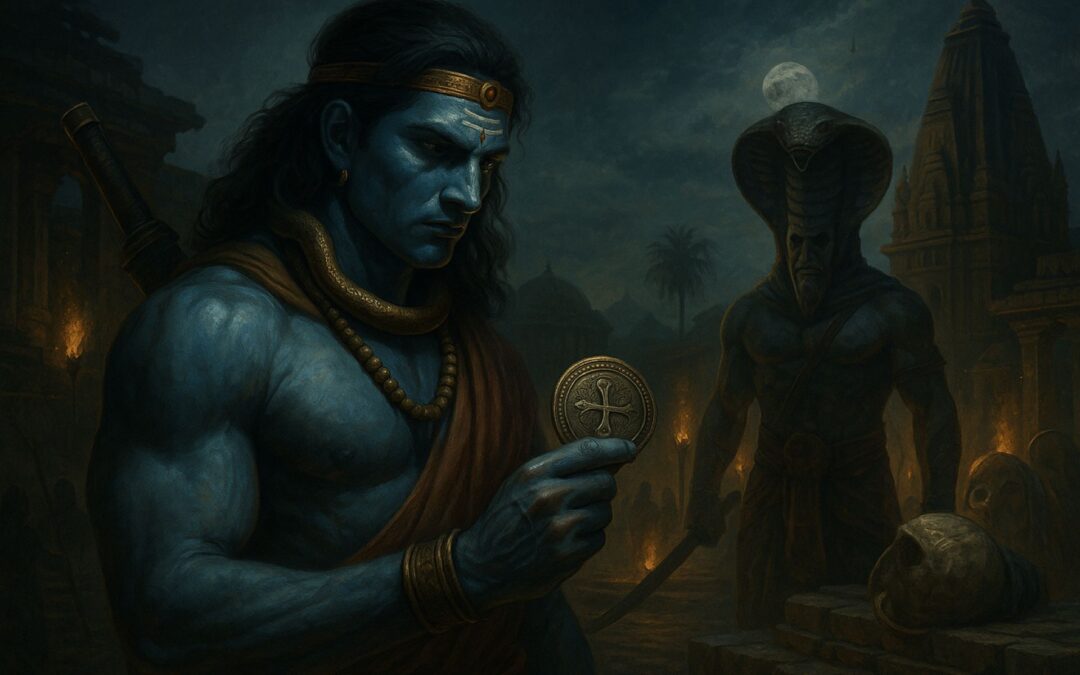
In the aftermath of the attack, as soldiers scour the scene for answers, something glimmers in the dirt — a coin stamped with the seal of Branga, a kingdom far to the east. Its presence feels deliberate, as though left behind to provoke pursuit. For Shiva, the coin becomes both evidence and omen, the first tangible sign pointing toward the elusive truth. Every legend about the Nagas has placed them in the shadows, but this clue pulls him toward geography, not mythology. Evil, it seems, has coordinates.
Determined to follow the trail, Shiva gathers a small band of his most loyal companions. There is Parvateshwar, the soldier of Meluha — a man who sees discipline as salvation; Nandi, whose devotion borders on worship; Veerbhadra, quiet and steadfast, a reflection of Shiva’s humanity; Ayurvati, the physician-priestess whose faith in healing defies superstition; and Bhagirath, the prince of Ayodhya, whose wit balances duty with grace. Anandmayi, the free-spirited Chandravanshi princess, joins them uninvited — her irreverence clashing brilliantly with Parvateshwar’s rigidity. Together, they embark on a journey down the Sarayu River, that ancient artery connecting the known and unknown worlds.
The voyage unfolds as both expedition and initiation. The Sarayu flows wide and calm, its mirror surface reflecting the unspoken tension among the crew. At dawn, the banks echo with hymns; by nightfall, they hum with debate. Ayurvati and Parvateshwar discuss philosophy and medicine, questioning the thin line between divine will and human intervention. Anandmayi teases Shiva about his quest for evil, insisting that if one looks hard enough, it hides inside every man. Her laughter is blasphemous but strangely liberating — a sound that punctures Shiva’s stern silence. Veerbhadra’s quiet loyalty becomes his anchor; while others question, he simply follows, his faith wordless yet unwavering.
As they journey east, the landscapes change — rivers grow wilder, forests denser, temples rarer. Each bend of the Sarayu seems to peel away another layer of certainty. The Meluhans aboard, once confident in their structured civilization, begin to sense the vastness of a world beyond their order. The journey becomes metaphor as much as motion: the river is no longer a path but a teacher, its current urging surrender, not conquest. Somewhere within Shiva, the fire of vengeance flickers, replaced by an ember of curiosity.
Yet, even amid reflection, danger lingers. The waters conceal serpentine shapes that vanish as swiftly as they appear. Villages whisper of Naga sightings; footprints disappear at dawn. The coin from Branga is no longer just a clue — it is a promise that this voyage will end not with the defeat of monsters, but with the dismantling of myths. And though Shiva does not yet realize it, every mile downriver carries him closer not to the heart of darkness, but to the truth that darkness itself may be misunderstood.
Through the Waters of Doubt
The voyage along the Sarayu deepens into something greater than pursuit — it becomes a journey of transformation. As the crew sails eastward, the river mirrors the contradictions in their hearts: tranquil on the surface, turbulent beneath. Each day begins with prayer and ends in debate. The calm rhythm of rowing gives way to restless contemplation. The men of Meluha, once so sure of their divine order, begin to question what that order means. They have left behind the predictable architecture of their homeland for an untamed world where belief itself seems fluid.
Parvateshwar, the stoic general, preaches discipline as the highest virtue. To him, dharma is law — clear, unbending, and ordained by the gods. Anandmayi, ever rebellious, counters him with laughter, her wit cutting through his logic like a blade through silk. “If law brings peace,” she asks, “why does it need soldiers to enforce it?” Their exchanges irritate and intrigue Shiva in equal measure. Each argument, though playful, unravels the absolutes that once anchored him. Ayurvati, meanwhile, listens more than she speaks. Her devotion to medicine — to the tangible act of saving lives — stands apart from both ideology and blasphemy. For her, healing is the truest form of worship. Her calm presence becomes a moral compass, reminding them that compassion transcends every creed.
The river turns from silver to black as they pass through dense forests where the stars vanish under fog. The crew grows uneasy — rumors of the Nagas whisper through the night. Footprints vanish at the edges of sandbanks; shapes flicker in the periphery. Yet nothing attacks. It is as if the river itself is watching. In those sleepless hours, Shiva begins to understand that evil may not announce itself with violence — it may hide in silence, in blindness, in the arrogance of certainty.
By the time they reach the next great bend, the Neelkanth’s once-unshakable faith in divine judgment has begun to soften. Each sunrise reveals not revelation but reflection. The Sarayu is no longer merely water; it is memory, illusion, and test. And through its endless movement, Shiva feels himself changing — less destroyer, more seeker, a man sailing toward questions the gods themselves cannot answer.
The Politics of Magadh
When the fleet arrives at Magadh, the contrast is immediate. The city glimmers with prosperity, its temples magnificent and its priests numerous, yet a strange hollowness pervades the air. Its rulers worship ritual but have forgotten purpose. Bureaucracy thrives where empathy has died. The city’s commander demands an exorbitant tax for portage — a calculated insult meant to test the Neelkanth’s pride. Shiva’s temper surges like the monsoon; his eyes burn blue with restrained fury. For a moment, the air thickens with the threat of divine retribution.
Then Bhagirath steps forward. The prince’s diplomacy cuts sharper than any blade. With a single legal maneuver, he purchases ownership of the ships, turning the tax into absurdity and humiliation for Magadh’s ruler. The confrontation dissolves without bloodshed, leaving Shiva thoughtful rather than triumphant. He sees for the first time the power of intellect over aggression — the strength in restraint. The lesson lingers: righteousness, without wisdom, can become its own form of tyranny.
In the chambers of Magadh’s palace, the rituals continue. Priests chant empty mantras; the wealthy make offerings for salvation they do not seek. The grandeur feels hollow to Shiva, its faith mechanical. Behind the incense and hymns lies decay — a moral disease far more dangerous than the plague he will later find in Branga. He senses that evil does not always hide in jungles or deformity; sometimes, it wears silk robes and speaks in the name of God.
Far from Magadh, the web of intrigue tightens. In Meluha and Swadweep, Daksha and Dilipa meet under the guise of alliance. They cloak ambition in piety, using Shiva’s legend as weapon and shield. Their union is not born of faith, but of fear — fear of losing control over a prophet they can no longer predict. As these empires conspire, the Neelkanth sails unknowingly deeper into their design.
Magadh becomes the perfect mirror for the world Shiva is learning to see: a civilization that confuses devotion with domination, purity with pride. For all its wealth and beauty, the city reeks of something invisible — the poison of self-righteousness. When Shiva finally leaves its shores, he carries not anger but understanding. Evil, he begins to suspect, is not disorder — it is the illusion of order enforced without compassion.
The City of Light and Shadows
The river widens, and the horizon glows with the promise of Kashi — the oldest and most sacred city of the land. Its silhouette emerges like a mirage, its countless temples rising from the banks like prayers carved in stone. To the weary travelers, Kashi is more than a destination; it is the embodiment of contradiction — radiant and corrupt, holy and profane, eternal and ever-changing. The scent of incense mingles with that of sweat and ash. Scholars argue in the courtyards, priests trade blessings for coin, and thieves quote scripture to justify their crimes. It is here that Shiva realizes civilization is not purity perfected but chaos refined.
The group is welcomed by King Chandraketu’s envoys, who guide them through the narrow, crowded streets. Shiva sees faces of every kind — ascetics with matted hair, merchants weighed down by gold, children playing beside the pyres of the dead. Life and death coexist in every breath of this city. It unsettles him. In Meluha, the world was neatly divided between order and sin, right and wrong. Kashi refuses such symmetry. It is a living philosophy, one that embraces imperfection as truth.
In this city, Parvateshwar’s devotion to discipline begins to falter under the heat of feeling. His affection for Anandmayi deepens, testing the boundaries of duty and desire. Their connection — forbidden by the rigid codes of caste and creed — becomes a silent rebellion, an unspoken sermon on the limits of law. Anandmayi’s laughter fills the palace halls; she embodies a freedom that both terrifies and attracts the Meluhan general. Their relationship, as Shiva observes it, becomes a mirror to his own struggle — between faith and freedom, order and empathy.
Meanwhile, Ayurvati tends to the city’s sick and destitute, her calm compassion standing in stark contrast to the priests’ vanity. She refuses payment for her services, telling Shiva, “Healing the body is simple. Healing the mind requires kindness.” Her words linger long after the day’s noise fades. Krittika, the adopted child who once served in Sati’s household, reappears briefly, caring for Kartik as if he were her own brother. Their quiet bond adds a tender counterpoint to the political tension — proof that innocence still survives amid corruption.
Kashi, for all its contradictions, becomes the crucible of revelation. It shows Shiva that enlightenment and ignorance are not opposites but neighbors. The city of light and shadows teaches him what no scripture ever could: that truth, in its purest form, thrives not in perfection, but in acceptance.
The Path to Branga
When Shiva’s fleet finally turns southeast, the land begins to change. The air thickens with humidity, and the horizon darkens with monsoon clouds. Branga, the fabled kingdom of the east, awaits — a land said to be older than Meluha, older even than the myths that built it. But what they find is not the grandeur of legend, but a civilization gasping under the weight of disease. The people of Branga are afflicted with a mysterious plague — their skin blackens, their limbs weaken, and their eyes dim with suffering. The streets smell of herbs, sweat, and despair.
King Chandraketu greets the Neelkanth not as a subject seeking blessing but as a man seeking mercy. His voice trembles when he reveals that the only known cure for the plague comes from the land of the Nagas — the very beings Shiva believes to be the embodiment of evil. The revelation cuts through the Neelkanth like lightning. How could the cursed be healers? How could evil preserve life? In that contradiction, something begins to shift within him.
Ayurvati throws herself into study, examining the disease with a scientist’s curiosity and a believer’s heart. She gathers herbs, observes symptoms, and speaks to the afflicted, refusing to treat them as hopeless. Her work inspires Shiva’s respect — she becomes the human face of his quest, the embodiment of reason tempered by compassion. Even Parvateshwar, once disdainful of Chandravanshi chaos, begins to see the virtue in their spontaneity. The rigid lines between civilizations blur, replaced by a shared awe for the mystery of existence.
The Brangans’ faith in the Nagas unsettles Shiva further. These people, humble and kind, do not speak of their supposed saviors as monsters but as protectors. They tell stories of shadowed figures who leave medicines by riverbanks under the cover of night. Their reverence is not rooted in fear, but in gratitude. For the first time, Shiva feels his divine mission bend beneath the weight of human truth. The Naga whom he sought to annihilate might not be the enemy at all.
At night, as thunder rolls over the delta, Shiva stands by the riverbank, holding the Branga coin that began his journey. Its surface, weathered by travel, glows faintly in the lightning’s flash. He sees in it the pattern of his own thoughts — circular, repeating, endless. The river carries no answers, only reflections. Branga becomes more than a stop along his path; it becomes the moment where vengeance transforms into wonder. The Neelkanth’s purpose dissolves into a deeper question: perhaps evil is not the absence of good, but the failure to recognize it when it wears a different face.
The Serpent’s Trail
When whispers of Naga movements reach Ayodhya, Sati cannot remain still. Her instincts — honed by discipline, sharpened by loss — drive her to act. Against advice, she gathers a small troop and sets out through the dense jungles near Icchawar. Her decision is not merely tactical; it is a reckoning. The hooded assassin who once spared her life haunts her thoughts. Somewhere in that face cloaked in shadow lies a truth she cannot ignore.
The forest she enters is unlike any she has known — wild, humid, and ancient, as though it hides memories rather than secrets. At night, the air thrums with unseen movement. One evening, a monstrous Liger — part lion, part tiger — bursts through the clearing, roaring like an omen. Her soldiers falter, but Sati stands her ground. Every strike she makes is exact, the culmination of years of control and training. When the beast collapses, it is not victory that fills her chest, but an echo of something deeper — the realization that courage cannot silence destiny. Word of her valor spreads, yet her triumph feels strangely hollow.
In the days that follow, Sati discovers what she has been searching for, though not in the way she expects. The Nagas she finds are not the monsters of Meluhan myth but a people exiled for the crime of imperfection. Their camp is orderly, their speech measured, their eyes watchful but not cruel. And then, among them, Sati sees two figures that stop her heart — Queen Kali, her long-lost sister, and the warrior she once called her enemy: the hooded Naga who attacked her in Ayodhya.
He lowers his hood, and time itself seems to fracture. The assassin is not her foe, but her son — Ganesh, the child she was forced to abandon at birth. The deformity that condemned him has become his identity, his armor. The truth is unbearable in its tenderness. The attack that began her family’s grief was never meant to kill; it was a plea for recognition. Sati falls to her knees, overcome by guilt and grace. Kali watches in silence, her strength carrying the sadness of years spent in exile.
In that moment, the tale of the cursed Nagas transforms into something profoundly human. The serpent’s trail — once thought to lead only toward darkness — now winds through the terrain of redemption. Sati remains with them briefly, learning of their struggle, their discipline, and the quiet dignity with which they endure rejection. When she finally returns to Shiva, she carries more than news; she carries the weight of revelation — that evil may not be what the world names it, and that sometimes, monsters are simply the misunderstood children of its gods.
The Revelation in Panchavati
The Neelkanth’s long pursuit ends at the edge of the Dandak forest, where mist coils through towering banyans and the sound of the Godavari softens to a hum. Shiva, weary from war and doubt, rides at the head of his convoy toward the place whispered of in legend — Panchavati, the hidden capital of the Nagas. What he expects to find is a kingdom of the cursed. What he discovers is order.
The city rises unexpectedly from the wilderness, its symmetry rivaling Meluha’s grandeur. High walls guard its periphery, and canals branch out from the river to feed its fields. Streets are clean, structures elegant, and the people — though marked by deformities — move with a calm assurance that unsettles the Meluhans. Panchavati is not a shadowed refuge but a civilization built on discipline and empathy. Founded by the mysterious Bhoomidevi, it represents a third path between Meluhan rigidity and Chandravanshi chaos — one where balance, not dominance, sustains harmony.
As Shiva walks through its avenues, he senses both awe and unease among his followers. The truth of the Nagas defies every sermon they’ve been taught. Here, the so-called cursed have built a world more humane than the one that banished them. Every encounter — every gesture of courtesy — dismantles a piece of Shiva’s certainty. The Neelkanth begins to understand that evil may not exist in the form of creatures, but in the blindness of those who need them to be evil.
And then, at the heart of this city of outcasts, comes the moment that will fracture the myth of his vengeance. In a quiet courtyard, among the banyan roots, Shiva sees a figure he believed forever lost — Brahaspati. The man whose death had ignited his war stands alive before him. The air seems to vanish; time folds. The questions that have defined his journey collapse into silence. Brahaspati does not speak. He simply looks at Shiva with the calm of a man who knows the truth but will not reveal it yet.
The book closes on that stillness — the collision of faith and reality suspended in a single breath. Panchavati, radiant and secretive, holds its mysteries close. Shiva’s mission, born of rage, now trembles on the edge of understanding. The revelation is not resolution, but awakening. Evil, he realizes, may not be a force to destroy — but a truth to be seen. And for the first time, the destroyer feels the burden of creation stirring within.
The Bond Restored
The revelations in Icchawar ripple into quiet tenderness. After years of exile, Sati’s family finally stands reunited — not through divine intervention, but through courage and forgiveness. Ganesh’s wounds from the Liger battle are healing; the once-feared warrior now sits beside his mother, laughing softly as she prepares his favourite dishes. In those moments, titles and deformities vanish. He is simply her son. Kali, the ever-formidable queen, lingers in the background, watching the reunion unfold with a mix of pride and disbelief. The air around them feels lighter, almost sacred.
Ganesh hesitates to stay, fearful of the world’s judgement. He insists that his mother should not suffer the shame of being seen with a Naga son. But Sati’s response silences him: “You are my son. You are his son. The entire world can live in your father’s heart.” Her voice is firm, her conviction absolute. It is both declaration and prophecy. Kali, struck by her sister’s strength, finds herself moved beyond words. The walls that caste, fear, and prejudice built begin to crumble in that moment of familial defiance.
Sati refuses to allow shame to dictate love. She insists that both Kali and Ganesh will travel with her to Kashi, to live as family — not as fugitives. For the first time, the Nagas are invited out of exile, not as enemies or anomalies, but as kin. Ganesh bows his head, struggling between reverence and disbelief. Kali, hardened by years of rejection, can only whisper her agreement. The bond restored in that small, flickering light of reconciliation becomes the quiet heartbeat of hope that sustains the story’s end.
The War Beyond Belief
The journey to Panchavati begins beneath a rising sun that glows pale through the dense canopy of the Dandak forest. The road ahead — the famed Naga path — stretches like a ribbon of stone through the wilderness, lined with twin hedges of thorns: one harmless, one fatally poisonous. It is a fitting metaphor for the Neelkanth’s road forward — beauty and danger intertwined. Shiva’s convoy moves slowly, an army of faith and uncertainty winding toward a secret that could remake the world.
As they travel, alliances deepen. Parvateshwar rides beside Bhagirath, their once-clashing loyalties tempered by shared purpose. Anandmayi’s laughter threads through the morning air, lightening the gravity of their mission. Kali and Ganesh ride with the Neelkanth’s family — a tableau unthinkable months before. In that uneasy harmony, Shiva senses the shifting of eras. The lines dividing civilization from exile, human from divine, begin to fade.
The forest grows darker as they advance, its silence pressing in like prophecy. The warriors march cautiously, unaware that the journey is nearing its end — and its beginning. Ahead lies Panchavati, a city whispered of in myth, and within it, the truth of the world’s greatest deception. The Nagas’ secret, the meaning of the Neelkanth’s legend, and the identity of evil itself wait to be unveiled.
The final pages close not with resolution but anticipation. Kali promises to show Shiva what only the Nagas know — “India’s need,” she calls it. Her words echo like thunder before a storm. The Neelkanth, once driven by rage, now rides toward revelation. When Brahaspati’s face emerges from the shadows of Panchavati, alive and waiting, silence replaces fury. The destroyer’s purpose falters — for the first time, the war he was born to fight may not be a war of blades, but of belief.
Character Analysis: Faces of Faith, Doubt, and Destiny
The world of The Secret of the Nagas is not driven by gods or villains, but by people — each caught between faith and doubt, each struggling to find meaning in a universe that refuses to conform to their certainties. Through them, Amish builds not just a story, but a philosophy: that divinity lies not in perfection, but in the relentless pursuit of truth despite imperfection.
Shiva: From Vengeance to Vision
The Neelkanth’s journey in this volume transforms him from warrior to seeker. At the outset, Shiva is still the man defined by anger — the destroyer of evil, the divine hammer of fate. But the events of the story dismantle that identity piece by piece. His encounters with the Chandravanshis, the Meluhans, and finally the Nagas reveal that every side believes itself righteous. As he sails down the Sarayu, his certainty erodes; his faith in destiny gives way to an emerging curiosity about its contradictions. By the time he reaches Panchavati, Shiva is no longer the wrathful god the world expects. He is a man standing at the threshold of wisdom — learning that to destroy evil, one must first understand it. His evolution mirrors the essence of dharma itself: not blind obedience, but the courage to question what one has been taught to revere.
Sati: The Courage of Compassion
Sati remains the moral axis of the narrative — a figure of restraint, dignity, and quiet rebellion. Her courage does not manifest in conquest, but in compassion that defies the world’s cruelty. When she rides into the jungles to confront the Nagas, it is not to hunt them, but to face the truth they represent. The discovery that the assassin was her own son, Ganesh, transforms her understanding of sin and shame. Her acceptance of him — and of her sister, Kali — becomes the emotional resolution of the book. Sati’s strength is that of endurance, her defiance rooted in grace. Where Shiva seeks justice, she embodies forgiveness. She is the bridge between worlds — the Meluhan ideal of perfection and the Naga acceptance of imperfection. Through her, the novel reveals that compassion is the highest form of courage.
Kali: The Exiled Queen
Kali stands as the embodiment of rejection turned into power. Cast out by her father, Daksha, for her deformities, she has forged a kingdom where difference becomes law and justice replaces hierarchy. Her leadership of the Nagas contrasts sharply with Meluha’s obsession with order. She is severe, disciplined, yet strangely maternal — her strength carved out of survival. When she reunites with Sati, the contrast between them deepens the novel’s moral tension: one raised in privilege, the other in exile. Kali’s acceptance of her fate transforms her deformity into divinity. She becomes not merely the queen of the Nagas, but the conscience of the story — proof that exclusion breeds clarity, and that the outcast often sees truth before the chosen do.
Ganesh: The Innocent Monster
Ganesh personifies the book’s central paradox — that evil is a matter of perception. His disfigurement has condemned him to a life of hiding, yet his heart remains pure. The revelation that he spared his mother in Ayodhya redefines the entire moral axis of the story. He is both the victim of civilization and the vessel of its redemption. To the Meluhans, he is a demon; to Sati, he is salvation. His silence, his restraint, and his inability to hate despite a lifetime of rejection make him one of the trilogy’s most quietly heroic figures. Ganesh embodies the truth that goodness is not the absence of ugliness but the transcendence of it.
Parvateshwar and Anandmayi: Order and Freedom Entwined
The general and the princess stand on opposite poles of ideology — yet they are drawn together by what neither understands: love. Parvateshwar’s devotion to Meluhan law defines his identity. Anandmayi’s laughter mocks that rigidity, her spirit unrestrained by duty or caste. Their relationship is the novel’s living metaphor for the fusion of discipline and chaos, logic and instinct. In a story about civilizations, they represent the possibility of harmony within contradiction. Through them, Amish reminds us that truth is rarely singular — it exists, like love, in the tension between opposites.
Ayurvati: The Rational Devotee
Ayurvati’s presence, though quiet, is essential. She represents science as faith — the belief that knowledge itself is divine. Her medical compassion in Branga and her steady reason throughout the journey make her the moral scientist of the group. She neither condemns nor sanctifies; she seeks to understand. In a world obsessed with prophecy, Ayurvati trusts observation. Her character anchors the novel’s philosophical undercurrent — that wisdom does not belong solely to temples, but also to those who heal, question, and learn.
Bhagirath: The Diplomat of Balance
Prince Bhagirath operates at the intersection of politics and virtue. His intelligence replaces valor, his diplomacy outshines the sword. It is Bhagirath who averts disaster in Magadh through wit rather than violence — a subtle but pivotal act that earns Shiva’s respect. He represents adaptability, the Chandravanshi virtue of fluidity in contrast to the Meluhan pursuit of rigidity. In Bhagirath, Amish gives form to the idea that leadership is not domination but discernment — the capacity to bend without breaking.
Daksha and Dilipa: The Architects of Deception
The two kings are mirror images of ambition masquerading as faith. Daksha, consumed by vanity, hides cruelty beneath the mask of devotion. Dilipa, his Chandravanshi counterpart, cloaks manipulation in diplomacy. Together, they represent the corruption of divine narrative by human hunger. Their scheming runs silently beneath the story’s surface, reminding us that evil often wears the face of order. They serve as the political shadow to Shiva’s spiritual awakening — rulers who weaponize belief while the true leader learns to transcend it.
Each of these figures — divine or flawed, royal or outcast — contributes to the moral architecture of The Secret of the Nagas. The book’s brilliance lies in how it allows each character to carry a fragment of truth, forcing the reader to assemble the whole. No one is entirely wrong, and no one entirely right. Through their intertwined destinies, Amish reminds us that the gods we worship are merely reflections of the choices we make — and that destiny, in the end, is not revelation, but recognition.
Themes and Motifs: Good, Evil, and the Illusion of Truth
In The Secret of the Nagas, good and evil are not cosmic absolutes but human constructs, constantly reshaped by fear, faith, and perception. Amish turns myth into moral inquiry — using familiar legends to ask whether virtue and vice are ever truly separate, or if both arise from the same source.
The Relativity of Evil
The central revelation of the story dismantles the Meluhan certainty that evil can be identified and destroyed. Shiva’s journey from vengeance to understanding mirrors the reader’s own awakening — that what one society calls corruption, another calls survival. The Nagas, branded as demons, are revealed to be a people forced into exile by the same perfectionism that Meluha worships. This inversion exposes the illusion of moral clarity. Evil, the book suggests, is not a quality inherent in beings, but a label born of ignorance and fear.
Perfection and Its Consequences
Meluha’s obsession with purity — physical, social, and moral — becomes the quiet antagonist of the novel. Its rigid system promises order but breeds cruelty. The ostracization of Kali and Ganesh is not an act of malice but of compliance, the by-product of a culture that mistakes flawlessness for righteousness. Amish critiques this ideal through contrast: while Meluha decays under its own rules, the Nagas thrive in adaptation and empathy. The message is clear — perfection is not divine; it is sterile.
Faith and Doubt as Dual Forces
Faith drives the story forward, but doubt gives it depth. Shiva’s faith in destiny fuels his courage, yet his doubt in its righteousness defines his humanity. Sati’s faith in dharma guides her choices, but her doubt in Meluhan morality opens her heart to forgiveness. Each character’s evolution depends on the tension between belief and questioning. Through this interplay, Amish redefines faith not as blind devotion, but as the strength to keep searching when certainty collapses.
The Illusion of Separation
The entire narrative is built on dissolving boundaries — between man and god, truth and myth, purity and impurity. The Meluhans and Nagas, the living and the exiled, the divine and the human — all exist within the same moral continuum. The illusion of separation is both their tragedy and their teacher. By the novel’s end, the serpent — once the symbol of deceit — becomes an emblem of wisdom and unity. The revelation that Brahaspati lives serves as the ultimate symbol of this blurred line between death and rebirth, hatred and forgiveness, ignorance and enlightenment.
Through these motifs, The Secret of the Nagas reframes mythology as moral psychology — suggesting that the battle between good and evil is never fought in the heavens, but in the human heart that seeks to know which is which.
Setting and Atmosphere: A Subcontinent on the Brink of Awakening
Amish Tripathi builds his India not as a mythic stage, but as a living civilization — vast, layered, and trembling on the threshold of transformation. The setting of The Secret of the Nagas is more than a backdrop; it is a moral landscape where geography mirrors consciousness. Rivers, forests, and cities each hold symbolic tension — between decay and renewal, illusion and revelation, order and chaos.
Meluha: The Cracking Facade of Perfection
Meluha remains a marvel of order and discipline — cities aligned to sacred geometry, citizens bound by ritual and duty. Yet beneath its clean streets, cracks begin to show. The empire that once stood as the model of divine governance is now haunted by the consequences of its own perfection. The air feels colder, the silence heavier, as its people cling to the illusion that virtue can be engineered. Through its uniformity, Meluha becomes a quiet dystopia — proof that a society without compassion eventually rots beneath its symmetry.
Swadweep: The Riverine Labyrinth of Contrast
If Meluha is static, Swadweep breathes. Its waterways and dense cities evoke a pulse that Meluha has forgotten — chaotic, vibrant, corrupt, and alive. The contrast between the two empires becomes a living metaphor for the human condition. Swadweep’s complexity — its mingling of piety and decadence — reflects Shiva’s own inner confusion. Here, he witnesses that moral clarity can drown in abundance just as easily as in scarcity. Through this chaotic terrain, the novel captures the rhythm of India itself: neither pure nor profane, but perpetually oscillating between the two.
Branga: The Fevered Realm of Faith and Desperation
The eastern kingdom of Branga is depicted as both sacred and diseased — a civilization praying for salvation yet complicit in its own suffering. Its people’s devotion to the mysterious black powder that cures their plague mirrors the human instinct to cling to miracles when reason fails. The humid air, the stench of sickness, and the restless chanting of the dying create an atmosphere of suffocating faith. Branga is a cautionary vision — of how belief, when unexamined, can become both medicine and poison.
Magadh: The Mirror of Corruption
The city of Magadh stands as the physical manifestation of political decay. Its opulence cannot conceal the moral erosion beneath. Here, truth bends to power, and justice exists only as spectacle. When Shiva confronts the governor, the encounter exposes not merely a corrupt man but a system rotting from the inside. The oppressive humidity, the weight of gold, and the scent of fear combine to turn the city into an allegory for the cost of complacency.
Panchavati: The Hidden Heart of Truth
By the time the story reaches Panchavati, the atmosphere transforms. Mist and shadow dominate the landscape, yet there is serenity in its stillness. The city, meticulously designed and eerily beautiful, reveals a civilization untouched by the vanity of perfection. Every canal, every garden, and every shrine seems to hum with quiet purpose. In this sacred symmetry, Shiva encounters not the cursed but the enlightened. The contrast between Meluha’s sterile precision and Panchavati’s organic harmony underscores the story’s central revelation — that purity without empathy is lifeless, while imperfection with compassion becomes divine.
Nature as Conscience
Across the novel, the natural world acts as the story’s moral compass. The rivers bleed, the forests whisper, the mountains brood. Each element mirrors human error and renewal. The Saraswati’s poisoned waters echo the spiritual contamination of Meluha, while the forests of Dandak conceal not evil but forgotten wisdom. The land breathes with consciousness — it witnesses, judges, and, at times, forgives.
Through this tapestry of places, The Secret of the Nagas transforms India from a setting into a state of mind — ancient yet awakening, wounded yet wise. Every city, every forest, every river is an echo of the same question that haunts its people: can a civilization so proud of its gods still remember the humanity that birthed them?
Tone and Style: Myth Reimagined Through Reason and Reverence
Amish Tripathi writes The Secret of the Nagas not as mythology retold, but as mythology rationalized. His tone carries the cadence of epic storytelling, yet his logic remains firmly human. The reverence he shows for ancient legend is balanced by a modern impulse to question it. Every divine act finds a scientific counterpart; every miracle is grounded in causality. Through this synthesis, Amish bridges faith and reason — transforming the mythic into the plausible, and the sacred into the relatable.
Mythic in Scale, Human in Voice
The novel’s language possesses the rhythm of scripture but the intimacy of conversation. Shiva, though revered as a god, speaks with the uncertainty of a man seeking meaning. This duality defines Amish’s tone — awe without submission. His prose invites readers to worship not power, but understanding. The grandeur of ancient India — its temples, rituals, and philosophies — is rendered through the vocabulary of modern curiosity. This blend of mythic scale and human vulnerability gives the narrative both emotional reach and philosophical weight.
The Language of Rational Divinity
Amish’s style rests on a singular conviction: that godliness can coexist with logic. Alchemy, medicine, and political science weave naturally into the religious fabric of the story. The Nagas’ deformities, once seen as divine curses, are explained through genetic reasoning; the blue throat of the Neelkanth becomes a symbol of chemical reaction rather than mysticism. Yet, these explanations do not erode the sacred — they renew it. The rationalization of myth does not desacralize the divine; it redefines it as a product of human will, discipline, and empathy.
Dialogues as Mirrors of Thought
Dialogue in the novel operates as moral discourse. Shiva’s conversations with Sati, Parvateshwar, and Brahaspati often read like philosophical dialogues rather than exchanges of speech. Each question reveals a layer of moral complexity; each silence, an unspoken reverence for truth. The rhythm of these interactions echoes the Upanishadic method — wisdom born from inquiry, not decree.
Pacing Between Revelation and Reflection
The structure of the book alternates between urgency and stillness. The battle scenes surge with kinetic detail, while the reflective moments — by rivers, in temples, under starless skies — carry a meditative pulse. This balance between movement and contemplation turns the story into an inward pilgrimage. The pacing mirrors Shiva’s evolution — from the external conquest of evil to the internal search for its meaning.
Moral Clarity Through Emotional Depth
Even as the book questions absolutes, its emotional clarity remains unshaken. Amish’s tone is not cynical; it is compassionate. He does not mock faith — he humanizes it. The reverence lies not in rituals, but in the courage to doubt them. Through this stylistic fusion, the novel achieves something rare: a myth retold without blind worship, and a philosophy explored without moral detachment.
Symbolism and Imagery: Serpents, Rivers, and the Dual Nature of Power
The symbolic architecture of The Secret of the Nagas lies in its fusion of physical imagery with moral inquiry. Every object, landscape, and creature carries allegorical weight — translating philosophy into form. Amish does not rely on abstract metaphor; his symbols are tactile, rooted in geography and ritual, yet each conceals a question about destiny, purity, and perception.
The Serpent: From Curse to Consciousness
The serpent, long the emblem of deceit and danger, undergoes its most radical reinterpretation in this book. To the Meluhans, the Nagas’ serpentine hood is the mark of corruption; to Shiva, it becomes a mirror reflecting the blindness of prejudice. The serpent evolves from symbol of evil to vessel of wisdom — echoing India’s oldest paradox, where poison and medicine coexist. In revealing that the Nagas are neither cursed nor demonic, Amish turns the serpent into a living metaphor for human misjudgment. It embodies both temptation and transcendence, reminding the reader that enlightenment often hides within what society fears most.
The River: The Flow of Moral Consequence
Rivers define the geography of the trilogy, but in The Secret of the Nagas, they become moral conduits. The poisoned Saraswati represents not just environmental decay but spiritual pollution — the cost of self-righteousness disguised as order. As Shiva journeys along its length, the river reflects his own inner contamination, carrying his vengeance downstream until it dissipates into understanding. Each crossing, from the Ganga to the Godavari, marks a stage in his purification. The rivers of India thus become arteries of moral renewal, binding together the novel’s philosophy of flow — that life and virtue both stagnate when contained.
The Blue Throat: The Burden of Divinity
Shiva’s Neelkanth mark, born from his consumption of poison, serves as both symbol and curse. The blue throat is not a sign of divine favor but of divine endurance — a constant reminder that knowledge, like poison, must be borne without bitterness. Its permanence signifies transformation through suffering: to carry pain is to understand truth. Amish reclaims the myth of the Neelkanth as an allegory for leadership — the willingness to absorb the world’s darkness without letting it destroy one’s humanity.
The Forest and the Hidden City
The Dandak forest and the concealed city of Panchavati are twin symbols of revelation. The forest, dense and perilous, represents ignorance — the chaos of perception before understanding. Panchavati, emerging from within it, stands for the order that arises from acceptance rather than control. The movement through the jungle into the city is the novel’s most vivid metaphor for awakening — a pilgrimage from myth to reason. By placing the civilization of truth at the heart of wilderness, Amish inverts the classical moral order: it is not the city that civilizes man, but wisdom hidden in the wild.
The Deformity: The Mask of Truth
Physical imperfection, recurring through the Nagas, becomes the book’s most provocative symbol. What Meluha calls deformity is revealed as a divine camouflage — a reflection of nature’s refusal to conform to human vanity. Kali’s extra limbs, Ganesh’s disfigured face, and even Sati’s scars speak to the same truth: that perfection is not the absence of flaw but the acceptance of it. The body, in Amish’s symbolic language, becomes scripture — the visible testament to invisible strength.
Through these layered symbols, The Secret of the Nagas builds a theology of perception. Serpents cease to be monstrous, rivers cleanse rather than divide, deformities reveal rather than conceal. Power itself becomes dual — creation and destruction, poison and cure, truth and illusion — coiled like a serpent within the same form.
Moral and Philosophical Reflection: The Nature of Evil and the Burden of Choice
Beneath its mythology and movement, The Secret of the Nagas is a moral dialogue — a meditation on how civilizations define evil, and how individuals bear the cost of those definitions. Amish uses the familiar framework of legend to stage a timeless philosophical conflict: the danger of mistaking certainty for truth. The book does not offer answers; it offers confrontation — between morality and mercy, justice and empathy, the law of gods and the conscience of men.
The Relativity of Good and Evil
From the moment Shiva’s vengeance gives way to doubt, the story transforms into an inquiry. Evil, once thought external — embodied by Nagas, demons, or enemies — dissolves into something internal: ignorance. The revelation that the so-called cursed are victims of Meluhan rigidity forces Shiva, and by extension the reader, to question the moral architecture of civilization. What if evil is not an absolute but a reflection of perspective? Through this shift, Amish dismantles one of mythology’s oldest binaries and redefines dharma not as obedience but as discernment.
The Ethics of Perfection
Meluha’s greatest virtue — its order — is also its greatest sin. Its obsession with flawlessness breeds exclusion; its devotion to purity breeds cruelty. The book presents this paradox with surgical precision: a society built on the dream of divine order cannot tolerate the humanity that sustains it. The Nagas, cast out for their deformities, become the living consequence of that ideal. Through them, Amish challenges the reader to confront a central philosophical irony — that the pursuit of perfection often leads to moral decay.
The Price of Knowledge
Every revelation in the novel carries a cost. When Shiva learns that the Nagas are not monsters, he loses the simplicity of purpose that once defined him. Knowledge demands disillusionment; enlightenment demands suffering. The blue throat becomes the emblem of that burden — the visible proof that wisdom requires endurance. In Amish’s philosophy, the pursuit of truth is not liberation but transformation — a shedding of comfort to see the world as it is, not as one wishes it to be.
Choice as the Axis of Divinity
The divine in Amish’s world does not reside in omnipotence but in choice. Gods are not born — they are made through moral decision. Shiva’s greatness lies not in his powers but in his willingness to choose compassion over certainty, doubt over dogma. Sati’s forgiveness, Kali’s strength, and Ganesh’s restraint all stem from conscious choice, not divine destiny. The novel’s moral vision thus aligns more with humanism than theology: it is choice, not birth, that determines sanctity.
The Burden of Vision
By the novel’s end, Shiva’s enlightenment isolates him. To see beyond illusion is to bear the loneliness of awareness. The sight of Brahaspati alive — the man he believed dead, the cause of his holy war — becomes not resolution but revelation. It exposes the fragility of belief and the danger of vengeance born from partial truth. In that silence, Shiva learns the final moral law of the book: that enlightenment is not triumph but humility — the quiet recognition that every certainty conceals another secret.
In The Secret of the Nagas, Amish transforms myth into moral anatomy. Evil ceases to be a creature to kill or a people to hate; it becomes a misunderstanding to outgrow. Every act of vengeance in the story yields insight, every revelation deepens compassion. The novel closes on that paradox — that to destroy evil, one must first forgive it.
Author and Context: Amish Tripathi and the Rebirth of Indian Myth
Amish Tripathi’s The Secret of the Nagas is both a continuation of the Shiva Trilogy and a testament to the author’s vision of myth as moral philosophy. By retelling ancient legends through the lens of human reason, Amish redefines what mythology can be for the modern Indian reader — not dogma to be preserved, but wisdom to be rediscovered.
Amish approaches divinity as evolution, not inheritance. His Shiva is no eternal god but a man whose choices elevate him to divinity, a radical departure from traditional mythic structures. This reinterpretation reclaims the essence of Indic thought: that every being possesses the potential for enlightenment through self-mastery and moral awakening. In turning gods into humans and humans into seekers, Amish restores to myth its original democratic spirit — accessible, questioning, and alive.
The novel also marks a literary and cultural inflection point. Emerging from an era when popular Indian fiction revolved around romance and realism, The Secret of the Nagas reinvigorated interest in philosophical storytelling. By embedding genetics, environmental ethics, and socio-political structures into a mythological frame, Amish constructed a bridge between the rational and the sacred. His work situates faith within the framework of science and governance, offering an evolved form of mythology that engages with the realities of modern life rather than escaping them.
What distinguishes Amish is not only his command of narrative rhythm but his philosophical conviction. His storytelling mirrors the Vedic approach — knowledge gained through inquiry. Every scene serves a dual purpose: to entertain and to awaken. By rendering moral questions as narrative conflicts, he transforms epics into laboratories of thought. The reader does not merely follow Shiva’s journey; they participate in his questioning.
Amish Tripathi thus emerges as both author and interpreter — a custodian of cultural inheritance and a craftsman of its rebirth. Through The Secret of the Nagas, he proves that mythology need not compete with modernity; it can illuminate it. His India is ancient yet awake, rooted in legend but fluent in logic — a civilization retold, not as nostalgia, but as reminder.
Key Quotes and Interpretations: Voices from the Age of Legend
The language of The Secret of the Nagas resonates with both scripture and introspection. Amish’s dialogue-driven style ensures that his philosophy surfaces not through exposition but through conversation — moments where emotion sharpens into insight. Each line reveals not just the speaker’s belief, but the moral weight of an evolving civilization.
“There is no evil, only perspectives.”
This is the central axiom of the book and the pivot of Shiva’s transformation. What begins as a quest for vengeance ends as a recognition of moral relativity. The line captures the essence of the Neelkanth’s awakening — that truth is multifaceted, and evil is often a shadow cast by limited understanding. In a world driven by ideology, it becomes a call for empathy and discernment over dogma.
“A person becomes evil when he believes he is infallible.”
Here, Amish strikes at the heart of Meluhan perfectionism. The statement serves as both social critique and spiritual warning. By equating certainty with corruption, it exposes the danger of unexamined virtue. The true evil, the book suggests, lies not in rebellion but in moral arrogance — the inability to question one’s own righteousness.
“Sometimes, to stand up for the truth, you have to stand alone.”
This line, voiced through Sati’s quiet defiance, embodies the novel’s moral courage. It is not the roar of a warrior but the still conviction of integrity. Her independence from Shiva’s divine authority and from Meluhan tradition positions her as the novel’s moral compass — a symbol of the courage required to confront collective blindness.
“Knowledge is a burden if it robs you of innocence.”
The paradox of enlightenment is laid bare in this reflection. Every revelation in the novel comes with loss — of faith, simplicity, and belonging. This acknowledgment transforms wisdom from a gift into a responsibility. The line deepens the meaning of Shiva’s blue throat: knowledge must be carried, not consumed.
“Truth does not need temples; it lives in conduct.”
This quote distills the trilogy’s ethos — that holiness resides in action, not architecture. By separating morality from ritual, Amish restores divinity to human choice. The temples, laws, and empires that frame the narrative all crumble under this principle, leaving character as the only true sanctuary of the divine.
Together, these lines form the philosophical skeleton of The Secret of the Nagas. Each one bridges mythology and modernity, transforming legend into guidance. Through them, Amish Tripathi reasserts an ancient idea in contemporary form — that truth is not inherited through birth or belief, but earned through consciousness and compassion.
One-Paragraph Moral Summary: The Awakening Beneath the Myth
In the end, The Secret of the Nagas becomes a mirror for the human condition — revealing that the monsters we fear are often born from our refusal to see. Through Shiva’s awakening, Amish transforms divinity into consciousness and myth into reflection: evil fades not when it is slain, but when it is understood. The river that began poisoned ends in stillness, carrying within its depths the truth that compassion, not certainty, redeems a civilization.