
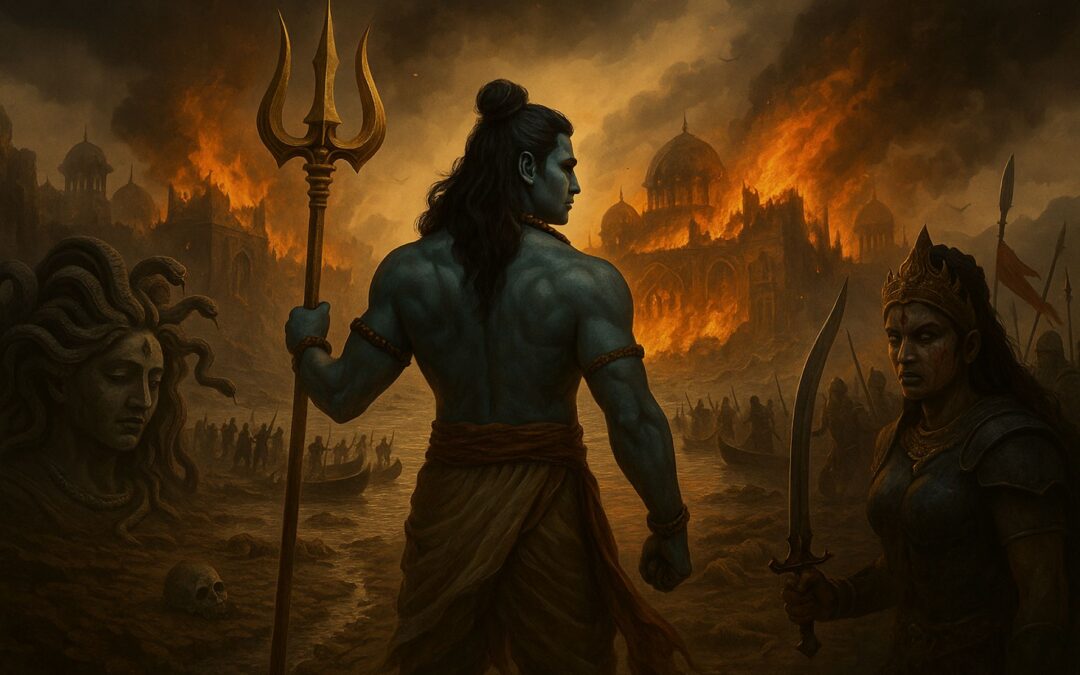
Overview: The War for the Soul of Meluha
In The Oath of the Vayuputras, Amish Tripathi brings the saga of Shiva to its fated conclusion — a reckoning between righteousness and excess, between the purity of ideals and the corruption of power. The land of Meluha, once envisioned as the perfect society, now stands divided under the weight of its own perfectionism. What began as a divine quest to destroy evil evolves into a moral confrontation with the very notion of what evil is.
Shiva, no longer merely the foreign barbarian from Tibet but the awakened Neelkanth, carries the burden of judgment. His war is not for conquest but for clarity — to restore balance in a world that has lost sight of its moral compass. The novel expands from political intrigue and divine warfare into a deeply human meditation on justice, sacrifice, and the cost of moral absolutism.

Plot Summary: The Final Journey of the Neelkanth
The concluding volume of the Shiva Trilogy unfolds as both a war epic and a moral reckoning — a story where faith, love, and power converge to test the very meaning of righteousness. As Shiva’s world teeters between devotion and delusion, his journey becomes one from vengeance to wisdom, from divinity to humanity.
The Fractured Empire and the Truth of Somras
The peace that once bound Meluha, Swadweep, and the outlying lands begins to unravel when Shiva discovers the grim secret buried within Meluha’s perfection — that its prosperity is built upon a silent crime. The Somras, long revered as the divine elixir of immortality, is revealed to be the root of decay across the Indian subcontinent. Its waste poisons the rivers of Branga, turning once fertile soil into desolate marsh. Children of the Nagas are born with deformities not as divine punishment but as the price of Meluhan excess. The very drink that grants longevity to the privileged condemns entire peoples to suffering.
The revelation strikes at the heart of Meluhan pride. The civilization that claims moral superiority, that worships order and reason as divine laws, is sustained by systemic exploitation. For Shiva, this moment is not just political — it is spiritual. Evil, he realizes, does not always manifest as cruelty or chaos. Sometimes it hides behind devotion, efficiency, and the blind faith that what has worked must always be right. The Somras becomes a symbol of the human paradox: that the pursuit of eternal life can destroy the living.
Nandi, Bhagirath, and the Vasudevas help Shiva trace the full scope of the damage. Temples of Somras production, scattered across the empire, are guarded as sacred spaces. Yet every dose produced leaves behind toxic residue that seeps into the rivers and soils of neighboring lands. The Brangas suffer diseases unknown to Meluha; the Nagas’ mutations are revealed to be biological consequences, not divine curses. The perfection of one civilization comes at the corrosion of others.
For the Neelkanth, this discovery redefines his mission. He was chosen to destroy evil, but how does one destroy an idea that was once good? Shiva’s divine quest transforms into a philosophical burden. He begins to see that his role is not to destroy people or nations, but to destroy imbalance — to remind creation of its forgotten limits. The revelation of the Somras is not the discovery of evil’s face; it is the realization of humanity’s shadow.
The final proof arrives not through debate, but through nature’s silence. The Saraswati River, the sacred artery of Meluhan civilization, begins to wither. Its waters, once radiant and pure, retreat deeper into the earth until only a thin stream remains. The mighty cities along its banks crumble into dust, their wells gone dry. The very lifeblood of Meluha evaporates before its people’s eyes — the divine river undone by human arrogance. For Shiva, it is the sign he can no longer ignore. The destruction is no longer prophecy; it is already here.
Meluha’s Denial and the Seeds of Civil War
Armed with proof and moral conviction, Shiva confronts the Meluhan elite. He enters the halls of Devagiri expecting reason, only to find pride. Emperor Daksha, once an ally and father-in-law, dismisses the revelations with cold disdain. The council of elders stands united behind him, intoxicated by their civilization’s self-image as the chosen keepers of Lord Ram’s legacy. To them, Somras is not merely a substance — it is faith itself, a sacrament that sustains the illusion of divine perfection.
Daksha’s refusal is not born of ignorance but arrogance. He cannot allow the truth to fracture the foundation upon which Meluha rests. To him, the suffering of the Brangas and Nagas is an unfortunate but necessary sacrifice for the greater good. This moral blindness transforms the emperor into the embodiment of the very evil Shiva seeks to confront — not malicious intent, but the corruption of virtue through pride.
The tension escalates into open defiance. Shiva withdraws from Meluha, his heart heavy with both anger and sorrow. The Vasudevas, Brangas, and Nagas rally to his side, recognizing in him not just a warrior, but a man fighting for moral truth. Meanwhile, Daksha fortifies his empire, aligning with the Ayodhyan ruler Dilipa and the priestly elite who see Shiva as a destabilizing force.
The air grows thick with inevitability. For all his divine aura, Shiva is powerless to prevent the tide of conflict. What began as a quest for moral clarity now spirals into the machinery of war. The land divides along ideological lines — between those who cling to old glories and those who dare to question them. Even the divine cannot stop the momentum of human denial.
The Divided Loyalties of Parvateshwar and Anandmayi
The fracture of empires soon reaches the hearts of individuals. Among Shiva’s followers, none face a greater test than Parvateshwar, the proud Meluhan general who has fought beside the Neelkanth through countless trials. Bound by an oath of allegiance to his emperor, Parvateshwar cannot raise his sword against Meluha, no matter how wrong its cause may seem. His honor is not one of blind obedience but of ancient discipline — to him, the sanctity of an oath outweighs even the wisdom of gods.
Shiva, understanding the purity of Parvateshwar’s heart, does not condemn him. Their parting is marked by mutual pain and respect. “Your dharma binds you as mine binds me,” Shiva tells him — a moment that crystallizes the novel’s moral complexity. There are no villains here, only men trapped within different interpretations of duty.
Anandmayi, Parvateshwar’s vivacious and fiercely independent wife, faces her own crucible. She has long admired Shiva’s courage and questioned the rigidity of Meluhan order. Yet when the time comes to choose, she follows her husband — not out of submission, but love. Her decision carries a quiet nobility; she embodies the cost of devotion in a world fractured by ideology.
Their departure wounds Shiva deeply. He loses not only a general but a brother in arms. The camaraderie that once united Meluhans and Nagas, soldiers and sages, begins to dissolve. Even among the righteous, the lines blur. Loyalty, love, and righteousness, once harmonious, are now at odds.
Meanwhile, Sati, Shiva’s wife and Daksha’s daughter, emerges as the moral anchor of the narrative. Torn between filial love and marital faith, she sides with truth — standing by Shiva as both partner and equal. Her loyalty is not passive; it is an act of rebellion against a father’s tyranny and a society’s hypocrisy. Where Parvateshwar’s dharma binds him, Sati’s liberates her. She represents the courage to follow conscience when tradition falters.
The division within Shiva’s inner circle mirrors the greater divide tearing the land apart. The Neelkanth’s cause, once clear, now exists in shades of gray — and each loyal heart carries its own definition of right.
The Discovery of the Neelkanth’s Origins
Amid the shifting tides of loyalty and the growing shadow of war, Shiva turns inward, haunted by an unanswerable question: Why him? Why should a mere tribal chieftain from Mount Kailash be burdened with the fate of nations? The Vasudevas, the secretive order of philosophers who serve as guides to the Neelkanth, offer fragments of revelation — but Shiva senses that the truth lies farther west, in the lands where legend first named his destiny.
It is through the Vasudeva elder Gopal that Shiva learns of Lord Manobhu, a name that trembles with divine resonance. Manobhu was not just a sage — he was a Vayuputra Lord, a custodian of balance, who centuries earlier foresaw the danger that the Somras would pose. He broke away from his brethren, left the West, and lived among mortals, waiting for the time when the world’s equilibrium would collapse.
Manobhu’s faith was not in gods but in human agency. He believed that one day, a man of flesh and blood — neither perfect nor divine — would arise to restore dharma. It was Manobhu who, foreseeing Shiva’s birth and temperament, consecrated the ritual that would one day mark him. The blue throat — the sacred sign that would make him the Neelkanth — was not the product of celestial destiny but of human intent.
For Shiva, this discovery reshapes his identity. The idea of divinity loses its mystique. He realizes that gods are not chosen — they are made through acts of clarity and courage. He is no longer the passive vessel of prophecy but the conscious embodiment of balance. The weight of this truth humbles him; the Neelkanth’s power is not a gift from the heavens but a responsibility inherited from those who believed humanity could be better than its gods.
The Journey to the Land of the Vayuputras
The search for answers leads Shiva and his closest followers — Nandi, Bhagirath, Kartik, and the Naga warriors — to the mysterious western lands spoken of only in whispers: the land of the Vayuputras. The journey is long, perilous, and symbolic. The farther they travel from the familiar kingdoms of India, the more the journey becomes a pilgrimage through the ruins of human pride.
They cross barren deserts that once held thriving cities — remnants of civilizations that rose too high and fell too hard. The air grows thinner, the silence heavier, as they enter a region untouched by time. The architecture of the Vayuputras’ domain is austere — carved into stone cliffs, guarded by symbols of balance and unity. Everything here breathes restraint, the essence of a people who learned long ago that unchecked creation leads only to decay.
The Vayuputras greet Shiva not with reverence but recognition. He is not their savior; he is their continuation — the blood of Manobhu, returned to fulfill an oath that predates kingdoms. Their leader, Mithra, a man of immense serenity and sorrow, tells Shiva that the Vayuputras have always existed beyond nations, acting only when imbalance threatens life itself. They do not worship gods — they serve balance.
Mithra reveals that the Neelkanth tradition is not divine mythology but pragmatic philosophy — a system of renewal designed to reset civilization whenever goodness grows destructive. “Every age,” Mithra says, “needs its destroyer, for creation cannot survive without death.” Shiva listens, silent, understanding that his war against Somras is not his alone; it is part of a cycle as old as existence.
Here, in the stillness of the Western mountains, the Neelkanth finds not command but confirmation. His purpose is no longer vengeance but restoration. And the tool of that restoration awaits him — a weapon older than faith itself.
The Oath and the Gift of the Pashupat Astra
In a ceremony lit by the dying sun, Mithra leads Shiva into the inner sanctum of the Vayuputras — a cavernous hall that glows with ancient energy. There, resting upon a pedestal of black stone, lies the Pashupat Astra, the weapon of destruction created by Lord Rudra, Shiva’s legendary predecessor. The weapon is not merely physical; it hums with the vibration of moral consequence. It can obliterate entire civilizations, erase life within miles, and bend reality to stillness.
But its power is as dangerous to the wielder as to the world. The Astra responds not to command but to intent. To unleash it in anger would destroy the user’s soul; to use it with clarity would burn the world clean. Mithra warns Shiva that such a weapon is both judgment and test — the embodiment of the law that creation must always pay for its imbalance.
As Shiva approaches it, the chamber fills with wind — a whispering chorus of a thousand past Vayuputras. He kneels before the Astra, not in awe, but in solemn recognition. This is not a gift, he realizes, but a burden. It is the physical manifestation of dharma’s most painful truth — that sometimes, mercy and morality cannot coexist.
Mithra asks him to take the Oath of the Vayuputras:
“To destroy not from rage but from reason.
To preserve not from fear but from faith.
To remember always that creation and destruction are brothers.”
Shiva accepts, his hand resting on the weapon’s hilt. The blue in his throat burns brighter — not from power, but from understanding. The Neelkanth has found his ultimate instrument, but also his greatest test. The weapon will one day demand a choice — between justice and peace, between love and balance.
As he rises, Mithra speaks softly: “When you use this, Neelkanth, remember — you will not be remembered as a god of mercy. You will be remembered as the god who saved creation by breaking its heart.”
The March to War and the Cult of Aten
When Shiva returns from the West, the air of Bharatvarsha crackles with dread. The fragile threads of diplomacy have snapped; the empire trembles beneath the weight of belief turned blind. Daksha, embittered by pride and stung by Shiva’s defiance, forges new alliances — first with Ayodhya, then with the shadowy forces that worship power over principle. In his desperation to preserve Meluha’s glory, he revives the Cult of Aten, an ancient order of assassins who once served as the enforcers of divine purity.
The Aten warriors are zealots, molded by ritual and fear. Their creed is annihilation — they see impurity everywhere and redemption nowhere. For them, Shiva is no god but a blasphemy, a barbarian who dares to defy the perfect order of Meluha. Their presence stains the battlefield with terror, transforming a war of conviction into one of extermination.
Shiva, for his part, marshals his forces with grim resolve. His army is not a monolith but a coalition of contradictions — the Nagas, fierce and scarred, driven by vengeance; the Brangas, faithful yet weakened by disease; the Vasudevas, philosophers wielding wisdom as weapon; and the Swadweepans, proud yet divided. Together they march under a single banner — not for conquest, but for justice.
The early battles are fought with intelligence and restraint. Kartik commands the field with the precision of his mother and the passion of his father; Ganesh, ever the thinker, counsels strategy over rage. Yet with every victory, the moral clarity of war blurs. Villages burn. Innocents die. The line between good and evil — once so sharply drawn — begins to dissolve into ash.
Amid this chaos, Shiva’s heart grows heavy. The words of Mithra haunt him: “Destruction is easy. Balance is hard.” He fights not just Daksha’s armies but the growing storm within himself — the slow corruption that even righteousness can bring. The Neelkanth’s challenge is no longer external; it is the temptation of divine certainty that threatens to consume him.
The war drags on. Both sides suffer, both claim victory. And when reason can no longer dictate the course of battle, fate does — through one act of devotion that will alter the destiny of gods and men alike.
Sati’s Last Battle and the Tragedy of Devotion
In the war’s darkest hour, Sati — warrior, queen, and conscience of the Neelkanth — finds herself at the heart of a massacre. The Aten assassins descend upon a Meluhan refugee camp, slaughtering soldiers, women, and children alike. Sati, stationed nearby, rides to their defense with only a small contingent of guards. She knows the odds are hopeless; she knows she will die. But in her world, dharma demands action even in the face of futility.
The battle unfolds like a tragic hymn. Sati’s blade flashes with unearthly grace — every movement deliberate, every strike an act of faith. She protects not her allies or her kingdom, but the defenseless — the very people both sides have forgotten amid their cries of righteousness. One by one, her guards fall. Her armor shatters, her body bleeds, but her spirit burns brighter with every wound.
When the leader of the assassins, Swuth, confronts her, he mocks her defiance — calls her mercy weakness. Yet even as blood clouds her vision, Sati’s voice is steady. “There is no weakness in protecting the innocent,” she says. “Only in killing them.” She strikes him down in a final surge of strength, but not before he drives his blade through her chest. The sound of her fall silences the battlefield.
When word reaches Shiva, the world narrows to grief. The man who once believed in control, in balance, in the moral geometry of action, is undone. His pain is raw, unbound, and unhealing. The death of Sati is not just personal — it is cosmic. She was the balance to his fire, the anchor to his divinity, the bridge between reason and rage. Without her, Shiva is no longer a god seeking truth. He is a man staring into the abyss.
The tragedy of Sati’s death is the emotional and spiritual climax of the trilogy. It transforms the story from epic to elegy — from the tale of a savior to the lament of a soul stripped bare. The Neelkanth’s silence that follows speaks louder than any roar of battle. The world has lost its conscience, and the destroyer prepares to do what destroyers do.
The Funeral Pyre and the Breaking of Tradition
The fields of Devagiri fall quiet as Sati’s body is brought to Shiva’s camp. The warriors lower their weapons; the sky itself seems to dim. Daksha and Veerini arrive — the father broken by guilt, the mother shattered by loss. Veerini cradles her daughter’s lifeless form, her wails tearing through the stillness like a curse upon the empire that prized perfection over compassion. Daksha, stripped of his pride, kneels beside Shiva, but the Neelkanth does not look at him. The distance between them has grown too vast for forgiveness.
When the pyre is built, Shiva issues a command that shocks even his closest allies: both Kartik and Ganesh are to light the fire together. It is an act forbidden by Meluhan law, for Ganesh, born deformed and a Naga, is deemed impure. But Sati’s death has stripped Shiva of patience for hypocrisy. “If the pure cannot stand beside the impure,” he says, “then purity itself is defiled.”
As the flames rise, the two sons stand together — warrior and philosopher, blood of one mother, heirs of a world reborn in fire. The pyre burns bright enough to light the night sky, consuming not just Sati’s body but the old world’s false certainties. Shiva watches in silence, tears searing down his ash-streaked face, the blue of his throat glowing faintly in the light of loss.
The ceremony becomes a silent revolution. The soldiers of Meluha weep openly; the Nagas, long shunned, stand unbowed. In that single moment, boundaries dissolve. The act of defiance is not simply ritual — it is renewal. Sati’s death, which could have ended the war, becomes the moment that defines it.
When dawn comes, Shiva is changed. His grief has hardened into clarity. The words of his oath echo in his mind — not as memory, but as command. The world has broken balance beyond repair, and now the destroyer must act.
The Wrath of the Destroyer: Devagiri’s Destruction
After the flames of Sati’s funeral die, silence descends — a silence heavier than war. The Neelkanth sits alone before her ashes, the air around him still with grief. He has known rage before, but this is something deeper: a calm so absolute it terrifies those who stand near him. The restraint that once defined Shiva now feels hollow. The world has gone past reason, past redemption. And in his heart, the promise of balance transforms into something elemental — the necessity of destruction.
Daksha, still lost in remorse, returns to Devagiri, unaware that fate follows close behind. The emperor’s courtiers, his generals, even his surviving citizens, cling to their routines as if order can save them from consequence. But high above the city, in the mountains that frame the Meluhan capital, Shiva’s army gathers. From a distance, Devagiri still gleams — its marble towers and symmetrical avenues a testament to Meluhan perfection. But that beauty, Shiva knows, is built on bones.
He withdraws to solitude to prepare. From within his tent, his companions hear only the rhythmic pulse of meditation — the deep, controlled breathing of a god confronting his final duty. In that stillness, he summons the Pashupat Astra — the weapon of the Vayuputras, the inheritance of balance and annihilation. The weapon does not shimmer; it hums, low and steady, a vibration that resonates through the very earth. Kartik and Ganesh, watching their father, feel the weight of inevitability. They do not protest. They have seen that some acts of destruction are not vengeance, but justice long denied.
As Shiva steps outside, the sky darkens. His army falls to its knees. Even the wind seems to hold its breath. When he releases the Astra, there is no thunderclap, no roar — only light. Blinding, pure, merciless light. It expands outward in silence, consuming Devagiri in an instant. Walls, temples, palaces — all reduced to dust. The white marble city turns black before dissolving into nothingness.
The explosion’s heat sears the land for miles, and yet Shiva stands unmoved. When the light fades, nothing remains but ash swirling in the air, falling softly like snow. The greatest civilization of its time has been erased — not by hatred, but by its own inability to see. The Pashupat Astra has fulfilled its purpose, but so too has the prophecy: the Neelkanth has destroyed evil, not in men, but in the idea that good can exist without limit.
The act ends the war, but it leaves the world hollow. The conqueror walks among the ruins, not triumphant, but broken. In fulfilling his destiny, Shiva has become what he feared — a god who destroys what he loves to save what he must.
Ashes and Ascension: The Return to Kailash
In the aftermath, the continent lies stunned. The survivors of both sides wander through the haze of loss, uncertain whether to mourn or begin anew. Meluha is gone; Ayodhya’s priests have fallen silent; the Vasudevas retreat to their sanctuaries to record what has transpired. The balance is restored, but the cost reverberates through generations.
Shiva, meanwhile, walks alone through the charred ruins. Around him, the rivers still boil, the air heavy with the scent of smoke. In the distance, Kartik commands the remaining armies to aid the wounded. Ganesh, ever contemplative, begins the slow work of reconciliation — bridging the broken alliances between men. Yet their father remains apart, lost to thought.
When the sky clears, Shiva gathers Sati’s ashes and begins his final journey — northward, toward Mount Kailash, the land of his birth. He travels without escort, without ceremony. The once-terrifying god of war is now a solitary figure, his blue throat dimmed, his aura subdued. Villagers who glimpse him along the way bow in silence, sensing not divinity, but sorrow made sacred.
Each step is a pilgrimage through memory. He recalls the laughter of his tribe in Tibet, the first sight of Meluha’s grandeur, the songs of the Nagas, the voice of Sati calling him “my love” beneath the red moon. Each recollection is both knife and balm. When he finally reaches the foothills of Kailash, he stops to gaze upon the snow-crowned peaks — ancient, untouched, and eternal. For the first time, he feels peace.
There, amid the stillness, he builds a small shrine — a circle of stones and flame — and places Sati’s ashes within. He lights the fire himself, whispering words that no one hears. The wind rises, carrying the ashes upward until they vanish into the mountain’s mist. The Neelkanth kneels, not as a god, but as a man who has lived, lost, and learned the price of creation.
He remains in Kailash for the rest of his days, a figure of silence and meditation. Some say he ascends beyond the mortal world, merging with the divine essence of Rudra; others believe he lives on, watching over mankind from the mountain’s heart. Either way, the destroyer becomes the guardian of renewal — the embodiment of the eternal cycle.
The Law of Balance: The End Becomes the Beginning
Years pass, and the story of the Neelkanth becomes legend. In the new cities that rise from Meluha’s ashes, storytellers speak of the man who destroyed a civilization to save a soul, who wielded fire not as punishment but as purification. Children grow up hearing that the blue-throated one came not to conquer evil, but to reveal it — that the true enemy is never darkness, but imbalance.
The Vasudevas, chroniclers of dharma, record his life as scripture. They call it The Oath of the Vayuputras — a covenant between humankind and the divine order, a promise that whenever good turns excessive, the destroyer will rise again. The war becomes myth, the myth becomes faith, and faith becomes the invisible thread that binds future generations to the memory of the Neelkanth.
Yet beneath the reverence, the moral remains painfully human: that virtue and vice are twins, born from the same mother — intention. Every civilization that worships perfection must one day confront the cost of its illusion. Shiva’s journey stands as warning and wisdom: that gods, too, must be willing to fall if balance is to endure.
In the stillness of Kailash, where wind hums like prayer, Shiva’s presence lingers — not as thunder, but as whisper. He has become the still center of motion, the calm eye of life’s endless storm. His legacy is not victory, but understanding: that creation and destruction are one act, divided only by time.
And so, as ages turn, new civilizations rise and fall, and once again, somewhere in the vast silence of the Himalayas, the blue light flickers — faint but alive — waiting for the next imbalance, the next awakening, the next god who will remember that to destroy wisely is the highest act of love.
Character Analysis: Duty, Destiny, and the Human Face of Divinity
At its heart, The Oath of the Vayuputras is not a tale of gods waging war, but of humans grappling with divinity — the unbearable weight of choice, the loneliness of righteousness, and the fragile boundary between faith and fanaticism. Each character in the novel mirrors a fragment of Shiva’s moral journey: loyalty and defiance, reason and devotion, balance and excess. Their destinies intertwine not by prophecy, but by conviction — each shaping the fate of a world teetering between creation and collapse.
Shiva: The Neelkanth as the Conscience of Creation
Shiva’s evolution from an unassuming tribal leader to the destroyer of the age defines the moral architecture of the trilogy. In this final installment, his struggle is no longer external — not with demons or kings — but internal. He must decide not what is evil, but when goodness becomes one. The revelation that Somras — the symbol of progress — is also the source of decay forces him to confront the central paradox of existence: that every virtue, when left unchecked, breeds its opposite.
Through his journey to the land of the Vayuputras, Shiva discovers that he is not chosen by divine fate but by moral readiness. His uncle Manobhu’s blood oath transforms him into a living ideal — a man made divine through responsibility, not power. The Pashupat Astra, bestowed upon him by Mithra, becomes the materialization of that responsibility: infinite strength bound by infinite restraint.
Sati’s death reveals his last transformation — from philosopher to force. His grief strips him of words, leaving him with only action. When he unleashes the Astra on Devagiri, it is not wrath but judgment, a return to equilibrium. By the novel’s end, Shiva becomes not the destroyer of worlds, but their conscience — a god who walks away from power to preserve its meaning.
Sati: The Moral Core of the Epic
If Shiva is the novel’s soul, Sati is its heartbeat — the steady rhythm of conviction beneath chaos. Her death is often seen as tragedy, but it is, in truth, apotheosis. Throughout the trilogy, she embodies balance: strength tempered by compassion, tradition guided by thought. In The Oath of the Vayuputras, she transcends her role as consort and queen to become the living embodiment of dharma itself.
Her final battle with the Aten assassins distills the essence of moral courage. She knows the odds and accepts death not as defeat, but as completion. Every act of hers reaffirms the belief that righteousness is not defined by victory, but by persistence. Even in her death, she becomes the spark for transformation — the event that compels Shiva to cleanse the world of its moral rot.
Sati’s decision to have both Kartik and Ganesh light her funeral pyre unites the divided halves of creation: order and chaos, purity and imperfection, human and divine. Her body burns, but her legacy ignites a new moral dawn.
Daksha: The Architect of Arrogance
Emperor Daksha is perhaps the most tragically human of all — a man consumed by his own belief in perfection. His unwavering faith in Meluha’s order blinds him to the suffering caused by his empire’s excess. To him, the Somras is not merely a substance but the symbol of his civilization’s greatness, the proof of humanity’s divine favor.
Yet Daksha’s greatest sin is not malice, but pride — the inability to see that even good can turn tyrannical. His actions destroy the daughter who loved him most, and his repentance comes too late. When he weeps beside Sati’s body, Meluha itself weeps through him. He becomes a cautionary figure: the reformer who mistook control for virtue, the leader who tried to build heaven and instead created hell.
Parvateshwar and Anandmayi: The Paradox of Loyalty
Parvateshwar embodies the noblest contradiction — a man torn between oaths and truth. Bound by his promise to Daksha, he cannot fight for Shiva, though he believes in his cause. His choice to honor duty over belief reveals a painful integrity. He teaches that righteousness is not a single path but a crossroads where every step demands sacrifice.
Anandmayi, in contrast, represents freedom through love. Fierce, irreverent, and unafraid, she follows Parvateshwar into exile not from submission but from devotion. Her laughter and spirit provide warmth amid the austerity of war. Together, they become a microcosm of the novel’s moral question: whether dharma lies in obedience or in the courage to follow one’s heart.
Ganesh and Kartik: The Two Faces of Inheritance
Sati’s sons, Ganesh and Kartik, personify the dual nature of human inheritance — wisdom and action, reflection and impulse.
Ganesh, born a Naga, embodies understanding through suffering. His deformities become emblems of insight, teaching him that imperfection is not sin but truth. He is a bridge between the outcast and the divine, showing that compassion, not conformity, sustains civilization.
Kartik, on the other hand, represents the fiery spirit of the new age — pragmatic, passionate, and unburdened by old dogmas. As a warrior, he inherits his mother’s discipline and his father’s courage, but his true strength lies in clarity. He fights not for vengeance, but for order. When he and Ganesh light Sati’s pyre together, they fuse intellect and valor — the twin pillars upon which the next era will stand.
Mithra and the Vayuputras: Custodians of Balance
The Vayuputras, led by Mithra, are neither gods nor saints, but witnesses — the unseen hand that maintains cosmic symmetry. Mithra’s role in Shiva’s journey is both mentor and mirror. By giving Shiva the Pashupat Astra, he offers not empowerment but burden. His calm detachment contrasts Shiva’s passion, embodying the stoic understanding that every act of preservation requires destruction.
Mithra represents the highest form of dharma: silent stewardship. His parting words — that Shiva will not be remembered as a god of mercy but as the god who saved creation by breaking its heart — encapsulate the trilogy’s moral essence.
Themes and Motifs: Dharma, Karma, and the Cost of Truth
Every thread of The Oath of the Vayuputras — every war cry, revelation, and act of sacrifice — weaves together into a tapestry of moral inquiry. Beneath its epic grandeur, the novel meditates on questions that have haunted civilizations: What is righteousness when goodness turns destructive? What is destiny when choice defines divinity? And what is truth when the very pursuit of it can destroy the world that seeks it?
The Nature of Evil: When Good Turns Excessive
Amish Tripathi’s central philosophical revelation emerges in this final volume — that evil is not born from malice, but from the excess of good. The Somras, once the nectar of life, becomes the agent of death; the civilization that built itself upon moral perfection becomes blind to the suffering it causes. This inversion dismantles the mythic simplicity of good and evil, replacing it with moral realism.
The drying of the Saraswati River, the genetic afflictions of the Nagas, the plague in Branga — all are symptoms of virtue carried too far. The same elixir that lengthens life corrodes balance, proving that unrestrained good is indistinguishable from evil. Through this, Tripathi reframes mythology as moral philosophy: the gods are not arbiters of morality but participants in its perilous balance.
Shiva’s ultimate realization — that to destroy evil is to destroy imbalance — becomes the trilogy’s defining truth. It transforms the myth of divine warfare into a meditation on restraint: that sometimes, destruction is not an act of wrath, but of moral necessity.
Dharma and the Burden of Choice
Dharma in Tripathi’s world is not a divine decree, but a human dilemma. Every character faces a choice that defines their moral universe. Shiva must decide between compassion and justice; Sati between obedience and conscience; Parvateshwar between loyalty and truth; Daksha between progress and humility. None emerge unscarred.
By rejecting simplistic binaries, the novel shows that dharma is situational — it demands discernment, not obedience. It asks the eternal question posed by the Mahabharata: when both sides believe they are right, where does righteousness lie? Shiva’s own answer — to act with awareness rather than ideology — echoes across every life he touches.
The moment he unleashes the Pashupat Astra on Devagiri encapsulates this moral complexity. His decision is not divine punishment, but reluctant acceptance. He acts not because he wishes to, but because he must. This is dharma at its purest — painful, paradoxical, and deeply human.
Karma and the Cycles of Renewal
The destruction of Devagiri is not an ending but a resetting of the moral clock. Karma, in the world of the Neelkanth, is not cosmic retribution but the inevitability of consequence. Every act, even virtuous ones, produces ripples that return to their source. The Meluhans’ exploitation of Somras destroys their river, their cities, and finally their civilization — a literal and moral reflection of cause and effect.
By situating karmic consequence within ecological collapse and political decay, Tripathi transforms abstract philosophy into narrative realism. The Saraswati’s desiccation becomes the universe’s quiet verdict on imbalance. The natural world itself becomes dharmic — it corrects excess, even when humans refuse to.
Yet karma also carries within it the seed of renewal. From Meluha’s ashes arise new cities, guided by the lessons of restraint. Even Shiva’s act of destruction becomes a cycle of creation — his wrath cleansing space for wisdom to return.
The Conflict Between Faith and Reason
The war between Shiva and Daksha is not merely political; it is a clash of epistemologies — between the blind certainty of faith and the questioning spirit of reason. Daksha embodies institutionalized belief — proud, ordered, unyielding. Shiva embodies inquiry — the courage to ask whether sacredness still serves life.
This conflict reflects a timeless human tension. When belief ceases to adapt, it becomes tyranny. When reason forgets reverence, it becomes arrogance. The tragedy of Meluha lies not in its failure to believe, but in its refusal to doubt. In this, Tripathi’s myth reclaims ancient Indian philosophy as a living, breathing discourse — a dialogue between logic and devotion rather than a hierarchy between them.
The Balance of Creation and Destruction
The mythic polarity between creation and destruction — between Brahma and Rudra — finds its fullest expression in Shiva’s journey. The Neelkanth learns that the two are not opposites but partners in a single cosmic rhythm. To preserve life, one must sometimes destroy its excess; to sustain order, one must allow chaos to clear the path.
The Pashupat Astra becomes the narrative embodiment of this principle. It is not a weapon of war, but a tool of balance — the same energy that can heal or annihilate depending on intent. Its detonation over Devagiri symbolizes the restoration of cosmic symmetry. Shiva’s act is both ending and beginning — the visible cycle of the universe replayed through human will.
The Cost of Truth
Every revelation in the novel carries a price. The truth about Somras destroys civilizations; the truth about Manobhu shatters Shiva’s illusions; the truth about balance demands Sati’s life. In this world, enlightenment is indistinguishable from loss.
Yet it is this very cost that gives the truth its sanctity. Those who seek it must sacrifice comfort, belonging, even love. Sati dies defending it, Shiva loses peace to preserve it, and Daksha faces ruin for denying it. Truth is not a possession but a purification — it strips away all that is false until only clarity remains.
Setting and Atmosphere: The Sacred and the Civilizational
The world of The Oath of the Vayuputras stretches far beyond geography. It is both landscape and moral terrain — a civilization in dialogue with its own divinity. Every city, river, and desert mirrors the state of its people’s soul. Amish Tripathi constructs his setting not as backdrop, but as a living participant in the story — a sentient geography that breathes, decays, and renews alongside the choices of its inhabitants.
The Civilization of Meluha: Perfection as Prison
Meluha, the empire of the Suryavanshis, once stood as a marvel of human ingenuity. Its straight roads, white marble cities, and immaculate irrigation canals embodied the ideal of order. Yet beneath its gleaming façade lies sterility — the stillness of a civilization that has mistaken perfection for progress. In its obsession with control, Meluha mirrors Daksha himself: proud, unyielding, and spiritually dehydrated.
The drying up of the Saraswati River — the sacred artery of Meluhan life — becomes the empire’s silent confession. The very source of their civilization’s vitality recedes into dust, mirroring the moral erosion brought on by their blind faith in the Somras. As the river fades, so does Meluha’s moral clarity. The once-beautiful landscape becomes an ecological ruin — a desert of brilliance drained of life.
Devagiri, the imperial capital, epitomizes this irony. Its architectural perfection — the symmetry, the sanctuaries, the luminous marble — feels sterile in contrast to the moral chaos of its rulers. When the Pashupat Astra finally descends upon the city, the destruction feels not apocalyptic but inevitable. The white city burns gold, then black — its geometry collapsing under the weight of its own arrogance.
Swadweep and Branga: The Chaotic Pulse of Humanity
If Meluha represents order taken to its extreme, Swadweep stands for its opposite — a world of diversity, debate, and moral elasticity. Its people thrive in contradiction; its politics are messy, its faiths plural. Here, Tripathi locates the vitality that Meluha has lost. The Swadweepans question everything, from gods to kings, embodying the restless curiosity that sustains balance in the human spirit.
Branga, by contrast, lies on the edge of ruin — a civilization crippled by the side effects of the Somras. Its dark rivers, diseased air, and desperate prayers create a haunting landscape of devotion betrayed by science. Yet even here, compassion persists. The Brangas’ suffering becomes Shiva’s moral compass, reminding him that the divine exists not in power, but in empathy.
Together, Swadweep and Branga form the counterweight to Meluha’s rigidity — the living half of the continent’s soul. Through them, Tripathi reasserts an ancient truth: that balance requires contradiction, and life thrives in imperfection.
The Naga Capital and the Underworld of Truth
The Naga kingdom, hidden within the dense forests of Panchavati, stands as a sanctuary for the rejected and the cursed. Its labyrinthine streets, carved through mist and vegetation, pulse with a strange serenity — a place where deformity is normalized and diversity celebrated. It is in this hidden city that Shiva encounters truth unfiltered by hierarchy or ritual.
Panchavati’s design contrasts sharply with Meluhan symmetry. It is organic, chaotic, alive — a city that breathes rather than commands. The Nagas’ world, bathed in shadow, becomes the novel’s metaphor for moral complexity. Just as the sun reveals but also blinds, darkness conceals but also protects. From this place of exile emerges the new dharma — a vision of justice that includes the impure, the outcast, and the forgotten.
Pariha: The Land of the Vayuputras
Beyond all the known kingdoms lies Pariha, the mysterious western realm of the Vayuputras. Its landscape — carved from stone, austere, and timeless — feels suspended between heaven and earth. The architecture is functional yet sacred, devoid of ornament yet dense with meaning. Here, silence replaces sound; restraint replaces abundance.
Pariha is not a civilization of conquest but of observation. Its people do not build cities for comfort, but for contemplation. The mountains echo with wind rather than prayer. In this stillness, Shiva finds not revelation but reflection. The land itself teaches balance — its barrenness reminding him that power without purpose is emptiness.
The Vayuputra sanctum, where Shiva takes his oath and receives the Pashupat Astra, is carved into rock as if nature herself shaped it for judgment. It becomes a physical representation of eternal law: cold, immovable, and impersonal. Standing there, Shiva confronts the weight of every civilization’s sin — that progress and decay are born from the same flame.
Kailash: The Return to Stillness
At the novel’s end, the journey turns inward — to Mount Kailash, Shiva’s homeland and ultimate refuge. Unlike the architectural marvels of Meluha or the hidden majesty of Pariha, Kailash is untouched, primordial. Its snow-capped silence carries no history, no pride — only truth.
When Shiva returns carrying Sati’s ashes, the mountain becomes both tomb and temple. Its stillness absorbs his grief; its peaks, veiled in cloud, reflect the purity of a soul unburdened by glory. In retreating to Kailash, Shiva withdraws from civilization, but not from life. The mountain’s serenity represents the final balance between chaos and order, action and contemplation, divinity and humanity.
Tone and Style: Epic Vision and Human Heart
Amish Tripathi’s narrative voice in The Oath of the Vayuputras walks the delicate bridge between myth and modernity — part scripture, part cinema, part philosophical meditation. His tone evolves in this final volume from the reverent wonder of The Immortals of Meluha and the moral tension of The Secret of the Nagas into a mature, reflective grandeur. The language carries the resonance of myth, but the intimacy of confession; it speaks to the gods while whispering to the human heart.
Tripathi does not write about divinity from a distance — he humanizes it. The tone is reverential but never submissive; it treats faith as a dialogue, not doctrine. Even at its most epic, the prose retains its pulse of humility, constantly reminding readers that greatness and goodness are not the same, and that even gods must question their righteousness.
The Fusion of Mythic Grandeur and Realist Precision
Tripathi’s stylistic genius lies in how he treats mythology as history and history as philosophy. His prose is visual, kinetic, and architectural — describing temples, rivers, and battlefields with the clarity of a chronicler and the rhythm of a poet. Each location breathes with moral texture: the symmetry of Meluha’s cities, the claustrophobic forests of Panchavati, the bleak austerity of Pariha.
At the same time, his language is stripped of ornamentation. The sentences move with a sense of inevitability — declarative, direct, and charged with purpose. This stylistic restraint mirrors the moral restraint of his protagonist. When Shiva speaks, it is not as a preacher but as a man learning to translate intuition into law.
The dialogue often carries the cadence of scripture — short, weighty, echoing philosophical truths — yet it is punctuated with moments of startling modern clarity. Phrases like “Good can become evil when taken too far” or “Evil is the consequence of imbalance” have the universality of aphorisms, bridging the distance between ancient mythology and contemporary ethics.
The Language of Philosophy Through Action
In Tripathi’s world, ideas are not preached — they are enacted. The tone of the novel transforms philosophy into movement. Every action is an argument; every death, a dialogue. The destruction of Devagiri, for instance, is not described as vengeance, but as ritual purification — the prose steady and solemn, as though aware that it is recording the undoing of a world.
This stylistic balance between motion and meditation is one of the book’s most defining features. The battles are not written for spectacle but for moral weight. Even in scenes of violence, the sentences retain rhythm and restraint, reflecting the Neelkanth’s own internal control. The result is epic storytelling that never sacrifices reflection for scale — a narrative that moves outward in scope but inward in meaning.
A Modern Oral Tradition
The trilogy as a whole revives the oral tradition of ancient Indian epics — stories meant to be told, not merely read. Tripathi’s prose carries that cadence: rhythmic, cyclical, echoing. Repetition is used not as redundancy but as invocation. Certain phrases — “balance,” “truth,” “dharma,” “evil is excess of good” — recur like chants, weaving moral continuity through the plot.
In this final volume, that oral rhythm deepens. The voice alternates between the immediacy of conversation and the timelessness of scripture. It feels at once ancient and accessible — the kind of tone that can speak to both faith and reason.
Emotional Resonance Beneath the Epic
For all its scale, The Oath of the Vayuputras remains a deeply emotional work. Tripathi’s tone never allows grandeur to overshadow grief. The death of Sati, for instance, is written with simplicity — no embellishment, no melodrama. The stillness of the prose mirrors Shiva’s own stillness, turning personal loss into universal mourning.
This emotional restraint heightens impact. The novel’s most powerful moments arrive in silence — the hush after Sati’s fall, the quiet before the Astra, the lonely ascent to Kailash. In these moments, the tone achieves what few epics manage: divinity rendered through silence, power expressed through stillness.
Structural Rhythm and Moral Architecture
Stylistically, the novel unfolds like a ritual. The pacing mirrors the spiritual journey — expanding with curiosity in its first act, tightening into tension during the war, and finally contracting into meditative silence. This structural rhythm mirrors the very philosophy of the book: creation, preservation, destruction, renewal.
Tripathi’s style, therefore, is not merely descriptive but architectural. Each sentence builds moral structure; each chapter reinforces rhythm. His prose forms a temple of meaning — solid, rhythmic, and reverent — within which the reader walks, not as spectator, but as participant.
Symbolism and Imagery: Blue Throats and Burning Worlds
Amish Tripathi’s imagination is deeply visual — every symbol in The Oath of the Vayuputras carries the weight of philosophy. His world is a tapestry of images where objects, colors, and elements are not decoration but meaning incarnate. In this concluding volume, imagery becomes revelation. Every symbol embodies a question about power, purity, and the paradox of divinity — how the sacred and the destructive are bound in the same flame.
The Blue Throat: The Weight of Divine Burden
The Neelkanth — “the one with the blue throat” — is both a title and a condition. Shiva’s azure mark, earned through Manobhu’s blood oath, is not a badge of power but of responsibility. It signifies the act of holding poison within — absorbing the world’s imbalance so others may survive. This symbol draws from the ancient myth of the Halahala, the cosmic poison Shiva once drank to save creation.
Tripathi reinterprets it as moral realism: the blue throat is the stain of awareness. It marks not perfection, but the ability to endure imperfection without succumbing to it. Shiva’s throat burns perpetually — a quiet reminder that leadership and divinity are inseparable from suffering. It is the scar of empathy, the color of conscience.
In every scene where the light touches his throat — from his oath in Pariha to the moment before he releases the Pashupat Astra — the imagery acts as visual theology. It tells the reader that true divinity is not immunity from pain, but the willingness to bear it.
The Saraswati: The Vanishing River of Dharma
Few symbols in the trilogy are as haunting as the drying Saraswati River. Once the sacred artery of Meluha, it flows through the first two books as a metaphor for life and knowledge. In this final volume, it becomes the emblem of decay — a civilization’s conscience evaporating under the heat of its own arrogance.
As the river shrinks into dust, it mirrors the moral desiccation of Meluha. The loss of its waters signifies more than environmental catastrophe; it is spiritual desolation — the silence of nature withdrawing its grace. The river’s absence haunts the narrative like a ghost, reminding readers that the divine cannot coexist with exploitation.
When the Pashupat Astra finally burns Devagiri, it feels less like punishment than fulfillment — the dry bed of the Saraswati finding its echo in a city turned to ash. What water once gave, fire now reclaims.
The Pashupat Astra: The Flame of Balance
The Pashupat Astra is both weapon and metaphor — the embodiment of Shiva’s moral dilemma. It contains the power to destroy creation itself, yet in the hands of the righteous, it becomes the instrument of restoration. Its energy is not chaotic but perfectly symmetrical — a divine mirror to Shiva’s own journey from fury to equanimity.
When Shiva takes the Astra, he accepts its philosophy: that destruction is sacred when born of awareness. The weapon’s silence before detonation reflects restraint; its blinding light, revelation. It burns not only cities but illusions — of perfection, control, and divine infallibility. The Astra’s fire purifies as it annihilates, becoming the cosmic equivalent of truth: devastating, yet necessary.
Sati’s Pyre: Fire as Liberation
The image of Sati’s funeral pyre stands as one of the most powerful in modern mythic fiction. Flames rise not merely to consume her body but to incinerate centuries of orthodoxy. By commanding both Ganesh and Kartik to light it together, Shiva transforms ritual into revolution.
The pyre’s light divides history: before it, the world was bound by purity; after it, by conscience. Fire, in Tripathi’s symbolism, is not destruction but liberation — a visible form of transformation. Sati’s pyre becomes the moment humanity learns that dharma cannot be inherited; it must be chosen.
Devagiri’s Annihilation: The Burning World
When the Pashupat Astra falls upon Devagiri, the imagery turns cosmic. The once-pristine city — a geometry of order and symmetry — dissolves in light. There are no screams, no lingering violence, only an eerie stillness as the empire disintegrates into flame. It is both apocalypse and baptism, a purification of the excess that has consumed creation.
The burning of Devagiri is the visual culmination of the trilogy’s moral architecture. The world that worshipped perfection is undone by its own imbalance. Through this imagery, Tripathi aligns civilization’s physical destruction with its moral reckoning — an allegory for every era that mistakes progress for goodness.
Kailash and the White Silence
After the fire, comes the mountain. Mount Kailash, with its eternal snow and unyielding quiet, stands as the antithesis to Devagiri’s burning grandeur. Its whiteness is not purity, but peace — the stillness that follows understanding. It represents the last stage of transformation: the dissolution of self into awareness.
When Shiva lays Sati’s ashes at Kailash, the mountain becomes both memorial and metaphor. Its silence absorbs all questions; its solitude becomes scripture. Here, color itself vanishes — blue, gold, red, all swallowed by white — signaling that balance has been restored.
Moral and Philosophical Reflection: The Burden of the God Within
At its philosophical core, The Oath of the Vayuputras dismantles the distance between man and god. It suggests that divinity is not a birthright, but a choice — that gods are not beings set apart, but mortals who bear awareness too heavy for ordinary life. The novel’s moral vision is profound yet unsettling: every human is capable of godhood, but only those willing to carry the burden of consequence can bear it.
The Central Truth: Evil as the Excess of Good
The novel’s most enduring idea is deceptively simple — that evil is born not from hatred but from virtue carried too far. The Somras, created to lengthen life and prevent decay, becomes the poison that corrupts earth and soul alike. What begins as devotion to life ends in a war against nature itself.
In this, Tripathi recasts morality as a living equilibrium rather than an absolute law. Goodness without self-restraint transforms into tyranny; progress without compassion becomes oppression. The drying of the Saraswati, the suffering of the Nagas, and the desolation of Devagiri all stem from this imbalance. Evil, therefore, is not external — it is the shadow cast by unexamined virtue.
This is what Shiva comes to understand: that to destroy evil is not to annihilate enemies but to restore symmetry. His war is against excess — against the arrogance that refuses to see when good has gone too far.
The Paradox of Divinity
Through Shiva, Tripathi presents a radical redefinition of the divine. The Neelkanth is not a god by nature, but a man who must act as one — a mortal condemned to make impossible choices for the sake of balance. His blue throat becomes the symbol of this paradox: divinity that bleeds, holiness that suffers.
Unlike traditional gods who rule through omnipotence, Shiva’s authority stems from doubt. His greatness lies not in certainty but in self-interrogation. The moments before he releases the Pashupat Astra — silent, trembling, aware — reveal a god who has not transcended humanity but embraced it fully. Divinity, the novel insists, is not freedom from choice but the perpetual burden of it.
The Cost of Balance
Balance, in this world, is not peace — it is sacrifice. The moral universe of The Oath of the Vayuputras runs on the principle that every correction demands loss. Sati’s death, the annihilation of Devagiri, and Shiva’s retreat into solitude are not punishments, but the necessary weights that restore cosmic symmetry.
Tripathi refuses the comfort of moral reward. There is no glory in righteousness, no serenity in doing what must be done. The Neelkanth’s final act is one of necessary violence — the destruction of a civilization to save the possibility of goodness itself. The moral question shifts from “What is right?” to “What must survive?”
In that sense, the novel’s philosophy echoes the Bhagavad Gita: action is dharmic not because it is pleasant, but because it is inevitable. The purity of intention does not erase the pain of consequence. Shiva becomes the embodiment of this law — the god who chooses to destroy even when it breaks him.
The Silence of God
When Shiva retreats to Mount Kailash, it is not victory but renunciation. His silence at the end of the story symbolizes the ultimate evolution of moral awareness. Words, laws, and ideologies — all the instruments of civilization — have failed. Only silence remains, not as void, but as understanding.
The mountain, white and unyielding, becomes the novel’s final metaphor for enlightenment. It stands above creation yet belongs to it, watching over the cycle of decay and renewal. In that silence, the reader senses the true meaning of balance: that dharma, once fulfilled, demands withdrawal, not dominance. The destroyer becomes the guardian by stepping away from the act itself.
The Humanization of the Divine
Perhaps the novel’s greatest philosophical contribution is its restoration of humanity to divinity. It reminds us that gods are not meant to be worshipped, but understood — as reflections of our own potential for wisdom, courage, and compassion. By the end, Shiva is not a being to be feared but a man to be remembered — the archetype of moral consciousness.
Tripathi’s message is clear: divinity is not found in temples or rituals, but in the courage to choose balance over desire, truth over comfort, and duty over devotion. The god within every human awakens only when they accept the pain of awareness.
Author and Context: Amish Tripathi and the Making of a Modern Epic
Amish Tripathi’s The Oath of the Vayuputras represents both the culmination of an imaginative saga and the reaffirmation of a new kind of Indian storytelling — one that fuses myth with rationalism, spirituality with structure, and devotion with discourse. To understand the novel’s significance, one must look briefly at the author’s own evolution and the intellectual context from which this trilogy emerged.
Amish Tripathi’s background in finance and management might appear distant from mythology, yet it shapes his method. His writing combines analytical clarity with moral depth, presenting gods not as mystical abstractions but as ethical paradigms. In the Shiva Trilogy, this intellectual discipline transforms ancient myth into modern allegory — stories where logic does not replace faith but refines it.
When The Immortals of Meluha first appeared, it startled readers with its audacity: to imagine Shiva — the most enigmatic of Indian deities — not as a supernatural being but as a man of flesh and blood, whose humanity itself becomes sacred. With The Oath of the Vayuputras, Tripathi completes that reimagining. His Shiva is no longer a warrior learning his place in history but a philosopher confronting the morality of his own power.
Tripathi’s world-building draws from the Vedic imagination but speaks in the idiom of modern thought. His Meluha is a moral state more than a political one; his Somras, a metaphor for technology and ambition without conscience. By grounding myth in realism — ecological, political, psychological — he renews the function of mythology in contemporary culture: to interpret, not escape, reality.
In writing The Oath of the Vayuputras, Tripathi joins a long lineage of Indian storytellers — from Vyasa to Kalidasa to modern novelists like Raja Rao — who treat myth as a living language. Yet unlike many retellings, his aim is not reverence but responsibility. The novel insists that mythology must evolve, that dharma must remain dynamic, that every generation must reimagine the divine in its own moral vocabulary.
Tripathi’s impact extends beyond literature. He revitalized the commercial landscape of Indian fiction by proving that spiritual depth and popular appeal need not be opposites. His prose, accessible yet layered, opened a bridge between young readers seeking meaning and ancient philosophy seeking voice. Through Shiva’s humanity, he made transcendence conversational again.
The Oath of the Vayuputras thus stands not only as the conclusion of a trilogy but as a cultural milestone — the moment modern Indian myth found its balance between the sacred and the rational. In Tripathi’s hands, storytelling becomes both worship and inquiry, affirming that to retell the old is not to repeat it, but to renew it.
Key Quotes and Interpretations: Echoes of Faith and Farewell
Each line in The Oath of the Vayuputras carries the distilled weight of centuries — philosophy made intimate, myth made human. Amish Tripathi’s prose often crystallizes vast moral ideas into simple, resonant sentences. The following quotes capture the trilogy’s essence: the anguish of choice, the humility of balance, and the eternity of moral responsibility.
“Evil is not a thing, but the result of what happens when one forgets to balance good.”
This line encapsulates the philosophical heart of the entire trilogy. Tripathi reframes evil not as a demonic force but as a distortion of virtue — the moment when good becomes blind to its limits. The lesson is timeless: every civilization that forgets balance sows the seeds of its own fall.
“The blue throat burns because it holds what others cannot bear.”
A reimagining of the Halahala myth, this metaphor defines Shiva’s divinity. His throat is not a symbol of glory but of sacrifice — the willingness to contain pain so others may live. The burn is perpetual, representing leadership as suffering, divinity as endurance, and compassion as the truest form of strength.
“Sometimes, even righteousness must burn to restore balance.”
This is the paradox of Shiva’s final act — the destruction of Devagiri. The line speaks to the painful truth that dharma is not always gentle. When systems built on good intentions begin to destroy life, they must be dismantled, even at moral cost. The statement echoes through history as a warning against the sanctification of progress.
“The river does not rebel when it dries; it waits for balance to return.”
The imagery of the dying Saraswati captures the natural world’s quiet wisdom. Unlike men, nature does not seek vengeance; it merely reflects the state of human morality. The river’s patience is divine — a reminder that life always moves toward equilibrium, even if civilizations do not.
“It is not faith that blinds, but the refusal to question it.”
This quote defines Daksha’s downfall and the philosophical rift between Meluha and Shiva. Tripathi’s tone here is not anti-faith but anti-stagnation. The statement honors the Indian philosophical tradition of anubhava — experiential understanding — over rigid belief. Faith, in this world, must remain alive through inquiry.
“The greatest gods are those who choose to walk away.”
These words describe Shiva’s retreat to Kailash. His silence is not abdication but transcendence — the acceptance that action must one day yield to stillness. Tripathi’s closing note is one of humility: that divine authority reaches its highest form not in control, but in surrender.
“Truth, when found, demands a price.”
This simple statement echoes through the trilogy’s every loss — Sati’s death, Meluha’s ruin, Shiva’s solitude. Truth in Tripathi’s world is not revelation but purification. It does not comfort; it cleanses. The line stands as both warning and benediction: that enlightenment requires the courage to lose everything false.
Together, these lines form the moral scripture of The Oath of the Vayuputras. They reveal a world where gods bleed, rivers die, and civilizations burn — yet through it all, truth endures. Each quote resonates like an echo fading across time, leaving behind the silence of understanding.
One-Paragraph Moral Summary: The Eternal Law of Balance
In the end, The Oath of the Vayuputras reveals that divinity is not an ascent above humanity, but a descent into its deepest responsibilities. Shiva’s journey — from warrior to philosopher, from destroyer to guardian — mirrors the cosmic rhythm of creation itself: to build, to decay, to begin again. The novel’s ultimate truth is neither triumph nor tragedy, but equilibrium. Good and evil, faith and reason, life and death — all are movements within a single pulse of existence. When any force grows unchecked, the universe calls upon a consciousness to restore its symmetry. In that sense, the Neelkanth is not one man, but the eternal within every being who dares to bear the weight of awareness. Balance, not victory, is the final law — the quiet heartbeat beneath the noise of creation.