
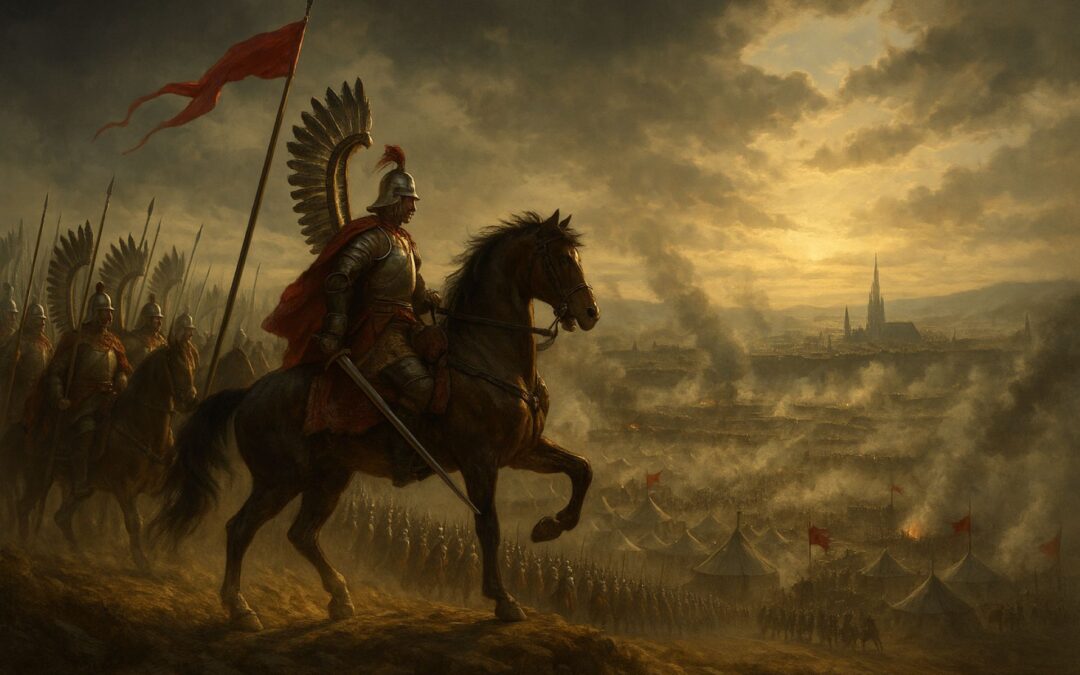
Prelude to the Siege
Europe in 1683 was a continent trembling under the weight of its own divisions. The Thirty Years’ War was a fading scar, yet its fractures still lingered — Catholics against Protestants, monarchies against one another, nations nursing grudges more bitter than reason. And amidst this chaos, one empire loomed over them all: the Ottoman Empire. For over two centuries it had advanced like a slow-moving storm, consuming the Balkans, seizing Hungary, and pushing relentlessly toward the heart of Europe.
Vienna stood in its path — proud, defiant, and utterly exposed. To the Habsburgs, it was the crown jewel of their dominion; to the Ottomans, it was the lock that barred the gates to Christendom. Every empire dreams of momentum — of that one conquest that sets history ablaze. For the Ottomans, Vienna was that dream.
When the siege began in mid-July, the city’s walls glimmered like stone sentinels against a sea of tents that covered the plains for miles. The sight was apocalyptic. Drums beat day and night in the Ottoman camp. Cannonballs crashed against Vienna’s bastions in unending rhythm, sending shards of masonry and dust raining over terrified defenders. Smoke filled the streets. The bells of St. Stephen’s Cathedral tolled not for worship but for warning.
Inside the walls, fear and hunger became the city’s twin masters. Water wells ran dry. Bread was rationed to crumbs. The stench of corpses — human and horse alike — hung in the summer air. Yet amid despair, something remarkable happened: resolve hardened. Soldiers and civilians alike dug trenches, carried powder, repaired walls. Even the city’s women took up arms or served at the ramparts.
They knew surrender meant extinction. Only weeks before, the nearby town of Perchtoldsdorf had opened its gates to the Ottomans under promise of mercy — and its people were massacred without hesitation. Vienna would not make the same mistake. Count Ernst Rüdiger von Starhemberg, the city’s commander, swore to hold the walls “until the last stone fell or the last man bled.” It was not bravado — it was the only option left between annihilation and eternity.
As the siege dragged on, it became more than a military struggle. It became a spiritual drama — the crescent moon pressing upon the cross, the East testing the mettle of the West. Across Europe, people prayed for Vienna. For its defenders, it was not merely a battle for land or sovereignty. It was a battle for civilization itself.
By early September, after two months of relentless bombardment, half of Vienna was rubble. Only a fraction of its defenders remained alive or able to fight. The Ottomans had breached the outer walls; starvation and disease stalked the rest. But even as the city’s endurance reached its breaking point, a glimmer of hope appeared beyond the hills — the faint sight of fires, lit by an approaching army. Europe, divided for centuries, was rallying for one last stand.
The moment that would decide the fate of the continent had arrived.
The Ottoman Ambition
To understand why the siege of Vienna happened, one must look backward — to 1453, when the Ottoman Empire conquered Constantinople and changed the course of history. That victory did not just topple an empire; it redefined what empire meant. When Sultan Mehmed II, known as “The Conqueror,” rode through the gates of Byzantium, he did so under a banner not of mere conquest but of succession. In his mind, the Ottomans were not destroyers of Rome — they were its heirs.
From that day forward, the empire’s sultans envisioned themselves as the rightful rulers of the civilized world. Their armies marched westward under divine sanction, seeing conquest as both a duty to God and a restoration of ancient order. By the mid-16th century, they had built a realm spanning three continents — from the deserts of Arabia to the mountains of Hungary. Their navy ruled the eastern Mediterranean; their trade routes pulsed with wealth from Asia and Africa. To their neighbors, the Ottomans were not merely powerful — they were inevitable.
But empires, like tides, rise not just by expansion but by belief. The Ottomans believed that their destiny pointed toward Europe. The Habsburgs believed that God had chosen them to stop it. Between these convictions lay the city of Vienna — both fortress and fulcrum, both symbol and obstacle.
The city’s importance was not just military but geographic. It sat at the confluence of Europe’s two great natural barriers — the Alps to the south and the Danube to the north — commanding access to the continent’s interior. From Vienna, one could march north to Bohemia, west to Bavaria, or south to Italy. It was a crossroads — whoever held it held Europe’s veins.
The Ottomans had tried once before. In 1529, Sultan Suleiman the Magnificent — the empire’s most formidable ruler — led an army of 120,000 men to Vienna’s gates. He came as the master of half the known world, but nature itself turned against him. Torrential rain flooded the plains, food spoiled, horses died, and winter arrived early. The siege failed. Suleiman withdrew, humiliated but not defeated. Vienna had survived by a thread, and Europe exhaled — yet only temporarily.
For over a century, the frontier between Christian and Ottoman lands settled uneasily across Hungary. But the empire’s hunger for expansion never truly faded. By the late 17th century, cracks were showing within Ottoman administration: power struggles at court, regional unrest, and the waning discipline of the Janissaries. Many in Constantinople saw a great conquest as the cure to the empire’s stagnation.
Enter Grand Vizier Kara Mustafa Pasha — a man of ambition equal to the empire’s myth. He was no mere soldier but a strategist, diplomat, and dreamer. To his mind, taking Vienna would immortalize him alongside Mehmed II and Suleiman. To the Sultan, it would renew Ottoman supremacy over Europe. And to both, it was destiny’s unfinished chapter.
Kara Mustafa convinced Mehmed IV that the time was ripe. The Habsburg Emperor Leopold I was distracted by religious turmoil and internal dissent. Protestant nobles in Hungary were rebelling, and France — the Habsburgs’ old rival — had promised neutrality. Europe, fractured and weary, looked weaker than it had in centuries.
So, the Grand Vizier gathered the empire’s might. From Anatolia, Syria, Egypt, and the Balkans, soldiers and supplies poured northward. Roads were cleared, bridges rebuilt, cannons forged, and thousands of camels laden with provisions. By spring 1683, the Ottoman war machine was ready — a juggernaut of faith and fury, marching toward what Kara Mustafa called “the key to all Europe.”
Vienna would soon learn what it meant to stand between ambition and empire.
The March to Vienna
The march began in the chill of early spring, 1683. From Edirne — the empire’s old capital near the Balkans — the Ottoman army rolled forward like an unstoppable tide. Behind it trailed a moving city: soldiers, engineers, cooks, camel drivers, armorers, imams, and merchants. Historians estimate its size at between 150,000 and 200,000 men, though some contemporaries claimed even more. It was the largest field army Europe had seen in living memory.
Grand Vizier Kara Mustafa Pasha rode at its head, a figure of austere elegance and unyielding pride. His command tent was a palace of silk and gold, complete with marble floors, fountains, and servants. To his men, he was the embodiment of the empire — calm, calculating, divinely chosen. Yet beneath that composure, Kara Mustafa carried a dangerous conviction: that destiny alone would deliver victory.
The army moved methodically through the Balkans, crossing rivers and valleys that had swallowed invaders for centuries. Roads were rebuilt; bridges repaired; depots stocked. The logistical precision was astonishing. Everywhere it went, the Ottoman host devoured the land — consuming crops, emptying villages, stripping forests for firewood. Local lords bowed or burned. By the time the army reached Belgrade, word of its coming had raced ahead into Europe like a rumor of apocalypse.
From there, the march split into divisions, converging again in Upper Hungary. Ottoman banners fluttered beside those of vassal states: Wallachia, Moldavia, Transylvania. The Crimean Tatars, led by their khan, brought tens of thousands of light cavalry — swift, merciless raiders who scouted, plundered, and terrorized. No European force dared challenge them in open battle.
Meanwhile, within the Habsburg lands, panic spread faster than the advancing army. Villages emptied, peasants fled into the woods, and rumors filled the void. Emperor Leopold I, beset by indecision, waited too long to mobilize. When it became clear that Vienna was the target, he fled with his court and archives, abandoning the capital on July 7. His retreat, though strategic, felt like betrayal. As he rode west toward safety, the city’s fate was sealed.
Vienna itself transformed overnight. Half its population — nearly sixty thousand souls — poured out of its gates in chaotic flight. Only the stubborn and the brave remained. The walls were patched, the moats cleared, and gunpowder stockpiled. Count Ernst Rüdiger von Starhemberg, the city’s military governor, assumed command. A hard man forged in wars against the Turks, Starhemberg inspired both fear and faith.
He commanded barely 15,000 defenders, including regular troops, local militia, and citizen volunteers. They faced an army more than ten times their size. Yet in their desperation, they found unity. “We will not surrender,” Starhemberg declared. “We will outlast the night.”
On July 14, the Ottoman host appeared on the horizon — a moving sea of banners and tents stretching across the plains. The city’s defenders watched from the ramparts as the crescent banners of the empire encircled them. The drums began to pound. The Siege of Vienna had begun.
The Siege Itself
What followed was a masterpiece of endurance — and a nightmare of attrition. The Ottomans approached the siege with chilling efficiency. Kara Mustafa ordered the city surrounded on all sides, cutting off supplies and communication. His camp became a city unto itself: marketplaces, forges, stables, and hospitals sprawling outward in geometric precision. At its center rose the vizier’s pavilion — grander than any palace in Vienna, an affront meant to intimidate.
The bombardment began within days. Over a hundred Ottoman cannons unleashed a relentless barrage that lasted from dawn until nightfall. The sound never ceased; even in sleep, the defenders dreamed of explosions. The city walls shook, splintered, and smoked, but they held. Vienna’s bastions were thick and well-built, remnants of Italian Renaissance fortifications designed precisely for such sieges.
When brute force failed, the Ottomans turned to science — or rather, to the dark art of undermining. Teams of sappers began tunneling under the walls, propping their shafts with timber and stuffing them with gunpowder. When detonated, these mines could obliterate entire bastions in seconds. The defenders countered by digging countermines — narrow tunnels branching into the earth, where they listened for the faint scrape of Ottoman picks. Sometimes they met underground, and savage fights erupted in the darkness: men choking on smoke and soil, stabbing blindly by candlelight.
Above ground, the siege was no less brutal. The heat of July gave way to the sweltering August sun. Corpses rotted in the streets; disease flourished. Starhemberg rationed food and water, but hunger gnawed at soldiers and civilians alike. Bread turned to dust; meat to memory. Rats became currency. Every morning, more bodies were carried to the makeshift cemeteries outside the churches — if the living had strength enough to bury them.
The Ottomans pressed on, confident that time would finish what their cannons could not. Kara Mustafa refused to risk a direct assault, believing attrition would yield a cleaner victory — one that preserved the city’s wealth for plunder and his own reputation for glory. It was a fatal miscalculation.
Inside Vienna, resolve only deepened. Priests walked the ramparts carrying relics; women mixed powder and patched uniforms; children carried water to the gunners. The city had become a fortress of faith and fury. “We fight not for survival,” Starhemberg reminded them, “but for the soul of Europe.”
As August bled into September, the siege reached its breaking point. Ammunition ran low, the walls were crumbling, and only a few thousand defenders remained fit to fight. Yet every dawn, the Habsburg banners still flew. Kara Mustafa prepared one final assault, confident the city would fall within days.
But fate was already turning against him. To the west, beyond the Danube and the wooded ridges, the horizon flickered with movement — the signal fires of an approaching army. A coalition had formed, led by men the Ottomans did not yet fear but soon would. The relief of Vienna was coming, and the world was about to witness the charge that would change history forever.
Europe’s Desperate Coalition
While Vienna burned beneath Ottoman cannon fire, a different kind of battle was unfolding across the continent — one of diplomacy, faith, and urgency. Pope Innocent XI, an austere man of deep conviction, had long warned that Christendom’s divisions would invite its destruction. France and the Habsburgs had spent generations undermining each other, Protestant and Catholic princes distrusted one another, and Poland — the only kingdom capable of immediate intervention — was itself weary from war. Yet now, with Vienna under siege and Europe trembling, the impossible began to happen: unity.
The Pope moved first. He opened the Church’s treasury, offering subsidies to any state willing to send men. He wrote letters to princes, monarchs, and bishops, invoking not politics but destiny — a call to defend civilization itself. “If Vienna falls,” he wrote, “there will be no more walls left between them and Rome.” Slowly, the message spread beyond religious boundaries. Even Protestant German princes, wary of Catholic ambition, recognized the existential threat.
But the true center of salvation lay to the northeast, in Poland. There, King John III Sobieski — scholar, soldier, and strategist — ruled a nation torn by internal strife but bound by fierce pride. He was no stranger to war. Years earlier, he had crushed the Ottoman army at the Battle of Khotyn, earning the respect of friend and foe alike. When word of Vienna’s plight reached him, he hesitated only long enough to secure the approval of his nobles and the Church. “I go,” he said, “not to save a city, but to save Christendom.”
Sobieski’s decision electrified Europe. The Polish Commonwealth agreed to march. Alongside his famed Winged Hussars, Sobieski mobilized tens of thousands of soldiers — infantry, cavalry, artillery, and engineers. Their discipline was as legendary as their speed; in less than a month, they traversed the Carpathians and advanced toward Austrian lands.
Meanwhile, Emperor Leopold I and Duke Charles of Lorraine rallied what remained of the Imperial forces. Bavaria, Saxony, and Franconia sent their contingents. Even small German states contributed men and arms. By early September, this unlikely coalition — Poles, Austrians, Germans, and volunteers from as far as Croatia and Ukraine — had assembled north of the Danube. They numbered around 80,000 men in total.
The crossing of the Danube was an act of coordination as daring as it was symbolic. Using pontoon bridges, the coalition moved its army across the wide river in disciplined silence. To the weary defenders of Vienna, the appearance of distant campfires on the hills above the city was almost mythic — proof that hope, long dead, had returned. Priests rang the cathedral bells. Civilians wept openly in the streets. After two months of darkness, the defenders finally saw light.
On the night of September 11, Sobieski and Charles of Lorraine met to finalize their plan. They agreed to attack at dawn, striking the Ottomans from the west while Vienna’s garrison attacked from within. The strategy was daring but simple: use terrain, speed, and shock to overwhelm a vastly superior force. Sobieski, whose understanding of cavalry tactics bordered on genius, would hold the right wing — the Polish flank — where the decisive blow would be struck.
As the commanders parted, torches flickered in the cold night air. Vienna slept fitfully below them; the Ottoman drums still pounded. But on the ridges above the Danube, a new rhythm had begun — the gathering heartbeat of an army about to change history.
The Battle of Vienna
Dawn broke on September 12, 1683, with the sound of distant gunfire echoing through the hills. The air was thick with dust and smoke; the sun rose blood-red over the plains. The Ottomans, caught between arrogance and disbelief, scrambled to reposition. Kara Mustafa, convinced that Vienna was days away from surrender, had left much of his army in the siege trenches. Only 20,000–30,000 troops were redeployed to face the oncoming enemy. It was his gravest mistake.
The coalition army unfurled across the high ground in a great arc. On the left flank stood Duke Charles of Lorraine with the Imperial Austrian forces, closest to the Danube. In the center were the contingents of Bavaria, Saxony, and Franconia — disciplined, steady, and grim. On the right, King Sobieski commanded his Polish troops, including the most feared cavalry in Europe: the Winged Hussars. The plan was elegant — the left and center would engage and pin down the Ottoman lines while Sobieski’s cavalry, delayed by rough terrain, maneuvered for the final, crushing descent.
At 4 a.m., the battle began. Ottoman skirmishers charged uphill, their war cries slicing through the morning air. Cannon fire thundered from both sides. For hours, the hills trembled under the weight of combat. The Austrians fought fiercely to hold their positions, storming villages fortified by the Turks — Nussdorf, Heiligenstadt, and Oberdobling — in a relentless advance. Every house became a fortress; every orchard, a battlefield.
By noon, the coalition had seized most of the ridge. The Ottomans counterattacked with waves of sipahi cavalry and Tatar horsemen, their curved sabers glinting in the sunlight. The clash was ferocious but costly. The Janissaries, the empire’s elite infantry, fought with their usual discipline, but the weight of numbers began to tell. Slowly, methodically, the coalition pressed forward.
Inside Vienna, the defenders watched from the ramparts, their hearts pounding. They could hear the distant roar of battle, see the smoke rising from the hills. When a volley of Polish cannon sounded from the west, the city erupted in cheers. Starhemberg knew the moment had come — the relief army had arrived.
By mid-afternoon, Kara Mustafa’s situation was deteriorating. His lines were stretched thin, his reserves scattered. The trenches that had once besieged Vienna now became traps for his own troops. Yet pride forbade retreat. He ordered his Janissaries to launch one final assault on the city walls, hoping to seize Vienna before the coalition could break through. It was a gamble born of desperation.
But fate no longer favored him. The mine laid beneath the city’s bastion — his final weapon — was discovered and defused by the Viennese sappers. The last hope of a breakthrough vanished. At the same time, on the hills to the west, Sobieski was ready.
The Polish king surveyed the battlefield from a ridge near the village of Kahlenberg. Before him stretched the disordered Ottoman camp — a sprawl of tents, wagons, and artillery. Turning to his men, he raised his sword high. “The time has come,” he said. “Forward, and let your courage be your faith.”
Then, in one of the most breathtaking moments in military history, 18,000 cavalry surged forward — the largest mounted charge ever recorded. The earth shook as they descended the slopes in four massive waves. At their head rode 3,000 Winged Hussars, their armor gleaming, their feathered wings whistling in the wind like the sound of judgment.
They struck the Ottoman flank with unstoppable force. The first line of defenders shattered instantly; the second collapsed moments later. Panic spread through the Ottoman ranks. Soldiers threw down their weapons and fled. The coalition infantry followed in pursuit, storming the Ottoman redoubts and tearing down banners as they went.
From within Vienna, the garrison burst through the gates, joining the fray. Starhemberg’s exhausted troops, driven by fury and faith, attacked the enemy trenches from behind. The Ottoman army crumbled under pressure from every side.
By 6 p.m., the battle was over. Kara Mustafa’s once-mighty army — the pride of an empire — had been annihilated. His tent, the symbol of Ottoman power, lay in ruins. Sobieski rode into the camp as the sun set over Vienna, its light breaking through smoke and dust like divine approval.
He dismounted, surveyed the wreckage, and ordered a message sent to Pope Innocent XI: “Venimus, vidimus, Deus vicit.”
We came, we saw — God conquered.
The Fall of Kara Mustafa Pasha
As darkness fell on September 12, 1683, the plains outside Vienna resembled a vision of apocalypse. Fires burned through the Ottoman camp; smoke twisted skyward like dark banners of defeat. What had once been the greatest army in the world now lay in ruin. Tents were ripped apart, artillery overturned, corpses scattered across the fields. Horses, camels, and men alike lay dead in tangled masses — victims of the day’s fury.
The victors could scarcely comprehend the scale of what they had achieved. For months, they had fought a ghostly, almost mythical power — the seemingly invincible Ottoman Empire — and now its might was broken at their feet. Allied soldiers poured into the abandoned camp, awestruck. There they found luxuries that defied imagination: silken tents embroidered with gold, Persian carpets, jeweled goblets, spices, perfumes, fountains, and food stores fit for kings. In the center stood the fallen pavilion of the Grand Vizier himself — larger than any cathedral in Vienna, its canopy embroidered with Qur’anic verses and its floors lined with velvet.
Sobieski entered it in silence, followed by his officers. He looked upon the wreckage not with triumph but with solemn wonder. On a table lay Kara Mustafa’s sword and seal — symbols of power now rendered meaningless. The king ordered a prayer of thanksgiving, then sent word to Pope Innocent XI: Venimus, vidimus, Deus vicit. “We came, we saw, God conquered.” It was more than victory — it was vindication, a belief that faith and courage had turned the tide of history.
Meanwhile, the defeated Ottomans fled southward in disarray. Panic tore through their ranks as the coalition pursued them through the night. Entire divisions dissolved; supply trains were abandoned. The retreat was so chaotic that the Ottomans lost nearly all their artillery, munitions, and treasury. Only fragments of the army reached safety across the Hungarian frontier.
At the center of this disaster rode Kara Mustafa Pasha — once the empire’s most powerful man, now a fugitive wrapped in humiliation. His dream of becoming the conqueror of Europe had ended in catastrophe. He returned to Belgrade not as a hero but as a condemned man, aware that failure on this scale could mean only one thing. The Ottoman court demanded answers, and the Sultan — Mehmed IV — demanded his head.
For weeks, rumors swirled through the empire: that Kara Mustafa blamed his subordinates, that he hoped to rally a new army, that he might even appeal directly to the Sultan for mercy. None of it mattered. On December 25, 1683, imperial envoys arrived at his tent bearing the traditional token of death — a length of silken cord.
Kara Mustafa received the order calmly. He asked for a moment of prayer, then knelt and wrapped the cord around his own neck as two executioners pulled it tight. It was a quiet, almost ceremonial death — the Ottoman custom reserved for nobles and high officials, a mark of dignity in disgrace. The man who had commanded an empire’s destiny died not on the battlefield, but in silence, strangled by the same silk that had once adorned his triumphal pavilion.
His body was buried in Belgrade; his head, embalmed in honey, was sent to Constantinople as proof of justice served. Thus ended the life of the man who nearly changed the fate of Europe.
Legacy: The Turning of the Tide
The victory at Vienna did more than end a siege — it ended an era. For over two centuries, the Ottoman Empire had embodied the relentless advance of the East, its armies pressing deeper into Europe year after year. But after 1683, that advance stopped forever. The defeat shattered the myth of Ottoman invincibility and set in motion the empire’s long, irreversible decline.
In the months that followed, Vienna rose from its ruins, battered but unbowed. Churches rang bells across the continent; poets compared the victory to the triumphs of ancient Rome. Pope Innocent XI declared it a miracle of divine intervention, canonizing it as the day Christendom had been saved. Yet the reality was more human — a coalition of flawed men, divided by language and loyalty, who came together in a single moment of clarity.
The battle’s consequences rippled far beyond Austria’s borders. In 1684, inspired by the success at Vienna, the Pope formed the Holy League — an alliance that would unite Christian powers against the Ottoman Empire in a new, coordinated campaign. Austria, Poland, Venice, and later Russia joined forces to push the Ottomans back from Europe’s doorstep. Over the next two decades, major Ottoman strongholds fell one by one: Buda, Belgrade, and eventually large swaths of Hungary and the Balkans.
For the Habsburgs, the victory transformed their destiny. Once a fractured dynasty on the defensive, they now emerged as the dominant power in Central Europe. The empire’s borders expanded, its prestige restored. Vienna, the city that had nearly perished, became the capital of a new age — a flourishing center of art, architecture, and enlightenment thought.
For Poland, the battle marked its final moment of glory. Sobieski was hailed across Europe as the “Savior of Christendom,” but his triumph did little to halt his country’s slow decline. Within a century, the Polish–Lithuanian Commonwealth would vanish from the map entirely. Still, the image of Sobieski leading the Winged Hussars down the slopes of Kahlenberg became legend — a symbol of courage in the face of overwhelming odds.
For the Ottoman Empire, the defeat was a wound from which it would never recover. Though it remained a vast power for centuries to come, the balance had shifted. No longer the aggressor, the empire found itself fighting to hold what it already possessed. The failed siege of Vienna marked the end of Ottoman expansion — and the beginning of European ascendancy.
In the collective memory of Europe, September 12, 1683 became more than a date. It became a turning point — the day the flood receded, the day civilization reclaimed its breath. When the thunder of hooves finally faded and the smoke cleared over Vienna, two truths remained: that courage had saved a continent, and that ambition — unchecked and overconfident — had destroyed an empire.
The siege had begun as an Ottoman dream of conquest. It ended as Europe’s reminder that even the mightiest power can fall before the will of those who refuse to surrender.