
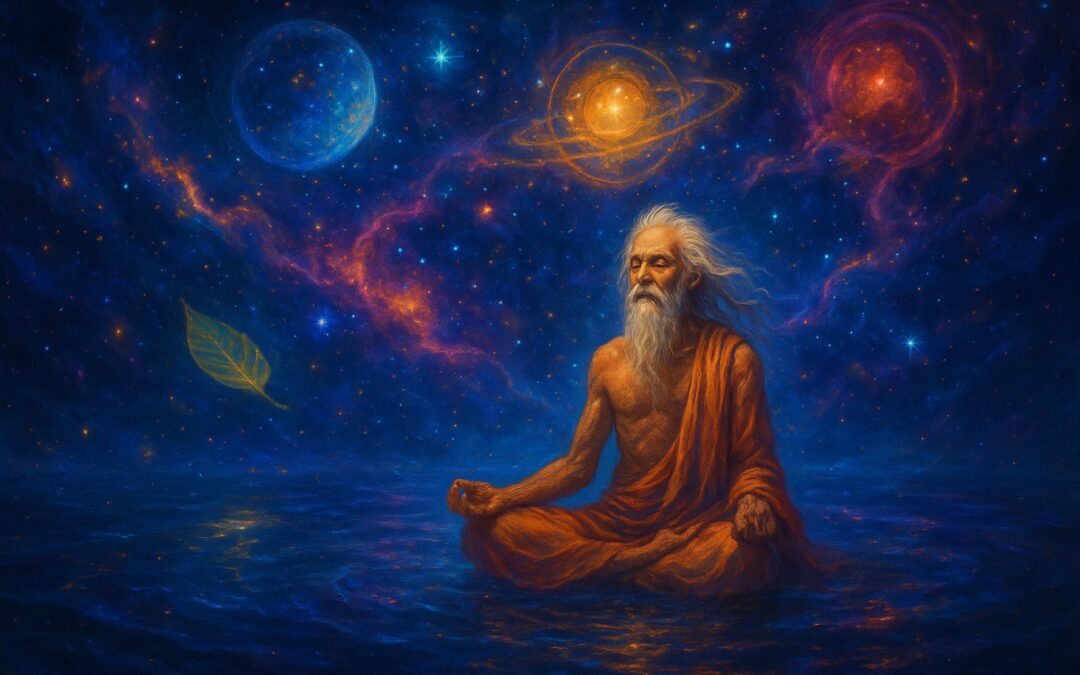
The concept of time is often understood as an unbroken flow, a river that perpetually moves forward. Yet, what if there were individuals capable of transcending this current? What if there were beings who could witness the beginning and end of entire universes, stepping outside time itself?
This intriguing notion is not confined to speculative fiction but is a recurring theme in ancient Hindu texts. These texts recount the extraordinary experiences of sages who ventured into realms beyond the limits of time, defying the very nature of reality as we know it.
One such sage, Markandeya, found himself drifting in an infinite cosmic ocean, witnessing the cyclical process of creation and destruction of universes multiple times over. These stories offer us a glimpse into a profound and ancient understanding of time, one that modern science is only beginning to grasp.
The Cosmic Vision of Markandeya: Beyond Time’s Grasp
In Hindu cosmology, time is not a straightforward, linear progression but a cyclical process that stretches across vast epochs. This cyclical nature is embedded deeply in the ancient texts, which describe entire universes being born, existing, and then collapsing into oblivion—only to be reborn again in an endless loop. This grand cosmic view of time stands in stark contrast to the way we experience time in our everyday lives, where past, present, and future seem to flow in a straight line. The story of Markandeya, a sage granted eternal youth, offers us an extraordinary window into this expansive understanding of time.
Markandeya’s experience takes place in the space between cycles of creation, a void that is often referred to as the “Cosmic Ocean” in Hindu scriptures. When the universe undergoes a dissolution—known as Pralaya—the world, along with all its material forms, dissolves into an endless dark expanse. Here, in this primordial sea, all that remains is a vast ocean stretching infinitely in every direction, devoid of any matter or structure. Markandeya, suspended in this void, witnesses a profound and timeless event: the complete destruction of the cosmos.
What makes Markandeya’s journey remarkable is not just his witness to destruction but his ability to observe the process of creation and destruction across multiple cycles of the universe. The sage’s experience is not bound by any particular timeframe, and he witnesses not just a singular event but the repetitive cycles of cosmic creation and destruction unfolding in an eternal loop. This view shatters our traditional understanding of time as a one-way street and suggests that time may instead be cyclical—endlessly repeating, where destruction is but a precursor to new creation.
But Markandeya’s journey transcends even the cyclical nature of the universe. Amidst the dissolution of all things, he discovers something extraordinary. Floating in the infinite ocean, he observes a small child resting on a banyan leaf, untouched by the destruction around him. This child is Lord Vishnu, the preserver of the universe, who exists in a state of timelessness, untouched by the annihilation of the cosmos. The banyan leaf upon which Vishnu rests symbolizes the link between creation and dissolution, an enduring symbol of divine preservation.
In a cosmic moment that can hardly be fathomed by the human mind, Markandeya is drawn into Vishnu’s divine form. As he enters Vishnu’s body, he is granted an all-encompassing perspective on existence. Inside Vishnu, Markandeya witnesses countless universes existing simultaneously, each with its own beings, timelines, and realities. He sees that the destruction of one universe does not mark the end of all things but is part of a larger, infinite cycle of creation and dissolution. In Vishnu’s divine form, time becomes irrelevant; it is as if past, present, and future exist all at once.
This experience asks us to reconsider our narrow understanding of time. Could time truly be an illusion, a subjective experience shaped by our human consciousness? If Markandeya, through divine intervention, was able to witness multiple universes and timelines simultaneously, might we too be capable of understanding time in a more expansive way? Perhaps, like Markandeya, we can transcend the limitations imposed by our own perceptions and explore a reality where time is not an unyielding force but a fluid, expansive concept.
Markandeya’s story challenges the very core of our beliefs about time. It suggests that the boundaries of time are far more malleable than we typically assume. Could it be that our experience of time is a limited, human-made construct, and that by expanding our consciousness, we too might witness the timeless nature of the universe?
The Time-Bending Wanderer: Devarshi Narad’s Divine Journey
While Markandeya’s cosmic journey allows him to transcend time entirely, the story of Devarshi Narad offers a different perspective on the relativity of time—a perspective grounded in the very fabric of reality itself. Devarshi Narad, unlike Markandeya, is not an observer from beyond the universe. He is a cosmic wanderer who moves through time and space within the universe, experiencing time in a way that transcends the human experience but is still firmly rooted in the cycles of existence.
Devarshi Narad’s story, as told in the Bhagavat Purana, introduces us to the concept of time as a relative and fluid phenomenon, subject to the conditions of the realms one inhabits. His journey begins when he enters the divine realm of Vishnu, known as Vaikuntha. This realm is depicted as a timeless, perfect space, untouched by the decay and destruction of the material world. In Vaikuntha, Devarshi Narad encounters a palace, the grandeur of which mirrors the divine nature of the realm itself. Here, he meets a beautiful woman, and his divine purpose seems momentarily forgotten.
For the first time, Devarshi Narad embraces the mortal experience, living as a human within this divine realm. He lives an entire human life, experiencing the pleasures and pains that come with it—love, loss, joy, and sorrow. The paradox here is profound: Devarshi Narad, a being of divine origin, willingly submerges himself into the impermanent, fleeting nature of human life. He embraces a world governed by time—a world that is bound by birth, growth, aging, and death.
However, the true revelation comes when Devarshi Narad’s human life reaches its natural conclusion. Having experienced what felt like decades of mortal existence, Devarshi Narad suddenly awakens back in Vaikuntha, only to realize that no time has passed at all. The years he spent living a human life, with all its trials and tribulations, were but moments in the timeless divine realm. This realization shakes the very foundation of his understanding of reality. The life he lived, the time he spent, was illusory—a relative experience shaped by his perception.
This episode challenges the conventional view of time as an unchanging, absolute entity. In the divine realm of Vaikuntha, time does not flow as it does on Earth. What seemed like decades to Devarshi Narad was, in fact, just moments in the divine realm, where time is not measured by clocks or calendars but by a higher, divine standard. This story suggests that time is not uniform across all planes of existence. What is experienced as time on Earth, with all its constraints, is merely one version of reality, bound by the limitations of human perception.
Devarshi Narad’s journey offers us a powerful metaphor for the relativity of time. His experience aligns closely with the principles of Einstein’s theory of relativity, which states that time is not absolute but depends on one’s position and speed in relation to other objects. In the divine realm, time is stretched or contracted depending on the observer’s perspective. For Devarshi Narad, this divine perspective revealed that the time he experienced was not a constant but something malleable, shaped by the realm he occupied.
What Devarshi Narad’s story ultimately reveals is that time is not a universal truth, but a construct that varies depending on the nature of existence. His divine experience suggests that our perception of time is limited by our human consciousness, which is bound by the rhythms of the physical world. In higher realms of consciousness or divine planes of existence, time operates on a different scale—one that is not dictated by the mortal understanding of cause and effect but by the eternal flow of divine presence.
This story, like Markandeya’s, invites us to expand our understanding of time and its relationship to consciousness. If time is relative and subject to our perception, then perhaps the way we experience it is only one interpretation of a much larger, more complex truth. Devarshi Narad’s awakening offers us the opportunity to reflect on how our experience of time shapes our lives and how, through expanding our consciousness, we might come to understand time in its fullest, most fluid form.
Time as an Illusion: The Essence of Maya
The concept of time as an illusion lies at the heart of Hindu philosophy, particularly in the concept of Maya. In Sanskrit, Maya refers to the illusory nature of the material world—where what we perceive as real is, in essence, a distorted reflection of the ultimate truth. This illusion extends to time itself. Time, as we commonly understand it, is not seen as an immutable, absolute force in Hindu thought, but as a subjective, mental construct that arises from our limited human perspective.
At its core, Maya suggests that our perception of time—our experience of the past, present, and future—is not an accurate reflection of the true nature of the universe. Instead, it is a product of our minds, shaped by our sensory experiences and the structure of the material world. Time, from this vantage point, becomes a filter through which we view reality, but not the reality itself. Just as a mirage appears to be water but is actually an illusion created by the distortion of light, our understanding of time is a mirage, shaped by the limitations of human consciousness.
The idea that time is an illusion challenges the very nature of our existence. From the moment we are born, we are conditioned to think in terms of past, present, and future. We are taught to structure our lives around this progression, measuring time in days, months, and years. But Hindu philosophy asks us to step back and question this framework. Is time as we experience it a true reflection of reality? Or is it a mere construct of the mind, a convenient way to make sense of our experiences within the confines of the material world?
This understanding is beautifully exemplified in the stories of the sages, such as Markandeya and Devarshi Narad, who transcend this illusion. For Markandeya, time becomes irrelevant as he witnesses the simultaneous unfolding of multiple universes, all existing in a state of eternal flux. For Devarshi Narad, his experience of living an entire human lifetime in what felt like a few moments reveals the subjective nature of time. Both sages, through their heightened states of consciousness, move beyond the constraints of temporal existence and witness a deeper, more expansive reality.
This idea of time as an illusion mirrors modern scientific understandings of the nature of reality, particularly in the field of quantum mechanics. Quantum physics tells us that at the subatomic level, particles do not follow the traditional rules of time and space. They exist in a state of superposition, where they can be in multiple places at once, and their behavior is influenced by the observer. Just as the sages’ experiences of time transcend the linear model of past, present, and future, quantum physics reveals that time, at its most fundamental level, is not the absolute, unyielding force we perceive it to be.
In this light, the ancient teachings of Hinduism offer us a glimpse into a deeper, more profound truth about time. They challenge us to view time not as a linear progression but as a flexible, relative concept—one that can be transcended when we shift our consciousness. If time is indeed an illusion, then perhaps our human experience is also a limited interpretation of a much grander, more interconnected reality.
The sages, through their spiritual practices, achieved states of heightened awareness that allowed them to experience this deeper reality, one where time was not an obstacle but a mere layer of existence to be transcended. This transcendence of time leads to an awakening—a realization that time, in its traditional form, is a construct of the mind. And by expanding our consciousness, we too might be able to access the timeless, eternal nature of the universe, where the boundaries of past, present, and future dissolve, and we are able to experience the full, unbroken continuum of existence.
The Sages as Cosmic Travelers: A New Perspective on Reality
The stories of Markandeya, Devarshi Narad, and other sages in Hindu texts offer more than just mystical tales. They present a profound view of reality, one that challenges our conventional understanding of time, space, and consciousness. These sages, through their unique spiritual practices and intense states of awareness, transcend the limitations of the material world and enter realms where the usual constraints of time and space do not apply. Their journeys invite us to question our own perception of reality and consider the possibility that the universe is not a static, rigid entity but a dynamic, interconnected web of possibilities.
One of the most striking aspects of the sages’ journeys is the way in which they experience time. Time, as we know it, is often seen as a linear, unidirectional force that moves forward, from past to present to future. This view of time is so ingrained in our consciousness that it can be difficult to imagine any other way of experiencing it. However, the sages show us that time is not fixed. For Markandeya, time ceases to be relevant as he witnesses the simultaneous unfolding of entire universes, each with its own timeline. This vision suggests that time, as we experience it, is only one of many possible ways in which reality can unfold.
Similarly, Devarshi Narad’s experience of living a full human life in what felt like mere moments challenges the notion that time is constant. In the divine realm of Vishnu, time operates on an entirely different scale, where what feels like decades to a mortal can be experienced as mere moments in the divine realm. This suggests that time is not an objective reality but a relative experience, shaped by the consciousness of the observer and the realm in which they exist. The experience of time, then, becomes fluid, flexible, and subjective—an ever-changing force that is not bound by the laws of physics or the limitations of human perception.
These stories lead us to consider a new perspective on reality itself. If time is not fixed and absolute, then what else about our perception of the universe might be subjective? Could our understanding of space, matter, and consciousness also be limited by our human senses? The sages’ ability to transcend time and space raises the possibility that our everyday experience of reality is just one interpretation of a much more expansive truth. They offer a view of the universe where all things are interconnected, where time is not a linear progression but a web of possibilities that exist simultaneously.
The idea that consciousness plays a central role in shaping our experience of reality is not unique to Hindu philosophy. Modern science, particularly in the fields of quantum mechanics and cosmology, is beginning to explore similar concepts. Quantum physics suggests that consciousness is deeply intertwined with the nature of reality, influencing how we observe and experience the world around us. In the quantum realm, particles exist in a state of superposition, where they can be in multiple places at once, and their behavior changes depending on the observer. This suggests that reality is not a fixed, objective entity but something that is shaped by our consciousness and perspective.
The sages’ experiences, then, offer a bridge between ancient wisdom and modern scientific discoveries. They suggest that our perception of reality is not fixed, but malleable and subjective. By expanding our consciousness, we may be able to access a deeper understanding of the universe—one where time, space, and matter are not separate entities but part of a larger, interconnected whole. The sages’ journeys challenge us to think beyond the limits of our perception and consider the possibility that there is much more to reality than meets the eye.
Ultimately, the teachings of the sages offer a new way of viewing the universe—not as a collection of isolated events unfolding in a linear fashion, but as a dynamic, interconnected web of possibilities, where time and space are not rigid constraints but fluid, relative experiences. By embracing this expanded view of reality, we can begin to explore the deeper truths that lie beyond our limited understanding of the world. In doing so, we may come closer to understanding the true nature of existence and our place within it.
Conclusion
The stories of the ancient Hindu sages, like Markandeya and Devarshi Narad, offer us profound insights into the nature of time, consciousness, and reality itself. Through their mystical journeys, these sages transcend the ordinary boundaries of time and space, revealing a universe far more complex and fluid than our conventional understanding allows. Their experiences suggest that time, as we perceive it, is not absolute but a relative construct shaped by our consciousness and the realms in which we exist.
These ancient teachings challenge us to rethink our perception of reality. They propose that time is not a linear, unyielding force but a dynamic, ever-changing experience that can be transcended through heightened states of awareness. As modern science begins to echo these ancient insights, particularly through the lens of quantum physics and relativity, we are reminded that the boundaries of human perception are not the ultimate limits of existence.
Perhaps, as the sages discovered, the greatest journey through time is not one of physical travel, but a journey of consciousness—a journey that allows us to experience the universe in its entirety, unbound by the constraints of time and space. As we look to the ancient wisdom contained in these texts, we are invited to expand our consciousness, step beyond our limited perceptions, and explore a deeper, more interconnected reality. In the end, it is through this awakening that we may come to understand not just the nature of time, but the very fabric of existence itself.