
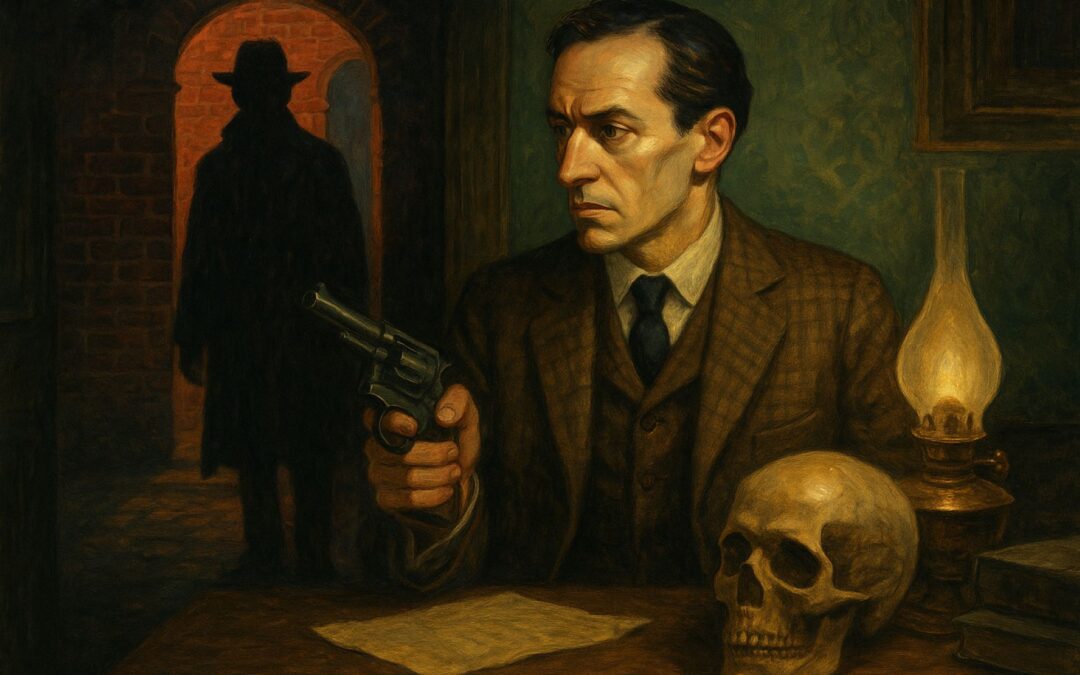
Few detective tales blend gothic suspense with transatlantic intrigue as seamlessly as The Valley of Fear. Written in 1915, this final full-length Sherlock Holmes novel plunges readers into a world where murder is not merely a crime of the moment but the culmination of decades-old vendettas. What begins with a ciphered note in Baker Street quickly unfurls into a saga that stretches from an English country manor to the coal-stained valleys of Pennsylvania, where secret societies thrived on terror. At its heart, the novel is less about solving a puzzle and more about confronting the long shadows cast by vengeance, fear, and the inescapable weight of history.

A Final Outing for Holmes
When The Valley of Fear appeared in 1915, it carried with it the weight of finality—this would be the last of Arthur Conan Doyle’s full-length novels starring Sherlock Holmes. Unlike the brisk short stories that filled the Strand Magazine, the novel offered Doyle room to weave a sprawling canvas, stretching from the hushed interiors of English country manors to the brutal landscapes of America’s coal-mining valleys.
In form, it is two novels grafted together: the first, a classic Holmesian puzzle of a locked-room murder; the second, a hard-edged chronicle of secret brotherhoods, treachery, and vengeance in the New World. The contrast is striking—polished drawing rooms and clipped speech in one half, violent fraternity and rough dialect in the other—yet the binding thread is fear, a force that knows no borders. The book reminds us that Holmes’s world, often thought of as cloistered and contained, is in fact porous, touched by transatlantic violence and shadowed by conspiracies larger than any one man can comprehend.
The novel also arrives at a peculiar cultural moment. Doyle was already weary of his most famous creation, and the fires of the Great War consumed Europe. Against this backdrop, the story feels less like a tidy entertainment and more like a meditation on the inescapability of the past. By choosing to center the narrative around vengeance that crosses oceans and decades, Doyle elevates Holmes’s adventure into something mythic—a tale of how no man, however clever, can wholly disentangle himself from the consequences of earlier battles.
A Ciphered Warning
The serenity of Baker Street mornings—teacups steaming, newspapers folded, the quiet ritual of Holmes’s pipe smoke—is disrupted by the arrival of a message unlike any other. It is not merely cryptic; it is literally enciphered, a jigsaw of symbols sent by a shadowy correspondent named Porlock. Porlock is no ally in the traditional sense. He is a reluctant Judas within Professor Moriarty’s criminal empire, a man compelled by conscience to betray fragments of the truth, yet too terrified to commit fully to treachery. His note dangles before Holmes like bait, offering knowledge of some dark scheme yet denying access without the missing key.
Before Holmes and Watson can press further, another letter arrives, this time in plain words, drenched in urgency. It implores Holmes to destroy the cipher, to abandon the matter, to recognize that the peril is too vast even for his intellect. Here lies the paradox of Porlock: he feeds Holmes the spark of danger and then begs him not to ignite it. For an ordinary man, such a warning might suffice. For Holmes, it has the opposite effect. The very fact that the message is linked, however obliquely, to Moriarty transforms it from curiosity into obsession. The professor’s shadow haunts every corner of Holmes’s imagination; any thread tied to that web demands pursuit.
The cipher, therefore, is not simply a puzzle to be solved. It is a declaration of war written in code, a whisper from the enemy camp that somewhere beyond the safe walls of Baker Street, blood is already spilling. What begins as ink on a slip of paper soon unfurls into a full-blooded crime that will carry Holmes and Watson far from London’s familiar fog into the darker valleys of fear itself.
Murder at Burlstone Manor
The journey from Baker Street to Burlstone Manor marks a shift from intellectual curiosity to visceral confrontation with crime. Inspector Alec Macdonald ushers Holmes and Watson into a case already steeped in dread: John Douglas, master of Burlstone, lies slain in his own chamber. The manor itself amplifies the eeriness. Surrounded by a stagnant moat and guarded by a drawbridge, it is less a home than a fortress, as though Douglas had always expected enemies to come knocking. Inside, the crime scene offers details that at first seem contradictory but, to Holmes, are a symphony of hidden meaning.
Douglas has been killed with a shotgun blast at such close range that his features are rendered unrecognizable—a grotesque obliteration that denies even the dignity of identification. Near his body lies a card marked with the cryptic inscription “VV341.” To the unimaginative eye, it looks like a clue too deliberate, perhaps even planted. The window of the chamber hangs open, yet the raised drawbridge outside would have made escape impossible, turning the room into a sealed chamber of violence. Each of these anomalies—obliteration of the face, planted card, window ajar—are brushstrokes in a painting of deliberate misdirection.
Cecil Barker, the victim’s close friend, insists he discovered the body, yet his account carries an undertone of rehearsed calm, as though he knows more than he confesses. The housekeeper, visibly shaken, reveals that Douglas had long lived with a sense of foreboding, warning her never to let down her guard. This was not a man surprised by death but one who had braced for it daily. For Holmes, the manor becomes less a crime scene than a theater where the last act of a tragedy has been performed—but the script itself remains to be deciphered.
The Shrouded Past of John Douglas
As Holmes pries deeper, the seemingly respectable John Douglas unravels into a man cloaked in secrecy. To his English neighbors, Douglas was genial, wealthy, and generous—a landed gentleman who had purchased his manor and settled into country life. Yet even in their fond recollections lurked oddities: his tendency to avoid crowded places, his habit of scanning faces in a room, and his palpable unease whenever strangers arrived in the village. His wife mirrored these anxieties, her nerves fraying whenever he traveled. Their life together resembled not the tranquility of the English gentry but the tense vigilance of fugitives.
Whispers of his past hinted at America, but the details remained vague, as if deliberately excised. Who was he before he became master of Burlstone? Why had he chosen this remote estate girdled by water, a natural moat against intruders? Holmes saw the outline of a man who had not built a home but a citadel. His mannerisms spoke not of eccentricity but of preparation—for an inevitable reckoning.
The more Holmes listened, the clearer it became that Douglas had been living under an unspoken law: the past would one day come calling. The murder, then, was not the eruption of sudden malice but the fulfillment of a long-promised vendetta. His life in England was merely a fragile pause, a brief interlude of peace before the dark tides of history surged across the Atlantic to claim him. To solve the crime, Holmes realized, meant not only uncovering the events of that fatal night but excavating the entire buried existence of John Douglas—the man who once lived another life under another name.
American Shadows: The Valley of Fear
The key to Burlstone Manor’s enigma lay not within its moated walls but across the Atlantic, in the turbulent coal-mining districts of Pennsylvania. Holmes’s unraveling of Douglas’s past revealed that he was once Birdy Edwards, a Pinkerton detective whose courage lay in deception rather than brute force. His assignment had been singular and deadly: infiltrate the Scowrers, a clandestine brotherhood that ruled the mines with an iron grip. These men were no petty criminals. They operated like a shadow government, dispensing “justice” through violence, enforcing silence with terror, and bending entire communities to their will.
The Valley of Fear—the region under their dominion—earned its name from the atmosphere of dread they cultivated. Miners lived in constant tension, unsure whether a misstep, a careless word, or a refusal to comply would invite a visit from masked enforcers. Murders occurred with ritualistic precision, framed as warnings rather than mere acts of rage. Into this inferno Edwards descended, masquerading as an ally, watching, listening, and carefully building a case brick by brick. His mission was fraught with peril: a single slip, a single glance too sharp, and he would have been buried in an unmarked grave.
Edwards’s work eventually bore fruit. Through painstaking patience and cold nerve, he gathered evidence sufficient to shatter the Scowrers’ power, sending their leaders to prison and scattering their remnants. But victory in such a battlefield was double-edged. To expose the Valley’s tyrants was also to inherit their undying hatred. Edwards escaped with his life, but the Scowrers branded him a traitor, a marked man. When he crossed the ocean and reshaped himself as John Douglas, he did not abandon his past—he carried it, a shadow that lengthened with every year. Holmes grasped this with clarity: the murder at Burlstone was not an isolated act of violence, but the echo of vengeance set in motion years earlier, in a valley steeped in fear.
A Fatal Encounter and a Clever Ruse
The reckoning arrived in the figure of Ted Baldwin, one of the Scowrers who had once tasted defeat at Edwards’s hand. Baldwin was not merely an assassin but a personal enemy, a man humiliated and hardened by prison, who carried vengeance like a blade waiting to strike. He tracked Douglas across the ocean, into the English countryside, and finally into Burlstone Manor. To Baldwin, the moment was destiny: at last, he could erase the man who had destroyed his world.
But vengeance miscalculated. When the confrontation came, Douglas proved no helpless victim. The encounter ended not with his death but Baldwin’s, struck down in the very act of attempting to kill him. It was here that Douglas’s ingenuity revealed itself. He knew Baldwin’s death would not end the pursuit—the Scowrers were many, and Moriarty’s network could reach even further. To survive, Douglas needed to vanish entirely. And so he devised a macabre masquerade: he staged Baldwin’s corpse as his own.
The shotgun blast that had obliterated the face served as the perfect disguise. The missing wedding ring, carefully removed, lent the scene the air of calculated murder rather than accidental misidentification. With Cecil Barker as his steadfast accomplice, Douglas spun the illusion of his own death. To the world, John Douglas was gone, murdered by some unseen hand. In reality, he was alive, planning his next disappearance, shedding yet another skin to escape the fate that hounded him.
The brilliance of the ruse lay not only in its theatricality but in its psychological depth. Douglas understood that fear is most effective when it leaves gaps for the imagination to fill. By creating confusion and finality in equal measure, he bought himself the most precious commodity a hunted man could possess: time. For Holmes, reconstructing this ruse was an act of respect as much as deduction—it was the recognition of a mind that, under duress, had matched cunning with survival instinct, playing a deadly game where the stakes were life itself.
The Puppet Master’s Shadow
Even as Holmes untangled the deception at Burlstone Manor, he sensed the presence of a larger, colder intelligence guiding the events. Ted Baldwin’s pursuit of Douglas was no random vendetta—it bore the fingerprints of Professor Moriarty. Known to Holmes as the “Napoleon of crime,” Moriarty operated not with his own hands but through layers of subordinates, pawns, and expendable loyalists. Baldwin was one such piece, moved across the board by an invisible player who never risked exposure.
To Moriarty, Douglas—formerly Birdy Edwards—was not merely a fugitive detective. He was a reminder that no one could defy criminal syndicates without consequence. By orchestrating Baldwin’s hunt, Moriarty wasn’t only attempting to silence a man; he was sending a message across his empire: betrayal would be punished no matter how many years passed, no matter how many oceans lay in between. This was how the professor maintained his supremacy—through fear, reputation, and the long arm of vengeance disguised as inevitability.
Holmes recognized this with a mix of admiration and loathing. Here was a criminal mind that mirrored his own brilliance, but in reverse, a dark reflection of reason employed toward ruin rather than justice. The case at Burlstone Manor was therefore not an isolated episode but another strand in the spider’s web Moriarty spun across continents. Each revelation only sharpened Holmes’s awareness that his struggle with the professor was not a matter of single victories but an endless war, waged in shadows, in which even triumph left behind ashes.
The Long Reach of Vengeance
At the close of the affair, Holmes reflected not with triumph but with gravity. John Douglas—Birdy Edwards—had eluded immediate death, but he could never escape the deeper truth: the past does not dissolve with time or distance. The Scowrers had been broken in Pennsylvania, yet their hatred remained unbroken. Like a coal fire smoldering underground, vengeance waits, silent and unseen, until the moment it flares again.
Douglas’s existence in England had been one long postponement, a fragile sanctuary ringed by moats and false identities. His clever ruse with Baldwin’s body might grant him months, perhaps even years, but Holmes knew that enemies of such tenacity would not forget. The Valley of Fear was not just a geographical location; it was a state of being, a psychological prison forged from dread and memory. Once a man is marked, the fear travels with him—across borders, across oceans, across lifetimes.
The story ends, then, not with neat justice but with inevitability. Holmes himself acknowledges that while clever minds may devise ruses and brave hearts may fight valiantly, no one is wholly free from the consequences of their history. Vengeance, once awakened, is like a shadow: tireless, patient, and unrelenting. And so The Valley of Fear leaves us not with the clean satisfaction of a solved puzzle but with the lingering chill of recognition—that the long reach of fear and retribution can outlast even the greatest of men.
Conclusion
The Valley of Fear stands apart in the Holmes canon for its breadth and gravity. Doyle does not simply deliver a clever whodunit; he crafts a meditation on how past deeds pursue men across oceans, disguises, and years. John Douglas’s plight reminds us that survival often demands cunning as much as courage, yet even the most ingenious ruse cannot silence the echo of vengeance forever. Hovering above it all is Moriarty, the invisible conductor of criminal orchestras, reminding Holmes—and the reader—that justice is never final, only provisional. The novel closes not with triumph, but with the unsettling truth that fear, once awakened, rarely sleeps again.