
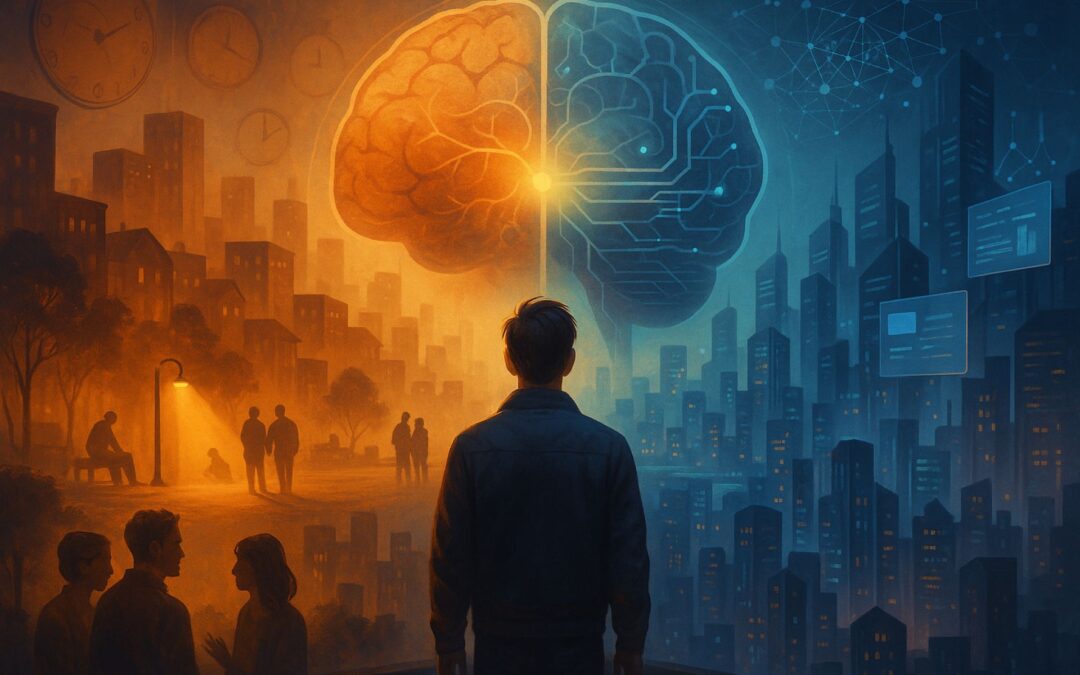
Before we talk about empathy, regret, or AI, let’s start with something simpler: the quiet, uncomfortable moments where you catch yourself reconsidering the way you’ve lived. Maybe it’s a conversation you replay for the hundredth time. Maybe it’s a mistake that suddenly looks different years later. Maybe it’s a headline about technology that makes you wonder what the next decade will look like—and what you’ll wish you had done differently.
We’re living in a strange intersection of psychology, culture, and machine intelligence. Our regrets are changing. Our empathy is shifting in ways we don’t fully understand. And our relationship with technology is accelerating faster than our ability to make sense of it.
This article is an attempt to map that terrain—to understand why regret lingers, why empathy can mislead, and why the world we’re building may value human connection more than ever before.
The Strange Art of Choosing Your Regrets
Regret is one of the few emotions that grows more sophisticated with time. When you’re young, regret feels dramatic—a painful jolt tied to embarrassment, impulsive decisions, or the fear of having ruined something permanently. But as you move through different seasons of life, regret changes shape. It becomes quieter, less theatrical, and far more revealing. Instead of being a punishment, it becomes a kind of internal audit, a slow, honest evaluation of how well your past choices matched the person you were trying to become.
Most people try to avoid regret entirely, but the more you pay attention, the clearer it becomes that regret has a purpose. It highlights the distance between your intentions and your actions. It exposes your blind spots. It forces you to confront where you acted out of ego, fear, or indifference. Regret hurts not because it condemns you, but because it sharpens your understanding of yourself.
And over time, something interesting happens: you stop trying to eliminate regret and start learning how to choose it.
Why Regret Feels Different After 40
At some point, regret stops being about isolated moments and starts being about patterns. You realize that the things that used to keep you up at night—awkward conversations, impulsive mistakes, questionable fashion phases—eventually fade into harmless anecdotes. They lose their emotional charge. Embarrassment evaporates with distance, and the events that once felt catastrophic turn into stories you tell at dinner.
But other regrets have a different texture. They don’t vanish with time; they deepen with it. These regrets aren’t about what you did—they’re about what you didn’t do. The trip you never took. The person you never apologized to. The opportunity you talked yourself out of. The risk you postponed until postponing became impossible.
Regrets of omission linger because they live in the imagination. You can picture the alternate version of your life where you acted differently. You can imagine the person you might’ve become. That phantom self follows you, not in a haunting way, but in a quietly instructive one.
The paradox is that your mistakes—every reckless choice, every failed attempt, every misguided instinct—built the architecture of who you are. Remove the wrong turns and the lessons disappear with them. Undo the failures and you undo the growth. You can’t separate regret from identity because they are intertwined; regret helps you understand the cost of becoming yourself.
This is why regret feels different with age: you develop the emotional intelligence to recognize its value, instead of treating it like an indictment.
The Regrets That Actually Stick
If you look closely at the regrets that persist, a clear pattern emerges: they’re almost always about people. You rarely lose sleep over the money you threw away on something stupid. You rarely obsess about the job you left too early or the party you shouldn’t have gone to. Time blunts those edges.
But time sharpens the regrets connected to relationships.
The grandparent you didn’t visit enough.
The parent you assumed would be around forever.
The partner you treated carelessly because you didn’t yet know how to love properly.
The friend you pushed away because you believed you had endless time to reconnect.
These regrets endure because they reveal something uncomfortable: we often behave as though the people we love exist outside the laws of impermanence. We expect them to stay. We assume we’ll have more time later. We believe that relationships can be paused and resumed without consequence.
And then life proves otherwise.
What stings isn’t just the loss—it’s the realization that you didn’t fully appreciate what you had while you had it. That’s the kind of regret that settles into your bones and teaches you how to treat the next chapter of your life with more tenderness, more attention, and more gratitude.
How Self-Forgiveness Becomes a Survival Skill
Most people think regret hurts because of the event itself. In reality, what hurts is what we believe that event says about us. If you cheated, does that make you unlovable? If you neglected someone, does that make you selfish? If you missed opportunities, does that make you weak? Regret quickly becomes a story about identity—and that’s where the real suffering lies.
Self-forgiveness isn’t about minimizing the mistake or excusing it. It’s about refusing to build your identity around your worst moments. It’s the difference between “I did something wrong” and “I am something wrong.”
Forgiving yourself means acknowledging that you were doing the best you could with the emotional tools you had at the time. Even the choices you’re ashamed of came from a version of you that didn’t yet have the clarity or maturity you have now. Growth comes from understanding the past, not punishing yourself for it.
Self-forgiveness is slow work. It requires honesty, humility, and compassion. But without it, regret becomes a cage. With it, regret becomes a teacher—the kind that doesn’t shame you, but equips you. It sharpens your discernment. It helps you choose better, respond better, and value better.
Because regret doesn’t disappear.
Regret evolves.
And with the right perspective, so do you.
The Empathy Trap We Don’t Talk About
Empathy has become a modern moral currency—an unquestioned virtue, a default prescription, a soft metric for measuring whether someone is “good.” But the more you study human behavior, the clearer it becomes that empathy is not a universal solution. It’s a tool. A powerful one, yes—but also a volatile one. And like any powerful tool, empathy can help you understand others or it can distort your perception entirely, depending on how it’s used.
In intimate relationships, empathy deepens connection. In large-scale social issues, it often creates confusion. Empathy can pull you toward one person’s pain so intensely that it blinds you to the broader consequences of your reaction. It can elevate symbolism over substance and emotion over clarity. And in a world where suffering is broadcast globally in real time, human beings simply aren’t equipped to feel everything accurately.
Empathy isn’t broken.
It’s misapplied.
Emotional Empathy vs Cognitive Empathy
The first misunderstanding is assuming that all empathy is the same. It’s not.
Emotional empathy is instinctual.
You see someone cry, and you feel their sadness.
You watch someone suffer, and your body mirrors their pain.
It’s fast, intense, and often overwhelming. Emotional empathy can make you compassionate—but it can also make you irrational. It hijacks your judgment. It creates urgency even when the situation requires precision.
Cognitive empathy, on the other hand, is deliberate.
Rather than feeling someone’s pain, you understand their perspective—without being consumed by it. You can interpret context, motives, and circumstances clearly. Cognitive empathy allows you to help effectively, because it isn’t clouded by emotional flooding.
Most of the world’s empathy crisis stems from confusing these two.
We praise the wrong kind.
We demand emotional empathy where cognitive empathy is actually required.
We elevate raw feeling above thoughtful understanding.
And that’s where things start to go wrong.
When Empathy Backfires at Scale
Human beings evolved in small tribes where empathy was used to maintain social harmony within groups of 50 to 100 people. Your emotional wiring was never meant to process the pain of millions of strangers across continents. But in the age of hyperconnectivity, you are exposed to endless streams of suffering, injustice, conflict, and heartbreak—far more than your nervous system can meaningfully absorb.
When empathy scales beyond its evolutionary context, several distortions occur:
1. Empathy narrows your focus.
It zeroes in on a single vivid story—the crying child, the viral video, the most photogenic victim—and blinds you to the thousands whose suffering is less visible but equally real.
2. Empathy encourages moral imbalance.
You start caring selectively, not proportionally. Emotional resonance becomes more important than facts.
3. Empathy strengthens tribal instincts.
You empathize more with people who look like you, sound like you, or validate your worldview. That selective empathy creates in-group/out-group thinking—exactly the opposite of what empathy is supposed to achieve.
4. Empathy can become self-serving.
People begin responding to tragedy not to help, but to signal that they feel deeply. Empathy becomes performance. Feeling becomes more important than fixing.
Empathy without boundaries doesn’t make you wiser.
It makes you easier to manipulate.
Real-World Empathy Disasters
When empathy goes unexamined, it can produce outcomes that are the opposite of what was intended.
Look at public policy.
After the murder of George Floyd, emotional empathy surged globally. Outrage was understandable. But the response—particularly the pressure placed on policing—created hesitation among officers in high-crime neighborhoods. The result was not safer communities, but a measurable rise in violence, especially in the very areas the protests aimed to protect.
The empathy was real.
The consequences were real.
The connection between them was not obvious until much later.
Look at media manipulation.
True-crime documentaries routinely dedicate hours to detailing the painful childhoods of serial killers, framing them as misunderstood products of trauma. These stories are crafted to generate empathy for the perpetrator—not the victims. With the right lighting, editing, and music, even the worst human behaviors can be reframed as tragic rather than monstrous.
When storytelling manipulates empathy, morality becomes slippery.
Look at global justice debates.
In El Salvador, the government imprisoned tens of thousands of gang members to free civilians from decades of fear. International critics reacted with empathy for the incarcerated, urging softer treatment. Meanwhile, the millions of ordinary Salvadorans finally walking safely in their own neighborhoods received less attention. Misplaced empathy risks prioritizing the comfort of aggressors over the safety of victims.
These aren’t arguments against compassion.
They are arguments for clarity.
Empathy is powerful.
But power without direction is dangerous.
Where Empathy Actually Works
Empathy thrives where information is complete.
Where intentions are visible.
Where consequences are immediate.
Where you know the people involved well enough to interpret their behavior with nuance.
This is why empathy works beautifully in:
- deep friendships
- committed relationships
- family dynamics
- small communities
- environments with shared history and context
In these spaces, empathy is grounded in reality, not assumption. It helps you understand, support, repair, and connect.
Everywhere else, empathy needs to be paired with reason, not unleashed uncritically. Feeling someone’s pain isn’t enough to understand the situation. Understanding the situation doesn’t require drowning in their pain.
Empathy is a tool—not a compass.
When used wisely, it strengthens bonds.
When used blindly, it erodes judgment.
And in a world that demands both connection and clarity, learning the limits of empathy may be just as important as learning empathy itself.
AI Isn’t Coming for Your Job — It’s Coming for Something Else
Every technological revolution begins with panic. The loom would kill weaving. Electricity would kill jobs. The internet would kill books. And now AI, supposedly, will kill creativity, writing, design, and every profession that depends on ideas. But history has never worked that way. Technology rarely destroys what makes us human—it simply destroys the bottlenecks that force us to ration our humanity.
What AI threatens isn’t your creativity.
It’s the scarcity of creativity.
What it dismantles isn’t livelihoods—it’s the long, frustrating distance between imagination and execution. And in doing so, it shifts the entire map of what becomes valuable in the future.
Creativity Is Becoming Abundant
For centuries, creativity required skill, time, experience, and often money. You couldn’t make a film without a crew. You couldn’t illustrate a book without an artist. You couldn’t compose music without knowing music theory. Creativity was slow, labor-intensive, and constrained by resources.
AI disrupts that entirely.
You can now sketch an idea and have it visualized in seconds.
You can generate melodies without touching an instrument.
You can brainstorm ten article angles in less time than it takes to open a notebook.
This doesn’t replace the creative person. It elevates them. The constraints disappear. The friction dissolves. The overhead drops to zero. When the grunt work is delegated to algorithms, the creator’s value shifts to vision, taste, curation, emotional insight, and originality—qualities machines cannot replicate.
AI raises the baseline.
If everyone can produce decent work instantly, the real currency becomes exceptional work—work infused with perspective, humanity, and lived experience. AI makes creativity wide, but only humans can make creativity deep.
The Real Scarcity Will Be Human Connection
We’ve been conditioned to believe that scarcity equals value. When books were rare, literacy was elite. When music was hard to record, artists became cultural gods. When attention was not weaponized by the internet, we spent it carefully.
But now, information is everywhere and creativity is approaching ubiquity. In a few years, high-quality writing, design, video editing, and idea generation will be as abundant as clean tap water. When the world is overflowing with content, the only thing left with real value is presence. Human presence.
This shift is already underway.
Look at how people behave:
They binge AI-generated content but passionately defend their favorite human creators.
They scroll through perfectly tailored feeds but crave imperfect, spontaneous live experiences.
They use dating apps more than ever yet complain they feel lonelier than ever.
We’re saturated with information but starving for intimacy.
We’re flooded with content but deprived of resonance.
We’re connected to thousands but bonded to none.
This is why live chess tournaments are unexpectedly popular. Why concerts are packed. Why in-person social events—especially dating—are making a quiet resurgence. Why podcasts thrive despite longer formats. Why communities, not platforms, are becoming the new north star.
We’ve entered a world where the rarest resource isn’t knowledge, or creativity, or productivity—it’s genuine human connection.
The Rise of Two Internets
As AI becomes woven into daily life, the digital world is splitting into two distinct ecosystems:
The Machine Internet
This is the realm of efficiency.
It’s where you go for answers, summaries, facts, comparisons, solutions, and frictionless output.
It’s helpful, fast, clean, and unemotional.
You will use it to:
– research ideas
– test assumptions
– generate drafts
– automate busywork
– understand complex topics quickly
It’s incredible—but it’s not human.
The Human Internet
This is the realm of identity, chaos, culture, and emotional friction.
It’s where you go to feel something.
It’s where you experience community, debate, connection, personality, humor, storytelling, imperfection—everything machines can mimic but never embody.
People will still flock to creators because they want to know the mind behind the message. They’ll attend live events because the energy can’t be downloaded. They’ll pay for community because machines can’t replace belonging. They’ll invest attention in people—not content—because the emotional signature of human experience is irreplaceable.
And this is the part most people miss:
AI won’t replace human creativity.
It will make human creativity matter more.
Because once the world is filled with machine-generated ideas, the only ideas that feel alive will come from real people.
Once content is infinite, the creators who stand out will be those who reveal themselves, not just their output.
Once everything is optimized, the only thing left with soul will be the unoptimized—the human.
In a world where AI handles the heavy lifting, the power shifts to the person who can think clearly, feel deeply, and connect authentically.
The machines will handle the work.
The humans who know how to use the machines will handle the world.
What All of This Says About Us
At first glance, regret, empathy, and artificial intelligence feel like unrelated topics—one emotional, one ethical, one technological. But when you zoom out, a pattern emerges. Each one exposes a different dimension of what it means to be human, and each reveals where our instincts collide with the complexity of modern life.
Regret teaches us how we misjudge our own priorities.
Empathy teaches us how we misinterpret other people’s experiences.
AI teaches us how we misunderstand our own value.
Together, they form a kind of psychological X-ray of our time. We’re living in a world where we’re constantly pulled between our emotional wiring and our intellectual understanding, between our human instincts and our machine-enhanced environment. And learning to navigate these tensions—without losing ourselves—is becoming a defining skill of the modern era.
Regret Without Self-Loathing
Regret is unavoidable. It’s also useful. Without regret, you’d lack the emotional data needed to course-correct. You’d repeat your mistakes with the confidence of someone who has learned nothing. The key is not to eliminate regret but to prevent it from becoming your identity.
Regret should point backward only long enough to teach you how to move forward. When regret becomes rumination, it stops being a lesson and becomes a punishment. That’s where self-loathing sneaks in. You start confusing your past choices with your worth as a person. You hold yourself to a standard nobody else could meet. You judge your former self with your current wisdom and call it accountability.
But real accountability includes compassion.
You forgive others because you understand their flaws.
You must be willing to understand your own.
Regret is information. Self-loathing is interpretation. And the more you learn to differentiate the two, the more your past becomes a library—rather than a prison.
Empathy Without Delusion
Empathy can be a virtue—but only when it’s grounded in clarity. Without boundaries, empathy becomes a fog that distorts your perception. You may think you’re being compassionate, but often you’re simply reacting emotionally, without understanding the full story.
The future belongs to those who can feel deeply and think clearly.
Empathy must be paired with reason:
– Feel what someone is feeling, but don’t drown in it.
– Care about others, but don’t collapse under the weight of their suffering.
– Advocate for justice, but don’t let outrage replace understanding.
This is especially important in a digital world where every tragedy is presented with dramatic urgency and emotional framing. Without discernment, empathy becomes a weapon—used to manipulate attention, distort priorities, and polarize communities.
The goal isn’t to have less empathy.
It’s to have accurate empathy.
Empathy that connects without blinding.
Empathy that helps without harming.
Empathy that you can actually act on.
Technology Without Fear
The rise of AI feels threatening because it challenges our assumptions about creativity, intelligence, and relevance. But the truth is far simpler: AI forces us to redefine where human value truly lies. What machines automate, humans no longer need to compete in. The more technology takes over the mechanical parts of creativity, the more we’re pushed toward the emotional, relational, intuitive, and experiential dimensions of being alive.
AI won’t replace your creativity—it will replace the excuses that prevented you from expressing it.
It won’t replace your intelligence—it will replace the tedious work that once consumed it.
It won’t replace your humanity—it will make your humanity more visible by contrast.
We’re moving into a world where efficiency is automated, but meaning is scarce. Facts are abundant, but wisdom is rare. Content is everywhere, but connection is precious. And if technology teaches us anything, it’s that the most powerful part of being human isn’t what we produce—it’s how we relate, how we choose, and how we make sense of our lives.
In this sense, AI won’t make humans obsolete.
It will make emotionally mature, self-aware humans indispensable.
The Final Thought
Regret teaches you where you’ve ignored your own values. Empathy teaches you where your emotions outrun your judgment. And technology—especially AI—teaches you what’s truly scarce: not intelligence, not creativity, but presence. The more the world automates what we once considered rare, the more valuable the deeply human becomes. Your attention. Your relationships. Your ability to reason through complexity without being swallowed by emotion.
We don’t get to undo our choices, and we don’t get to feel everyone’s pain without distortion. But we do get to choose how we move forward—what we learn, what we forgive, what we focus on, and which connections we decide to nurture.
In a time when empathy can blind, regret can trap, and AI can overwhelm, the real work is surprisingly ancient: show up, stay grounded, think clearly, choose wisely, and give your humanity to the people who can feel it.