
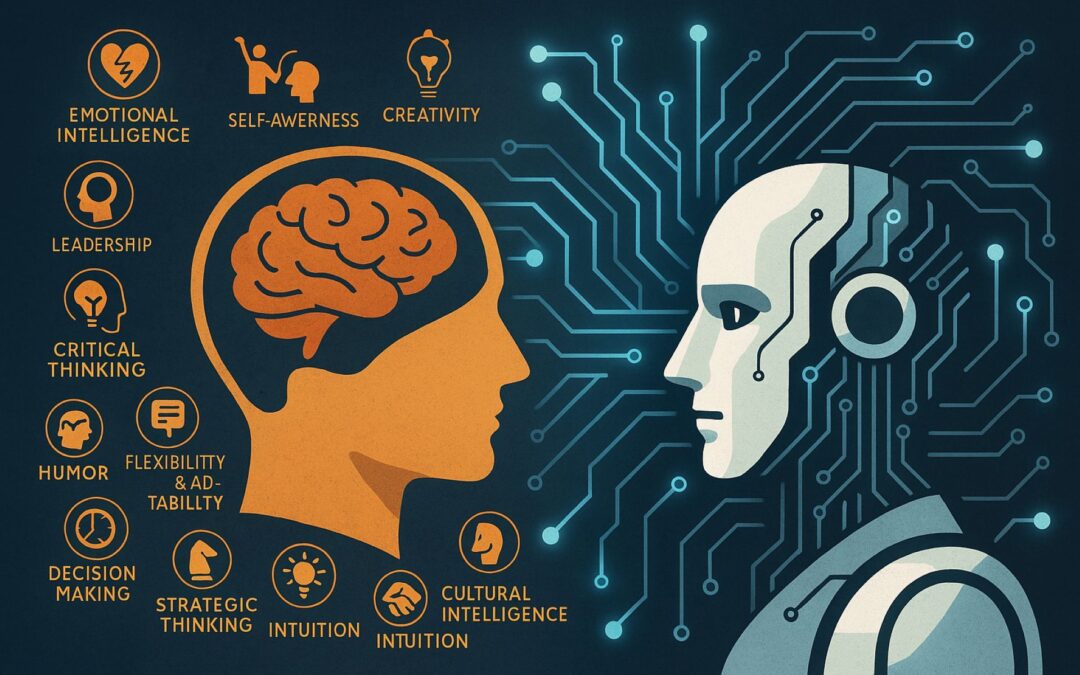
In the contemporary landscape, the proliferation of artificial intelligence (AI) has sparked discussions about the future of work and the potential obsolescence of certain human skills. However, amid these debates, it’s crucial to acknowledge the intrinsic value of skills that transcend the capabilities of AI. While machines may excel in specific tasks, there exist realms of human expertise that defy replication. In this exploration, we delve into the essence of these irreplaceable skills, highlighting their significance in an AI-driven world.
1. Emotional Intelligence (EQ)
Emotional intelligence, often abbreviated as EQ, is a multifaceted skill that involves the ability to recognize, understand, and manage emotions—both in oneself and others. Unlike traditional intelligence (IQ), which emphasizes cognitive abilities, EQ focuses on the emotional and social aspects of human interaction. At its core, emotional intelligence allows people to navigate complex social dynamics and maintain positive relationships, both in personal and professional contexts.
One of the most crucial aspects of emotional intelligence is self-awareness, the ability to recognize and understand one’s own emotions. For example, when you’re feeling stressed or angry, emotional intelligence allows you to identify these emotions and manage them in a way that doesn’t harm your interactions with others. It helps you ask, “Why am I feeling this way?” and respond to these emotions in a healthy, constructive manner. A person with high EQ can acknowledge their stress without letting it take over their behavior, allowing them to remain calm and rational.
Empathy is another cornerstone of emotional intelligence. It involves the ability to understand and share the feelings of others. Empathetic individuals are able to step into someone else’s shoes, perceive their emotional state, and respond in ways that offer support or comfort. This ability is especially vital in leadership, customer service, and counseling roles, where understanding the emotional needs of others is key to providing effective support. AI, however, lacks this true empathy. It may process and mimic emotional responses based on algorithms, but it cannot genuinely feel what another person is experiencing or react in a compassionate, human way.
Furthermore, emotional intelligence enhances communication. A person with high EQ can read subtle social cues, such as body language, tone of voice, and facial expressions, to fully understand a situation. This ability allows them to engage in meaningful conversations, offering the right words or actions at the right time. A leader with emotional intelligence, for instance, can recognize when their team is struggling emotionally and step in to offer support or adjust their approach to alleviate stress. In contrast, AI may be able to detect emotions based on patterns, but it cannot fully interpret the nuances of a conversation or offer the emotional guidance that human beings can provide.
In professional environments, emotional intelligence fosters collaboration and conflict resolution. High EQ allows individuals to navigate interpersonal conflicts with diplomacy, maintain open channels of communication, and build trust within teams. While AI can analyze data to optimize processes, it cannot understand the intricate dynamics of a team or provide the emotional intelligence needed to resolve conflicts or foster cooperation. The emotional bond created through EQ is crucial for building high-functioning teams, making it a skill that will always remain irreplaceable.
2. Creativity
Creativity is one of the most distinctive human traits. It’s the ability to generate new ideas, think outside the box, and devise original solutions to problems. Creativity is not just limited to artistic expression; it permeates every facet of life, from problem-solving in business to innovation in technology. Humans can draw inspiration from their experiences, emotions, and the world around them to create something entirely new, while AI is confined to data and pre-existing knowledge.
Take innovation in business as an example. Entrepreneurs create new products and services not by following an existing formula but by imagining something that does not yet exist. A tech entrepreneur might identify a gap in the market and envision a new platform or device that revolutionizes the way we communicate or work. AI, by contrast, cannot “imagine” such breakthroughs; it can only build upon existing models and trends. AI might suggest improvements to a product or help optimize a process, but it cannot create entirely new concepts without human guidance.
Similarly, the creative process in the arts—whether it’s painting, writing, or music composition—is fueled by human imagination, emotional experiences, and cultural contexts. A painter may capture the depth of human emotion on a canvas, translating feelings of joy, sadness, or longing into visual art. AI can replicate artistic styles or generate random compositions, but it lacks the ability to connect with human experiences and emotions on the same level. An AI program can follow algorithms to create music or generate images, but it does not possess the emotional depth or subjective insight required to produce truly original work.
Creativity is also about experimentation and adaptation. It’s about trying new ideas, learning from failures, and making intuitive leaps to discover new possibilities. An artist might blend genres of music in a way that has never been done before, or a chef might combine ingredients in a new dish, experimenting with flavors until something remarkable is born. AI, on the other hand, follows predefined rules and patterns. It can optimize and predict based on data, but it cannot take those leaps into the unknown, where true innovation happens. Creativity, by nature, transcends patterns and data, and it’s this ability to venture into the unknown that makes creativity an irreplaceable skill.
3. Leadership
Leadership is the ability to inspire, motivate, and guide others toward achieving a common goal. Effective leaders create vision, foster collaboration, and build trust within teams. Leadership is not just about making decisions or issuing orders—it’s about understanding the needs of individuals, adapting to circumstances, and guiding a team through challenges while keeping morale high. A key aspect of leadership is the ability to inspire others, something that AI simply cannot replicate.
For example, a strong leader in a company is not just concerned with the company’s bottom line—they also understand the emotional and psychological needs of their team. They know how to empower their employees, how to recognize their achievements, and how to support them through tough times. They create a culture where individuals feel valued and motivated to contribute their best. AI, in contrast, may be able to process performance data, but it cannot foster the same sense of connection, understanding, or empowerment. A robot boss would never be able to inspire loyalty, build personal connections, or make decisions based on the human aspects of leadership.
A leader must also be adaptable, willing to shift strategies as circumstances change, and capable of making tough decisions when necessary. AI may be able to generate data-driven recommendations, but it lacks the intuition and human understanding to navigate complex situations with empathy and wisdom. Leaders often need to make judgment calls that consider not only data but also the unique dynamics of their team, including interpersonal relationships, morale, and emotions. These factors cannot be reduced to data points, and AI cannot understand or respond to them in the nuanced way that human leaders can.
Furthermore, leadership involves setting a vision and motivating others to work toward that vision, even in times of uncertainty or hardship. AI can assist with logistical tasks, but it cannot provide the vision, encouragement, and strategic foresight that a human leader can. Leadership is about more than managing—it’s about connecting with people, making them believe in something bigger than themselves, and encouraging them to give their best effort. This human-centric aspect of leadership ensures that it will remain irreplaceable, no matter how advanced AI becomes.
4. Critical Thinking
Critical thinking is the ability to analyze and evaluate information, form reasoned judgments, and make decisions based on logical reasoning rather than emotional impulses or biases. It requires the ability to identify patterns, question assumptions, and weigh evidence before making conclusions. Critical thinking is essential in both personal and professional settings, as it enables individuals to navigate complex issues, solve problems creatively, and make informed decisions.
While AI excels in processing large amounts of data and identifying patterns, it lacks the ability to think critically in the human sense. AI can analyze data points and make predictions, but it cannot evaluate the broader context of a situation or consider the ethical, emotional, or subjective aspects of a problem. For instance, an AI system may identify an issue in a financial report, but it would not be able to assess the broader implications of that issue on company culture, employee morale, or customer satisfaction. Critical thinking requires the ability to see the bigger picture, something AI is not equipped to do.
Moreover, critical thinking often involves making judgments in situations where there is no clear or definitive answer. A person might need to decide whether to invest in a new technology that could disrupt the market, but there are many unknowns and uncertainties involved. AI can process data and offer potential outcomes, but it cannot weigh the uncertainty or make a judgment based on intuition, experience, or long-term thinking. Human critical thinking is shaped by a lifetime of experiences, values, and perspectives that cannot be replicated by a machine.
Critical thinking also involves self-reflection—questioning one’s own beliefs, biases, and assumptions. This level of introspection and meta-cognition is unique to humans. While AI can analyze information, it cannot engage in self-awareness or reflect on its own processes. Critical thinking is not just about gathering facts; it’s about understanding how those facts fit into a larger narrative, and that understanding is deeply human.
5. Interpersonal Communication
Interpersonal communication is the ability to convey thoughts, ideas, and emotions effectively to others, while also understanding and responding to their communication in turn. This involves not only verbal communication but also non-verbal cues such as body language, facial expressions, tone of voice, and gestures. It’s the ability to form connections, build rapport, and navigate social interactions in a meaningful way.
AI can facilitate communication by translating languages, scheduling meetings, or even generating written content. However, it cannot interpret or respond to the nuanced signals of human interaction that are so vital in personal and professional settings. For example, a person who is upset may say, “I’m fine,” but their tone of voice, body language, and facial expressions might convey otherwise. A human communicator can pick up on these cues, offering reassurance, empathy, or further inquiry. An AI, however, would take the statement at face value, missing the emotional complexity of the situation.
Effective interpersonal communication also involves understanding context—what is being said, how it’s being said, and why it’s being said. A skilled communicator can adapt their message depending on the person they are speaking to, the situation, and the emotional tone of the conversation. AI can analyze patterns in communication, but it lacks the flexibility to adapt to every situation. Human communication is deeply shaped by emotions, experiences, and cultural context, and AI, as advanced as it may be, cannot fully grasp the intricacies of these factors.
Furthermore, interpersonal communication is essential for building trust and resolving conflicts. In a workplace setting, an employee who feels misunderstood or undervalued may need a manager who can communicate effectively to rebuild trust. AI, despite its ability to analyze data, cannot offer the kind of personalized, emotionally intelligent communication that is essential for maintaining healthy relationships in any context. The human ability to listen actively, respond with empathy, and engage in authentic dialogue remains an irreplaceable aspect of interpersonal relationships.
6. Flexibility and Adaptability
Flexibility and adaptability are the bedrock of success in today’s fast-paced, ever-evolving world. These two complementary qualities allow individuals to thrive in situations where the future is uncertain, the environment is changing rapidly, or when unforeseen obstacles arise. They are the skills that enable human beings to shift gears, pivot strategies, and adjust approaches based on new information, conditions, or experiences.
Adaptability refers to the ability to adjust to new situations, challenges, or environments. It’s about being able to perform effectively despite changing circumstances. For instance, during a crisis, a leader with adaptability can rethink their approach, adjust goals, and shift their strategy to guide the team through uncertainty. In contrast, AI systems are often rigid in their programming. While AI can process data and provide recommendations, its ability to adapt to unforeseen scenarios is limited to the parameters within which it was designed. If a new, unpredictable problem arises, AI may struggle, as it lacks the creative flexibility that humans possess.
Flexibility, on the other hand, is the ability to shift your thinking or approach when faced with new information. It’s a mental and emotional agility that enables people to change direction quickly. Take the example of a startup founder facing a market shift. A founder who is flexible will recognize the need to pivot, adjust their product offering, and try new marketing strategies without hesitating or becoming overwhelmed by the change. AI can only adjust within its programmed structure—if the input data doesn’t match its pre-established model, it can’t act flexibly to solve a new problem. A human, however, can think outside the box, use intuition, and leverage experience to overcome novel challenges.
This adaptability and flexibility are critical in environments where constant change is the norm, such as technology, business, or personal development. As the world around us continues to evolve, the ability to rapidly respond to new opportunities and challenges will be a key differentiator. The combined skill set of flexibility and adaptability ensures that humans can thrive in uncertainty, while AI, despite its processing power, lacks the instinctual creativity required for true adaptability.
7. Empathy
Empathy is one of the most fundamentally human skills, allowing individuals to connect on a deeper level with others. It’s the ability to understand, share, and respond to another person’s emotional state, making it essential for effective communication, relationship-building, and conflict resolution. Empathy goes beyond simply recognizing emotions; it involves feeling and interpreting them in a way that encourages emotional bonds, trust, and a deeper understanding of the human experience.
A parent comforting a child after a disappointment demonstrates empathy. They don’t just recognize the child’s feelings of sadness—they connect with those feelings and offer support in a way that acknowledges the emotional state. This type of nuanced emotional response is something that AI can mimic in limited ways (through scripted phrases or sentiment analysis), but it can never genuinely feel what a human does. A machine might detect when someone is upset, but it will lack the emotional depth and authenticity required to offer meaningful support.
In professional settings, empathy plays a significant role in leadership, teamwork, and customer service. Leaders with high empathy can understand the struggles of their team members, provide guidance when needed, and foster an environment of trust and understanding. For instance, a manager might notice that an employee is stressed and take proactive steps to alleviate their workload, creating a supportive environment. An AI, though it may optimize tasks or track productivity, will never have the emotional awareness or capacity for empathy that human leaders rely on to manage people effectively.
Empathy is also central to conflict resolution. When people disagree or experience tension, it’s often because of unspoken emotions or miscommunications. An empathetic individual can recognize the emotional undercurrents of a situation and work to de-escalate conflicts, find common ground, and create solutions that address both practical and emotional concerns. This human sensitivity allows for the resolution of disputes in ways that are both practical and emotionally intelligent, something AI simply cannot replicate.
8. Cultural Intelligence
Cultural intelligence (CQ) refers to the ability to understand, appreciate, and navigate the complexities of different cultures, traditions, and social norms. It goes beyond mere knowledge about other cultures—it involves the ability to interact effectively with people from diverse backgrounds, recognizing that different people may have different values, beliefs, and practices.
In business, cultural intelligence is essential for success in global markets. A person with high cultural intelligence understands that business etiquette in one country may be very different from another. For instance, while some cultures value directness in communication, others may find it impolite. An individual with high CQ knows how to adjust their approach based on these differences, ensuring that their interactions are respectful and effective. AI can be programmed with data about cultural norms and social practices, but it will never fully understand the depth of cultural contexts or the nuances of how people from different cultures feel, behave, or interact.
Cultural intelligence also plays a crucial role in fostering inclusivity and diversity. People with high CQ are able to recognize and respect differences in people’s backgrounds, behaviors, and viewpoints. They know how to create environments where individuals from all walks of life feel valued, included, and understood. A business leader with cultural intelligence can build diverse teams that collaborate effectively, celebrate their differences, and contribute innovative ideas. AI, however, can’t truly “feel” the cultural experiences of others. While it can be trained to recognize patterns of behavior across different groups, it cannot engage in the personal and emotional insights that come from living within or understanding a particular culture.
Moreover, cultural intelligence is about adaptability. In global business environments, people constantly face new challenges in unfamiliar cultural contexts. Whether dealing with international clients, relocating for work, or collaborating with a multicultural team, cultural intelligence helps individuals adapt, empathize, and succeed. AI’s inability to grasp these subtleties means that humans will always be essential for navigating and shaping global interactions, making cultural intelligence an indispensable skill.
9. Decision Making
Decision-making is the process of selecting a course of action from multiple alternatives. It’s a critical skill that involves evaluating options, considering the implications, and choosing the one that aligns with personal, professional, or organizational goals. Effective decision-making relies not only on data and logic but also on judgment, intuition, and values—elements that make it a uniquely human skill.
AI can assist in decision-making by processing large amounts of data, identifying patterns, and even predicting outcomes based on historical information. However, its decision-making is confined to the data and rules provided to it. AI cannot make decisions that require moral judgments, consider long-term consequences in a nuanced way, or weigh intangible factors such as personal relationships, values, or ethics. For example, an AI system might suggest the most cost-effective way to downsize a company based purely on financial data, but it would not understand the emotional toll on employees or the company’s long-term reputation.
In business, leaders often face decisions where the right answer is not clear-cut. Decisions about hiring, promotions, partnerships, or ethical dilemmas require human judgment and emotional intelligence. A CEO might need to choose between two candidates, not just based on their resumes but on their potential fit within the company culture, their ability to inspire others, and their alignment with the company’s mission and values. AI can help provide data, but it cannot make these value-based decisions.
Furthermore, decision-making often involves making compromises and weighing risks. Humans are capable of recognizing when a solution isn’t perfect but is the best available option under the circumstances. AI might be able to suggest optimal solutions, but it lacks the flexibility to make subjective judgments based on conflicting goals, uncertainties, or personal preferences. Humans, therefore, will always be needed to navigate the complexities and nuances of decision-making, especially when long-term strategy, relationships, and ethical considerations are at stake.
10. Strategic Thinking
Strategic thinking is the ability to think long-term, anticipate future challenges, and develop plans that guide an organization toward its goals. It involves analyzing the current situation, forecasting potential scenarios, and aligning resources and actions with a broader vision. Strategic thinking is what allows leaders to move beyond short-term problems and focus on the long-term success of their teams, companies, or communities.
AI excels in analyzing data and identifying patterns, which can be useful for tactical decision-making. However, strategic thinking requires the ability to see beyond data and consider broader contexts, such as market trends, human behavior, and global changes. For instance, when a company is planning for expansion into new markets, strategic thinking goes beyond analyzing financial data—it involves understanding the political, economic, and cultural landscapes of those markets, predicting potential shifts, and devising a flexible strategy to adapt to changes.
Human strategic thinkers also take into account factors that AI cannot assess—such as organizational culture, values, and the human aspects of leadership and teamwork. Strategic decisions often require a deep understanding of human psychology and organizational behavior. A strategic leader needs to balance data with intuition, experience, and creativity, envisioning possibilities that cannot be quantified in numbers.
AI can assist by providing data-driven insights and suggesting paths to achieve specific objectives, but it cannot create a comprehensive strategy that incorporates both hard data and human elements. Strategic thinking involves envisioning the future, identifying opportunities, mitigating risks, and building consensus across teams. These elements of foresight, adaptability, and leadership are what make strategic thinking an irreplaceable human skill.
11. Intuition
Intuition is often described as the ability to understand something instinctively, without the need for conscious reasoning. It’s that gut feeling that guides decision-making when data or logic alone cannot provide a clear answer. Intuition is built over time through experience, knowledge, and emotional intelligence, and it plays a significant role in making decisions in situations where facts and logic are insufficient or when the path forward is unclear.
For example, a seasoned investor might feel confident about a stock that looks risky, even though its financial data doesn’t fully support that decision. This “gut feeling” may stem from years of experience in reading the market and observing the behavior of companies in similar situations. Intuition allows humans to act swiftly when there is no time to analyze every detail or when the data is ambiguous. While AI can process vast amounts of data and offer insights, it lacks the emotional depth and experiential learning that underpin human intuition.
Intuition is not just about making snap decisions, though; it’s a deeply integrated part of human cognition. It’s often the result of recognizing patterns and making connections between seemingly unrelated pieces of information. For example, a detective solving a case might suddenly make a leap of understanding that leads to the right conclusion, even if they can’t immediately articulate why they reached that insight. AI, despite its powerful pattern recognition capabilities, doesn’t possess this kind of intuitive leap. It follows predetermined algorithms and processes but can’t make leaps of judgment based on experience or emotional resonance. Intuition often overrides pure logic, and it’s this ability that allows humans to make decisions based on things they might not fully understand at the conscious level.
Furthermore, intuition is essential in navigating social and personal relationships. A leader, for instance, might make an intuitive decision to trust one person over another, even when there’s no obvious reason for that choice based on the available data. This decision may be based on subtle cues, past interactions, and the leader’s emotional awareness—things that AI cannot measure. Intuition allows humans to make decisions that are not just data-driven but deeply connected to the emotional, social, and psychological dimensions of life.
12. Negotiation
Negotiation is a critical human skill that involves reaching an agreement between parties with differing interests or perspectives. It’s about finding common ground, compromising when necessary, and ensuring that all parties involved feel respected and understood. Negotiation requires emotional intelligence, empathy, and social skills—qualities that AI cannot replicate.
While AI can be programmed to negotiate based on predefined parameters, it lacks the emotional intelligence necessary for understanding the nuances of human communication. Negotiation often involves more than just agreeing on numbers or facts; it’s about building relationships, understanding the motivations of others, and finding mutually beneficial solutions. AI, for example, might propose a deal based purely on data, but it cannot sense the emotions behind the negotiation—such as tension, frustration, or underlying concerns—that may require a shift in strategy or tone.
A human negotiator, in contrast, can adjust their approach in real-time, recognizing when the other party is feeling tense or uncertain. They might soften their tone, reframe the discussion, or offer concessions to help build rapport. AI is limited by the data it processes and lacks the ability to perceive emotions, which means it can’t effectively navigate the complex, often emotional, terrain of human negotiations. Additionally, negotiation is rarely a straightforward exchange of offers and counteroffers; it’s an ongoing process of adapting to changing circumstances, recalibrating approaches, and finding creative solutions—all of which require a level of emotional intelligence that AI doesn’t possess.
Moreover, negotiation is often about managing expectations and managing power dynamics. A skilled negotiator knows when to push for a better deal and when to back off, when to assert themselves and when to yield. AI, even with the most sophisticated algorithms, doesn’t understand power dynamics in the same way humans do. It cannot anticipate human behavior or the impact of emotional states on a negotiation. This deep understanding of human psychology is what makes negotiation an irreplaceable skill.
13. Humor
Humor is an essential human quality that allows individuals to engage, connect, and relieve tension in both social and professional settings. It is a complex skill that involves timing, wordplay, and understanding the emotional needs of others. Humor allows us to build rapport, foster connections, and defuse tense situations. While AI can generate jokes or mimic humor, it cannot capture the essence of what makes humor truly effective—it’s the emotional connection and understanding that makes humor such a powerful tool.
One of the reasons AI struggles with humor is that it lacks the social awareness required to gauge the appropriateness of a joke or comment in any given situation. Humor is deeply contextual—what might be funny in one culture or setting could be offensive or inappropriate in another. Humans use humor not only to entertain but also to communicate complex ideas, to create bonds, or to express dissatisfaction in a non-confrontational way. An AI may be able to generate a joke based on patterns, but it cannot determine whether the audience will find it funny or if it’s suitable for the moment.
For example, a comedian uses humor to build a relationship with their audience. They know when to make people laugh, when to push boundaries, and when to offer a lighthearted break from serious topics. This skill goes beyond the ability to tell a joke—it requires an understanding of the audience’s emotional state, their cultural context, and the social atmosphere. AI, despite its ability to process vast amounts of data, can’t engage with an audience in this way. It lacks the nuance, timing, and cultural sensitivity that human humor demands.
Moreover, humor is a social bonding tool. It helps people to connect, break the ice, and establish a sense of belonging. Humor often defies logic—sometimes a person laughs simply because the absurdity of a situation resonates with them, even if the joke makes no sense. This emotional resonance and the social dynamics involved in humor are uniquely human. AI can simulate jokes, but it can never replicate the profound impact of humor on relationships and social cohesion.
14. Resilience
Resilience is the ability to recover from setbacks, adapt to challenging circumstances, and maintain a positive outlook despite adversity. It’s a critical skill that helps individuals persevere in the face of failure, disappointment, or hardship. Resilience goes beyond merely enduring difficult times—it involves learning from these experiences, growing stronger, and continuing to move forward with renewed determination. AI, in contrast, lacks the ability to be resilient because it does not experience emotions or learn from failures in the same way humans do.
Humans build resilience through personal experiences, emotional endurance, and the support of others. It’s about facing challenges head-on, managing stress, and bouncing back stronger after a setback. For instance, an athlete who sustains an injury might face a difficult recovery process, but their resilience allows them to overcome the physical and mental obstacles to return to their sport. AI, however, lacks the personal experiences that build resilience. If an AI system encounters a failure or an error, it simply recalibrates or follows the program’s corrective measures. It does not experience the emotional or mental toll of failure, nor does it have the drive to improve based on personal growth.
Resilience is also about motivation and perseverance. In a world where obstacles are inevitable, resilient individuals are those who remain focused on their long-term goals despite short-term setbacks. Whether it’s continuing to work toward a career goal after facing rejection or rebuilding after a business failure, resilience is about maintaining the effort and the belief that things will improve. AI, by contrast, follows programmed routines. It can process data and optimize processes, but it cannot demonstrate the determination, the willingness to push through adversity, or the drive to keep moving forward despite challenges.
In the context of work, resilience is key to navigating periods of stress, managing burnout, and maintaining productivity in the face of obstacles. People with resilience can continue their work even when things are difficult, find ways to manage their workload effectively, and recover from exhaustion. AI can assist in reducing workloads or automating tasks, but it will never exhibit the kind of emotional resilience required to manage the complexities of human life.
15. Self-Awareness
Self-awareness is the capacity to reflect on one’s own thoughts, emotions, behaviors, and the way they impact others. It is foundational to personal growth, emotional intelligence, and effective decision-making. Being self-aware means understanding your strengths and weaknesses, recognizing your emotions, and being able to adjust your actions accordingly. This introspection and self-reflection are what allow individuals to grow, evolve, and align their actions with their core values and goals.
Self-awareness plays a significant role in leadership, as it enables leaders to recognize their own biases, identify areas for improvement, and manage their reactions in a way that fosters trust and respect. A self-aware leader knows when they need help, when to step back, and when to take charge. They also recognize the impact of their decisions on their team and take responsibility for their actions. AI lacks this level of introspection—it does not evaluate its own existence, make judgments about its role, or reflect on the consequences of its actions. It can perform tasks, but it cannot engage in the kind of reflective practice that leads to self-improvement and personal growth.
In addition to its role in leadership, self-awareness is crucial in personal development. It helps individuals recognize patterns in their behavior, address unhealthy habits, and make decisions that align with their values. Self-awareness is also key to emotional regulation—it enables individuals to manage their emotions and reactions, preventing rash decisions or emotional outbursts. AI, by contrast, operates without self-reflection or emotional intelligence. It can perform tasks according to programming but does not engage in introspection or adapt its behavior based on its internal state or growth. It’s a tool, not a being capable of self-exploration or emotional development.
Self-awareness is essential for building meaningful relationships. By being aware of one’s own emotions and behaviors, individuals can better understand the perspectives of others and adjust their communication to create stronger, more empathetic connections. AI cannot truly understand the complexity of human relationships. While it can analyze data, it cannot engage in self-reflection or adjust its behavior in response to emotional feedback in the same way that self-aware humans can.
Conclusion
In an era defined by technological innovation and rapid change, it’s essential to recognize the enduring value of human skills and capabilities. While AI may augment our efficiency and productivity, it can never replicate the nuanced complexities of human ingenuity, empathy, and creativity. By embracing our unique strengths and cultivating irreplaceable skills, we chart a course towards a future enriched by human potential and innovation. Let us harness the power of AI as a tool for progress while affirming the timeless essence of our humanity.