
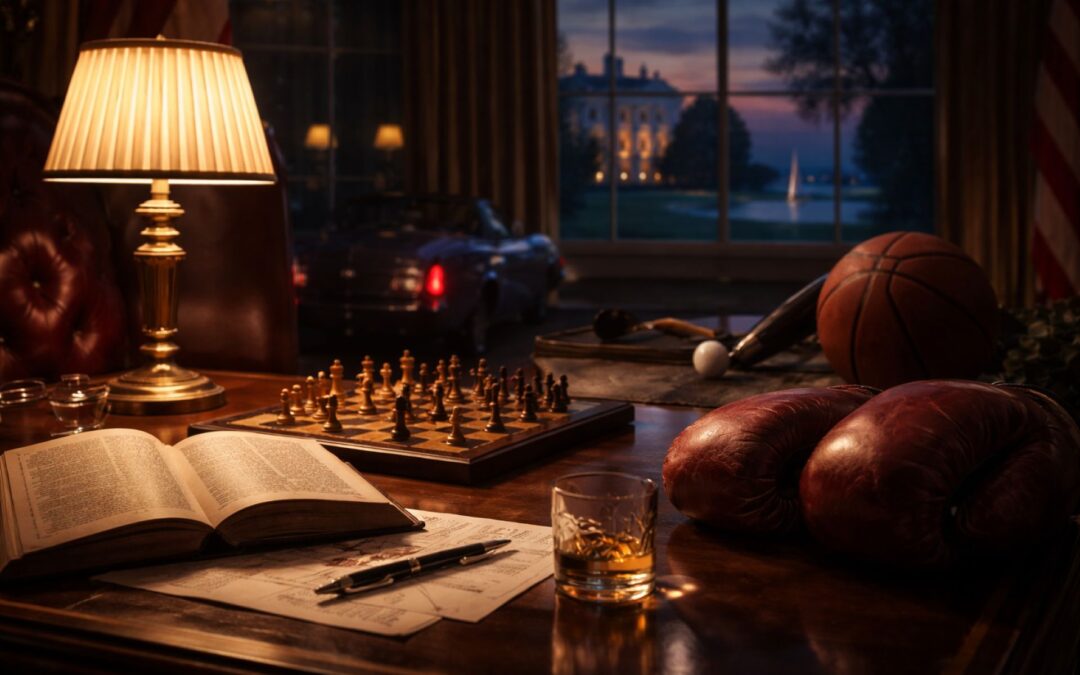
Power is public. Hobbies are private.
For over two centuries, American presidents have stood at the center of war rooms, economic crises, cultural revolutions, and political storms. We study their speeches, policies, victories, and failures. Yet the most revealing details about them often surface far from the podium — in stables, libraries, fishing streams, boxing rings, bowling alleys, and even on a mechanical horse hidden inside the White House.
These weren’t trivial pastimes. They were pressure valves. Identity anchors. Psychological resets.
From George Washington methodically breeding a stronger American mule to Theodore Roosevelt boxing until he lost sight in one eye, from Franklin Roosevelt quietly sorting through a million postage stamps to Barack Obama draining three-pointers on a converted White House court, each president’s hobby offers insight into how they coped with authority — and how they understood themselves.
Across eras, hobbies evolved from gentlemanly pursuits to performative media moments. But one thing remained constant: how a president relaxes often mirrors how he governs.
To understand American leadership more deeply, we begin not with legislation — but with leisure.
The Founders and the Gentleman Republic
The earliest presidents were shaped by Enlightenment ideals, agrarian discipline, and a belief that leadership required both intellect and self-mastery. Their hobbies reflected a generation that saw personal cultivation as part of public duty.
George Washington — Building a Better Mule
George Washington approached farming the way he approached nation-building: strategically. His obsession with breeding stronger, more durable mules was not a rural distraction. It was economic infrastructure. By importing a rare Spanish donkey and carefully crossbreeding livestock at Mount Vernon, Washington hoped to strengthen American agriculture itself.
Even in leisure, he was constructing systems. His hobby reveals a leader who believed in foundations, patience, and long-term payoff. Washington did not seek spectacle. He sought durability.
John Adams — Reading and Relentless Walking
John Adams processed the world through thought and motion. He read constantly and walked miles each day, using physical exertion as a companion to intellectual digestion. His habits were steady, disciplined, and solitary.
Adams did not cultivate a public image through grand gestures. He cultivated his mind. His presidency reflected the same temperament: serious, principled, sometimes combative, but rooted in intellectual conviction.
Thomas Jefferson — Fossils and National Pride
Thomas Jefferson’s fascination with mastodon bones might seem eccentric, but it was ideological. At a time when European naturalists argued that the New World was biologically inferior, Jefferson collected prehistoric fossils to prove America’s grandeur.
He even instructed the Lewis and Clark expedition to search for them. To Jefferson, science, symbolism, and nationalism were intertwined. His hobby reveals a visionary who understood that ideas — even about mammoths — could shape a nation’s identity.
James Madison — Chess as Constitutional Thinking
James Madison, the architect of the Constitution, favored chess. Long, strategic matches — often with Jefferson — mirrored his political mind. Chess rewards patience, foresight, structural awareness, and calculated restraint.
Madison’s hobby reflects a leader who thought in systems. Every move had consequences. Every imbalance required correction. Governance, like chess, was about anticipating the board several turns ahead.
James Monroe — The Discipline of the Saddle
James Monroe maintained a lifelong devotion to horseback riding, a skill forged during the Revolutionary War. Even in older age, he rode regularly, often to visit Jefferson.
Horsemanship requires control without panic — the ability to guide strength without crushing it. Monroe’s calm, steady presidency reflected that same balance: firm but rarely theatrical.
John Quincy Adams — Cold Water at Dawn
John Quincy Adams practiced what today might be called early biohacking. Before sunrise, he walked miles and plunged into cold water for a daily swim. It was ritual, discipline, and mental clarity rolled into one.
In an era before modern wellness culture, Adams understood something timeless: physical resilience strengthens political endurance. His morning ritual symbolized a presidency grounded in self-control and personal rigor.
Together, these early leaders treated hobbies not as indulgence but as refinement. Whether cultivating livestock, intellect, or physical stamina, they saw self-improvement as inseparable from public service.
The Expansionist and Civil War Era
As the young republic expanded westward and political tensions hardened, presidential hobbies began reflecting something more turbulent. Competition intensified. Emotional coping became more visible. The country was growing — and straining.
Andrew Jackson — The Thrill of the Race
Andrew Jackson’s obsession with horse racing fit his temperament perfectly. He owned, bred, and trained racehorses — even constructing racing stables near the White House. Competition wasn’t entertainment for Jackson; it was identity.
Horse racing rewards aggression, instinct, and bold risk. Jackson governed much the same way — confrontational, decisive, unapologetically forceful. His hobby mirrors a presidency driven by personal conviction and raw willpower.
Martin Van Buren — Tavern Culture and Political Socializing
Raised in his father’s tavern, Martin Van Buren grew up immersed in political conversation lubricated by whiskey. Drinking, in his era, was not merely vice — it was social currency. Deals were shaped in convivial rooms long before they were signed in offices.
Van Buren’s comfort in these spaces reflects his political strength: coalition-building through personal connection. His hobby underscores a presidency rooted in social maneuvering rather than ideological crusading.
William Henry Harrison — Rome and Republican Virtue
William Henry Harrison immersed himself in Roman history, especially Plutarch’s accounts of classical leaders. His fascination with ancient republics shaped even his public speeches.
This was a man who saw America through the lens of Rome — virtue, duty, and stoicism. His intellectual hobby reveals a leader preoccupied with legacy and historical continuity.
John Tyler — The Violinist
John Tyler began playing the violin as a child and became so skilled he nearly pursued music professionally. Even after leaving office, he continued performing in small domestic ensembles.
Music requires rhythm, listening, and emotional modulation. Tyler’s hobby suggests a leader attuned to harmony — though his presidency often faced discord within his own party.
James K. Polk — The Man Without Leisure
James K. Polk claimed that no president who fulfilled his duties faithfully could afford hobbies. He rejected leisure almost entirely.
His “hobby” was work itself. That relentless focus reflected a presidency defined by expansion, territorial acquisition, and administrative discipline. Polk’s avoidance of recreation speaks to a leader who equated rest with inefficiency.
Zachary Taylor — Loyalty to Old Whitey
Zachary Taylor cherished his longtime horse, Old Whitey, allowing the animal to graze on the White House lawn. The bond traced back to battlefield days.
Taylor’s attachment reflects a soldier’s loyalty — less interested in spectacle than in familiar, reliable companionship. His presidency carried the same straightforward military demeanor.
Millard Fillmore — Building a Library
Growing up with almost no access to books, Millard Fillmore developed a lifelong reverence for reading. As president, he established the first official White House library.
His hobby reveals upward mobility through knowledge. For Fillmore, books were not decoration — they were empowerment.
Franklin Pierce — Drinking as Escape
Franklin Pierce’s relationship with alcohol deepened after the tragic deaths of his children. For him, drinking became anesthesia rather than celebration.
His hobby reveals the human vulnerability beneath the office. In an era of mounting sectional crisis, Pierce’s personal grief and coping mechanisms mirrored a presidency struggling under emotional weight.
James Buchanan — The Dinner Host
James Buchanan loved elaborate dinners filled with conversation, food, and late-night discussion. Despite remaining unmarried, he thrived in social settings.
His hobby reflects a leader more comfortable in drawing rooms than in decisive confrontation. As civil war loomed, Buchanan’s preference for conviviality over conflict became historically consequential.
Abraham Lincoln — Books and Storytelling
Abraham Lincoln devoured literature — especially Shakespeare — and wielded storytelling as a strategic tool. Humor became armor during the Civil War.
Lincoln’s hobby wasn’t diversion; it was psychological resilience. Stories softened tension, built connection, and allowed him to process unimaginable pressure.
Andrew Johnson — The Tailor President
Andrew Johnson never abandoned his tailoring skills. Even as president, he occasionally mended garments himself.
Tailoring demands precision and attention to fit — small adjustments that hold structures together. Johnson’s hobby reflects a craftsman’s identity carried into the political arena.
Ulysses S. Grant — The Horse Whisperer
From childhood, Ulysses S. Grant displayed extraordinary horsemanship. He set records at West Point and was even once arrested for speeding his carriage in Washington.
Grant’s calm authority over powerful animals parallels his military leadership: steady, controlled, understated strength.
This era’s hobbies reveal a country in transition. Discipline, competition, grief, ambition — the personal lives of presidents began to echo the mounting pressures of a divided nation.
The Gilded Age and Progressive Presidents
Industrialization transformed America — railroads expanded, cities swelled, fortunes exploded, and inequality deepened. The presidency became more public, more pressured, and more performative. Hobbies during this era reveal tension between discipline and indulgence, image and escape.
Rutherford B. Hayes — The Siamese Celebrity
Rutherford B. Hayes welcomed one of the first Siamese cats to America into the White House. The cat quickly became a minor celebrity, charming guests and interrupting formal settings.
In an age of political fatigue after Reconstruction, Hayes’ affection for his pet suggests a leader drawn to domestic calm rather than confrontation. His hobby reflected a quieter presidency trying to stabilize a restless nation.
James Garfield — Ambidextrous Intellect
James Garfield could write Greek with one hand and Latin with the other simultaneously. It wasn’t practical — it was performative brilliance.
This unusual talent mirrored Garfield’s scholarly mind and love of classical learning. In a rapidly industrializing America, he embodied intellectual refinement amid political machine culture.
Chester A. Arthur — Fishing and Fashion
Chester A. Arthur enjoyed elegant clothing and long fishing trips away from Washington. He balanced polished appearance with retreat into nature.
His hobbies reveal duality: public sophistication and private solitude. Arthur governed during a time of reform pressures, and his personal rhythms suggest someone aware of both spectacle and the need to withdraw from it.
Grover Cleveland — Silence in the Wild
Grover Cleveland turned to fishing and duck hunting for stillness. Politics was loud; water was quiet.
His pastime reflects a leader who valued simplicity and directness. Cleveland’s presidency, like his fishing trips, often emphasized restraint and personal independence.
Benjamin Harrison — Secret Marksman
Benjamin Harrison took discreet hunting excursions, demonstrating skill as a marksman. It was controlled aggression, exercised away from public view.
His hobby hints at a president comfortable with precision and order — traits that defined his more administrative style of governance.
William McKinley — Card Games and Domestic Ritual
William McKinley’s evenings were often spent playing cards with his wife, Ida. He sometimes intentionally lost to preserve harmony.
This domestic routine reveals a leader who valued emotional diplomacy in small spaces. McKinley understood that stability begins in the private sphere.
Theodore Roosevelt — Boxing Until Blindness
Theodore Roosevelt believed physical struggle forged character. As president, he sparred regularly in the White House until a punch detached his retina, permanently blinding one eye.
He simply switched to jiu-jitsu.
Roosevelt’s hobby reflects relentless self-transformation. For him, strength was moral as much as physical. His presidency carried that same energy — reformist, muscular, unafraid of confrontation.
William Howard Taft — Golf for the Masses
William Howard Taft embraced golf at a time when it was considered elitist. By playing publicly and enthusiastically, he helped normalize it in American culture.
Golf demands patience and measured swings rather than explosive action. Taft’s temperament mirrored that steady, deliberate pace.
Woodrow Wilson — Relentless Rounds
Woodrow Wilson played over a thousand rounds of golf during his presidency. Even snowstorms didn’t stop him; aides painted balls red so he could see them.
Golf became Wilson’s release valve during World War I and postwar negotiations. His intensity on the course paralleled his rigid moral certainty in politics.
Warren G. Harding — Poker and Risk
Warren Harding hosted regular poker nights at the White House, complete with alcohol and gambling during Prohibition. At one point, he reportedly gambled away White House china.
Poker rewards bluffing, calculated risk, and social maneuvering — traits that defined Harding’s inner circle. His hobby symbolized both charm and recklessness.
Calvin Coolidge — The Mechanical Horse
Calvin Coolidge secretly rode a mechanical exercise horse in his bedroom. Reserved and image-conscious, he preferred controlled, private routine over public display.
His unusual exercise ritual reflects a president who guarded personal space fiercely while projecting stoic restraint.
Herbert Hoover — Hooverball
To stay active, Herbert Hoover adopted a sport invented for him: throwing heavy medicine balls over a net on the White House lawn. “Hooverball” was competitive and physical.
The game reflects Hoover’s engineering mindset — structured, rule-based, and solution-oriented. Even recreation felt organized.
Franklin D. Roosevelt — The Stamp Collector
Franklin D. Roosevelt collected more than a million stamps over his lifetime. During the Great Depression and World War II, he sorted them meticulously.
Stamp collecting demands patience, global awareness, and attention to detail. FDR’s hobby offered order amid chaos — a quiet counterbalance to monumental responsibility.
This era reveals contrast: some presidents leaned into discipline, others into indulgence. Some sought physical strength, others emotional retreat. The presidency was becoming modern — and hobbies were evolving with it.
The World War and Cold War Presidents
By the mid-20th century, the presidency had become fully global. Nuclear weapons, televised speeches, and ideological standoffs raised the stakes of leadership to unprecedented levels. Hobbies during this era often doubled as image management — carefully aligned with strength, relatability, or escape.
Harry Truman — Piano at the White House
Harry Truman never abandoned the piano. Long before politics, he had taken formal lessons and seriously considered a musical path. Even as president, he played publicly and confidently.
The piano requires discipline, rhythm, and emotional timing. Truman’s hobby reflected his grounded, middle-class persona — steady, unpretentious, but capable of commanding the room when needed.
Dwight Eisenhower — Golf and the Commander’s Green
Dwight Eisenhower loved golf so much he installed a putting green at the White House. The game became synonymous with his presidency.
Golf rewards patience, precision, and calm under pressure — traits Eisenhower embodied as a former Supreme Allied Commander. Even his famous irritation with squirrels damaging the green reveals a leader who valued order and control.
John F. Kennedy — Sailing Toward Freedom
John F. Kennedy’s lifelong passion for sailing matched his public image: cool, agile, navigating turbulent waters with composure. On the yacht Honey Fitz, politics felt distant.
Sailing is about adjusting to wind and tide rather than overpowering them. Kennedy’s hobby symbolized a presidency defined by fluid charisma and strategic balance during the Cold War.
Lyndon B. Johnson — Amphibious Car Pranks
Lyndon Johnson entertained guests at his Texas ranch by driving his amphibious car straight into a lake, pretending the brakes had failed before revealing it could float.
The prank reveals Johnson’s love of dominance through performance. He governed similarly — overwhelming opponents with personality, pressure, and theatrical force.
Richard Nixon — Solitude in the Bowling Alley
Richard Nixon had a private bowling alley installed beneath the White House. Bowling became an isolated escape from the growing noise of scandal and distrust.
Bowling is solitary competition — structured, repetitive, self-contained. Nixon’s hobby reflects a leader who increasingly withdrew inward, preferring controlled environments to chaotic political battles.
Gerald Ford — Speed on the Slopes
Gerald Ford escaped to Colorado for aggressive ski trips. Even the Secret Service had to learn to ski to keep up with him.
Skiing demands balance at high speed. Ford’s athleticism reinforced his image as straightforward and physical — a contrast to the political turbulence he inherited.
Jimmy Carter — Fly Fishing for Stillness
Jimmy Carter preferred fly fishing, a hobby built on patience and silence rather than trophies. It offered space for reflection.
Fishing requires waiting rather than forcing outcomes — a metaphor for Carter’s often methodical, principle-driven leadership style.
Ronald Reagan — Back to the Ranch
Ronald Reagan retreated to his California ranch to ride horses, mend fences, and disconnect from Washington. There, politics was intentionally left behind.
Reagan’s hobby reinforced his frontier mythology — rugged individualism, independence, and simplicity. It strengthened the narrative he projected nationally.
George H. W. Bush — Skydiving Against Fear
George H. W. Bush returned to skydiving decades after being shot down during World War II. He leapt again at 72, then 75, 80, 85, and even 90 years old.
Skydiving is controlled confrontation with fear. Bush’s repeated jumps symbolized resilience and quiet courage — a personal ritual of defiance against age and memory.
In the nuclear age, hobbies became more visible. Presidents understood that recreation shaped perception. Strength, composure, relatability — each pastime subtly contributed to the image of command in a world watching more closely than ever.
The Modern Media Presidents
In the 24-hour news cycle and social media era, hobbies are no longer purely private. They are branding tools, cultural signals, and extensions of political identity. Recreation now communicates as much as policy.
Bill Clinton — The Saxophone Moment
Bill Clinton’s appearance on late-night television playing the saxophone during the 1992 campaign became a defining cultural moment. It wasn’t just music — it was messaging.
The performance positioned him as relatable, contemporary, and emotionally expressive. In the television age, authenticity had to be visible. Clinton understood that cultural fluency could translate into political connection.
George W. Bush — Painting in Reflection
After leaving office, George W. Bush turned to painting — especially portraits of veterans and world leaders. The quiet, introspective art form surprised many observers.
Painting requires patience, observation, and humility. It suggests reflection rather than reaction. Bush’s post-presidential hobby reshaped public perception, revealing a contemplative dimension that had been largely unseen.
Barack Obama — Basketball and Team Rhythm
Barack Obama’s devotion to basketball was lifelong. As president, he converted part of the White House grounds into a court and regularly played pickup games.
Basketball demands teamwork, quick decision-making, spatial awareness, and rhythm. It mirrors collaborative leadership — fast-paced but strategic. Obama’s hobby reinforced his image as cool under pressure and comfortable in coordinated movement.
Donald Trump — Golf as Negotiation Ground
Donald Trump’s affinity for golf extends beyond recreation. He owns multiple courses and frequently frames the game as a space for deal-making.
Golf offers private conversation in relaxed settings. It is competitive but measured. For Trump, the course functions as both leisure and leverage — a setting where relationships and negotiations intertwine.
Joe Biden — The Corvette and Memory
Joe Biden’s prized 1967 Chevrolet Corvette Stingray, a gift from his father, represents more than horsepower. It symbolizes continuity, nostalgia, and American industrial pride.
Classic cars connect past to present. For Biden, the vehicle reflects sentiment, family legacy, and attachment to tradition. His hobby underscores a leadership style rooted in personal history and long-standing relationships.
In the modern era, hobbies have become extensions of narrative. They humanize presidents, reinforce archetypes, and project relatability. Whether through music, art, sport, or machinery, leisure now operates as soft power — shaping perception in a hyperconnected world.
Conclusion
Across more than two centuries, presidential hobbies have shifted from private refinement to public performance — but their deeper function has remained constant.
They are coping mechanisms.
George Washington bred mules while building a nation. Abraham Lincoln read Shakespeare while holding a fractured union together. Theodore Roosevelt boxed to harden his body and will. Franklin Roosevelt sorted stamps while orchestrating global war strategy. George H. W. Bush jumped from planes to confront old fear. Barack Obama found rhythm on a basketball court. Joe Biden revs an engine that connects him to his past.
In every era, the pressures changed — agrarian uncertainty, civil war, industrial upheaval, nuclear standoff, media saturation. But each president turned to something that restored balance.
Some sought silence. Some sought strength. Some sought control. Others sought connection.
Hobbies are rarely random. They reflect temperament. They reveal how leaders decompress, how they regain clarity, how they anchor identity when the office threatens to consume it.
History often judges presidents by policy and crisis.
But sometimes, the most revealing portrait of power appears not in a speech — but in the quiet ritual that follows it.