
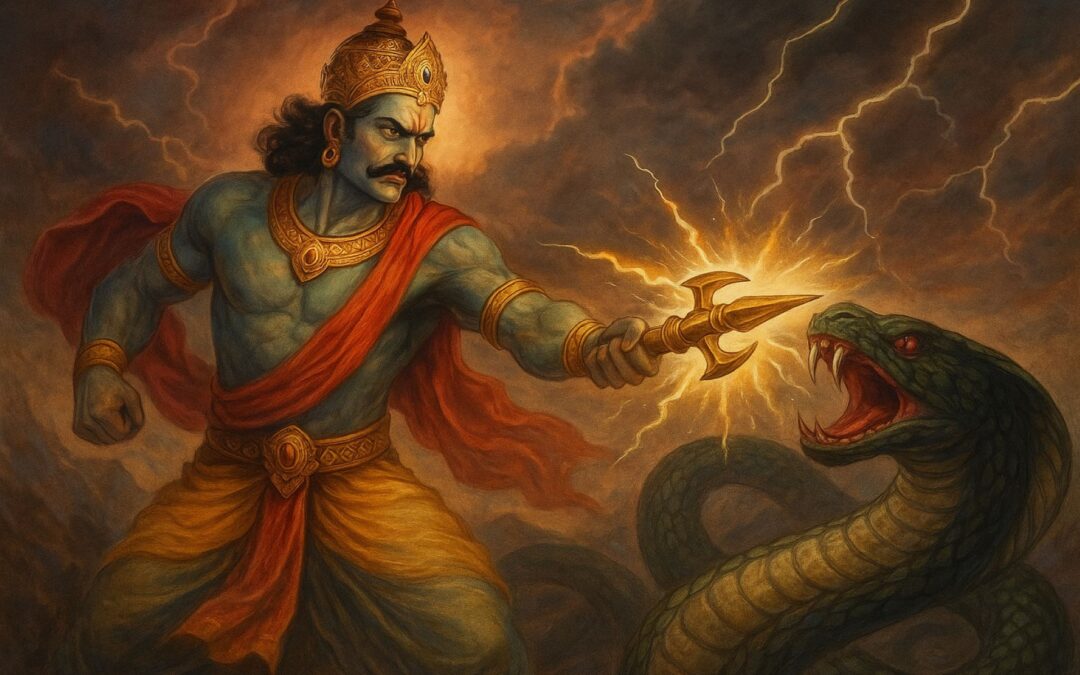
In the annals of ancient mythology, the story of Indra’s battle against Vritra is one that stands out as a testament to the cosmic struggle between order and chaos. This tale is not just about gods and demons but about sacrifice, purity, and the unbreakable will to protect what is right.
The weapon that tipped the balance of this battle, the Vajra, was no ordinary weapon—it was forged from something far more potent: the selfless sacrifice of a sage. This is the story of how the universe was saved by a weapon crafted from purity and devotion.
The Rise of Vritra and the Threat to the Universe
In the vast and ancient expanse of Hindu mythology, the struggle between the Devas and Asuras is one of the most defining narratives, symbolizing the eternal conflict between order and chaos, light and darkness. The Devas, protectors of the universe, were the embodiment of righteousness, harmony, and cosmic order, while the Asuras, led by beings like Vritra, were the forces of destruction and disorder. Among these Asuras, Vritra stood out as the most formidable, not just in terms of raw power, but in his cunning and ambition.
Vritra, with his serpent-like form, was more than a demon; he was a living representation of malevolent forces that sought to drown the world in darkness and suffering. He had one clear goal: to destroy the balance of the universe, submerging it in a never-ending night. To achieve this, he seized control of the rivers, which in ancient traditions were seen as the veins of the earth, carrying life and nourishment to all living beings. With his immense strength, Vritra trapped the rivers in his grasp, halting their flow. The result was disastrous: droughts spread across the land, crops withered, and famine loomed over the world.
As the rivers stopped flowing, the very essence of life was threatened. The Devas, despite their divine abilities, were helpless against Vritra’s overwhelming might. The weapons they wielded, forged in the celestial forges, shattered against his invincible form. In every battle, Vritra’s power seemed unassailable, and the Devas’ hope began to dwindle. The Earth, which depended on the rivers for survival, began to suffer. The heavens themselves trembled as the consequences of Vritra’s reign became apparent: chaos, hunger, and despair spread like a dark cloud across the cosmos. With each passing moment, Vritra’s grip tightened, and the Devas were left with a haunting question—how could they defeat an enemy who was seemingly invulnerable?
The Search for a Solution: A Weapon of Purity
The Devas, in their desperation, sought the counsel of Lord Vishnu, the preserver of creation, who was known for his divine wisdom and the ability to see beyond the immediate turmoil. As they approached Vishnu, they were met with a harsh truth: Vritra’s power was not the result of mere strength, but rather the effect of a divine boon he had received, granting him immunity from all weapons. This boon had rendered him invulnerable, and no ordinary weapon—no matter how powerful—could harm him.
Vishnu’s revelation stunned the Devas, leaving them with a feeling of helplessness. How could they possibly defeat Vritra if no weapon could harm him? But Vishnu, ever the insightful guide, revealed a crucial detail that could turn the tide of the battle. There was a way to defeat Vritra, but it required a weapon unlike any other—one forged from the bones of a sage whose life had been devoted entirely to Dharma (righteousness). This sage had to be pure, selfless, and dedicated beyond measure to the cosmic law of balance. The weapon created from such a sage’s bones would carry with it an unmatched power, capable of piercing even Vritra’s indestructible armor.
The Devas, stunned by this new knowledge, now faced the monumental task of finding such a sage. Who among the countless sages of the universe could meet the divine standards required to create such a weapon? Who could make the ultimate sacrifice for the preservation of Dharma and the restoration of balance? It seemed an impossible task, but the solution was hidden in the purity of selflessness. The Devas set their minds to the search, knowing that only one could save the universe from the grip of Vritra.
The Sacred Sage: Dadichi’s Selfless Sacrifice
Amidst the growing sense of despair, one name surfaced—the name of a sage who embodied the very essence of purity, selflessness, and dedication to Dharma: Dadichi. Dadichi was a sage of exceptional wisdom, renowned across the cosmos for his deep understanding of the Vedas, the sacred texts that governed the laws of the universe. His knowledge was vast, his devotion unparalleled. He had spent years meditating in isolation, immersing himself in the practices of Dharma, and his very existence radiated an aura of divine purity.
Dadichi’s reputation for purity was such that even the gods looked upon him with reverence. He was not only known for his intellectual prowess but also for his unwavering commitment to spiritual growth and cosmic law. His life had been one of asceticism, marked by rigorous penance, discipline, and a complete detachment from worldly desires. But this very detachment would soon become the source of the universe’s salvation.
The Devas, knowing the enormity of the sacrifice they were asking of him, approached Dadichi with trepidation. They came to him with humility and reverence, their faces filled with both hope and sorrow. They explained the peril the universe faced and the need for a weapon capable of destroying Vritra. They revealed to Dadichi that the only way to defeat Vritra was for him to sacrifice his life, as his bones would become the material from which the weapon—the Vajra—would be forged.
Dadichi listened quietly, and then, with profound serenity, he agreed. “If my life can restore balance and protect the universe,” he said, “then I shall gladly give it up. The body is but a vessel; the soul is eternal.” His willingness to offer up his life, knowing the magnitude of the sacrifice, was a rare and profound act of selflessness. It was an embodiment of the ultimate devotion to Dharma—surrendering oneself completely for the good of the universe.
True to his word, Dadichi began his final preparations. Through intense spiritual practices and penance, he purified his body and soul, ensuring that his bones would be the strongest material in the universe. As he breathed his last breath, his body turned to ash, leaving behind his sacred, luminous bones—an eternal testament to his sacrifice. These bones, imbued with his purity and devotion, would soon become the key to saving the universe.
Crafting the Vajra: The Divine Weapon
Once Dadichi had made the ultimate sacrifice, his bones were carefully gathered by the Devas and entrusted to Vishvakarma, the divine architect known for his unparalleled skill in crafting weapons of immense power. Vishvakarma’s ability to create divine objects was legendary, and now, he faced a task that was both monumental and sacred: to forge a weapon capable of defeating Vritra from Dadichi’s sacred remains.
Vishvakarma set to work with great reverence and care, knowing that the weapon he was about to create was not merely a tool of destruction, but a symbol of Dadichi’s purity, devotion, and selflessness. He crafted the Vajra—a weapon that shimmered with divine energy, its form resembling a thunderbolt, imbued with an aura of both power and grace. This was no ordinary weapon; it was a manifestation of the very essence of Dadichi’s life and sacrifice.
The Vajra was forged with unmatched precision. Every strike of Vishvakarma’s divine hammer added a layer of sacred energy to the weapon. Its strength was unmatched, for it was not created from mere physical materials, but from the purity of Dadichi’s soul. The Vajra was designed to pierce through the strongest armor and destroy the most invulnerable of beings, making it the perfect weapon to confront the mighty Vritra. But the weapon’s true power did not lie solely in its destructive capabilities; it was a symbol of selflessness, devotion, and the cosmic order that Dadichi had dedicated his life to protecting.
With the Vajra in hand, the Devas, led by Indra, prepared to face Vritra in the final confrontation. They knew that this weapon, forged in sacrifice, was their only hope, and they set out with renewed determination.
The Battle: Indra vs. Vritra
The battle that followed between Indra and Vritra was not merely a physical confrontation—it was a clash of cosmic principles. On one side stood Indra, the king of the Devas, wielding the Vajra, a weapon imbued with divine energy and the essence of selfless sacrifice. On the other side stood Vritra, a demon whose power had grown unchecked, whose confidence in his invincibility was overwhelming.
The skies darkened as the two forces collided. The heavens themselves seemed to tremble as the battle raged, with the very fabric of the universe at stake. Vritra, certain of his invulnerability, mocked Indra and the Devas, laughing as he prepared to unleash his devastating powers. “No weapon can harm me,” Vritra boasted. “You are wasting your time. You will never defeat me.”
But Indra, resolute and unwavering, raised the Vajra. With a single, mighty strike, the weapon tore through Vritra’s defenses, shattering his invulnerability as if it were nothing more than paper. The force of the strike was beyond comprehension—like the fury of a thousand storms unleashed upon the demon. Vritra let out a final, earth-shaking roar before he fell, his body crumbling under the weight of the Vajra’s power.
Vritra’s defeat marked the end of his reign of terror. The universe had been saved, but the victory came at a heavy price—the sacrifice of Dadichi, whose bones had formed the very weapon that had ended the demon’s tyranny. The Devas, while victorious, knew that this victory was only possible because of the selflessness and purity of Dadichi’s sacrifice.
The Legacy of Dadichi: A Timeless Reminder
The victory over Vritra was not merely a triumph of good over evil, but a testament to the enduring power of selflessness, purity, and devotion to Dharma. Dadichi’s sacrifice became a timeless symbol of the strength that lies in giving, not taking. His story serves as a reminder that true power is not measured by physical strength or material wealth, but by the ability to give of oneself for the greater good.
The Vajra, created from Dadichi’s bones, is not just a weapon—it is a symbol of spiritual strength, a divine tool forged from purity and devotion. It represents the unbreakable bond between selflessness and cosmic order, showing that even in the face of overwhelming chaos, it is the purity of one’s actions that can restore balance and harmony.
Dadichi’s legacy continues to inspire those who seek to live with integrity, devotion, and a commitment to righteousness. His story teaches us that, like him, we too can find strength in selflessness, and that by living according to higher principles, we can change the course of history. Dadichi’s bones, now immortalized in the Vajra, remind us that the greatest victories are not won by force, but by the purity of our hearts and the sacrifices we are willing to make for the greater good.
Conclusion
The story of how Indra defeated Vritra using the sacred weapon, the Vajra, is more than just a mythological tale—it is a profound lesson in sacrifice, purity, and the eternal struggle between chaos and order. Through the selfless act of the sage Dichi, whose life and devotion were the very foundation of the Vajra, the universe was saved from the clutches of darkness. His sacrifice symbolizes the enduring power of selflessness and the unyielding commitment to Dharma—the cosmic law that governs the universe.
In a world often driven by the pursuit of power and material gain, Dichi’s story reminds us that true strength lies not in what we accumulate, but in what we are willing to give for the greater good. The Vajra, crafted from his bones, stands as a timeless symbol of the divine power that comes from purity, devotion, and the willingness to sacrifice for others. It is a reminder that, sometimes, the greatest victories are not achieved by force, but through acts of profound selflessness, and it is through these acts that we can hope to restore balance and harmony in the world around us.