

Before you can live a good life, you must first decide what “good” even means.
That’s the silent question every person answers—whether consciously or not—through their choices, priorities, and sacrifices. Behind every career path, every moral stance, every relationship that lasts or breaks apart, there’s a hidden architecture of judgment and preference. We call that architecture values.
Values are not slogans or moral platitudes; they are the invisible forces that determine what we pursue, tolerate, and reject. They are the internal algorithms behind our decisions—the difference between a life that feels coherent and one that feels adrift. Yet most of us inherit our values rather than define them. We act on them daily without understanding their origins or implications.
This first chapter of the Values Series is about stepping back to examine that foundation.
What exactly are values? How do they differ from needs or preferences? Why do they sometimes conflict, and what happens when they fall out of alignment? From Aristotle’s virtue ethics to Carol Ryff’s psychology of well-being, we’ll explore how philosophers and scientists alike have tried to map the moral landscape of human life—and why knowing your values might be the most practical kind of wisdom there is.
The Compass Beneath Every Decision
Every human life unfolds under the silent governance of values. They are the unseen logic behind the things we chase, the people we love, and the boundaries we refuse to cross. Before a single word is spoken or a decision consciously made, values are already at work—filtering perception, shaping emotion, and guiding choice. They form the grammar of meaning in our inner world, the syntax by which we translate desire into direction.
Imagine a compass—its needle quivering, aligning itself invisibly to magnetic north. Values function the same way, though their north is moral rather than geographic. They orient us not toward a place, but toward a principle. Every decision—whether to tell the truth, forgive a betrayal, or stand up to power—is an act of orientation. You are, in essence, deciding which direction your compass honors.
What makes values so powerful is that they operate both consciously and unconsciously. Consciously, we might name them: honesty, freedom, loyalty, compassion. Unconsciously, they influence how we interpret every experience. Two people can face the same situation and react in entirely different ways—not because one is smarter or stronger, but because their internal compasses point toward different ideals. One seeks harmony; the other seeks justice. One values stability; the other freedom. The difference in reaction reveals the architecture of their inner world.
When aligned, this compass brings coherence. Life feels navigable, even amid uncertainty. The individual knows why they act, and that knowing creates peace. But when our lived behavior strays from our internal map—when we work in a job that violates integrity, maintain relationships that suffocate growth, or chase goals that conflict with meaning—something in us protests. That discomfort we label as anxiety or guilt is often not dysfunction but dissonance. It’s the compass trying to reorient itself.
Values, then, are not luxuries of character but necessities of direction. Without them, decisions become reactive rather than intentional. We become susceptible to trends, crowds, and convenience, living by borrowed convictions rather than earned ones. With them, even failure has dignity—because it stems from choice, not confusion.
At their core, values perform three vital functions:
- They define identity. To know what you value is to know who you are. Without values, identity dissolves into imitation.
- They create coherence. Values connect thought, emotion, and action, ensuring that what you believe aligns with how you live.
- They generate meaning. In honoring a value, even suffering becomes purposeful. Endurance makes sense when it serves what you deem worthy.
History’s great figures—philosophers, scientists, reformers—differed in beliefs but shared one trait: they lived in fidelity to their values. That consistency is what makes a life feel whole.
When a person finally stops asking, “What should I do?” and starts asking, “What do I stand for?”—they begin to navigate existence not by external approval, but by internal truth. That is the function of the compass within: not to remove uncertainty, but to ensure we move through it without losing our way.
The Anatomy of a Value
To understand values, we must first demystify them. The term is often tossed around loosely—used to justify behavior, signal morality, or frame identity. Yet few pause to ask what a value actually is. Philosophers and psychologists alike agree: a value is not a rule, not a preference, not even a belief. It is a deeply held conviction about what is worth striving for. It is the internal measure by which we assess right and wrong, important and trivial, meaningful and hollow.
Values are the psychological DNA of a person. They quietly dictate how we perceive the world, what goals we set, and how we justify our actions. Two people may witness the same event and draw entirely different conclusions, not because of differing logic but because of differing value systems. One sees courage, the other recklessness. One sees rebellion, the other integrity. The difference is not in the act—it’s in the lens.
The Structure of Values
Every value contains three essential components: cognitive, emotional, and behavioral. Cognitively, we recognize it as important (“I believe honesty matters”). Emotionally, we feel it when it’s upheld or violated (pride when truthful, guilt when deceitful). Behaviorally, we act upon it, often without conscious calculation. This triadic nature makes values stable yet dynamic—mental blueprints animated by emotion and reinforced by habit.
Unlike opinions or attitudes, values do not shift easily. They are the product of accumulated experience—family upbringing, cultural conditioning, moral exemplars, personal victories, and failures. Over time, repetition crystallizes preference into principle. You might start valuing kindness because it earns approval, but after years of practice, it becomes self-justifying—you are kind because it feels right.
Core Characteristics of Values
- They are enduring.
Values don’t expire with circumstance. They form slowly and resist sudden change, which is why life transitions—career shifts, breakups, moral crises—can feel destabilizing: they threaten the continuity of our inner framework. - They are abstract.
Values represent ideals, not specific outcomes. “Freedom” is not a place; “justice” is not a single law. Their abstraction allows them to transcend context, applying equally to personal, social, and spiritual domains. - They are motivational.
Every human drive ultimately ties back to a value. Ambition expresses achievement, empathy reflects compassion, rest mirrors self-care. Even destructive behaviors can trace back to distorted or conflicting values—control mistaken for security, indulgence mistaken for happiness. - They are hierarchical.
Not all values weigh the same. Some dominate others, consciously or subconsciously. This hierarchy is what gives personality its distinct shape. One person may value order above freedom; another, freedom above order—and the world will feel different to each. - They are contextual.
While values remain stable, their expression adapts. “Respect” in a military setting may demand obedience; in a creative team, it may demand openness. Context reveals not the inconsistency of values but their flexibility—the art of applying principle to circumstance.
Values as the Hidden Architecture of Behavior
Think of values as the unseen architecture of decision-making. They are not the visible structure but the foundation beneath it. They decide which goals seem noble and which temptations feel wrong, even when logic argues otherwise. They are the invisible hand shaping how we love, lead, compete, and forgive.
In this sense, values are the grammar of morality—rules not of syntax but of meaning. They tell us how to combine action and intention into coherence. Without them, even achievement feels hollow; with them, even sacrifice can feel worthwhile.
Understanding the anatomy of values is not an intellectual exercise—it is an act of orientation. To know your values is to see the blueprint of your mind: the architecture that explains not just what you do, but why you do it the way you do.
Distinguishing Values from Needs and Preferences
Much of the confusion around human behavior stems from our tendency to conflate values, needs, and preferences—three forces that often overlap but function on profoundly different planes. The distinctions between them are not semantic; they are structural. Without understanding how they differ, we mistake momentary satisfaction for purpose, and comfort for fulfillment.
Needs: The Foundation of Survival
At the most basic level lie needs—biological, psychological, and social requirements for survival and stability. Food, water, rest, safety, and belonging form the bedrock of existence. Abraham Maslow famously arranged these in a hierarchy, from physiological needs at the base to self-actualization at the top.
Needs are universal and urgent. You cannot reason with hunger or negotiate with oxygen. They demand attention until met. Yet, while essential, needs are not moral. Eating when hungry does not make one virtuous, nor does thirst make one unethical. Needs simply ensure continuity of life; they do not define how to live.
The confusion begins when we elevate needs into moral imperatives—when the instinct for safety becomes the justification for cowardice, or the desire for belonging mutates into conformity. When needs overrun values, the result is a life of reaction, not reflection.
Preferences: The Texture of Desire
One level above needs are preferences—subjective inclinations toward one option over another. They add texture to existence: liking mornings over nights, jazz over pop, solitude over company. Preferences color experience but rarely carry moral weight.
Preferences are situational and mutable. They change with context, exposure, and emotion. You may prefer silence when working but music when cooking; solitude during heartbreak but company during joy. Preferences serve comfort and variety, not consistency or meaning.
The danger arises when we confuse preferences with identity. In a culture obsessed with self-expression, people often mistake taste for truth. They curate playlists and aesthetics and call it authenticity, forgetting that identity built on preference alone crumbles with the next trend. Preferences express personality, but they do not define principle.
Values: The Architecture of Meaning
Then come values—the highest tier, and the only one that transcends circumstance. Values are the durable frameworks through which we interpret experience and assign significance. They answer not “What do I want?” but “What matters most?”
A person who values honesty will tell the truth even when it costs them comfort. A person who values compassion will choose forgiveness even when anger feels justified. In other words, values compel action against convenience.
Where needs anchor survival and preferences decorate desire, values construct meaning. They transform existence from mechanical continuity into moral coherence. Needs keep you alive; preferences make life enjoyable; values make life worth living.
The Cost of Confusion
When these domains blur, the consequences ripple through every aspect of life. A person mistaking needs for values will justify selfishness as self-care or avoidance as peace. Another mistaking preferences for values may chase novelty, mistaking dopamine for purpose. Both eventually meet the same emptiness—the hollow fatigue of pursuing comfort over conviction.
A fulfilled life requires hierarchy: needs satisfied, preferences enjoyed, and values obeyed. You cannot meditate your way out of hunger, nor can you eat your way into meaning. Wisdom lies in knowing which voice is speaking within you at any given moment—the stomach, the mood, or the conscience.
The Alignment Principle
When needs, preferences, and values align, life flows with remarkable ease. You eat to sustain energy, not escape emotion. You choose environments that nurture both pleasure and principle. You rest without guilt because it honors self-respect, not laziness. This alignment doesn’t guarantee happiness every moment—it guarantees integrity.
Ultimately, values serve as the adjudicator among the three. They are the arbiter of choice—the mechanism through which we decide which needs to honor first, which preferences to indulge, and which sacrifices are worth making. Without this internal hierarchy, we drift from impulse to impulse, confusing appetite for authenticity.
Values, then, are not just lofty ideals—they are the organizing intelligence of life itself. They turn chaos into coherence, ensuring that what we want, what we do, and what we believe all point in the same direction.
Mapping Human Priorities: Schwartz’s Values Wheel
If values are the architecture of meaning, then Shalom Schwartz gave us one of the most elegant blueprints for understanding their design. His theory of Basic Human Values, developed over decades of cross-cultural research, sought to answer a universal question: Are there certain values that all humans, across societies and generations, hold in common?
The answer, Schwartz discovered, was yes—but not in the way most people think. Values are not random or infinite; they organize themselves into a system governed by tension and balance. This structure became known as Schwartz’s Values Wheel, a circular model mapping ten core value domains that recur in every human society.
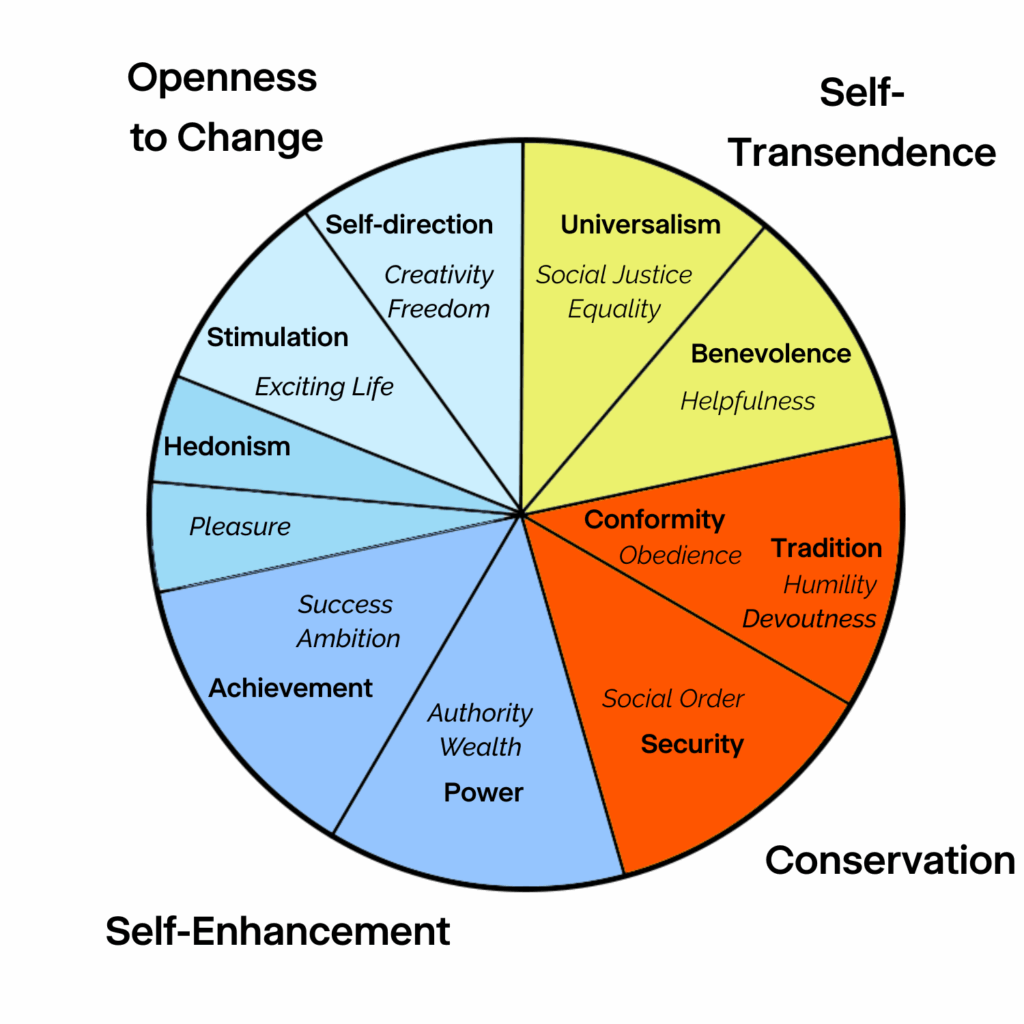
The Ten Universal Values
- Self-Direction – The pursuit of independence, creativity, and freedom of thought. These individuals value autonomy over conformity; they seek to live by inner conviction, not external pressure.
- Stimulation – The craving for excitement, novelty, and challenge. It reflects a need for vitality—a refusal to stagnate.
- Hedonism – The appreciation of pleasure and sensory gratification. Contrary to moral suspicion, hedonism here isn’t decadence—it’s the recognition that joy and satisfaction sustain the human spirit.
- Achievement – The desire for personal success through competence and mastery. This value fuels ambition and effort but can morph into obsession if untethered from ethics.
- Power – The pursuit of status, control, and authority. While often maligned, power isn’t inherently corrupt—it’s the means through which influence and protection can be exercised.
- Security – The longing for safety, harmony, and stability—both personal and societal. It emphasizes predictability and order in an uncertain world.
- Conformity – The discipline to restrain impulses and adhere to social expectations. It guards communal trust, ensuring cohesion through shared norms.
- Tradition – The reverence for cultural or religious customs and inherited wisdom. Tradition preserves continuity and identity across generations.
- Benevolence – The drive to care for and protect others with whom one is close. It is the root of empathy, nurturing, and loyalty.
- Universalism – The broadest of all values—the concern for all people, nature, and the collective good. It transcends tribe and identity, aspiring toward harmony on a global scale.
Each of these values represents a distinct motivational goal. No single value exists in isolation; together, they form a continuous wheel, each segment influencing and opposing the others.
The Circle of Tension and Harmony
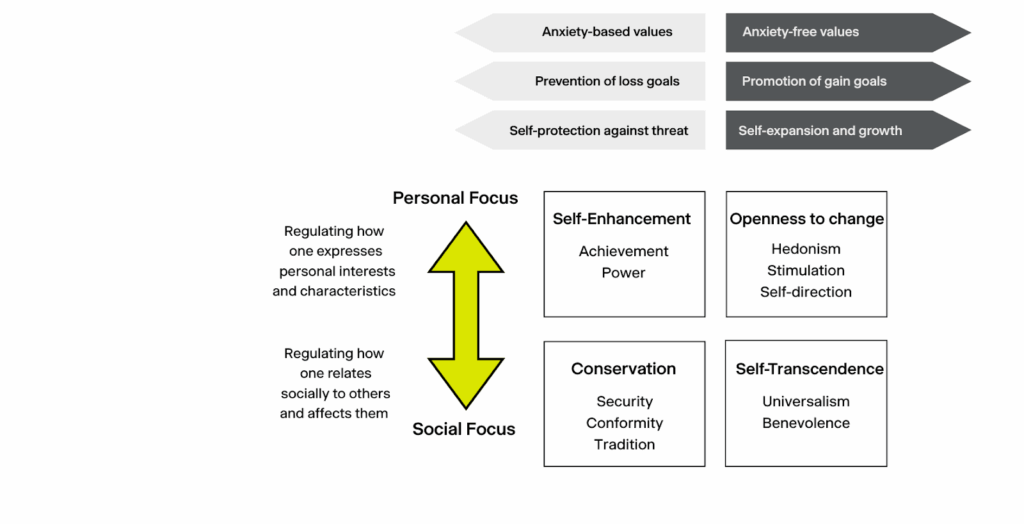
Unlike hierarchical moral systems that rank values from “higher” to “lower,” Schwartz’s model places them on a circle—because human motivation is dynamic, not linear. The circle’s arrangement reveals the psychological tensions that govern our choices.
Opposing values sit across from each other, symbolizing conflict. For example:
- Self-Direction opposes Conformity, reflecting the eternal struggle between individuality and social belonging.
- Power stands opposite Universalism, mirroring the tension between self-interest and altruism.
- Hedonism often clashes with Tradition or Security, as the pursuit of pleasure can threaten stability or discipline.
Values adjacent to one another, however, reinforce each other. Achievement aligns naturally with Power; Benevolence harmonizes with Universalism. These relationships explain why people can embody certain clusters of values while finding others instinctively alien.
This circular arrangement elegantly mirrors the moral geometry of human life—each virtue requiring the moderation of its opposite. A society overemphasizing security breeds stagnation; one overvaluing freedom risks fragmentation. The healthiest cultures and individuals maintain movement within the wheel, not fixation on a single axis.
Your Place on the Wheel
Schwartz’s model is not just theoretical—it is diagnostic. Every individual can locate themselves somewhere on this circle based on what they most prioritize. Are you driven by achievement and power, or by benevolence and universalism? Do you crave stimulation and novelty, or tradition and security?
Recognizing your place on the wheel reveals the pattern of your motivation—what energizes you, what frustrates you, and where your internal conflicts arise. Someone valuing independence may feel suffocated in hierarchical organizations; a person prioritizing harmony may crumble in competitive environments. These aren’t flaws but signals—feedback from your value system indicating misalignment.
The Dance Between Opposites
The genius of Schwartz’s theory lies in its acknowledgment that every value carries its own shadow. The drive for freedom can become isolation; the pursuit of security can harden into fear. Each value, when pursued to excess, consumes the balance it depends on.
The task, then, is not to maximize all values but to harmonize them—to live consciously within the wheel’s tension rather than trying to eliminate it. The paradox of moral maturity is realizing that peace is not found in choosing sides but in maintaining proportion.
In this light, Schwartz’s Values Wheel is not just a psychological model—it’s a moral compass, one that maps the universal landscape of human aspiration. It reminds us that every life is a negotiation between competing goods, and wisdom lies not in picking the “right” value but in knowing when each must take its turn steering the wheel.
Instrumental and Terminal Values
In the 1970s, social psychologist Milton Rokeach introduced a deceptively simple framework that forever changed how we understand human motivation. He argued that all values fall into one of two categories: instrumental and terminal. The distinction seems academic at first glance, but it captures one of the most profound truths about human behavior—that the way we live (means) and what we live for (ends) are deeply intertwined.
The Two Layers of Human Motivation
Terminal values represent our ultimate goals in life. They are the end states we wish to reach—the destinations that make effort worthwhile. Examples include happiness, freedom, wisdom, love, peace, or self-respect. These values answer the question “Why am I doing this?”
Instrumental values, on the other hand, describe the methods or behaviors we adopt to achieve those goals. They are the habits of character that get us there—honesty, courage, responsibility, creativity, self-discipline, and kindness. They answer the question “How will I live to get there?”
This two-tier system forms the architecture of our moral life. Every meaningful action we take, whether consciously or not, involves a negotiation between an instrumental approach and a terminal purpose. You work hard (instrumental) to achieve financial independence (terminal). You speak honestly (instrumental) to maintain integrity (terminal). You practice compassion (instrumental) to foster love (terminal).
When the Means Betray the Ends
Problems arise when the two layers fall out of sync—when the road we take no longer leads to the destination we claim to seek. Many of life’s most painful contradictions stem from this disconnection.
A person might pursue success (terminal) through deceit (instrumental), or chase peace of mind (terminal) through avoidance (instrumental). In such cases, the chosen path sabotages the very outcome desired. The journey corrupts the destination.
This conflict breeds the inner dissonance we recognize as guilt, confusion, or moral fatigue. You can reach your goal and still feel hollow because the methods you used violated the values meant to give that goal meaning. As Rokeach emphasized, integrity is not just about having values—it’s about aligning the instrumental with the terminal.
The Symmetry of Character
Consider two people who share the same terminal value—say, happiness.
One seeks it through pleasure, indulging in every comfort life offers. The other seeks it through growth, embracing discomfort as a path to fulfillment. Both are pursuing happiness, but the quality of their happiness differs because their instrumental values differ.
This principle scales to societies as well. A culture that prizes freedom but neglects justice loses coherence. One that values prosperity without honesty breeds corruption. The strength of any moral or political system depends on the congruence between its means and its ends.
When the means elevate the ends, character flourishes. When the means contradict them, corruption spreads—both personally and collectively.
Building Coherence
Rokeach’s framework helps us see that ethical living is less about perfection and more about coherence. Coherence means that your daily conduct reflects your deeper ideals—that what you do mirrors why you do it. This is the essence of integrity, the seamlessness between intention and action.
To live coherently is to continually ask:
- Do my methods reflect the future I seek?
- Does the way I treat others align with the kind of world I want to live in?
- Am I sacrificing long-term peace for short-term gain?
These questions are not moral chores; they are navigational instruments. They keep your compass true when the terrain shifts.
The Bridge Between Action and Aspiration
If terminal values represent mountains in the distance, instrumental values are the steps you take to climb them. The beauty of Rokeach’s insight lies in its humility—it does not demand perfection, only direction. You may never fully reach your terminal ideals, but you can live them incrementally through your daily behavior.
When honesty, discipline, and courage become habitual, they transform not only your outcomes but your experience of the journey itself. You stop chasing peace as a future state and start practicing it in motion. The means, lived rightly, become the end in real time.
In the end, Rokeach’s model reminds us that moral growth is not about acquiring more values—it’s about aligning the ones we already have. To walk the talk, to embody what we believe, to make our methods worthy of our goals—that is the quiet work of a principled life.
The Hierarchy and Conflict of Values
Human beings rarely live by a single value. We are constellations of competing priorities—each bright and compelling in its own right, but often pulling us in opposite directions. This internal tension is not a flaw in design; it is the signature of moral consciousness. To live with values is to live with conflict.
The Personal Hierarchy
Every person carries a hierarchy of values, whether explicitly known or unconsciously lived. Some prioritize freedom over stability; others choose loyalty over truth, comfort over growth, or achievement over compassion. The order in which these values rank determines not just what we do, but who we become.
This hierarchy is dynamic, not fixed. It shifts subtly as we move through life stages and experiences. A young professional might place ambition at the top, while an aging parent may elevate family or tranquility. Neither is wrong—the hierarchy evolves as our definition of a good life matures.
Psychologists describe this as value salience—the degree to which a particular value commands attention in a given moment. In times of crisis, security dominates; in times of plenty, growth takes precedence. But beneath those momentary shifts lies a more stable core: the few values we consistently return to, like emotional home base. Identifying these core priorities is one of the most clarifying acts of self-awareness.
The Clash Within
Where there is hierarchy, there is inevitable friction. Values collide when the pursuit of one threatens the expression of another. Honesty versus kindness. Freedom versus responsibility. Success versus balance. The friction between them is not a malfunction—it is the very crucible of ethical choice.
Consider the surgeon who must choose between prolonging a life and respecting a patient’s wish to die peacefully. Or the journalist torn between revealing the truth and protecting a source. These are not dilemmas of right and wrong, but of competing rights. Each side represents a legitimate value; the conflict emerges from their collision.
Such tensions create what philosophers call moral ambivalence—a state where clarity cannot be found in abstract principle alone. Resolution demands judgment, context, and sometimes sacrifice. The mature mind accepts that harmony between values is not always possible, and that integrity sometimes means choosing which value to honor in that moment while acknowledging the cost of neglecting another.
The Cultural Hierarchy
On a collective scale, societies reflect similar hierarchies. Western cultures often elevate autonomy, progress, and innovation—values that celebrate the individual’s power to shape destiny. Eastern and collectivist cultures tend to honor harmony, duty, and interdependence—values that prioritize cohesion over assertion.
Neither orientation is morally superior; each solves one side of the human paradox. The West maximizes freedom but breeds alienation. The East safeguards community but risks conformity. Civilization progresses not through uniformity of values, but through their dynamic tension—a pendulum swinging between the self and the whole.
Understanding these cultural hierarchies also reveals the friction in global ethics. Environmental policy, social justice, and economic development often clash because they arise from different value priorities—growth versus sustainability, liberty versus equality, tradition versus reform. The task of leadership, therefore, is not to enforce a single value system, but to mediate between them without losing coherence.
The Anatomy of Conflict
Value conflict is emotionally taxing because it strikes at the core of identity. When two values we cherish come into opposition, the psyche experiences it as self-division. You cannot honor one without betraying the other. This inner tension generates guilt, doubt, or paralysis. But conflict, properly engaged, sharpens moral clarity.
Through conflict, we discover which values are foundational and which are peripheral. The mother who leaves her career to raise her child may feel torn between achievement and care, but the decision reveals her hierarchy: she has chosen love over status. The entrepreneur who risks comfort for innovation affirms growth over security. Conflict, then, is not failure—it is a declaration of priority.
Negotiating the Hierarchy
Maturity in moral life means learning to negotiate values rather than idolize them. Rigid absolutism—placing one value permanently above all others—breeds intolerance and imbalance. Flexibility, by contrast, allows context to determine which principle must lead.
This negotiation is an art, not a formula. It requires the ability to step back, to ask:
- Which value is most vital in this situation?
- Which value can yield without self-betrayal?
- What are the long-term consequences of this order?
When this reflection becomes habitual, conflict transforms from chaos into calibration. You stop asking, “What’s the right thing to do?” and begin asking, “Which of my principles must guide me right now?”
The Creative Tension of Life
To live by values is to live in tension. Harmony is not achieved by erasing conflict, but by accepting it as part of a balanced moral ecosystem. Just as muscles strengthen through resistance, so too does character develop through the friction of competing goods.
Ultimately, the goal is not to eliminate hierarchy or conflict, but to become conscious of them. The unexamined hierarchy governs you; the examined one serves you. When you understand the order of your values, every choice—no matter how painful—becomes an act of alignment rather than confusion.
In that awareness, life’s contradictions no longer feel like moral crises but like necessary negotiations within a larger, coherent design. And through those negotiations, the architecture of one’s character takes its final, enduring shape.
The Psychology of Well-Being
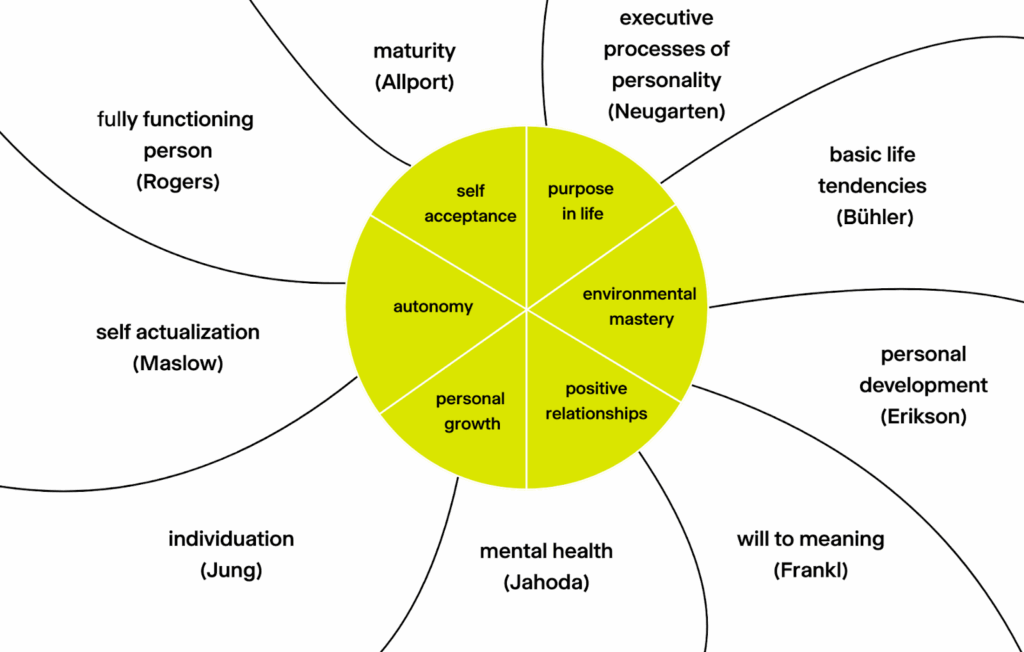
If philosophy teaches us why values matter, psychology reveals how they operate within us. While moral philosophy gives us frameworks for judgment, psychology shows the tangible consequences of living in or out of alignment with our values. One of the most illuminating models bridging these two worlds comes from Dr. Carol Ryff, who developed the Six Dimensions of Psychological Well-Being—a framework that captures the lived expression of values as measurable components of a flourishing life.
Ryff’s research sought to answer a deceptively simple question: What does it mean to be well, beyond the absence of illness? She discovered that true well-being isn’t merely about happiness or comfort—it’s about living in harmony with one’s internal principles. Her six dimensions—autonomy, environmental mastery, personal growth, positive relations, purpose in life, and self-acceptance—map directly onto the lived experience of value alignment.
Each dimension represents not an isolated trait, but a reflection of certain core values made manifest in daily life. Together, they demonstrate how psychological health and moral coherence are two sides of the same coin.
1. Autonomy: Living by Inner Conviction
At its heart, autonomy is about self-governance—the ability to act according to your convictions rather than bending under external pressure. People high in autonomy possess a strong internal locus of control; they navigate life guided by their own moral compass, not by the shifting winds of social approval.
Autonomy expresses values such as integrity, courage, and independence. It’s the capacity to hold steady in a world that constantly tries to persuade, seduce, or intimidate you into conformity. Autonomy doesn’t mean rebellion for its own sake; it means discerning between your own voice and the echo of others.
When autonomy falters, values blur. The person begins to perform rather than live—to act out borrowed convictions, to trade authenticity for belonging. The mind becomes divided: outwardly agreeable, inwardly resentful. True autonomy restores unity between inner truth and outer action.
2. Environmental Mastery: Shaping Your World
Environmental mastery is the ability to manage and influence the world around you—to create conditions where your values can actually thrive. It reflects the belief that one is not merely subject to circumstance but capable of shaping it.
This dimension expresses values like competence, responsibility, and order. It’s not about controlling everything but about cultivating environments—physical, emotional, relational—that align with your ideals. For instance, someone who values peace will design a life that minimizes unnecessary chaos; someone who values learning will surround themselves with stimulation and challenge.
Without mastery, even noble values wither. A person who values creativity but lives in constant distraction, or who values family but fills every hour with work, slowly erodes their own foundation. Mastery is the bridge between intention and execution—the art of structuring life so that your highest values are not aspirational, but operational.
3. Personal Growth: The Value of Becoming
To live well is to remain unfinished. Personal growth reflects the continual expansion of one’s potential—the ongoing willingness to evolve, adapt, and deepen. It embodies values like curiosity, wisdom, and self-improvement.
Growth is often uncomfortable because it demands friction against old patterns. Yet stagnation carries a greater cost: the quiet despair of unrealized capacity. People who prioritize growth see challenges not as threats to stability but as invitations to refine character. Every setback becomes data; every hardship, a teacher.
Living this value means embracing life as a process of becoming rather than arriving. It is the refusal to let comfort calcify into complacency.
4. Positive Relations: The Value of Connection
No human being is complete in isolation. Positive relations represent the ability to form deep, trusting, and empathetic bonds with others. It’s the outward expression of values like kindness, loyalty, forgiveness, and love.
Healthy relationships mirror our values back to us—they reveal whether we live by compassion or control, generosity or judgment. The people we attract and the conflicts we face both act as diagnostic tools for our inner life.
When this dimension weakens, relationships become transactional; empathy is replaced by ego management. But when nurtured, connection becomes a mirror in which both parties grow. Every authentic bond reinforces the truth that values do not exist in isolation—they are relational currencies, enriched by exchange.
5. Purpose in Life: Direction Through Meaning
Purpose gives structure to existence. It is the lived expression of the question, “For what am I here?” It channels our energy toward long-term goals anchored in values like service, justice, excellence, or faith.
Purpose is not something we find once—it’s something we refine continually as our awareness deepens. For some, it manifests through vocation; for others, through family, art, or service. Whatever its form, purpose aligns action with principle, ensuring that life doesn’t devolve into mere activity.
When purpose is lost, even success feels hollow. When rediscovered, even hardship feels worthwhile. A value-driven purpose transforms effort into devotion—it turns labor into legacy.
6. Self-Acceptance: Peace with One’s Humanity
Finally, self-acceptance is the quiet culmination of all other dimensions. It’s the capacity to embrace one’s flaws, past mistakes, and contradictions without surrendering the desire to grow. It reflects values like honesty, compassion, and humility directed inward.
Self-acceptance is not complacency; it is clarity. It means recognizing the limits of control and meeting oneself with grace. People who live in alignment with this value experience a rare form of freedom—the ability to evolve without self-rejection.
Without self-acceptance, even the noblest values can turn tyrannical. Perfectionism masquerades as excellence; guilt replaces accountability. But when we accept ourselves fully, we become capable of genuine transformation because we are no longer fighting against who we are.
The Integration of Values and Well-Being
Ryff’s model reveals that psychological health and moral integrity are inseparable. When your behavior reflects your deepest values, you experience wholeness. When it contradicts them, you experience fragmentation. Alignment, not achievement, becomes the measure of wellness.
This integration explains why people who live authentically often radiate calm—even amid uncertainty. Their lives may not be easy, but they are coherent. Their choices make sense to them, and that inner congruence is what we intuitively recognize as peace.
In essence, well-being is not the absence of struggle but the presence of alignment. A person may face external chaos yet remain internally ordered because their life orbits around a stable constellation of values. In that state, effort feels purposeful, relationships feel meaningful, and selfhood feels intact.
Philosophy calls it virtue. Psychology calls it integration. But the lived experience is the same—clarity, coherence, and quiet strength born from the daily practice of living one’s values.
Aristotle and the Golden Mean
More than two millennia before modern psychology attempted to quantify well-being, Aristotle offered a map for moral and emotional balance that remains astonishingly relevant. His concept of the Golden Mean sits at the heart of his ethical philosophy—a principle that suggests virtue is found not in extremes, but in the measured middle between them. Where Carol Ryff described well-being as value alignment, Aristotle described virtue as the equilibrium between excess and deficiency. Both are, in essence, guides to the same end: living in harmony with one’s nature and one’s values.
The Principle of the Mean
To Aristotle, goodness was not an abstract ideal but a practice. Virtue, he argued in Nicomachean Ethics, is a state of character that chooses the mean relative to us—“determined by reason and as a person of practical wisdom would determine it.” Every emotion, desire, and behavior lies on a continuum. At one extreme is excess; at the other, deficiency. Between them lies the mean—the point of moral precision.
For example:
- Courage sits between cowardice (deficiency of confidence) and recklessness (excess of it).
- Generosity balances stinginess and extravagance.
- Honesty finds its midpoint between brutal candor and deceptive flattery.
The virtue is not a fixed midpoint—it is contextual, depending on circumstance, personality, and intention. What is generous for one may be excessive for another. What is courageous in battle may be reckless in diplomacy. Virtue, therefore, is not about following static rules but exercising dynamic judgment.
Virtue as Practical Wisdom
Aristotle’s word for this moral intelligence was phronesis, or practical wisdom—the capacity to discern the right degree of action in any situation. It is not theoretical knowledge but lived insight, gained through experience and reflection.
This wisdom transforms values from abstract ideals into calibrated behaviors. You might value honesty, but phronesis helps you decide how to express it: when to speak truth plainly, and when to temper it with compassion. You might value ambition, but phronesis reminds you to pursue excellence without arrogance. It is this capacity for balance that distinguishes virtue from fanaticism.
A person without phronesis treats values as absolutes and thus weaponizes them. Discipline turns to rigidity; loyalty turns to blindness. A person with phronesis, by contrast, treats values as instruments—tuned precisely, never struck too hard or too soft.
The Perils of Extremes
Aristotle warned that both extremes—excess and deficiency—corrupt virtue. Too little courage breeds cowardice; too much produces recklessness. The same applies to modern values.
- Discipline, when rigid, becomes self-punishment.
- Empathy, when unbounded, turns into self-sacrifice.
- Confidence, when inflated, mutates into arrogance.
- Humility, when overextended, collapses into self-erasure.
In each case, the value itself is not wrong; it is simply unbalanced. The danger lies in mistaking intensity for integrity—believing that the more of a virtue you display, the more virtuous you are. In reality, moral excellence is not magnitude but proportion.
This insight is timeless. In a culture obsessed with extremes—hustle without rest, virtue without nuance, ambition without reflection—Aristotle’s reminder is revolutionary: Too much of a good thing ceases to be good.
The Modern Echo
What Aristotle called the Golden Mean, psychology now calls optimal functioning. It is the same principle observed in Ryff’s model of well-being and Schwartz’s wheel of values: that balance, not absolutism, produces harmony. The courageous person and the psychologically healthy person both practice self-regulation—acting neither from fear nor from impulse, but from measured intent.
In everyday terms, the Golden Mean translates into self-awareness. It’s the capacity to pause before acting, to weigh competing values, and to choose the degree that best fits the moment. It asks, “What does balance look like here?” rather than “What does winning look like?”
The Ethics of Calibration
Aristotle’s ethics is sometimes misunderstood as moderation for moderation’s sake. But the Golden Mean is not mediocrity; it’s precision. It is not about avoiding extremes but mastering them—knowing how far to push without tipping into self-destruction.
Imagine a violin string. Too loose, and it produces no sound; too tight, and it snaps. Virtue lies in tension calibrated just right. In the same way, the human spirit resonates best under the right degree of pressure—enough ambition to propel growth, enough restraint to preserve peace.
This metaphor reveals why the Golden Mean remains vital in the modern age. The world often rewards extremes: louder voices, faster results, grander displays of certainty. Yet, over time, those who endure are the ones who master equilibrium—the quiet strength of proportion.
The Harmony of the Self
To live by the Golden Mean is to turn moral life into an art form—a daily act of tuning. It’s the ability to hold opposing impulses in tension without being consumed by either. The goal is not perfection, but harmony—a steady alignment between passion and principle, action and reflection, self and society.
When we apply this principle to our values, balance becomes the foundation of wisdom. Honesty guided by empathy fosters trust; ambition tempered by humility yields greatness without arrogance; freedom balanced by responsibility creates order without oppression.
Aristotle’s insight was not a doctrine but an invitation—to live consciously, to navigate life’s contradictions with grace. He believed that happiness (eudaimonia)—the flourishing of the human soul—emerges not from indulgence or denial, but from alignment with reason and proportion.
In the end, the Golden Mean is not simply a moral formula—it is a philosophy of living well. It teaches that goodness is not found at the edges but in the interplay between them. And that wisdom, in its purest form, is not about choosing one extreme over another, but about knowing how to move gracefully between the two.
Toward a Life of Value-Alignment
Understanding values is not an intellectual luxury; it is the quiet work of self-direction. To know what you value is to know what you serve, what you refuse, and what kind of life you are shaping with every choice. Once you see that values govern emotion, behavior, and meaning alike, you realize that wisdom lies less in acquiring new virtues and more in aligning the ones you already hold.
A coherent life is not one free of conflict—it’s one where conflict reveals clarity. The aim is not moral perfection but internal consistency: the ability to act in harmony with what you deem right, even when the world tempts you otherwise.
When values, actions, and purpose converge, life gains rhythm. Effort becomes devotion. Choice becomes expression. And in that quiet alignment, peace takes root—not the peace of passivity, but of coherence.
In the next chapter, we’ll explore how these inner structures extend outward—how our values shape the bonds we form, the conflicts we endure, and the compatibility we crave. Because values, though personal, only truly reveal their power when lived in relationship with others.